
AI Retrofit vs Rewrite is the key decision enterprises face when adding AI to existing SaaS applications. AI retrofit enhances an existing platform by integrating AI capabilities without changing its core architecture, while AI rewrite rebuilds the application to become AI-native. For most mature SaaS products, AI retrofit offers faster deployment, lower costs, and reduced production risk.
TL;DR
- Most SaaS applications do not need a complete rewrite to adopt AI.
- AI retrofit allows organizations to introduce AI while preserving proven business logic.
- Rewriting should be considered only when legacy architecture prevents future scalability.
- API-first AI architectures, RAG, copilots, and AI agents make retrofit practical for modern SaaS platforms.
- The right strategy depends on business goals, technical debt, delivery timelines, and expected ROI
Executive Summary
Enterprise software is entering a new phase where AI is becoming an expected capability rather than a competitive differentiator. Customers increasingly expect SaaS applications to provide intelligent search, conversational interfaces, workflow automation, predictive insights, and AI-assisted decision-making.
For product leaders, however, one question remains:
Should we rebuild our application to become AI-native, or can we integrate AI into what we already have?
The answer depends less on AI technology and more on the maturity of your existing platform.
For most organizations, the fastest path to AI adoption is not rewriting years of stable business logic. Instead, it is retrofitting AI into existing applications using APIs, Retrieval-Augmented Generation (RAG), AI orchestration, and copilots while keeping production systems stable.
This article explores the differences between AI retrofit and AI rewrite, provides a practical decision framework, and outlines how enterprises can modernize SaaS applications without disrupting existing customers or business operations.
Why AI Modernization Doesn’t Always Mean Rebuilding
Many organizations assume adopting AI requires rebuilding their SaaS platform. In reality, modern AI architectures allow enterprises to introduce intelligent capabilities through APIs, orchestration layers, and AI services while preserving existing applications, reducing both implementation risk and time to value.
When cloud migration first emerged, many organizations believed every application needed to be rebuilt.
The same misconception exists today with AI.
While some applications genuinely require architectural transformation, the majority of enterprise SaaS platforms already contain years of optimized business logic, customer workflows, security models, and integrations.
Replacing these systems simply to introduce AI often creates unnecessary cost and risk.
Instead, organizations are increasingly adopting AI modernization—enhancing existing applications with AI capabilities while preserving the components that already deliver business value.
This approach enables enterprises to innovate incrementally rather than undertaking large-scale redevelopment projects.
Read our blog on Legacy Modernization Services in 2026: How Enterprises Are Cutting Costs with AI
Traditional Modernization vs AI Modernization
| Traditional Application Modernization | AI Modernization |
|---|---|
| Replace legacy systems | Enhance existing applications |
| Long transformation cycles | Incremental AI adoption |
| Large capital investment | Lower implementation cost |
| High production risk | Controlled rollout |
| Platform-focused | Business capability-focused |
Enterprise Insight: AI should extend the value of your existing SaaS platform—not erase years of product maturity and customer trust.
AI Retrofit vs AI Rewrite: What’s the Difference?
AI retrofit enhances an existing SaaS application by integrating AI services into its current architecture, while AI rewrite rebuilds the application around AI-native principles. For mature enterprise products, retrofit often delivers faster ROI with significantly lower business risk.
Although both strategies introduce AI capabilities, they differ substantially in execution and business impact.
AI Retrofit
AI retrofit introduces AI capabilities alongside existing functionality without replacing the application’s core architecture.
Typical enhancements include:
- AI Copilots
- Intelligent Search
- Document Summarization
- Workflow Recommendations
- Predictive Analytics
- AI Assistants
Existing APIs, databases, authentication, and business rules remain intact.
AI Rewrite
AI rewrite involves redesigning significant portions of the application architecture to support AI-first experiences.
This may include:
- New application architecture
- Event-driven workflows
- AI-native user interfaces
- New backend services
- Platform migration
While this approach offers maximum flexibility, it requires significantly greater investment and delivery time.
AI retrofit integrates AI capabilities such as copilots, intelligent search, automation, and generative AI into an existing SaaS application without changing its core architecture. AI rewrite rebuilds the application to become AI-native. For most enterprises, retrofitting AI provides faster deployment, lower costs, reduced production risk, and quicker business value, while rewrites are best suited for applications with significant architectural or technical limitations.
AI Retrofit vs AI Rewrite
| Capability | AI Retrofit | AI Rewrite |
|---|---|---|
| Time to Market | Weeks to Months | Months to Years |
| Development Cost | Lower | High |
| Production Risk | Low | High |
| Existing Business Logic | Reused | Often Rebuilt |
| Customer Disruption | Minimal | Significant |
| AI Readiness | High | Very High |
| Return on Investment | Faster | Longer-term |
| Best For | Mature SaaS Products | Legacy Platforms Requiring Transformation |
When Should You Retrofit Instead of Rewrite?
Retrofitting AI is ideal when an application is stable, business-critical, and capable of supporting AI integrations. Rewriting should be reserved for platforms where architectural limitations or excessive technical debt prevent long-term innovation.
The decision should be based on business value—not technology trends.
Organizations should evaluate:
- Current platform stability
- Customer adoption
- Technical debt
- Delivery timelines
- Budget
- AI use cases
- Future product roadmap
Many successful AI initiatives begin with a targeted retrofit before expanding into broader modernization programs.
Read our blog on AI API Design Best Practices: Building Secure, Scalable, and Enterprise-Ready AI APIs
Enterprise Decision Framework
| Business Scenario | Retrofit | Rewrite |
|---|---|---|
| Existing SaaS performs well | ✅ | |
| Customers require AI quickly | ✅ | |
| Limited modernization budget | ✅ | |
| Stable APIs already exist | ✅ | |
| Significant technical debt | ✅ | |
| Planned platform redesign | ✅ | |
| Monolithic architecture limiting growth | ✅ | |
| New AI-first product strategy | ✅ |
Key Takeaway: If your SaaS platform already solves core business problems effectively, AI should enhance—not replace—it.
Business Benefits of AI Retrofit
AI retrofit allows enterprises to deliver intelligent user experiences while minimizing development effort, protecting existing investments, and accelerating innovation. It offers a practical modernization path that balances speed, scalability, and operational stability.
Organizations adopting AI retrofit typically realize benefits across three dimensions:
Business Benefits
- Faster AI adoption
- Reduced implementation costs
- Faster return on investment
- Improved customer experience
- Increased product differentiation
Technical Benefits
- Reuse existing services
- Lower migration complexity
- API-first architecture
- Easier maintenance
- Reduced production risk
AI Benefits
- AI copilots
- Intelligent search
- Natural language interfaces
- Workflow automation
- Enterprise AI readiness
Business Value Comparison
| Business Goal | AI Retrofit | AI Rewrite |
|---|---|---|
| Faster AI rollout | ⭐⭐⭐⭐⭐ | ⭐⭐☆☆☆ |
| Lower operational risk | ⭐⭐⭐⭐⭐ | ⭐⭐☆☆☆ |
| Preserve existing investment | ⭐⭐⭐⭐⭐ | ⭐☆☆☆☆ |
| Platform flexibility | ⭐⭐⭐⭐☆ | ⭐⭐⭐⭐⭐ |
| Long-term architectural freedom | ⭐⭐⭐☆☆ | ⭐⭐⭐⭐⭐ |
Enterprise AI Architecture: Add Intelligence Without Breaking Production
Modern AI architectures enable organizations to add intelligent capabilities through modular AI services, APIs, orchestration layers, and Retrieval-Augmented Generation (RAG), allowing existing SaaS platforms to remain stable while evolving with AI.
Instead of embedding AI directly into production services, leading enterprises introduce a dedicated AI layer that operates independently of core business logic.
Microsoft’s AI Architecture Center provides architectural guidance and reference patterns for integrating AI into enterprise applications, helping organizations design scalable, secure, and production-ready AI solutions while modernizing existing software systems.
This architecture enables teams to experiment, iterate, and scale AI capabilities without affecting mission-critical applications.
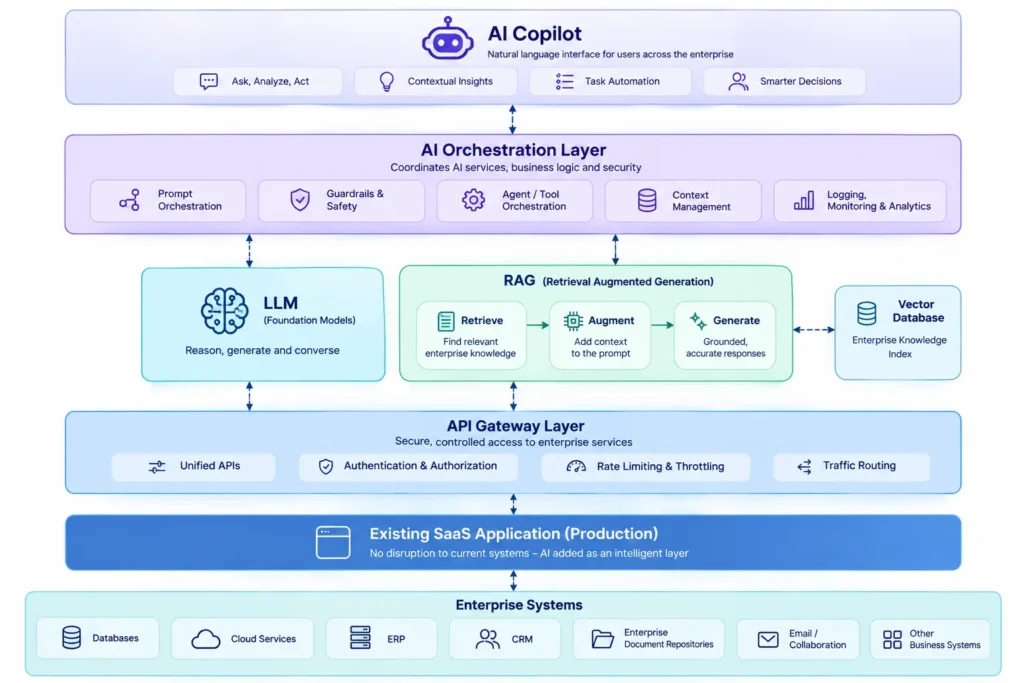
Typical AI Retrofit Architecture
| Existing SaaS Layer | AI Enhancement |
|---|---|
| Web & Mobile UI | AI Copilot |
| API Layer | AI Gateway |
| Business Services | AI Orchestration |
| Enterprise Database | Vector Database + RAG |
| Authentication | Shared Identity |
| Monitoring | AI Observability |
This modular approach reduces deployment risk while enabling continuous AI innovation.
Key Takeaways
- AI modernization does not automatically require rebuilding an application.
- AI retrofit enables organizations to introduce AI while preserving proven business logic and customer workflows.
- Rewrites should be reserved for applications constrained by architecture rather than driven by AI trends.
- Modular AI architectures built around APIs, RAG, orchestration, and copilots provide a scalable path to enterprise AI adoption.
- The most successful AI modernization initiatives prioritize business value, incremental delivery, and production stability.
Best Practices for Retrofitting AI into Existing SaaS
A successful AI retrofit focuses on augmenting existing business capabilities rather than replacing them. Organizations that adopt an API-first, modular architecture with strong governance and measurable business outcomes can introduce AI faster while minimizing operational risk.
The most successful AI initiatives don’t begin with replacing applications—they begin by identifying high-impact business problems where AI can deliver immediate value.
Instead of attempting to AI-enable every feature at once, enterprises should modernize incrementally, validating business outcomes before expanding AI adoption.
Enterprise AI Retrofit Best Practices
| Best Practice | Business Value |
|---|---|
| Start with one high-value use case | Faster ROI and quicker adoption |
| Keep AI separate from core business logic | Lower implementation risk |
| Adopt an API-first architecture | Easier integration and scalability |
| Use Retrieval-Augmented Generation (RAG) | More accurate and contextual AI responses |
| Implement AI observability | Monitor quality, latency, and usage |
| Secure AI interactions | Protect enterprise data and prompts |
| Measure business KPIs | Demonstrate AI value beyond technical metrics |
Enterprise Insight: The goal of an AI retrofit is not to make every feature AI-powered—it’s to make the right business workflows more intelligent.
Enterprise AI Integration Patterns
Organizations can integrate AI into existing SaaS applications using different architectural patterns depending on business objectives. Choosing the right pattern minimizes disruption while maximizing scalability and user adoption.
Not every AI capability requires the same integration strategy.
Some use cases enhance user productivity, while others automate workflows or improve decision-making.
Understanding these patterns helps teams select the most effective modernization approach.
Read our blog on Microsoft Fabric for Multi-Agent AI Architectures: Enterprise Guide
AI Integration Pattern Comparison
| Pattern | Best Use Case | Business Benefit |
|---|---|---|
| AI Copilot | Productivity & assistance | Improved user experience |
| Retrieval-Augmented Generation (RAG) | Knowledge search | Accurate, contextual responses |
| AI Agents | Workflow automation | Reduced manual effort |
| Predictive AI | Forecasting & recommendations | Better business decisions |
| Generative AI APIs | Content creation | Faster task completion |
Recommended Starting Point
For most enterprise SaaS applications, begin with:
- AI Copilot
- Intelligent Search (RAG)
- Workflow Recommendations
These use cases deliver measurable value without requiring major architectural changes.
Common Mistakes That Delay AI Modernization
Many AI modernization initiatives struggle because organizations focus on technology rather than business outcomes. Avoiding common architectural and implementation mistakes significantly improves adoption and long-term success.
| Common Mistake | Better Approach |
|---|---|
| Rewriting before validating AI use cases | Start with targeted AI retrofit |
| Embedding prompts directly into application code | Externalize prompt management |
| Connecting AI directly to production databases | Introduce an AI orchestration layer |
| Ignoring Responsible AI and governance | Implement AI guardrails and monitoring |
| Measuring only model performance | Track business KPIs and user adoption |
Remember: AI should reduce complexity—not introduce more of it.
Read our blog on What is Model Context Protocol (MCP)? A Complete Enterprise Guide
Security and Governance Considerations
Introducing AI into enterprise applications requires security and governance to be designed from the outset. Protecting enterprise data, enforcing access controls, and monitoring AI interactions are essential for responsible AI adoption.
AI services often process sensitive customer information, proprietary business data, and internal knowledge.
Without appropriate safeguards, organizations risk exposing confidential information or generating inconsistent outputs.
Enterprise AI Governance Checklist
- Authenticate AI service requests.
- Apply Role-Based Access Control (RBAC).
- Encrypt data in transit and at rest.
- Filter sensitive prompts and responses.
- Maintain audit logs for AI interactions.
- Monitor token usage and operational costs.
- Review AI outputs for quality and compliance.
Traditional Application Security vs AI Security
| Traditional Applications | AI-Powered Applications |
|---|---|
| User authentication | User + AI identity |
| API security | API + Prompt security |
| Database access | Enterprise data + Vector stores |
| Application logs | AI observability & traceability |
| Static business rules | Dynamic AI governance |
Enterprise AI Modernization Roadmap
AI modernization should be approached as a phased transformation rather than a one-time implementation. Starting with targeted pilots allows organizations to validate business value before scaling AI capabilities across the product portfolio.
Five-Phase AI Modernization Roadmap
| Phase | Activities | Outcome |
|---|---|---|
| Assess | Identify AI opportunities and business goals | AI strategy |
| Prioritize | Select high-value use cases | Pilot roadmap |
| Integrate | Introduce AI through APIs and orchestration | Production-ready AI features |
| Govern | Apply security, monitoring, and Responsible AI controls | Trusted AI operations |
| Scale | Expand successful AI capabilities across the platform | Enterprise-wide AI adoption |
AI Retrofit vs Rewrite: ROI Comparison
While AI rewrites may provide greater long-term architectural flexibility, AI retrofits typically deliver faster return on investment by leveraging existing applications, infrastructure, and business logic.
For most organizations, the primary objective is not building an AI-native platform—it is delivering business value quickly and sustainably.
ROI Comparison
| Evaluation Criteria | AI Retrofit | AI Rewrite |
|---|---|---|
| Initial Investment | Lower | Higher |
| Time to Business Value | Weeks to Months | Months to Years |
| Risk to Existing Customers | Low | High |
| Reuse of Existing Assets | High | Limited |
| Operational Disruption | Minimal | Significant |
| Long-Term Flexibility | High | Very High |
Decision Tip: If your application already delivers strong business value, focus on enhancing it with AI rather than rebuilding functionality that already works.
Key Takeaways
- AI retrofit is the preferred modernization strategy for most enterprise SaaS platforms because it accelerates AI adoption while minimizing production risk.
- API-first integration, Retrieval-Augmented Generation (RAG), and AI copilots enable organizations to introduce intelligent capabilities without disrupting existing business processes.
- Organizations should prioritize business outcomes over technology trends by focusing on high-value AI use cases first.
- Strong governance, security, and observability are essential to ensure AI solutions remain trustworthy, compliant, and scalable.
- A phased modernization roadmap helps enterprises validate AI investments before expanding adoption across the organization.
Enterprise Use Cases of AI Retrofit vs. Rewrite
AI retrofit enables organizations to introduce intelligent capabilities into existing SaaS platforms without disrupting production. Across industries, enterprises are using AI to improve customer experiences, automate workflows, and accelerate decision-making while preserving their existing technology investments.
Rather than rebuilding entire platforms, organizations are embedding AI where it delivers the greatest business impact.
| Industry | AI Retrofit Use Case | Business Outcome |
|---|---|---|
| SaaS | AI Copilot for users | Higher product adoption |
| Financial Services | Document intelligence & risk analysis | Faster underwriting and compliance |
| Healthcare | Clinical documentation assistant | Improved clinician productivity |
| Retail | AI-powered product recommendations | Increased conversions |
| Manufacturing | Predictive maintenance insights | Reduced downtime |
| Insurance | Claims summarization | Faster claim processing |
| Customer Support | AI-assisted ticket resolution | Lower support costs |
Enterprise Insight: The highest-performing AI initiatives typically begin by improving one business workflow rather than transforming the entire application.
AI Retrofit, Rewrite, or Hybrid? A Decision Framework
The best modernization strategy depends on your application’s architecture, business priorities, and AI maturity. While retrofitting is the preferred choice for most organizations, a hybrid approach can balance short-term value with long-term modernization goals.
Many enterprises don’t need to choose between retrofit or rewrite. Instead, they adopt a hybrid strategy:
- Retrofit AI into the existing application for immediate value.
- Gradually modernize high-impact services using cloud-native architectures.
- Replace legacy components only when business value justifies the investment.
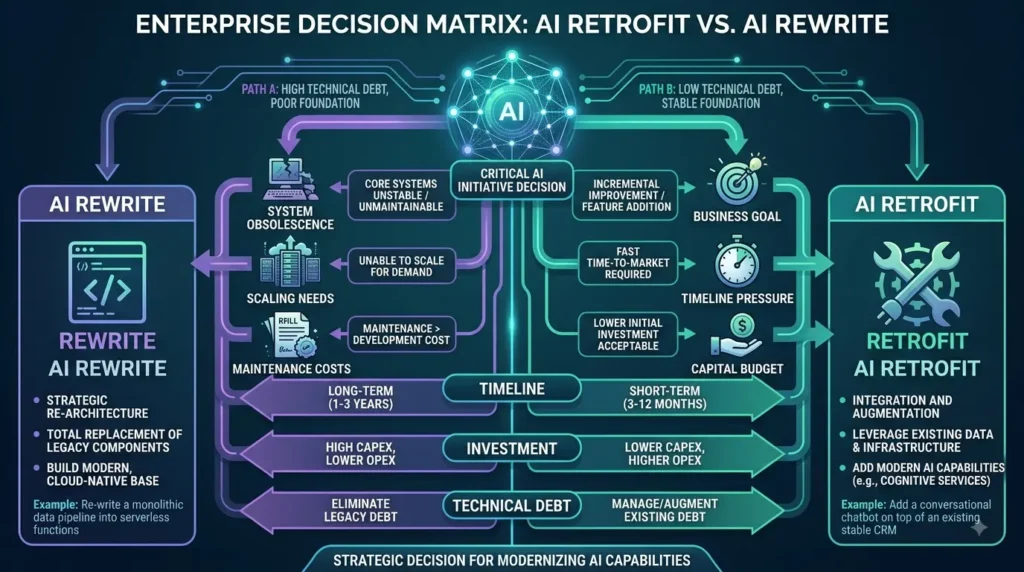
Enterprise Decision Matrix
| Evaluation Criteria | Retrofit | Hybrid | Rewrite |
|---|---|---|---|
| Need AI in less than 6 months | ✅ | ✅ | |
| Stable production platform | ✅ | ✅ | |
| Modernization already planned | ✅ | ✅ | |
| High technical debt | ✅ | ✅ | |
| Legacy technology limits innovation | ✅ | ||
| Greenfield AI-native product | ✅ |
Recommendation: For most mature SaaS products, retrofit first and modernize strategically. A full rewrite should be driven by business transformation—not by AI adoption alone.
Measuring Success: AI Modernization KPIs
AI modernization should be measured using business outcomes, operational efficiency, and user adoption—not just technical metrics. Tracking the right KPIs helps organizations demonstrate ROI and continuously improve AI capabilities.
Business KPIs
| KPI | Business Impact |
|---|---|
| User Adoption | Measures AI feature usage |
| Customer Satisfaction (CSAT/NPS) | Improved user experience |
| Time Saved | Increased productivity |
| Feature Adoption Rate | AI value realization |
| Revenue Impact | Product differentiation |
Operational KPIs
| KPI | Objective |
|---|---|
| AI Response Time | Faster interactions |
| API Success Rate | Reliable AI services |
| AI Accuracy | Better business outcomes |
| Support Ticket Reduction | Lower operational costs |
| AI Cost per Request | Optimize infrastructure spend |
Conclusion
Enterprise AI adoption doesn’t require abandoning the applications that already power your business. In most cases, the fastest and most cost-effective path to AI is to retrofit intelligent capabilities into existing SaaS platforms, preserving proven business logic while delivering new customer value.
A well-executed AI retrofit enables organizations to introduce copilots, intelligent search, workflow automation, and predictive insights with minimal disruption. By combining API-first integration, Retrieval-Augmented Generation (RAG), and modular AI services, enterprises can modernize incrementally, reduce implementation risk, and accelerate time-to-value.
A complete rewrite still has its place—but only when architectural constraints, technical debt, or strategic product transformation make incremental modernization impractical.
At Techment, we help organizations modernize SaaS platforms through enterprise AI engineering, application modernization, cloud-native architectures, and responsible AI implementation—enabling businesses to innovate faster while keeping production systems stable and secure.
Frequently Asked Questions (FAQs)
1. What is AI retrofit?
AI retrofit is the process of integrating AI capabilities—such as copilots, intelligent search, recommendations, or workflow automation—into an existing application without rebuilding its core architecture.
2. What is the difference between AI retrofit and AI rewrite?
AI retrofit enhances an existing application using APIs and modular AI services, while AI rewrite involves rebuilding significant parts of the application to become AI-native. Retrofit typically delivers faster ROI with lower implementation risk.
3. Can legacy SaaS applications support Generative AI?
Yes. Most SaaS platforms can integrate Generative AI using APIs, Retrieval-Augmented Generation (RAG), AI orchestration layers, and vector databases without requiring a complete application rewrite.
4. When should an organization choose a full rewrite?
A rewrite is appropriate when the current platform has significant technical debt, cannot scale, or no longer aligns with long-term business and product goals.
5. What is the safest way to introduce AI into production?
Start with a focused, high-value use case, integrate AI through secure APIs, implement governance and monitoring, and expand incrementally based on measurable business outcomes.
Related Reads
- 7 Strategic Reasons Enterprise AI Adoption and Readiness Is No Longer Optional in 2026
- 7 Critical Differences Between AI Readiness vs AI Adoption That Most Enterprises Ignore in 2026
- Enterprise AI Strategy in 2026
- AI-Ready Enterprise Checklist for Microsoft Fabric
- Data Quality for AI in 2026: The Ultimate Blueprint
- Why Modern Data Platforms Are Critical for RAG Success in Enterprises