AI helps insurers meet compliance and audit requirements by monitoring regulatory changes, organizing audit evidence, testing controls, detecting anomalies, and supporting AI model governance. To use it responsibly, insurers need validated outputs, secure data access, human oversight, documented approvals, and traceable audit trails that demonstrate how compliance activities and material decisions were reviewed.
Executive Summary
Insurance companies operate in a highly regulated environment where underwriting decisions, claims handling, pricing models, financial reporting, customer communications, and risk management activities must be supported by reliable evidence. Artificial intelligence (AI) can help insurers improve compliance monitoring, automate control testing, organize audit evidence, identify anomalies, and accelerate regulatory reporting.
However, AI does not automatically make an insurer compliant. Poorly governed AI can introduce new risks, including inaccurate outputs, biased decisions, inadequate documentation, data privacy violations, and limited explainability. Insurers must therefore establish clear governance, human accountability, data controls, model validation, and audit trails for both AI tools used in compliance functions and AI systems that influence insurance decisions.
The strongest approach combines AI-driven efficiency with established compliance frameworks, documented controls, human oversight, and evidence that auditors can independently verify.
TL;DR
- AI can support insurance compliance by monitoring controls, analyzing documents, detecting anomalies, and organizing audit evidence.
- Governance remains essential: insurers must validate AI outputs, assign accountability, control data access, and document material decisions.
- Auditability must be designed in: retain source records, model versions, approvals, outputs, exceptions, and remediation evidence.
- AI-driven underwriting and pricing require particular care because inaccurate or biased results can affect consumers and create regulatory exposure.
- Third-party AI is not an accountability shortcut: insurers need vendor due diligence, appropriate contractual safeguards, and ongoing oversight.
- Start with bounded, lower-risk workflows and expand after measuring accuracy, control effectiveness, and operational value.
Introduction: Why AI Compliance Matters in Insurance
Insurance compliance is becoming more data-intensive as insurers adopt digital claims processing, automated underwriting, predictive analytics, generative AI, and AI-enabled customer service. Compliance teams must interpret policies and regulations, test controls, investigate exceptions, maintain evidence, and respond to internal and external audits—often across fragmented systems.
AI can help address these challenges by turning large volumes of structured and unstructured information into searchable evidence, prioritizing potential risks, and automating repetitive compliance activities. For example, an AI-enabled system could compare claims files against a documented checklist, flag missing approvals, or help map a new regulatory requirement to existing controls.
But speed alone is not the objective. Insurers need processes that are accurate, explainable, reproducible, secure, and defensible under examination. The goal is not to replace compliance professionals or auditors with AI. It is to give them better tools to identify risks, verify controls, and make informed decisions.
This distinction is particularly important in insurance, where decisions can affect access to coverage, premiums, claim payments, and consumer rights.
Read more about AI in Insurance: Benefits, Use Cases in 2026
What Is AI-Enabled Compliance in Insurance?
AI-enabled compliance in insurance uses machine learning, natural language processing, document intelligence, and generative AI to help insurers interpret requirements, monitor controls, detect exceptions, and prepare reliable compliance evidence. It can improve the speed and consistency of compliance work, but regulated decisions still require appropriate validation, oversight, and accountability.
Where AI fits into the compliance lifecycle
AI can support several connected activities:
- Regulatory intelligence: Identify relevant changes in regulatory publications and route them to the appropriate subject-matter experts.
- Obligation mapping: Help translate requirements into policies, controls, owners, and evidence requests.
- Control monitoring: Analyze transactions and system records to identify possible control failures.
- Evidence management: Classify documents, extract relevant details, and link evidence to audit requirements.
- Exception investigation: Summarize supporting records and prioritize cases for review.
- Audit preparation: Assemble evidence packs, identify missing documentation, and draft initial responses for human verification.
- Remediation tracking: Monitor action plans, deadlines, ownership, and closure evidence.
These capabilities should be treated as decision support unless the organization has explicitly approved and validated a more automated use case.
AI claims automation must be supported by robust enterprise architecture. Techment’s AI-Ready Enterprise Checklist with Microsoft Fabric outlines readiness considerations.
Why Do Insurers Need AI for Compliance and Audit Readiness?
Insurers need AI for compliance and audit readiness because regulatory obligations span large volumes of policies, claims, customer records, models, vendor relationships, and operational controls. AI can help teams find relevant evidence faster, identify unusual patterns, and focus review effort on higher-risk areas while preserving human judgment over material compliance decisions.
1. Increasing volumes of regulatory and operational data
Compliance evidence may be spread across policy administration platforms, claims systems, customer relationship management tools, data warehouses, emails, spreadsheets, and third-party applications. AI-assisted search and classification can help teams locate relevant records without relying entirely on manual review.
2. More complex AI and model oversight
Insurers may use AI in fraud detection, underwriting, pricing, claims triage, customer interactions, and forecasting. Each use case can create different risks and require different validation, monitoring, and documentation. A centralized inventory and risk-based governance process help teams understand where AI is being used and what controls apply.
3. Faster audit preparation
Preparing for an audit often involves repeated requests for policies, control descriptions, approvals, transaction samples, model documentation, and remediation evidence. AI can help assemble these materials, identify gaps, and produce initial summaries for review.
4. Earlier detection of control weaknesses
Rules-based systems and AI analytics can flag patterns such as unusual payment activity, missing approvals, inconsistent claim documentation, or unexpected changes in key metrics. These alerts should trigger investigation—not be treated automatically as proof of fraud or non-compliance.
5. More consistent compliance operations
Standardized AI-assisted workflows can help apply the same review checklist across teams and business units. Consistency improves when prompts, evaluation criteria, approval rules, and evidence requirements are documented and controlled.
How Can Insurers Use AI to Meet Compliance and Audit Requirements?
Insurers can use AI to support regulatory monitoring, control testing, audit evidence collection, model governance, claims and underwriting reviews, third-party risk management, and regulatory reporting. Each workflow should define its intended purpose, data permissions, accuracy thresholds, human review requirements, audit records, and escalation process before deployment.
1. Automate regulatory change monitoring
AI can help compliance teams review regulator publications, consultation papers, circulars, enforcement notices, and updated guidance. Natural language processing can classify documents by jurisdiction, product line, business function, and potential impact.
A practical workflow could:
- Monitor approved official regulatory sources.
- Identify new or amended documents.
- Summarize the apparent changes with links to the original source.
- Map the changes to potentially affected policies and controls.
- Route the assessment to a compliance owner.
- Record the final interpretation, decision, and implementation deadline.
Control requirement: AI-generated regulatory summaries should be verified against the original legal or regulatory text. A model’s summary is not itself an authoritative interpretation of the law.
2. Improve audit evidence collection
AI can help locate, classify, and summarize records required for an audit. It can also compare an evidence request with the records available and highlight missing, outdated, or inconsistent documentation.
For example, an insurer preparing for a claims audit could use AI to retrieve the applicable claims procedure, relevant transaction records, approval history, exception notes, and remediation documentation.
A well-designed evidence process should preserve:
- The original source document or system record.
- The source location and relevant date.
- The control or audit request the evidence supports.
- The extraction or transformation performed.
- The reviewer and approval status.
- Any limitations, missing records, or exceptions.
AI should not fabricate missing evidence or silently replace source records with generated summaries.
3. Strengthen continuous control monitoring
AI analytics can help monitor transactions and operational events against documented control objectives. Depending on the workflow, systems can combine deterministic rules, statistical anomaly detection, and machine learning to identify potential exceptions.
Insurance examples include:
- Claims payments that deviate from approved authorization thresholds.
- Missing or inconsistent claim documentation.
- Unusual patterns in refunds, adjustments, or manual overrides.
- Repeated control failures across a business unit.
- Unapproved access to sensitive data.
- Incomplete evidence for required approvals.
A useful design combines rule-based checks for clearly defined requirements with AI-based prioritization for complex or unusual patterns. Each alert should include enough context for an authorized reviewer to investigate it.
4. Make AI model governance more auditable
When AI influences underwriting, pricing, claims decisions, fraud referrals, or customer eligibility, insurers need a documented view of how the model is developed, validated, approved, deployed, monitored, and changed.
An AI model inventory can capture:
- Model name, purpose, owner, and business process.
- Risk classification and affected customer groups.
- Data sources and data-quality assessments.
- Validation results and known limitations.
- Performance, drift, and fairness monitoring.
- Human review and override procedures.
- Version history and change approvals.
- Incident records and retirement decisions.
Model governance should be proportionate to the model’s materiality and potential impact. A tool that summarizes internal policy documents does not necessarily require the same controls as a model that materially influences coverage or pricing decisions.
5. Support claims and underwriting compliance
AI can help reviewers identify missing documents, inconsistent information, possible policy mismatches, or cases requiring specialist review. It can also summarize a file’s relevant facts and cite the underlying records for verification.
For example, an AI-assisted claims review may identify a missing approval or a discrepancy between a claim note and a supporting document. The system can explain why the case was flagged and direct the examiner to the source evidence.
However, AI outputs should not be treated as conclusive determinations of coverage, fraud, eligibility, or liability. High-impact decisions need appropriate human review, validated decision criteria, and a clear record of the basis for the outcome.
6. Improve regulatory reporting and examination responses
AI can help compliance teams collect information from approved systems, map data to report fields, identify inconsistencies, and draft responses to regulatory requests.
A controlled reporting workflow should include source reconciliation, validation rules, named approvers, version control, and evidence of final submission. AI may prepare a draft, but accountable personnel should verify the figures, definitions, scope, and legal meaning before submission.
7. Strengthen third-party AI oversight
Insurers often rely on external providers for analytics, document processing, fraud detection, cloud services, and AI-enabled platforms. Outsourcing a capability does not necessarily remove the insurer’s responsibility for its use or outcomes.
AI can assist vendor assessments by organizing questionnaires, reviewing contractual documents, summarizing security evidence, and tracking required remediation. It should not replace due diligence or specialist review.
Vendor oversight should consider:
- Intended use and materiality of the supplied AI.
- Data provenance, permitted use, and retention.
- Security, privacy, and access controls.
- Model validation and performance evidence.
- Change notification and incident reporting.
- Audit and information-access rights, where appropriate.
- Subcontractor dependencies and exit arrangements.
Which Insurance Compliance Processes Are Best Suited to AI?
The most suitable initial use cases are generally repetitive, evidence-heavy, and measurable workflows where AI can assist without making unreviewed high-impact decisions. Insurers should evaluate each use case by potential consumer impact, regulatory exposure, data sensitivity, error cost, and the feasibility of independent verification.
| Compliance use case | How AI helps | Essential safeguard |
|---|---|---|
| Regulatory monitoring | Summarizes and categorizes official updates | Verify against authoritative publications |
| Audit preparation | Retrieves and organizes evidence | Preserve source records and traceability |
| Control testing | Flags anomalies and missing controls | Validate alerts and document disposition |
| Claims file review | Identifies inconsistencies and missing documents | Human review for material outcomes |
| Underwriting model oversight | Supports inventory, validation, and monitoring | Fairness, actuarial, and legal review as applicable |
| Regulatory reporting | Maps and reconciles report inputs | Independent validation and approval |
| Vendor risk assessment | Organizes due diligence evidence | Specialist assessment and contractual review |
| Policy and procedure management | Compares documents and identifies changes | Authorized compliance approval |
A practical starting point is to prioritize workflows where the insurer can measure time saved, error rates, evidence completeness, and reviewer acceptance without compromising customer protections.
What Are the Key Risks of Using AI for Insurance Compliance?
AI introduces compliance risks when its outputs are inaccurate, biased, untraceable, insecure, or used beyond their approved purpose. Insurers should assess not only the risks of the AI model itself, but also the data, integrations, users, vendors, and business decisions connected to it.
Inaccurate or fabricated outputs
Generative AI may produce plausible but incorrect summaries, citations, interpretations, or explanations. Use retrieval from approved sources, preserve citations, validate critical fields, and require qualified review for material conclusions.
Bias and unfair discrimination
Data and models can produce unfair outcomes or act as proxies for protected characteristics. Insurers should assess the data, methodology, outputs, and actual impacts of relevant systems, using appropriate actuarial, legal, and fairness expertise.
Weak audit trails
If a system records only the final answer, investigators may be unable to establish which source data, model version, rules, or approvals influenced the result. Logging should be designed around the evidence needed to reconstruct and review material actions.
Data privacy and security exposure
Compliance teams may work with sensitive personal, health, financial, or claims data. Apply least-privilege access, approved processing environments, data minimization, retention controls, encryption, and restrictions on sending sensitive information to unauthorized AI services.
Overreliance on automation
An AI-generated alert, summary, or recommendation can be mistaken for a verified finding. Define what the system may do independently, what requires approval, and when a case must be escalated to a human specialist.
Third-party and model-change risks
A vendor may change a model, data source, or service in ways that affect performance or compliance. Require appropriate change notifications, validation, incident escalation, and periodic reassessment.
Incomplete regulatory interpretation
Regulatory obligations differ by jurisdiction, product, business activity, and legal entity. AI can help identify potentially relevant requirements, but the insurer must confirm applicability with qualified compliance or legal professionals.
What Should an AI-Ready Insurance Audit Trail Include?
An AI-ready audit trail should allow an authorized reviewer to reconstruct what happened, which sources and system versions were involved, who approved material actions, and how exceptions were resolved. The appropriate level of detail depends on the use case, applicable requirements, data sensitivity, and risk of the decision.
A practical audit record may include:
- Identity and ownership: System, model, workflow, business owner, and authorized operator.
- Purpose and context: The approved use case and the action or decision being supported.
- Source evidence: Source-system references, document identifiers, timestamps, and relevant data lineage.
- Model details: Model or service version, configuration, relevant rules, and deployment version.
- Input and output records: The information needed to reconstruct the process, subject to privacy and retention requirements.
- Decision controls: Confidence or validation checks where meaningful, reviewer actions, approvals, and overrides.
- Exceptions: Alerts, failed checks, missing evidence, and escalation records.
- Remediation: Corrective action, accountable owner, closure date, and supporting evidence.
Not every workflow requires storing every prompt or every intermediate model output indefinitely. Logging should be risk-based and privacy-aware, with retention and access policies defined in advance.
Which Frameworks and Regulations Should Insurers Consider?
Insurers should map AI compliance practices to the laws and supervisory expectations that apply to their jurisdictions, products, and activities. Frameworks such as the NAIC Model Bulletin on the Use of Artificial Intelligence Systems by Insurers and the NIST AI Risk Management Framework can inform governance, but their legal status and applicability differ.
NAIC Model Bulletin on AI Systems
The National Association of Insurance Commissioners (NAIC) adopted its Model Bulletin on the Use of Artificial Intelligence Systems by Insurers in December 2023. It outlines expectations for responsible AI governance and reminds insurers that decisions or actions made or supported by AI must comply with applicable insurance laws and regulations.
The bulletin is a model for state-level adoption, not a single federal insurance law that automatically applies identically in every state. Insurers should verify the current requirements and supervisory guidance in each relevant jurisdiction.
Official resource: NAIC — Artificial Intelligence in Insurance
New York Department of Financial Services guidance
New York DFS Insurance Circular Letter No. 7 (2024) addresses insurers’ use of AI systems and external consumer data in underwriting and pricing. It discusses governance, fairness, actuarial validity, vendor oversight, and regulatory examination expectations.
This guidance is particularly relevant to insurers conducting the covered activities in New York. It should not be treated as a universal rule for every insurer or every AI use case.
Official resource: New York DFS — Insurance Circular Letter No. 7 (2024)
NIST AI Risk Management Framework
The NIST AI Risk Management Framework (AI RMF) is a voluntary framework that helps organizations incorporate trustworthiness considerations into the design, development, use, and evaluation of AI systems. Its core functions—Govern, Map, Measure, and Manage—provide a useful structure for organizing AI risk activities and evidence.
Official resource: NIST — AI Risk Management Framework
Other applicable requirements
Depending on the insurer’s operations, teams may also need to consider insurance-specific laws and regulations, privacy and data protection requirements, cybersecurity obligations, records-retention rules, financial reporting controls, and applicable AI legislation. Applicability should be assessed by jurisdiction, legal entity, product, and use case rather than assumed from a generic checklist.
Important: This article provides general information, not legal advice. Compliance teams should confirm current requirements with qualified counsel and relevant regulators.
How Can Insurers Build an AI-Enabled Compliance Architecture?
An AI-enabled compliance architecture connects authoritative regulatory content, controlled enterprise data, AI services, workflow orchestration, human approvals, and evidence storage. Its purpose is to make compliance activities more efficient while ensuring that material findings remain traceable, reviewable, and subject to established controls.
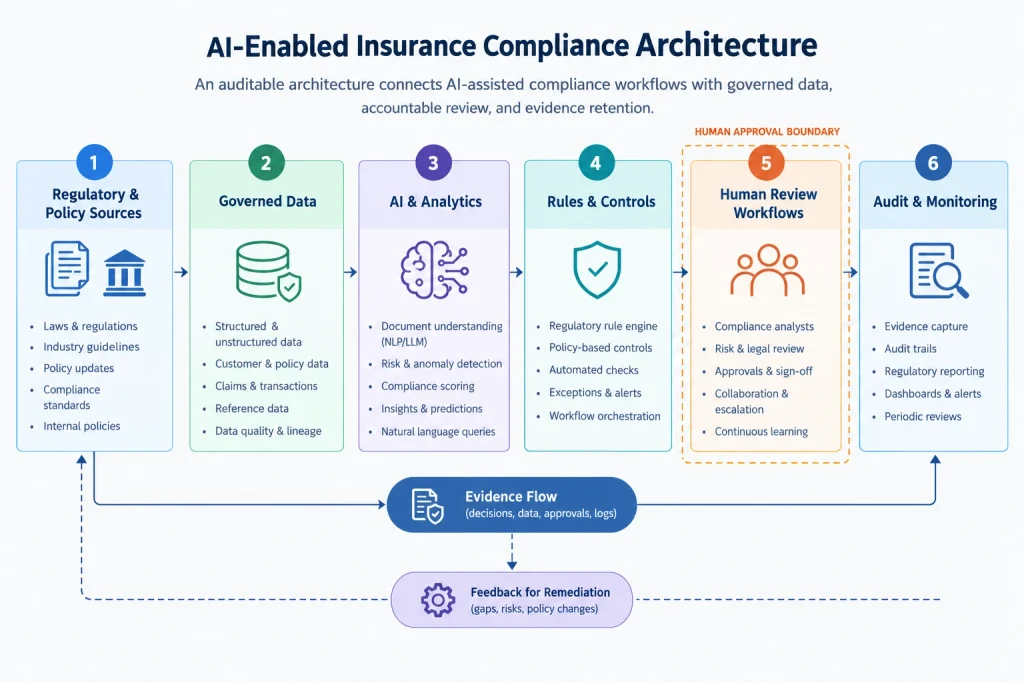
Recommended architecture layers
1. Regulatory and policy sources
Maintain approved sources for regulations, supervisory guidance, internal policies, procedures, and control descriptions. Track document versions and effective dates.
2. Governed data and evidence layer
Connect to authorized claims, policy, finance, identity, model inventory, and document systems. Apply data classification, access controls, lineage, and retention rules.
3. AI and analytics layer
Use suitable technologies for document extraction, semantic search, classification, anomaly detection, and summarization. Where a generative AI system answers questions from internal documents, retrieval-augmented generation (RAG) can help ground responses in approved sources, provided retrieval quality and citations are verified.
4. Rules and control engine
Use deterministic rules for clearly specified obligations, thresholds, approvals, and validation requirements. Combine these with AI assistance where interpretation or prioritization is useful.
5. Workflow and human oversight
Route exceptions, uncertain outputs, material findings, and regulated decisions to accountable reviewers. Record approvals, overrides, escalation, and resolution.
6. Audit and monitoring layer
Capture relevant system activity, source references, model versions, validation results, access events, and remediation records. Monitor both operational performance and compliance-control effectiveness.
Architecture decisions should reflect existing systems, data sensitivity, deployment constraints, and regulatory obligations. AI should not become an uncontrolled side channel around established systems of record.
Read more about Microsoft Fabric for Insurance Carriers: A Reference Architecture
A Practical Roadmap for Implementing AI in Insurance Compliance
Insurers can implement AI for compliance through a phased roadmap that starts with a clearly bounded workflow, establishes measurable controls, pilots the solution with human review, and expands only after validation. This approach reduces the risk of automating an unreliable process or introducing an untraceable dependency into a regulated activity.
Phase 1: Assess requirements and current processes
- Inventory key compliance activities, audits, and recurring evidence requests.
- Identify manual bottlenecks and known control weaknesses.
- Map relevant jurisdictions and regulatory obligations.
- Establish a baseline for time, quality, cost, and error rates.
Deliverable: Prioritized use-case inventory and current-state assessment.
Phase 2: Select a bounded pilot
Choose a workflow with clear inputs, measurable outputs, and manageable risk—for example, audit evidence classification or internal policy search.
Define the intended use, prohibited actions, users, escalation paths, and success criteria before development begins.
Deliverable: Approved pilot charter and risk assessment.
Phase 3: Establish data and governance controls
- Confirm source-data permissions and quality.
- Define ownership and approval responsibilities.
- Select approved AI services and deployment patterns.
- Set logging, retention, privacy, and security requirements.
- Establish validation and incident-management procedures.
Deliverable: Governance and control design.
Phase 4: Build and validate
Test the system against representative examples, edge cases, incomplete records, conflicting sources, and adversarial inputs where relevant. Measure factual accuracy, citation quality, false positives, false negatives, reviewer acceptance, and failure behavior.
Deliverable: Test results, limitations, and documented approval decision.
Phase 5: Pilot with human review
Run the workflow alongside the existing process where practical. Compare AI-assisted results with verified outcomes, investigate errors, and record reviewer overrides.
Deliverable: Pilot evaluation and remediation plan.
Phase 6: Operationalize and continuously improve
Monitor system performance, access, exceptions, model changes, and compliance outcomes. Reassess the system when regulations, source data, business processes, or underlying AI services change.
Deliverable: Operational monitoring plan and periodic review schedule.
How Should Insurers Measure the ROI of AI Compliance?
Insurers should measure AI compliance ROI through a combination of operational efficiency, evidence quality, control effectiveness, risk reduction, and user adoption. Time savings alone are insufficient if the system increases errors, creates additional review work, or weakens the reliability of audit evidence.
| Metric | What it measures | How to use it |
|---|---|---|
| Audit preparation time | Time needed to collect and organize evidence | Compare before and after implementation |
| Evidence completeness | Percentage of requested evidence items available and valid | Identify documentation gaps |
| Reviewer acceptance rate | Share of AI-assisted outputs accepted after review | Track output usefulness and quality |
| Material error rate | Errors that could affect a compliance conclusion or decision | Set risk-based tolerance and escalation |
| Exception resolution time | Time from detection to verified closure | Assess investigation efficiency |
| False-positive rate | Alerts that do not represent meaningful exceptions | Reduce unnecessary investigation effort |
| Control coverage | Share of relevant controls monitored or tested | Identify blind spots |
| Cost per review | Average cost of completing a defined review | Compare total operating costs, including oversight |
Establish baselines before deployment and report results by use case. Include implementation, integration, licensing, validation, security, monitoring, and human-review costs in the business case. Avoid claiming a compliance benefit solely because a model processes documents faster.
Common Mistakes Insurers Should Avoid
Insurers can undermine AI compliance initiatives by automating before defining control requirements, treating generated content as verified evidence, or failing to assign accountability. Avoiding these mistakes is as important as choosing the right model or platform.
- Automating an unclear process: Standardize the control and evidence requirements first.
- Treating AI summaries as primary evidence: Preserve and verify original records.
- Ignoring model limitations: Document known weaknesses and test failure modes.
- Overlooking fairness: Assess consumer impacts where AI influences underwriting, pricing, claims, or access to coverage.
- Assuming vendor compliance transfers responsibility: Establish appropriate oversight and contractual safeguards.
- Logging too little—or collecting everything indiscriminately: Design records around auditability, privacy, security, and retention needs.
- Failing to involve compliance teams early: Include compliance, legal, actuarial, security, data, and business owners in relevant design decisions.
- Expanding without evidence: Require successful validation and documented approval before broadening the use case.
The Future of AI in Insurance Compliance and Audit
AI-enabled insurance compliance is likely to move from isolated document-assistance tools toward integrated, continuously monitored control environments. Advances in document intelligence, governed enterprise search, machine learning, and AI agents may help insurers connect regulatory obligations with operational evidence and remediation workflows.
Potential developments include:
- Continuous compliance monitoring: More frequent assessment of defined controls instead of relying only on periodic manual sampling.
- Connected regulatory obligations and controls: Traceable links between regulatory requirements, internal policies, tests, and evidence.
- More explainable AI-assisted decisions: Better source references, decision records, and monitoring of model behavior.
- AI-assisted audit analytics: Faster identification of exceptions and patterns across larger data sets.
- Governed AI agents: Agents that execute bounded compliance tasks under explicit identities, permissions, approval rules, and audit logging.
- More structured AI oversight: Greater focus on model inventories, documented risk management, third-party data and model governance, and evidence of control effectiveness.
These developments will not eliminate the need for qualified professionals. They increase the importance of designing systems where automation is bounded, evidence is reliable, and accountability is clear.
Conclusion
AI can help insurers make compliance and audit processes faster, more consistent, and more evidence-driven. The greatest value comes from combining automated document analysis, regulatory monitoring, control testing, anomaly detection, and evidence preparation with strong governance and human oversight.
Successful adoption starts with a well-defined use case, approved data sources, measurable performance criteria, and an audit trail that allows reviewers to verify what happened. As AI becomes more deeply embedded in underwriting, claims, and operational decision-making, insurers should treat governance and auditability as core architecture requirements—not features to add after deployment.
Techment can help insurance organizations assess AI opportunities, strengthen data and governance foundations, modernize compliance workflows, and design enterprise AI solutions with security, traceability, and operational controls built in. A focused assessment can help identify where AI can deliver measurable efficiency while maintaining the accountability that regulated insurance operations demand.
Frequently Asked Questions
1. How can AI help insurance companies meet compliance requirements?
AI can help insurers monitor regulatory updates, classify evidence, test controls, detect anomalies, support model governance, and prepare regulatory reports. Outputs must be validated, and the insurer remains responsible for meeting applicable legal and regulatory obligations.
2. Can AI automate insurance audits?
AI can automate parts of audit preparation, such as document retrieval, evidence classification, reconciliation, and exception identification. It should not replace independent audit judgment or be treated as proof that a control is effective without appropriate verification.
3. How does AI improve audit readiness for insurers?
AI can improve audit readiness by connecting evidence to specific controls, identifying missing documentation, summarizing source records, and tracking remediation. A reliable process preserves original evidence, timestamps, version history, reviewer approvals, and exception records.
4. What is the role of AI governance in insurance compliance?
AI governance defines how AI systems are approved, accessed, monitored, validated, changed, and retired. It assigns ownership, documents risk, controls data use, establishes human oversight, and supports evidence that AI systems operate within approved boundaries.
5. Can AI be used for insurance regulatory reporting?
Yes. AI can help extract information, map data to report fields, identify inconsistencies, and draft responses. Insurers should validate calculations, definitions, source records, and final submissions through established review and approval processes.
6. What are the biggest risks of AI in insurance compliance?
Key risks include inaccurate outputs, biased decisions, weak audit trails, data privacy breaches, unauthorized access, third-party model changes, and excessive reliance on automation. Controls should be proportionate to the use case and the potential impact on consumers.
7. How should insurers govern AI used in underwriting and pricing?
Insurers should document the model’s purpose, data sources, validation, ownership, performance, and limitations. They should assess actuarial validity and potential unfair discrimination, maintain appropriate oversight, and confirm the requirements that apply in each jurisdiction.
8. How can insurers start implementing AI for compliance?
Start by mapping recurring compliance tasks and evidence gaps, then select a bounded, measurable pilot. Establish ownership, approved data access, validation criteria, audit logging, and human review before evaluating results and expanding to additional workflows.
Related Reads
- AI-Ready Enterprise Checklist with Microsoft Fabric
- AI-Powered Risk Assessment in Insurance: Models & Use Cases
- RAG for Insurance: How Retrieval-Augmented AI Speeds Up Claims Processing
- Microsoft Fabric for Insurance Carriers: A Reference Architecture
- AI in Insurance: Benefits, Use Cases in 2026