Microsoft Fabric for Multi-Agent AI Architectures provides a unified data, analytics, governance, and AI platform that enables enterprises to build intelligent AI agent ecosystems. By combining OneLake, Data Engineering, Data Science, Real-Time Intelligence, and Power BI, Microsoft Fabric allows multiple AI agents to collaborate securely using trusted enterprise data while maintaining governance, scalability, and business alignment.
Executive Summary
The next generation of enterprise AI is no longer defined by individual chatbots or standalone copilots. Organizations are increasingly deploying multi-agent AI architectures, where multiple specialized AI agents work together to analyze data, automate workflows, make decisions, and support employees across business functions.
While this collaborative approach significantly expands AI capabilities, it also introduces new challenges. AI agents must share trusted data, coordinate tasks, maintain context, comply with governance policies, and scale across complex enterprise environments.
Microsoft Fabric addresses these challenges by unifying data engineering, analytics, machine learning, real-time intelligence, and governance into a single SaaS platform. Built around OneLake, Fabric provides a centralized, governed data foundation that enables AI agents to access consistent information, collaborate efficiently, and generate trusted insights.
For enterprises investing in Agentic AI, Microsoft Fabric offers more than a data platform—it provides the operational backbone required to deploy, govern, and continuously optimize intelligent AI ecosystems.
Why Multi-Agent AI Needs Microsoft Fabric
Multi-agent AI systems require a unified data platform that enables multiple AI agents to securely access shared enterprise knowledge, collaborate in real time, and operate under consistent governance. Microsoft Fabric provides this foundation by integrating data engineering, analytics, AI, and governance into a single platform, reducing architectural complexity while improving scalability and trust.
Traditional enterprise AI applications typically consist of a single model responding to user requests. Although effective for straightforward tasks, these systems often struggle when organizations need AI to execute complex, cross-functional business processes.
Modern enterprises increasingly require AI systems capable of:
- Coordinating across multiple business domains
- Accessing data from numerous enterprise applications
- Collaborating with other AI agents
- Executing autonomous workflows
- Continuously learning from operational feedback
- Maintaining governance and regulatory compliance
Consider an enterprise procurement scenario:
Rather than relying on one large AI model, organizations may deploy multiple specialized agents:
- A Research Agent retrieves supplier information.
- A Financial Agent evaluates pricing trends.
- A Compliance Agent validates regulatory requirements.
- A Risk Agent assesses vendor exposure.
- A Workflow Agent initiates approvals.
- A Reporting Agent summarizes insights for executives.
Each agent performs a specialized function while collaborating through shared enterprise data.
Without a unified platform, organizations quickly encounter fragmented data, duplicated integrations, inconsistent business logic, governance gaps, and escalating operational costs.
Microsoft Fabric addresses these challenges by providing:
- A unified enterprise data foundation through OneLake.
- Integrated analytics and AI capabilities.
- Centralized governance and compliance.
- Native support for real-time intelligence.
- Shared semantic models for consistent decision-making.
This enables enterprises to build AI systems that are collaborative, scalable, and enterprise-ready.
Comparison Table: Single-Agent AI vs Multi-Agent AI
| Capability | Single-Agent AI | Multi-Agent AI |
|---|---|---|
| Task Execution | Individual | Collaborative |
| Decision Making | Centralized | Distributed |
| Scalability | Medium | High |
| Context Sharing | Limited | Shared Knowledge |
| Business Complexity | Simple | Enterprise-scale |
| Fault Isolation | Low | High |
| Parallel Processing | Limited | Native |
| Enterprise Automation | Moderate | Excellent |
| Governance | Simple | Centralized |
| Business Agility | Moderate | High |
Key Insight: Multi-agent AI excels in complex enterprise environments where specialized agents collaborate using a common knowledge foundation.
What Is Microsoft Fabric?
Microsoft Fabric is Microsoft’s unified analytics and AI platform that combines data engineering, data integration, data science, real-time intelligence, business intelligence, and governance into a single SaaS environment. It enables enterprises to eliminate data silos and build AI solutions using a shared, governed data foundation.
Enterprise data has traditionally been fragmented across multiple platforms, warehouses, lakes, reporting tools, and cloud services. This fragmentation creates significant barriers for AI systems, which rely on consistent, high-quality, and accessible data to generate accurate insights.
Microsoft Fabric addresses this challenge by bringing together multiple data and analytics capabilities within a unified ecosystem. Rather than stitching together disconnected services, organizations can manage the entire data lifecycle—from ingestion and transformation to analytics and AI—within a single platform.
At the heart of Fabric is OneLake, a unified data lake that serves as the single source of truth for structured, semi-structured, and unstructured data. Combined with integrated workloads such as Data Factory, Data Engineering, Data Science, Real-Time Intelligence, and Power BI, Fabric enables enterprises to operationalize AI without the complexity of maintaining separate data estates.
For multi-agent AI architectures, this unified approach ensures that every AI agent operates on the same trusted, governed, and continuously updated enterprise knowledge base.
Microsoft Fabric Components Supporting AI
| Microsoft Fabric Service | Primary Function | Value for AI Agents |
|---|---|---|
| OneLake | Unified enterprise storage | Shared knowledge base |
| Data Factory | Data ingestion | Continuous data availability |
| Data Engineering | Data preparation | Feature-ready datasets |
| Lakehouse | Unified storage architecture | Structured and unstructured data access |
| Data Science | Machine learning lifecycle | Predictive intelligence |
| Real-Time Intelligence | Streaming analytics | Event-driven AI |
| Power BI | Business analytics | Human oversight and explainability |
| Microsoft Purview | Governance | Compliance and lineage |
What Is a Multi-Agent AI Architecture?
A multi-agent AI architecture is a collaborative AI system in which multiple specialized AI agents work together to solve complex business problems. Each agent performs a distinct function while sharing enterprise knowledge, coordinating actions, and operating under centralized governance.
Unlike traditional AI applications that depend on a single model, multi-agent systems distribute intelligence across specialized agents. This modular design improves scalability, resilience, and adaptability, making it well-suited for enterprise environments where workflows span multiple departments and systems.
Each agent is optimized for a specific responsibility. For example:
- A Research Agent gathers information from enterprise repositories.
- An Analytics Agent interprets business data.
- A Planning Agent coordinates workflows.
- A Compliance Agent ensures adherence to policies.
- An Automation Agent executes operational tasks.
- A Monitoring Agent tracks system performance.
These agents collaborate by exchanging context and leveraging shared enterprise data, enabling organizations to automate sophisticated processes while maintaining transparency and control.
As enterprises adopt agentic AI, orchestration frameworks such as Azure AI Foundry, Semantic Kernel, and Microsoft Copilot Studio increasingly work alongside Microsoft Fabric to coordinate agent interactions and manage lifecycle operations.
Multi-Agent AI Architecture Component
| Component | Purpose | Microsoft Ecosystem |
|---|---|---|
| AI Agents | Specialized business tasks | Azure AI Foundry |
| Orchestrator | Coordinates agent interactions | Semantic Kernel / LangGraph |
| Knowledge Layer | Enterprise context | OneLake |
| Data Pipelines | Data ingestion | Data Factory |
| Analytics Layer | Business insights | Power BI |
| Governance Layer | Security and compliance | Microsoft Purview |
| Identity Layer | Authentication | Microsoft Entra ID |
| Monitoring Layer | Performance tracking | Fabric Monitoring |
Why Microsoft Fabric Is Emerging as the Preferred Platform for Agentic AI
Microsoft Fabric is uniquely positioned for agentic AI because it unifies enterprise data, analytics, governance, and AI capabilities within a single platform. This integration reduces architectural complexity, accelerates deployment, and enables AI agents to collaborate using trusted business data.
Most enterprise AI projects fail not because of inadequate AI models but because of fragmented data ecosystems. AI agents become significantly more effective when they can access consistent, governed, and real-time information without relying on complex integrations.
Microsoft Fabric addresses this by providing:
- A unified enterprise data estate through OneLake.
- Native integration with Microsoft 365, Dynamics 365, Azure AI, and Power BI.
- Centralized governance through Microsoft Purview.
- End-to-end analytics and AI capabilities within a single SaaS platform.
- Reduced data movement, lowering latency and operational costs.
This convergence enables organizations to move beyond isolated AI assistants toward intelligent ecosystems where multiple agents collaborate seamlessly across business functions.
Read more about our partnership with Microsoft to understand how we help enterprises unify their data.
Comparison Table: Traditional Data Platform vs Microsoft Fabric
| Capability | Traditional Data Platform | Microsoft Fabric |
|---|---|---|
| Data Storage | Multiple repositories | OneLake |
| Data Integration | Multiple ETL tools | Unified Data Factory |
| AI Development | External platforms | Native integration |
| Analytics | Separate BI tools | Power BI built-in |
| Governance | Distributed | Centralized |
| Real-Time Intelligence | Additional services | Native capability |
| AI Readiness | Moderate | High |
| Data Duplication | High | Minimal |
| Total Cost of Ownership | Higher | Lower |
| Enterprise Scalability | Medium | High |
Enterprise Decision Framework
Is Microsoft Fabric the Right Foundation for Your Multi-Agent AI Strategy?
| Business Requirement | Microsoft Fabric Fit |
|---|---|
| Microsoft 365 ecosystem | ⭐⭐⭐⭐⭐ |
| Azure AI services | ⭐⭐⭐⭐⭐ |
| Enterprise analytics | ⭐⭐⭐⭐⭐ |
| Unified governance | ⭐⭐⭐⭐⭐ |
| Real-time intelligence | ⭐⭐⭐⭐⭐ |
| Cross-functional AI agents | ⭐⭐⭐⭐⭐ |
| Hybrid cloud architecture | ⭐⭐⭐⭐☆ |
| Open-source AI experimentation | ⭐⭐⭐☆☆ |
| Academic AI research | ⭐⭐⭐☆☆ |
Recommendation: Organizations already invested in the Microsoft ecosystem will realize the greatest value from Microsoft Fabric, particularly when building enterprise-scale multi-agent AI solutions that require integrated data, analytics, governance, and AI orchestration.
Read our blog on Microsoft Fabric Architecture Explained: Complete Enterprise Guide (2026)
Key Takeaways
- Multi-agent AI represents the next evolution of enterprise AI, enabling specialized agents to collaborate on complex business processes.
- Microsoft Fabric provides the unified data, analytics, and governance foundation these agents require to operate effectively.
- OneLake eliminates data silos by creating a single source of truth for enterprise knowledge.
- Native integration with AI, analytics, and governance services reduces architectural complexity and accelerates deployment.
- Enterprises adopting Microsoft Fabric can build scalable, secure, and trusted agentic AI ecosystems while maintaining compliance and operational efficiency.
Enterprise Architecture Overview
| Layer | Purpose | Microsoft Services |
|---|---|---|
| Experience Layer | Business interactions | Teams, Power Apps, Dynamics 365, Web Apps |
| AI Agent Layer | Specialized AI agents | Azure AI Foundry, Copilot Studio |
| Orchestration Layer | Agent coordination | Semantic Kernel, LangGraph, Azure AI Agent Service |
| Knowledge Layer | Enterprise knowledge | OneLake, Lakehouse |
| Analytics Layer | Business intelligence | Power BI, Semantic Models |
| AI Services Layer | Machine learning & LLMs | Azure OpenAI, Fabric Data Science |
| Data Layer | Enterprise data | Data Factory, Warehouse, Lakehouse |
| Governance Layer | Security & compliance | Microsoft Purview, Entra ID |
| Monitoring Layer | Performance & observability | Fabric Monitoring, Azure Monitor |
Enterprise Insight: Instead of building separate platforms for data engineering, analytics, machine learning, and governance, Microsoft Fabric consolidates these capabilities into a single operational environment, simplifying the deployment of collaborative AI systems.

OneLake: The Enterprise Knowledge Foundation
OneLake serves as the centralized knowledge layer for multi-agent AI architectures, enabling every AI agent to securely access consistent, governed, and up-to-date enterprise data. This eliminates data duplication, improves collaboration, and ensures all agents operate using the same business context.
In multi-agent environments, inconsistent data is one of the primary causes of conflicting recommendations and unreliable AI outputs. When each agent accesses different datasets or disconnected repositories, the quality of enterprise decision-making deteriorates rapidly.
OneLake addresses this challenge by acting as a single logical data lake across the organization. It centralizes structured, semi-structured, and unstructured data while maintaining governance and lineage.
This shared knowledge foundation enables:
- Retrieval-Augmented Generation (RAG)
- Semantic search
- Cross-agent collaboration
- Shared business context
- Enterprise-wide knowledge reuse
- Reduced data duplication
For example, a finance agent, procurement agent, and compliance agent can simultaneously access supplier contracts stored in OneLake, ensuring consistent reasoning and reducing redundant processing.
Why OneLake Matters for AI Agents
| Challenge | Without OneLake | With OneLake |
|---|---|---|
| Data silos | High | Eliminated |
| Duplicate storage | Frequent | Minimal |
| Agent consistency | Low | High |
| Knowledge sharing | Manual | Automatic |
| Governance | Fragmented | Centralized |
| Data freshness | Variable | Continuous |
Data Factory: Fueling AI with Trusted Data Pipelines
Microsoft Fabric Data Factory automates data ingestion, transformation, and orchestration, ensuring AI agents continuously receive trusted, high-quality data from enterprise systems without manual intervention.
AI agents are only as effective as the quality of the data they consume. Data Factory provides a robust integration layer that connects ERP systems, CRM platforms, cloud storage, APIs, IoT devices, and third-party applications into Fabric.
Its low-code and scalable data integration capabilities reduce engineering effort while ensuring that enterprise AI systems always work with fresh, validated information.
Key Capabilities
- Automated ETL/ELT pipelines
- Incremental data refresh
- Event-driven ingestion
- Workflow orchestration
- API connectivity
- Data quality validation
Business Benefits
- Faster data availability
- Reduced integration complexity
- Improved AI accuracy
- Lower maintenance overhead
Lakehouse: Unifying Structured and Unstructured Data
Fabric Lakehouse combines the scalability of a data lake with the performance of a data warehouse, allowing AI agents to seamlessly access structured, semi-structured, and unstructured enterprise data from a single repository.
Enterprise AI relies on diverse data types, including transactional records, customer interactions, PDFs, emails, IoT streams, and multimedia content. Managing these data formats across separate platforms introduces unnecessary complexity.
Fabric’s Lakehouse architecture unifies these datasets, making them immediately accessible for AI training, retrieval, analytics, and reasoning.
Traditional Warehouse vs Lakehouse
| Capability | Data Warehouse | Lakehouse |
|---|---|---|
| Structured Data | ✓ | ✓ |
| Unstructured Data | Limited | ✓ |
| AI Workloads | Moderate | Excellent |
| Scalability | Medium | High |
| Cost Efficiency | Moderate | High |
| Real-Time Analytics | Limited | Native |
Fabric Data Science: Embedding Predictive Intelligence
Fabric Data Science enables enterprises to build, train, deploy, and operationalize machine learning models directly within Microsoft Fabric, allowing AI agents to combine generative reasoning with predictive analytics.\
Generative AI alone cannot answer every enterprise question. Many business scenarios require predictive capabilities such as forecasting demand, detecting fraud, optimizing inventory, or estimating customer churn.
Fabric Data Science provides integrated notebooks, AutoML, experiment tracking, and model deployment capabilities that extend the intelligence of AI agents beyond language generation.
Enterprise Applications
- Predictive maintenance
- Customer churn prediction
- Sales forecasting
- Financial risk assessment
- Demand planning
- Inventory optimization
Real-Time Intelligence: Powering Event-Driven AI
Fabric Real-Time Intelligence enables AI agents to monitor and respond to live business events, allowing enterprises to automate decisions based on streaming data rather than historical information.
Many industries operate in environments where decisions must be made within seconds. Manufacturing sensors, financial transactions, cybersecurity alerts, and supply chain updates generate continuous streams of data.
Real-Time Intelligence processes these events as they occur, enabling AI agents to detect anomalies, trigger workflows, and initiate corrective actions immediately.
Industry Applications
| Industry | Real-Time Use Case |
|---|---|
| Manufacturing | Predictive maintenance |
| Retail | Dynamic inventory updates |
| Banking | Fraud detection |
| Healthcare | Patient monitoring |
| Logistics | Shipment tracking |
| Energy | Grid optimization |
Power BI: The Human Intelligence Layer
Power BI provides visualization, explainability, and executive oversight for multi-agent AI systems, enabling business leaders to monitor AI performance, validate recommendations, and maintain human accountability.
Although AI agents automate analysis and execution, enterprise decisions still require human oversight. Power BI bridges the gap between autonomous AI and executive decision-making by transforming AI outputs into intuitive dashboards and reports.
Business users can:
- Monitor AI KPIs
- Track agent performance
- Review workflow outcomes
- Validate recommendations
- Identify anomalies
- Measure business impact
This transparency increases trust while supporting responsible AI adoption.
Semantic Models: The Common Language for AI Agent
Semantic models provide standardized business definitions and relationships, ensuring that every AI agent interprets enterprise data consistently regardless of department or use case.
One of the biggest challenges in enterprise AI is inconsistent terminology. Revenue, customer value, or operational efficiency may be defined differently across departments, leading to conflicting AI outputs.
Fabric Semantic Models establish a shared business vocabulary that every AI agent can use when reasoning over enterprise data.
Benefits
- Consistent metrics
- Shared business definitions
- Improved explainability
- Reduced hallucinations
- Better cross-agent collaboration
Integrating Azure AI Foundry with Microsoft Fabric
Azure AI Foundry complements Microsoft Fabric by providing advanced AI model management, orchestration, prompt engineering, and agent development capabilities, while Fabric supplies the governed enterprise data foundation.
Together, Microsoft Fabric and Azure AI Foundry create a comprehensive platform for enterprise agentic AI.
| Azure AI Foundry | Microsoft Fabric |
|---|---|
| Build AI agents | Enterprise data |
| Prompt engineering | OneLake |
| Agent orchestration | Analytics |
| Model evaluation | Governance |
| AI workflows | Power BI |
| AI deployment | Data Engineering |
Best Practice: Use Azure AI Foundry to develop and orchestrate specialized agents while leveraging Microsoft Fabric as the centralized data, analytics, and governance platform.
Architecture Comparison Matrix
| Capability | Traditional Analytics Platform | Microsoft Fabric |
|---|---|---|
| Unified Data | Partial | ✓ |
| AI Integration | External | Native |
| Multi-Agent Support | Limited | Excellent |
| Governance | Fragmented | Integrated |
| Real-Time Intelligence | Additional tools | Built-in |
| Business Intelligence | Separate | Native |
| Data Lineage | Partial | Comprehensive |
| Enterprise Scalability | Moderate | High |
Enterprise Design Principles
Successful multi-agent AI architectures are built on principles of modularity, shared knowledge, governance-by-design, observability, and human oversight. Microsoft Fabric supports these principles through its integrated platform capabilities.
Design Principles
- Design AI agents around business capabilities rather than technical functions.
- Use OneLake as the single source of enterprise knowledge.
- Separate orchestration logic from business data.
- Embed governance, security, and compliance into every layer.
- Monitor AI agents continuously using observability and KPIs.
- Enable human-in-the-loop workflows for high-impact decisions.
- Optimize for scalability by designing loosely coupled, reusable agents.
Decision Matrix: Choosing the Right Microsoft Fabric Components
| Enterprise Requirement | Fabric Capability |
|---|---|
| Unified enterprise knowledge | OneLake |
| Automated data integration | Data Factory |
| AI-ready data storage | Lakehouse |
| Predictive analytics | Data Science |
| Live operational insights | Real-Time Intelligence |
| Executive dashboards | Power BI |
| Data governance | Microsoft Purview |
| Identity & Access | Microsoft Entra ID |
Key Takeaways
- Microsoft Fabric provides the architectural foundation for enterprise-scale multi-agent AI systems.
- OneLake enables all AI agents to collaborate using a shared, governed knowledge base.
- Data Factory and Lakehouse ensure trusted, AI-ready data is continuously available.
- Fabric Data Science extends agent capabilities with predictive analytics and machine learning.
- Real-Time Intelligence supports event-driven automation across dynamic business environments.
- Power BI delivers transparency, explainability, and executive oversight for AI-driven decisions.
- Integrating Azure AI Foundry with Microsoft Fabric creates a scalable, secure, and future-ready platform for agentic AI.
Enterprise Use Cases for Microsoft Fabric Multi-Agent AI
Microsoft Fabric enables organizations to operationalize multi-agent AI across business functions by providing a unified data platform, governance framework, and analytics foundation. Instead of isolated AI assistants, enterprises can deploy collaborative AI agents that automate complex workflows, improve decision-making, and deliver measurable business outcomes.
One of the biggest advantages of Microsoft Fabric is its ability to support cross-functional AI collaboration. Every AI agent accesses governed enterprise data through OneLake while leveraging shared semantic models, ensuring consistency, traceability, and compliance.
Below are some high-value enterprise scenarios where Microsoft Fabric significantly enhances multi-agent AI deployments.
Enterprise Multi-Agent AI Use Cases
| Industry | AI Agents | Microsoft Fabric Components | Business Outcome |
|---|---|---|---|
| Financial Services | Fraud, Risk, Compliance, Reporting | OneLake, Data Science, Real-Time Intelligence | Faster fraud detection and regulatory reporting |
| Healthcare | Clinical Assistant, Scheduling, Documentation | Lakehouse, Data Factory, Power BI | Improved patient experience and clinician productivity |
| Manufacturing | Predictive Maintenance, Quality, Supply Chain | IoT Streams, Real-Time Intelligence | Reduced downtime and improved production efficiency |
| Retail | Inventory, Pricing, Recommendation, Customer Support | OneLake, Power BI, Data Science | Higher sales and optimized inventory |
| Human Resources | Recruitment, Onboarding, Policy Assistant | Copilot Studio, OneLake | Faster hiring and improved employee experience |
| Procurement | Supplier Analysis, Contract Review, Risk Assessment | Purview, Data Science | Better sourcing decisions and lower procurement risk |
Multi-Agent Collaboration Example
| AI Agent | Primary Role | Input | Output |
| Research Agent | Retrieves supplier information | ERP, CRM | Vendor profile |
| Analytics Agent | Analyzes supplier performance | Historical data | Performance score |
| Risk Agent | Evaluates operational risk | External datasets | Risk assessment |
| Compliance Agent | Validates regulations | Policies | Compliance report |
| Workflow Agent | Initiates approvals | Business rules | Automated workflow |
| Executive Agent | Creates business summary | All agent outputs | Decision dashboard |
Enterprise Insight
This collaborative model enables organizations to automate end-to-end business processes while maintaining transparency and governance—something that single-agent AI systems struggle to achieve.
Best Practices for Building Multi-Agent AI with Microsoft Fabric
Organizations achieve the greatest success with Microsoft Fabric when they treat AI agents as enterprise products rather than isolated automation projects. A governed data foundation, standardized semantic models, observability, and continuous optimization are essential for building scalable, trustworthy AI ecosystems.
Successful enterprise deployments consistently follow these practices:
Data Foundation
- Centralize enterprise knowledge using OneLake.
- Eliminate duplicate datasets.
- Standardize semantic models.
- Maintain data lineage.
AI Architecture
- Build specialized agents instead of monolithic AI.
- Keep orchestration independent from business logic.
- Use Retrieval-Augmented Generation (RAG) to ground AI responses.
- Design reusable AI capabilities.
Governance
- Integrate Microsoft Purview from the beginning.
- Define AI ownership.
- Implement human approval workflows.
- Maintain audit trails.
Continuous Optimization
- Monitor hallucination rates.
- Evaluate business KPIs.
- Optimize prompts.
- Retrain models continuously.
Enterprise AI Best Practice Checklist
| Checklist | Status |
| OneLake implemented | ✓ |
| Semantic Model created | ✓ |
| Data Governance enabled | ✓ |
| Purview integrated | ✓ |
| AI Observability configured | ✓ |
| RAG implemented | ✓ |
| Human-in-the-loop workflows | ✓ |
| AI Security policies enabled | ✓ |
| Executive dashboards available | ✓ |
Microsoft Fabric Implementation Roadmap
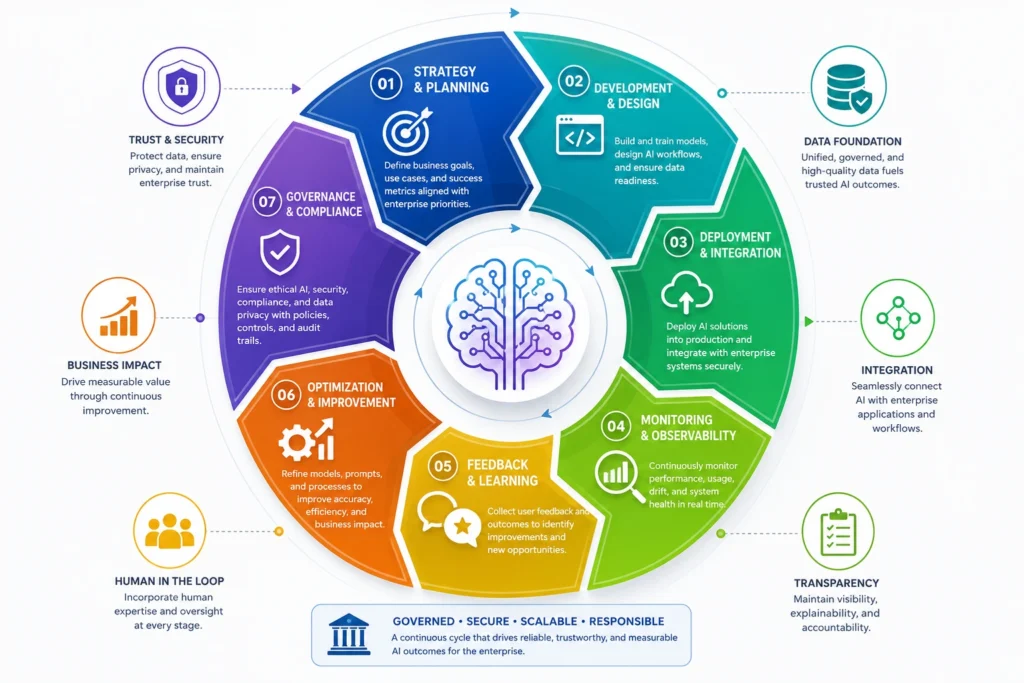
Implementing Microsoft Fabric for multi-agent AI should follow a phased roadmap that aligns business priorities, data readiness, AI development, governance, and continuous optimization. A structured implementation minimizes risk while accelerating enterprise adoption.
Five-Phase Roadmap
| Phase | Duration | Key Activities | Deliverables |
| Assess | 2–4 Weeks | AI maturity assessment, data audit | AI strategy |
| Build Foundation | 4–8 Weeks | OneLake, Data Factory, Lakehouse | Unified data platform |
| Develop AI Agents | 6–12 Weeks | Azure AI Foundry, Copilot Studio | Multi-agent ecosystem |
| Deploy & Govern | 4 Weeks | Purview, Monitoring, Security | Production AI |
| Optimize | Continuous | KPI monitoring, retraining, governance reviews | Continuous improvement |
Enterprise Adoption Timeline
Microsoft Fabric Governance for Multi-Agent AI
AI governance ensures that multiple AI agents operate securely, transparently, and consistently while complying with enterprise policies and regulatory requirements. Microsoft Fabric embeds governance capabilities directly into the platform through Microsoft Purview, OneLake, and integrated security controls.
Governance extends beyond data protection. In multi-agent systems, organizations must govern:
- AI models
- Data access
- Prompt management
- Agent permissions
- Business decisions
- Audit trails
- Human approvals
Learn more about implementing unified data framework in Implementing Data Governance Frameworks That Work: A Strategic Playbook for Enterprise Leaders
Governance Framework
| Governance Area | Microsoft Capability |
| Data Governance | OneLake + Purview |
| Security | Microsoft Entra ID |
| Compliance | Microsoft Purview |
| Data Lineage | Purview |
| Monitoring | Fabric Monitoring |
| Identity | Entra ID |
| Access Control | RBAC |
| Audit Logs | Microsoft Fabric |
Security Considerations
Enterprise multi-agent AI architectures introduce new security considerations because multiple autonomous systems access sensitive enterprise data. Microsoft Fabric provides enterprise-grade security through Zero Trust principles, identity management, encryption, and centralized governance.
Security Best Practices
- Implement Role-Based Access Control (RBAC).
- Use Microsoft Entra ID for authentication.
- Encrypt data at rest and in transit.
- Monitor agent activities continuously.
- Apply Zero Trust architecture.
- Restrict agent permissions using least-privilege principles.
For organizations implementing enterprise AI, the Microsoft Fabric documentation explains how OneLake serves as a unified data foundation, enabling secure data sharing across analytics workloads while reducing data duplication and improving governance.
Read our blog on Microsoft Fabric Security for Enterprise AI: Best Practices, Architecture & Governance
Security Matrix
| Security Area | Traditional AI | Microsoft Fabric |
| Identity | Basic | Entra ID |
| Encryption | Partial | Enterprise |
| Data Lineage | Limited | Comprehensive |
| Governance | Manual | Automated |
| Audit | Limited | Built-in |
| Compliance | External | Integrated |
Measuring Success: Enterprise AI KPIs
Organizations should evaluate multi-agent AI using both technical and business metrics. Microsoft Fabric enables continuous monitoring of AI performance through integrated analytics, dashboards, and observability tools, ensuring AI systems deliver measurable business value.
Operational KPIs
| KPI | Target |
| AI Agent Response Time | <2 seconds |
| Data Freshness | Near Real-Time |
| Agent Availability | 99.9% |
| Workflow Success Rate | >95% |
| AI Accuracy | >90% |
Business KPIs
| KPI | Business Value |
| Productivity Improvement | Faster operations |
| Cost Savings | Reduced operational expenses |
| Customer Satisfaction | Better experiences |
| Decision Speed | Improved agility |
| Revenue Growth | Higher business value |
Responsible AI KPIs
| KPI | Objective |
| Hallucination Rate | Minimize |
| Bias Incidents | Reduce |
| Human Review Rate | Optimize |
| Compliance Violations | Zero |
| Explainability Score | Increase |
Microsoft Fabric AI Maturity Model
The Microsoft Fabric AI Maturity Model helps organizations assess their readiness for enterprise AI adoption and define a roadmap toward intelligent, collaborative multi-agent ecosystems.
| Level | Characteristics | Microsoft Fabric Capability |
| Level 1 | Disconnected Data | Data Factory |
| Level 2 | Unified Analytics | Lakehouse |
| Level 3 | Predictive AI | Data Science |
| Level 4 | Intelligent AI Agents | Azure AI Foundry |
| Level 5 | Autonomous Multi-Agent AI | Microsoft Fabric + OneLake |
Microsoft Fabric vs Alternative Enterprise AI Platforms
While several enterprise platforms support AI development, Microsoft Fabric differentiates itself through its unified architecture that combines data engineering, analytics, governance, and AI within a single SaaS platform.
| Feature | Microsoft Fabric | Databricks | Snowflake Cortex |
| Unified SaaS Platform | ✓ | Partial | Partial |
| Native BI | Power BI | External | External |
| OneLake | ✓ | ✗ | ✗ |
| AI Governance | Excellent | Good | Good |
| Multi-Agent Readiness | Excellent | Excellent | Moderate |
| Real-Time Intelligence | Native | Limited | Moderate |
| Microsoft Ecosystem Integration | Excellent | Moderate | Moderate |
Common Challenges and Mitigation Strategies
Although Microsoft Fabric simplifies enterprise AI adoption, organizations must address challenges such as fragmented data, governance complexity, orchestration, and AI reliability. A structured implementation approach significantly reduces these risks.
| Challenge | Business Impact | Mitigation |
| Data Silos | Poor AI accuracy | OneLake |
| Hallucinations | Low trust | RAG + Human Review |
| Governance | Compliance risk | Purview |
| Cost Management | Budget overruns | FinOps |
| Agent Coordination | Workflow failures | Semantic Kernel |
| Security | Data exposure | Entra ID + Zero Trust |
Future Trends
The future of enterprise AI lies in autonomous, collaborative agent ecosystems that continuously learn, reason, and optimize business operations. Microsoft Fabric is well positioned to support this evolution through unified data, governance, and AI capabilities.
Emerging trends include:
- Agent-to-Agent Communication Protocols
- AI-native Business Process Automation
- Multi-modal AI Agents
- Knowledge Graph Integration
- Autonomous Data Products
- Self-Optimizing AI Systems
- AI Observability Platforms
- Federated Enterprise Intelligence
- Digital Workforce Ecosystems
Key Takeaways
- Microsoft Fabric provides a unified enterprise platform for building scalable multi-agent AI architectures.
- OneLake establishes a governed, enterprise-wide knowledge foundation for AI collaboration.
- Integrated analytics, machine learning, governance, and observability simplify enterprise AI deployment.
- Microsoft Purview and Entra ID strengthen governance, security, and compliance.
- Continuous monitoring and optimization are essential for maintaining AI performance and business value.
- Organizations that combine Microsoft Fabric with Azure AI Foundry, Copilot Studio, and RAG architectures are well positioned to scale intelligent enterprise automation.
Conclusion
Microsoft Fabric is rapidly becoming the foundation for enterprise multi-agent AI by bringing together data engineering, analytics, governance, AI services, and business intelligence within a single SaaS platform. As organizations move toward collaborative AI ecosystems, success will depend on more than deploying sophisticated models—it will require trusted data, unified governance, seamless orchestration, and continuous optimization.
By leveraging OneLake as a centralized knowledge foundation, integrating Azure AI Foundry for agent development, and embedding Microsoft Purview for governance, enterprises can build secure, scalable, and explainable AI ecosystems that deliver measurable business outcomes. Rather than treating AI as isolated applications, Microsoft Fabric enables organizations to create intelligent, connected systems that evolve with business needs and drive long-term competitive advantage.
For organizations embarking on this journey, partnering with experienced specialists can accelerate success. Techment combines deep expertise in Microsoft Fabric, Enterprise AI, Data Engineering, Retrieval-Augmented Generation (RAG), AI Agents, and AI Modernization to help enterprises design, implement, and optimize production-ready multi-agent AI solutions that maximize business value.
Frequently Asked Questions (FAQs)
1.What is Microsoft Fabric for Multi-Agent AI Architectures?
Microsoft Fabric for Multi-Agent AI Architectures is a unified enterprise platform that enables multiple AI agents to securely collaborate using shared, governed data. By integrating OneLake, Data Factory, Data Science, Real-Time Intelligence, Power BI, and Microsoft Purview, Fabric provides the data foundation, governance, and analytics required to build scalable, intelligent, and compliant AI ecosystems.
2. How does Microsoft Fabric support multi-agent AI systems?
Microsoft Fabric supports multi-agent AI by providing a centralized data layer through OneLake, enabling all AI agents to access the same trusted enterprise data. Combined with Azure AI Foundry, Copilot Studio, Semantic Models, and Real-Time Intelligence, Fabric allows agents to share context, coordinate tasks, automate workflows, and generate consistent, explainable business insights while maintaining enterprise-grade governance.
3. Why is OneLake important for enterprise AI agents?
OneLake acts as the single source of truth for enterprise data, eliminating data silos and ensuring every AI agent works with consistent, up-to-date information. This improves collaboration between agents, enhances Retrieval-Augmented Generation (RAG), reduces duplicate data pipelines, and strengthens governance, security, and compliance across AI workloads.
4. What are the business benefits of using Microsoft Fabric for multi-agent AI?
Organizations using Microsoft Fabric for multi-agent AI can accelerate AI adoption while reducing architectural complexity. Key benefits include unified data management, real-time analytics, enterprise-grade governance, improved collaboration between AI agents, lower infrastructure costs, faster decision-making, enhanced security, and greater scalability for AI-driven business processes.
5. How can enterprises implement Microsoft Fabric for multi-agent AI successfully?
A successful implementation begins with assessing AI maturity and establishing a governed data foundation using OneLake. Organizations should then build semantic models, integrate AI agents with Azure AI Foundry or Copilot Studio, implement Microsoft Purview for governance, enable continuous monitoring through Fabric Observability and Power BI, and optimize agent performance using feedback loops, KPIs, and ongoing model improvements. This phased approach ensures scalable, secure, and business-aligned enterprise AI deployments.
Related Reads
- What Is Microsoft Fabric? A Comprehensive Overview for Enterprise Leaders
- Microsoft Fabric vs Snowflake: A Data Management Showdown
- AI-Ready Enterprise Checklist with Microsoft Fabric
- Microsoft Fabric FabCon 2026 Insights: Key Announcements Driving Real Business Impact in AI & Data
- Microsoft Fabric Architecture: A CTO’s Guide to Modern Analytics & AI
- Data Quality for AI in 2026: Enterprise Guide
- Best Practices for Generative AI Implementation in Business