
AI agent governance establishes the identity, access, monitoring, and accountability controls needed to secure autonomous AI agents. Non-human identity governance helps organizations identify each agent, assign an accountable owner, restrict permissions, trace actions, manage credentials, and revoke access when an agent is no longer authorized.
AI governance for agentic systems establishes the identity, access, monitoring, and accountability controls needed to secure autonomous AI agents. Non-human identity governance helps organizations identify each agent, assign an accountable owner, restrict permissions, trace actions, manage credentials, and revoke access when an agent is no longer authorized.
AI agents are moving beyond generating answers to executing business tasks, accessing enterprise applications, calling APIs, updating records, and coordinating with other agents. Yet many organizations still govern these systems using controls designed for human users and traditional service accounts. AI governance for agentic systems is the framework of policies, identity controls, permissions, oversight, monitoring, and accountability that keeps autonomous AI actions secure, traceable, and compliant. A critical gap is non-human identity (NHI) governance: knowing which agent is acting, who is accountable for it, what it can access, and whether its actions can be audited.
For enterprises deploying AI agents across cloud platforms, SaaS applications, data systems, and business workflows, this is not just an AI ethics issue. It is an identity security, access governance, operational risk, and compliance challenge. Organizations that address it early can scale agentic AI with clearer accountability and stronger controls.
Executive Summary
Agentic AI introduces a governance challenge that traditional identity and access management programs may not fully address. An agent can operate for extended periods, invoke tools dynamically, delegate work to other agents, and use credentials or permissions to perform actions across enterprise systems. If these activities are not tied to distinct identities, accountable owners, and auditable authorization decisions, organizations may struggle to establish who initiated an action and whether it was permitted.
Non-human identities include service accounts, application identities, workload identities, API credentials, automation accounts, and increasingly, identities associated with AI agents. The challenge is not simply to create an identity for every agent. It is to govern the entire lifecycle of that identity and the permissions, tools, data, and delegated actions associated with it.
A mature governance model combines identity and access management (IAM), privileged access management (PAM), secrets management, zero-trust controls, agent inventory, activity monitoring, human oversight, and AI risk management. It also maps these controls to applicable regulatory and contractual requirements.
The practical objective is straightforward: every agent should have a defined purpose, accountable sponsor, minimum necessary access, controlled ability to act, and a verifiable record of its activity.
As highlighted in Techment’s Enterprise AI Strategy in 2026, scaling AI requires aligning data, governance, and infrastructure before automation expands.
TL;DR
- The blind spot: AI agents can access systems and execute actions without the same ownership, lifecycle management, and audit discipline applied to human identities.
- Non-human identity governance: Establishes how service accounts, workload identities, API credentials, and agent identities are created, authorized, monitored, and retired.
- The primary risks: Excessive privileges, shared credentials, orphaned agents, delegated access abuse, poor audit trails, and unauthorized agent-to-agent actions.
- The core controls: Unique or appropriately isolated identities, least privilege, time-bound access, secrets protection, activity logging, human accountability, and continuous monitoring.
- The compliance challenge: Organizations must demonstrate not only that an AI system has policies, but also that its real-world access and actions are controlled and evidenced.
- The implementation approach: Inventory agents, classify risk, assign owners, govern access, monitor actions, test controls, and establish lifecycle management.
- The business outcome: A more scalable and auditable foundation for enterprise AI adoption.
What Is AI Governance for Agentic Systems?
AI governance for agentic systems is the set of organizational, technical, and operational controls that define how AI agents are approved, deployed, given access, monitored, evaluated, and retired. It extends conventional AI governance to systems that can take actions through tools, APIs, enterprise applications, and other agents.
Traditional generative AI applications often return content for a person to review. Agentic systems may go further: they can interpret a goal, select tools, plan a sequence of operations, and execute some steps with limited human intervention.
That shift changes the governance requirements. An agent that only summarizes a public document presents a different risk from one that can change payroll records, approve payments, access confidential customer information, or modify cloud infrastructure.
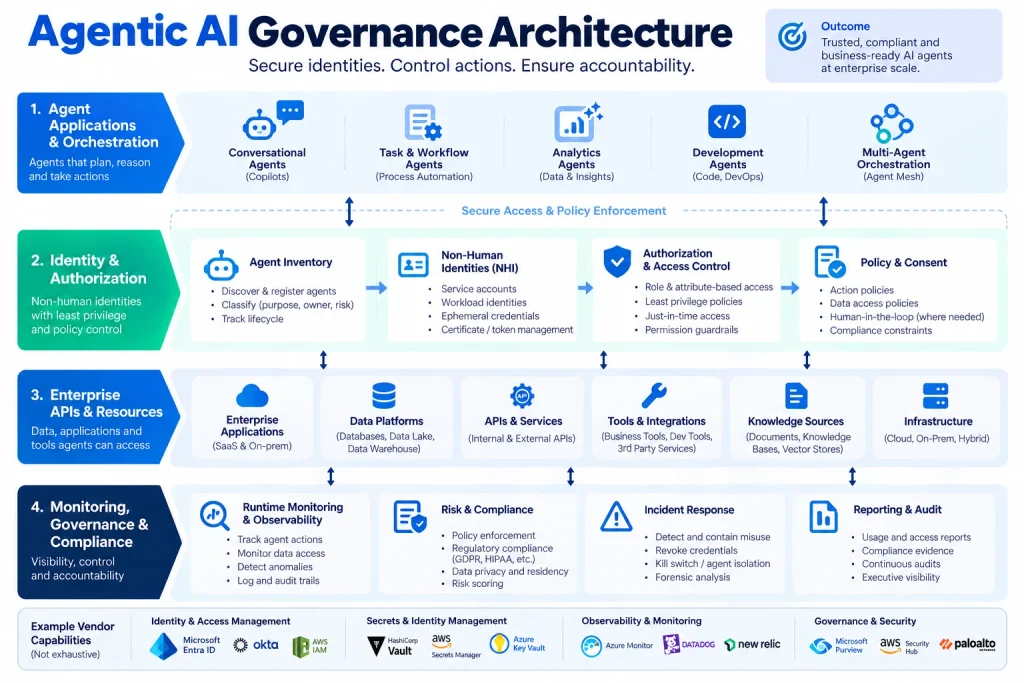
Effective agentic AI governance must therefore address several connected questions:
- What is the agent intended to do?
- Who owns it and approves its deployment?
- Which identity does it use when accessing a resource?
- What data, tools, and actions are permitted?
- Can it delegate work or transfer authority to another agent?
- How are actions logged, reviewed, and investigated?
- What happens when the agent is compromised, becomes unnecessary, or changes ownership?
- Which legal, regulatory, contractual, and internal policies apply?
AI governance provides the overall accountability framework. Identity governance supplies a critical enforcement mechanism by connecting the agent’s activity to controlled access and lifecycle decisions.
What Is the Non-Human Identity Blind Spot?
The non-human identity blind spot occurs when organizations lack a complete, reliable view of the automated identities and credentials used by AI agents, along with their owners, privileges, dependencies, and activity. This makes it harder to determine whether an agent’s access is justified, whether its actions were authorized, and how to revoke access when risk changes.
Enterprises already manage non-human identities through service principals, service accounts, API keys, OAuth credentials, workload identities, and other machine authentication mechanisms. Agentic AI adds a more dynamic layer: an agent may choose tools at runtime, invoke several services in sequence, or coordinate work across multiple identities and applications.
The blind spot emerges when AI development moves faster than identity governance.
Why traditional identity controls may be insufficient
Traditional service accounts often have a defined application purpose and relatively stable access pattern. An AI agent can have a broader and less predictable execution pattern because its model selects actions based on context and tool availability.
For example, a finance agent may have read access to invoices, permission to create payment requests, and access to a workflow tool. If these capabilities are not separated by policy, the agent could potentially initiate a workflow beyond its intended role, especially if it receives manipulated instructions or misinterprets a request.
The issue is not that AI agents are inherently ungovernable. It is that their permissions and runtime behavior must be governed together.
The identity questions enterprises must answer
| Governance question | What the organization needs to know |
|---|---|
| Identity | Which agent or workload made the request? |
| Ownership | Which person or team is accountable for the agent? |
| Authorization | Which resources and operations can it access? |
| Delegation | Is it acting as itself, on behalf of a user, or through another agent? |
| Provenance | Which request, workflow, and tool call led to the action? |
| Lifecycle | Is the agent still approved, needed, and properly sponsored? |
| Compliance | Can the organization demonstrate that required controls operated? |
| Incident response | Can the agent’s access be restricted or revoked quickly? |
If these questions cannot be answered consistently, the organization has an identity governance gap—even if it has a mature IAM platform.
Why Agentic AI Changes Identity and Access Management
Agentic AI changes identity governance because the system can make decisions about which tools to invoke and which steps to take, while the resulting operations still depend on conventional authentication and authorization mechanisms. Enterprises must govern not just the model, but also the identities, permissions, tools, and delegation paths through which the model can affect business systems.
1. Agents can act beyond a single interaction
An agent may execute a long-running task, resume a workflow later, or operate on a schedule. Its permissions may remain active after the original request or business need has ended.
Governance must cover the complete lifecycle, not just initial approval.
2. One agent can connect to many systems
A single agent might access CRM data, query a warehouse, create a ticket, and update an ERP record. Each integration introduces its own identity, permission, logging, and policy considerations.
A governance system must account for these dependencies and ensure that the combined set of capabilities does not exceed the agent’s intended authority.
3. Delegation complicates accountability
An agent may call another agent, which invokes a tool using a different identity. If logs capture only the final service account, investigators may not be able to reconstruct the original request or the full chain of decisions.
The architecture should preserve the relationship between the initiating actor, agent identities, delegated operations, and final resource actions.
4. Credentials can become a path to privilege escalation
An agent with access to secrets, token-generation tools, or broad application permissions may create a route to resources beyond its intended scope.
Short-lived credentials, workload identity federation, restricted token scopes, and secret isolation can reduce this exposure. They must be combined with authorization checks on the resources being accessed.
5. Agent populations can grow faster than manual governance
Development teams can create agents for different departments, prototypes, and workflows. Some may become redundant or abandoned while retaining credentials and permissions.
Automated discovery, inventory, ownership assignment, access reviews, and decommissioning are essential for controlling agent sprawl.
Related Reading: AI Orchestration Platforms: The Enterprise Guide to Coordinating AI at Scale in 2026
Non-Human Identity Governance vs. Traditional IAM
Traditional IAM remains a foundation for agentic AI security, but it must be extended to cover the identity lifecycle and execution patterns of AI agents. NHI governance focuses on the non-human identities and credentials that enable automated access, while agentic AI governance additionally addresses model-driven decisions, tool selection, delegated actions, and the evidence needed to reconstruct behavior.
| Capability | Traditional IAM | NHI and agentic governance |
|---|---|---|
| Identity inventory | Users, groups, applications | Users, workloads, service accounts, agents, and agent dependencies |
| Authentication | Human and application authentication | Workload authentication, agent identity, and delegated authentication |
| Authorization | Role- and policy-based access | Least privilege across tools, data, APIs, and multi-step workflows |
| Lifecycle | Joiner, mover, leaver and application lifecycle | Agent creation, sponsor assignment, access review, suspension, and retirement |
| Monitoring | Sign-ins and resource access | Sign-ins plus agent actions, tool calls, delegation, and workflow outcomes |
| Privilege control | Roles, permissions, privileged access | Scoped agent capabilities, restricted delegation, approval gates, and action limits |
| Accountability | User, application, or service owner | Agent owner or sponsor, initiating principal, identity, and action provenance |
| Incident response | Disable user or credential | Contain the agent, revoke its access, inspect downstream actions, and preserve evidence |
These capabilities overlap. Organizations should extend existing identity and security investments rather than automatically replacing them with a separate AI governance stack.
The Core Risks of Ungoverned AI Agent Identities
Ungoverned agent identities can turn an AI failure into a security or compliance incident. The main risks include excessive privileges, compromised credentials, unclear accountability, unauthorized delegation, inadequate audit evidence, and agents that continue operating after their business purpose has ended.
1. Excessive permissions and privilege accumulation
An agent may receive broad access because it is easier to grant a single role than to model every task-specific requirement. Over time, new tools and responsibilities can expand its permissions without a corresponding review.
Control: Apply least privilege, separate read and write permissions, scope access by resource and action, and review privileges as the agent’s purpose changes.
2. Shared credentials and unclear attribution
When several agents use the same service account or API key, security teams may be unable to attribute an action to a particular agent or execution.
Control: Use distinct identities or appropriately isolated identity contexts, and preserve correlation identifiers for the initiating request and downstream operations.
3. Credential exposure and token misuse
API keys, refresh tokens, and client secrets may be exposed through logs, prompts, source code, tool outputs, or insecure configuration.
Control: Use managed identity or workload federation where supported, keep secrets in approved secret stores, rotate credentials, and restrict token lifetime and scope.
4. Prompt injection and tool misuse
An agent may encounter malicious instructions in a document, email, web page, or tool response. If the agent has broad privileges and the application trusts its decisions without independent checks, manipulated content can lead to unauthorized actions.
Control: Treat retrieved content as untrusted input, constrain tool permissions, validate high-impact actions in deterministic application logic, and require approval for sensitive operations.
5. Uncontrolled agent-to-agent delegation
A parent agent may delegate tasks to a specialist agent with broader access than the parent needs. Without explicit delegation policies, the combined system may exceed the original authorization boundary.
Control: Define permitted delegation relationships, constrain each child agent’s authority, and log both the delegation decision and the downstream action.
6. Orphaned agents and stale permissions
An agent may remain active after its owner leaves, its project ends, or its underlying business process changes.
Control: Assign accountable sponsors, review ownership changes, enforce expiration and periodic access reviews, and disable identities when the agent is retired.
7. Compliance gaps and incomplete audit trails
If the organization cannot connect an agent’s action to an approved purpose, identity, permission, and decision record, it may be unable to produce sufficient evidence for internal audits or applicable regulatory obligations.
Control: Maintain tamper-resistant logs where appropriate, record authorization decisions, preserve relevant workflow context, and define evidence-retention requirements before deployment.
Read more about RAG vs Fine-Tuning vs AI Agents: Choosing the Right LLM Strategy .
A Reference Architecture for AI Agent Identity Governance
A practical governance architecture connects the agent runtime to a dedicated identity and authorization layer, controlled tools and resources, centralized monitoring, and a governance process that assigns ownership and manages lifecycle decisions. The objective is to make every meaningful action identifiable, authorized, traceable, and reversible where technically possible.
Layer 1: Agent registry and ownership
Maintain an inventory of deployed agents and their key attributes:
- Unique agent identifier.
- Business purpose and approved use cases.
- Owner, sponsor, and technical contact.
- Environment, platform, and deployment location.
- Data classifications and connected systems.
- Risk classification and approval status.
- Lifecycle state and review date.
This registry should cover production agents and, according to risk policy, development agents, prototypes, and third-party agents.
Layer 2: Identity and credential management
Assign an appropriate identity to each agent or isolated agent instance, based on the platform and risk model. Manage credentials through supported mechanisms such as managed identities, workload identity federation, OAuth flows, or controlled service principals.
Avoid embedding long-lived secrets in prompts, source code, or agent memory. Ensure that identity creation, credential issuance, and revocation follow approved processes.
Layer 3: Policy and authorization enforcement
Enforce authorization at the resource or tool boundary, not solely through natural-language instructions to the model.
Controls should cover:
- Permitted tools and APIs.
- Read, write, delete, and administrative actions.
- Resource and data scope.
- Delegated user access.
- Time-bound privileges.
- Approval requirements for high-impact operations.
- Restrictions on agent-to-agent communication.
The model may recommend an action, but a trusted policy enforcement layer should decide whether the action is permitted.
Layer 4: Runtime monitoring and audit
Capture relevant identity and action events, including:
- Agent identity and initiating principal.
- Authentication and authorization results.
- Tool or API invoked.
- Resource accessed or modified.
- Timestamp and request correlation ID.
- Approval and policy decisions.
- Success, failure, and error status.
- Relevant agent and workflow version information.
Log design should minimize sensitive content while preserving enough evidence for investigation and compliance. Not every internal reasoning detail needs to be captured; the goal is to reconstruct meaningful system actions and their authorization context.
Layer 5: Governance, compliance, and response
Connect technical controls to risk management, policies, access reviews, incident response, and audit processes.
Security teams should be able to suspend an agent, revoke access, block a class of risky agents, investigate affected resources, and preserve evidence when an incident occurs.
This architecture can be implemented with existing enterprise security components, supplemented by agent-specific identity and management capabilities where needed.
Read more about How to Build AI-Ready Data Foundations: A Strategic Enterprise Guide..
The Agent Identity Lifecycle: From Creation to Decommissioning
Agent identity governance must cover the full lifecycle of an agent, from initial registration and approval to access changes, ongoing review, suspension, and retirement. Identity creation alone does not establish governance; the organization must continuously validate that the agent remains necessary, properly owned, and appropriately authorized.
| Lifecycle stage | Required governance activity | Evidence to retain |
|---|---|---|
| Discover | Identify the agent, platform, integrations, and business purpose | Registry record and discovery source |
| Approve | Assess business need, risk, and permitted actions | Risk assessment and approval record |
| Provision | Assign identity, owner, credentials, and baseline policy | Identity and configuration record |
| Authorize | Grant only necessary resources and operations | Access assignments and approvals |
| Operate | Monitor actions, authentication, and policy enforcement | Logs, alerts, and execution records |
| Review | Reassess privileges, ownership, and continued need | Access review and remediation record |
| Respond | Restrict or suspend an agent during an incident | Incident timeline and containment evidence |
| Retire | Revoke access, remove credentials, and archive required evidence | Decommissioning confirmation |
Why ownership and sponsorship matter
Every agent should have a named accountable owner or sponsor who can approve its intended purpose, review its access, and decide whether it should continue operating.
Ownership must be more than a metadata field. If an owner leaves the organization or changes roles, the governance process should transfer sponsorship or trigger a review. An agent without an accountable sponsor should not be allowed to retain high-impact privileges indefinitely.
Microsoft Entra documents agent identity governance capabilities that include sponsors, access packages, lifecycle management, and time-bound access. Organizations using other platforms should implement equivalent controls through their identity and security systems. See Microsoft Entra: Governing Agent Identities.
Compliance for Agentic AI: What Organizations Need to Prove
Compliance for agentic systems requires evidence that relevant obligations have been translated into operational controls. Depending on the use case, organizations may need to demonstrate accountability, appropriate access, risk assessment, human oversight, monitoring, incident handling, and controlled lifecycle management. The applicable requirements depend on jurisdiction, industry, data, and the system’s intended use.
AI governance is not the same as identity compliance
Identity controls can demonstrate who or what accessed a system and whether the access was authorized. AI governance also addresses whether the agent is appropriate for the task, how its risks are assessed, whether its behavior is evaluated, and what human oversight is required.
A mature program connects these areas rather than assuming that passing an identity audit automatically proves an AI system is compliant.
Regulatory and framework considerations
NIST AI Risk Management Framework (AI RMF)
The NIST AI RMF provides a voluntary framework organized around four functions: Govern, Map, Measure, and Manage. Enterprises can use it to structure AI risk accountability, identify agent-specific risks, evaluate control effectiveness, and manage incidents and changes across the lifecycle.
Official resource: NIST AI RMF.
EU AI Act
The EU AI Act establishes obligations based on factors such as the system’s classification, role in the AI value chain, and intended use. Some requirements concern transparency, risk management, documentation, human oversight, and other safeguards. Not every agent is automatically a high-risk AI system, and identity governance alone does not establish compliance.
Organizations should map the specific use case to applicable provisions and current implementation timelines. See the European Commission’s AI Act Service Desk.
ISO/IEC 42001
ISO/IEC 42001 provides requirements for establishing, implementing, maintaining, and continually improving an AI management system. It can help organizations formalize responsibilities, risk management, operational controls, and continual improvement. Certification or alignment with a management system should not be presented as proof that every agent action is secure.
Official resource: ISO — ISO/IEC 42001.
Security and application risk frameworks
OWASP’s Agentic AI Security Initiative addresses security challenges associated with autonomous agents and multi-step AI workflows. Its work can inform technical threat modeling, action controls, transparency, and agent-specific security testing.
These frameworks serve different purposes. The compliance mapping should identify the applicable requirement, the technical or organizational control, the accountable owner, the evidence source, and the review frequency.
A practical compliance evidence matrix
| Control objective | Example evidence |
|---|---|
| Agent accountability | Inventory, purpose, named owner, and sponsor |
| Access authorization | Role assignments, resource scopes, and approval records |
| Least privilege | Permission reviews and documented exceptions |
| Lifecycle management | Provisioning, review, expiration, and decommissioning records |
| Human oversight | Approval workflows, escalation paths, and intervention records |
| Traceability | Correlated identity, tool, API, and resource activity logs |
| Risk management | Risk assessments, tests, mitigations, and review records |
| Incident response | Containment procedures, incident reports, and remediation evidence |
| Data governance | Classification, access restrictions, retention, and deletion records |
This matrix is a practical starting point, not a substitute for a formal legal or regulatory assessment.
Best Practices for Governing Non-Human Identities in Agentic Systems
The most effective NHI governance programs combine established identity security principles with agent-specific controls. The priority is to ensure that an agent has only the access it needs, remains accountable to a human or team, and cannot bypass security policy simply because an LLM selected an action.
1. Give agents a distinct, governable identity
Avoid relying on a shared human account or an undocumented service account for agent operations. Use identity constructs appropriate to the platform, and maintain enough isolation to attribute actions to the correct agent and execution.
Where a platform supports dedicated agent identities, evaluate how those identities integrate with existing identity governance and resource authorization.
2. Enforce least privilege at the tool boundary
Restrict which tools the agent can call and which operations each tool can perform. Separate read access from write access and administrative privileges.
A prompt saying “do not delete customer records” is not a security boundary. The application and underlying resource permissions must enforce that restriction.
3. Prefer short-lived credentials and managed identity
Use managed identities or workload identity federation where supported. Keep unavoidable secrets in approved vaults, rotate them according to policy, and restrict their scope and lifetime.
Avoid exposing credentials to the model context unless there is a specific, secure reason and the architecture has been reviewed.
4. Treat delegated authority as a first-class control
When an agent acts on behalf of a user, preserve the identity and permissions of the initiating principal where appropriate. When an agent acts autonomously, authorize its own identity explicitly.
Do not assume that a parent agent’s permission automatically justifies every action taken by a child agent or tool.
5. Require human approval for high-impact actions
Use approval gates for actions such as releasing large payments, changing privileged access, deleting critical records, or making other consequential changes.
Approval should be bound to a clear action and its parameters. A vague approval to “handle the issue” should not authorize unlimited downstream operations.
6. Maintain end-to-end auditability
Correlate the original request, agent identity, delegated calls, policy decisions, tool executions, and resource changes. Make sure the audit trail is useful to security operations, internal audit, and incident response.
Use privacy-aware logging that preserves meaningful evidence without indiscriminately collecting sensitive prompts or business data.
7. Automate access reviews and decommissioning
Agent populations are difficult to govern through manual reviews alone. Automate ownership checks, access expiration, review reminders, inactivity detection, and decommissioning workflows where possible.
When an agent is retired, revoke its credentials and access, remove scheduled jobs and integrations, and preserve required evidence under the organization’s retention policy.
8. Test for adversarial and unexpected behavior
Include prompt injection, unauthorized tool selection, privilege escalation attempts, malicious retrieved content, and unexpected delegation in security tests.
Validate not just the agent’s text response, but whether the enforcement layers prevented prohibited operations.
How to Implement an Agentic AI Governance Program
A practical implementation should begin with visibility and risk prioritization, then establish identity ownership, authorization, monitoring, and evidence collection. Organizations do not need to redesign every security system at once; they should first control the agents that can reach sensitive data or execute consequential actions, then expand coverage using a repeatable operating model.
Phase 1: Discover and inventory agents
Identify agents across sanctioned platforms, developer environments, SaaS products, cloud workloads, and business automation tools.
Record each agent’s purpose, owner, identity, credentials, connected resources, deployment environment, risk tier, and lifecycle status.
Deliverable: A consolidated agent and NHI inventory with identified gaps.
Phase 2: Classify agent risk
Classify agents based on the sensitivity of data accessed, the impact of actions, autonomy level, privilege scope, external exposure, and ability to delegate.
A read-only internal knowledge assistant should not automatically receive the same controls as an agent that can modify financial records or administer cloud infrastructure.
Deliverable: Risk tiers with mandatory control requirements for each tier.
Phase 3: Establish identity and ownership standards
Define how agents receive identities, how owners and sponsors are assigned, how credentials are managed, and how access requests are approved.
Set standards for distinct identity contexts, service-account use, workload federation, and cross-tenant scenarios.
Deliverable: An agent identity standard and lifecycle policy.
Phase 4: Implement least privilege and action controls
Map each agent’s purpose to its required tools and permissions. Remove unnecessary privileges, enforce resource-level authorization, and add approval gates for high-impact operations.
Review delegated and agent-to-agent interactions as part of the same authorization model.
Deliverable: Approved permissions and enforced action boundaries.
Phase 5: Centralize monitoring and evidence
Collect identity events, tool-call records, authorization decisions, and relevant resource activity. Correlate events across systems so investigators can reconstruct an action from initiation to outcome.
Connect agent alerts to existing security operations and incident response processes.
Deliverable: An auditable event trail and tested response playbooks.
Phase 6: Automate governance and continuous improvement
Automate periodic access reviews, ownership reassignment, credential rotation, risk-based restrictions, and decommissioning.
Use incidents, test results, audit findings, and changes in agent capabilities to update policies and controls.
Deliverable: A repeatable governance lifecycle with measurable control effectiveness.
Metrics for Measuring Agentic AI Governance Maturity
Agent governance should be measured by the coverage and effectiveness of controls, not simply by the number of agents registered. The right metrics show whether identities have accountable owners, whether permissions are appropriately scoped, whether activity can be reconstructed, and whether risks are remediated within defined timeframes.
| Metric | What it reveals |
|---|---|
| Agent inventory coverage | Percentage of discovered agents recorded in the governance inventory |
| Ownership coverage | Percentage of agents with an active owner or sponsor |
| Least-privilege compliance | Percentage of agents that meet defined permission standards |
| Access review completion | Percentage of required reviews completed on time |
| Credential hygiene | Percentage of identities using approved credential controls |
| Audit traceability | Percentage of sampled high-impact actions with complete correlated evidence |
| Orphaned identity count | Number of agents with missing ownership or expired business justification |
| Decommissioning time | Time required to revoke access after retirement or a risk decision |
| Policy violation rate | Frequency of blocked or detected attempts to exceed authorized boundaries |
| Incident response time | Time to identify, contain, and remediate agent-related incidents |
Define the measurement scope, target, and reporting cadence for each metric. A target of zero unauthorized high-impact actions is a useful control objective, but organizations must also test whether their monitoring can detect and report violations accurately.
Common Mistakes in AI Agent Governance
Governance programs often fail when they treat agent registration as sufficient, assume prompts can enforce security, or focus only on model risk while ignoring the identities that actually access enterprise resources. These mistakes can leave major gaps even in organizations with mature cybersecurity programs.
Mistake 1: Treating every agent as a normal service account
A generic service account may provide authentication but not enough context about the agent’s purpose, sponsor, lifecycle, or delegated activity.
Better approach: Add agent-specific inventory, ownership, authorization, and monitoring controls to existing NHI governance.
Mistake 2: Assuming a human approval at deployment is enough
Agent behavior, integrations, and privileges can change after launch.
Better approach: Reassess access when the agent’s purpose, tools, owner, model, or operating environment changes.
Mistake 3: Trusting the model to enforce permissions
A model instruction is not equivalent to an authorization policy.
Better approach: Enforce access restrictions in identity systems, APIs, tool wrappers, and resource-level policies.
Mistake 4: Logging only the final API call
A downstream service account may show what changed but not which agent initiated the action or why it was authorized.
Better approach: Correlate identities and workflow events across the full execution chain.
Mistake 5: Assuming compliance is a documentation exercise
A written policy does not demonstrate that access controls, reviews, and approvals are operating effectively.
Better approach: Test controls, retain operational evidence, remediate exceptions, and review effectiveness regularly.
Mistake 6: Ignoring third-party and shadow agents
Agents embedded in SaaS platforms, developer tools, and business applications may use identities that central AI teams do not directly manage.
Better approach: Extend discovery and vendor governance to third-party agents, integrations, and their access paths.
The Future of AI Governance for Agentic Systems
As agents become more capable of using tools, delegating tasks, and operating across organizational boundaries, governance will increasingly depend on identity-aware authorization, runtime controls, and verifiable action histories. The direction is toward treating agents as managed operational entities with explicit authority, rather than simply as software features embedded inside applications.
Several developments are likely to shape enterprise practice:
- Agent-aware identity platforms: Identity systems are adding capabilities to register agents, assign accountable sponsors, govern their access, and manage their lifecycle.
- Policy-driven runtime controls: Authorization decisions are likely to become more contextual, incorporating identity, resource sensitivity, action type, and risk signals.
- Delegation-aware audit trails: Enterprises will need better ways to trace actions across parent agents, child agents, tools, and downstream services.
- Automated agent discovery: Security teams will increasingly need visibility into agents deployed across sanctioned platforms and third-party environments.
- Continuous compliance evidence: Rather than relying only on periodic manual audits, organizations can automate evidence collection and control checks where appropriate.
- More explicit agent security standards: Industry initiatives are developing guidance for transparency, control, and security across agentic workflows.
These developments do not eliminate the need for security architecture and human accountability. Enterprises should validate each platform’s actual capabilities, integration requirements, and limitations before relying on it for compliance-critical workloads.
How Techment Can Help Govern Enterprise Agentic AI
Scaling agentic AI requires more than building capable agents. Organizations need an architecture that connects enterprise AI strategy with identity governance, secure integrations, data access controls, monitoring, and operational accountability.
Techment helps enterprises develop and modernize AI solutions through enterprise AI strategy, AI agent development, data engineering, cloud modernization, RAG architecture, and enterprise software engineering. These capabilities can support a governance approach that connects the agent’s business purpose to its technical permissions, operational behavior, and compliance evidence.
For organizations preparing to deploy agents across sensitive enterprise workflows, a focused agentic AI governance assessment can identify identity blind spots, prioritize high-risk access paths, and establish a phased roadmap for secure implementation.
The objective is not to slow down AI adoption. It is to ensure that every agent has only the authority it needs, a clear human accountable for its operation, and an auditable path from request to action.
Frequently Asked Questions
1. What is AI governance for agentic systems?
AI governance for agentic systems is the framework of policies, technical controls, monitoring, and accountability used to manage AI agents that can take actions through tools and enterprise systems. It covers identity, access, risk management, human oversight, auditability, and lifecycle controls.
2. What is a non-human identity in AI?
A non-human identity is a digital identity used by software, workloads, services, or automated systems rather than a person. In AI environments, this can include service accounts, application identities, workload identities, API credentials, and identities specifically assigned to AI agents.
3. Why do AI agents need their own identities?
Appropriately isolated agent identities help organizations attribute activity, scope permissions, manage access, and revoke authorization without relying on shared human credentials. The right identity pattern depends on whether the agent acts autonomously, operates on behalf of a user, or uses delegated services.
4. What is the NHI governance blind spot?
The NHI governance blind spot is the lack of reliable visibility into the identities, permissions, owners, credentials, and activities of automated systems. For AI agents, it becomes more complex when agents dynamically invoke tools, delegate work, or access multiple enterprise applications.
5. How is agentic AI governance different from traditional AI governance?
Traditional AI governance often emphasizes model risk, data quality, fairness, transparency, and human oversight. Agentic AI governance must also address execution authority: which identity an agent uses, what it can do, how it delegates actions, and how those actions are controlled and audited.
6. How can organizations secure AI agent identities?
Organizations should maintain an agent inventory, assign accountable owners, use distinct or appropriately isolated identities, enforce least privilege, protect credentials, apply time-bound access, monitor activity, and automate access reviews and decommissioning.
7. What is the role of zero trust in agentic AI security?
Zero trust applies explicit verification and least-privilege principles to each access request rather than assuming that an agent is trustworthy because it operates inside a corporate environment. Agent access should be evaluated against identity, resource, action, policy, and relevant risk signals.
8. How should enterprises govern agent-to-agent communication?
They should define which agents can communicate, what each agent may request, and which permissions are available to downstream agents. The system should preserve identity and delegation context, enforce authorization at the resource boundary, and record meaningful events across the execution chain.
Related Reads
- Agentic AI Orchestration: 7 Strategic Pillars for Scalable AI in 2026
- Enterprise AI Strategy in 2026
- How to Build AI-Ready Data Foundations: A Strategic Enterprise Guide.
- 7 Real-World Agentic AI Use Cases Transforming Enterprise Operations in 2026
- Agentic Workflow Solutions: The Future of Enterprise Automation in 2026
- Best Practices for Generative AI Implementation in Business
- How AI Agents Are Driving 10x Productivity for Modern Businesses
- Fabric AI Readiness: How to Prepare Your Data for Scalable AI Adoption.