
Enterprise AI strategy in 2026 is no longer about experimentation or isolated pilots. For CIOs and data leaders, it has become a board-level priority focused on scalable execution, governance, and measurable business value. As generative AI, automation, and predictive intelligence mature, enterprises must move from fragmented initiatives to a cohesive enterprise AI strategy framework that aligns technology, data, operating models, and business outcomes.
By 2026, most large enterprises will already have AI systems in production. The differentiator will not be access to models, but how effectively AI is governed, scaled, and embedded into enterprise workflows. Organizations without a clearly defined enterprise AI roadmap risk stalled pilots, regulatory exposure, duplicated investments, and weak return on AI spend.
This guide explains how to build an enterprise AI strategy in 2026, covering the framework, roadmap, operating model, and governance practices CIOs need to scale AI responsibly across the enterprise
TL;DR (Executive Summary)
- Enterprises entering 2026 face a decisive moment in AI adoption as generative AI, automation, and predictive intelligence reach maturity.
- A winning enterprise AI strategy in 2026 requires clear business alignment, a strong data foundation, ethical governance, scalable architecture, and a roadmap from pilot to production.
- This guide provides a research-backed, step-by-step framework to design, operationalize, and scale AI across the enterprise.
- Leaders will find actionable insights, KPIs, governance models, and real-world examples to accelerate value capture from AI initiatives.
What Is an Enterprise AI Strategy?
An enterprise AI strategy is a structured, organization-wide blueprint that defines how artificial intelligence will create business value, improve decision-making, and enable long-term competitive advantage. It goes far beyond experimentation or deploying isolated AI tools. Instead, it unifies business goals, architecture, governance, operating models, and measurable outcomes into a cohesive, scalable plan.
A strong enterprise ai strategy framework ensures that every AI initiative is tied directly to business priorities: improving operational efficiency, enhancing customer experiences, reducing costs, accelerating innovation, or enabling new digital business models. Research highlights that enterprises with clearly articulated AI strategies outperform peers in revenue growth, productivity, and innovation velocity.
Without an enterprise ai strategy framework, enterprises fall into predictable pitfalls:
1. Fragmented AI Adoption
Business units deploy disparate tools, leading to duplication, incompatibility, and wasted effort.
2. Poor ROI and Value Leakage
McKinsey research indicates that only about 20–21% of organizations achieve enterprise-level impact from AI initiatives, with most pilots failing to scale due to weak data foundations, inadequate governance, and poor integration into business processes.
3. Compliance, Ethical, and Legal Risks
As AI regulation intensifies, lack of governance can expose enterprises to severe penalties, reputational damage, or biased decision systems.
4. Data Silos and Infrastructure Gaps
AI thrives on reliable data. A strategy prevents silos and ensures unified pipelines, quality controls, and scalable architecture.
5. Talent and Operational Challenges
Enterprises lacking clear operating models struggle to coordinate cross-functional AI teams, slowing execution.
A well-designed enterprise AI strategy in 2026 changes this trajectory. It clarifies what matters, aligns executives and business leaders, and ensures AI initiatives are prioritized based on feasibility, value, and risk. It also strengthens enterprise readiness by building the necessary capabilities, governance frameworks, and infrastructure to scale AI consistently and responsibly.
Read more on how Microsoft Fabric AI solutions fundamentally transform how enterprises unify data, automate intelligence, and deploy AI at scale in our blog.
Why Enterprise AI Strategy Must Evolve in 2026
2026 is shaping up to be a decisive year for enterprise AI. Over the past three years, generative AI has moved from experimental pilots to production-grade systems. Gartner predicts that by 2026, more than 80% of enterprises will have GenAI APIs and models in production, transforming knowledge work, automation, decision-making, and customer experiences. At the same time, regulatory frameworks — including the EU AI Act and sector-specific compliance mandates — are pushing enterprises to adopt more rigorous, ethical, and transparent AI practices.
Against this backdrop, enterprises can no longer afford loosely connected AI experiments or isolated proofs of concept. What they need is a coherent, long-term enterprise AI strategy in 2026 — one that unites business priorities, data readiness, governance, operating models, and execution frameworks into a single, scalable roadmap. This strategy must clearly answer: Where should AI create value? What foundations are required? How do we scale responsibly?
We help you shape AI direction and deliver organizational impact. It integrates proven industry practices, forward-looking insights, cross-industry use cases, and Techment’s transformation expertise.
If your enterprise is preparing to build, refine, or scale its AI strategy for 2026, this comprehensive guide will show you how to move from vision to execution — with data integrity, governance, and measurable value at the core.
Strengthen your foundation with our offerings as AI strategy and road-mapping.
The 7 Pillars of a Scalable Enterprise AI Framework
Building a high-impact enterprise AI strategy in 2026 requires addressing a set of universal pillars that ensure end-to-end readiness, responsible scaling, and long-term value. These pillars form the backbone of strategy execution and help enterprises progress from vision to measurable business outcomes.
1. Business Alignment & Vision
Every successful AI strategy begins with a clear, measurable vision tied to business priorities. Gartner and Deloitte emphasize that enterprises with defined ambitions — such as reducing operational costs by 30%, improving customer satisfaction scores, or automating compliance workflows — see faster time-to-value. Leaders must articulate:
- What AI should achieve
- Which business areas will benefit most
- What metrics define success (revenue, efficiency, risk, customer value)
2. Data Strategy & Infrastructure
Data is the engine that fuels AI adoption. Enterprises need reliable, governed, accessible data across systems:
- A unified data architecture that breaks silos
- Secure pipelines and integration layers
- Robust data governance and lineage
- Compliance with privacy and regulatory frameworks
- Cloud or hybrid data platforms optimized for scale
Deloitte + VAST (2025) research Strong data foundations and AI Factory architecture deliver ~30–40% faster AI performance, while KPMG Pulse Q3 2025 reports show that enterprises with robust data strategies saw ~4× increase in GenAI agent adoption within two quarters.
3. Use-Case Identification and Prioritization
High-performing companies prioritize AI use cases based on:
- Business value
- Data readiness
- Complexity and risk
- Time-to-impact
Start with high-value, low-risk use cases before expanding to advanced AI capabilities.
4. Governance, Ethics & Compliance
Responsible AI is no longer optional. Enterprises need:
- Ethical frameworks
- Audit trails
- Bias detection mechanisms
- Explainability tools
- Cross-functional governance councils
IBM and Microsoft highlight that ethical AI programs reduce regulatory exposure and build stakeholder trust.
5. Operating Model & Organizational Readiness
Enterprises must establish cross-functional teams — data scientists, MLOps, engineers, compliance, business leaders — supported by change management, training programs, and modern DevOps/MLOps workflows.
6. Execution & Scalability
Scaling AI requires:
- Integration with enterprise systems
- Standardized processes
- Robust monitoring and continuous learning
- A roadmap from PoC → MVP → scaled production
7. Measurement, KPIs & ROI Tracking
Define clear KPIs early: cost-to-serve reduction, throughput improvements, product quality enhancements, revenue uplift, or cycle-time reduction.
See how insights become decisions in Enterprise Data Quality Framework: Best Practices for Reliable Analytics and AI
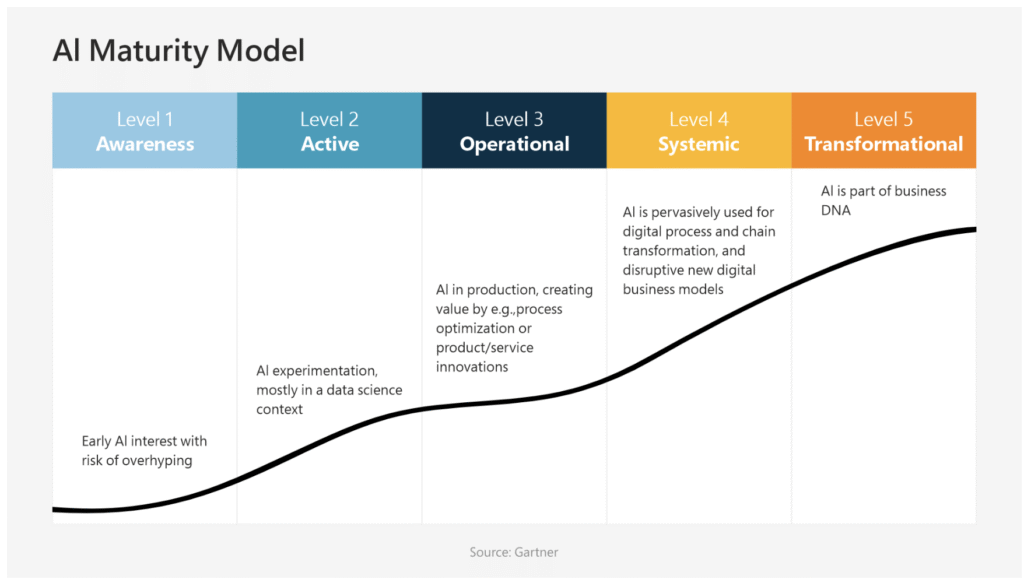
Enterprise AI Maturity Model (2026 Edition)
Stage 1 – Isolated AI Experiments
- Department pilots
- No governance
- Limited ROI
Stage 2 – Operational AI
- Cross-functional use cases
- Early MLOps
- Basic governance
Stage 3 – Scaled Enterprise AI
- Shared data platform
- Central governance council
- Measured ROI
Stage 4 – AI-Native Enterprise
- Embedded AI workflows
- Automated decision intelligence
- Continuous optimization
How to Build an Enterprise AI Roadmap (Step-by-Step)
Implementing AI at scale in a global enterprise requires moving beyond pilots to a standardized, governed operating model that aligns technology, data, and business execution. Channel partners are already seeing strong demand for AI business application data preparation, signaling that enterprises are prioritizing clean, governed, and scalable data foundations as a prerequisite for AI at scale. At the same time, regulatory frameworks, data risk, and ethical expectations are tightening, making ad-hoc AI adoption unsustainable for global organizations. Successful organizations follow a consistent, enterprise-wide approach rather than scaling isolated solutions.
To implement AI at scale, global enterprises should focus on five core actions:
- Align AI initiatives to global business priorities
Define enterprise-level objectives and success metrics so regional teams build toward shared outcomes. - Standardize data foundations across regions
Establish unified data architecture, governance, and quality standards to support consistent model performance. - Adopt a scalable AI operating model
Use federated teams with centralized governance to balance global control and local innovation. - Operationalize AI through MLOps and automation
Deploy standardized pipelines for model development, deployment, monitoring, and continuous improvement. - Embed governance, security, and compliance by design
Ensure models meet regulatory, ethical, and risk requirements across jurisdictions.
When executed correctly, this approach enables enterprises to scale AI responsibly driving measurable business impact while maintaining control, trust, and compliance across geographies.
Lay the groundwork for AI readiness, identify ROI-positive use cases, and build a prioritized execution roadmap designed for value, feasibility, and governance with our AI services.
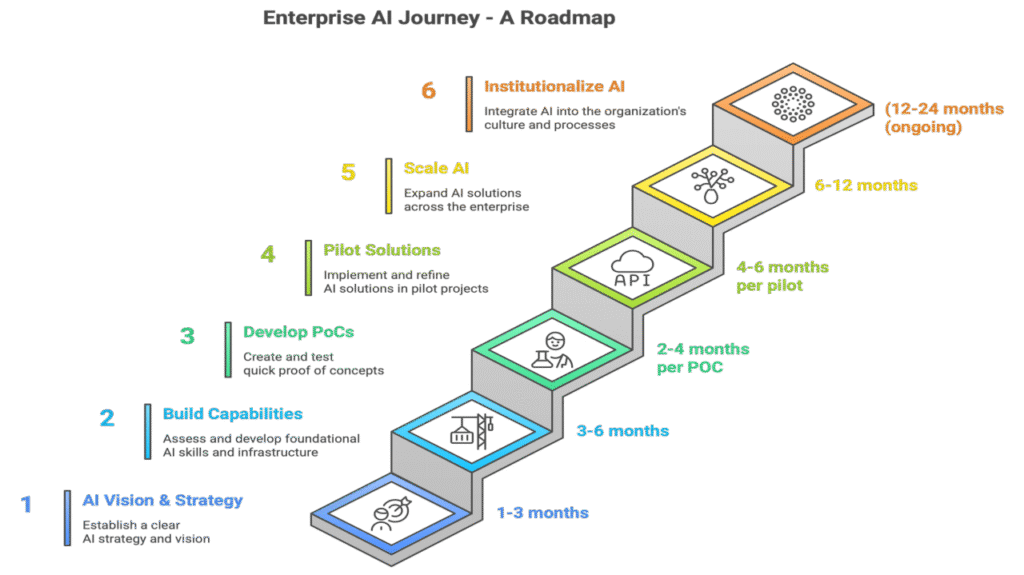
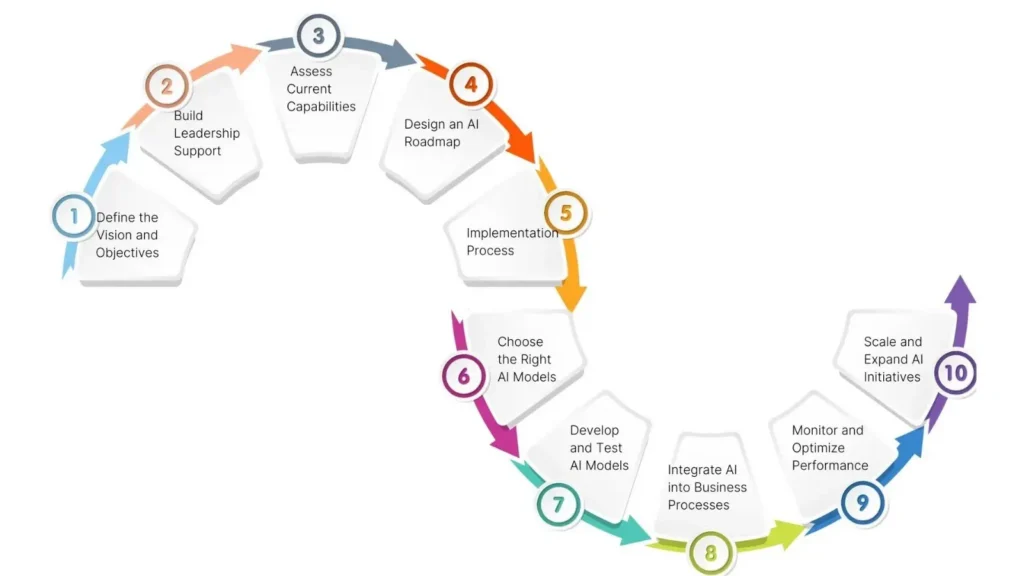
Step-by-Step Enterprise AI Transformation Roadmap: From Pilot to Production
Enterprises that achieve meaningful AI outcomes follow a structured, staged roadmap. This roadmap is not linear; it is iterative, progressively strengthening capabilities while expanding impact.
Step 1: Assess Current AI and Data Maturity
Gartner’s Maturity Model for AI Adoption show that successful AI programs begin with a factual assessment of enterprise readiness:
- Data accessibility, quality, lineage, and governance
- Infrastructure and integration maturity
- Workforce skills and AI literacy
- Existing analytics and automation capabilities
- Risk posture, compliance readiness, and governance gaps
Step 2: Define the AI Vision and Enterprise-Level Objectives
Leadership alignment is a prerequisite. CIOs, CTOs, and business heads must define:
- Strategic intent (efficiency, growth, resilience, experience)
- Targeted business outcomes
- Investment priorities and constraints
- Risk boundaries and governance expectations
This is where AI stops being exploratory and becomes an enterprise capability as mentioned in Deloitte — State of AI in the Enterprise.
Step 3: Identify, Evaluate, and Prioritize Use Cases
Enterprises should build a use-case portfolio, prioritizing opportunities by:
- Value potential
- Technical feasibility
- Data availability
- Operational risk
- Time-to-impact
McKinsey’s research shows that organizations using value-versus-feasibility scoring achieve 30–50% faster time-to-value.
Step 4: Build the Data Foundation and Governance Model
AI success depends on:
- High-quality, complete, and timely data
- Scalable data integration pipelines
- Standardized metadata and documentation
- Data privacy, security, and compliance with emerging regulations
Forrester — Build a Modern Data Strategy show that this foundation ensures that models are trustworthy, scalable, and ready for operational deployment.
Step 5: Pilot, Experiment, and Validate Value
AI pilots must be:
- Rapid
- Business-led
- Data-driven
- Measured against KPIs
Enterprises should focus on usability, integration, risk evaluation, and user adoption during this stage.
Step 6: Formalize Responsible AI Governance
Elements include:
- Model risk management
- Ethical and fairness guidelines
- Bias assessment and reduction practices
- Audit trails and explainability standards
- Cross-functional oversight committees
Step 7: Operationalize and Scale
Scaling requires:
- MLOps workflows
- Cross-functional squads
- API-based model delivery
- Standardized deployment pipelines
- Monitoring for drift, accuracy, and performance
This is where enterprises convert pilots into enterprise-wide capabilities.
Step 8: Measure, Optimize, and Iterate
Enterprises must track:
- Financial value (revenue uplift, cost savings)
- Operational metrics (cycle-time reduction, accuracy gains)
- Customer outcomes (satisfaction, responsiveness)
- Risk and compliance performance
This closes the loop and ensures AI evolves with business needs.
Read our blog that explores how AI copilots for enterprises are transforming executive leadership in 2026.
Enterprise AI Architecture Blueprint (2026 Edition)
An enterprise AI strategy fails without a scalable architecture. In 2026, architecture is no longer just infrastructure — it is the operating backbone that determines whether AI scales or stalls.
A modern enterprise AI architecture blueprint consists of six integrated layers:
1. Unified Data Foundation
AI performance depends on governed, high-quality, accessible data.
- Hybrid or multi-cloud data platform
- Real-time + batch ingestion pipelines
- Metadata management and lineage tracking
- Enterprise-wide data quality controls
- Secure access with role-based permissions
Without unified data, AI initiatives fragment across business units.
2. Feature & Model Development Layer
This layer enables repeatable, reusable AI development.
- Feature stores for consistency
- Model training environments
- Version control for datasets and models
- Collaboration between data science and engineering teams
Standardization here reduces duplication and accelerates time-to-value.
3. MLOps & LLMOps Orchestration
Moving from pilot to production requires disciplined operationalization.
- CI/CD pipelines for model deployment
- Automated testing and validation
- Model registry and versioning
- Drift detection and retraining triggers
- Performance monitoring dashboards
Enterprises that institutionalize MLOps reduce model failure rates and increase trust.
4. Integration & API Layer
AI must embed directly into workflows.
- API-first architecture
- Event-driven integration
- Workflow orchestration
- Compatibility with ERP, CRM, supply chain, and finance systems
AI should power decisions inside systems — not sit in dashboards.
5. Governance & Control Layer
Governance is embedded in architecture, not added later.
- Audit trails and model documentation
- Explainability tooling
- Bias monitoring systems
- Access logging and compliance tracking
This layer ensures AI systems remain trustworthy and defensible.
6. Application & Decision Layer
The final layer operationalizes intelligence.
- AI copilots
- Automated decision engines
- Predictive alerts
- Optimization systems
This is where AI drives measurable business value.
Architecture Principle for 2026
Leading enterprises adopt modular, composable architectures that allow flexibility across vendors, models, and regulatory requirements.
Scalable AI requires architectural discipline — not just advanced models.
Common Enterprise AI Challenges (and How to Fix Them)
Even mature enterprises face structural, operational, and cultural challenges when scaling AI. Addressing these early improves velocity and reduces risk.
Challenge 1: Data Silos and Poor Data Quality
Gartner (July 2024 survey) shows that 63% of organizations don’t have—or are unsure if they have—AI-ready data management practices. It also highlights that poor data quality remains one of the most frequently mentioned challenges blocking advanced analytics (AI) deployment through 2025.
Mitigation:
- Invest in data engineering and high-quality pipelines
- Implement unified governance, quality checks, and metadata standards
- Create enterprise data catalogues for discoverability
Challenge 2: Talent Gaps and Skills Shortages
AI adoption requires data scientists, ML engineers, platform engineers, and domain experts.
Mitigation:
- Upskill internal teams
- Build a hybrid talent model (staff augmentation + partnerships)
- Standardize operating models to reduce dependency on rare skills
Challenge 3: Fragmented Initiatives Without Business Alignment
McKinsey’s 2024–25 surveys highlight that nearly 90–99% of organizations are using AI, yet only 1% consider themselves mature, and ~39% report EBIT impact, with barriers including leadership inertia, data readiness, and execution gaps
Mitigation:
- Centralize governance
- Maintain a unified use-case portfolio
- Involve business owners from inception to deployment
Challenge 4: Scaling from Pilot to Production
Most enterprises succeed at pilots but struggle at scale.
Mitigation:
- Adopt modern MLOps
- Implement architectural standards
- Integrate AI into existing systems through API-first design
Challenge 5: Regulatory, Ethical, and Privacy Risks
With emerging regulations (EU AI Act, U.S. state-level AI laws), operational risk is increasing.
Mitigation:
- Design AI governance early
- Maintain model lineage, documentation, and audits
- Integrate bias detection tools
Explore more in Top 6 Cultural Benefits of Using AI in Enterprise
Enterprise AI Trends Shaping Strategy in 2026
As enterprises approach 2026, AI strategies must account for emerging shifts in technology, business models, and governance.
Trend 1: Hybrid AI Models (Predictive + Generative)
Gartner predicts that by 2026, over 60% of enterprise applications will embed GenAI to augment workflows.
Hybrid AI blends:
- Predictive analytics
- Optimization engines
- LLM-based reasoning
- Content and code generation
This yields more adaptive, end-to-end automation capabilities.
Trend 2: Composable, Modular AI Architectures
Enterprises are moving away from monolithic platforms toward composable AI stacks that support rapid integration, experimentation, and vendor flexibility.
Academic research emphasizes modular architectures as the foundation for scalable, resilient AI ecosystems.
Trend 3: Model Risk Management (MRM) Becomes Mandatory
Regulated industries must adopt auditable AI processes.
Key elements:
- Explainability
- Bias monitoring
- Versioning
- Human-in-the-loop controls
Trend 4: AI-Native Workflows for Business Functions
Workflows across finance, HR, supply chain, and operations are becoming AI-native, with embedded decision intelligence.
Trend 5: Rapid Expansion of Industry-Specific AI Models
Vertical LLMs tailored to healthcare, BFSI, manufacturing, and retail are becoming mainstream, offering higher accuracy and compliance alignment.
See how Techment drives reliability in Enterprise Data Governance Framework: A Practical Guide That Actually Works
Industry Use Cases with Measurable Outcomes
Below are high-impact, enterprise-ready use cases aligned with 2026 adoption patterns
Customer Service & Operations
- GenAI-powered virtual assistants
- Automated knowledge base generation
- Real-time interaction summarization
- Workforce augmentation for service desks
Finance & Compliance
- Intelligent document processing
- Automated risk scoring
- Anomaly detection in payments
- Regulatory reporting with GenAI summarization
Supply Chain & Manufacturing
- Predictive maintenance
- Demand forecasting
- Real-time inventory optimization
- Autonomous quality inspection systems
Product Development & Engineering
- Code generation and review
- Coordinated R&D simulations
- Automated design assistance
Marketing & Personalization
- Hyper-personalized campaigns
- AI-driven content generation
- Customer insights and micro-segmentation
Assess Your Fabric-Readiness with This simple step- Is Your Enterprise AI-Ready? A Fabric-Focused Readiness Checklist
Governance, Security, and Responsible AI Best Practices
Responsible AI is now an enterprise requirement, not an optional control. Enterprises must embed governance throughout the AI lifecycle.
Enterprise Governance Essentials
- Ethical guidelines and principles
- Standards for transparency and explainability
- Human oversight requirements
- Documentation, audits, version control
Security and Privacy Controls
- Data minimization
- Secure training pipelines
- Encryption for data-in-use
- Identity and access management
- Threat modeling for AI systems
Ongoing Monitoring & Drift Detection
Models degrade if not monitored. Enterprises need:
- Drift detection
- Bias tracking
- Automated retraining triggers
- Usage analytics
Explore Techment’s enterprise AI governance practices in Autonomous Anomaly Detection and Automation in Multi-Cloud Micro-Services environment
Measuring Success: KPIs, ROI & Continuous Improvement
Enterprises must measure AI using a balanced scorecard of business, operational, and risk metrics.
Business KPIs
- Revenue uplift
- Cost reduction
- Customer lifetime value
- Market expansion
Operational KPIs
- Cycle-time reduction
- Automation coverage
- Error-rate reduction
- Throughput gains
Risk & Compliance KPIs
- Fairness metrics
- Model explainability score
- Compliance adherence
- Incident reduction
Continuous Improvement Loop
AI maturity grows through:
- Iterative learning
- Periodic model reviews
- Governance oversight
- Expansion into new business domains
Find our how you can turn your data into your biggest asset with Leveraging Data Transformation for Modern Analytics.
Enterprise AI Readiness Checklist for 2026
Before scaling an enterprise AI strategy in 2026, it is best to take expert advisory services for developing an enterprise AI roadmap to assess readiness across five areas:
1. Data Readiness
- Is data accessible, governed, and high quality?
- Do we have unified data architecture?
2. People Readiness
- Do teams understand AI’s business impact?
- Do we have multidisciplinary roles in place?
3. Technical Readiness
- Are platforms scalable, modular, API-driven?
- Are MLOps and DevOps workflows established?
4. Governance Readiness
- Do we have ethical AI standards?
- Are compliance and risk processes defined?
5. Use-Case Readiness
- Are use cases aligned with business strategy?
- Are feasibility and risk assessments completed?
Read our blog on Data Quality for AI: The Ultimate 2026 Blueprint for Trustworthy & High-Performing Enterprise AI.
Why 2026 Is a Strategic Inflection Point for Enterprise AI
For 2026 firmwide AI strategy implementation, it is necessary that AI becomes embedded in enterprise workflows and platforms. Regulatory changes, advances in GenAI, and emerging competitive pressures will reshape industries. Organizations that delay building a cohesive AI strategy risk:
- Higher operational costs
- Increased regulatory exposure
- Slower transformation outcomes
- Being outpaced by AI-powered competitors
Now is the moment to shift from experimentation to enterprise capability building.
Our blog on Best Practices for Generative AI Implementation in Business will help you stay on the right path of enterprise AI strategy in 2026 adoption.
How Enterprises Build and Scale AI Capabilities
Techment partners with enterprises to build AI capabilities that are scalable, responsible, and measurably impactful.
Strategic Advisory & Readiness Assessment
We conduct maturity assessments spanning data, architecture, governance, and operational readiness.
Data & Platform Engineering
Our teams design modern data platforms, integrate pipelines, and build foundations for AI at scale.
AI/ML & GenAI Development
We specialize in:
- Predictive models
- Generative applications
- Decision intelligence systems
- AI workflow automation
Governance-First Approach
Compliance, ethics, and explainability are embedded from day one.
Operationalization & Scaling
Techment enables enterprises to progress from prototype to production, with end-to-end support across MLOps, integration, observability, and continuous improvement.
Co-Development & Managed Services
We augment internal teams and provide managed services to accelerate delivery and reduce transformation risk.
Read our expert insights before you follow the enterprise AI strategy in 2026 roadmap – How to Assess Data Quality Maturity: Your Enterprise Roadmap
Conclusion —From AI Vision to Enterprise Impact
A successful enterprise AI strategy in 2026 is not defined by tools or models, but by disciplined alignment, governance, and a strong data foundation. Enterprises that adopt a capability-based approach — prioritizing value, readiness, risk, and scalability — will outperform competitors and build lasting transformation momentum.
Now is the time to move from experimentation to enterprise-wide enablement. Leaders should start with a readiness assessment, prioritize high-value opportunities, strengthen foundations, and engage partners who bring both strategic and execution maturity.
Explore how Techment can support your AI modernization, and scalable deployment. Our teams are ready to co-design, build, and operationalize AI capabilities that deliver measurable impact.
FAQs About Enterprise AI Strategy in 2026
1. What is the ROI of an enterprise AI strategy in 2026?
ROI typically includes cost reduction, improved operational throughput, revenue uplift, faster decision cycles, and enhanced customer experiences.
2. What tools enable enterprise-scale AI?
Composable data platforms, MLOps pipelines, orchestration tools, vector databases, governance platforms, and cloud-native AI services.
3. How do enterprises integrate AI with existing systems?
API-first design, event-driven architecture, and standardized pipelines enable smooth integration.
4. What governance challenges arise?
Bias, explainability, compliance alignment, and auditability are the most common challenges.
5. How can enterprises measure AI success?
Using a combination of business, operational, and risk KPIs aligned with strategic objectives.
Related Reads
- Microsoft Fabric vs Snowflake: Data Management Showdown
- Microsoft Azure for Enterprises: Cloud AI Modernization
- AI-Ready Enterprise Checklist for Microsoft Fabric
- Enterprise Data Quality Framework: Best Practices for Reliable Analytics and AI
- Essential Design Patterns in Modern Data Pipelines
- How to Assess Data Quality Maturity: Your Enterprise Roadmap
- Data Migration
- Data Transformation
- Data Pipeline Engineering
- Data Cleansing & Cataloging
- Data Governance & Quality