
AI API design best practices focus on building secure, scalable, versioned, and developer-friendly APIs that enable AI models, applications, and intelligent agents to interact reliably with enterprise systems. Well-designed AI APIs improve interoperability, governance, performance, and maintainability while supporting modern AI use cases such as generative AI, Retrieval-Augmented Generation (RAG), AI agents, and enterprise automation.
Executive Summary
As organizations increasingly adopt generative AI, AI agents, and intelligent automation, APIs have become the critical interface between AI models and enterprise systems. Whether exposing an LLM as a service, integrating Retrieval-Augmented Generation (RAG), or orchestrating multi-agent workflows, APIs determine how effectively AI applications communicate, scale, and evolve.
Unlike traditional software APIs, AI APIs handle probabilistic outputs, contextual prompts, model versions, vector searches, streaming responses, and sensitive enterprise data. Poorly designed APIs can lead to inconsistent outputs, security vulnerabilities, high latency, increased operational costs, and difficult integrations.
This article outlines AI API design best practices based on guidance from Microsoft Azure Architecture Center, Google Cloud API Design Guide, OpenAI API recommendations, and enterprise API design principles. It provides practical strategies for designing AI APIs that are secure, scalable, developer-friendly, and optimized for enterprise adoption.
Why AI API Design Matters
AI APIs are the foundation of enterprise AI applications, enabling communication between AI models, business applications, and enterprise data. Following AI API design best practices improves scalability, interoperability, security, and developer experience while reducing integration complexity and operational risks.
Every enterprise AI solution—from customer support copilots to autonomous AI agents—relies on APIs to exchange information and perform actions. These APIs connect AI models with databases, enterprise applications, vector stores, knowledge repositories, and third-party services.
However, AI introduces new requirements that traditional APIs were not designed to address:
- Managing prompts and context
- Handling streaming responses
- Supporting model versioning
- Managing token consumption
- Enforcing responsible AI policies
- Integrating vector databases
- Supporting conversational memory
Without a thoughtful API strategy, organizations often encounter inconsistent integrations, rising infrastructure costs, and governance challenges.
By applying AI-specific API design principles, enterprises can create reusable services that accelerate AI adoption while maintaining reliability and compliance.
Traditional APIs vs AI APIs
| Capability | Traditional APIs | AI APIs |
|---|---|---|
| Deterministic Responses | ✓ | Partial |
| Natural Language Input | ✗ | ✓ |
| Context Awareness | Limited | Native |
| Streaming Responses | Limited | ✓ |
| Model Versioning | Rare | Essential |
| Prompt Management | ✗ | ✓ |
| Vector Search Integration | ✗ | ✓ |
| AI Governance | Limited | Critical |
Key Insight: AI APIs are not simply REST endpoints for AI models—they are intelligent interfaces that must manage context, reasoning, observability, and governance alongside traditional API concerns.
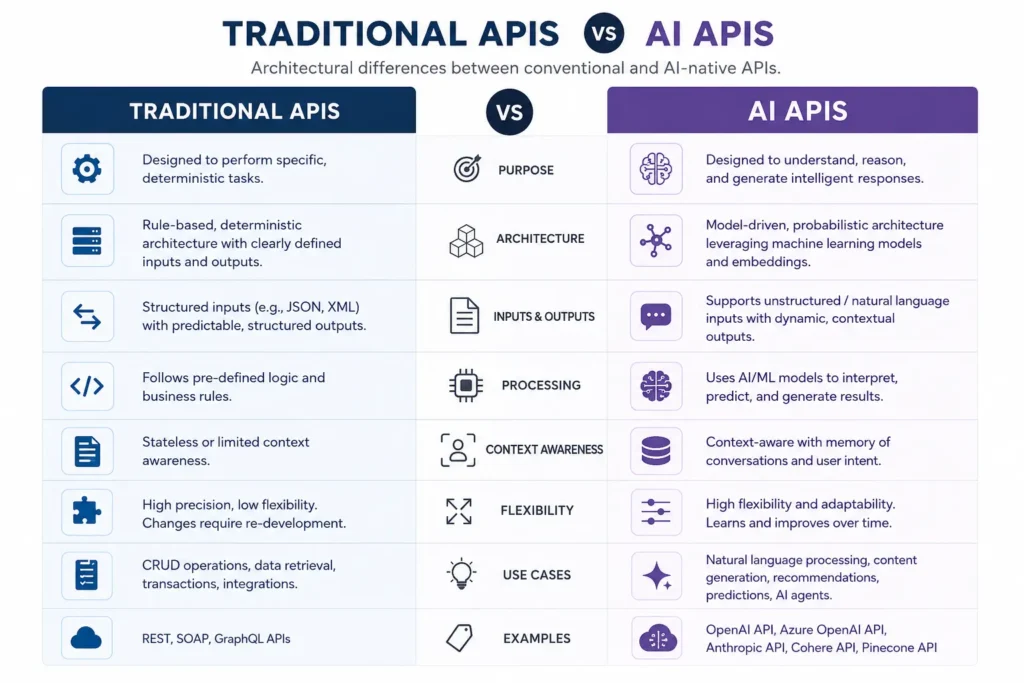
What Are AI APIs?
AI APIs are application programming interfaces that expose artificial intelligence capabilities such as language understanding, image generation, embeddings, speech recognition, or predictive analytics to applications and services. They act as the communication layer between AI models and enterprise software.
An AI API enables developers to integrate AI capabilities into applications without directly managing model infrastructure. Depending on the use case, an AI API may provide access to:
- Large Language Models (LLMs)
- Embedding models
- Vision models
- Speech services
- Recommendation engines
- Predictive models
- AI agents
- Vector search services
For enterprises, AI APIs also integrate with business systems, enabling AI-powered workflows such as document processing, intelligent search, customer support, and decision automation.
Read our blog on AI Context Engineering: The New Competitive Advantage for Enterprise AI
Common Types of AI APIs
| AI API Type | Purpose | Example Use Case |
|---|---|---|
| LLM APIs | Natural language generation | Enterprise copilots |
| Embedding APIs | Semantic search | RAG applications |
| Vision APIs | Image understanding | Quality inspection |
| Speech APIs | Voice interactions | Virtual assistants |
| Prediction APIs | Forecasting | Demand planning |
| AI Agent APIs | Workflow automation | Autonomous operations |
Core Principles of AI API Designs
Successful AI APIs balance usability, scalability, security, and governance. They should expose AI capabilities through consistent, versioned, and well-documented interfaces while accounting for the unique challenges of AI workloads, such as prompt management, probabilistic outputs, and model evolution.
Although AI APIs extend traditional API design principles, they require additional considerations to support dynamic AI behavior and enterprise requirements.
1. Design for Simplicity
Keep endpoints intuitive and task-oriented. Avoid exposing unnecessary model complexity to consumers.
Example:
✅ /summarize-document
Instead of
❌ /invoke-model
2. Treat Prompts as Inputs
Prompts are business inputs and should be validated, versioned, and documented similarly to API payloads.
3. Design for Context
AI responses depend on context. APIs should support conversation history, metadata, user preferences, and external knowledge sources without exposing implementation complexity.
4. Support Streaming
Large AI responses should be streamed where appropriate to improve responsiveness and user experience.
5. Ensure Consistency
Standardize:
- Naming conventions
- Error handling
- Authentication
- Response structures
- Metadata
- Versioning
Read our blog on RAG in 2026.
AI API Design Principles
| Principle | Why It Matters |
|---|---|
| Simplicity | Easier adoption |
| Stateless Design | Better scalability |
| Context Awareness | Higher AI accuracy |
| Versioning | Controlled evolution |
| Security | Protect enterprise data |
| Observability | Faster troubleshooting |
| Documentation | Better developer experience |
| Governance | Responsible AI adoption |
Essential Characteristics of Enterprise AI APIs
Enterprise AI APIs differ from public AI services because they must integrate with internal systems, enforce governance policies, and support mission-critical workloads. Designing for security, reliability, scalability, and compliance is essential for long-term success.
Enterprise AI APIs should demonstrate the following characteristics:
Scalability
Support increasing workloads without degrading performance.
Reliability
Handle failures gracefully and provide predictable behavior under load.
Security
Protect sensitive prompts, enterprise data, and AI-generated outputs.
Observability
Capture metrics, traces, latency, token usage, and model performance.
Governance
Enforce responsible AI policies, access controls, and auditability.
Enterprise AI API Checklist
| Capability | Enterprise Requirement |
|---|---|
| Authentication | OAuth 2.0 / API Keys |
| Authorization | RBAC |
| Encryption | TLS |
| Monitoring | OpenTelemetry |
| Rate Limiting | Required |
| Versioning | Required |
| Documentation | OpenAPI |
| Logging | Centralized |
| AI Guardrails | Recommended |
AI API Architecture Patterns
Choosing the right architecture pattern is critical for building scalable AI APIs. Depending on business requirements, organizations may adopt direct model APIs, API gateways, orchestration layers, or agent-based architectures to optimize performance, governance, and maintainability.
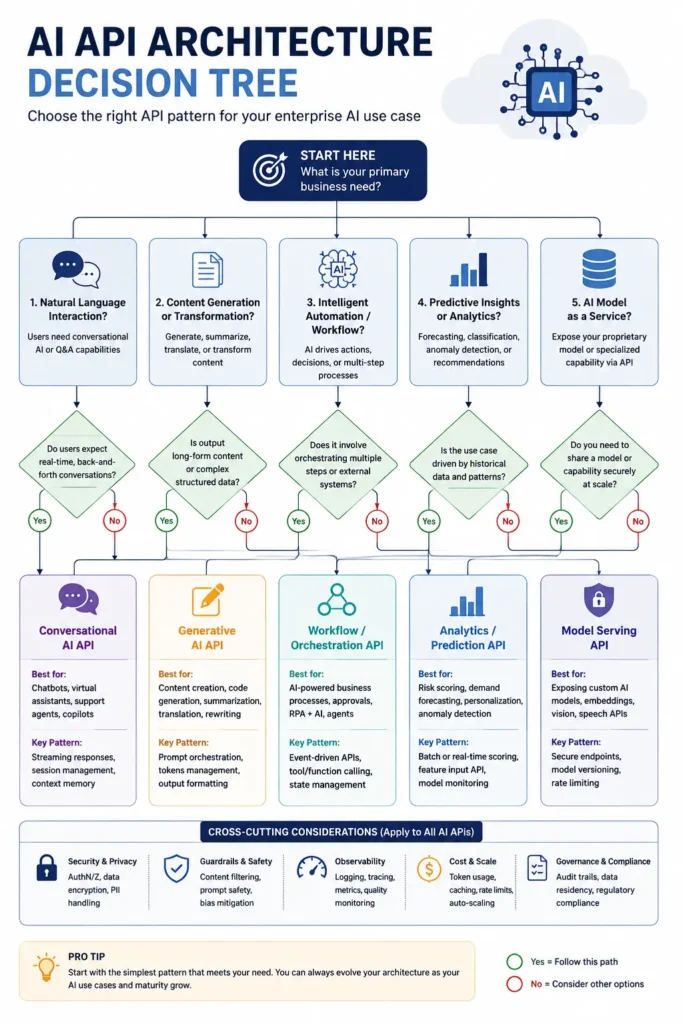
Common AI API Architectures
| Pattern | Best For | Complexity |
|---|---|---|
| Direct Model API | Prototypes | Low |
| API Gateway | Enterprise applications | Medium |
| AI Orchestration Layer | RAG & LLM workflows | High |
| Multi-Agent API Layer | Autonomous AI systems | Very High |
Decision Framework
| Business Need | Recommended Architecture |
|---|---|
| AI Chatbot | Direct AI API |
| Enterprise Copilot | API Gateway |
| RAG Solution | Orchestration Layer |
| AI Agents | Multi-Agent API Layer |
| Multi-LLM Platform | AI Gateway + Orchestrator |
AI API Design Maturity Model
The AI API maturity model helps organizations assess their readiness for enterprise AI integration and identify the capabilities required to evolve from simple AI endpoints to intelligent, governed API ecosystems.
| Level | Characteristics |
|---|---|
| Level 1 | Basic AI endpoint |
| Level 2 | Authenticated AI API |
| Level 3 | Context-aware AI API |
| Level 4 | Enterprise AI API Platform |
| Level 5 | AI Agent API Ecosystem |
Key Takeaways
- AI APIs are the backbone of enterprise AI, connecting models, applications, and business systems.
- Traditional API design principles must be extended to support prompts, context, streaming, model versioning, and AI governance.
- Well-designed AI APIs improve developer experience, interoperability, security, and scalability.
- Enterprises should adopt standardized API patterns, strong observability, and governance from the outset to support long-term AI adoption.
- Designing AI APIs as reusable enterprise services accelerates innovation while reducing maintenance complexity.
AI API Architecture Best Practices
A well-designed AI API architecture separates AI models, orchestration, business logic, and enterprise integrations into modular layers. This improves scalability, simplifies maintenance, enhances security, and allows organizations to evolve AI models independently from applications consuming the APIs.
Unlike conventional APIs that typically expose deterministic business functions, AI APIs manage dynamic prompts, contextual information, vector searches, streaming responses, and probabilistic outputs. A modular architecture ensures these concerns remain isolated, reducing technical debt while enabling flexibility.
A recommended enterprise AI API architecture consists of:
- Client Applications
- API Gateway
- AI Orchestration Layer
- Prompt & Context Management
- AI Models
- Vector Database
- Enterprise Systems
- Observability & Governance
This layered design allows organizations to swap LLM providers, scale workloads independently, and introduce governance controls without disrupting downstream applications.
Enterprise AI API Reference Architecture
| Layer | Responsibility | Technologies |
|---|---|---|
| Experience Layer | Web, Mobile, Copilots | React, Angular, Teams |
| API Gateway | Authentication, Routing | Azure API Management, Kong |
| AI Orchestration | Prompt orchestration | LangGraph, Semantic Kernel |
| AI Layer | LLMs & Models | Azure OpenAI, OpenAI, Anthropic |
| Knowledge Layer | RAG & Embeddings | Azure AI Search, Pinecone |
| Enterprise Layer | CRM, ERP, Databases | SAP, Salesforce, Dynamics 365 |
| Monitoring Layer | Logs & Metrics | Azure Monitor, OpenTelemetry |
Authentication and Authorization
Authentication and authorization are foundational to AI API security. Enterprise AI APIs should verify user identities, enforce least-privilege access, and protect sensitive enterprise data using modern identity standards such as OAuth 2.0, OpenID Connect, and Role-Based Access Control (RBAC).
AI APIs often expose sensitive capabilities, including document summarization, financial analysis, customer information, and enterprise workflows. Unlike public APIs, they frequently process proprietary business data and personally identifiable information (PII).
Implementing robust authentication and authorization ensures that only authorized users and systems can invoke AI capabilities.
Best Practices
- Use OAuth 2.0 or OpenID Connect.
- Implement RBAC for endpoint access.
- Separate user identity from service identity.
- Secure API keys using a secrets manager.
- Enable token expiration and rotation.
- Apply least-privilege principles.
Microsoft’s Azure Architecture Center provides comprehensive API design best practices, covering principles such as consistency, versioning, security, scalability, and maintainability that are essential for building reliable enterprise APIs, including AI-powered services.
Read our blog on Continuous Improvement Framework for Enterprise AI
Authentication Comparison
| Method | Security | Enterprise Recommendation |
| API Keys | Medium | Suitable for internal testing |
| OAuth 2.0 | High | Recommended |
| OpenID Connect | High | Recommended |
| JWT | High | Recommended |
| Mutual TLS | Very High | High-security environments |
Request and Response Design
AI APIs should expose predictable request and response structures that include prompts, contextual metadata, model information, and confidence indicators. Consistent payloads simplify integrations and improve developer experience.
Unlike traditional APIs, AI APIs often require more than a simple request body. They may include prompts, conversation history, user context, retrieval parameters, model settings, and safety constraints.
Similarly, responses should include metadata beyond the generated output.
Recommended Response Elements
- Generated content
- Model version
- Token usage
- Response latency
- Confidence score (if applicable)
- Citations or sources
- Safety indicators
- Error information
Standard AI API Response Structure
| Component | Purpose |
| Response | Generated content |
| Metadata | Model information |
| Sources | RAG citations |
| Usage | Token consumption |
| Trace ID | Debugging |
| Safety | Content moderation |
API Versioning Strategies
AI models evolve rapidly, making API versioning essential for maintaining compatibility while introducing new capabilities. Enterprises should version APIs independently from AI models to minimize disruption and support controlled upgrades.
Unlike conventional software, AI systems evolve continuously through new prompts, model updates, and fine-tuning.
Best practices include:
- Semantic versioning
- Backward compatibility
- Version-specific documentation
- Deprecation policies
- Separate model version from API version
API Versioning Approaches
| Strategy | Example | Recommendation |
| URI Versioning | /v1/chat | Excellent |
| Header Versioning | API-Version | Good |
| Query Parameters | ?version=v2 | Moderate |
| Model Versioning | GPT-4.1 | Separate from API |
Prompt Contracts and Context Management
Prompt contracts standardize how prompts, system instructions, user inputs, and contextual information are passed to AI models. Establishing consistent prompt contracts improves reliability, reduces hallucinations, and simplifies prompt lifecycle management.
Treat prompts as first-class API assets.
Instead of embedding prompts within application code:
- Externalize prompt templates.
- Version prompts independently.
- Validate prompt inputs.
- Standardize system instructions.
- Separate user context from business context.
This improves maintainability while enabling prompt optimization without API changes.
Designing for Streaming Responses
Streaming APIs improve user experience by returning AI-generated content incrementally rather than waiting for the entire response. They reduce perceived latency and are particularly valuable for conversational AI, copilots, and document generation.
Streaming has become the default interaction model for modern LLM applications.
Best Practices
- Stream partial responses.
- Handle interruptions gracefully.
- Display typing indicators.
- Support resumable sessions.
- Log streamed tokens separately.
Standard API vs Streaming API
| Capability | Standard API | Streaming API |
| Response Speed | Slower | Faster |
| User Experience | Moderate | Excellent |
| Large Responses | Less Efficient | Excellent |
| Conversational AI | Moderate | Ideal |
Error Handling and Resilience
AI APIs should return structured, actionable error responses that distinguish between application errors, model failures, rate limits, validation issues, and infrastructure problems. Consistent error handling improves reliability and simplifies troubleshooting.
Common AI API errors include:
- Prompt validation failures
- Authentication errors
- Rate limit exceeded
- Model unavailable
- Context length exceeded
- Vector retrieval failures
Error Response Best Practices
| Error | HTTP Code | Recommendation |
| Invalid Prompt | 400 | Validate inputs |
| Authentication | 401 | Verify token |
| Unauthorized | 403 | RBAC |
| Rate Limited | 429 | Retry with backoff |
| Model Failure | 500 | Retry |
| Timeout | 504 | Async processing |
Performance Optimization
AI APIs should be optimized for latency, throughput, and cost. Techniques such as caching, batching, streaming, prompt optimization, and asynchronous processing improve user experience while reducing infrastructure costs.
Optimization Techniques
- Prompt optimization
- Response caching
- Embedding caching
- Batch processing
- Asynchronous execution
- Token optimization
- Connection pooling
- Load balancing
Optimization Matrix
| Technique | Latency | Cost | Scalability |
| Streaming | High | Medium | High |
| Caching | High | Low | High |
| Async Processing | Medium | Medium | High |
| Prompt Optimization | Medium | High | Medium |
| Batching | Medium | High | High |
Observability and Monitoring
Enterprise AI APIs require comprehensive observability that extends beyond traditional API monitoring. Organizations should track AI-specific metrics such as token usage, hallucination rates, latency, prompt success, model utilization, and user satisfaction.
Unlike deterministic applications, AI APIs require monitoring across both infrastructure and model behavior.
Key Metrics
- Request latency
- Token consumption
- Cost per request
- Prompt success rate
- Hallucination rate
- Model utilization
- User satisfaction
- API availability
AI API Observability Dashboard
| Metric | Business Value |
| Response Time | User Experience |
| Token Usage | Cost Optimization |
| Error Rate | Reliability |
| Model Latency | Performance |
| Prompt Success | AI Quality |
| Throughput | Scalability |
Enterprise AI API Design Patterns
Selecting the appropriate AI API design pattern depends on application complexity, governance requirements, and scalability goals. Modern enterprises increasingly combine API gateways, orchestration layers, and agent-based architectures to support intelligent AI workflows.
Pattern Comparison
| Pattern | Best For | Complexity |
| Direct Model API | Prototypes | Low |
| Gateway Pattern | Enterprise AI | Medium |
| RAG API Pattern | Knowledge Systems | High |
| AI Orchestration Pattern | Complex Workflows | High |
| Multi-Agent Pattern | Autonomous AI | Very High |
Decision Framework: Choosing the Right AI API Architecture
| Requirement | Recommended Pattern |
| Chatbot | Direct AI API |
| Enterprise Copilot | Gateway Pattern |
| Knowledge Search | RAG API |
| Workflow Automation | AI Orchestration |
| Autonomous AI | Multi-Agent APIs |
Key Takeaways
- Separate AI models, orchestration, APIs, and enterprise systems into modular architectural layers.
- Implement OAuth 2.0, RBAC, and Zero Trust principles to secure AI APIs.
- Standardize request/response contracts with prompt versioning and contextual metadata.
- Support streaming responses to improve responsiveness and user experience.
- Treat prompts as versioned assets and manage them independently of application code.
- Optimize performance using caching, batching, asynchronous processing, and token management.
- Monitor AI-specific metrics such as latency, hallucination rate, prompt success, and token consumption to continuously improve API performance.
Enterprise AI API Implementation Roadmap
Implementing AI APIs requires a phased approach that aligns business goals, API strategy, governance, AI models, and operational monitoring. Organizations that standardize AI APIs early reduce technical debt and accelerate enterprise AI adoption.
Five-Phase AI API Roadmap
| Phase | Duration | Activities | Deliverables |
| Assess | 2–4 Weeks | AI readiness, API inventory, business priorities | API strategy |
| Design | 4–6 Weeks | API contracts, security model, architecture | API specifications |
| Build | 6–10 Weeks | API development, orchestration, integrations | Production-ready APIs |
| Deploy | 2–4 Weeks | API gateway, monitoring, documentation | Enterprise deployment |
| Optimize | Continuous | KPI monitoring, prompt optimization, governance | Continuous improvement |
Future Trends in AI API Design
AI APIs are evolving beyond simple model endpoints into intelligent service layers that orchestrate multiple models, AI agents, enterprise workflows, and real-time business data. Future AI APIs will be increasingly context-aware, autonomous, secure, and standards-driven.
Emerging Trends
- Agentic APIs for autonomous workflows
- Multi-model routing and orchestration
- Model Context Protocol (MCP) integration
- AI Gateway platforms
- AI-native API marketplaces
- Semantic APIs
- Event-driven AI APIs
- AI observability and FinOps
- Policy-as-Code for AI governance
- Adaptive AI API optimization
Key Takeaways
- AI APIs are the foundation of modern enterprise AI applications, enabling secure and scalable access to AI capabilities.
- Applying AI API design best practices improves interoperability, governance, performance, and developer experience.
- Standardized API contracts, prompt lifecycle management, observability, and security are essential for enterprise AI success.
- AI APIs should be designed as reusable business services rather than tightly coupled model endpoints.
- Organizations that invest in governed, scalable AI APIs today will be better positioned to support AI agents, generative AI, and intelligent automation in the future.
Conclusion
AI APIs have become the backbone of enterprise AI, connecting intelligent models with business applications, data platforms, and operational workflows. As organizations expand their adoption of generative AI, Retrieval-Augmented Generation (RAG), and AI agents, the quality of API design will directly influence scalability, security, and business outcomes.
By following proven AI API design best practices—including modular architecture, robust security, API versioning, prompt lifecycle management, observability, and governance—enterprises can build AI platforms that are resilient, reusable, and future-ready. Rather than treating AI APIs as simple endpoints, organizations should view them as strategic digital assets that enable innovation across the enterprise.
At Techment, we help enterprises design, build, and modernize AI platforms by combining expertise in AI Engineering, API-first architecture, Microsoft Azure, cloud-native development, RAG, AI agents, and enterprise software engineering. Our approach ensures AI APIs are secure, scalable, and aligned with long-term business goals.
Frequently Asked Questions (FAQs)
1. What are AI APIs?
AI APIs are application programming interfaces that expose artificial intelligence capabilities—such as language generation, image recognition, speech processing, or predictive analytics—to applications, enabling developers to integrate AI into business workflows without managing the underlying models.
2. How are AI APIs different from traditional APIs?
Unlike traditional APIs that return deterministic responses, AI APIs generate probabilistic outputs, manage prompts and context, support model versioning, and often integrate with vector databases, AI agents, and Retrieval-Augmented Generation (RAG) systems.
3. What are the most important AI API design best practices?
Key best practices include designing consistent API contracts, implementing strong authentication and authorization, versioning APIs independently from AI models, supporting observability, managing prompts as reusable assets, enabling streaming responses, and applying Responsible AI guardrails.
4. How can organizations secure AI APIs?
Organizations can secure AI APIs by implementing OAuth 2.0 or OpenID Connect, enforcing Role-Based Access Control (RBAC), encrypting data in transit and at rest, validating prompts, applying rate limiting, monitoring API activity, and integrating AI-specific content moderation.
5. Why is API governance important for enterprise AI?
API governance ensures AI services remain secure, compliant, reusable, and maintainable. It helps organizations standardize API design, manage model versions, enforce security policies, monitor performance, and maintain auditability across enterprise AI deployments.