

Introduction
A decade ago, digital transformation was viewed as a competitive differentiator. Today, it is simply how business gets done. The same transition is now happening with artificial intelligence.
Enterprise AI adoption is no longer an innovation initiative reserved for experimental teams or technology-first companies. It is rapidly becoming foundational infrastructure shaping how organizations operate, make decisions, serve customers, and compete in increasingly volatile markets.
The pace of this shift is unprecedented.
Unlike earlier waves of enterprise transformation—which often unfolded gradually over years—AI adoption is compressing competitive timelines. Organizations that once enjoyed years to modernize now face pressure to evolve in months. Customers are adapting faster. Competitors are scaling smarter. Expectations around speed, personalization, responsiveness, and intelligence are being reset in real time.
According to research from McKinsey & Company, organizations implementing AI effectively are already seeing measurable productivity improvements, faster decision cycles, and operational efficiency gains across multiple functions. Meanwhile, analysts at Gartner suggest AI will increasingly become embedded into everyday enterprise workflows, making “AI-enabled business” the default operating model rather than a strategic exception.
This transformation raises a critical question for enterprise leaders:
What happens to organizations still treating AI as optional?
Increasingly, the answer is clear: they risk operating at a structural disadvantage.
Much like businesses without websites struggled during the internet boom, organizations delaying AI readiness may soon find themselves competing against companies operating with fundamentally different levels of intelligence, automation, and agility.
Yet successful enterprise AI adoption is not simply about implementing a chatbot, purchasing automation software, or deploying isolated machine learning projects.
The organizations gaining lasting advantage are approaching AI differently.
They are treating it as:
- A new operational capability
- A strategic business mindset
- A workforce transformation enabler
- A continuous learning journey
- A catalyst for organizational adaptability
In this blog, we explore why enterprise AI adoption has become non-negotiable in 2026, the market shifts accelerating urgency, the risks of waiting too long, and how enterprises can build AI-ready organizations capable of evolving continuously.
We also examine what separates companies merely experimenting with AI from those successfully embedding intelligence into the fabric of business itself.
TL;DR
- Enterprise AI adoption has shifted from innovation to business necessity.
- AI-native companies are redefining speed, efficiency, and customer expectations.
- Organizations delaying AI risk falling behind in decision-making, productivity, and personalization.
- Successful AI transformation is driven by mindset and culture—not tools alone.
- Future-ready businesses combine human expertise with intelligent automation.
- Leadership, workforce readiness, and responsible AI governance are becoming strategic priorities.
- Organizations that adapt early will build stronger resilience, agility, and long-term growth.
Why Enterprise AI Adoption Became a Business Imperative in 2026
A few years ago, adopting AI was largely associated with innovation labs, experimentation budgets, and digital-first disruptors. Organizations invested in pilots because they wanted to explore what AI might become. According to McKinsey research on AI business value, organizations implementing AI effectively are already seeing measurable productivity gains and faster decision-making
In 2026, the conversation has changed entirely.
AI is no longer viewed through the lens of experimentation.
It is increasingly viewed through the lens of survival, scalability, and competitiveness.
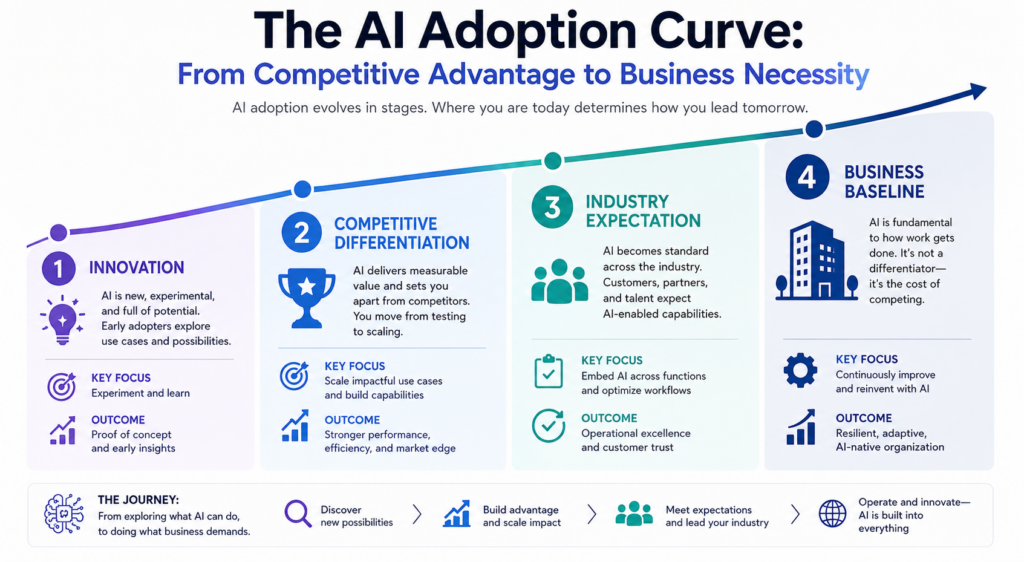
The Shift From Innovation to Expectation
Every major technology shift follows a predictable adoption cycle.
Initially, early adopters gain disproportionate advantage. Over time, those innovations evolve into market expectations. Eventually, what once differentiated companies becomes the baseline customers simply assume exists.
The internet followed this path.
Cloud computing followed this path.
Mobile-first experiences followed this path.
Now, enterprise AI adoption is accelerating through the same transition—but significantly faster.
Consumers already interact with AI daily through intelligent search engines, personalized recommendations, voice assistants, fraud detection systems, predictive experiences, and conversational interfaces.
As a result, customer expectations are changing across industries.
Businesses are increasingly expected to:
- Deliver highly personalized interactions
- Respond instantly to inquiries
- Anticipate customer needs proactively
- Eliminate friction in digital experiences
- Provide smarter, context-aware services
When customers experience these standards elsewhere, they begin expecting them everywhere.
This shift means organizations are no longer competing only against industry peers.
They are competing against the best digital experiences customers encounter anywhere.
For example, a healthcare provider may now be compared against the seamless digital convenience of e-commerce. A manufacturing supplier may be judged against predictive service experiences customers receive from consumer technology platforms.
AI is collapsing traditional competitive boundaries.
The AI Adoption Curve: From Competitive Advantage to Business Necessity
AI Is Becoming Enterprise Infrastructure
One of the most important mindset shifts leaders must make is understanding that AI is evolving into infrastructure.
Much like cloud computing became foundational to digital operations, AI is becoming foundational to modern decision-making.
Organizations increasingly rely on intelligent systems to support:
- Demand forecasting
- Risk management
- Customer engagement
- Workflow automation
- Predictive maintenance
- Knowledge retrieval
- Financial analysis
- Strategic planning
This is especially relevant for organizations modernizing data ecosystems and analytics foundations.
For enterprises building scalable AI readiness, strong data architecture remains essential. Organizations increasingly recognize that fragmented systems create barriers to successful AI outcomes.
Relevant internal perspective: How to Evaluate an AI-Ready Data Platform: 7 Critical Criteria Enterprise Leaders Must Assess in 2026 provide important insights into strengthening data foundations for scalable intelligence initiatives.
Without strong data readiness, even sophisticated AI initiatives often struggle to scale meaningfully.
The Real Cost of Delayed Enterprise AI Adoption
The risk of delaying AI adaptation is often misunderstood.
Many organizations assume waiting simply means postponing efficiency gains.
In reality, the consequences are far more structural.
Organizations delaying enterprise AI adoption may experience:
Operational drag
Manual workflows increasingly become bottlenecks against automated competitors.
Slower decision-making
Organizations relying heavily on manual analysis struggle to respond quickly to changing conditions.
Customer experience gaps
Consumers increasingly expect intelligent and proactive experiences.
Talent challenges
Top talent increasingly gravitates toward organizations investing in modern technologies.
Competitive disadvantage
AI-native businesses are redefining market expectations faster than legacy organizations can respond.
The result is not just slower growth.
It is a widening capability gap.
In many industries, businesses are no longer competing on marginal improvements.
They are competing against entirely different operating models.
The 5 Market Shifts Making Enterprise AI Adoption Non-Negotiable
Understanding why enterprise AI adoption matters requires examining the larger market forces reshaping business itself.
Several structural shifts are accelerating urgency.
Together, they are transforming AI from a strategic option into an operational requirement.
1. Customer Expectations Are Being Reset by AI
Customers no longer benchmark experiences solely within industries.
They benchmark experiences across every digital interaction they encounter.
If personalized recommendations feel effortless in retail, customers expect relevance in financial services.
If support becomes conversational and instant elsewhere, waiting days for resolution feels outdated.
Modern customers increasingly expect businesses to:
- Predict intent
- Personalize communication
- Eliminate friction
- Deliver rapid responses
- Maintain continuity across channels
This expectation shift explains why conversational AI, intelligent search, and predictive systems are becoming standard operating capabilities.
Organizations investing in customer intelligence strategies are increasingly embedding AI-powered experiences into service ecosystems.
Related internal insight: Conversational AI for Customer Service: A Step-by-Step Enterprise Guide explores how enterprises are reshaping engagement models through intelligent automation.
2. Decision Velocity Has Become a Competitive Weapon
Enterprise competition increasingly favors organizations capable of making faster, more informed decisions.
In volatile markets, slow decisions often become expensive decisions.
AI-powered analytics are transforming how leaders:
- Detect emerging risks
- Forecast disruptions
- Model future scenarios
- Analyze customer behavior
- Optimize operational performance
Organizations that once relied on quarterly reporting cycles increasingly operate in near real time.
This shift matters because market disruptions no longer unfold slowly.
Economic shifts, supply chain issues, customer behavior changes, and emerging opportunities now evolve at unprecedented speed.
Organizations operating without intelligent decision systems may struggle to keep pace.
3. AI-Native Companies Are Changing Competitive Benchmarks
Perhaps the biggest pressure facing traditional enterprises comes from AI-native competitors.
These organizations are designed around intelligent systems from the beginning.
Their operations often include:
- Highly automated workflows
- Intelligent customer engagement
- Predictive operational models
- Rapid experimentation cycles
- Lower administrative overhead
As these companies scale, they raise expectations for entire industries.
Processes that once felt optimized can suddenly appear inefficient.
Enterprise leaders must now evaluate not only current efficiency—but future competitiveness.
4. Workforce Productivity Is Being Redefined
AI is fundamentally changing how work gets done.
Repetitive, manual tasks increasingly shift toward intelligent automation.
This enables teams to focus more heavily on:
- Strategy
- Creativity
- Problem-solving
- Relationship management
- Innovation
In software engineering, AI copilots accelerate development.
In analytics, AI reduces time spent on repetitive data preparation.
In customer operations, intelligent assistants reduce response friction.
The result is a workforce model centered around augmentation rather than replacement.
5. Adaptability Has Become the Ultimate Competitive Advantage
Perhaps the biggest lesson emerging from the AI era is simple:
No organization will remain static.
The question is not whether disruption will happen.
The question is whether organizations can evolve alongside it.
Businesses thriving in 2026 are building systems designed for adaptation.
They continuously test, learn, iterate, and improve.
Rather than resisting change, they operationalize it.
This shift is making organizational adaptability itself a strategic capability.
How AI-Native Companies Are Rewriting Competitive Benchmarks
Enterprise leaders often underestimate just how dramatically AI-native businesses are redefining expectations.
The disruption is not incremental.
It is structural.
Traditional organizations typically optimize existing systems.
AI-native organizations redesign systems entirely.
The difference matters.
Where traditional enterprises often layer technology onto legacy processes, AI-native companies rethink workflows from first principles.
Instead of asking:
“How do we improve this process?”
They ask:
“Should this process even exist in its current form?”
This mindset difference is reshaping industries faster than many incumbents expected.
AI-Native Organizations Move Faster
Speed is increasingly becoming one of the most valuable business currencies.
AI-native businesses operate with dramatically shorter feedback loops.
They can:
- Analyze customer behavior faster
- Detect operational inefficiencies earlier
- Launch improvements more rapidly
- Personalize experiences instantly
- Test ideas continuously
This creates compounding advantage.
The faster organizations learn, the faster they improve.
And the faster they improve, the harder they become to catch.
Traditional businesses operating through slower approval chains, fragmented systems, and manual reporting processes often struggle to compete at similar speed.
Personalization at Enterprise Scale Is Becoming Standard
Historically, personalization was resource intensive.
Businesses segmented customers broadly and relied heavily on assumptions rather than dynamic behavioral insights.
AI-native organizations are changing that model.
Today, intelligent systems allow enterprises to personalize engagement at scale through:
- Behavioral analytics
- Predictive recommendations
- Context-aware messaging
- Adaptive pricing strategies
- Intelligent customer journeys
In sectors such as retail, banking, healthcare, logistics, and SaaS, personalization increasingly influences customer retention and revenue growth.
Customers no longer compare experiences against competitors in isolation.
They compare experiences against the best intelligent interactions they receive anywhere.
This means organizations failing to modernize risk creating experience gaps customers increasingly notice.

The Hidden Cost of Delaying Enterprise AI Adoption
For many organizations, hesitation around enterprise AI adoption often comes from uncertainty.
Leaders may question:
- Where to start
- Whether ROI justifies investment
- Which use cases matter most
- How governance should evolve
- Whether teams are prepared
These concerns are valid.
But the bigger risk increasingly lies in standing still.
Delay Creates Compounding Competitive Disadvantage
AI maturity compounds.
Organizations implementing intelligent systems today are not simply gaining short-term efficiency.
They are building:
- Better data ecosystems
- Smarter workflows
- More adaptive operating models
- Stronger experimentation cultures
- Higher organizational learning velocity
Over time, these advantages accumulate.
The result becomes a widening capability gap between AI-enabled businesses and slower-moving competitors.
Organizations delaying enterprise AI adoption often face:
Rising operational costs
Manual work becomes increasingly expensive relative to automation.
Lower responsiveness
Slower organizations struggle to react to customer and market changes.
Missed innovation opportunities
Without experimentation infrastructure, breakthrough opportunities are overlooked.
Talent retention challenges
Modern talent increasingly seeks environments equipped with advanced technologies.
Decreased resilience
Organizations lacking intelligent forecasting capabilities struggle during volatility.
According to enterprise research from major consulting firms, organizations embedding AI strategically often outperform peers in productivity, agility, and operational scalability.
The implication is clear:
AI readiness is becoming increasingly tied to business resilience.
The Real Risk Is Not AI Failure—It Is Organizational Inertia
A common misconception is that AI transformation fails because of technology limitations.
More often, failure occurs because organizations resist change.
The challenge is rarely technical alone.
It is organizational.
Successful enterprise AI adoption requires companies to rethink:
- How work happens
- How decisions are made
- How teams collaborate
- How experimentation is encouraged
- How leaders measure success
The organizations seeing the strongest results are not necessarily investing the most money.
They are often the organizations most willing to evolve.
Why Enterprise AI Adoption Is More About Culture Than Technology
One of the biggest misconceptions surrounding enterprise AI adoption is the belief that transformation begins with software procurement.
In reality, technology is only one piece of the equation.
Culture determines whether AI becomes transformational or fragmented.
Beyond One-Time AI Implementation
Many enterprises still approach AI as a discrete initiative.
They purchase a tool.
Launch a pilot.
Build a chatbot.
Automate a workflow.
Then wait for transformational outcomes.
But AI maturity rarely emerges from isolated projects.
High-performing organizations treat AI as an organizational capability rather than a standalone deployment.
They continuously:
- Explore new use cases
- Experiment with intelligent workflows
- Build internal knowledge
- Reevaluate outdated processes
- Encourage cross-functional learning
This shift from implementation to adaptability separates successful enterprises from struggling ones.
Rather than asking:
“What AI tool should we buy?”
Leading organizations ask:
“How should our organization evolve to work intelligently?”
Continuous Learning Becomes a Strategic Advantage
AI capabilities evolve rapidly.
Models, platforms, workflows, and enterprise use cases shift constantly.
What feels innovative today may become baseline tomorrow.
As a result, organizational adaptability becomes essential.
Successful enterprises increasingly foster:
Curiosity
Encouraging teams to explore emerging possibilities.
Experimentation
Creating safe environments for testing.
Cross-functional collaboration
Combining domain expertise with technical capabilities.
Continuous education
Helping employees work effectively alongside intelligent systems.
Responsible governance
Ensuring innovation aligns with business trust.
Businesses that cultivate learning cultures are better equipped to adapt to changing technology landscapes.
Organizations resisting change often struggle to keep pace.
Relevant internal perspective: AI-Powered Automation: The Competitive Edge in Data Quality Management highlights why structured experimentation matters for sustainable adoption.
Human + AI: The Most Successful Enterprise Operating Model
A recurring fear surrounding AI remains workforce replacement.
Yet the most effective organizations are demonstrating something very different.
The strongest AI strategies are not replacing people.
They are amplifying people.
AI Should Empower, Not Replace
AI excels in environments requiring:
- Pattern recognition
- Large-scale analysis
- Repetition
- Speed
- Predictive modeling
- Information processing
Humans remain uniquely essential for:
- Strategic judgment
- Ethical reasoning
- Creativity
- Leadership
- Emotional intelligence
- Relationship building
The future of work increasingly belongs to organizations blending both strengths.
Rather than replacing expertise, intelligent systems increasingly augment decision-making.
Examples include:
Finance teams using predictive analytics to improve forecasting.
Customer support teams leveraging conversational AI for faster issue resolution.
Software engineers accelerating development with AI copilots.
Marketing teams personalizing campaigns dynamically.
Operations leaders using intelligent forecasting for supply chain resilience.
This combination of human expertise and intelligent systems creates stronger business outcomes than either alone.
Leadership Must Drive AI Transformation
Enterprise AI transformation cannot remain isolated inside IT or innovation teams.
Leadership involvement matters.
Executives play a critical role in:
- Setting AI vision
- Prioritizing investments
- Defining responsible governance
- Encouraging experimentation
- Building organizational trust
The most successful leaders approach AI not as a technology project—but as a business transformation initiative.
Without executive alignment, AI efforts often become fragmented and difficult to scale.

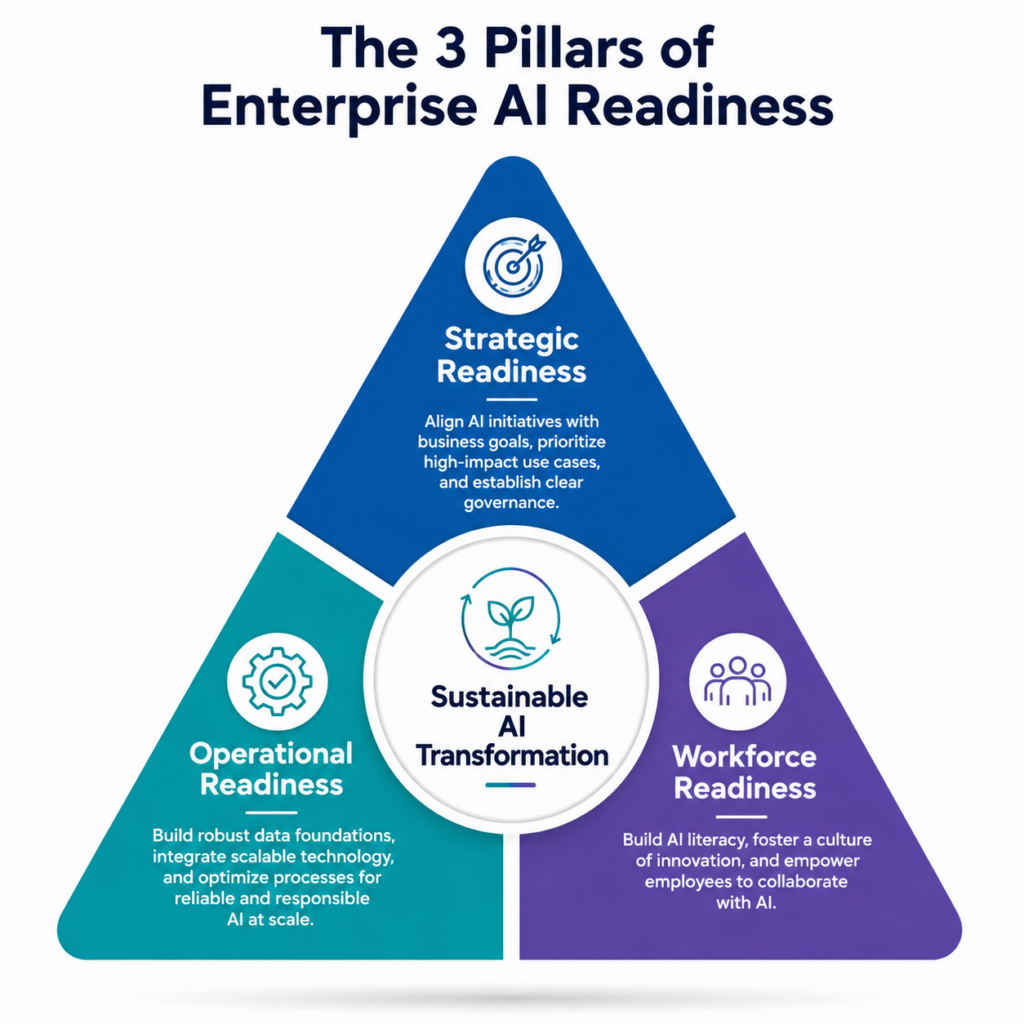
The 3 Pillars of an AI-Ready Organization
Organizations serious about enterprise AI adoption increasingly focus on three foundational readiness dimensions.
Without them, AI initiatives often remain fragmented.
1. Operational Readiness
Operational readiness focuses on identifying where AI can improve business performance.
This includes evaluating workflows involving:
- Repetitive manual effort
- High-volume information processing
- Decision bottlenecks
- Customer friction points
- Forecasting challenges
Organizations should begin by asking:
Where are inefficiencies slowing growth?
The best AI use cases often emerge from solving meaningful operational pain points.
For enterprises modernizing analytics environments, scalable data ecosystems are especially important.
Relevant internal insight: Fabric AI Readiness: How to Prepare Your Data for Scalable AI Adoption explains why strong data foundations directly influence enterprise AI outcomes.
2. Workforce Readiness
Technology readiness means little without workforce confidence.
Employees increasingly need support learning:
- AI literacy fundamentals
- Workflow collaboration with intelligent systems
- Responsible AI usage
- Data interpretation skills
- Critical evaluation of AI outputs
Organizations creating learning-first environments often accelerate adoption more successfully.
Fear decreases when understanding increases.
3. Strategic Readiness
Perhaps the most overlooked dimension is strategic readiness.
AI must align with long-term business priorities.
Organizations should ask:
- How does AI strengthen competitive differentiation?
- Which capabilities matter most for customers?
- How will AI support future resilience?
- What governance structures are required?
Discover more in our partnership page and understand the strategic benefits we bring as a solutions partner.
The 3 Pillars of Enterprise AI Readiness
How Enterprise Leaders Should Approach Responsible AI in 2026
As enterprise AI adoption accelerates, governance becomes increasingly important.
Trust is becoming a competitive differentiator.
Organizations cannot scale AI responsibly without clear frameworks for:
- Data privacy
- Transparency
- Security
- Ethical use
- Bias mitigation
- Accountability
Leaders increasingly recognize that responsible AI is not a regulatory checkbox.
It is foundational to sustainable growth.
Enterprises embedding governance early often scale faster because trust barriers decrease.
Explore how enterprise reliability improves with governance-forward architecture in our data governance solution offerings.
How Techment Helps Enterprises Build AI-Ready Operations
AI transformation is rarely successful through technology implementation alone.
Enterprises increasingly require strategic guidance to modernize data ecosystems, strengthen governance, operationalize intelligence, and align AI investments with measurable business outcomes.
At Techment, organizations are supported across the full transformation journey—from strategy through execution.
This includes:
Building AI-Ready Data Foundations
Successful enterprise AI adoption depends on trusted, scalable, and governed data.
Techment helps enterprises modernize fragmented ecosystems to improve:
- Data accessibility
- Data quality
- Real-time analytics
- Governance maturity
- Cross-functional intelligence
Accelerating AI Readiness
Organizations often struggle to identify high-impact AI opportunities.
Techment supports:
- AI readiness assessments
- Intelligent automation strategies
- Enterprise analytics modernization
- Responsible AI implementation
- Microsoft ecosystem modernization
Enabling Responsible, Scalable Innovation
AI success requires more than experimentation.
It requires scalable execution backed by governance.
Techment helps enterprises balance:
- Innovation speed
- Compliance
- Data trust
- Organizational readiness
- Long-term resilience
The goal is not simply implementing AI.
It is building organizations capable of evolving continuously.
Conclusion
The conversation around AI has fundamentally changed.
The question is no longer whether organizations should invest in enterprise AI adoption.
The real question is:
How quickly can organizations evolve to remain competitive?
AI is no longer an emerging innovation sitting at the edge of enterprise strategy.
It is becoming foundational infrastructure shaping how organizations operate, make decisions, engage customers, and scale growth.
Businesses delaying adaptation may soon find themselves competing against organizations operating with entirely different levels of speed, intelligence, and agility.
Yet successful transformation is not simply about implementing tools.
The organizations leading in 2026 understand something deeper:
AI is a mindset of continuous evolution.
It requires:
- Learning
- Experimentation
- Workforce enablement
- Responsible governance
- Strategic adaptability
The businesses best positioned for long-term success will not necessarily be the organizations spending the most on AI.
They will be the organizations most willing to evolve alongside it.
The future belongs to enterprises prepared to learn continuously, adapt intelligently, and innovate responsibly.
And that journey begins now.
FAQs
1. Is enterprise AI adoption only relevant for large enterprises?
No. While large organizations often scale AI faster, mid-sized businesses increasingly benefit from automation, predictive analytics, and intelligent workflows. The key is prioritizing high-impact use cases.
2. How long does enterprise AI adoption take?
AI transformation is continuous rather than fixed. Many organizations see operational improvements within months, while broader organizational maturity develops over several years.
3. What is the biggest barrier to enterprise AI adoption?
Culture often matters more than technology. Organizations resistant to experimentation or workforce learning typically struggle to scale AI successfully.
4. Does AI replace jobs?
In most enterprise environments, AI augments human work rather than replacing it. The strongest outcomes emerge when intelligent systems improve productivity while employees focus on higher-value work.
5. What should organizations prioritize first?
Data readiness, workforce enablement, and business-aligned use cases are typically the strongest starting points.
Related Read
- Enterprise AI Strategy in 2026
- Fabric AI Readiness: How to Prepare Your Data for Scalable AI Adoption
- AI-Ready Enterprise Checklist with Microsoft Fabric
- How to Build AI-Ready Data Foundations: A Strategic Enterprise Guide
- AI strategy and modernization planning.
- AI-Powered Data Engineering: The Next Frontier for Enterprise Growth
- Data Validation in Pipelines: Ensuring Clean Data Flow for Strategic
- Why Is Data Orchestration: Making Pipelines Smarter Imperative To Understand
- Cloud-Native Data Engineering: The Future of Scalability for the Enterprise
- Data Lakehouse vs Data Warehouse: Key Differences