Why AI Readiness vs AI Adoption Matters More Than Ever
There is a dangerous assumption shaping enterprise conversations right now:
“If we are not adopting AI fast enough, we are already behind.”
At first glance, that belief feels rational. AI capabilities are evolving rapidly. Competitors are announcing generative AI pilots. Boards are asking difficult questions. Leadership teams feel increasing pressure to demonstrate momentum.
Yet speed alone rarely creates durable competitive advantage.
The distinction between AI readiness vs AI adoption is emerging as one of the most strategically important decisions enterprise leaders will make over the next several years.
Many organizations mistakenly assume AI success depends on how quickly they deploy tools. In reality, long-term success depends on whether the enterprise is structurally prepared to scale those tools responsibly.
This is where many organizations fail.
They focus on adoption before readiness.
They invest in experimentation before alignment.
They deploy AI before clarifying governance.
The result is not transformation. It is fragmentation.
According to McKinsey, while enterprise AI experimentation continues to rise significantly, only a small percentage of organizations successfully scale AI initiatives across business functions. The gap often comes down to operating model maturity, not technology selection.
According to McKinsey’s State of AI research, while enterprise AI experimentation continues to rise, only a relatively small percentage of organizations successfully scale AI initiatives across business functions — often because operating model maturity lags behind implementation ambition. According to McKinsey’s State of AI research, while enterprise AI experimentation continues to rise, only a relatively small percentage of organizations successfully scale AI initiatives across business functions — often because operating model maturity lags behind implementation ambition.
Why Enterprise Leaders Are Getting AI Strategy Wrong
For many executives, AI adoption appears measurable.
A pilot launches.
A vendor is selected.
A chatbot goes live.
A generative AI assistant becomes available internally.
These activities create visible momentum.
AI readiness, however, feels slower.
It requires organizations to confront uncomfortable questions:
What business problems are we actually solving?
Is our data trustworthy enough for AI?
Who owns accountability for AI outcomes?
What risks become unacceptable at scale?
How do we govern experimentation?
These conversations are less visible than launching tools, but they determine whether AI becomes an accelerator or a liability.
For enterprise leaders exploring long-term transformation, understanding the relationship between strategy, governance, and scalable implementation is essential. Relevant considerations are explored in Techment’s enterprise perspective on AI modernization and implementation readiness.
TL;DR
- AI readiness vs AI adoption is one of the most misunderstood distinctions in enterprise transformation.
- AI adoption is a decision; AI readiness is an organizational condition.
- Enterprises often fail because they scale tools before governance, data quality, ownership, and measurement exist.
- Sustainable AI advantage comes from operating maturity, not experimentation speed.
- Organizations that invest in AI readiness frameworks are better positioned to scale responsibly and capture measurable business value.
The Enterprise Rush Toward AI Adoption Is Creating Strategic Blind Spots
Over the last two years, enterprise AI conversations have shifted dramatically.
Organizations are no longer asking:
“Should we use AI?”
Instead, the question has become:
“How fast can we implement it?”
This subtle shift matters.
Because urgency often replaces strategic sequencing.
The Pressure to Demonstrate AI Momentum
Several forces are driving aggressive enterprise AI adoption:
- Board-level expectations
- Competitive pressure
- Vendor marketing
- Productivity expectations
- Fear of disruption
- Investor narratives around AI transformation
The pressure becomes particularly intense for CTOs, CDOs, and platform leaders.
No executive wants to appear unprepared.
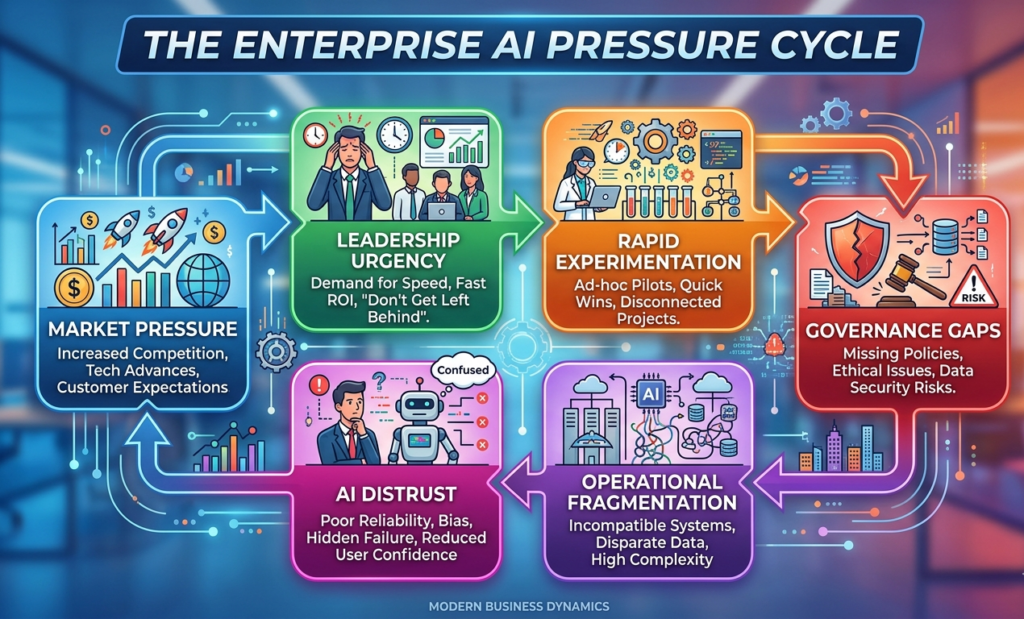
However, reacting too quickly creates a different risk:
Artificial acceleration without operational readiness.
Organizations begin purchasing tools before governance exists. Departments launch disconnected pilots. Different business units adopt competing platforms. Success metrics become inconsistent. Eventually, leaders face an uncomfortable realization: The technology works. The organization does not.
Map the fastest path to a modern, unified data platform with deeper understanding of our Microsoft Fabric Readiness.
AI Adoption Is a Decision. AI Readiness Is an Organizational Condition
This is perhaps the most important distinction in the entire conversation around AI readiness vs AI adoption.
The two concepts are fundamentally different.
AI Adoption Is Something Organizations Do
AI adoption is transactional.
An organization chooses to implement a capability.
Examples include:
- Deploying copilots
- Introducing generative AI assistants
- Automating workflows
- Launching predictive analytics
- Implementing conversational AI
- Piloting recommendation engines
These actions can happen relatively quickly.
In some cases, implementation takes weeks.
This creates a misleading perception:
That organizations are “becoming AI-enabled.”
But deployment alone rarely signals transformation.
AI Readiness Is Something Organizations Become
AI readiness is cumulative.
It reflects organizational maturity across several dimensions.
An AI-ready enterprise demonstrates alignment in:
Strategic clarity
Leaders understand which measurable business outcomes AI should improve.
Data maturity
Reliable, accessible, governed data exists across systems.
Governance
Clear policies define acceptable AI use, accountability, ethics, and escalation.
Workforce capability
Teams understand how to work effectively with AI systems.
Measurement discipline
Success metrics are defined before implementation begins.
Risk management
Security, compliance, privacy, and reputational risks are proactively addressed.
Without these foundations, organizations struggle to scale.
Organizations that integrate AI cost governance into their broader data governance strategy achieve significantly better outcomes. Explore Data Quality for AI in 2026: The Ultimate Blueprint for Accuracy, Trust & Scalable Enterprise Adoption.
AI Readiness vs AI Adoption: Key Enterprise Differences
| Dimension | AI Adoption | AI Readiness |
|---|---|---|
| Nature | Decision | Organizational condition |
| Timeline | Fast | Progressive |
| Focus | Technology deployment | Capability maturity |
| Success metric | Implementation | Business value |
| Risk | Fragmentation | Deliberate scaling |
| Ownership | IT-led | Enterprise-wide |
Tables like this improve featured snippet potential for competitive search terms.
The Cost of Confusing the Two
When organizations confuse readiness with adoption, several problems emerge:
Pilot overload
Too many disconnected initiatives emerge without shared goals.
Undefined ROI
Teams struggle to explain measurable business outcomes.
Governance debt
Risks accumulate faster than controls.
Tool redundancy
Departments purchase overlapping AI capabilities.
Employee distrust
Poor experiences reduce confidence in enterprise AI initiatives.
These failures are rarely technical.
They are structural.
Techment’s work around scalable enterprise modernization emphasizes why data foundations, governance maturity, and operational clarity are prerequisites for responsible AI acceleration.
AI Does Not Create Organizational Chaos — It Reveals It
Many organizations blame AI when implementations struggle.
That diagnosis is usually incorrect.
AI rarely creates structural weaknesses.
It exposes them.
And it does so quickly.
Fragmented Data Becomes Visible at Scale
AI systems amplify the quality of enterprise data.
If data is fragmented, outputs become inconsistent.
If data lacks governance, results become unreliable.
If systems remain siloed, AI struggles to create contextual intelligence.
This becomes especially problematic for generative AI systems dependent on enterprise knowledge retrieval.
Without trusted information architecture, hallucinations increase.
Trust decreases.
Adoption slows.
This is why many enterprise leaders are reassessing data modernization before scaling AI.
Reliable AI begins with reliable information.
Ownership Gaps Become Impossible to Ignore
AI also exposes leadership ambiguity.
Common enterprise questions suddenly emerge:
- Who owns AI performance?
- Which department governs ethical boundaries?
- Who approves scaling?
- Who manages model risk?
- Who defines acceptable outcomes?
Many organizations realize too late that accountability frameworks never existed.
That creates operational paralysis.
Process Ambiguity Becomes Operational Risk
Organizations with inconsistent workflows often assume AI will create efficiency automatically.
The opposite is usually true.
Undefined processes create inconsistent automation outcomes.
AI cannot standardize chaos.
It magnifies it.
For leaders evaluating AI readiness, strengthening data governance and quality frameworks becomes essential before scaling intelligent systems enterprise-wide.
The “We’ll Figure Governance Out Later” Trap
One of the most common mistakes enterprises make sounds deceptively reasonable:
“Let’s experiment first. We can formalize governance later.”
The intention is understandable.
Leaders want speed.
Teams want flexibility.
Innovation feels urgent.
But unmanaged experimentation often creates hidden organizational debt.
What AI Readiness Actually Looks Like in Enterprise Organizations
Despite growing investment, many organizations still misunderstand what AI readiness means.
It is not about having an AI lab.
It is not about hiring a Chief AI Officer.
And it is certainly not about purchasing the newest tools.
AI readiness is organizational preparedness.
It reflects whether an enterprise can scale AI responsibly, repeatedly, and measurably.
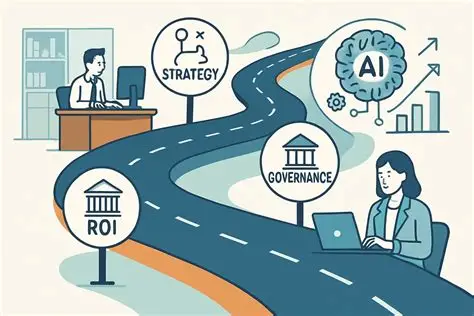
The 5 Pillars of an AI Readiness Framework
The strongest enterprises build readiness across five dimensions.
Strategic alignment
AI initiatives must connect directly to measurable business outcomes.
Questions leaders should answer include:
- What problem are we solving?
- Which KPIs improve?
- What value threshold justifies scaling?
Organizations that skip this stage often end up pursuing technology without strategic intent.
Data readiness
AI performance depends on data quality.
Poor-quality data produces unreliable outputs at scale.
Leaders should assess:
- Data accessibility
- Data governance maturity
- Metadata quality
- Lineage visibility
- Trustworthiness of enterprise systems
For enterprises prioritizing trusted data ecosystems, modern governance and quality frameworks become essential components of readiness.
Governance and risk
An enterprise AI governance framework should define:
- Acceptable use cases
- Approval workflows
- Risk thresholds
- Human oversight requirements
- Escalation paths
Workforce readiness
Employees need enablement.
AI transformation is not purely technological.
It is behavioral.
Organizations should invest in:
- AI literacy programs
- Leadership education
- Role redesign
- Responsible usage training
Measurement maturity
Many AI programs fail because success criteria were never defined.
Before deployment, organizations should establish:
- Financial metrics
- Productivity benchmarks
- Operational improvements
- Customer outcomes
- Risk reduction indicators
Buying a platform often provides built-in compliance capabilities, while building requires organizations to design governance frameworks from scratch.
The Real Competitive Advantage in AI Is Not Speed — It Is Readiness
There is a widespread assumption that AI winners will simply be the fastest adopters.
That assumption is flawed.
Technology advantages rarely remain exclusive for long.
AI models are becoming more accessible.
Implementation barriers continue to fall.
Generative AI capabilities are rapidly commoditizing.
Which raises an important strategic question:
If everyone has access to similar tools, what becomes the differentiator?
The answer is organizational maturity.
Why AI Readiness Compounds Over Time
Unlike software, readiness compounds.
Organizations with strong readiness capabilities build advantages that become difficult to replicate.
These advantages include:
Governance maturity
Better decisions happen faster because risk boundaries are clear.
Cross-functional alignment
Business and technology teams operate with shared goals.
Reliable data ecosystems
AI produces more trusted outcomes.
Scaling discipline
Successful pilots transition into enterprise capabilities.
Measurable ROI
Executives can justify investment confidently.
McKinsey research consistently shows that organizations extracting the greatest AI value are typically those integrating AI deeply into operating models rather than treating it as isolated experimentation.
Fast AI Adoption vs Sustainable AI Advantage
| Fast Adoption | Sustainable Readiness |
|---|---|
| Short-term momentum | Long-term capability |
| Tool-focused | Outcome-focused |
| Fragmented pilots | Scalable frameworks |
| Reactive decisions | Governance-led scaling |
| Unclear ROI | Measurable enterprise value |
This comparison supports snippet optimization.
For enterprises seeking long-term transformation, Techment’s approach to enterprise AI strategy emphasizes building operational maturity before acceleration.
When AI Adoption Actually Makes Strategic Sense
None of this suggests organizations should delay AI indefinitely.
That would be equally problematic.
The goal is not hesitation.
The goal is sequencing.
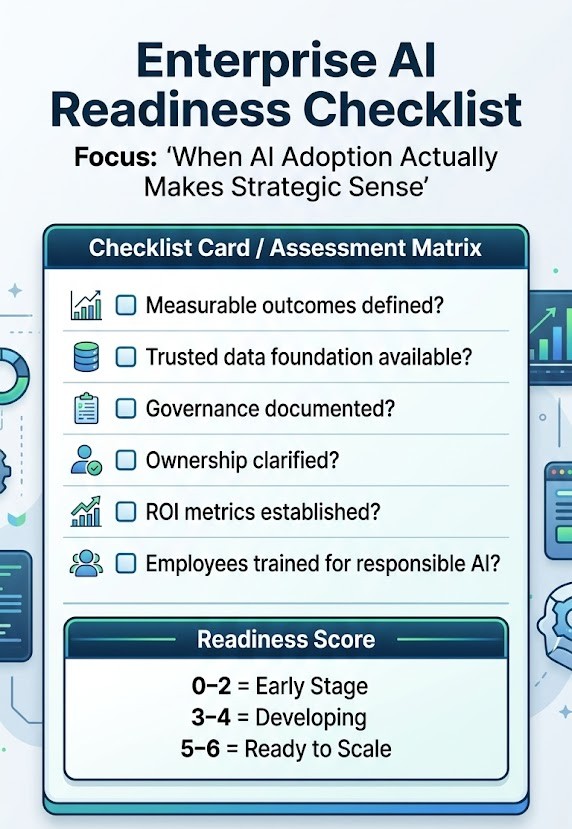
AI adoption becomes transformational when readiness exists first.
Signs Your Organization Is Ready for AI Adoption
Business outcomes are defined
Leaders know what success looks like.
Not vague ambition.
Specific measurable outcomes.
For example:
- Reduce customer response time by 40%
- Improve forecasting accuracy by 20%
- Reduce manual reporting effort by 60%
Data foundations are reliable
Organizations trust their underlying information systems.
Governance exists before scale
Policies are proactive, not reactive.
Ownership is clear
Every initiative has accountable leaders.
Scaling criteria exist
Organizations understand:
- What qualifies success
- When pilots stop
- When investments expand
Enterprise Comparison Table
AI Readiness vs AI Adoption: What Enterprise Leaders Must Understand
| Dimension | AI Adoption | AI Readiness |
|---|---|---|
| Definition | Technology deployment | Organizational preparedness |
| Timeline | Immediate | Progressive |
| Focus | Tools & pilots | Capability maturity |
| Ownership | IT-led | Enterprise-wide |
| Risk | Fragmentation | Controlled scaling |
| Success Metric | Usage | Business outcomes |
| Goal | Implementation | Sustainable transformation |
Why Most Organizations Still Get AI Readiness vs AI Adoption Wrong
The answer is simple:
Adoption is visible. Readiness is invisible.
Executives can showcase pilots.
They can announce partnerships.
They can publish AI roadmaps.
Readiness rarely receives attention because it happens internally.
In workshops.
In architecture reviews.
In governance conversations.
In difficult organizational discussions.
Ironically, the quiet work often determines enterprise outcomes.
Why Boards Reward Activity Over Readiness
Enterprise incentives unintentionally encourage premature adoption.
Leaders feel pressure to demonstrate:
- Innovation
- Momentum
- Market relevance
- Digital transformation progress
This creates a dangerous pattern:
Organizations optimize for appearing AI-ready instead of becoming AI-ready.
A Better Strategic Question
Instead of asking:
“How quickly can we implement AI?”
Leaders should ask:
“What would make us confident scaling AI across the enterprise?”
That single shift changes everything.
It moves the conversation:
From hype → discipline
From reaction → preparation
From experimentation → operating capability
And ultimately:
From short-term pilots → enterprise advantage
Our blog explores the Build vs Buy AI decision in depth—analyzing enterprise use cases, architectural considerations, operating models, and emerging hybrid approaches.
How Techment Helps Enterprises Build AI Readiness Before AI Adoption
For many organizations, the challenge is not deciding whether AI matters.
It is understanding how to implement it responsibly.
Enterprises often struggle with fragmented data, inconsistent governance, unclear ownership, and limited readiness visibility.
This is where structured enablement becomes essential.
Techment helps organizations move from experimentation toward scalable enterprise AI capability through:
Enterprise AI strategy and readiness assessments
Helping leaders identify maturity gaps before scaling begins.
Data modernization for AI readiness
Building trusted data ecosystems required for reliable AI performance.
Governance and responsible AI frameworks
Establishing accountability, security, compliance, and risk oversight.
Microsoft ecosystem modernization
Supporting enterprise transformation through Azure, Microsoft Fabric, analytics modernization, and AI-driven architectures.
End-to-end implementation support
From roadmap definition to execution and optimization.
For organizations evaluating readiness, Techment’s resources around enterprise AI strategy, data governance, AI-ready architectures, and modernization provide practical guidance for building scalable foundations.
Conclusion
The debate around AI readiness vs AI adoption is no longer theoretical.
It is becoming one of the defining enterprise leadership challenges of this decade.
The organizations that succeed with AI will not necessarily be the fastest.
They will be the most prepared.
AI adoption is increasingly accessible.
Competitive advantage is not.
What remains difficult to replicate is organizational readiness:
- Governance maturity
- Trusted data ecosystems
- Accountability structures
- Measurable value frameworks
- Disciplined scaling
That is where sustainable enterprise advantage emerges.
For leaders navigating enterprise transformation, the strategic question is no longer:
“How fast can we adopt AI?”
It is:
“How confidently can we scale it?”
And increasingly, the answer depends on readiness first.
FAQ: AI Readiness vs AI Adoption
1. What is the difference between AI readiness and AI adoption?
AI adoption refers to implementing AI technologies, while AI readiness measures whether an organization is structurally prepared to scale AI successfully.
2. Why do enterprises fail at AI adoption?
Most failures stem from poor readiness — fragmented data, weak governance, unclear ownership, and undefined success metrics.
3. How can organizations assess AI readiness?
Through structured evaluations of strategy, governance, workforce capability, data maturity, and measurement frameworks.
4. Should organizations delay AI adoption?
No. The objective is responsible sequencing — building readiness while scaling intentionally.
5. What industries benefit most from AI readiness frameworks?
Highly regulated industries including healthcare, finance, insurance, manufacturing, and public sector organizations often benefit significantly due to compliance complexity.