
Decision intelligence is an approach that combines AI, business rules, contextual data, and probabilistic reasoning to turn information into structured, actionable decisions. Unlike generative AI, which primarily produces content and recommendations, decision intelligence enables enterprise AI systems to evaluate options, assess confidence, apply constraints, and determine the next best action. As organizations move beyond chat-based interfaces toward autonomous AI agents, decision intelligence is becoming a critical foundation for building AI systems that do not just generate responses but make reliable, explainable, and business-aligned decisions.
Executive Summary
For the last few years, enterprise AI has largely been defined by one idea: generate better answers. Large Language Models can write, summarize, reason, generate code, and power increasingly sophisticated AI agents.
But many enterprise workflows are not primarily language-generation problems. They are decision problems: routing a request, scoring a risk, selecting a workflow, filtering a record, validating a result, or deciding whether human review is required.
This article explores the emerging idea of decision-oriented AI through Jev, introduced by TypeSafe AI as a System One model. Rather than positioning Jev as a replacement for generative AI, the more useful perspective is architectural: different models can perform different jobs.
Jev was announced on 15 September 2026, alongside a reported $40 million seed round led by DCVC, and is currently available through early access, with developers admitted from a waitlist on a rolling basis.
The broader opportunity is to move from AI as a conversational feature toward AI as an intelligence layer embedded inside software—where deterministic code executes, statistical models predict, decision models choose, generative models reason and communicate, and humans govern exceptional cases.
Key Takeaways
- Decision-oriented AI focuses on structured judgments rather than open-ended text generation.
- Jev is presented as TypeSafe AI’s first System One model, designed for focused application decisions.
- Calibrated probabilities can support confidence-aware automation, validation, and human review.
- Decision-oriented models can complement generative models in AI agent architectures.
- Enterprise AI systems need explicit decision policies, monitoring, and abstention paths.
- Model selection should account for accuracy, latency, cost, and the consequences of incorrect decisions.
The Core Idea
1. We Have Built AI That Can Talk. Now We Need AI That Can Decide.
Traditional software follows predefined rules. Generative AI introduced a much more flexible interface: input goes into a model and natural-language output comes back.
That flexibility is powerful, but production software often needs predictable outputs. If an application needs to classify a customer request into Billing, Technical Support, Sales, or Account Management, a paragraph of natural language creates an extra interpretation layer.
A decision-oriented model approaches the problem differently: the application defines the decision space and the model provides a structured judgment. The distinction may look small, but at scale it can simplify how AI is integrated into production workflows.
2. What Is Jev?
Jev is TypeSafe AI’s first System One model. The concept is to answer focused application questions with structured decisions rather than treating every task as open-ended text generation.
In practice, the application sends Jev a block of unstructured program state together with a set of typed questions—for example, a Choice between predefined categories or a numeric Score. Jev evaluates all of the questions in a single parallel pass instead of generating text one token at a time, and returns typed answers with calibrated probabilities. Because outputs are constrained to the declared types, there is no free text to parse and no malformed output to repair.
A useful abstraction is:
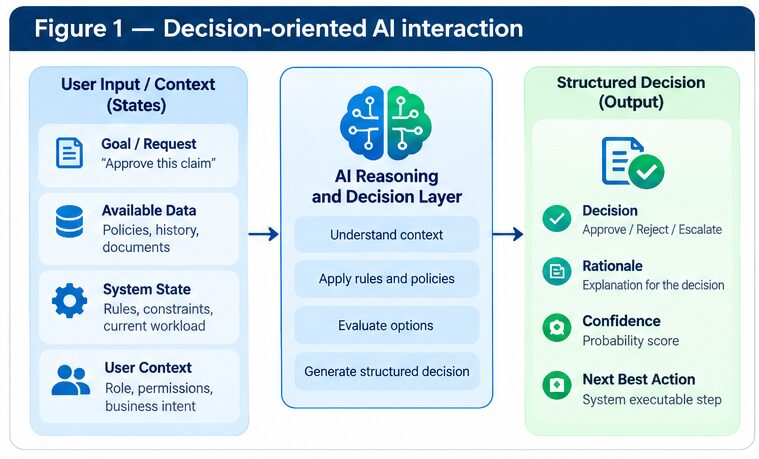
State → Question → Decision → Action
For example, an application can ask which workflow should handle an incoming request. The model can return a choice together with a probability or confidence signal, while the surrounding application remains responsible for the business action.
The important architectural principle is separation of concerns: the model provides judgment; the application controls execution.
Vendor-reported characteristics at launch include end-to-end latency of roughly 70–500 milliseconds, input pricing of about $0.042 per million tokens, and no charge for output tokens.
3. System One vs. System Two
The System One / System Two terminology is a useful way to think about different AI jobs. Generative and reasoning-oriented models are valuable for open-ended reasoning, summarization, code generation, planning, and communication.
The terminology draws on Daniel Kahneman’s distinction in Thinking, Fast and Slow between fast, intuitive System 1 cognition and slower, deliberate System 2 reasoning. AI researchers have used the same framing to describe complementary “fast” and “slow” components within intelligent systems.
Decision-oriented models are useful for bounded tasks such as classification, scoring, routing, verification, ranking, and gating.
The point is not that one category replaces the other. The stronger enterprise pattern is specialization: use the right model for the right decision.
4. Decisions Instead of Strings
Software works naturally with structured objects. A decision such as {"category":"technical_support","confidence":0.94} is directly consumable by an application. A paragraph that says a request is “probably related to technical support” requires interpretation and validation.
Decision-oriented AI makes the decision boundary explicit. That can reduce parsing complexity and make downstream policies easier to implement.
5. Why Probabilities Matter
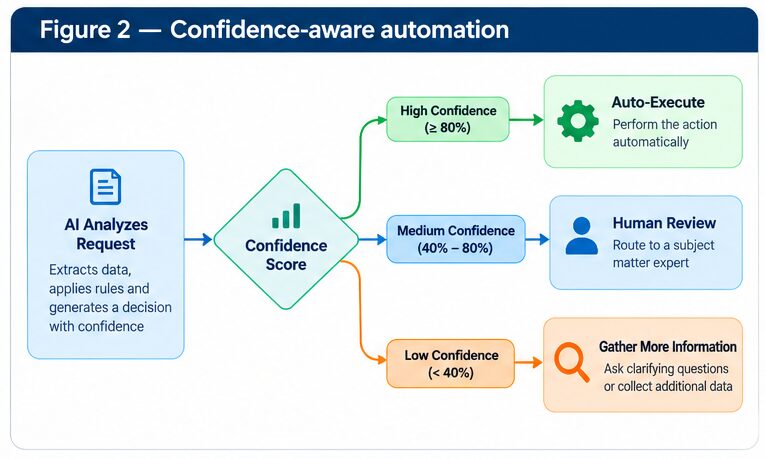
Consider two predictions. In the first, Technical Support has a probability of 0.96 and the alternatives are very small. In the second, Technical Support is 0.38, Billing is 0.34, and Sales is 0.28.
Both have the same top prediction, but they should not necessarily trigger the same action.
This creates a useful enterprise pattern: high confidence can trigger automation, medium confidence can trigger validation, and low confidence can trigger human review or a fallback process.
Calibration is what makes this pattern safe. A model is well calibrated when its stated probabilities match observed outcomes—decisions reported at 0.90 confidence should be correct roughly 90% of the time. TypeSafe states that Jev is trained specifically to produce calibrated probabilities, but thresholds should still be set and monitored using an organization’s own labelled data.
6. Why This Matters for AI Agents
Modern agents may combine LLMs, search, databases, APIs, retrieval systems, tools, and specialized models. They also make many small decisions: Is the request valid? Which agent should handle it? Which tool should be called? Is retrieved information relevant? Should another model be consulted? Should the result be trusted?
Using a large generative model for every one of these decisions can create unnecessary latency, cost, and complexity. A specialized decision layer can act as a routing and gating component around generative models.
Early independent testing illustrates the trade-off. In a four-workflow benchmark reported by DataCamp, Jev reached 67.8% accuracy compared with 67.9% for a fast frontier LLM configuration, at a small fraction of the per-decision cost and with sub-second latency. Larger frontier configurations scored higher—around 73–74%—but took tens of seconds per case and cost considerably more. The lesson is not that one model wins, but that accuracy, cost, and latency must be balanced decision by decision.
7. Enterprise Use Cases
Decision-oriented AI can be relevant wherever an enterprise repeatedly makes bounded, high-volume judgments.
Customer service can use it for routing and prioritization. Risk systems can use it for scoring and review gates. Document intelligence can use it for relevance, categorization, and human-review decisions. Data-quality pipelines can use it for fuzzy classification and anomaly-related decisions.
Launch materials and early reviews highlight similar patterns: content moderation, ticket and request routing, high-volume batch scoring and ranking, and verification guardrails that check the actions of AI agents [2][4].
The value comes from connecting the model to a measurable business action—not simply from producing an impressive demo.
8. An Interesting Opportunity: AI in Property Analytics and Valuation
Property analytics provides a useful example because valuation systems combine statistical prediction with many surrounding decisions.
A valuation workflow may need to determine whether a sale is valid, whether a comparable property is relevant, whether a record should be included, how similar a neighborhood is, and whether a valuation result requires human review.
These are not all regression problems. Many are classification, scoring, ranking, and gating problems. Decision-oriented AI can therefore be considered as a layer around established statistical and machine-learning valuation models rather than a replacement for them.
9. Jev Does Not Replace LLMs
A common mistake in technology discussions is to frame each emerging model as a replacement for the previous generation.
Jev is not intended to write long-form articles, power every conversational interaction, or replace every machine-learning model. Its value is in a narrower class of decision problems.
Its limitations matter just as much. Jev does not produce natural-language explanations, it works only where the answer space is defined in advance, and—although it cannot return malformed output—it can still be confidently wrong. Teams that need an auditable rationale for each decision will still need complementary techniques and human oversight [3][4].
A mature enterprise architecture may combine deterministic code, statistical models, decision AI, generative AI, and human review. The future is likely to be compositional rather than dominated by a single model.
10. The Shift from AI Features to AI Infrastructure
Early enterprise AI adoption often looked like “add a chatbot.” Then it became “add a copilot.” Today many organizations are experimenting with agents.
The next question is more architectural: Which parts of our business processes should become AI-driven decisions?
This moves AI from a feature sitting on top of an application toward an intelligence layer inside the application’s workflow architecture.
Figure 4. A compositional enterprise AI architecture.
11. The Most Important Concept: AI With an Abstention Path
AI systems should not always be forced to decide. A production system can be designed with three outcomes:
YES → automate
NO → reject or stop
UNCERTAIN → escalate
This is particularly important in high-impact workflows. The goal is not to make AI perfect. The goal is to make AI predictably useful within a controlled system, with clear thresholds, monitoring, and human fallback paths.
Read more about it in Enterprise AI Strategy in 2026: A Practical Framework for Scalable, Governed AI
12. What This Means for Data Scientists
The traditional machine-learning workflow is often described as:
Data → Features → Model → Prediction → Metric
A production decision system adds another layer:
Data → Model → Probability → Decision Policy → Action → Feedback → Monitoring
That makes probability, calibration, threshold optimization, ranking, uncertainty estimation, cost-sensitive decision-making, experimentation, and model monitoring increasingly important.
In this sense, the rise of decision AI may make statistical thinking more—not less—important in modern AI engineering.
- Probability and calibration
- Classification and ranking
- Threshold optimization
- Uncertainty estimation
- Cost-sensitive decision making
- Human-in-the-loop system design
- Model evaluation and monitoring
13. The Bigger Picture: From Generative AI to Decision Intelligence
The most useful question is not simply whether an organization should use Jev. The stronger question is: Where in our business processes do we need intelligence, but not necessarily generated text?
Look for decisions that are repetitive, high-volume, difficult to encode with rigid rules, currently handled manually, or currently delegated to expensive general-purpose models.
This is consistent with how Gartner frames decision intelligence: a practical discipline used to improve decision-making by explicitly understanding and engineering how decisions are made, supported by platforms that combine data, analytics, rules, machine learning, and AI.
Start with a bounded decision. Define acceptable outputs. Measure accuracy and calibration. Establish confidence thresholds. Add a human fallback. Then monitor the system in production.
That is how emerging AI technology becomes enterprise technology.
Conclusion: The Future of AI May Be Less About Talking—and More About Choosing
Generative AI gave software the ability to communicate. Decision-oriented AI explores something different: the ability to make structured judgments inside software.
Jev and the System One approach are interesting examples of this direction. They do not imply that LLMs are going away. The more compelling future is one where different forms of intelligence work together:
Code executes.
Machine learning predicts.
Decision models choose.
Generative models reason and communicate.
Humans govern the system.
The winning enterprise AI architecture may therefore not be the one with the single most powerful model. It may be the one that understands which intelligence belongs where.
AI is moving from being something we talk to, toward something that participates directly in how software makes decisions.
Final Thought
The next generation of AI applications will not be measured only by how impressive their answers sound. They will be measured by how reliably intelligence can be converted into action.
Frequently Asked Questions
1. What is decision intelligence in enterprise AI?
Decision intelligence is an approach to improving decision-making by understanding and engineering how decisions are made. In enterprise AI, it can bring together data, analytics, rules, machine learning, and AI to support structured decisions and business actions.
2. What is Jev AI?
Jev is TypeSafe AI’s first System One model. It is designed to answer focused application questions with structured decisions rather than treating every task as open-ended text generation.
3. How is decision-oriented AI different from generative AI?
Generative AI produces natural-language content for tasks such as reasoning, summarization, code generation, planning, and communication. Decision-oriented AI focuses on bounded tasks such as classification, scoring, routing, verification, ranking, and gating.
4. Why are calibrated probabilities important in AI decision-making?
Calibration helps an organization understand whether a model’s stated probabilities align with observed outcomes. This can support confidence-aware automation, validation, and human review when thresholds have been evaluated using representative data.
5. Does Jev replace large language models?
Jev is not intended to replace every large language model or machine-learning model. Its value is in a narrower class of decision problems. A mature enterprise architecture may combine deterministic code, statistical models, decision AI, generative AI, and human review.
6. What is an abstention path in AI?
An abstention path allows an AI system to escalate a decision when it is uncertain rather than being forced to produce an automated outcome. A production workflow can support automation, rejection or stopping, and escalation to human review.
7. How can enterprises use decision-oriented AI?
Potential applications include customer-service routing, risk scoring, document relevance and categorization, data-quality workflows, content moderation, high-volume ranking, and verification guardrails for AI agents.
Related Reads
- Enterprise AI Strategy in 2026: How CIOs Build Scalable, Impact-Driven AI Roadmaps
- Microsoft Fabric vs Snowflake: Data Management Showdown
- Microsoft Azure for Enterprises: Cloud AI Modernization
- AI-Ready Enterprise Checklist for Microsoft Fabric
- Enterprise Data Quality Framework: Best Practices for Reliable Analytics and AI
- Essential Design Patterns in Modern Data Pipelines
- How to Assess Data Quality Maturity: Your Enterprise Roadmap