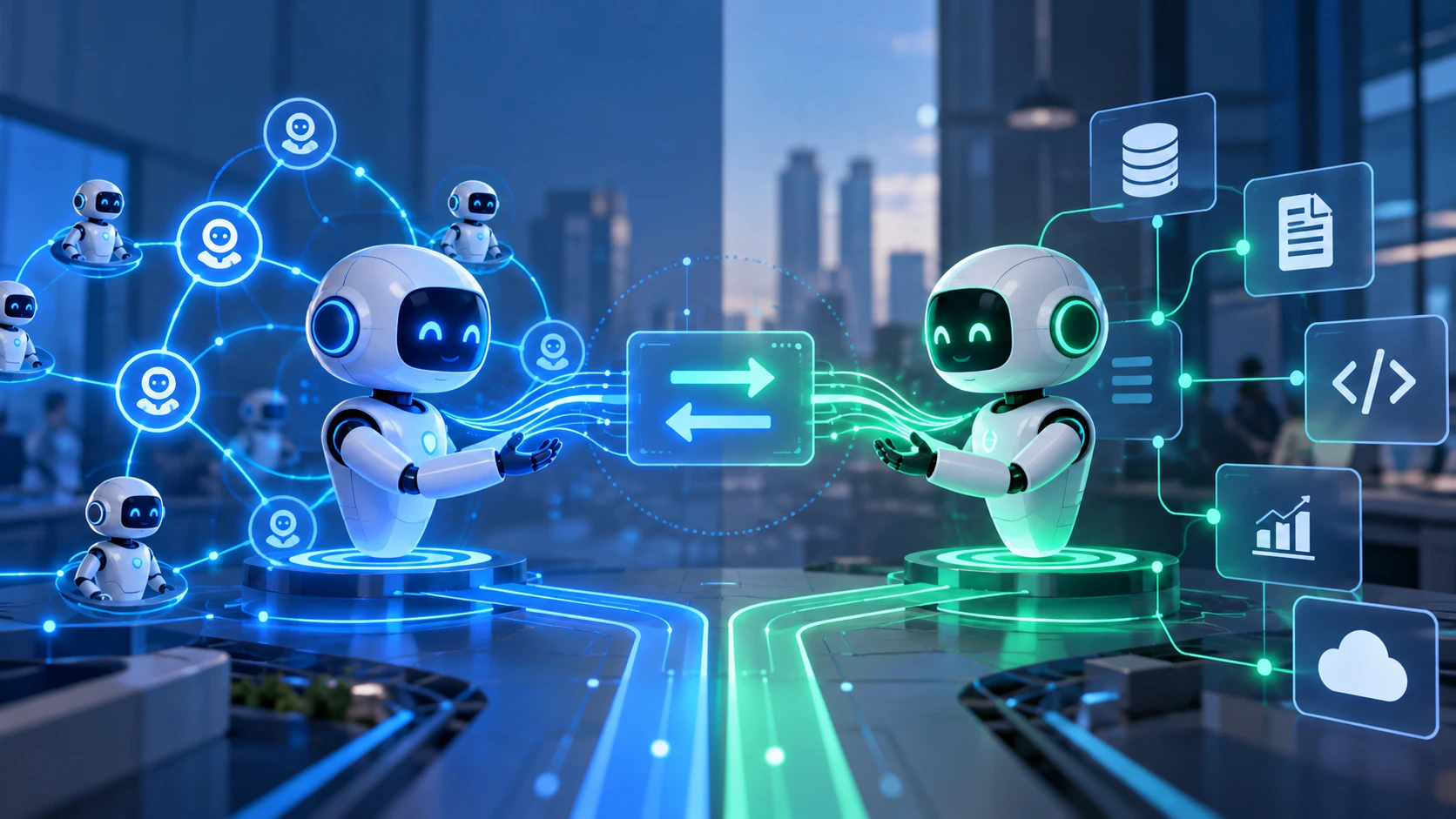
Model Context Protocol (MCP) is an open standard that enables AI applications, large language models (LLMs), and AI agents to securely connect with external tools, enterprise systems, databases, APIs, and business applications through a standardized interface. By eliminating custom integrations, MCP simplifies AI interoperability, improves scalability, and enables intelligent agents to access real-time business context.
Executive Summary
Enterprise AI is entering a new phase where success depends not only on the intelligence of large language models but also on their ability to interact with real-world business systems. AI assistants, copilots, and autonomous agents increasingly need access to enterprise knowledge, APIs, databases, collaboration platforms, CRM systems, ERP applications, and cloud services to deliver meaningful business outcomes.
Historically, integrating AI with these systems required custom APIs, proprietary connectors, and significant development effort. This approach created fragmented architectures, duplicated integrations, inconsistent governance, and higher maintenance costs.
The Model Context Protocol (MCP) solves this problem by introducing an open, standardized protocol for connecting AI models with external tools and data sources. Instead of building separate integrations for every application, organizations can develop MCP-compatible servers that expose business capabilities in a consistent, secure, and reusable way.
For enterprises investing in AI agents, Retrieval-Augmented Generation (RAG), and intelligent automation, MCP provides the interoperability layer that enables scalable, secure, and future-ready AI ecosystems.
Why Enterprise AI Needs Model Context Protocol
Modern AI applications require access to real-time business information, enterprise applications, and external tools to generate accurate, context-aware responses. Model Context Protocol enables standardized communication between AI models and enterprise systems, eliminating fragmented integrations while improving scalability, governance, and interoperability.

Large Language Models excel at reasoning and natural language understanding, but they cannot independently retrieve live enterprise data or perform business actions.
Consider a simple employee request:
“Summarize my open sales opportunities, create a presentation, email my manager, and schedule a review meeting.”
Without external integrations, an LLM cannot:
- Query Salesforce
- Read Microsoft Outlook
- Access Microsoft Teams
- Retrieve SharePoint documents
- Create PowerPoint presentations
- Schedule meetings
- Update CRM systems
Each capability traditionally required separate APIs, authentication mechanisms, and custom development.
As organizations deploy multiple AI assistants and autonomous agents, maintaining these integrations becomes increasingly complex.
This challenge is commonly known as the AI Integration Problem.
Model Context Protocol addresses this by introducing a universal communication layer between AI models and enterprise tools.
Instead of creating hundreds of proprietary integrations, organizations expose enterprise capabilities through MCP-compatible servers that any MCP-enabled AI application can securely access.
Read our blog on RAG in 2026: How Retrieval-Augmented Generation Works for Enterprise AI
Enterprise AI Without MCP vs With MCP
| Capability | Without MCP | With MCP |
|---|---|---|
| API Integration | Custom development | Standardized |
| Enterprise Data Access | Limited | Unified |
| Tool Discovery | Manual | Automatic |
| AI Agent Collaboration | Difficult | Native |
| Scalability | Moderate | High |
| Maintenance | Complex | Simplified |
| Governance | Inconsistent | Centralized |
| Vendor Interoperability | Low | High |
Key Insight: MCP transforms AI integration from a collection of one-off connectors into a standardized ecosystem, enabling organizations to scale AI solutions more efficiently.
What is Model Context Protocol (MCP)?
Model Context Protocol (MCP) is an open protocol that standardizes how AI models, applications, and intelligent agents discover, access, and interact with external tools, enterprise systems, APIs, and data sources. It provides a secure, interoperable framework that allows AI systems to retrieve context and perform actions beyond their built-in capabilities.
Model Context Protocol was introduced to solve one of the most significant challenges in enterprise AI: context sharing.
Large Language Models are trained on historical data and operate within limited context windows. Without external connectivity, they cannot:
- Access current business information.
- Retrieve enterprise knowledge.
- Execute workflows.
- Interact with software applications.
- Perform business transactions.
MCP introduces a standardized communication model where AI applications communicate with external systems using well-defined interfaces.
Think of MCP as an API standard specifically designed for AI systems.
Just as HTTP standardized communication for the web, MCP standardizes communication between AI models and business systems. The Model Context Protocol Official Specification provides the authoritative technical standard for implementing MCP, including its architecture, communication model, client-server interactions, transport mechanisms, and security considerations. It serves as the primary reference for developers and enterprises building interoperable AI applications.
Rather than every AI vendor creating proprietary connectors, MCP enables a consistent way to expose tools, resources, and prompts to AI models.
Simple Analogy
Imagine buying a laptop.
Without USB-C:
- Every device requires a different cable.
With USB-C:
- One universal connector works across devices.
Model Context Protocol does the same for AI.
Instead of building separate integrations for every AI model and every enterprise application, organizations create one MCP-compatible interface that multiple AI applications can use.
This dramatically simplifies enterprise AI architecture.
Read our blog on AI Context Engineering: The New Competitive Advantage for Enterprise AI
Traditional AI Integration vs MCP
| Traditional Integration | MCP Integration |
|---|---|
| Custom APIs | Standard Protocol |
| Vendor-specific connectors | Universal Interface |
| High maintenance | Lower maintenance |
| Limited interoperability | High interoperability |
| Duplicate development | Reusable integrations |
| Difficult governance | Centralized governance |
Core Components of Model Context Protocol
Model Context Protocol consists of three primary components: MCP Hosts, MCP Clients, and MCP Servers. Together, these components create a standardized ecosystem where AI applications securely discover, access, and interact with enterprise capabilities.
MCP Host
The host is the AI application or environment where users interact with an AI model.
Examples include:
- AI Assistants
- Chat applications
- Enterprise copilots
- Developer tools
- IDEs
The host coordinates communication between users and external systems.
MCP Client
The client acts as the communication layer between the AI application and MCP servers.
Responsibilities include:
- Discovering available tools
- Managing requests
- Sending prompts
- Receiving responses
- Maintaining sessions
- Handling authentication
MCP Server
An MCP server exposes enterprise capabilities to AI models.
Servers can connect to:
- Databases
- APIs
- CRM platforms
- ERP systems
- Cloud storage
- Internal applications
- Document repositories
- Business workflows
Instead of exposing raw APIs, the server provides structured capabilities that AI models can safely consume.
MCP Component Overview
| Component | Responsibility | Example |
|---|---|---|
| Host | User interaction | Claude Desktop, AI Copilot |
| Client | Protocol communication | MCP SDK |
| Server | Enterprise capability provider | Salesforce MCP Server |
| Tool | Executable function | Create Invoice |
| Resource | Enterprise information | Customer database |
| Prompt | Reusable AI instruction | Sales Summary Prompt |
Why MCP is Becoming the Standard for Agentic AI
As enterprises adopt AI agents capable of autonomous reasoning and workflow execution, standardized communication becomes essential. MCP enables AI agents to securely discover tools, share business context, and collaborate across enterprise systems, making it a foundational protocol for agentic AI.
Modern AI is evolving beyond chatbots into agentic AI, where autonomous agents plan tasks, use tools, collaborate with other agents, and execute business processes.
For example, a customer service agent may need to:
- Retrieve customer history from Salesforce.
- Access invoices from SAP.
- Search internal documentation.
- Create support tickets.
- Send follow-up emails.
- Update CRM records.
Without MCP, each integration must be built separately.
With MCP, every capability becomes discoverable through a common protocol, enabling agents to dynamically select and use the tools they need.
This interoperability is one of the key reasons why MCP is rapidly gaining adoption across the enterprise AI ecosystem.
Comparison: APIs vs MCP
| Feature | Traditional APIs | Model Context Protocol |
|---|---|---|
| Built for AI | No | Yes |
| Tool Discovery | Manual | Automatic |
| Context Sharing | Limited | Native |
| AI Agent Support | Partial | Excellent |
| Reusable Integrations | Limited | High |
| Standardized Interface | No | Yes |
| Enterprise Scalability | Moderate | High |
Enterprise Benefits of Model Context Protocol
Model Context Protocol helps organizations simplify AI integration, improve interoperability, strengthen governance, and accelerate enterprise AI adoption. By standardizing how AI systems interact with business tools, MCP reduces development complexity while enabling scalable, secure, and future-ready AI architectures.
Business Benefits Matrix
| Business Challenge | MCP Benefit |
|---|---|
| Too many integrations | Standardized protocol |
| Vendor lock-in | Open interoperability |
| AI scalability | Reusable connectors |
| Maintenance overhead | Reduced engineering effort |
| Governance complexity | Centralized control |
| AI innovation | Faster deployment |
| Tool fragmentation | Unified access |
| Business agility | Accelerated automation |

Decision Framework: Is MCP Right for Your Enterprise?
| If Your Organization Needs… | MCP Recommendation |
|---|---|
| AI Agents | ⭐⭐⭐⭐⭐ |
| Enterprise Copilots | ⭐⭐⭐⭐⭐ |
| RAG Applications | ⭐⭐⭐⭐⭐ |
| Tool Integration | ⭐⭐⭐⭐⭐ |
| API Standardization | ⭐⭐⭐⭐⭐ |
| Single Standalone Chatbot | ⭐⭐⭐☆☆ |
| Experimental AI Projects | ⭐⭐⭐☆☆ |
Key Takeaways
- Model Context Protocol (MCP) is emerging as the standard communication protocol for enterprise AI integrations.
- MCP enables AI models and agents to securely access external tools, APIs, databases, and business applications through a standardized interface.
- It simplifies AI architecture by replacing fragmented, custom integrations with reusable, interoperable connections.
- MCP is particularly valuable for agentic AI, enterprise copilots, and Retrieval-Augmented Generation (RAG) applications that require real-time business context.
- As AI ecosystems grow more complex, MCP provides the interoperability layer needed to build scalable, governed, and future-ready enterprise AI solutions.
Read our blog on 10 Effective Steps To Building RAG Applications: From Prototype to Production-Grade Enterprise Systems
Model Context Protocol (MCP) Architecture
Model Context Protocol (MCP) follows a client-server architecture that enables AI applications to securely communicate with enterprise tools, data sources, and services through standardized interfaces. Rather than creating custom integrations for every AI application, MCP introduces a reusable communication layer that simplifies interoperability, improves governance, and accelerates enterprise AI adoption.
As organizations deploy AI copilots, autonomous agents, and Retrieval-Augmented Generation (RAG) systems, AI models increasingly need to interact with multiple enterprise applications in real time. However, point-to-point integrations quickly become difficult to manage, particularly when dozens of AI applications require access to hundreds of enterprise systems.
Model Context Protocol addresses this challenge by introducing standardized communication between three primary components:
- MCP Hosts
- MCP Clients
- MCP Servers
This layered architecture enables AI systems to discover available capabilities, retrieve enterprise context, invoke tools, and execute workflows without requiring proprietary integrations for every application.
Understanding the MCP Communication Flow
MCP enables AI applications to interact with enterprise systems through a structured request-response workflow. Instead of directly calling APIs, AI models communicate with MCP servers, which expose business capabilities such as tools, resources, and prompts using standardized interfaces.
Instead of manually selecting APIs, the AI application dynamically discovers which capabilities are available and invokes only those required to complete the task.
MCP Workflow vs Traditional API Calls
| Step | Traditional Integration | MCP Workflow |
|---|---|---|
| Tool Discovery | Manual | Automatic |
| API Mapping | Hardcoded | Dynamic |
| Authentication | Custom | Standardized |
| Context Sharing | Limited | Native |
| Maintenance | High | Low |
| Scalability | Moderate | High |
MCP Servers: Exposing Enterprise Capabilities
An MCP server acts as a standardized gateway between AI applications and enterprise systems. Instead of exposing raw APIs, MCP servers present business capabilities as discoverable tools, resources, and prompts that AI models can safely access.
Think of an MCP server as an intelligent wrapper around enterprise applications.
Rather than allowing an AI model to interact directly with hundreds of APIs, the MCP server provides structured interfaces describing:
- What information is available
- Which actions can be performed
- Required parameters
- Security permissions
- Expected responses
This abstraction significantly simplifies AI integration while improving governance and security.
Common Enterprise MCP Servers
| MCP Server | Enterprise System | Example Capability |
| Salesforce MCP | CRM | Retrieve customer details |
| SAP MCP | ERP | Create purchase order |
| Microsoft 365 MCP | Productivity | Send email |
| SharePoint MCP | Knowledge Management | Search documents |
| GitHub MCP | Software Development | Create pull request |
| Jira MCP | Project Management | Create issue |
| ServiceNow MCP | ITSM | Open incident |
MCP Tools, Resources, and Prompts
MCP standardizes three key building blocks—tools, resources, and prompts—that enable AI applications to perform actions, retrieve information, and reuse structured instructions across enterprise systems.
Tools
Tools allow AI applications to perform actions.
Examples include:
- Create invoice
- Send email
- Schedule meeting
- Generate report
- Update CRM
- Execute workflow
Tool Examples
| Tool | Action |
| Send Email | Outlook |
| Create Opportunity | Salesforce |
| Approve Invoice | SAP |
| Deploy Code | GitHub |
| Schedule Meeting | Teams |
Resources
Resources provide contextual information.
Examples:
- Product catalog
- Customer database
- Knowledge articles
- Employee directory
- Inventory data
- Policies
Resources improve AI reasoning by supplying live enterprise context.
Prompts
Prompts are reusable instructions provided by MCP servers.
Rather than rewriting complex prompts repeatedly, organizations expose standardized prompt templates.
Examples include:
- Executive summary
- Financial analysis
- Sales pipeline review
- Incident report
- Compliance audit
MCP Building Blocks
| Component | Purpose | Example |
| Tool | Performs action | Send Email |
| Resource | Provides context | CRM Database |
| Prompt | Standardized instruction | Sales Summary |
Transport Mechanisms in MCP
MCP supports standardized communication between clients and servers using transport mechanisms such as Standard Input/Output (stdio) and HTTP-based communication, allowing both local and remote integrations depending on enterprise requirements.
Different enterprise scenarios require different communication methods.
Local MCP
Suitable for:
- Desktop AI applications
- Developer tools
- IDE extensions
- Local assistants
Typically uses:
- Standard Input/Output (stdio)
Remote MCP
Suitable for:
- Enterprise applications
- Cloud AI
- SaaS platforms
- Distributed AI agents
Typically uses:
- HTTP
- HTTPS
- WebSockets (where applicable)
Local vs Remote MCP
| Feature | Local MCP | Remote MCP |
| Communication | stdio | HTTP |
| Performance | Excellent | High |
| Deployment | Desktop | Cloud |
| Scalability | Limited | Enterprise |
| Authentication | Local | Enterprise Identity |
| Use Cases | IDEs | Business Applications |
MCP Security Model
Security is a foundational aspect of Model Context Protocol. MCP separates AI reasoning from enterprise data access by allowing organizations to apply authentication, authorization, auditing, and governance at the server level rather than exposing unrestricted APIs to AI models.
Enterprise AI requires strict security controls because AI agents frequently interact with sensitive business information.
MCP improves security by ensuring:
- AI models never receive unrestricted database access.
- MCP servers validate permissions.
- Authentication occurs before tool execution.
- Enterprise identity providers remain in control.
- Organizations retain complete audit visibility.
Enterprise Security Layers
| Layer | Purpose |
| Authentication | Verify identity |
| Authorization | Verify permissions |
| Encryption | Protect communication |
| Audit Logging | Record activity |
| Governance | Policy enforcement |
| Rate Limiting | Prevent abuse |
MCP and Retrieval-Augmented Generation (RAG)
Model Context Protocol complements Retrieval-Augmented Generation (RAG) by providing standardized access to enterprise knowledge sources. While RAG retrieves relevant information, MCP enables AI applications to discover, access, and interact with those knowledge repositories through consistent interfaces.
Many organizations assume MCP replaces RAG.
It does not.
Instead:
RAG answers:
“How does the AI retrieve knowledge?”
MCP answers:
“How does the AI access enterprise systems?”
Together they create a powerful enterprise AI architecture.
RAG vs MCP
| Capability | RAG | MCP |
| Retrieves Knowledge | ✓ | Partial |
| Connects Applications | ✗ | ✓ |
| Executes Actions | ✗ | ✓ |
| Standardized Protocol | ✗ | ✓ |
| Tool Discovery | ✗ | ✓ |
| Enterprise Interoperability | Limited | Excellent |
MCP vs APIs vs OpenAPI
Traditional APIs expose application functionality, while OpenAPI standardizes API documentation. MCP extends these concepts by standardizing how AI models discover, understand, and use enterprise capabilities, making it purpose-built for intelligent AI applications.
Comparison Matrix
| Capability | REST APIs | OpenAPI | MCP |
| Standard API Definition | Partial | ✓ | ✓ |
| Built for AI | ✗ | ✗ | ✓ |
| Tool Discovery | ✗ | Partial | ✓ |
| Prompt Support | ✗ | ✗ | ✓ |
| Resources | ✗ | ✗ | ✓ |
| AI Context | ✗ | ✗ | ✓ |
| Enterprise AI Ready | Moderate | Good | Excellent |
Enterprise Architecture Patterns
Organizations can deploy MCP using different architectural patterns depending on scalability, governance, and business requirements. Choosing the appropriate pattern ensures secure, maintainable, and future-ready AI integrations.
Pattern 1 — Single MCP Server
Best for:
- Small organizations
- Departmental AI
- Pilot projects
Pattern 2 — Domain-Based MCP Servers
Separate servers for:
- HR
- Finance
- Sales
- Marketing
- Operations
Best for medium-to-large enterprises.
Pattern 3 — Enterprise MCP Gateway
Large enterprises often deploy:
AI Applications
        │
        ▼
Enterprise MCP Gateway
        │
────────────────────────────
Finance MCP
Sales MCP
HR MCP
Operations MCP
IT MCP
────────────────────────────
This architecture centralizes governance while allowing independent domain ownership.
Architecture Comparison
| Architecture | Complexity | Scalability | Governance |
| Single Server | Low | Medium | Moderate |
| Domain Servers | Medium | High | High |
| Enterprise Gateway | High | Excellent | Excellent |
Decision Framework: When Should Enterprises Adopt MCP?
| Scenario | MCP Recommendation |
| AI Copilots | ⭐⭐⭐⭐⭐ |
| AI Agents | ⭐⭐⭐⭐⭐ |
| Enterprise Search | ⭐⭐⭐⭐☆ |
| RAG Systems | ⭐⭐⭐⭐⭐ |
| Legacy API Modernization | ⭐⭐⭐⭐☆ |
| Small Internal Chatbot | ⭐⭐⭐☆☆ |
| Static FAQ Bot | ⭐⭐☆☆☆ |
Common Implementation Mistakes
Successful MCP adoption depends on thoughtful architecture, governance, and security. Organizations that treat MCP merely as another API layer often fail to realize its full value in enabling scalable AI interoperability.
Avoid these common pitfalls:
| Mistake | Impact | Recommendation |
| Building oversized MCP servers | Poor maintainability | Design domain-specific servers |
| Skipping authentication | Security risks | Integrate enterprise identity providers |
| Exposing raw APIs | Increased complexity | Expose business capabilities instead |
| Ignoring governance | Compliance challenges | Apply centralized policies and auditing |
| Tight coupling with AI models | Reduced flexibility | Keep MCP independent of specific LLMs |
Key Takeaways
- MCP provides a standardized client-server architecture for AI integration.
- MCP servers expose enterprise tools, resources, and prompts through reusable interfaces.
- The protocol simplifies interoperability while improving governance and security.
- MCP complements—not replaces—technologies such as APIs and Retrieval-Augmented Generation (RAG).
- Enterprises can scale AI adoption more efficiently by implementing domain-based or gateway-centric MCP architectures.
Enterprise Use Cases of Model Context Protocol (MCP)
Model Context Protocol (MCP) enables enterprises to connect AI models and agents with business applications, APIs, and enterprise data through a standardized interface. This allows organizations to move beyond isolated AI assistants and build intelligent systems that automate workflows, access real-time information, and execute business actions securely and at scale.
While many organizations initially use AI for conversational assistants, the greatest business value emerges when AI can interact directly with enterprise systems. MCP enables this by providing a standardized protocol that connects AI applications with CRMs, ERPs, databases, document repositories, developer tools, and cloud platforms.
Instead of building hundreds of custom integrations, organizations can expose business capabilities through reusable MCP servers, allowing multiple AI applications to leverage the same enterprise services.
Enterprise Use Cases
| Industry | MCP Integration | Business Outcome |
|---|---|---|
| Financial Services | Banking systems, CRM, Fraud platforms | Faster fraud investigations and customer support |
| Healthcare | EHR systems, Scheduling, Knowledge Base | Improved patient assistance and clinical productivity |
| Retail | Inventory, Pricing, CRM, ERP | Personalized shopping and inventory optimization |
| Manufacturing | IoT, ERP, Supply Chain | Predictive maintenance and production planning |
| Human Resources | HRMS, Payroll, Employee Directory | Intelligent HR assistants and onboarding automation |
| IT Operations | ServiceNow, Jira, GitHub | Automated incident management and DevOps support |
| Sales | Salesforce, Outlook, Teams | Opportunity analysis and proposal generation |
| Customer Support | CRM, Ticketing Systems | Faster issue resolution and contextual responses |
Enterprise AI Workflow Powered by MCP
| AI Agent | MCP Server | Business System | Outcome |
| Sales Agent | Salesforce MCP | CRM | Opportunity insights |
| HR Agent | Workday MCP | HRMS | Employee onboarding |
| IT Agent | ServiceNow MCP | ITSM | Incident creation |
| Finance Agent | SAP MCP | ERP | Invoice processing |
| Research Agent | SharePoint MCP | Knowledge Base | Enterprise search |
| Developer Agent | GitHub MCP | Source Code | Code review automation |
Best Practices for Implementing MCP
Organizations achieve the highest value from Model Context Protocol when they implement it as an enterprise integration standard rather than a project-specific connector. Domain-driven architecture, centralized governance, and secure tool exposure enable scalable AI ecosystems that remain maintainable over time.
Architecture Best Practices
- Design domain-specific MCP servers.
- Avoid exposing raw APIs directly.
- Separate business logic from AI orchestration.
- Use reusable tools instead of application-specific connectors.
Security Best Practices
- Integrate enterprise identity providers.
- Apply Role-Based Access Control (RBAC).
- Encrypt communications.
- Enable audit logging.
- Follow Zero Trust principles.
AI Best Practices
- Use Retrieval-Augmented Generation (RAG) alongside MCP.
- Keep prompts modular and reusable.
- Standardize tool descriptions.
- Monitor AI interactions continuously.
Enterprise MCP Implementation Checklist
| Checklist | Status |
| Enterprise systems identified | ✓ |
| MCP servers designed | ✓ |
| Authentication implemented | ✓ |
| RBAC enabled | ✓ |
| Audit logging configured | ✓ |
| RAG integrated | ✓ |
| AI observability enabled | ✓ |
| Governance policies defined | ✓ |
| Business KPIs established | ✓ |
Enterprise Implementation Roadmap
Implementing Model Context Protocol requires a phased approach that aligns AI strategy, enterprise integrations, governance, and operational readiness. Organizations that establish a strong integration foundation before scaling AI agents achieve faster adoption and lower long-term maintenance costs.
Five-Phase Implementation Roadmap
| Phase | Duration | Activities | Deliverables |
| Assess | 2–4 Weeks | AI maturity assessment, integration inventory | AI integration strategy |
| Design | 4–6 Weeks | MCP architecture, governance, security | Reference architecture |
| Build | 6–10 Weeks | MCP servers, clients, enterprise connectors | Working integrations |
| Deploy | 2–4 Weeks | Production rollout, monitoring | Enterprise deployment |
| Optimize | Continuous | KPI reviews, governance updates, server enhancements | Continuous improvement |

Governance and Security for MCP
Governance is critical to enterprise MCP deployments because AI systems interact with sensitive business data and operational workflows. A well-governed MCP implementation combines identity management, access control, auditing, policy enforcement, and continuous monitoring to ensure secure and compliant AI operations.
Unlike traditional APIs, MCP exposes business capabilities to AI systems, making governance an essential architectural layer.
Governance Components
- Authentication
- Authorization
- Data lineage
- Policy enforcement
- Audit logging
- Tool approval workflows
- Version management
- Compliance monitoring
Governance Framework
| Governance Area | Best Practice |
| Identity | Microsoft Entra ID / OAuth |
| Authorization | Role-Based Access Control |
| Compliance | Centralized policy management |
| Audit | Comprehensive activity logs |
| Tool Approval | Controlled publishing |
| Monitoring | Continuous observability |
| Versioning | MCP Server lifecycle management |
Measuring MCP Success: KPIs
Organizations should evaluate MCP implementations using both technical and business KPIs. Measuring interoperability, tool usage, latency, governance compliance, and business outcomes helps demonstrate the value of standardized AI integrations.
Technical KPIs
| KPI | Target |
| Tool Discovery Success Rate | >99% |
| MCP Server Availability | 99.9% |
| Average Response Time | <2 seconds |
| Failed Requests | <1% |
| Authentication Success Rate | >99% |
Business KPIs
| KPI | Business Outcome |
| Integration Time | Reduced implementation effort |
| Connector Reuse | Lower development costs |
| AI Adoption Rate | Faster enterprise adoption |
| Employee Productivity | Improved operational efficiency |
| Automation Rate | Increased workflow automation |
AI Performance KPIs
| KPI | Objective |
| Context Accuracy | Improve |
| Hallucination Reduction | Increase |
| Successful Tool Invocation | Maximize |
| Task Completion Rate | Increase |
| User Satisfaction | Improve |
MCP Maturity Model
The MCP Maturity Model helps organizations assess their AI integration capabilities and define a roadmap toward standardized, interoperable, enterprise-scale AI ecosystems.
| Level | Characteristics | Enterprise Capability |
| Level 1 | Standalone AI | Chatbots |
| Level 2 | API Integrations | Custom connectors |
| Level 3 | Standardized MCP | Shared integrations |
| Level 4 | AI Agents | Multi-tool workflows |
| Level 5 | Autonomous Enterprise AI | Collaborative AI ecosystem |
MCP vs Alternative AI Integration Approaches
While APIs, plugins, and proprietary connectors enable AI integrations, MCP provides a standardized, AI-native protocol that improves interoperability, scalability, and governance across enterprise ecosystems.
| Capability | APIs | Plugins | MCP |
| AI Native | ✗ | Partial | ✓ |
| Standard Tool Discovery | ✗ | Partial | ✓ |
| Reusable Integrations | Moderate | Limited | Excellent |
| Enterprise Governance | Moderate | Limited | Excellent |
| Multi-Agent Support | Limited | Partial | Excellent |
| Vendor Neutral | Moderate | Low | High |
| Long-Term Scalability | Moderate | Moderate | High |
Common Challenges and Mitigation Strategies
Although MCP simplifies enterprise AI integration, organizations may encounter challenges related to governance, server design, security, and operational scalability. Addressing these early ensures sustainable AI adoption.
| Challenge | Business Impact | Mitigation Strategy |
| Legacy System Integration | Delayed deployments | Wrap legacy APIs with MCP servers |
| Poor Tool Design | Low AI effectiveness | Create task-specific tools |
| Weak Governance | Compliance risks | Centralized governance framework |
| Authentication Complexity | Security issues | Enterprise identity integration |
| Duplicate MCP Servers | Maintenance overhead | Domain-driven architecture |
| Performance Bottlenecks | Slow AI responses | Load balancing and caching |
Future Trends in Model Context Protocol
Model Context Protocol is expected to become a foundational interoperability standard for enterprise AI as organizations increasingly deploy AI agents, autonomous workflows, and collaborative AI ecosystems across cloud and hybrid environments.
Emerging trends include:
- Enterprise AI marketplaces for MCP tools
- Cross-vendor AI interoperability
- Agent-to-Agent communication standards
- AI-native enterprise operating systems
- Autonomous workflow orchestration
- Industry-specific MCP servers
- Integrated AI governance platforms
- Multi-cloud MCP ecosystems
Key Takeaways
- Model Context Protocol standardizes how AI systems connect with enterprise applications, APIs, and business data.
- MCP reduces integration complexity while improving interoperability, governance, and scalability.
- Enterprises can expose reusable business capabilities through MCP servers rather than building custom integrations for every AI application.
- Combining MCP with Retrieval-Augmented Generation (RAG) enables AI models to access both enterprise knowledge and enterprise tools.
- Organizations adopting MCP today are laying the foundation for secure, collaborative, and autonomous AI ecosystems.
Conclusion
Model Context Protocol (MCP) is emerging as one of the most significant advancements in enterprise AI integration. As organizations move from isolated chatbots to intelligent AI agents capable of reasoning, collaborating, and executing business workflows, the need for a standardized integration layer becomes increasingly important.
MCP addresses this challenge by providing a universal protocol that enables AI models to securely discover and interact with enterprise tools, resources, and services. By reducing integration complexity, improving interoperability, and strengthening governance, MCP empowers organizations to scale AI initiatives with greater confidence and efficiency.
When combined with complementary technologies such as Retrieval-Augmented Generation (RAG), AI agents, vector databases, and enterprise data platforms, MCP forms the foundation of a modern, composable AI architecture. Enterprises that embrace MCP today will be better equipped to build connected, context-aware, and future-ready AI ecosystems capable of delivering measurable business value.
At Techment, we help organizations design and implement enterprise AI platforms that integrate Model Context Protocol, AI agents, RAG, Microsoft Fabric, cloud-native architectures, and robust governance frameworks. Our expertise enables businesses to accelerate AI adoption while ensuring scalability, security, and long-term operational success.
Frequently Asked Questions (FAQs)
1. What is Model Context Protocol (MCP)?
Model Context Protocol (MCP) is an open standard that enables AI models, applications, and intelligent agents to securely connect with external tools, enterprise systems, APIs, and data sources through a standardized interface, improving interoperability and reducing integration complexity.
2. How does MCP differ from traditional APIs?
Traditional APIs expose application functionality for software integrations, whereas MCP is specifically designed for AI systems. It standardizes how AI models discover tools, access contextual information, and execute actions, making it ideal for AI agents and enterprise copilots.
3. Can MCP be used with Retrieval-Augmented Generation (RAG)?
Yes. MCP complements RAG by enabling AI systems to interact with enterprise tools and services, while RAG focuses on retrieving relevant information from knowledge sources. Together, they create a more capable and context-aware enterprise AI architecture.
4. Is Model Context Protocol secure for enterprise environments?
Yes. MCP supports enterprise-grade security by integrating authentication, authorization, encryption, audit logging, and governance controls. Organizations can enforce role-based access, monitor AI interactions, and manage permissions centrally through MCP servers.
5. Why is MCP important for AI agents?
AI agents need access to real-time enterprise data and business applications to perform meaningful tasks. MCP provides a standardized way for agents to discover tools, retrieve context, execute workflows, and collaborate securely, making it a foundational technology for scalable agentic AI.
Related Reads
- RAG in 2026
- RAG vs Fine-Tuning vs AI Agents: Choosing the Right LLM Strategy
- Best Practices for Generative AI Implementation in Business.
- Agentic AI
- Microsoft Fabric Readiness Assessment
- AI, data and analytics trends to rule in 2026
- Enterprise Data Quality Framework: Best Practices for Reliable Analytics and AI
- How to Manage AI Agents Across Your Organization: Governance, Security & Best Practices