AI-native and AI-enabled are not the same. An AI-enabled application adds artificial intelligence to an existing product, while an AI-native application is built with AI as its core architecture from day one. Although both leverage AI technologies, they differ significantly in software architecture, scalability, adaptability, data strategy, and long-term business value.
For enterprises planning AI investments, understanding this distinction is critical. Choosing the wrong approach can lead to technical debt, fragmented AI capabilities, and limited scalability, whereas the right strategy enables intelligent automation, continuous learning, and sustainable innovation.
This article explains the differences between AI-native and AI-enabled systems, compares their architectures, explores real-world examples, and helps enterprise leaders determine which approach aligns best with their digital transformation strategy.
Enterprise AI adoption has accelerated significantly over the past few years, with organizations investing in generative AI, intelligent automation, and AI-powered decision-making. According to the McKinsey Global Survey on the State of AI, AI is increasingly moving from experimentation to enterprise-wide deployment, making it essential for businesses to choose the right architectural approach.
TLDR
AI-enabled applications enhance existing software by integrating AI capabilities such as predictive analytics, copilots, chatbots, or automation.
AI-native applications are built with AI as the core engine, enabling continuous learning, intelligent decision-making, and autonomous workflows.
AI-enabled solutions are well suited for modernizing legacy systems with lower implementation risk.
AI-native architectures are ideal for organizations building next-generation digital products and AI-first business models.
Many enterprises begin with AI enablement before evolving toward AI-native architectures as their AI maturity grows.
AI-Native vs. AI-Enabled: What’s the Difference?
Artificial intelligence has become a strategic priority for enterprises, but not all AI-powered applications are built the same. While many organizations describe their products as “AI-powered,” they generally fall into one of two categories: AI-enabled or AI-native.
An AI-enabled application integrates artificial intelligence into an existing software product to automate tasks, improve decision-making, or enhance user experiences. An AI-native application, on the other hand, is designed around AI from the outset, making machine learning, large language models (LLMs), or other AI technologies fundamental to how the application operates.
Understanding the difference is essential for CIOs, CTOs, product leaders, and enterprise architects evaluating AI investments. The approach an organization chooses influences software architecture, scalability, innovation, data strategy, operational efficiency, and long-term business value.
This article explains the differences between AI-native and AI-enabled applications, compares their architectures, explores enterprise use cases, and provides a practical framework for choosing the right AI strategy.
Why Does the Difference Between AI-Native and AI-Enabled Matter?
Short answer: The distinction determines how effectively an organization can scale AI initiatives, adopt intelligent automation, deploy AI agents, and build future-ready digital products.
For many enterprises, AI adoption starts with enhancing existing systems. Adding AI-powered search, recommendation engines, or virtual assistants can improve productivity without replacing established applications.
However, as AI becomes central to business operations, organizations often discover that legacy architectures limit innovation. Scaling AI across departments, supporting autonomous decision-making, or integrating generative AI into complex workflows becomes increasingly difficult when AI exists only as an add-on.
AI-native architectures address these limitations by embedding intelligence into every layer of the application—from data pipelines and model orchestration to user interactions and business processes. This enables applications to continuously learn, adapt, and improve as new data becomes available.
The distinction isn’t simply technical; it’s a strategic decision that shapes how organizations innovate, compete, and create long-term business value.
Enterprise takeaway: Organizations focused on incremental modernization often benefit from AI-enabled solutions, while businesses pursuing AI-first transformation are better positioned with AI-native architectures.
Definition: An AI-enabled application is traditional software enhanced with artificial intelligence to automate tasks, generate insights, personalize experiences, or improve operational efficiency without fundamentally changing its underlying architecture.
Rather than rebuilding an application from scratch, organizations integrate AI capabilities such as machine learning, natural language processing (NLP), computer vision, predictive analytics, or generative AI through APIs or cloud AI services.
The software continues to operate using its existing business logic, while AI improves specific workflows or user interactions.
For many enterprises, this represents the most practical path to AI adoption because it delivers measurable business value while preserving investments in existing technology platforms.
AI-enabled applications typically follow a layered architecture:
The core business application remains unchanged.
AI services are integrated through APIs, cloud platforms, or middleware.
Data is processed by AI models to generate recommendations, predictions, or automated responses.
Human users validate or act on AI-generated insights.
Because AI operates as an extension of the application rather than its foundation, organizations can implement AI capabilities incrementally without disrupting existing operations.
Common AI capabilities added to enterprise applications
Organizations commonly integrate AI to support:
Intelligent document processing
Customer service chatbots
AI copilots for productivity
Predictive analytics
Recommendation engines
Fraud detection
Workflow automation
Demand forecasting
Sales forecasting
Natural language search
These capabilities enhance operational efficiency while minimizing implementation complexity.
Real-world examples of AI-enabled applications
Several enterprise platforms illustrate the AI-enabled approach:
Microsoft 365 Copilot enhances Word, Excel, PowerPoint, and Outlook with generative AI while preserving the familiar Microsoft 365 experience.
Salesforce Einstein adds AI-powered forecasting, lead scoring, and customer insights to Salesforce CRM.
Modern ERP platforms use predictive analytics for inventory optimization, procurement planning, and demand forecasting.
Customer support platforms integrate conversational AI to automate routine inquiries and improve response times.
In each example, AI extends an existing product rather than defining it.
Benefits of AI-enabled applications
For organizations beginning their AI transformation journey, AI-enabled solutions provide several advantages:
Faster implementation
Lower upfront investment
Reduced disruption to business operations
Improved employee productivity
Better customer experiences
Easier integration with legacy enterprise systems
Faster return on investment
These benefits make AI enablement an attractive strategy for enterprises seeking incremental modernization.
Challenges of AI-enabled applications
Although AI-enabled systems accelerate AI adoption, they also inherit the limitations of the underlying software architecture.
Common challenges include:
Fragmented AI capabilities across multiple applications
Integration complexity
Data silos
Limited scalability
Higher long-term maintenance
Difficulty implementing autonomous AI workflows
As enterprise AI adoption matures, these constraints often encourage organizations to explore AI-native architectures.
Enterprise takeaway: AI-enabled applications deliver rapid business value and are ideal for modernizing legacy systems, but their long-term innovation potential is constrained by the underlying architecture.
What Is an AI-Native Application?
Definition: An AI-native application is built with artificial intelligence as its core operating principle, making AI fundamental to how the application learns, reasons, automates, and delivers value.
Unlike AI-enabled software, AI-native applications are designed around machine learning models, large language models (LLMs), intelligent agents, and continuously evolving data pipelines from the very beginning.
AI isn’t an additional capability—it is the application.
Because intelligence is embedded into the architecture, AI-native systems continuously improve through data, adapt to changing business conditions, and support increasingly autonomous decision-making.
How AI-native applications work?
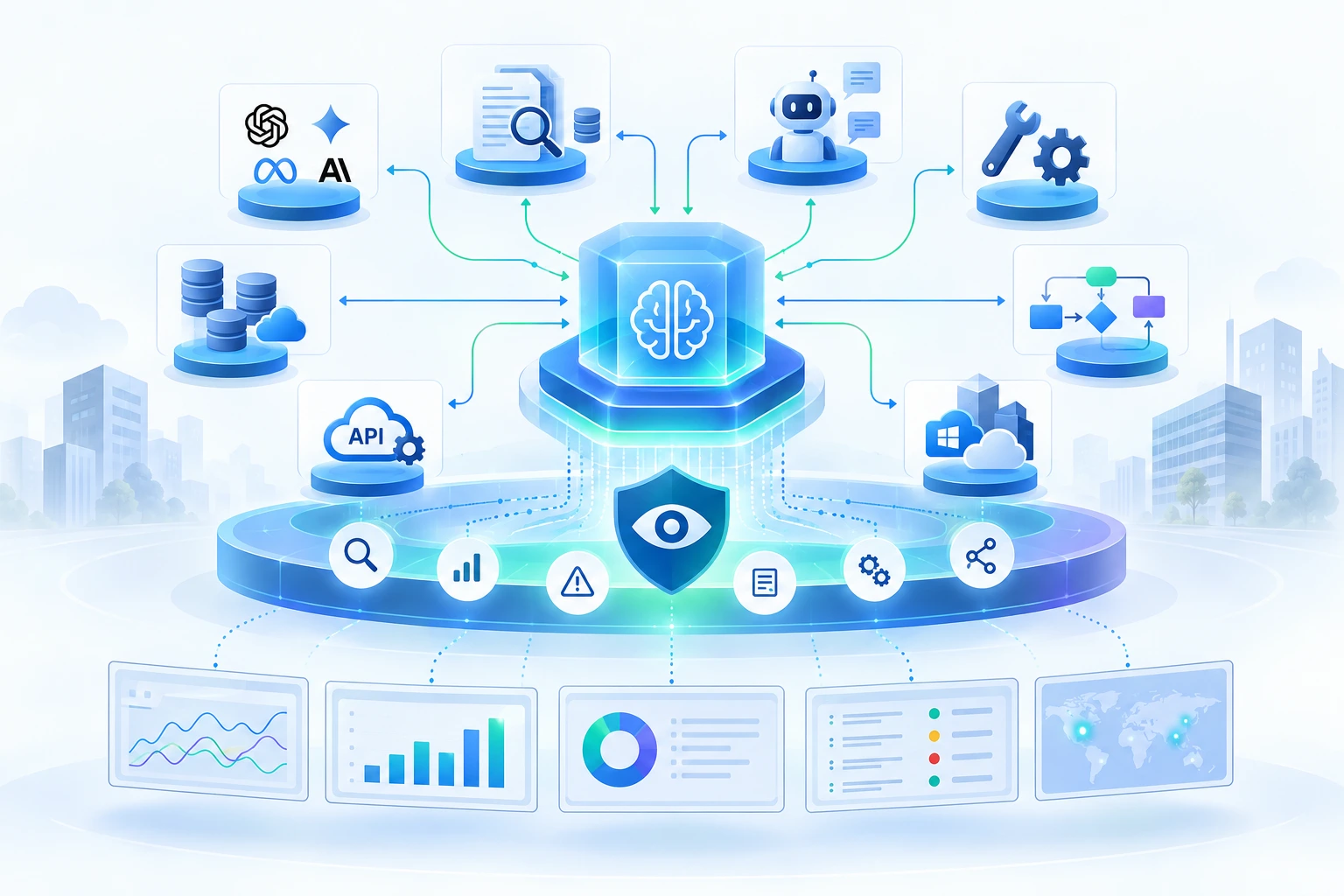
AI-native platforms are architected around an integrated AI ecosystem that includes:
Machine learning models
Foundation models and LLMs
Vector databases for semantic retrieval
Retrieval-Augmented Generation (RAG)
AI agents and orchestration frameworks
Continuous model monitoring (MLOps)
Cloud-native infrastructure
Real-time data pipelines
Together, these components enable applications to reason, generate content, automate workflows, and learn from every interaction.
Rather than following predefined rules, AI-native applications evolve as they process new data and user feedback.
Characteristics of AI-native applications
AI-native systems typically:
Place AI at the center of application architecture
Continuously learn from enterprise data
Adapt workflows dynamically
Support intelligent decision-making
Scale efficiently using cloud-native infrastructure
Enable autonomous and agentic AI capabilities
This architecture allows organizations to create products that become more intelligent over time instead of requiring constant manual enhancements.
Examples of AI-native applications
AI-native products span a growing range of enterprise use cases:
Conversational AI assistants powered by large language models
AI coding assistants that understand developer intent
Autonomous driving platforms that continuously learn from sensor data
AI research assistants that synthesize information instead of simply retrieving documents
AI-native customer service platforms capable of autonomous issue resolution
Without AI, these applications would not function.
Why AI-native matters
As enterprises move beyond experimentation toward enterprise-wide AI adoption, AI-native architectures provide the flexibility required to support intelligent automation, AI agents, hyper-personalization, and continuous innovation.
Instead of simply improving existing workflows, AI-native applications create entirely new ways of working, enabling organizations to automate complex decisions, accelerate product innovation, and deliver adaptive customer experiences at scale.
Enterprise takeaway: AI-native applications are best suited for organizations building next-generation digital products where intelligence, adaptability, and continuous learning are core business capabilities rather than optional features.
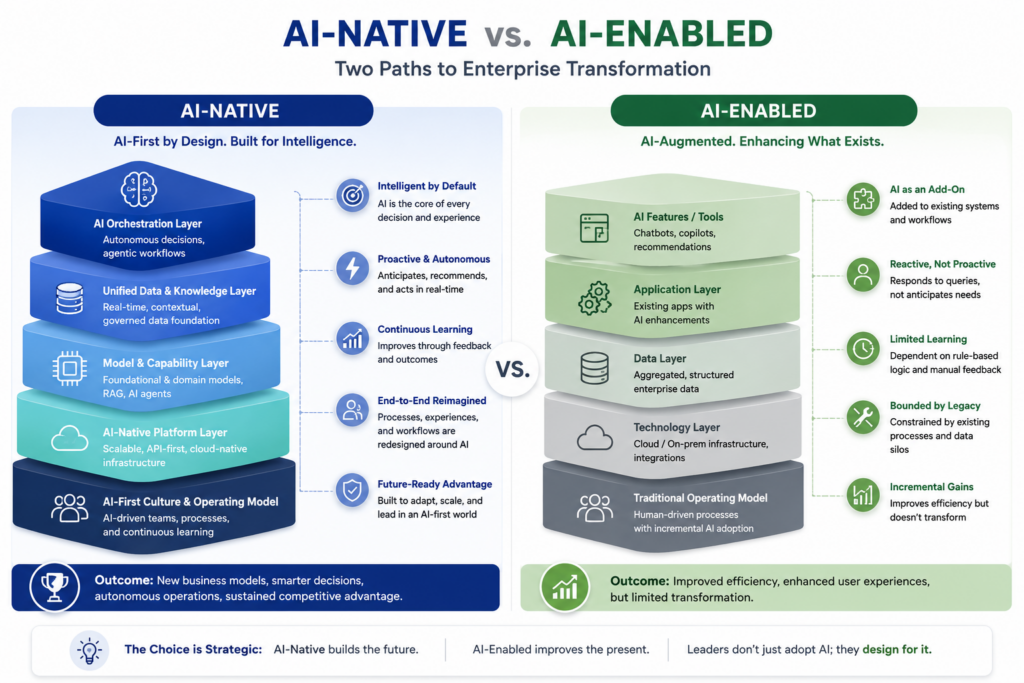
AI-Native vs. AI-Enabled: Understanding the Key Differences
1. Architecture
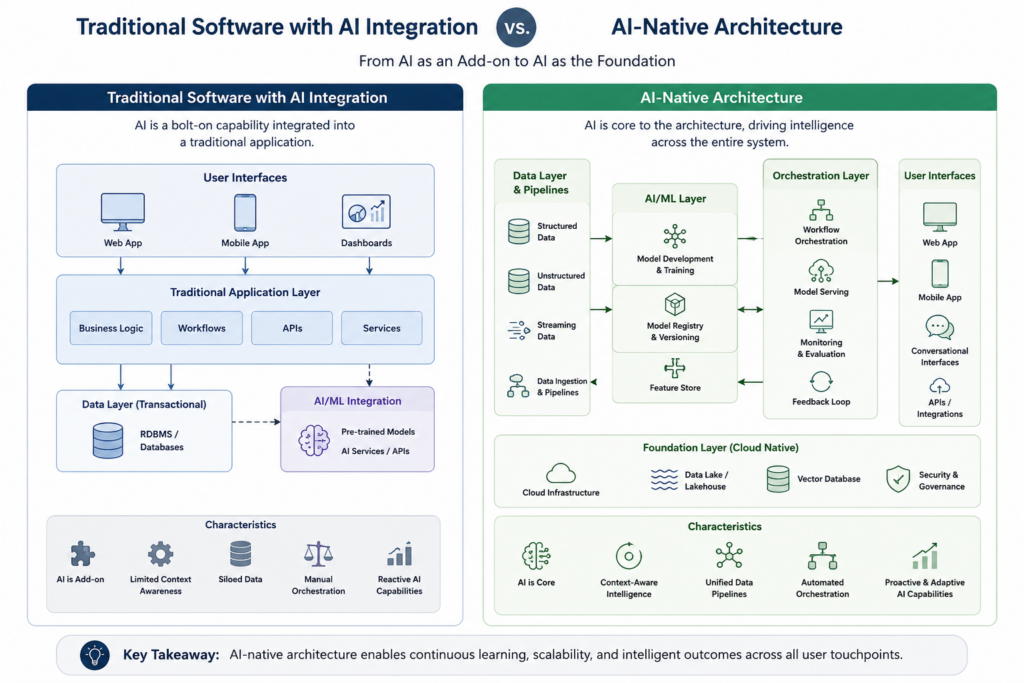
AI-enabled applications add AI to existing software, while AI-native applications are architected around AI from the beginning.Architecture is one of the most significant differentiators.
AI-enabled systems typically integrate AI services through APIs, cloud platforms, or middleware. The core application remains unchanged, and AI functions as an enhancement layer. This approach works well for extending the life of existing enterprise systems without requiring a complete redesign.
AI-native applications, by contrast, are built around AI from day one. Data pipelines, machine learning models, inference engines, orchestration layers, and user experiences are designed as a unified ecosystem. Intelligence is embedded throughout the application, enabling it to evolve as new data becomes available.
Enterprise takeaway: If your business relies heavily on legacy systems, AI enablement offers a practical modernization path. If you’re building a new digital platform, AI-native architecture provides greater flexibility and future scalability.
2. Data Strategy
AI-enabled applications use data to improve existing processes, while AI-native applications treat data as the engine of continuous learning.
In AI-enabled environments, enterprise data supports specific use cases such as forecasting, recommendations, or automation. Data improves individual features but doesn’t fundamentally change how the application operates.
AI-native systems are designed around continuous data ingestion and learning. Every interaction, transaction, and feedback signal becomes an opportunity to refine models, improve predictions, and personalize experiences.
This creates a feedback loop where the application becomes smarter over time.
Enterprise takeaway: Organizations with strong data governance and modern data platforms are better positioned to realize the full value of AI-native architectures.
3. Scalability
AI-enabled systems scale by adding more AI capabilities, while AI-native systems scale intelligence across the entire application.
Scaling AI-enabled applications often requires integrating additional models, APIs, or automation tools. As the number of AI use cases grows, integration complexity, maintenance effort, and operational costs can increase.
AI-native platforms are designed to support expanding datasets, evolving models, and growing user demands without fundamentally changing the underlying architecture.
This makes AI-native systems more resilient as organizations adopt advanced capabilities such as AI agents, multimodal AI, or autonomous workflows.
4. Innovation
AI-enabled applications optimize existing workflows, while AI-native applications create entirely new ways of working. Most AI-enabled initiatives focus on improving efficiency by automating repetitive tasks or enhancing decision support.
AI-native applications unlock new business models by enabling capabilities that were previously impossible, such as intelligent assistants, autonomous operations, adaptive user experiences, and generative content creation.
Rather than making existing software faster, AI-native products redefine what software can do.
AI-enabled projects typically generate value through productivity gains, cost reduction, and improved customer experiences.AI-native initiatives create strategic differentiation by enabling continuous innovation, faster product development, intelligent automation, and AI-driven business models.
For many organizations, AI enablement represents the first phase of a broader AI transformation journey.
Real-World Examples of AI-Enabled and AI-Native Applications
Understanding the distinction becomes easier when viewed through practical examples.
Organization
AI Approach
Why?
Microsoft 365 Copilot
AI-Enabled
AI enhances existing productivity applications.
Salesforce Einstein
AI-Enabled
AI improves CRM workflows without replacing the platform.
Adobe Acrobat AI Assistant
AI-Enabled
AI summarizes and analyzes documents within an existing application.
OpenAI ChatGPT
AI-Native
The application is fundamentally powered by large language models.
Perplexity AI
AI-Native
AI-driven search and reasoning define the product experience.
Waymo
AI-Native
Autonomous driving depends entirely on AI-powered perception and decision-making.
These examples demonstrate that AI-enabled products extend existing capabilities, whereas AI-native products depend on AI for their core functionality.
Which Approach Should Enterprises Choose
The right choice depends on your organization’s digital maturity, business objectives, technology landscape, and AI ambitions.
There is no one-size-fits-all answer. Many organizations will adopt both approaches at different stages of their AI journey.
Choose AI-enabled if your organization:
Relies on legacy enterprise systems
Wants faster AI adoption with lower implementation risk
Needs to improve operational efficiency
Has limited AI expertise
Is focused on short-term productivity gains
Choose AI-native if your organization:
Is building new digital products or platforms
Has a modern cloud and data infrastructure
Wants AI to become a core business capability
Plans to deploy AI agents and autonomous workflows
Views AI as a long-term competitive differentiator
Decision framework: If your goal is to optimize existing operations, AI-enabled solutions are often the right starting point. If your goal is to create new business value through intelligence, AI-native development is the better long-term strategy.
Can AI-Enabled Applications Become AI-Native?
Short answer: Yes—but the transition requires architectural modernization, data readiness, and a shift from AI integration to AI-first design.
Most enterprises won’t become AI-native overnight. Instead, they evolve through a phased transformation.
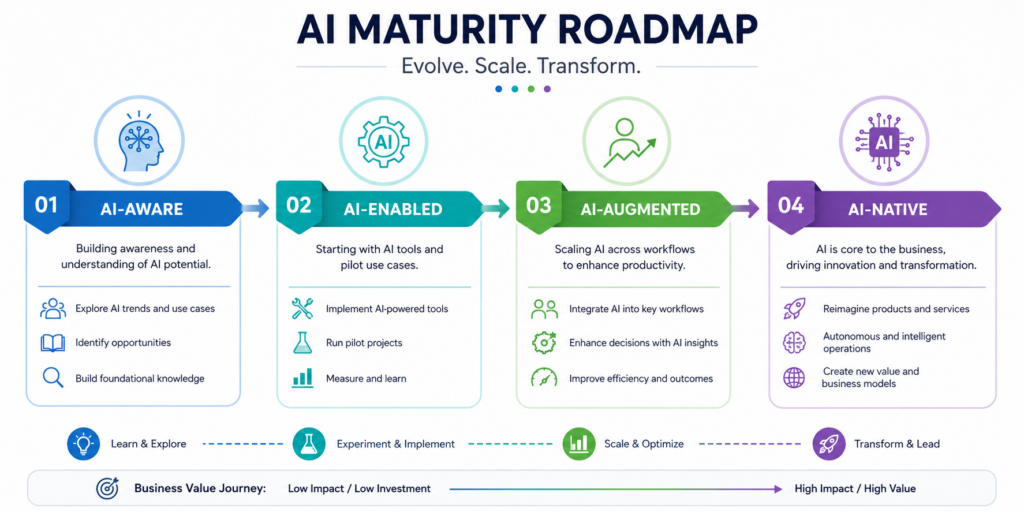
A Practical AI Maturity Journey
Stage
Focus
Outcome
Stage 1: AI-Aware
Experiment with AI tools and copilots
Improved productivity
Stage 2: AI-Enabled
Integrate AI into existing applications
Automated workflows and better decision support
Stage 3: AI-Augmented
Standardize AI across business functions
Connected AI experiences and enterprise governance
Stage 4: AI-Native
Design applications around AI-first principles
Continuous learning, intelligent automation, and adaptive products
This progression enables organizations to build AI capabilities while minimizing disruption and maximizing return on investment.
Best Practices for Transitioning to an AI-Native Enterprise
Moving from AI-enabled to AI-native requires more than deploying new models—it requires rethinking how software, data, and business processes work together.
Consider the following best practices:
Modernize your data architecture to enable real-time, high-quality data access.
Establish robust AI governance to ensure security, compliance, and responsible AI practices.
Invest in MLOps to streamline model deployment, monitoring, and lifecycle management.
Design modular, cloud-native applications that can integrate evolving AI capabilities.
Prioritize high-value use cases where AI can transform customer experiences or operational efficiency.
Foster cross-functional collaboration between business leaders, product teams, data engineers, and AI specialists.
Enterprise takeaway: Becoming AI-native is not a single technology project—it is an organizational transformation that combines modern architecture, trusted data, responsible AI governance, and continuous innovation.
The Future of Enterprise AI: From AI-Enabled to AI-Native
Short answer: Most enterprises will continue using AI-enabled solutions in the near term, but the long-term trajectory points toward AI-native architectures that embed intelligence into every layer of the business.
The rapid adoption of generative AI, large language models (LLMs), and AI agents is changing how organizations design software and deliver digital experiences. Rather than simply automating existing workflows, enterprises are increasingly reimagining applications around intelligent systems that can reason, learn, and adapt.
Several trends are accelerating this shift:
AI agents are moving beyond task automation to orchestrate complex, multi-step business workflows.
Retrieval-Augmented Generation (RAG) is enabling AI applications to securely access enterprise knowledge and deliver context-aware responses.
Multimodal AI is combining text, images, audio, and video to create richer customer and employee experiences.
Cloud-native AI platforms are simplifying the deployment and scaling of AI models across the enterprise.
Responsible AI and governance are becoming essential to ensure transparency, compliance, and trust in AI-driven decisions.
As these technologies mature, the distinction between AI-enabled and AI-native will become even more important. Organizations that invest in modern data platforms, AI-ready architectures, and responsible AI practices will be better positioned to innovate at scale.
Enterprise takeaway: AI-enabled solutions are an effective starting point, but AI-native architectures are likely to define the next generation of enterprise software and digital transformation.
How Techment Helps Enterprises Build AI-Ready Businesses
At Techment, we help organizations move beyond AI experimentation to enterprise-scale adoption. From integrating AI into existing applications to designing AI-native platforms powered by generative AI, AI agents, and modern data architectures, our teams work with clients to build secure, scalable, and business-focused AI solutions.
Whether your goal is to modernize legacy systems, develop AI-powered products, or create an AI-first digital strategy, adopting the right architecture today can unlock sustainable innovation and long-term competitive advantage.
Conclusion
The conversation around enterprise AI is no longer about whether to adopt AI—it’s about how to adopt it strategically.
For organizations with established technology ecosystems, AI-enabled applications offer a practical way to improve productivity, automate routine processes, and deliver immediate business value without disrupting existing operations. They provide a strong foundation for organizations beginning their AI journey.
However, as AI becomes central to business strategy, many enterprises will find that incremental enhancements alone are not enough. Building intelligent, adaptive, and scalable digital products requires a shift toward AI-native architectures, where AI is embedded into the core of the application rather than layered on afterward.
The most successful organizations won’t view AI-enabled and AI-native as competing approaches. Instead, they’ll see them as different stages of an AI maturity journey—using AI-enabled solutions to modernize today while investing in AI-native capabilities that will drive tomorrow’s innovation.
Whether you’re modernizing legacy systems, launching AI-powered products, or developing an enterprise AI roadmap, success depends on aligning technology investments with long-term business objectives, data readiness, and responsible AI practices.
Key Takeaways
AI-enabled applications improve existing software by integrating AI capabilities such as copilots, predictive analytics, and automation.
AI-native applications are built with AI at their core, enabling continuous learning, adaptability, and intelligent decision-making.
AI-enabled solutions provide a faster, lower-risk path to enterprise AI adoption.
AI-native architectures support long-term innovation, autonomous workflows, and AI-first business models.
Most organizations will progress from AI-enabled to AI-native as their AI maturity, data capabilities, and business needs evolve.
Frequently Asked Questions (FAQs)
1. What is the main difference between AI-native and AI-enabled?
AI-enabled applications integrate AI into existing software to enhance specific capabilities, whereas AI-native applications are built with AI as the core foundation of the product. In AI-native systems, intelligence drives the application’s primary functionality rather than serving as an additional feature.
2 Is AI-native better than AI-enabled?
Not necessarily. The right approach depends on your business goals. AI-enabled solutions are ideal for modernizing legacy systems quickly and cost-effectively, while AI-native applications are better suited for organizations building AI-first products or pursuing long-term digital transformation.
3. Can an AI-enabled application become AI-native?
Yes. Many organizations begin by adding AI capabilities to existing systems and gradually evolve toward AI-native architectures by modernizing their data platforms, redesigning application architectures, and embedding AI into core business processes.
4. Which industries benefit most from AI-native applications?
Industries with large volumes of data, dynamic decision-making, and customer-centric operations often gain the greatest value. These include healthcare, financial services, retail, manufacturing, logistics, telecommunications, and software-as-a-service (SaaS).
5. Are AI-native applications more expensive to build?
AI-native applications generally require a higher upfront investment due to modern infrastructure, data engineering, model development, and AI governance requirements. However, they often deliver greater long-term value through continuous learning, automation, and scalability.
6. Is generative AI always AI-native?
No. A business can integrate generative AI into an existing application, making it AI-enabled. Generative AI becomes AI-native when it forms the core capability of the product and is central to how the application delivers value.
7. Should enterprises replace legacy systems with AI-native applications?
Not always. A phased modernization strategy is often the most practical approach. Enterprises can start with AI-enabled enhancements to existing systems while building AI-native capabilities for new digital products and strategic initiatives.
8. How do AI agents fit into AI-native applications?
AI agents are a natural extension of AI-native architectures. They can plan, reason, and execute multi-step tasks autonomously by combining large language models, enterprise data, and workflow orchestration, enabling more adaptive and intelligent business processes.
The Techment Editorial Team collaborates with subject matter experts, architects, consultants, and technology leaders to create practical insights on AI, data engineering, cloud modernization, Microsoft Fabric, analytics, and enterprise transformation.