An AI-first enterprise embeds artificial intelligence into business processes, products, and decision-making instead of treating AI as a standalone technology. It combines trusted data, intelligent automation, governance, and continuous learning to improve operational efficiency, customer experience, innovation, and business agility at enterprise scale.
Introduction
Artificial intelligence is transforming enterprise operations from rule-based automation to intelligent decision-making. While automation improves efficiency, an AI-first enterprise uses data, machine learning, generative AI, and decision intelligence to optimize operations, enhance customer experiences, and create new business value.
Building an AI-first enterprise requires more than deploying AI models. It demands a modern data foundation, scalable AI infrastructure, responsible governance, and an operating model where humans and AI collaborate to make faster, better decisions.
This guide explains what an AI-first enterprise is, why traditional automation is no longer sufficient, the technologies that enable enterprise AI, and a practical framework for implementing AI at scale.
TL;DR
- An AI-first enterprise embeds AI into business operations, products, and decision-making rather than treating it as a standalone technology initiative.
- Traditional automation follows predefined rules, while AI-powered systems continuously learn, adapt, and optimize outcomes.
- Success depends on five capabilities: trusted data, scalable AI infrastructure, intelligent automation, responsible AI governance, and an AI-driven operating model.
- Organizations should focus on business outcomes instead of isolated AI pilots.
- Enterprises that operationalize AI effectively improve productivity, decision quality, innovation, and customer experience while building long-term competitive advantage.
What Is an AI-First Enterprise?
An AI-first enterprise integrates artificial intelligence into every critical business function, enabling systems to assist or automate decisions using real-time data, predictive analytics, and generative AI. Rather than using AI for isolated projects, intelligence becomes a core capability across operations, products, and customer experiences. According to McKinsey – The State of AI, while 88% of global organizations report using AI in at least one business function, only 33% have successfully scaled it enterprise-wide. This gap underscores a critical transition challenge: moving beyond siloed automation toward holistic intelligence.
For many organizations, digital transformation focused on automating repetitive tasks using technologies such as Robotic Process Automation (RPA), workflow engines, and Business Process Management (BPM). While these investments improved operational efficiency, they were largely designed to execute predefined rules rather than respond to changing business conditions.
An AI-first enterprise moves beyond task automation by embedding intelligence into enterprise workflows. Machine learning models identify patterns, large language models (LLMs) interpret unstructured information, AI agents automate complex workflows, and decision intelligence platforms recommend or execute actions based on business objectives.
Instead of asking: “How can we automate this process?”
AI-first organizations ask:
“How can AI improve this decision?”
This shift fundamentally changes how enterprises operate, innovate, and compete.
Read our blog on How to Build AI-Ready Data Foundations.
Characteristics of an AI-First Enterprise
An AI-first organization typically demonstrates several defining characteristics:
| Traditional Enterprise | AI-First Enterprise |
|---|---|
| Data supports reporting | Data continuously drives decisions |
| Automation executes rules | AI recommends and automates decisions |
| Siloed business systems | Connected enterprise AI ecosystem |
| Reactive operations | Predictive and adaptive operations |
| Periodic business insights | Real-time decision intelligence |
| AI projects | Enterprise-wide AI operating model |
The transition is not simply about deploying more AI models. It requires rethinking enterprise architecture, governance, business processes, and organizational culture so intelligence becomes part of everyday operations.
Why Isn’t Traditional Automation Enough?
Traditional automation improves efficiency by executing predefined rules. AI extends automation by learning from data, adapting to changing conditions, and continuously improving business outcomes.
Automation has delivered measurable value over the past decade by reducing manual effort, improving consistency, and accelerating business processes. However, rule-based systems operate only within predefined scenarios. They cannot interpret ambiguity, recognize emerging patterns, or optimize decisions when business conditions change.
For example:
- An automated invoice processing system validates invoices against predefined business rules.
- An AI-powered finance platform detects anomalies, predicts payment delays, prioritizes collections, and recommends actions before problems occur.
The difference is significant. Automation executes processes. AI optimizes decisions.
Watch: The Future of Decision Intelligence Copilots
Explore how AI copilots are evolving from information assistants into intelligent decision partners
As enterprises generate larger volumes of structured and unstructured data, decision-making has become a competitive differentiator. Organizations increasingly require systems that can combine historical trends, real-time signals, business context, and predictive analytics to support faster and more accurate decisions.
This is why many enterprises are evolving from process automation to decision intelligence, where AI actively assists employees, augments business operations, and enables autonomous workflows.
Automation vs. AI-First Enterprises
| Capability | Traditional Automation | AI-First Enterprise |
| Primary Goal | Process efficiency | Business intelligence |
| Decision Making | Rule-based | Data-driven and predictive |
| Adaptability | Low | High |
| Learning | Static workflows | Continuous learning |
| Intelligence | Limited | Embedded across operations |
| Business Value | Cost reduction | Growth, innovation, resilience, and customer experience |
Organizations that remain focused solely on automation risk creating faster processes without making better decisions. AI-first enterprises combine automation with intelligence, enabling systems to optimize outcomes rather than simply execute tasks.
Know more about AI Orchestration vs Traditional Workflow Automation.
What Technologies Power an AI-First Enterprise?
Enterprise AI depends on an integrated technology stack that combines trusted data, scalable infrastructure, advanced AI models, governance, and continuous operations. No single technology creates an AI-first enterprise; value comes from how these capabilities work together.
Modern AI-first organizations build a connected ecosystem rather than isolated AI projects.
1. Enterprise Data Platform
High-quality data remains the foundation of every successful AI initiative. Organizations require integrated data platforms that consolidate structured and unstructured data from enterprise applications, cloud services, IoT devices, and external sources while maintaining governance and quality.
2. Data Fabric and Data Mesh
Modern data architectures improve data accessibility without requiring complete centralization.
- Data Fabric creates a unified layer for discovering, integrating, and governing enterprise data.
- Data Mesh decentralizes ownership while maintaining standardized governance across business domains.
Together, these architectures improve scalability and accelerate AI adoption.
3. Foundation Models and Large Language Models
Foundation models power capabilities such as document understanding, enterprise search, code generation, knowledge management, conversational AI, and intelligent assistants.
These models become significantly more valuable when connected to enterprise data through Retrieval-Augmented Generation (RAG), enabling responses grounded in proprietary business knowledge.
4. Intelligent Automation and AI Agents
Modern AI agents extend traditional automation by planning tasks, interacting with applications, retrieving information, and making context-aware decisions.
Instead of automating a single activity, AI agents orchestrate entire business workflows across multiple enterprise systems.
5. MLOps, LLMOps, and AI Observability
Operationalizing AI requires continuous monitoring, governance, and lifecycle management.
Leading organizations establish:
- MLOps pipelines for machine learning deployment
- LLMOps practices for generative AI applications
- AI observability platforms to monitor model quality, bias, performance, and compliance
These capabilities ensure enterprise AI remains accurate, secure, and trustworthy as business conditions evolve.
Read our blog on AI-Native Engineering Explained: The Enterprise Guide to AI-Driven Software Development
The Five Pillars of an AI-First Enterprise
Successful AI-first organizations build five interconnected capabilities rather than pursuing isolated AI initiatives. Together, these pillars create the foundation for enterprise-scale intelligence.
1. Trusted Data Foundation
Every AI system depends on accurate, governed, and accessible data.
Organizations should prioritize:
- Enterprise data governance
- Master data management
- Data quality monitoring
- Metadata management
- Secure data sharing
- Real-time data pipelines
Without trusted data, even the most advanced AI models produce unreliable outcomes.
2. Scalable AI Platform
An enterprise AI platform provides the infrastructure required to build, deploy, monitor, and scale AI solutions consistently across the organization.
Core capabilities include:
- Cloud-native infrastructure
- Model management
- Vector databases
- API orchestration
- Feature stores
- Model registries
- Enterprise security
A standardized platform reduces duplication while accelerating AI deployment.
3. Intelligent Automation and Decision Intelligence
The greatest business value comes from combining automation with AI-powered decision support.
Examples include:
- Predictive maintenance
- Intelligent customer service
- Dynamic pricing
- Demand forecasting
- Fraud detection
- Supply chain optimization
These systems continuously improve by learning from operational data and user feedback.
4. Responsible AI Governance
Enterprise AI must be transparent, explainable, secure, and compliant.
Effective governance includes:
- AI risk management
- Bias detection
- Explainability
- Human oversight
- Regulatory compliance
- Model monitoring
- Auditability
Responsible AI builds trust while reducing operational and regulatory risk.
5. AI-Driven Operating Model
Technology alone does not create an AI-first enterprise.
Organizations also need:
- Executive sponsorship
- Cross-functional AI governance
- AI Centers of Excellence (CoEs)
- Workforce upskilling
- Change management
- Business ownership of AI outcomes
The most successful enterprises treat AI as a strategic business capability rather than an isolated technology initiative.
Explore more in our blog on The 30-60-90 Day Enterprise AI Readiness Roadmap For Enterprise AI Success.
AI-First Enterprise Reference Architecture
An AI-first enterprise requires an integrated architecture that connects data, AI models, business applications, governance, and continuous learning. Rather than deploying isolated AI solutions, organizations should build a reusable AI platform that supports enterprise-wide innovation.
A modern AI architecture enables intelligence to flow seamlessly across business functions, ensuring AI applications can securely access trusted data, generate insights, and automate decisions at scale.
Reference Architecture
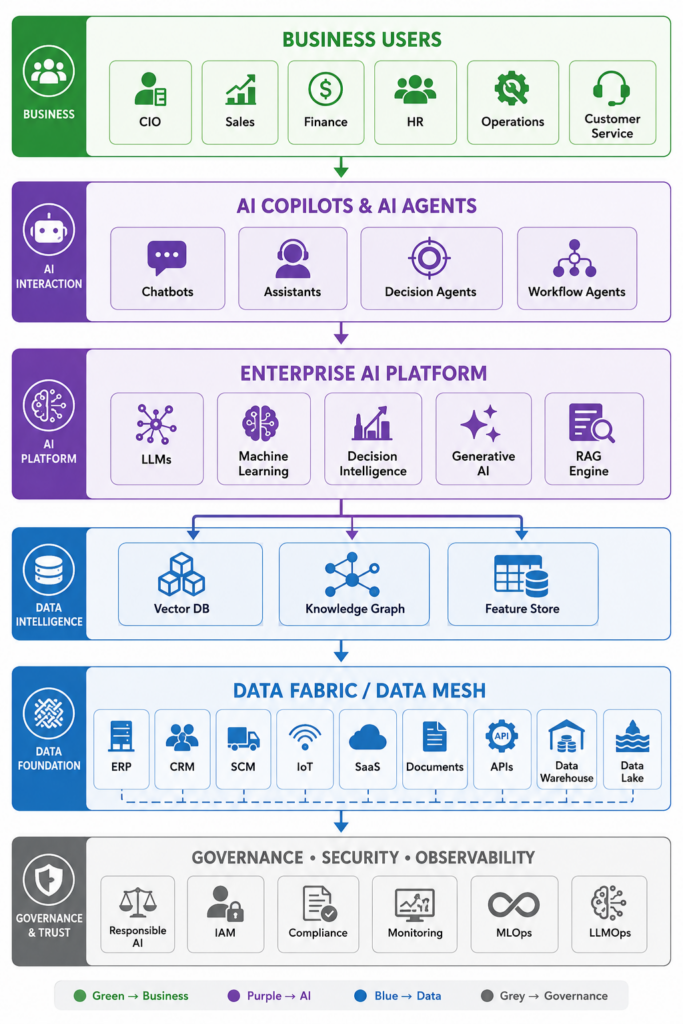
| Layer | Purpose | Key Technologies |
|---|---|---|
| Business Applications | Deliver AI-powered business outcomes | ERP, CRM, SCM, HRMS, Customer Portals |
| AI Experience Layer | Conversational AI, copilots, AI agents | AI Assistants, Agentic AI, Chatbots |
| AI Platform | Model development, deployment, orchestration | ML Platforms, LLM Platforms, AI Gateways |
| Intelligence Layer | Prediction and reasoning | Machine Learning, LLMs, RAG, Decision Intelligence |
| Knowledge Layer | Enterprise knowledge retrieval | Vector Databases, Knowledge Graphs, Feature Stores |
| Data Layer | Unified enterprise data | Data Fabric, Data Mesh, Data Lakehouse |
| Infrastructure Layer | Scalable compute | Hybrid Cloud, Kubernetes, GPUs, Edge Computing |
| Governance Layer | Security and compliance | Responsible AI, IAM, AI Observability, MLOps, LLMOps |
Key Architecture Principles
- Build reusable AI capabilities instead of project-specific solutions.
- Separate data, AI, and application layers for scalability.
- Enable secure access to enterprise knowledge using RAG.
- Continuously monitor AI performance through MLOps and AI observability.
- Embed governance throughout the AI lifecycle rather than after deployment.
A modular architecture reduces technical debt while enabling faster experimentation and enterprise-wide AI adoption.
Steps To Build an AI-First Enterprise
Successful AI transformation is a business modernization initiative—not simply an AI implementation project. Organizations that scale AI successfully follow a structured roadmap that aligns technology investments with measurable business outcomes.
Step 1. Assess AI Readiness
Begin with a comprehensive assessment of organizational readiness.
Evaluate:
- Business priorities
- Data maturity
- Technology landscape
- Governance capabilities
- AI skills
- Executive sponsorship
The goal is to identify high-value opportunities while understanding capability gaps.
Step 2. Build a Trusted Data Foundation
Before deploying AI, establish a reliable data ecosystem.
Priorities include:
- Data governance
- Data quality management
- Metadata management
- Master Data Management (MDM)
- Enterprise data catalog
- Real-time data integration
Poor-quality data remains the leading cause of failed AI initiatives.
Step 3. Prioritize High-Impact Use Cases
Avoid deploying AI everywhere.
Instead, prioritize initiatives with:
- Clear business value
- Measurable ROI
- Available data
- Executive sponsorship
- Cross-functional impact
Prioritization Matrix
| Business Value | Implementation Complexity | Priority |
|---|---|---|
| High | Low | Immediate |
| High | High | Strategic |
| Low | Low | Opportunistic |
| Low | High | Defer |
This approach helps organizations deliver quick wins while building long-term AI capabilities.
Step 4. Build an Enterprise AI Platform
Rather than creating isolated AI solutions, establish a shared platform that provides:
- Model development
- AI gateways
- API management
- Feature stores
- Vector databases
- Prompt management
- Security controls
- Monitoring
A common platform accelerates development and reduces operational complexity.
Step 5. Operationalize AI with MLOps and LLMOps
Deploying a model is only the beginning.
Enterprise AI requires continuous:
- Model monitoring
- Drift detection
- Retraining
- Performance optimization
- Compliance monitoring
- Prompt evaluation
- Version management
Operational excellence ensures AI systems remain accurate, reliable, and secure over time.
Step 6. Scale Across Business Functions
Once foundational capabilities are established, expand AI across the enterprise.
Typical adoption areas include:
- Customer Service
- Sales
- Marketing
- Finance
- Procurement
- HR
- Manufacturing
- Supply Chain
- IT Operations
Scaling becomes significantly easier when business units share common platforms, governance, and reusable AI assets.
Step 7. Govern Responsibly
AI governance should evolve alongside AI adoption.
Organizations should define:
- Risk frameworks
- Ethical AI policies
- Human approval workflows
- Explainability standards
- Regulatory compliance
- Data privacy controls
Responsible AI builds trust among customers, employees, and regulators.
Step 8. Continuously Improve
AI-first enterprises treat AI as an evolving capability rather than a completed project.
Continuous improvement includes:
- Monitoring business KPIs
- Expanding successful use cases
- Retraining models
- Capturing user feedback
- Optimizing AI adoption
- Measuring ROI
The most successful organizations build feedback loops that allow both AI systems and business processes to improve over time.
Read expert insights in our blog on Legacy Modernization Services in 2026: How Enterprises Are Cutting Costs with AI.
AI-First Enterprise Maturity Model
AI maturity is determined by how deeply intelligence is embedded into business operations—not by the number of AI models deployed.
| Maturity Level | Characteristics |
|---|---|
| Level 1 – Manual | Human-driven processes with minimal automation |
| Level 2 – Automated | Rule-based automation across business functions |
| Level 3 – AI-Assisted | AI supports employees with recommendations and insights |
| Level 4 – AI-Driven | AI actively automates decisions within defined guardrails |
| Level 5 – Autonomous Enterprise | AI continuously optimizes workflows with human oversight |
Organizations should assess their current maturity before defining transformation goals.
Enterprise AI Use Cases
AI-first enterprises create value by combining predictive analytics, generative AI, automation, and decision intelligence across business functions.
| Industry | AI Use Case | Business Outcome |
|---|---|---|
| Retail | Demand forecasting, dynamic pricing, inventory optimization | Improved margins and reduced stockouts |
| Manufacturing | Predictive maintenance, visual inspection, production optimization | Lower downtime and higher operational efficiency |
| Financial Services | Fraud detection, risk modeling, intelligent underwriting | Faster decisions and reduced financial risk |
| Healthcare | Clinical decision support, patient engagement, operational planning | Better patient outcomes and resource utilization |
| Energy & Utilities | Predictive asset maintenance, demand forecasting | Improved reliability and lower maintenance costs |
| Telecommunications | Network optimization and predictive maintenance | Reduced outages and better service quality |
| Logistics | Route optimization and warehouse automation | Lower transportation costs and faster delivery\ |
Build vs. Buy vs. Partner: Choosing the Right AI Strategy
There is no universal approach to enterprise AI. The right strategy depends on business objectives, technical capabilities, budget, and time-to-value.
| Approach | Best For | Advantages | Limitations |
|---|---|---|---|
| Build | Organizations with strong AI engineering capabilities | Maximum customization and IP ownership | Higher investment and longer implementation time |
| Buy | Standard business use cases | Faster deployment and lower operational complexity | Limited flexibility and vendor dependence |
| Partner | Enterprises pursuing strategic AI transformation | Faster innovation, reduced delivery risk, access to specialized expertise | Success depends on selecting the right implementation partner |
For many enterprises, a hybrid approach—combining commercial AI platforms with custom-built capabilities delivered alongside experienced implementation partners—offers the best balance of speed, flexibility, and long-term scalability.
Read further in our blog on Build vs Buy AI in 2026: The Ultimate Enterprise Strategy Guide for Faster ROI, Control, and Scalable Innovation
AI-First Enterprise Readiness Checklist
Before launching an enterprise AI initiative, confirm that your organization can answer “Yes” to most of these questions:
- Do we have executive sponsorship for AI initiatives?
- Is our enterprise data governed and trusted?
- Have we identified measurable business use cases?
- Do we have an AI governance framework?
- Can our infrastructure support AI workloads?
- Are MLOps or LLMOps capabilities in place?
- Have we established AI security and compliance controls?
- Is there a plan for workforce upskilling and change management?
- Do we have KPIs to measure AI business impact?
- Can successful AI solutions be scaled across business units?
Organizations that address these foundational capabilities are significantly better positioned to move from experimentation to enterprise-wide AI adoption.
Our blog on Cost Optimization Strategies for LLM Deployments: The Ultimate Enterprise Playbook for Scalable AI in 2026 provides a comprehensive enterprise playbook covering architecture, governance, infrastructure, and operational best practices
What Challenges Do Enterprises Face When Becoming AI-First?
Most AI initiatives fail because organizations focus on technology instead of business readiness. Data quality, governance, change management, and scalability—not AI models—are the biggest barriers to enterprise adoption.
Understanding these challenges early helps organizations design scalable AI operating models instead of isolated proof-of-concept projects.
| Challenge | Business Impact | Best Practice |
|---|---|---|
| Poor data quality | Inaccurate predictions and unreliable insights | Implement enterprise data governance and quality frameworks |
| Legacy systems | Slow AI adoption and integration complexity | Modernize using APIs, cloud-native services, and data fabrics |
| Skills gap | Low adoption and limited business value | Upskill teams and establish an AI Center of Excellence (CoE) |
| Lack of governance | Compliance, security, and reputational risks | Adopt Responsible AI policies and model governance |
| Pilot-to-production gap | High experimentation with limited ROI | Standardize deployment using MLOps and reusable AI platforms |
| Organizational resistance | Delayed transformation and poor adoption | Align leadership, business teams, and IT through structured change management |
Common Mistakes to Avoid
Many enterprises repeat the same avoidable mistakes during AI transformation:
- Starting with technology instead of business outcomes.
- Building isolated AI pilots with no enterprise roadmap.
- Ignoring data quality and governance.
- Measuring technical metrics instead of business KPIs.
- Underestimating organizational change management.
- Treating AI as an IT initiative rather than a business transformation program.
Organizations that address these issues early are significantly more likely to scale AI successfully across business functions.
How Do You Measure the Success of an AI-First Enterprise?
The success of an AI-first enterprise should be measured by business outcomes, operational improvements, and organizational adoption—not simply by the number of AI models deployed.
Enterprise AI KPI Framework
| KPI Category | Example Metrics |
|---|---|
| Business Impact | Revenue growth, operating margin, cost reduction, customer lifetime value |
| Operational Efficiency | Cycle time reduction, automation rate, productivity improvements |
| Decision Intelligence | Forecast accuracy, decision latency, AI-assisted decisions, recommendation acceptance rate |
| Adoption & Scale | AI users, business units adopting AI, production AI applications |
| Governance & Trust | Model explainability, compliance audits, bias incidents, model uptime |
Organizations should establish baseline measurements before deployment and continuously track progress to demonstrate business value.
Why Should Enterprises Become AI-First Now?
AI is rapidly becoming a competitive necessity rather than a technology differentiator. Organizations that operationalize AI today are better positioned to improve productivity, accelerate innovation, and respond to changing market conditions.
Several market trends are accelerating enterprise AI adoption:
1. Generative AI Has Become Enterprise-Ready
Large language models, AI copilots, and agentic AI systems are moving beyond experimentation into enterprise production, enabling knowledge management, software development, customer support, and business process automation.
2. Data Volumes Continue to Grow
Organizations generate massive amounts of structured and unstructured data every day. AI enables enterprises to transform this data into actionable insights that would be impossible to analyze manually.
3. Decision Speed Has Become a Competitive Advantage
Markets change faster than traditional planning cycles. AI-powered decision intelligence enables organizations to respond to operational, customer, and market signals in near real time.
4. AI Is Reshaping Enterprise Operating Models
Modern enterprises are embedding AI across products, operations, customer experiences, and internal workflows. Rather than replacing employees, AI augments human expertise by automating repetitive work and supporting faster, better-informed decisions.
The organizations that invest in AI strategically today will be better positioned to adapt to future business and technology shifts.
How Techment Helps Enterprises Become AI-First
Building an AI-first enterprise requires more than technology implementation. It requires a strategic partner capable of aligning business objectives, modern data platforms, AI engineering, and governance into a scalable operating model.
Techment helps organizations accelerate AI transformation through end-to-end consulting and implementation services.
Our Core Capabilities
Organizations partner with Techment because we combine expertise in AI, cloud, data engineering, enterprise software development, and digital transformation.
Our delivery approach focuses on:
- Business-first AI strategy
- Enterprise-scale architecture
- Responsible AI governance
- Cloud-native implementation
- Reusable AI platforms
- Measurable business outcomes
Whether modernizing existing operations or building AI-native products, Techment helps enterprises accelerate time-to-value while minimizing implementation risk.
Talk to our experts to get details on comprehensive solutions that help you accelerate your digital transformation journey. Contact Us.
Key Takeaways
- AI-first enterprises embed intelligence across business operations rather than deploying isolated AI projects.
- Success depends on trusted data, scalable AI platforms, governance, and organizational readiness.
- AI transformation is an ongoing business capability—not a one-time technology initiative.
- Organizations should prioritize measurable business outcomes over model complexity.
- Responsible AI practices are essential for building trust, compliance, and long-term scalability.
Conclusion
Automation transformed enterprise efficiency by eliminating repetitive work. The next phase of digital transformation is about enabling systems to analyze information, recommend actions, and support intelligent decision-making at scale.
An AI-first enterprise combines trusted data, modern AI platforms, intelligent automation, and responsible governance to create a continuously learning organization. Rather than replacing human expertise, AI augments it—helping teams make faster, more informed decisions while improving operational resilience and customer experiences.
Organizations that invest in strong data foundations, scalable AI architecture, and enterprise-wide governance today will be better positioned to innovate, adapt, and compete in an increasingly AI-driven economy.
For enterprises beginning or accelerating this journey, a structured roadmap, measurable KPIs, and experienced implementation partners can significantly reduce risk and improve time-to-value.
Our AI & Data Readiness Assessment helps organizations identify critical gaps in data quality, infrastructure, and organizational readiness, transforming uncertainty into a clear path forward before it becomes a costly setback.
Frequently Asked Questions
1. What is an AI-first enterprise?
An AI-first enterprise embeds artificial intelligence into business processes, decision-making, products, and customer experiences so that AI becomes a core business capability rather than a standalone technology initiative.
2. How is an AI-first enterprise different from traditional automation?
Traditional automation follows predefined business rules, while AI-first enterprises use machine learning, generative AI, and predictive analytics to continuously learn, adapt, and improve decisions based on real-time data.
3. What technologies are required to build an AI-first enterprise?
Core technologies include enterprise data platforms, data fabrics, cloud infrastructure, machine learning platforms, large language models (LLMs), Retrieval-Augmented Generation (RAG), vector databases, AI agents, MLOps, and AI governance frameworks.
4. How long does AI transformation typically take?
Enterprise AI transformation is a continuous journey rather than a fixed-duration project. Many organizations begin realizing value through targeted use cases within months while expanding AI capabilities over several years.
5. What industries benefit most from becoming AI-first?
AI delivers measurable value across industries including healthcare, financial services, retail, manufacturing, energy, utilities, telecommunications, logistics, and public sector organizations.
6. How can organizations measure AI maturity?
AI maturity can be assessed by evaluating data readiness, governance, AI adoption across business functions, operational integration, decision automation, and measurable business outcomes.
7. What is the biggest barrier to enterprise AI adoption?
The biggest challenge is rarely AI technology itself. Most organizations struggle with fragmented data, governance gaps, legacy infrastructure, and organizational change management.
8. What role does Responsible AI play?
Responsible AI ensures enterprise AI systems are transparent, secure, explainable, fair, and compliant with evolving regulatory and organizational requirements. It builds trust while reducing operational and compliance risks.
Related Reads
- AI Orchestration vs Traditional Workflow Automation
- AI Orchestration Platforms: The Enterprise Guide to Coordinating AI at Scale in 2026
- Legacy Modernization Services in 2026: How Enterprises Are Cutting Costs with AI
- Top AI Workflow Orchestration Tools in 2026 for Enterprise Scale
- AI- Native Application Engineering
- AI-Powered Customer Journey Orchestration in Retail: A CTO’s Guide for 2026
- AI Agent Evaluation Frameworks Compared: Choosing the Right Platform for Enterprise AI in 2026