Introduction
Artificial intelligence is transforming how enterprises operate, but AI initiatives are only as effective as the data that powers them. Despite significant investments in AI platforms and cloud technologies, many organizations struggle to move beyond pilot projects because their data ecosystems lack the trust, governance, and scalability required for enterprise adoption.
AI-ready data foundations provide the structure needed to support analytics, machine learning, generative AI, and intelligent automation at scale. They combine high-quality data, embedded governance, modern architecture, and business-aligned modernization to ensure AI systems produce reliable outcomes while meeting regulatory and operational requirements.
This guide explores why data readiness has become the defining factor for enterprise AI success and outlines a practical framework for building a trusted foundation that accelerates innovation while reducing risk.
TL;DR
- AI success depends more on trusted data than advanced AI models.
- Four capabilities—data quality, governance, architecture, and modernization—form the foundation of enterprise AI.
- Organizations that operationalize data trust improve AI adoption, governance, and operational efficiency.
- A phased modernization strategy delivers faster business value than large-scale technology replacement.
Why AI-Ready Data Foundations Matter
Enterprise AI has moved beyond experimentation. Organizations are deploying AI-powered copilots, predictive analytics, intelligent automation, and generative AI to improve decision-making and operational efficiency. However, many initiatives fail to deliver measurable business outcomes because the underlying data is fragmented, inconsistent, or poorly governed.
The challenge is rarely a lack of data. Most enterprises generate vast amounts of information across ERP systems, CRM platforms, cloud applications, operational databases, IoT devices, and external sources. The real challenge is ensuring that this data is accurate, trusted, accessible, and governed consistently across the organization.
Without a strong data foundation, AI models inherit existing data problems. Poor-quality inputs lead to inaccurate predictions, governance gaps increase compliance risk, and disconnected systems slow innovation. As organizations scale AI, these issues become more expensive and more difficult to resolve.
Research reinforces this challenge. 97% of organizations have active AI initiatives, but only 5% believe their data is ready to support AI at enterprise scale, according to a 2026 survey by Dun & Bradstreet. Enterprise analytics leaders increasingly identify data readiness as the largest constraint to scaling AI initiatives.
Building AI-ready data foundations enables enterprises to move beyond isolated AI pilots and establish a scalable environment where trusted data supports business decisions, operational resilience, and continuous innovation.
Explore the most critical enterprise AI agent adoption challenges, including data readiness, governance complexity, orchestration issues, ROI ambiguity, and organizational resistance
Watch the Webinar: Learn how Decision Intelligence AI Copilots help business leaders transform enterprise data into faster, smarter decisions using Microsoft Azure AI and modern enterprise architecture.
What Are AI-Ready Data Foundations?
AI-ready data foundations are the combination of data management capabilities, governance practices, and modern architecture that allow organizations to develop, deploy, and scale AI with confidence.
Rather than focusing solely on technology, they establish the operational discipline required to ensure enterprise data is reliable, reusable, and aligned with business objectives.
An AI-ready data foundation enables organizations to:
- Deliver trusted data for AI and analytics.
- Standardize governance across business domains.
- Improve data quality through continuous monitoring.
- Support secure access to enterprise information.
- Scale AI initiatives without creating duplicate pipelines or unnecessary complexity.
Business Value of AI-Ready Data Foundations
| Capability | Business Outcome |
|---|---|
| Trusted data quality | More accurate AI insights and predictions |
| Embedded governance | Improved compliance and lower operational risk |
| Modern data architecture | Faster delivery of AI and analytics initiatives |
| Reusable data products | Reduced duplication and lower infrastructure costs |
| Scalable modernization | Faster innovation with measurable business value |
For enterprise leaders, AI readiness is no longer a technical objective. It is a business capability that determines how effectively organizations can adopt AI while maintaining trust, security, and operational efficiency.
Organizations exploring scalable AI foundations should first evaluate their understanding and for a deep dive take a read of the blog on Fabric AI Readiness: How to Prepare Your Data for Scalable AI Adoption
Is Your Enterprise AI-Ready?
Many organizations believe they’re ready for AI because they’ve invested in cloud platforms, analytics tools, or machine learning initiatives. Yet AI adoption often stalls because the underlying data foundation lacks the consistency and governance needed to scale.
The table below highlights common indicators that your organization may need to strengthen its data foundation before expanding enterprise AI.
| If your organization… | Your data foundation may need attention |
|---|---|
| Struggles to trust reports or dashboards | ✓ |
| Rebuilds data pipelines for every project | ✓ |
| Has unclear data ownership | ✓ |
| Relies on manual data validation | ✓ |
| Finds governance difficult to enforce | ✓ |
| Experiences rising cloud costs without measurable value | ✓ |
| Cannot scale AI beyond pilot projects | ✓ |
If several of these challenges sound familiar, the issue may not be your AI strategy—it may be the data foundation supporting it.
Before beginning implementation, organizations should evaluate their current maturity using a structured AI readiness checklist to identify gaps across data, governance, technology, security, and workforce capabilities.
The Four Capabilities Every AI-Ready Enterprise Needs
Organizations that successfully scale AI consistently strengthen four interconnected capabilities:
- Data Quality to ensure enterprise data is accurate, complete, and trusted.
- Data Governance to embed security, compliance, and accountability into daily operations.
- Modern Data Architecture to enable reusable data products and scalable analytics.
- Business-Driven Modernization to align technology investments with measurable business outcomes.
Rather than treating these as separate initiatives, leading enterprises develop them together as part of a long-term strategy for trusted AI.
Building an AI-ready data foundation isn’t about adopting another platform—it’s about creating an environment where data can be trusted, governed, and reused across the enterprise.
The four capabilities below provide the foundation for scalable AI adoption.
1. Data Quality: Build Trust in Every AI Decisi
AI is only as reliable as the data behind it. Inaccurate, inconsistent, or outdated data leads to unreliable insights, poor model performance, and low confidence in AI-driven decisions.
Rather than treating data quality as a one-time cleanup exercise, leading organizations continuously monitor critical datasets and resolve issues before they affect business outcomes.
Key focus areas
- Continuous data quality monitoring
- Business-defined quality standards
- Automated validation and alerts
- Clear ownership for critical datasets
Business outcome: Reliable AI insights, improved decision-making, and reduced operational rework.
2. Data Governance: Enable AI with Confidence
Governance is often viewed as a barrier to innovation, but effective governance does the opposite—it enables teams to use trusted data securely and consistently.
Instead of relying on policy documents alone, AI-ready organizations embed governance into everyday workflows through metadata, lineage, role-based access, and standardized business definitions.
Key focus areas
- Role-based access controls
- Enterprise business glossary
- Data lineage and traceability
- Metadata-driven governance
Business outcome: Faster access to trusted data while improving security, compliance, and accountability.
3. Modern Data Architecture: Design for Scale
Enterprise AI depends on an architecture that supports reuse rather than duplication. Legacy environments often require custom integrations for every initiative, increasing costs and slowing delivery.
Modern data architectures simplify this complexity by creating reusable data products, standardized integration patterns, and interoperable platforms that can evolve with changing business needs.
Key focus areas
- Reusable data products
- Standardized integration patterns
- Hybrid and multi-cloud support
- Centralized metadata and observability
Business outcome: Faster AI deployment, lower operational costs, and greater scalability across business functions.
4. Business-Driven Modernization: Focus on Outcome
Successful modernization isn’t measured by the number of systems migrated—it’s measured by business value delivered.
Rather than replacing legacy systems all at once, leading enterprises modernize incrementally, prioritizing initiatives that improve decision-making, operational efficiency, and AI readiness.
Key focus areas
- Outcome-first modernization roadmap
- Incremental implementation
- Shared governance and architecture standards
- Continuous optimization
Business outcome: Faster time-to-value, reduced transformation risk, and a scalable foundation for future AI initiatives.
Learn how governance impacts AI success: Data Governance For Data Quality
A Practical Framework for Building AI-Ready Data Foundations
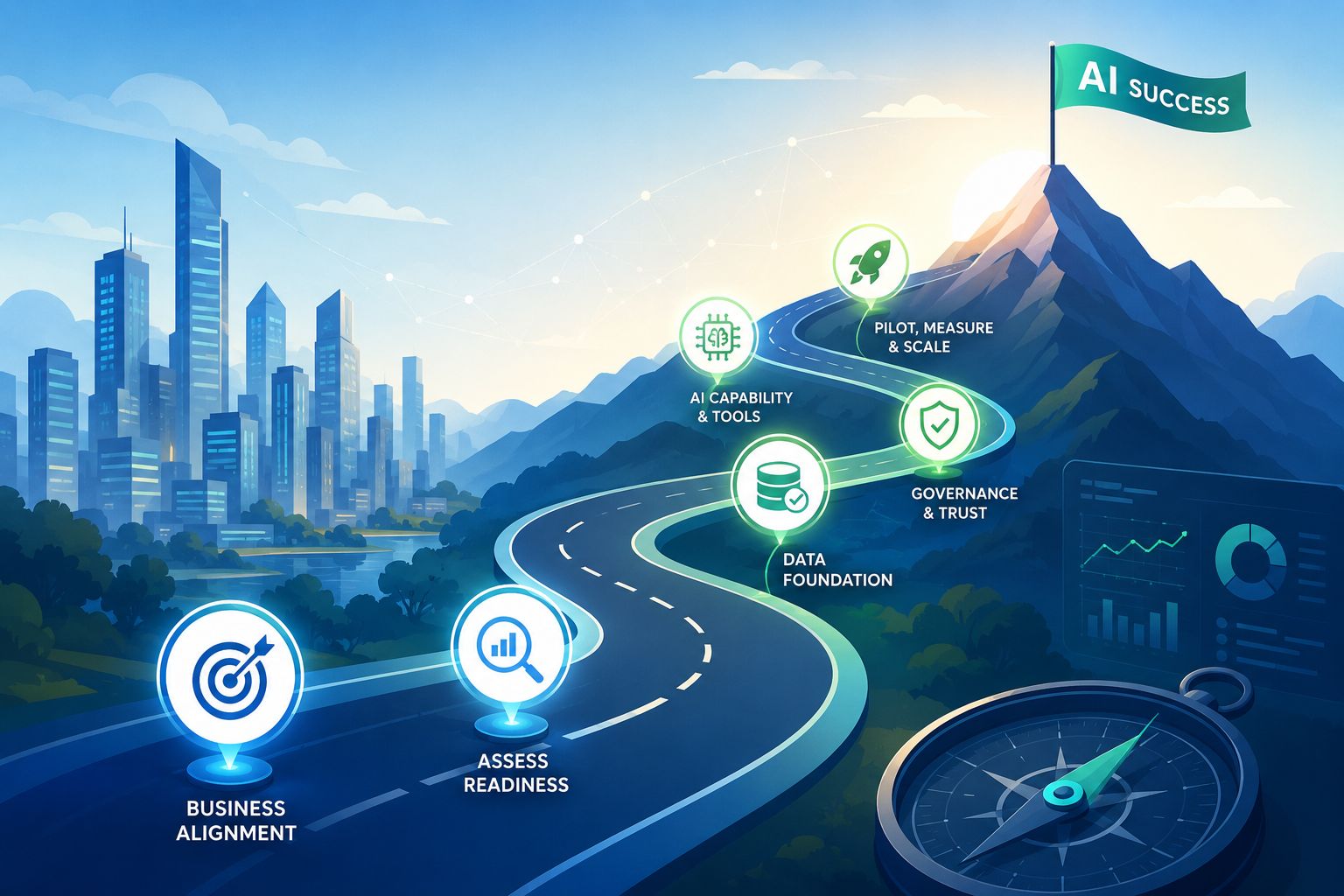
Building an AI-ready enterprise doesn’t require a complete technology overhaul. Organizations typically make faster progress by taking an incremental, business-led approach.
| Step | What to Do | Business Outcome |
|---|---|---|
| Assess | Evaluate data quality, governance, architecture, and current AI readiness | Identify gaps and prioritize investments |
| Prioritize | Focus on high-value business domains such as customer, finance, or operations | Deliver measurable business impact faster |
| Govern | Establish ownership, business definitions, lineage, and access controls | Build trust and improve compliance |
| Modernize | Standardize reusable data platforms, pipelines, and integration patterns | Reduce complexity and improve scalability |
| Scale | Expand AI initiatives using trusted, reusable data products | Accelerate enterprise-wide AI adoption |
This phased approach helps organizations improve data readiness while minimizing disruption and ensuring modernization efforts remain aligned with business priorities.
Read our blog on How to Assess Data Quality Maturity: Your Enterprise Roadmap
Common Mistakes That Slow AI-Ready Data Foundations
Many AI initiatives fail not because of technology limitations, but because organizations overlook foundational data capabilities.
Common pitfalls include:
- Treating governance as documentation instead of embedding it into workflows.
- Building duplicate data pipelines instead of reusable data products.
- Measuring project success by technology deployments rather than business outcomes.
- Modernizing infrastructure without improving data quality or governance.
- Waiting for a complete transformation before scaling AI.
Avoiding these mistakes allows organizations to establish a stronger foundation for analytics, automation, and enterprise AI.
Measuring Success
As AI initiatives mature, organizations should measure progress using business-focused metrics rather than technical outputs alone.
| KPI | Why It Matters |
|---|---|
| Data quality score | Measures trust in enterprise data |
| Trusted datasets | Indicates AI readiness across business domains |
| Pipeline reuse rate | Reflects architectural maturity and efficiency |
| Metadata and lineage coverage | Improves governance and discoverability |
| AI deployment time | Measures operational agility |
| Cloud cost per workload | Tracks modernization efficiency |
Tracking these indicators helps enterprise leaders understand whether their data foundation is improving AI readiness while delivering measurable business value.
Read our expert insights in our blog – The 30-60-90 Day Enterprise AI Readiness Roadmap For Enterprise AI Success
Conclusion
Enterprise AI success is built on trusted data—not technology alone.
Organizations that invest in data quality, governance, modern architecture, and business-driven modernization create the foundation needed to scale AI confidently, improve decision-making, and reduce operational complexity. Rather than pursuing large-scale transformations, a phased approach enables teams to deliver measurable value while continuously strengthening enterprise data capabilities.
As AI adoption accelerates, the organizations that succeed will be those that treat data as a strategic business asset. Building an AI-ready data foundation today helps enterprises unlock more reliable insights, support responsible AI, and create a scalable platform for future innovation.
Ready to assess your organization’s AI readiness? Techment helps enterprises build trusted data foundations that accelerate AI adoption, improve governance, and modernize data platforms. Connect with our experts to discuss your data and AI strategy.
Frequently Asked Questions – FAQs
1. How do enterprises build AI-ready data foundations?
Enterprises build AI-ready data foundations by strengthening four core areas: data quality, governance, architecture, and modernization. Trusted AI depends on reliable, reusable, governed enterprise data.
2. Why do enterprise AI initiatives fail?
Most failures stem from poor data readiness, fragmented systems, weak governance, and inconsistent quality rather than limitations in AI models themselves.
3. What is the most important component of AI readiness?
Trusted data quality is foundational, but scalability requires alignment between governance, reusable architecture, and modernization.
4. How long does it take to become AI-ready?
Enterprise timelines vary, but most organizations see meaningful progress within 6–18 months through phased modernization and domain prioritization.
5. Should organizations modernize before adopting AI?
Not necessarily. Most enterprises succeed through incremental modernization aligned with business priorities instead of delaying AI entirely.
Related Reads
- Enterprise AI Strategy in 2026
- Data Quality for AI in 2026: The Ultimate Blueprint for Accuracy, Trust & Scalable Enterprise Adoption
- Microsoft Fabric Architecture: A CTO’s Guide to Modern Analytics & AI
- AI-Ready Enterprise Checklist for Microsoft Fabric
- Leveraging Data Transformation for Modern Analytics