Introduction: Why AI-Native Engineering Is No Longer Optional
Software engineering is undergoing one of the most important transformations since the rise of cloud computing. For decades, enterprise software development relied on a familiar pattern: engineers manually wrote code, QA teams validated releases, DevOps handled deployments, and architects managed infrastructure complexity. While tools evolved, the underlying workflow remained largely human-driven.
That model is quietly changing. In this guide, we explore how AI-native engineering is reshaping enterprise software development, where organizations are seeing measurable value, the governance risks leaders must address, and what it takes to build an AI-ready engineering organization.
TL;DR
- AI-native engineering is fundamentally changing software development, embedding artificial intelligence into every phase of the SDLC.
- Enterprises are moving beyond experimentation toward AI-assisted coding, automated testing, intelligent observability, and autonomous software operations.
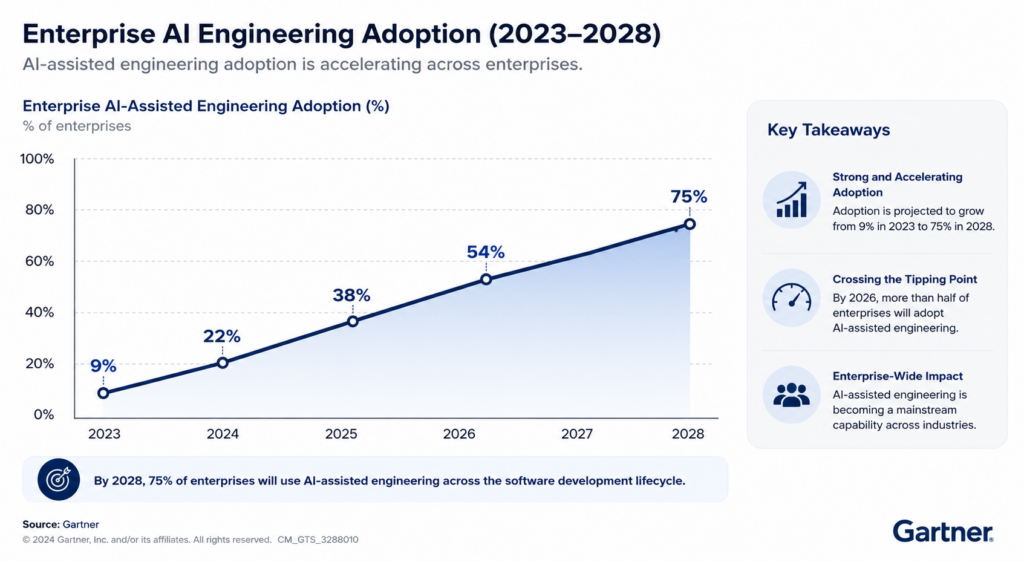
- By 2028, 75% of enterprise engineers are expected to use AI coding assistants daily, according to Gartner.
- The shift is not just technological—it is changing engineering operating models, governance frameworks, talent strategies, and software economics.
- Organizations that successfully adopt AI-native engineering will likely outperform competitors on speed, resilience, innovation, and cost efficiency.
Why AI-Native Engineering Is Becoming an Enterprise Imperative
The pressure on enterprise software teams has never been greater. Today, artificial intelligence is becoming deeply embedded into how software is designed, written, tested, secured, deployed, and maintained. Code assistants generate production-ready functions. AI systems identify vulnerabilities before release. Intelligent testing platforms automatically create test cases. Observability systems predict outages before customers experience disruptions.
This shift has created what many engineering leaders now call AI-Native Engineering. Unlike traditional software development that merely adopts AI tools, AI-native engineering treats artificial intelligence as an integral participant across the software lifecycle.
According to Gartner, by 2028, 75% of enterprise software engineers are expected to use AI-powered coding assistants daily, compared with less than 10% in early 2023. The result is not simply faster coding—it is a redefinition of how software teams operate, innovate, and deliver business value.
For CTOs, engineering leaders, and enterprise architects, the critical question is no longer:
“Should we use AI?”
It is: “How do we redesign software delivery for an AI-native future?”
Business leaders demand faster innovation cycles, customers expect seamless digital experiences, cybersecurity threats continue escalating, and engineering organizations are being asked to deliver more with constrained budgets. Traditional software development methods are struggling to keep pace.
The Enterprise Delivery Gap
Many organizations still face major engineering bottlenecks:
- Lengthy development cycles
- Rising technical debt
- Talent shortages
- Software quality issues
- Slow incident resolution
- Fragmented DevOps workflows
AI-native engineering addresses these constraints by augmenting—not replacing—engineering teams.
Instead of forcing developers to spend hours debugging repetitive issues or manually writing boilerplate code, AI systems increasingly automate lower-value tasks while enabling engineers to focus on architecture, problem-solving, and innovation.
According to McKinsey, generative AI could improve engineering productivity by 20–45% in software development workflows, depending on implementation maturity.
Why Leaders Are Paying Attention
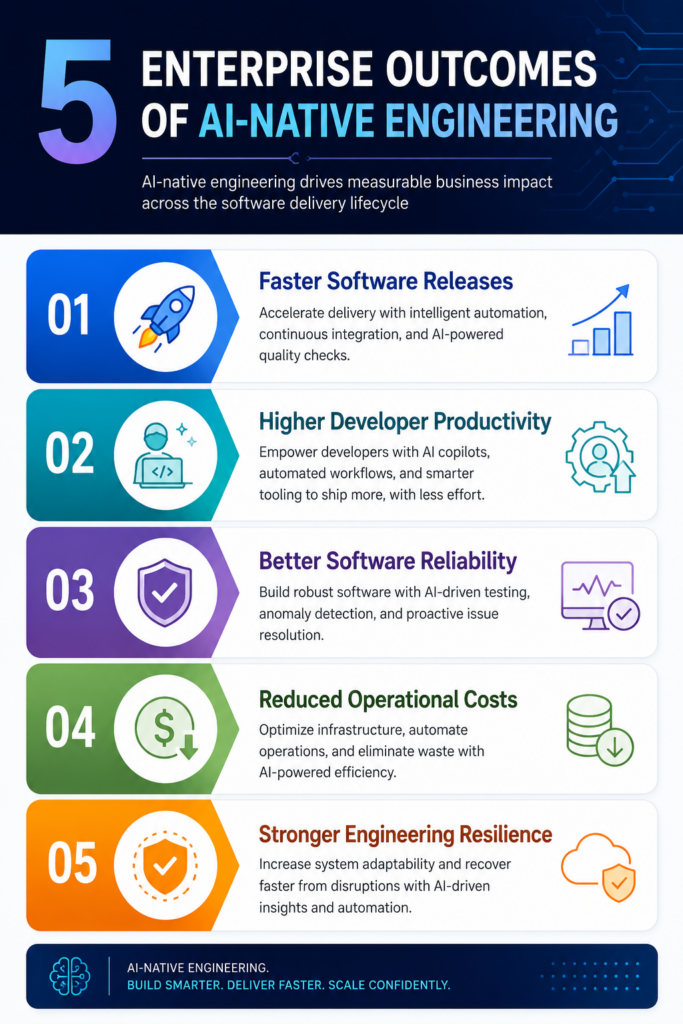
For enterprise executives, the value proposition goes far beyond productivity gains. AI-native engineering can materially improve:
- Speed to market– Applications reach customers faster.
- Developer experience– Engineers spend less time on repetitive work.
- Software quality– AI-driven testing reduces defects.
- Operational resilience– Predictive observability improves uptime.
- Cost efficiency– Automation lowers operational overhead.
This evolution aligns closely with broader enterprise modernization strategies.
Organizations modernizing cloud and analytics ecosystems are increasingly recognizing that AI-ready software delivery must sit alongside broader transformation initiatives.
For leaders evaluating enterprise AI readiness, Techment’s perspective on enterprise modernization offers useful context:
Read our blog on: Enterprise AI Strategy in 2026
What AI-Native Engineering Actually Means
The term AI-native engineering is frequently misunderstood. Many organizations mistakenly assume it refers to using coding assistants such as GitHub Copilot or ChatGPT during development. That interpretation is incomplete.
AI Tools vs AI-Native Engineering
Using AI tools does not automatically make an engineering organization AI-native. An enterprise becomes AI-native when artificial intelligence becomes embedded into the engineering operating model itself.
This means AI participates across:
- Requirements generation
- System architecture recommendations
- Code generation
- Test automation
- Security validation
- CI/CD optimization
- Incident prediction
- Performance monitoring
- Documentation generation
In essence, AI becomes a collaborative engineering layer.
From Human-Led to Intelligence-Augmented SDLC
Historically:
Humans executed. Tools assisted.
Now:
Humans orchestrate. AI collaborates.
This distinction matters because AI-native engineering changes team structures, workflows, accountability models, and governance.
Rather than assigning developers purely execution-focused tasks, enterprises increasingly position engineers as:
- System designers
- AI supervisors
- Architecture decision-makers
- Product problem-solvers
The role of engineering shifts upward in strategic value.
The Rise of the AI-Native SDLC
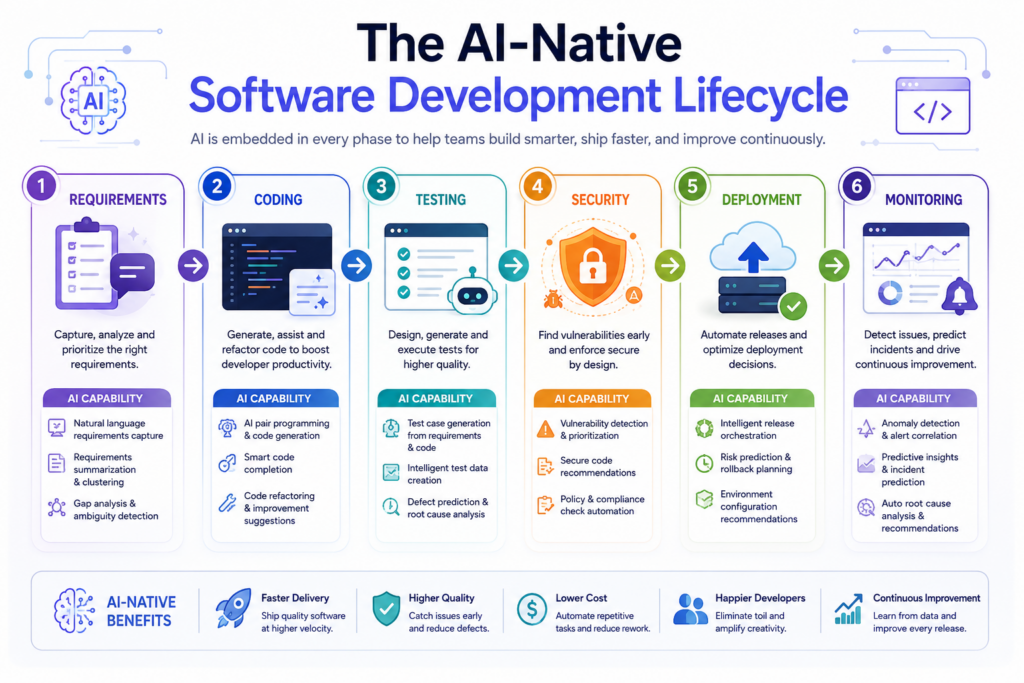
An AI-native software development lifecycle introduces intelligence at every stage:
- Planning: AI analyzes requirements.
- Development: Code assistants accelerate implementation.
- Testing: Automated QA identifies failures.
- Security: AI scans vulnerabilities.
- Deployment: Predictive release intelligence reduces risk.
- Operations: Intelligent observability prevents incidents.
How Artificial Intelligence Is Quietly Rewriting Developer Workflows
The biggest transformation in AI-native engineering is happening quietly inside daily engineering workflows. Most enterprises are not replacing developers. They are redesigning how developers work.
AI-Assisted Coding Is Becoming Standard
Code generation tools now help engineers:
- Generate repetitive code
- Explain unfamiliar codebases
- Suggest architecture patterns
- Improve documentation
- Refactor legacy systems
This dramatically reduces engineering friction. Instead of spending hours writing boilerplate functions, developers can focus on higher-order design decisions.\ However, enterprise leaders should avoid a simplistic narrative that AI merely makes engineers faster. The real value lies in reducing cognitive overload.
The Productivity Paradox
Interestingly, engineering leaders are discovering an important truth: More generated code does not automatically equal better outcomes.
Poor governance can create:
- Security vulnerabilities
- Technical debt
- Hallucinated logic
- Compliance risks
- Inconsistent architecture
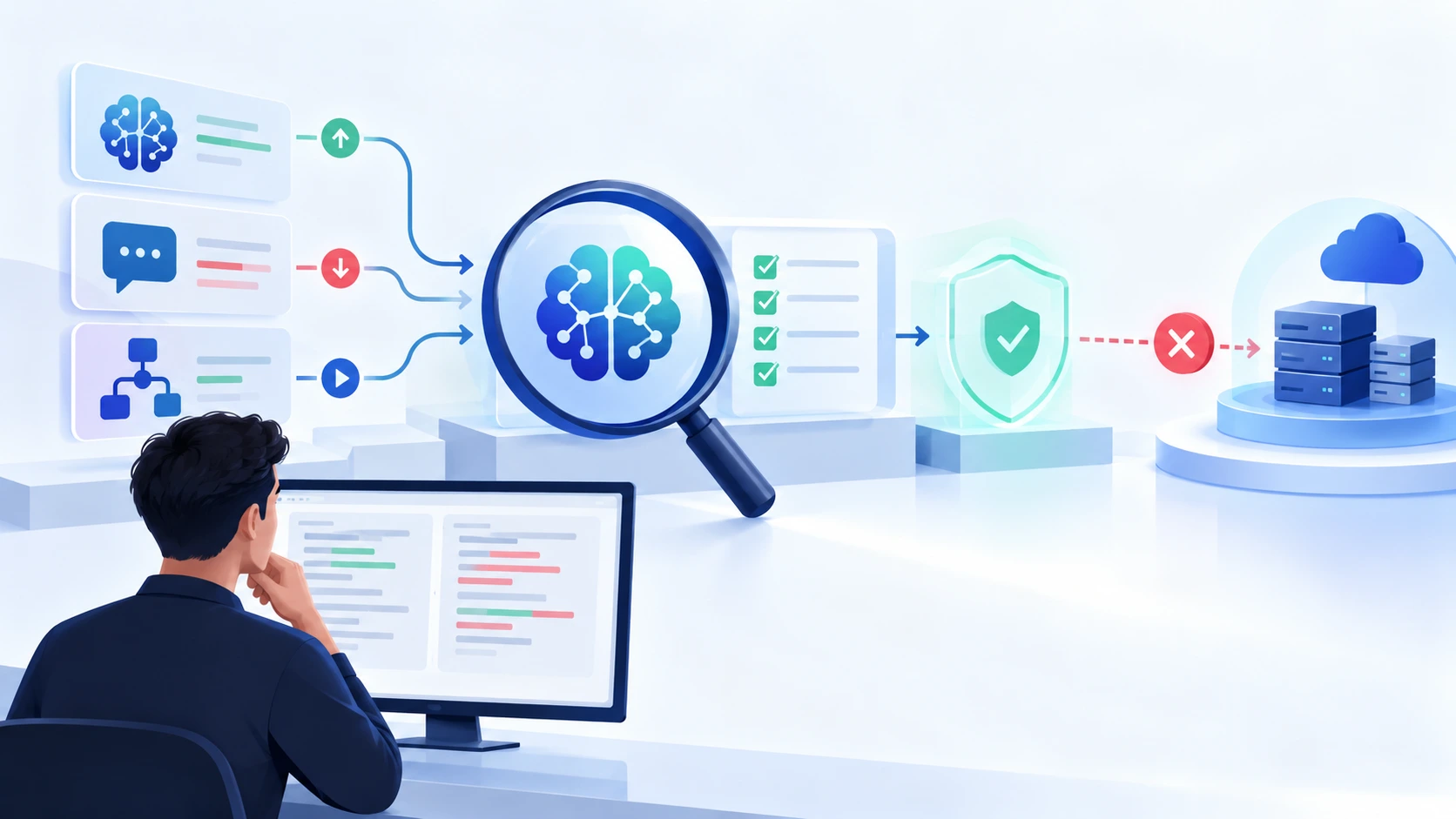
This is why leading organizations increasingly treat AI-generated code as reviewable suggestions, not autonomous production output.
Enterprise Insight: The Rise of Engineering Governance
High-performing enterprises are building governance around:
- Prompt engineering standards
- Human review workflows
- Secure AI model usage
- Approved coding assistants
- AI audit trails
This mirrors broader enterprise governance initiatives in data and AI ecosystems.
Organizations looking to operationalize trusted AI environments should also evaluate foundational governance models: Data Governance for Data Quality: Future-Proofing Enterprise Data
Traditional vs AI-Native Engineering Workflows
| Traditional Engineering | AI-Native Engineering |
|---|---|
| Manual coding | AI-assisted coding |
| Static testing | Intelligent testing |
| Reactive monitoring | Predictive monitoring |
| Manual documentation | Auto-generated knowledge |
| Human-only debugging | AI-supported debugging |
The AI-Native Software Development Lifecycle (SDLC)
The most profound shift in AI-native engineering is not happening in coding alone. It is reshaping the entire software lifecycle.
Planning & Requirements Intelligence
AI systems increasingly analyze:
- Historical requirements
- Customer tickets
- Product usage trends
- Market signals
This helps product teams prioritize smarter.
Development & Intelligent Pair Programming
Modern engineering increasingly resembles collaborative problem solving.
Developers now work alongside AI systems capable of:
- Writing functions
- Generating APIs
- Suggesting optimizations
- Creating documentation
AI-Powered Testing
Testing remains one of the most valuable enterprise use cases.
AI systems can:
- Generate test cases
- Predict failure scenarios
- Identify regressions
- Detect anomalies
This improves release confidence significantly.
Intelligent Observability & Incident Prevention
AI-native engineering extends beyond deployment. Modern observability platforms increasingly predict failures before incidents occur. Instead of waiting for outages, AI analyzes telemetry signals proactively. This shift reduces downtime and improves resilience. Organizations modernizing analytics and operational intelligence strategies increasingly connect engineering telemetry with enterprise-wide intelligence ecosystems.
Relevant perspective: Microsoft Fabric Architecture: A CTO’s Guide to Modern Analytics & AI
The New Enterprise Engineering Stack: What Changes in an AI-Native World
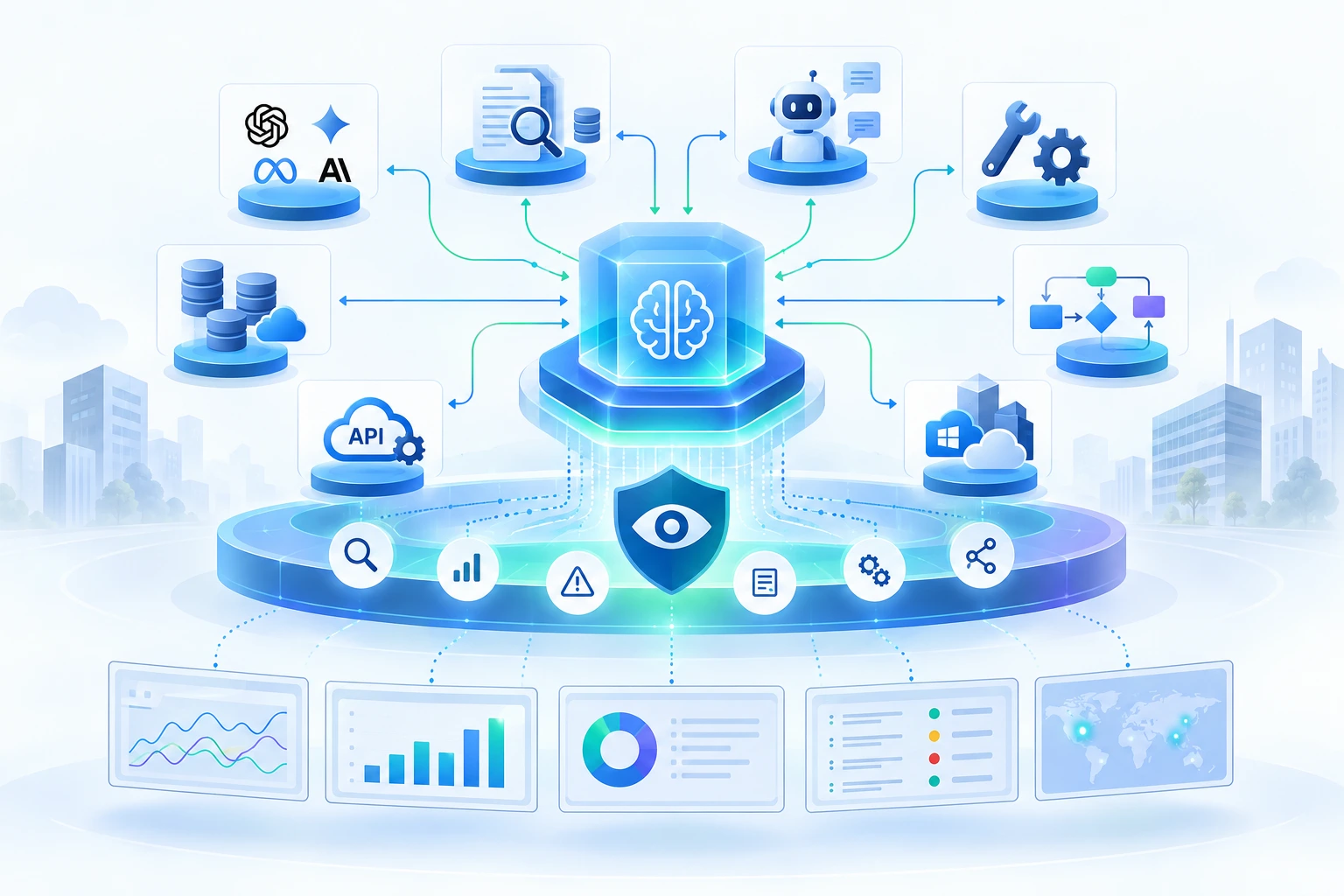
AI-native engineering introduces a new technology stack.
Traditional stack:
IDE → CI/CD → Monitoring
AI-native stack:
AI coding layer → Knowledge intelligence → Autonomous testing → Predictive operations → Governance layer
Emerging Enterprise Categories
- AI coding assistants– Accelerate implementation.
- Knowledge retrieval systems (RAG)– Provide organizational context.
- Engineering copilots– Support architecture decisions.
- Autonomous testing systems– Reduce manual QA effort.
- Observability intelligence– Improve reliability.
This is not simply tooling evolution. It represents a structural shift in enterprise software delivery. Enterprises that successfully adopt these patterns will likely create meaningful competitive advantages in engineering velocity and product innovation.
Benefits, Risks, and Trade-Offs of AI-Native Engineering
The growing adoption of AI-native engineering is not simply driven by excitement around generative AI. Enterprise leaders are embracing this shift because traditional software delivery models are increasingly struggling to meet modern business expectations. Faster release cycles, rising cybersecurity demands, engineering talent shortages, and increasing software complexity have exposed the limitations of conventional development workflows. AI-native engineering offers a new operating model—one where intelligence is embedded directly into software delivery to improve speed, resilience, and decision-making.
At the same time, organizations must recognize that AI-native engineering is not a frictionless transition. While the productivity upside is substantial, enterprises also face challenges around governance, trust, software quality, and operational control. Sustainable success comes not from adopting AI the fastest, but from implementing it responsibly and strategically.
Faster Engineering Velocity Without Sacrificing Innovation
One of the clearest benefits of AI-native engineering is accelerated software delivery. Enterprise development teams spend a disproportionate amount of time on repetitive activities such as documentation, code scaffolding, debugging, and testing. AI-assisted development reduces this burden by automating low-value tasks and enabling engineers to spend more time solving meaningful business problems.
For example, developers increasingly rely on AI coding assistants to generate boilerplate code, recommend architecture improvements, explain legacy systems, and suggest fixes during debugging. This reduces development friction and shortens release timelines without forcing teams to compromise on innovation quality. Organizations that successfully operationalize AI-native engineering often find themselves delivering products faster while maintaining stronger engineering focus on strategic priorities.
Improving Software Quality Through Intelligence-Augmented Development
Contrary to common assumptions, the most important value of AI-native engineering may not be speed—it may be software quality. Faster coding alone does not create enterprise advantage if software becomes unreliable or difficult to maintain. AI introduces meaningful improvements across testing, quality assurance, observability, and defect detection.
Modern AI-driven testing systems can automatically generate test cases, identify edge scenarios, predict regressions, and flag anomalies before deployment. Similarly, intelligent observability platforms analyze telemetry patterns to identify unusual system behavior long before outages affect customers. These capabilities reduce downtime, improve release confidence, and create more resilient digital systems.
The Governance and Security Risks Leaders Must Address
Despite its promise, AI-native engineering introduces significant governance concerns that enterprise leaders cannot afford to overlook. AI-generated code, while useful, is not inherently secure or production-ready. Developers may unknowingly introduce vulnerabilities, hardcoded credentials, outdated dependencies, or non-compliant coding patterns into enterprise systems.
The challenge becomes even more complex when organizations scale AI usage across hundreds or thousands of engineers. Without governance standards, teams may use inconsistent prompts, unapproved AI models, or unsecured external environments, increasing compliance and cybersecurity risk. This makes governance a foundational requirement rather than an optional layer.
Leading organizations are increasingly establishing enterprise guardrails around:
- Approved AI coding environments
- Security review pipelines
- Human validation checkpoints
- Model access governance
- Responsible AI standards
The most mature organizations understand a critical truth: AI-native engineering scales successfully only when trust scales alongside automation.
Enterprises operationalizing AI at scale often strengthen governance in parallel with engineering modernization to ensure sustainable adoption.
Relevant perspective: Best Practices for Generative AI Implementation in Business — A Practical Guide for Enterprises
AI-Native Teams vs Traditional Engineering Teams
Perhaps the biggest transformation introduced by AI-native engineering is organizational rather than technological. Software engineering teams themselves are evolving as artificial intelligence becomes embedded into everyday workflows. The traditional division of responsibilities across development, testing, operations, and architecture is gradually giving way to more intelligence-augmented collaboration models.
Historically, enterprise engineering teams operated through highly specialized functions. Developers wrote code, QA teams validated releases, DevOps managed deployment pipelines, and architects focused on systems design. While this model provided structure, it often slowed innovation due to siloed workflows and sequential handoffs.
In contrast, AI-native engineering encourages a more collaborative and fluid operating model where intelligence becomes part of the engineering process itself.
How Engineering Roles Are Evolving
Rather than replacing software engineers, AI is elevating the nature of engineering work. Developers are shifting away from repetitive implementation toward higher-value problem solving. Quality assurance teams increasingly focus on validating AI-generated testing strategies instead of manually executing repetitive testing cycles. Similarly, DevOps teams are transitioning toward predictive infrastructure management supported by intelligent observability systems.
This evolution means future engineering organizations will rely less on task execution and more on intelligent orchestration.
Traditional Engineering vs AI-Native Engineering Teams
| Traditional Engineering | AI-Native Engineering |
|---|---|
| Manual development | AI-assisted delivery |
| Human-driven testing | Intelligent QA automation |
| Reactive incident response | Predictive observability |
| Sequential workflows | Continuous intelligence |
| Functional silos | Cross-functional collaboration |
The New Skills Gap Enterprises Must Prepare For
As AI-native engineering matures, the skills required from engineering teams will evolve significantly. Future engineers will still need strong programming fundamentals, but they will also require capabilities in AI supervision, systems thinking, model evaluation, and governance literacy.
Critical future skills include:
- Prompt engineering for development workflows
- AI governance and validation
- Intelligent architecture design
- Model evaluation and trust verification
- Human-AI collaboration practices
Organizations that invest early in workforce readiness will likely outperform competitors during this transition. Engineering leaders should begin viewing AI enablement not as a tooling exercise but as a workforce transformation initiative.
Organizations preparing broader AI readiness strategies should also evaluate foundational modernization efforts: AI-Ready Enterprise Checklist: Microsoft Fabric Readiness Guide
A Practical Enterprise Roadmap for Implementing AI-Native Engineering
Successfully adopting AI-native engineering requires far more than introducing coding assistants into development workflows. Organizations seeing measurable outcomes typically approach implementation through phased maturity rather than broad experimentation.
The most successful enterprises start by strengthening engineering foundations before scaling intelligent workflows.
Phase 1: Evaluate Engineering Readiness
Before deploying AI capabilities, organizations should first assess engineering maturity. AI performs best in environments where documentation, code quality, observability, and governance already exist.
Leadership teams should evaluate:
- Technical debt levels
- Security posture
- Documentation quality
- Developer workflows
- Knowledge fragmentation
Poor engineering maturity often limits AI effectiveness.
Phase 2: Start With Low-Risk, High-Value Use Cases
Organizations should initially focus on narrow use cases that deliver immediate value without introducing excessive operational risk. Early wins help build confidence and demonstrate measurable ROI.
Recommended starting areas include:
- Documentation generation
- Unit test creation
- Internal knowledge retrieval
- Developer code assistance
- Bug detection and debugging support
This approach enables teams to establish trust gradually.
Phase 3: Build Governance Before Scaling
One of the biggest mistakes enterprises make is scaling AI before governance exists. Without clear operating standards, organizations often create fragmented adoption, inconsistent quality, and security risks.
Governance frameworks should define:
- Approved AI tools
- Data privacy controls
- Human review expectations
- Prompt engineering standards
- Auditability requirements
Strong governance accelerates—not slows—enterprise adoption.
Phase 4: Scale Intelligence Across the SDLC
Once organizations establish trust and operational maturity, they can expand AI-native capabilities across the broader software lifecycle. This includes intelligent architecture recommendations, autonomous testing, predictive deployment optimization, and intelligent observability.
Enterprise AI Engineering Maturity Model
| Stage | Enterprise Characteristics |
|---|---|
| Level 1 | Isolated experimentation |
| Level 2 | AI coding copilots |
| Level 3 | Intelligent SDLC integration |
| Level 4 | Predictive engineering operations |
| Level 5 | Fully AI-native engineering organization |
How Techment Helps Enterprises Build AI-Native Engineering Foundations
AI-native engineering succeeds only when supported by strong foundations across data, cloud, governance, analytics, and enterprise AI readiness. Many organizations struggle not because they lack ambition, but because fragmented systems and poor data quality limit intelligent automation at scale.
Techment helps enterprises modernize the foundations required to operationalize AI-native engineering effectively. This includes cloud modernization, AI-ready architecture, unified analytics, governance frameworks, and scalable intelligence ecosystems that support software modernization initiatives.
Organizations accelerating enterprise AI transformation often benefit from integrated guidance across platform strategy, governance, and execution.
We also help organizations strengthen foundational data quality and governance practices—critical prerequisites for trustworthy AI systems and intelligent engineering workflows.
Conclusion: The Quiet Shift Redefining Enterprise Software Development
The rise of AI-native engineering represents more than another technology trend—it marks a structural transformation in how software is built, deployed, and optimized. Artificial intelligence is quietly reshaping software delivery by embedding intelligence into every phase of the engineering lifecycle, from coding and testing to deployment and observability.
However, long-term success will not come from automation alone. Enterprises that lead in this new era will combine engineering discipline, governance maturity, workforce readiness, and trusted AI implementation strategies. The future of software development is not human versus machine—it is human expertise amplified by intelligent systems.
For enterprise leaders, the question is no longer whether AI-native engineering will influence software delivery. The real question is how quickly organizations can evolve before competitors redefine the market around them.
Frequently Asked Questions
1. What is AI-native engineering?
AI-native engineering refers to embedding artificial intelligence across the software development lifecycle, enabling intelligent support for coding, testing, deployment, observability, and engineering operations. Unlike traditional development models, AI becomes an integrated collaborator rather than a standalone productivity tool.
2. Will AI replace software engineers?
AI is far more likely to augment engineers than replace them. While repetitive coding tasks may become increasingly automated, engineers will continue to play critical roles in architecture, systems thinking, governance, business problem solving, and intelligent oversight.
3. What are the biggest risks of AI-native engineering?
The biggest risks include governance gaps, security vulnerabilities, hallucinated code outputs, technical debt acceleration, and inconsistent engineering quality. Organizations can reduce these risks significantly through strong review processes and AI governance frameworks.
4. How should enterprises begin adopting AI-native engineering?
Organizations should start with low-risk use cases such as documentation automation, AI-assisted coding, unit testing, and internal knowledge retrieval. Building trust gradually before scaling intelligent workflows often leads to stronger long-term outcomes.