
A unified data platform is a single platform that combines data ingestion, storage, integration, analytics, governance, and AI capabilities into one centralized environment. Instead of managing separate tools for ETL, warehousing, reporting, and machine learning, organizations use a unified data platform to manage the complete data lifecycle from a single source of truth.
Introduction
As enterprises generate data from cloud applications, IoT devices, operational systems, and customer interactions, managing fragmented data environments has become increasingly difficult. A unified analytics platform eliminates these silos by bringing data engineering, real-time analytics, governance, and business intelligence together on a shared foundation.
Modern platforms such as Microsoft Fabric represent the next generation of unified data and AI platforms, enabling organizations to build trusted, AI-ready data ecosystems without maintaining multiple disconnected technologies.
Read more on how Microsoft Fabric AI solutions fundamentally transform how enterprises unify data, automate intelligence, and deploy AI at scale in our blog.
TL;DR – Executive Summary
- A unified data platform consolidates data ingestion, storage, analytics, governance, and AI into a single enterprise platform.
- Organizations can reduce infrastructure complexity, eliminate duplicate data, and improve decision-making through a single source of truth.
- A modern unified analytics platform supports batch processing, real-time analytics, business intelligence, and machine learning from the same data foundation.
- Microsoft Fabric is a leading Fabric unified platform, integrating OneLake, Data Factory, Data Engineering, Data Warehouse, Power BI, Real-Time Intelligence, and Microsoft Purview into one SaaS experience.
What Is a Unified Data Platform?
A unified data platform is an enterprise architecture that integrates every stage of the data lifecycle—from ingestion and storage to transformation, analytics, governance, and AI—within a single, centrally managed platform.
Unlike traditional data environments, where organizations use separate tools for ETL, data lakes, warehouses, reporting, and machine learning, a unified platform provides one consistent ecosystem for managing enterprise data. This unified approach enables engineering, analytics, and business teams to work with the same trusted datasets, governance policies, and metadata.
The primary objective of a unified data platform is to create a single source of truth that supports both operational and analytical workloads while simplifying data management across hybrid and multi-cloud environments.
A modern unified platform typically supports:
- Data ingestion from structured, semi-structured, and unstructured sources
- Centralized storage using open formats such as Delta Lake and Parquet
- Data transformation and engineering pipelines
- Business intelligence and self-service analytics
- AI and machine learning workloads
- Built-in governance, security, compliance, and lineage
As organizations increasingly adopt generative AI and advanced analytics, a unified data and AI platform has become the preferred architecture for delivering trusted, enterprise-scale intelligence.
Explore how to improve decision making with AI adoption in the blog: Augmented Analytics Dashboards: AI-Driven Insights for Smarter Enterprise Decisions
Why Organizations Need a Unified Data Platform
Most enterprises have expanded their technology landscape over the past decade by adopting cloud warehouses, SaaS applications, streaming platforms, and specialized analytics tools. While these investments solved individual business challenges, they also created fragmented architectures where data is duplicated, governance becomes inconsistent, and analytics teams spend significant time maintaining integrations instead of delivering insights.
Common challenges include:
- Data silos across departments and business units
- Multiple versions of the same business metrics
- Complex ETL pipelines requiring continuous maintenance
- Inconsistent governance and security policies
- High infrastructure and licensing costs
- Slow adoption of AI due to fragmented data
A unified data platform addresses these issues by consolidating data management into a single architecture that supports enterprise-wide collaboration, governance, and analytics.
Read our blog on Microsoft fabric Complete overview to know how unified data platform works.
Core Components of a Unified Data Platform
Every modern unified data platform combines several capabilities that traditionally required multiple independent technologies.
1. Data Ingestion
The platform connects to enterprise applications, databases, IoT devices, streaming services, APIs, and third-party systems to ingest both batch and real-time data.
2. Unified Data Storage
A centralized storage layer serves as the enterprise’s single source of truth. Modern platforms typically use open storage formats such as Delta Lake and Parquet to improve interoperability and reduce vendor lock-in.
3. Data Engineering and Transformation
Built-in data engineering capabilities standardize, cleanse, validate, and enrich raw data before it is consumed by analytics or AI workloads.
4. Unified Analytics
A unified analytics platform enables business intelligence, self-service reporting, dashboards, predictive analytics, and real-time monitoring without moving data across multiple systems.
5. AI and Machine Learning
A modern unified data and AI platform provides shared datasets, feature engineering, model training, and AI deployment using governed enterprise data.
6. Governance and Security
Integrated governance ensures data quality, lineage, access control, compliance, and auditing are enforced consistently throughout the entire data lifecycle.
Together, these components eliminate redundant technologies while enabling organizations to scale analytics and AI with greater confidence.
ng multiple analytics workloads into a single SaaS experience.
See how Microsoft Data Fabric compares against traditional data warehousing across scalability, governance, AI readiness, cost, and decision intelligence.
Unified Data Platform Architecture
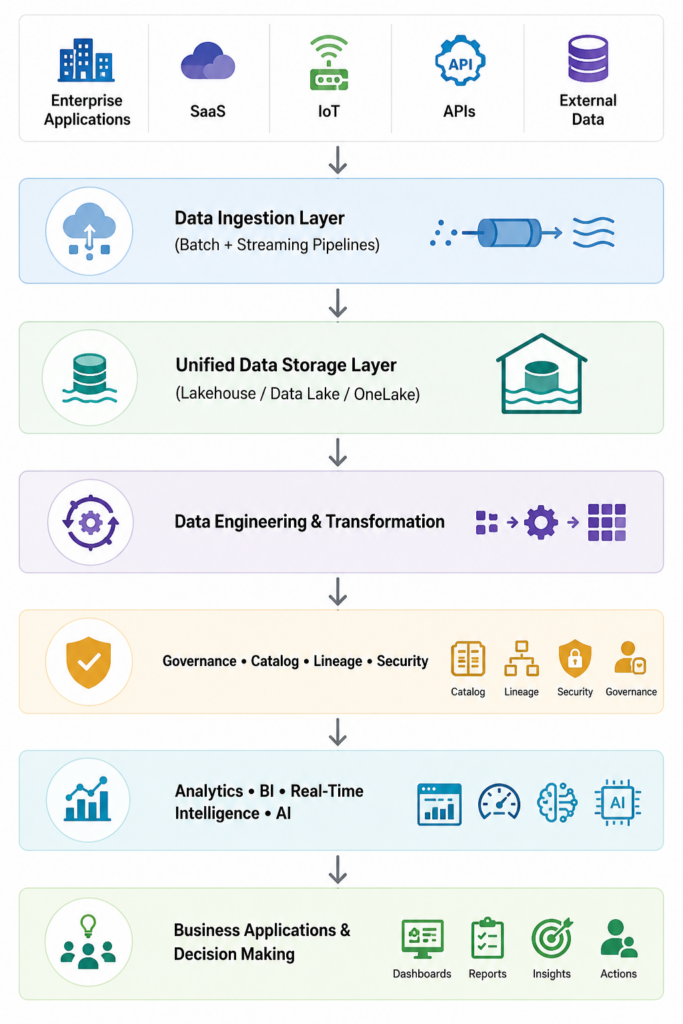
A unified data platform follows a layered architecture that simplifies enterprise data management while supporting analytics, governance, and AI from a single foundation.
The architecture typically consists of six integrated layers:
Data Sources
Enterprise applications such as ERP, CRM, HR systems, finance platforms, IoT devices, SaaS applications, APIs, and external data providers continuously generate structured and unstructured data.
↓
Data Ingestion Layer
Batch pipelines, streaming services, and connectors collect data from multiple sources while maintaining data quality and consistency.
↓
Unified Storage Layer
A centralized storage environment stores all enterprise data using open formats, creating a scalable single source of truth for analytics and AI.
↓
Processing & Data Engineering
Data engineering pipelines cleanse, transform, validate, and standardize raw data into business-ready datasets that can be reused across multiple workloads.
↓
Governance Layer
Metadata management, data lineage, security policies, cataloging, compliance controls, and role-based access ensure trusted enterprise data.
↓
Analytics & AI Layer
Business intelligence, dashboards, self-service analytics, machine learning, predictive analytics, generative AI, and operational applications consume the same governed datasets.
Read more about Microsoft Fabric Architecture in our blog.
Unified Data Platform Benefits
A unified data platform helps organizations centralize enterprise data, improve governance, accelerate analytics, and reduce infrastructure complexity. By replacing disconnected point solutions with a single, governed platform, businesses can make faster decisions, lower operational costs, and build AI-ready data foundations.
As organizations continue to scale data across hybrid and multi-cloud environments, the benefits extend beyond operational efficiency—they enable long-term digital transformation and enterprise-wide innovation.
1. Eliminate Data Silos and Create a Single Source of Truth
One of the biggest challenges enterprises face is fragmented data spread across multiple systems, departments, and cloud environments. Different teams often rely on separate datasets, leading to inconsistent reporting and conflicting business metrics.
A unified data platform consolidates data into a shared, governed environment where everyone works from the same trusted information.
Business impact:
- Consistent KPIs across departments
- Improved cross-functional collaboration
- Higher confidence in business decisions
- Reduced data duplication
2. Accelerate Analytics and Business Decision-Making
Traditional architectures require data to move across multiple systems before it becomes available for reporting. This increases latency and delays business insights.
A unified analytics platform enables data engineering, warehousing, real-time analytics, and business intelligence to work on the same data foundation, significantly reducing processing time.
Business impact:
- Faster reporting cycles
- Near real-time dashboards
- Improved operational visibility
- Quicker executive decision-making
3. Reduce Infrastructure and Operational Costs
Maintaining separate ETL tools, warehouses, governance platforms, analytics solutions, and AI services increases licensing costs and operational overhead.
A unified platform simplifies the technology stack by integrating these capabilities into one ecosystem.
Organizations can benefit from:
- Lower software licensing costs
- Reduced infrastructure duplication
- Simplified platform administration
- Less maintenance for engineering teams
Over time, this results in a lower total cost of ownership (TCO) while improving platform scalability.
Read our blog to know more about Microsoft Fabric Pricing in 2026: Complete F SKU Cost Breakdown.
4. Strengthen Governance, Security, and Compliance
As data volumes grow, maintaining consistent governance becomes increasingly difficult.
A unified data platform embeds governance throughout the entire data lifecycle instead of treating it as a separate process.
Built-in capabilities include:
- Data lineage
- Metadata management
- Role-based access control
- Data cataloging
- Data quality monitoring
- Regulatory compliance
- Audit trails
This governance-first approach helps organizations meet compliance requirements while improving trust in enterprise data.
5. Build an AI-Ready Enterprise
Artificial intelligence depends on trusted, consistent, and well-governed data.
A unified data and AI platform provides standardized datasets, shared metadata, and centralized governance that enable machine learning, predictive analytics, and generative AI initiatives.
Instead of preparing data separately for every AI project, organizations can reuse governed enterprise datasets across multiple AI workloads.
6. Improve Scalability Across Hybrid and Multi-Cloud Environments
Modern enterprises rarely operate within a single cloud platform.
A unified architecture supports:
- On-premises systems
- Public cloud platforms
- Private cloud environments
- SaaS applications
- Streaming data
- IoT ecosystems
This flexibility allows organizations to modernize gradually while maintaining governance and operational consistency.
Business Outcomes of a Unified Data Platform
| Business Challenge | Unified Data Platform Benefit |
|---|---|
| Data silos | Single source of truth |
| Slow reporting | Faster analytics and real-time insights |
| Multiple data tools | Reduced operational complexity |
| High infrastructure costs | Lower total cost of ownership |
| Weak governance | Built-in security, lineage, and compliance |
| Limited AI adoption | AI-ready governed datasets |
Unified Data Platform vs Data Lake vs Data Warehouse
A data lake stores large volumes of raw data, a data warehouse is optimized for structured reporting, while a unified data platform combines storage, integration, analytics, governance, and AI into a single enterprise ecosystem.
Understanding these differences helps organizations select the right architecture for modern analytics and AI initiatives.
| Capability | Unified Data Platform | Data Lake | Data Warehouse |
|---|---|---|---|
| Data Storage | ✔ | ✔ | ✔ |
| Data Engineering | ✔ | Partial | Limited |
| Analytics | ✔ | External tools | ✔ |
| Real-Time Processing | ✔ | Limited | Limited |
| AI & Machine Learning | ✔ | External integration | Limited |
| Governance | Built-in | Separate tools | Partial |
| Business Intelligence | Native | External | Native |
| Data Lineage | ✔ | Limited | Partial |
| Single Platform Experience | ✔ | ✖ | ✖ |
When Should You Choose a Unified Data Platform?
A unified platform is the better choice if your organization:
- Operates across multiple cloud environments
- Needs centralized governance
- Supports analytics and AI at scale
- Wants to reduce infrastructure complexity
- Requires both batch and real-time analytics
- Plans to modernize legacy data architectures
Unified Data Platform vs Point Solutions: Which Is More Cost-Effective?
Many organizations continue to build data ecosystems using separate products for ingestion, storage, analytics, governance, and AI. While this approach offers flexibility, it often increases integration complexity, operational costs, and technical debt.
A unified platform reduces total cost of ownership by eliminating duplicate infrastructure, minimizing data movement, and simplifying platform administration.
| Cost Factor | Point Solutions | Unified Data Platform |
|---|---|---|
| Software Licensing | High | Lower |
| Data Movement | Frequent | Minimal |
| Maintenance | Complex | Simplified |
| Governance | Multiple Tools | Integrated |
| AI Readiness | Additional Integration | Native |
| Operational Overhead | High | Lower |
For most enterprises, adopting a unified platform leads to lower long-term infrastructure costs and faster time-to-value than maintaining multiple disconnected technologies.
Unified Data Platform Examples
Several vendors now offer platforms that integrate analytics, governance, AI, and data engineering into a unified experience. While each platform has its strengths, they all aim to reduce architectural complexity and enable enterprise-scale analytics.
Microsoft Fabric
A SaaS-based unified data platform that integrates OneLake, Data Factory, Data Engineering, Data Warehouse, Real-Time Intelligence, Power BI, Microsoft Purview, and Copilot into a single ecosystem.
Best suited for: Microsoft-centric enterprises seeking an end-to-end unified analytics platform.
Databricks Data Intelligence Platform
Databricks combines data engineering, lakehouse architecture, machine learning, and AI development on Apache Spark.
Best suited for: Organizations with advanced data science and AI workloads.
Snowflake AI Data Cloud
Snowflake offers cloud-native data warehousing with integrated data sharing, governance, analytics, and AI capabilities.
Best suited for: Enterprises prioritizing scalable cloud analytics and secure data collaboration.
Google BigQuery
BigQuery provides serverless data warehousing with integrated analytics, machine learning, and AI services through the Google Cloud ecosystem.
Best suited for: Organizations invested in Google Cloud Platform.
SAP Datasphere
SAP Datasphere enables organizations to unify SAP and non-SAP enterprise data while preserving business context and governance.
Best suited for: Enterprises running SAP-centric business applications.
Is Microsoft Fabric a Unified Data Platform?
Yes. Microsoft Fabric is widely recognized as a modern unified data platform because it combines data engineering, data integration, storage, analytics, governance, business intelligence, and AI into a single SaaS experience.
Unlike traditional architectures that require multiple independent products, Microsoft Fabric enables organizations to manage the complete data lifecycle from one integrated environment.
Its architecture is built around OneLake, a centralized storage layer that supports every analytics workload without duplicating data.
How Microsoft Fabric Maps to a Unified Data Platform
| Unified Data Platform Layer | Microsoft Fabric Capability |
|---|---|
| Data Ingestion | Data Factory |
| Unified Storage | OneLake |
| Data Engineering | Spark & Lakehouse |
| Data Warehouse | Fabric Warehouse |
| Real-Time Analytics | Real-Time Intelligence |
| Business Intelligence | Power BI |
| Governance | Microsoft Purview |
| AI & Copilot | Fabric AI & Copilot |
This integrated architecture enables organizations to support reporting, advanced analytics, machine learning, and generative AI using the same governed data foundation.
Why Microsoft Fabric Stands Out
Microsoft Fabric differentiates itself by delivering a fully integrated Fabric unified platform rather than a collection of loosely connected services.
Key advantages include:
- OneLake as a single source of truth
- Shared metadata across workloads
- Native Power BI integration
- Embedded Microsoft Purview governance
- Open data formats, including Delta Lake
- Built-in AI capabilities through Microsoft Copilot
- Reduced data movement and duplication
- SaaS-first architecture with simplified operations
For organizations already using Microsoft Azure or Microsoft 365, Fabric provides a streamlined path to modernizing enterprise analytics while supporting future AI initiatives
Best Practices for Implementing a Unified Data Platform
Successful implementation requires more than deploying new technology. Organizations should align business goals, governance, architecture, and operating models to maximize long-term value.
1. Start with Business Outcomes
Define measurable objectives before selecting technology.
Examples include:
- Improving customer analytics
- Accelerating executive reporting
- Supporting AI initiatives
- Reducing infrastructure costs
- Strengthening regulatory compliance
Technology should support business strategy—not drive it.
2. Establish Governance Early
Governance should be embedded from the beginning rather than added after implementation.
Prioritize:
- Data ownership
- Metadata management
- Data cataloging
- Security policies
- Data quality standards
- Regulatory compliance
Strong governance builds trust while supporting enterprise scalability.
3. Design for Scalability
Choose an architecture capable of supporting:
- Hybrid cloud
- Multi-cloud environments
- Streaming data
- AI workloads
- Future business growth
Avoid architectures that require significant redesign as data volumes increase.
4. Build Reusable Data Products
Instead of creating isolated datasets for every project, develop standardized data products that can be reused across analytics, reporting, and AI initiatives.
This reduces duplication while improving consistency throughout the organization.
5. Balance Self-Service with Governance
Business users should be able to explore trusted data independently without compromising security or compliance.
Certified datasets, role-based access, and standardized business definitions help maintain this balance.
How Techment Helps Enterprises Build Unified Data Platform
Technology alone does not deliver business transformation. Successful modernization requires the right strategy, architecture, governance, and implementation expertise.
As a Microsoft Solutions Partner, Techment helps organizations design and implement enterprise-ready unified data platforms that support analytics, governance, and AI from a single foundation.
Our approach includes:
Strategy & Assessment
- Data maturity assessment
- Current-state architecture review
- Microsoft Fabric readiness assessment
- AI adoption roadmap
Architecture & Modernization
- Lakehouse and warehouse architecture
- Data integration strategy
- Governance framework
- OneLake implementation
- Enterprise data modeling
Platform Implementation
- Data engineering
- Pipeline modernization
- Analytics enablement
- Power BI implementation
- AI integration
- Microsoft Purview deployment
Optimization & Managed Services
- Performance tuning
- Cost optimization
- Governance automation
- Platform monitoring
- Continuous AI enablement
Whether organizations are modernizing legacy data warehouses or building a cloud-native analytics ecosystem, Techment helps accelerate implementation while reducing risk and maximizing business value.
Our AI-Ready Enterprise Checklist for Microsoft Fabric provides a step-by-step roadmap for evaluating your data maturity, modernizing pipelines, enabling governance, and operationalizing AI at scale.
Conclusion
Enterprise data environments have evolved beyond traditional warehouses and isolated analytics tools. As organizations continue to adopt AI, real-time analytics, and hybrid cloud architectures, fragmented data ecosystems become increasingly difficult and expensive to manage.
A unified data platform addresses these challenges by bringing together data ingestion, storage, engineering, analytics, governance, and AI into one integrated environment. This unified approach improves data quality, strengthens governance, reduces operational complexity, and enables faster, more confident business decisions.
Modern solutions such as Microsoft Fabric demonstrate how organizations can simplify their technology landscape while building a scalable, AI-ready data foundation. By integrating analytics, governance, and AI within a single SaaS platform, Fabric enables enterprises to move from disconnected data systems to connected intelligence.
Organizations that invest in a unified data platform today will be better positioned to scale analytics, operationalize AI, and adapt to changing business demands in the years ahead.
Ready to build AI-first intelligence? Schedule your Microsoft Fabric AI Consultation.
Frequently Asked Questions (FAQ): Unified Data Platforms & Microsoft Fabric
1. What is a unified data platform in simple terms?
A unified data platform is a centralized environment that combines data ingestion, storage, transformation, analytics, governance, and AI into one platform. It provides a single source of truth that enables organizations to manage the complete data lifecycle while improving collaboration, governance, and business decision-making.
2. What are the benefits of a unified data platform?
Key benefits include:
Reduces data silos across the enterprise
Accelerates analytics and reporting
Improves governance and regulatory compliance
Lowers infrastructure and operational costs
Creates a trusted foundation for AI and machine learning
3. What is the difference between a unified data platform and a data lake?
A data lake primarily stores raw structured and unstructured data, whereas a unified data platform combines storage with data engineering, analytics, governance, AI, and business intelligence. It provides an end-to-end environment rather than a storage repository alone.
4. Is Microsoft Fabric a unified data platform?
Yes. Microsoft Fabric is a unified data and AI platform that integrates data engineering, OneLake storage, data warehousing, real-time analytics, Power BI, Microsoft Purview, and AI capabilities into a single SaaS experience, making it one of the most comprehensive enterprise data platforms available.
Related Reads
- Microsoft Fabric vs Traditional Data Warehousing: The Modern Data Fabric Guide for 2026
- Microsoft Architecture
- Microsoft Fabric Architecture Explained: Complete Enterprise Guide (2026)
- Data Lakehouse vs Data Warehouse: Key Differences
- Microsoft Fabric Pricing Explained: Know Your Costs Before You Build
- AI-Ready Enterprise Checklist for Microsoft Fabric