
Introduction
Retail customer expectations have changed faster than most enterprise operating models. Consumers no longer compare retailers only against competitors—they compare every experience against the best digital interaction they have ever had. Whether it is personalized recommendations from e-commerce platforms, frictionless checkout experiences, or context-aware promotions, expectations for relevance and convenience continue to rise.
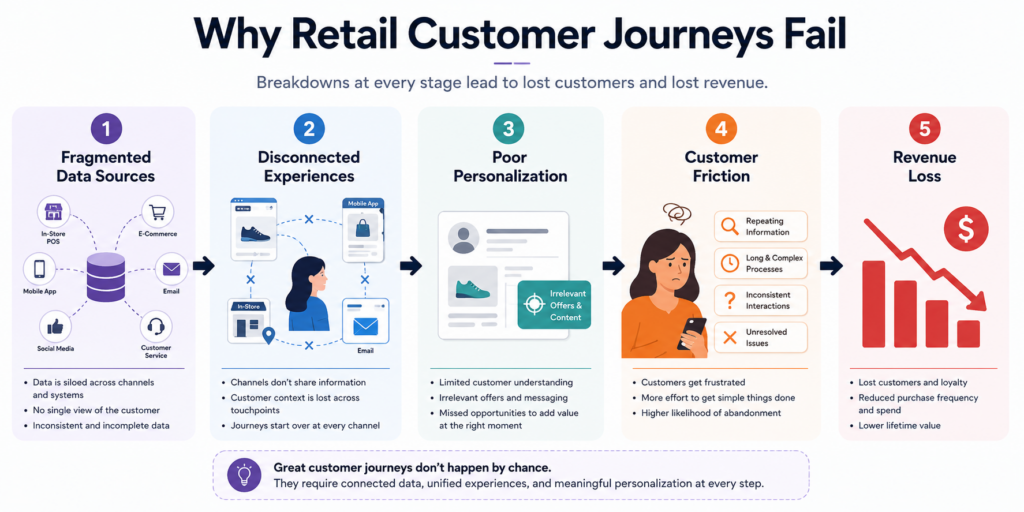
Yet many retail enterprises still struggle with fragmented customer experiences. Customer data sits across disconnected CRM systems, loyalty platforms, POS environments, mobile apps, e-commerce engines, and marketing systems. The result is inconsistent messaging, delayed engagement, poor personalization, and missed revenue opportunities.
This is where AI-powered customer journey orchestration in retail is becoming strategically critical.
This guide explores how AI-powered customer journey orchestration in retail works, why it matters, the enterprise architecture behind it, real-world applications, implementation challenges, and what retail leaders should prioritize in 2026.
TL;DR
- Traditional retail customer journeys are fragmented and increasingly ineffective in omnichannel environments.
- AI-powered customer journey orchestration in retail enables real-time personalization across channels, improving engagement, loyalty, and conversion.
- Enterprise retailers are moving beyond segmentation toward predictive, intent-driven experiences powered by AI and unified customer intelligence.
- Successful orchestration requires modern data architecture, governance, customer identity resolution, and operational readiness.
- Retail leaders that operationalize AI-powered journey orchestration can significantly improve retention, basket size, and customer lifetime value.
Why Retail Customer Journeys Are Breaking Down in 2026
Retail customer journeys have become increasingly fragmented. A single customer may discover products through social media, compare pricing on a mobile device, visit a physical store, abandon an online cart, engage with customer support, and finally purchase through an app. Yet many enterprises still manage these interactions through disconnected systems.
The challenge is not a lack of customer data. The challenge is the inability to orchestrate it intelligently.
Research from industry analysts consistently shows that customers expect personalized experiences, yet most retailers struggle to operationalize personalization at scale. Traditional segmentation models based on demographics or broad behavioral clusters are proving inadequate in environments where customer expectations evolve in real time.
Read our blog on AI Orchestration Platforms: The Enterprise Guide to Coordinating AI at Scale in 2026.
Why Traditional Journey Models Fail
Legacy customer journey strategies were designed around predictable funnels:
Awareness → Consideration → Purchase → Retention
Retail reality in 2026 is significantly more dynamic.
Customers move across channels continuously:
- Mobile
- E-commerce
- Physical stores
- Social commerce
- Conversational AI
- Loyalty programs
- Customer service ecosystems
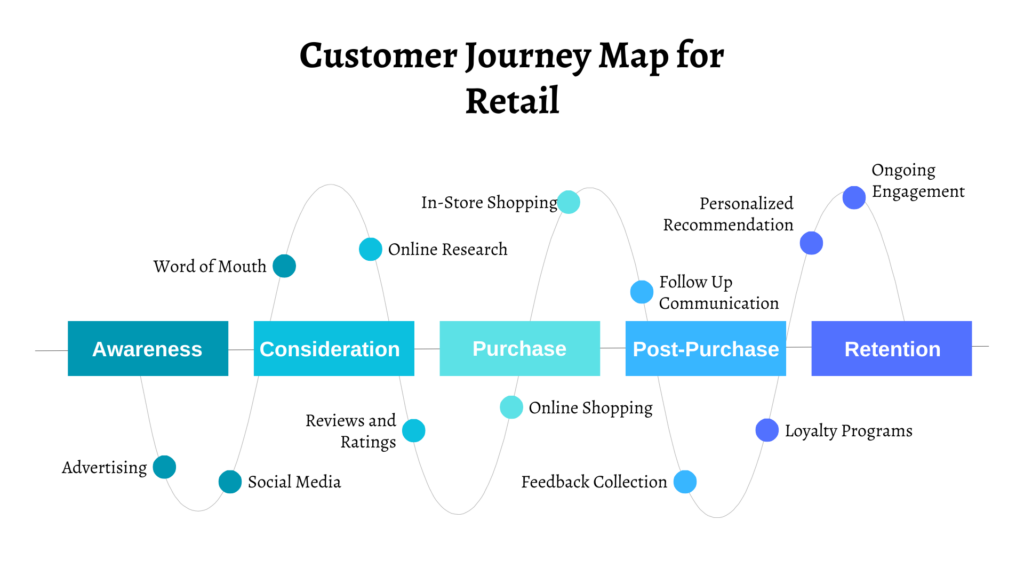
Journeys are non-linear, contextual, and highly personalized. Without orchestration, retailers face challenges such as:
Inconsistent experiences– A customer receives irrelevant promotions despite recent purchases.
Poor channel continuity– Online browsing behavior does not influence in-store recommendations.
Reactive engagement– Marketing teams respond after customers disengage.
Low personalization maturity– Offers remain rule-based instead of predictive.
For enterprise leaders modernizing customer engagement, foundational data modernization becomes essential. Retail organizations increasingly require unified intelligence layers capable of supporting scalable AI experiences.
Relevant modernization initiatives often begin with enterprise data readiness strategies such as: Enterprise AI Strategy in 2026
What Is AI-Powered Customer Journey Orchestration in Retail?
At its core, AI-powered customer journey orchestration in retail refers to the use of artificial intelligence to coordinate customer interactions across channels in real time based on behavior, intent, context, and predictive insights.
Unlike traditional marketing automation, journey orchestration is not rule-based alone. It is adaptive. AI continuously learns from customer interactions and optimizes experiences dynamically.
How It Works
An orchestration platform continuously ingests signals from:
- Purchase history
- Browsing behavior
- In-store activity
- Loyalty engagement
- Customer service interactions
- Inventory systems
- Location intelligence
- Contextual triggers
AI models evaluate:
- Purchase intent
- Propensity to churn
- Product affinity
- Timing sensitivity
- Channel preferences
The system then recommends or automates:
- Personalized offers
- Dynamic promotions
- Product recommendations
- Inventory-aware experiences
- Customer retention actions
- Conversational support engagement
Instead of static campaigns, retailers move toward living customer journeys.
From Segmentation to Prediction
Retail leaders are increasingly shifting away from broad segmentation. Traditional approach: Millennial urban shoppers interested in fashion.
AI-powered approach: Customer likely to purchase premium athleisure products within seven days based on recent browsing behavior, loyalty activity, and regional inventory patterns.”
That difference fundamentally changes customer engagement economics.
| Traditional Retail Engagement | AI-Orchestrated Retail Engagement |
|---|---|
| Rule-based campaigns | Predictive personalization |
| Static segmentation | Dynamic intent modeling |
| Reactive communication | Real-time engagement |
| Channel silos | Unified omnichannel journeys |
| Periodic optimization | Continuous AI learning |
Why This Matters to Enterprise Retail
AI-driven orchestration affects critical business metrics:
- Customer lifetime value (CLV)
- Repeat purchases
- Basket size
- Customer retention
- Marketing ROI
- Store conversion rates
- Omnichannel consistency
For enterprise retailers, the opportunity extends beyond marketing efficiency. It becomes a competitive differentiation strategy.
Organizations modernizing enterprise AI ecosystems often pair customer intelligence initiatives with scalable AI operating models and data readiness programs: Best Practices for Generative AI Implementation in Business — A Practical Guide for Enterprises
The 5-Layer Architecture Behind AI-Powered Customer Journey Orchestration in Retail
Retail leaders often underestimate the architectural complexity required for enterprise-grade orchestration.
Personalization cannot exist without trustworthy, unified data.
Successful AI-powered customer journey orchestration in retail depends on five foundational layers.
1. Customer Data Foundation
This layer consolidates data across:
- POS systems
- CRM
- E-commerce platforms
- Loyalty systems
- Customer support
- Mobile engagement
- Marketing systems
The goal is to establish a single customer view. Without unified identity resolution, orchestration becomes fragmented.
2. Data Quality & Governance Layer
Poor customer data directly impacts personalization outcomes. If customer identities are duplicated or behavioral signals are incomplete, recommendations deteriorate.
Enterprise retailers increasingly prioritize:
- Master data management
- Identity resolution
- Governance policies
- Data lineage
- Consent management
Modern AI initiatives succeed only when data reliability is prioritized.
Relevant enterprise perspective: Data Quality for AI in 2026: The Ultimate Blueprint for Accuracy, Trust & Scalable Enterprise Adoption
3. Intelligence Layer
This layer includes:
- Machine learning models
- Recommendation engines
- Predictive analytics
- Churn prediction
- Behavioral scoring
- Propensity modeling
AI identifies patterns humans cannot detect at scale.
4. Decisioning & Orchestration Layer
This layer determines:
What should happen next?
Examples:
- Send a personalized offer
- Trigger customer service outreach
- Recommend complementary products
- Delay promotion timing
- Prioritize loyalty rewards
5. Experience Delivery Layer
This includes customer-facing channels:
- Apps
- Websites
- Physical stores
- SMS
- Conversational AI
- Call centers
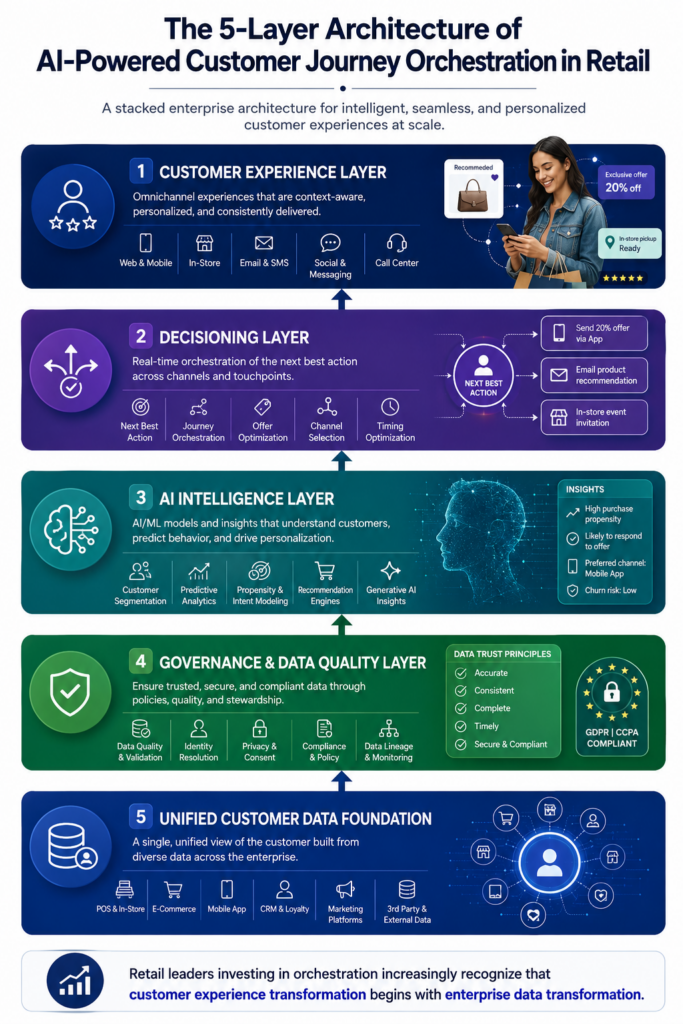
Retail leaders investing in orchestration increasingly recognize that customer experience transformation begins with enterprise data transformation.
Relevant reading: Leveraging Data Transformation for Modern Analytics
7 Enterprise Use Cases of AI-Powered Customer Journey Orchestration in Retail
Enterprise retailers are no longer experimenting with personalization in isolated campaigns. They are operationalizing AI-powered customer journey orchestration in retail across the full customer lifecycle to increase loyalty, reduce churn, and maximize customer lifetime value.
The most successful implementations combine customer intelligence, predictive analytics, and omnichannel engagement into a single orchestration strategy.
1. Hyper-Personalized Product Recommendations
Traditional recommendation engines rely heavily on historical purchases.
AI-powered orchestration goes significantly further.
Retailers can evaluate:
- Browsing signals
- Session behavior
- Product affinity
- Inventory availability
- Seasonality
- Geographic demand
- Real-time contextual triggers
For example, if a customer repeatedly explores premium skincare products but abandons purchase, AI can dynamically personalize recommendations across email, app notifications, website banners, and even in-store associate experiences.
The objective is relevance—not promotional overload.
Retailers increasingly recognize that personalization quality depends on trusted enterprise data foundations and intelligent data readiness.
Relevant reading: Fabric AI Readiness: How to Prepare Your Data for Scalable AI Adoption
2. Predictive Cart Abandonment Recovery
Cart abandonment remains a major challenge in omnichannel retail.
Traditional methods trigger generic reminder emails.
AI orchestration enables predictive intervention.
Instead of simply reacting to abandonment, AI predicts:
- Purchase hesitation
- Discount sensitivity
- Intent strength
- Best communication channel
- Timing likelihood
For high-intent customers, orchestration systems may delay discounting to protect margins. For low-confidence buyers, AI may recommend limited-time incentives or personalized bundles. This enables revenue optimization rather than blanket discount dependency.
3. Real-Time Omnichannel Continuity
Retail customers expect continuity across every touchpoint.
Example: A customer researches products online, visits a store, and later engages through mobile. Without orchestration: Experiences feel disconnected.
With AI-powered customer journey orchestration in retail, contextual awareness persists across channels.
This enables:
- Store associate recommendations
- Personalized mobile engagement
- Inventory-aware product suggestions
- Loyalty-driven offers
4. Dynamic Loyalty Personalization
Most loyalty systems remain transactional. AI enables behavioral loyalty.
Instead of generic rewards:
Customers receive experiences tailored to:
- Shopping habits
- Predicted preferences
- Purchase frequency
- Engagement behavior
This shifts loyalty from discounts to relevance.
5. Conversational Commerce & Intelligent Customer Support
Retail journeys increasingly include conversational touchpoints.
AI-powered assistants can:
- Recommend products
- Resolve service issues
- Recover abandoned purchases
- Trigger next-best actions
Conversational AI becomes especially powerful when integrated into orchestration ecosystems.
Relevant perspective: Conversational AI for Customer Service: A Step-by-Step Enterprise Guide
6. Churn Prediction and Customer Retention
Enterprise retailers increasingly use predictive AI to identify churn before customers disengage.
AI evaluates:
- Reduced browsing frequency
- Lower basket size
- Decreased loyalty activity
- Support sentiment
- Declining engagement signals
Instead of reactive retention campaigns, retailers proactively intervene.
7. Dynamic Pricing and Promotion Optimization
Retail margins remain under pressure. AI orchestration helps retailers personalize promotions without unnecessary revenue erosion.
Retailers optimize:
- Price elasticity
- Demand forecasting
- Inventory levels
- Customer sensitivity
Traditional Retail vs AI-Orchestrated Retail- Benefits, Risks, and Trade-Offs Retail Leaders Must Consider
The promise of AI-powered customer journey orchestration in retail is compelling.
However, enterprise leaders should approach implementation pragmatically.
AI-driven orchestration introduces measurable advantages—but also operational complexity.
Key Benefits
Improved Customer Lifetime Value
- Highly personalized experiences improve repeat purchases and customer retention.
- Customers reward relevance.
- Retailers that consistently deliver contextual experiences often see stronger loyalty performance.
Better Marketing Efficiency
- AI reduces wasted campaign spending.
- Rather than broad segmentation, retailers target customers based on behavioral probability.
This improves:
- Marketing ROI
- Conversion efficiency
- Retention effectiveness
Stronger Omnichannel Consistency
- Journey orchestration eliminates disconnected customer experiences.
- Whether customers interact through stores, websites, mobile apps, or support channels, personalization remains context-aware.
Smarter Inventory and Promotion Decisions
- AI helps retailers avoid margin erosion.
- Instead of unnecessary discounting, orchestration systems personalize incentives intelligently.
Risks & Trade-Offs
Data Fragmentation
- Retail AI succeeds only when data ecosystems are integrated.
- Fragmented architectures remain the biggest barrier.
Privacy & Consent Complexity
Personalization depends on customer trust.
Retailers must ensure:
- Consent transparency
- Ethical data usage
- Governance enforcement
- Compliance readiness
Over-Automation Risks
- Excessive personalization can feel intrusive.
- Retail leaders must balance automation with human-centric experience design.
Organizational Readiness
AI orchestration is not only a technology initiative.
It requires:
- Cross-functional alignment
- Data governance maturity
- AI operating models
- Change management
For many enterprises, AI transformation begins with a stronger enterprise-wide data and governance foundation.
Relevant reading: Data Governance for Data Quality: Future-Proofing Enterprise Data
| Opportunity | Enterprise Challenge |
|---|---|
| Real-time personalization | Fragmented systems |
| Better retention | Identity resolution complexity |
| Higher conversion | Governance risks |
| Omnichannel consistency | Organizational silos |
| Improved loyalty | Privacy concerns |
How Retail Enterprises Can Successfully Implement AI Customer Journey Orchestration
Successful orchestration initiatives rarely begin with technology selection. They begin with business strategy.
Step 1: Define Business Outcomes
Retail leaders should avoid vague AI ambitions. Instead, prioritize measurable goals.
Examples:
- Improve customer retention by 15%
- Increase average basket size
- Reduce churn
- Improve loyalty engagement
- Increase omnichannel conversion
Step 2: Modernize the Data Foundation
Customer orchestration requires:
- Unified customer profiles
- Scalable analytics
- Real-time pipelines
- Customer identity resolution
Retailers modernizing AI capabilities increasingly prioritize enterprise data transformation initiatives.
Relevant reading: What a Microsoft Data and AI Partner Brings to Your Data Strategy
Step 3: Prioritize High-Impact Use Cases
Avoid enterprise-wide complexity initially.
Start with:
- Product recommendations
- Churn prediction
- Cart recovery
- Loyalty personalization
Step 4: Create Governance Guardrails
Governance should be embedded early.
This includes:
- Privacy policies
- Data governance
- Model monitoring
- Ethical AI standards
Step 5: Scale Through Continuous Learning
AI orchestration improves through iteration.
Retail leaders should continuously evaluate:
- Conversion rates
- Retention
- Personalization accuracy
- Customer sentiment

The Retail AI Maturity Curve illustrates how organizations evolve from basic, reactive customer interactions to fully autonomous, AI-driven journeys. At the early stages, retailers rely on rule-based engagement and segmented campaigns, but as data maturity and AI capabilities grow, they unlock predictive insights and real-time orchestration across channels. Ultimately, leading retailers move toward autonomous retail journeys—where AI continuously learns, decides, and acts in the moment to deliver hyper-personalized, context-aware experiences at scale. For CTOs, this progression is not just about adopting new technologies, but about building the right data foundation, governance, and AI capabilities to enable seamless, intelligent customer journey orchestration in 2026 and beyond.
How Techment Helps Enterprises Modernize Retail Customer Intelligence
Retail organizations often struggle to operationalize customer orchestration because technology investments remain disconnected from enterprise data maturity.
Techment helps enterprises bridge this gap through a strategic, end-to-end approach to AI readiness, data modernization, and intelligent customer engagement.
Techment supports retailers through:
Enterprise Data Modernization
Unified customer intelligence depends on connected, trustworthy data ecosystems.
Techment helps retailers modernize fragmented architectures to create scalable foundations for AI-powered customer experiences.
Relevant perspective: Leveraging Data Transformation for Modern Analytics
AI Readiness for Customer Intelligence
AI orchestration requires high-quality, AI-ready enterprise data. Techment helps enterprises prepare their data environments for scalable personalization and predictive engagement.
Governance and Responsible AI
Retail personalization must balance innovation with trust.
Techment supports governance frameworks that strengthen:
- Data quality
- Compliance
- Explainability
- Responsible AI adoption
End-to-End Delivery
From roadmap creation to implementation and optimization, Techment helps retail enterprises operationalize intelligent customer experiences without compromising scalability or governance.
Conclusion
Retail customer expectations are evolving faster than traditional engagement models can support.
Static customer journeys, disconnected personalization, and fragmented omnichannel experiences are becoming competitive liabilities.
This is why AI-powered customer journey orchestration in retail is emerging as a strategic priority for enterprise leaders.
Retailers that successfully operationalize orchestration can move beyond reactive engagement toward predictive, intelligent, and highly personalized customer experiences.
However, technology alone is not enough.
Success depends on strong data foundations, governance maturity, responsible AI practices, and scalable operating models.
As retail competition intensifies in 2026, organizations that transform customer intelligence into real-time action will be best positioned to improve loyalty, retention, and long-term revenue growth.
Techment helps enterprises modernize the data, AI, and governance foundations required to operationalize intelligent customer journeys at scale.
FAQs
1. What is AI-powered customer journey orchestration in retail?
AI-powered customer journey orchestration in retail uses artificial intelligence to personalize customer experiences across channels using behavioral, contextual, and predictive data.
2. How is AI-powered customer journey orchestration different from marketing automation?
Marketing automation is largely rule-based. AI orchestration continuously learns from customer interactions and dynamically optimizes experiences.
3. What technologies support retail customer journey orchestration?
Common technologies include:
Customer data platforms (CDPs)
Predictive analytics
AI recommendation engines
Real-time analytics platforms
Conversational AI
Data governance frameworks
4. What are the biggest implementation challenges?
The largest barriers include:
Fragmented customer data
Governance maturity
Privacy requirements
Organizational readiness
Identity resolution complexity
5. How long does enterprise retail orchestration take?
Most enterprises start with focused use cases and scale gradually. Meaningful outcomes often emerge within 6–12 months depending on data maturity and architecture readiness.
Related Reads
- Enterprise AI Strategy in 2026
- Data Quality for AI in 2026: The Ultimate Blueprint for Accuracy, Trust & Scalable Enterprise Adoption
- Best Practices for Generative AI Implementation in Business — A Practical Guide for Enterprises
- Conversational AI for Customer Service: A Step-by-Step Enterprise Guide
- Agentic Workflow Solutions: The Future of Enterprise Automation in 2026