Introduction
AI workflow orchestration has become the backbone of enterprise AI adoption. As organizations move from isolated AI pilots to production-ready agents and automated business processes, selecting the right orchestration platform is essential for scalability, governance, security, and seamless integration. In this guide, we compare the top AI workflow orchestration tools in 2026, highlighting their capabilities, ideal use cases, strengths, and limitations to help enterprises choose the platform that best fits their AI strategy.
This guide explores the top AI workflow orchestration tools in 2026, evaluates their enterprise readiness, examines implementation trade-offs, and provides a strategic framework for choosing the right orchestration platform.
TL;DR
- AI workflow orchestration tools are becoming the operating layer for enterprise GenAI in 2026.
- Enterprises are shifting from isolated AI pilots to coordinated AI ecosystems involving agents, workflows, LLMs, governance, and automation.
- Tools like LangGraph, CrewAI, Microsoft Fabric, Databricks Mosaic AI, Semantic Kernel, AutoGen, Vertex AI, and n8n are emerging as leaders.
- Choosing the wrong orchestration approach can increase security risks, technical debt, hallucinations, and operational complexity.
- Enterprise leaders should evaluate orchestration platforms based on governance, scalability, interoperability, observability, and AI lifecycle maturity.
- The future of AI orchestration is moving toward autonomous enterprise systems powered by multi-agent intelligence.
AI workflow orchestration tools becoming mission critical
Modern enterprises no longer operate with a single AI model solving isolated problems. Instead, organizations are deploying interconnected ecosystems involving foundation models, vector databases, retrieval pipelines, AI agents, business applications, governance systems, APIs, and enterprise workflows. Without orchestration, even sophisticated AI investments quickly become fragmented, difficult to govern, and expensive to scale.
Research from leading advisory firms suggests that enterprises investing in AI platforms are increasingly prioritizing orchestration and observability over experimentation. The challenge is no longer access to AI—it is coordination.
A fragmented AI ecosystem creates operational bottlenecks:
- Models operating in silos
- Poor prompt management
- Inconsistent data access
- Limited governance visibility
- Workflow failures across enterprise systems
- Rising infrastructure costs
The next generation of AI leaders—CTOs, CDOs, enterprise architects, and platform engineering teams—must think beyond standalone GenAI applications.
They must build intelligent operating systems for enterprise AI.
Watch: The Future of Decision Intelligence Copilots
Explore how AI copilots are evolving from information assistants into intelligent decision partners.
How AI Workflow Orchestration Tools Matter More in 2026
From AI Experiments to Enterprise Systems
The biggest misconception in enterprise AI is assuming that deploying a model equals business transformation. It does not. According to Gartner, organizations are increasingly moving from isolated GenAI pilots toward engineered AI systems requiring governance, observability, and orchestration capabilities.
A production-ready AI environment involves far more than LLM access. Organizations must coordinate:
- Data ingestion
- Context retrieval
- Prompt execution
- Model selection
- Guardrails
- Monitoring
- Human approvals
- Workflow automation
- Governance policies
This growing complexity explains why AI workflow orchestration tools are emerging as foundational infrastructure. In simple terms, orchestration platforms act as the control layer for enterprise AI ecosystems. Rather than manually stitching systems together, orchestration platforms help enterprises coordinate:
What AI Orchestration Actually Connects
Models and LLMs– Organizations increasingly operate multiple models simultaneously—OpenAI, Anthropic, Gemini, Mistral, and proprietary enterprise models. Orchestration enables intelligent routing between models depending on cost, latency, risk, and performance.
Enterprise Data Systems– AI systems are only as useful as their contextual awareness. Workflow orchestration integrates vector databases, enterprise warehouses, streaming systems, and operational data environments.
For organizations modernizing analytics infrastructure, platforms discussed in Techment’s enterprise modernization perspective become especially relevant for enabling scalable AI readiness. See:
Enterprise AI Strategy in 2026
AI Agents– One of the defining trends of 2026 is the rise of AI agents.
Rather than a single chatbot responding to prompts, enterprises are deploying specialized agents:
- Research agents
- Compliance agents
- Data analysis agents
- Customer intelligence agents
- Procurement agents
- Software engineering copilots
Orchestration tools manage communication and coordination between these systems.
Why Enterprises Are Increasing Investment in AI Orchestration
Several forces are accelerating adoption.
Rising Complexity of GenAI Deployments
A single customer service AI interaction may involve:
- Intent detection
- Data retrieval from CRM
- Policy validation
- Knowledge base lookup
- Model reasoning
- Approval workflows
- Customer response generation
Without orchestration, maintaining reliability becomes unsustainable.
Governance Pressure Is Increasing
As AI regulation evolves globally, governance requirements are intensifying.
Enterprises must now answer:
- Which model generated this output?
- What data source informed the decision?
- Was sensitive information exposed?
- Can decisions be audited?
This makes orchestration inseparable from governance.
Organizations focused on trusted AI implementation increasingly prioritize strong data governance foundations before scaling AI workloads. A useful perspective appears in: Data Governance for Data Quality: Future-Proofing Enterprise Data
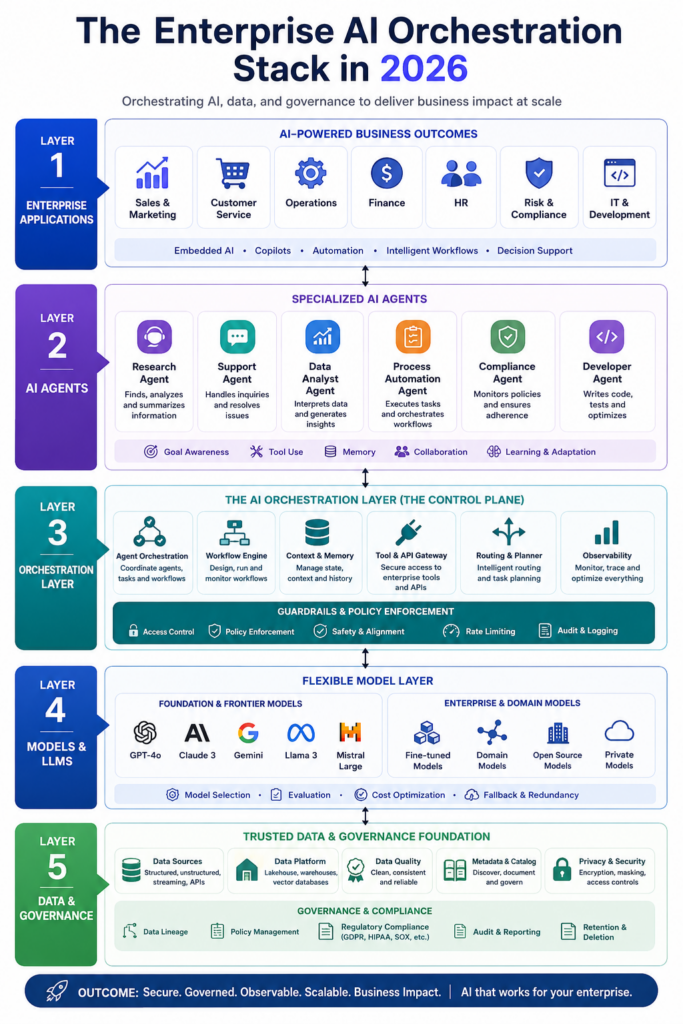
7 Enterprise Criteria for Evaluating AI Workflow Orchestration Tools
Choosing orchestration technology based solely on popularity is a mistake. Enterprise requirements differ significantly from startup experimentation. Below is the framework leading organizations increasingly use when evaluating AI workflow orchestration tools.
1. Multi-Agent Coordination Capabilities
The future of enterprise AI is not single-model execution. It is multi-agent collaboration.
Leading orchestration platforms must coordinate:
- Sequential workflows
- Parallel agents
- Role-specific AI systems
- Shared memory management
- Decision routing
For example: A financial services workflow might include:
Agent 1: Fraud detection
Agent 2: Compliance review
Agent 3: Customer communication
Agent 4: Escalation approval
The orchestration layer ensures synchronization.
2. Governance and Explainability
Enterprise leaders increasingly reject black-box AI systems. The strongest orchestration platforms include:
- Audit trails
- Prompt tracking
- Version control
- Data lineage
- Role-based access control
This becomes particularly important in healthcare, banking, insurance, and public-sector environments.
3. LLM Flexibility
Vendor lock-in is becoming a major strategic risk. Enterprises increasingly prefer orchestration systems that support:
- OpenAI
- Claude
- Gemini
- Llama
- Mistral
- Private models
Flexibility prevents cost escalation and improves resilience.
4. Observability and Monitoring
Production AI systems fail in unexpected ways. Leaders now prioritize:
- Hallucination detection
- Latency monitoring
- Workflow tracing
- Error handling
- Cost observability
Without visibility, AI scaling becomes operationally risky.
5. Enterprise Integration
Orchestration tools must connect seamlessly with:
- ERP systems
- CRM platforms
- Data warehouses
- APIs
- Security systems
- Cloud platforms
For Microsoft-centric organizations, modern data architectures often become foundational to scalable orchestration readiness. Microsoft Azure for Enterprises: Cloud AI Modernization
6. Security and Compliance
Security teams increasingly require:
- Encryption
- Identity controls
- Access governance
- Sensitive data masking
- Human approval checkpoints
This becomes especially important for regulated workloads.
7. Scalability
Many orchestration tools perform well during pilots but struggle under enterprise load. Leaders must assess:
- Multi-region deployment
- Throughput handling
- Workflow resilience
- Cost optimization
- Production stability
The Top AI Workflow Orchestration Tools in 2026: Enterprise Overview
Before diving into deeper analysis, enterprise leaders should understand that no orchestration platform solves every problem.
Some tools excel at agent orchestration, while others focus on workflow automation, observability, cloud-native AI operations, or enterprise governance.
Enterprise Comparison Table: Top AI Workflow Orchestration Tools in 2026
| Tool | Best For | Enterprise Readiness | Key Strength |
|---|---|---|---|
| LangGraph | Agent workflows | High | Stateful multi-agent systems |
| CrewAI | Autonomous agents | Medium-High | Collaborative AI agents |
| Microsoft Fabric AI | Enterprise data ecosystems | Very High | Unified analytics + AI |
| Databricks Mosaic AI | Data-intensive AI | Very High | AI + lakehouse integration |
| Zapier | AI-powered business automation | High | AI + cross-application workflows |
| Semantic Kernel | Enterprise copilots | High | Microsoft ecosystem |
| AutoGen | Multi-agent AI | High | Complex collaboration |
| Vertex AI Pipelines | Cloud-native orchestration | High | GCP integration |
| Prefect | Workflow automation | Medium-High | Reliability |
| Apache Airflow | Data orchestration | High | Mature ecosystem |
| n8n | Low-code automation | Medium | Rapid integration |
| Flowise | Visual orchestration | Medium | Speed |
| LlamaIndex | Retrieval workflows | High | RAG optimization |
1. LangGraph: The Enterprise Standard for Stateful AI Agent Workflows
Among emerging AI workflow orchestration tools, LangGraph has rapidly become one of the strongest contenders for enterprise-grade AI agents.
Built around graph-based orchestration, LangGraph allows enterprises to design workflows where AI systems can reason, pause, revisit decisions, and collaborate dynamically.
This represents a major leap beyond traditional linear automation.
Why LangGraph Is Gaining Enterprise Attention
Conventional workflows assume predictable execution. AI systems are different.
Enterprise AI frequently requires:
- Decision branching
- Recursive reasoning
- Human approvals
- Memory retention
- Context switching
LangGraph handles this complexity elegantly.
For example:
A claims-processing workflow in insurance might include:
- Document analysis
- Fraud risk evaluation
- Policy validation
- Exception handling
- Human escalation
- Final recommendation
Rather than following rigid automation logic, LangGraph enables adaptive orchestration.
Enterprise Strengths
- Stateful orchestration – AI retains workflow memory.
- Human-in-the-loop support– Critical for regulated environments.
- Strong ecosystem compatibility– Works across multiple LLM providers.
Enterprise Trade-Offs
LangGraph can introduce architectural complexity. Organizations without strong AI engineering maturity may struggle during implementation. This is why many enterprises first strengthen foundational AI readiness before scaling orchestration programs.
For example, organizations improving AI data maturity often focus heavily on data reliability first:
Data Quality for AI in 2026: The Ultimate Blueprint for Accuracy, Trust & Scalable Enterprise Adoption
Best For
- Advanced AI agents
- Multi-step reasoning
- Enterprise copilots
- Regulated workflows
2. CrewAI: Collaborative AI Agent Systems for Business Automation
If LangGraph focuses heavily on orchestration logic, CrewAI emphasizes role-based collaboration between AI agents. This makes CrewAI especially appealing for organizations experimenting with autonomous business operations. Instead of deploying a single LLM, CrewAI enables teams of specialized agents to collaborate.
A marketing workflow might include:
- Strategy agent
- SEO agent
- Content research agent
- Compliance reviewer
- Publishing coordinator
This collaborative model increasingly mirrors how enterprises organize human teams.
Why CrewAI Is Trending in 2026
The rise of agentic AI is reshaping orchestration priorities. Organizations are moving toward:
AI teams rather than AI assistants.– CrewAI’s architecture aligns closely with this trend.
Enterprise Strengths
- Role-based orchestration– Clear responsibilities improve explainability.
- Strong experimentation capabilities– Useful for innovation teams.
- Rapid prototyping– Faster deployment cycles.
Enterprise Risks
Governance maturity still lags behind more established enterprise platforms. Security-conscious industries may require additional controls.
3. Microsoft Fabric AI: Unified Enterprise Orchestration for Data + AI
Among enterprise-grade AI workflow orchestration tools, Microsoft Fabric AI is increasingly emerging as a strategic platform for organizations that want to orchestrate not only AI models—but also the data ecosystem powering them.
Unlike standalone orchestration frameworks, Microsoft Fabric brings together:
- Data engineering
- Analytics
- Data science
- Real-time intelligence
- Governance
- AI workflows
This unified architecture is becoming increasingly valuable as organizations move from AI experimentation to operational scale.
Why Microsoft Fabric AI Matters in 2026
The biggest orchestration challenge in enterprises is fragmentation.
Many organizations operate:
- Multiple warehouses
- Siloed governance systems
- Separate AI tooling
- Disconnected pipelines
- Duplicate datasets
This fragmentation slows AI deployment and increases risk. Microsoft Fabric addresses this by creating a single orchestration layer between enterprise data and AI execution.
For example:
A retail enterprise using Fabric may orchestrate:
- Customer behavioral signals
- Real-time sales data
- Predictive inventory forecasting
- LLM-powered insights generation
- Automated reporting workflows
All within a governed environment.
Enterprise Strengths
- Unified AI + data orchestration– Eliminates ecosystem fragmentation.
- Strong governance through Purview– Critical for enterprise compliance.
- Excellent Microsoft ecosystem integration– Works seamlessly with Azure, Power BI, and Copilot ecosystems.
- Scalable AI readiness– Ideal for enterprise-wide orchestration strategies.
Organizations exploring AI readiness often benefit from strengthening their data foundation before orchestration maturity. A strong reference point is:
Fabric AI Readiness: How to Prepare Your Data for Scalable AI Adoption
For deeper architecture insights, explore: Microsoft Fabric Architecture: A CTO’s Guide to Modern Analytics & AI
Enterprise Trade-Offs
Fabric excels for Microsoft-aligned enterprises but may feel heavyweight for organizations seeking lightweight agent experimentation.
Best For
- Enterprise-wide orchestration
- AI modernization programs
- Governed GenAI systems
- Data-intensive AI operations
4. Databricks Mosaic AI: AI Workflow Orchestration for Data-Heavy Enterprises
Databricks Mosaic AI is becoming one of the strongest AI workflow orchestration tools for organizations managing complex AI workloads tied to large-scale data ecosystems.
Its biggest differentiator is proximity to enterprise data.
Instead of moving information between disconnected systems, Mosaic AI enables orchestration directly inside the lakehouse environment.
Why Data-Centric Orchestration Matters
AI performance increasingly depends on data quality.
Poor orchestration creates:
- Hallucinations
- Poor retrieval quality
- Governance failures
- Model inconsistency
This explains why enterprises are prioritizing orchestration close to trusted data sources.
Mosaic AI enables:
- RAG orchestration
- Model lifecycle workflows
- Feature engineering coordination
- Vector search integration
- Multi-model execution
Enterprise Strengths
- Strong lakehouse integration– Ideal for advanced analytics teams.
- Excellent support for RAG systems– Especially valuable for enterprise knowledge systems.
- Built-in governance– Reduces operational risk.
Organizations scaling retrieval architectures often combine orchestration with strong retrieval governance strategies:
RAG Models in 2026: Enterprise Strategy Guide
Enterprise Risks
Requires stronger data engineering maturity than low-code orchestration platforms.
Best For
- Data-centric enterprises
- Financial services
- Manufacturing intelligence
- AI-heavy analytics organizations
5. Semantic Kernel: Enterprise Copilot Orchestration at Scale
Semantic Kernel has gained momentum as one of the leading AI workflow orchestration tools for organizations building enterprise copilots.
Built by Microsoft, Semantic Kernel enables structured orchestration of prompts, memory, plugins, and reasoning workflows.
Why Semantic Kernel Stands Out
Many enterprises are moving toward:
Role-based enterprise copilots
Examples include:
- HR copilots
- Finance copilots
- Legal assistants
- Sales intelligence copilots
Semantic Kernel provides the orchestration framework to coordinate these systems.
Enterprise Strengths
- Strong Microsoft alignment– Excellent for Azure environments.
- Plugin architecture– Supports enterprise extensibility.
- Memory orchestration– Improves contextual continuity.
Enterprise Trade-Offs
Less visual than low-code competitors. Requires engineering expertise.
Best For
- Enterprise copilots
- Microsoft-centric organizations
- Governed AI assistants
6. AutoGen: Multi-Agent AI Workflow Orchestration for Complex Reasoning
AutoGen has rapidly become one of the most discussed AI workflow orchestration tools in enterprise AI circles. Its key advantage includes the following –
Advanced agent collaboration.– Instead of a single workflow, AutoGen enables intelligent conversations between multiple agents.
For example:
A legal workflow may involve:
Agent 1: Case analysis
Agent 2: Risk assessment
Agent 3: Contract validation
Agent 4: Compliance review
AutoGen orchestrates collaboration dynamically.
Enterprise Strengths
- Exceptional reasoning flexibility– Supports advanced problem solving.
- Multi-agent orchestration– Ideal for high-complexity environments.
- Cross-functional workflows– Improves automation depth.
Enterprise Risks
Operational governance remains immature compared to enterprise platforms.
Best For
- Complex reasoning systems
- Research automation
- Legal intelligence
- High-value enterprise workflows
7. Vertex AI Pipelines: Cloud-Native Enterprise AI Orchestration
For organizations deeply invested in Google Cloud, Vertex AI is emerging as a powerful orchestration layer. Unlike lightweight automation tools, Vertex AI focuses heavily on:
- MLOps
- Model lifecycle management
- Pipeline orchestration
- Enterprise-scale deployment
Enterprise Strengths
- Cloud-native orchestration– Strong scalability.
- Integrated governance– Improves lifecycle visibility.
- End-to-end AI management– Useful for mature organizations.
Enterprise Risks
Can create cloud dependency.
Best For
- Google Cloud enterprises
- Mature MLOps teams
- Enterprise-scale deployments
8. Zapier: AI-Powered Workflow Automation and Agent Orchestration
Zapier has evolved from a traditional no-code workflow automation platform into an AI-enabled orchestration layer for business processes. Its current capabilities allow organizations to combine deterministic workflow automation with AI-assisted decision-making and agent-driven actions within the same workflow. For enterprises looking to connect AI capabilities with existing business applications, Zapier provides a low-code approach to workflow orchestration. Teams can automate processes across CRM, marketing, customer support, productivity, and other business systems without building every integration from scratch
Zapier is particularly valuable when AI workflows need to interact with a broad ecosystem of business applications. Teams can build these workflows conversationally by describing a process and letting Zapier’s AI assistant configure the workflow, or by adding AI by Zapier steps directly into any Zap to classify, summarize, generate outputs, and trigger downstream actions across connected systems.
For example, a lead-management workflow could:
- Capture a new lead from a website
- Use AI to classify the lead
- Enrich or analyze the available information
- Route the lead based on predefined criteria
- Update the CRM
- Notify the appropriate sales representative
Enterprise Strengths
- Low-code automation – Minimal engineering effort.
- Extensive integrations – Connects with more than 9,000 of applications.
- AI-enhanced workflows – Built-in AI steps via AI by Zapier.
- Governed access layer – OAuth-managed, auditable app permissions.
Enterprise Risks
Zapier excels at business process automation and application integration. Organizations with highly complex, developer-centric AI orchestration requirements may want to evaluate it alongside code-first frameworks.
Best For
- AI-powered business process automation
- Connecting AI capabilities with enterprise applications
- Governed AI workflows requiring auditable, permissioned app access
- Low-code AI adoption
- Teams looking to automate cross-application processes
How Enterprises Should Choose AI Workflow Orchestration Tools in 2026
Selecting among AI workflow orchestration tools requires strategic alignment—not trend following.
The best platform depends on:
If You Prioritize Multi-Agent AI
Choose:
- LangGraph
- CrewAI
- AutoGen
If You Prioritize Data-Centric AI
Choose:
- Databricks Mosaic AI
- Microsoft Fabric AI
If You Prioritize Enterprise Governance
Choose:
- Zapier
- Microsoft Fabric
- Vertex AI
- Semantic Kernel
If You Prioritize Rapid Automation
Choose:
- n8n
- Flowise
If You Prioritize Reliability
Choose:
- Prefect
- Airflow
Decision framework for selecting AI workflow orchestration tools
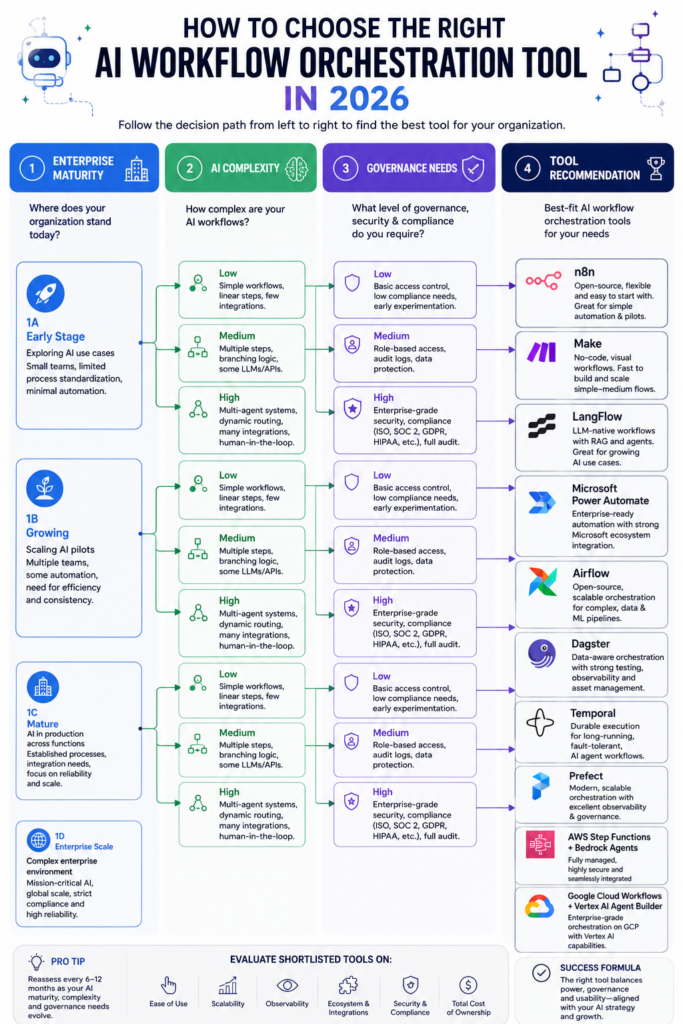
Enterprise Decision Framework
Before platform selection, leaders should evaluate:
- Data maturity– Is enterprise data AI-ready?
- Governance readiness– Can workflows be audited?
- Cloud strategy– Does orchestration align with cloud investments?
- Skills availability– Does internal engineering maturity support implementation?
- Scalability expectations– Will the platform support enterprise growth?
The Future of AI Workflow Orchestration Tools: From Automation to Autonomous Enterprises
The next frontier is not workflow automation. It is workflow autonomy. By 2026 and beyond, enterprises will increasingly deploy:
- Autonomous AI teams
- Self-improving workflows
- Dynamic model routing
- Real-time agent collaboration
- Decision intelligence systems
This evolution will reshape enterprise operating models. Organizations that fail to orchestrate AI effectively may struggle with:
- Rising operational complexity
- Governance risk
- Poor ROI
- Fragmented AI systems
The winners will treat orchestration as strategic infrastructure.
How Techment Helps Enterprises Operationalize AI at Scale
Enterprise AI success requires more than tooling. It requires architecture, governance, data readiness, and operational maturity. Techment helps organizations move from fragmented AI pilots to governed, scalable AI ecosystems through:
Enterprise AI Strategy
Techment helps organizations define enterprise-wide AI roadmaps aligned to measurable business outcomes.
Explore: Enterprise AI Strategy in 2026
AI Readiness and Data Modernization
Scalable orchestration starts with trusted data.
Organizations modernizing their analytics environment often begin with: Fabric AI Readiness: How to Prepare Your Data for Scalable AI Adoption
Responsible AI and Governance
Governed AI systems require high-quality, trusted enterprise data.
Learn more: Data Quality for AI in 2026: The Ultimate Blueprint for Accuracy, Trust & Scalable Enterprise Adoption
Enterprise Data Transformation
AI orchestration performs best when supported by modern data ecosystems.
Explore: Leveraging Data Transformation for Modern Analytics
Conclusion
The rise of enterprise AI is fundamentally changing how organizations operate.
In 2026, AI workflow orchestration tools are no longer optional infrastructure—they are strategic enablers of scalable, governed, enterprise intelligence.
The right orchestration platform can accelerate AI maturity, improve operational efficiency, strengthen governance, and enable autonomous business workflows.
But selecting the right platform requires careful consideration of enterprise priorities, architectural maturity, governance requirements, and long-term scalability.
Organizations that treat orchestration as a foundational capability—not an afterthought—will be better positioned to unlock sustainable AI value.
As enterprises continue moving toward intelligent operating models, the question is no longer whether orchestration matters.
It is which orchestration strategy will define competitive advantage.
FAQs
1. What are AI workflow orchestration tools?
AI workflow orchestration tools coordinate AI systems, workflows, agents, models, and enterprise data pipelines to automate intelligent business processes.
2. Which AI workflow orchestration tools are best for enterprises?
Leading enterprise options in 2026 include LangGraph, Microsoft Fabric AI, Databricks Mosaic AI, Semantic Kernel, AutoGen, Vertex AI, and CrewAI.
3. What is the difference between AI orchestration and workflow automation?
Workflow automation executes predefined rules. AI orchestration coordinates intelligent systems, agents, and adaptive reasoning.
4. Are AI workflow orchestration tools necessary for GenAI?
Yes. Without orchestration, enterprises struggle to scale GenAI reliably, securely, and cost-effectively.
5. Which orchestration tool works best for Microsoft enterprises?
Microsoft Fabric AI and Semantic Kernel are strong choices due to ecosystem integration and governance capabilities.