An enterprise AI copilot is an AI-powered assistant that integrates large language models (LLMs), enterprise data, and business applications to help employees automate tasks, retrieve knowledge, and make faster decisions. Unlike generic AI chatbots, enterprise copilots securely access organizational knowledge, connect with CRM and ERP systems, and operate within governance and compliance policies, making them a strategic productivity platform for modern businesses.
Introduction
Artificial intelligence has moved beyond experimentation. Today, the competitive advantage lies not in adopting AI, but in operationalizing it across the enterprise. Organizations are increasingly deploying AI copilots to empower employees with intelligent assistants that understand business context, access enterprise knowledge, and automate repetitive work.
Unlike public AI tools, enterprise AI copilots operate within organizational boundaries. They connect securely to business systems, retrieve relevant information from internal knowledge bases, execute tasks across enterprise applications, and comply with governance policies. Whether assisting customer support teams, helping developers write code, enabling sales representatives to prepare proposals, or accelerating financial reporting, AI copilots are redefining knowledge work.
For CIOs, CTOs, business executives, and digital transformation leaders, the challenge is no longer whether to implement AI—but how to build secure, scalable, and production-ready AI copilots that deliver measurable business outcomes.
This guide provides a practical framework for designing, implementing, and scaling enterprise AI copilots using modern technologies such as Large Language Models (LLMs), Retrieval-Augmented Generation (RAG), AI agents, vector databases, orchestration frameworks, and enterprise integrations.
TL;DR
- Enterprise AI copilots are AI-powered assistants that combine Large Language Models (LLMs), enterprise data, and business applications to help employees work more efficiently.
- Unlike generic AI chatbots, enterprise copilots securely access internal documents, knowledge bases, CRM, ERP, and collaboration platforms to deliver business-specific responses.
- A production-ready AI copilot consists of five core components: LLM, Retrieval-Augmented Generation (RAG), orchestration, enterprise integrations, and security & governance.
- Start with a high-impact business use case such as IT support, HR, sales, finance, or customer service before expanding across the organization.
- Build a well-structured knowledge base and implement RAG to improve response accuracy and reduce AI hallucinations.
- Integrate the copilot with enterprise platforms like Microsoft 365, Salesforce, SAP, ServiceNow, and internal APIs to automate workflows and retrieve real-time data.
- Implement security, governance, and compliance from day one using role-based access control (RBAC), encryption, audit logging, and responsible AI practices.
- Run a pilot deployment, measure user adoption and business outcomes, then scale based on performance insights.
- Continuously monitor the copilot using MLOps and AI observability tools to improve accuracy, performance, and user experience.
- A phased implementation approach helps organizations reduce risk, accelerate ROI, and build a scalable AI foundation for future automation.
Why Enterprise AI Copilots Matter in 2026
Enterprise AI copilots are becoming the primary interface between employees and business systems. Rather than searching across multiple applications or manually completing repetitive tasks, employees can interact with enterprise knowledge using natural language.
Enterprises are rapidly adopting AI copilots as generative AI becomes a core part of digital transformation. According to McKinsey’s State of AI report, organizations are increasingly investing in AI to improve productivity, automate knowledge work, and accelerate business outcomes. Several factors are driving this shift:
- Increasing volumes of enterprise data
- Rapid advancements in foundation models
- Growing demand for workplace productivity
- Maturing AI governance frameworks
- Enterprise-ready cloud AI platforms
As organizations continue modernizing their digital workplaces, AI copilots are evolving from simple assistants into intelligent collaborators capable of supporting complex business workflows.
Read thsi blog on How AI Copilots Are Transforming Executive Decision-Making in 2026
What Is an Enterprise AI Copilot?
An enterprise AI copilot is a secure, AI-powered assistant that combines large language models with enterprise data, applications, and workflows to help employees find information, automate tasks, and improve decision-making. Unlike consumer AI assistants, enterprise copilots operate within organizational security, compliance, and governance frameworks.
Think of an enterprise AI copilot as an intelligent colleague that understands both human language and your organization’s knowledge ecosystem.
Instead of answering questions based solely on publicly available information, it can:
- Search internal documentation
- Retrieve customer information
- Generate business reports
- Draft emails and proposals
- Summarize meetings
- Analyze enterprise data
- Trigger business workflows
- Execute actions across connected applications
Rather than replacing employees, AI copilots augment human capabilities by reducing cognitive load and accelerating knowledge-intensive work.
Explore more on Enterprise AI Strategy in 2026: A Proven Roadmap for Future-Ready Enterprises
Key Characteristics of Enterprise AI Copilots
| Capability | Business Value |
|---|---|
| Natural language conversations | Improves accessibility for all employees |
| Enterprise knowledge retrieval | Eliminates information silos |
| Business system integration | Executes actions across applications |
| Context awareness | Delivers personalized responses |
| Task automation | Reduces repetitive manual work |
| Security and governance | Protects sensitive business data |
| Continuous learning | Improves relevance over time |
Enterprise AI Copilot vs Chatbot vs AI Agent vs Digital Assistants
Although these terms are often used interchangeably, they represent different levels of AI capability. Enterprise AI copilots combine conversational intelligence, enterprise knowledge access, workflow automation, and contextual reasoning, making them significantly more capable than traditional chatbots or virtual assistants.
| Feature | Traditional Chatbot | Digital Assistant | AI Copilot | AI Agent |
|---|---|---|---|---|
| Rule-based responses | ✓ | Partial | No | No |
| Natural conversations | Limited | Yes | Yes | Yes |
| Enterprise knowledge access | No | Limited | Yes | Yes |
| RAG-enabled retrieval | No | Sometimes | Yes | Yes |
| Multi-step reasoning | No | Limited | Yes | Advanced |
| Tool execution | No | Limited | Yes | Autonomous |
| Workflow automation | Minimal | Limited | Yes | Extensive |
| Decision support | No | Basic | Advanced | Advanced |
| Human collaboration | Low | Medium | High | Variable |
| Autonomous execution | No | No | Partial | High |
Understanding the Evolution
The evolution of enterprise AI can be viewed in four stages:
Traditional Chatbots rely on predefined rules and scripted conversations. They work well for repetitive customer queries but struggle with unexpected questions.
Digital Assistants introduced conversational interfaces and voice interactions but typically have limited access to enterprise data.
Enterprise AI Copilots combine LLMs, enterprise search, business applications, and workflow automation to assist employees in real time.
AI Agents extend copilots by autonomously planning, reasoning, and executing complex workflows with minimal human intervention.
For most organizations today, AI copilots provide the optimal balance between automation and human oversight.
Why Organizations Are Investing in Enterprise AI Copilots
Organizations invest in enterprise AI copilots because they improve productivity, accelerate decision-making, reduce operational costs, and make organizational knowledge instantly accessible. Instead of replacing employees, copilots amplify human capabilities by eliminating repetitive work and surfacing relevant information when it is needed most.
Several enterprise trends are converging to make AI copilots a strategic priority.
1. Knowledge Work Is Growing More Complex
Employees interact with dozens of enterprise systems daily. Finding accurate information often consumes more time than using it.
AI copilots reduce this friction by acting as a unified conversational interface across enterprise applications.
2. Enterprise Knowledge Is Fragmented
Critical business information is scattered across:
- SharePoint
- Microsoft Teams
- Confluence
- Salesforce
- SAP
- ServiceNow
- Databases
- PDFs
- Emails
- Internal Wikis
Rather than searching multiple repositories, employees simply ask questions in natural language.
3. Productivity Has Become a Competitive Advantage
Organizations are increasingly measuring:
- Time saved
- Faster issue resolution
- Employee satisfaction
- Customer response times
- Operational efficiency
AI copilots directly contribute to each of these metrics by reducing manual effort and accelerating workflows.
4. Foundation Models Have Matured
Recent advances in LLMs have significantly improved:
- Reasoning
- Long-context understanding
- Tool calling
- Function execution
- Multimodal capabilities
- Structured output generation
This maturity enables enterprises to move beyond experimentation toward production-scale deployments.
Common use cases include IT support, HR, sales, finance, customer service, legal, and software development, where employees frequently interact with large volumes of enterprise information.
| Business Function | Typical AI Copilot Use Case |
|---|---|
| IT | Internal support and troubleshooting |
| HR | Employee onboarding and policy assistance |
| Sales | CRM insights and proposal generation |
| Finance | Reporting and data analysis |
| Legal | Contract summarization and compliance |
| Customer Support | Response drafting and knowledge retrieval |
Enterprise AI Copilot Architecture
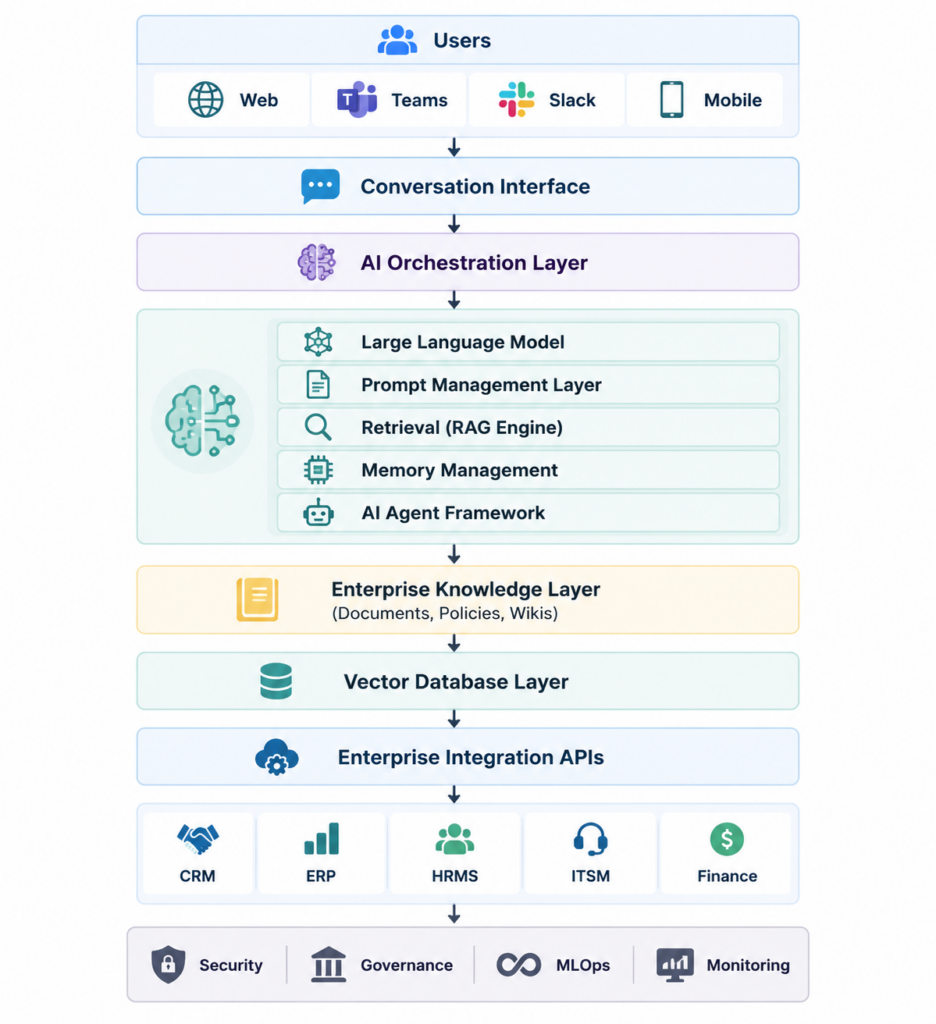
A production-ready enterprise AI copilot consists of multiple interconnected layers that work together to understand user intent, retrieve organizational knowledge, generate accurate responses, execute business actions, and continuously improve through monitoring and governance.
Unlike consumer AI applications, enterprise copilots require an architecture that prioritizes reliability, scalability, security, and integration.
At a high level, the architecture consists of several logical layers.
Core Components of an Enterprise AI Copilot
Every enterprise AI copilot is built on a set of foundational components that enable language understanding, knowledge retrieval, workflow orchestration, enterprise integration, and governance. Together, these layers transform a general-purpose language model into a secure, business-aware AI assistant.
1. Large Language Model (LLM)
The LLM serves as the reasoning engine of the copilot. It interprets user queries, understands intent, generates natural language responses, and coordinates complex interactions.
When selecting an LLM, organizations should evaluate:
- Accuracy and reasoning quality
- Latency requirements
- Context window size
- Cost efficiency
- Data residency needs
- Multimodal support
- Enterprise licensing
2. Retrieval-Augmented Generation (RAG)
RAG grounds AI responses in your organization’s own knowledge rather than relying solely on the model’s pre-trained information.
A robust RAG pipeline typically includes:
- Document ingestion
- Semantic chunking
- Embedding generation
- Vector indexing
- Contextual retrieval
- Response grounding
This significantly improves answer accuracy while reducing hallucinations.
3. AI Orchestration Layer
The orchestration layer manages:
- Prompt construction
- Conversation state
- Tool selection
- Workflow coordination
- Multi-step reasoning
- Agent collaboration
It acts as the central control plane that connects users, AI models, enterprise systems, and business logic.
How to Build an Enterprise AI Copilot: Step-by-Step
Building an enterprise AI copilot requires more than integrating an LLM. A successful implementation starts with identifying the right business problem, preparing enterprise data, designing a secure AI architecture, and continuously optimizing the solution after deployment.
Step 1. Identify the Right Business Use Case
Start with a focused business problem that delivers measurable value. Rather than building a generic AI assistant, prioritize use cases where employees spend significant time searching for information or performing repetitive tasks.
Common enterprise use cases include:
- IT helpdesk automation
- HR policy assistance
- Sales proposal generation
- Customer support
- Financial reporting
- Legal document review
- Enterprise knowledge management
Define clear success metrics such as reduced response times, improved productivity, or lower support costs before moving into development.
Step 2. Design the AI Architecture
Once the use case is defined, design an architecture that balances performance, scalability, and security.
A typical enterprise AI copilot includes:
| Layer | Purpose |
|---|---|
| LLM | Natural language understanding and response generation |
| RAG | Retrieves enterprise knowledge before generating answers |
| Vector Database | Stores document embeddings for semantic search |
| Orchestration | Manages prompts, workflows, and tool execution |
| Enterprise Integrations | Connects CRM, ERP, HRMS, and business applications |
| Security Layer | Authentication, authorization, and governance |
Choosing the right architecture early reduces technical debt and simplifies future expansion.
Step 3. Build a High-Quality Knowledge Base
The quality of your AI copilot depends on the quality of the data it can access.
Before implementation:
- Consolidate enterprise documents
- Remove outdated content
- Define document ownership
- Apply metadata and tagging
- Create automated ingestion pipelines
Typical enterprise knowledge sources include:
- SharePoint
- Confluence
- Microsoft Teams
- Internal Wikis
- PDFs
- Databases
- CRM records
- Product documentation
Well-structured knowledge improves retrieval accuracy and reduces AI hallucinations.
Step 4. Implement Retrieval-Augmented Generation (RAG)
RAG is one of the most important components of an enterprise AI copilot. Instead of relying only on an LLM’s training data, it retrieves relevant enterprise information before generating a response.
A production RAG pipeline typically includes:
- Document ingestion
- Semantic chunking
- Embedding generation
- Vector indexing
- Similarity search
- Context-aware response generation
This ensures responses are based on current enterprise knowledge rather than outdated or generic information.
Step 5. Integrate Enterprise Applications
The real value of an AI copilot comes from connecting it with the applications employees use every day.
Common integrations include:
- Microsoft 365
- Salesforce
- SAP
- Oracle
- ServiceNow
- Dynamics 365
- Jira
- Slack
- Microsoft Teams
- Internal APIs
These integrations allow the copilot to retrieve live business data, automate workflows, and perform actions across enterprise systems.
Step 6. Implement Security and Governance
Enterprise AI must be designed with security and compliance from the beginning.
Key governance controls include:
- Role-based access control (RBAC)
- Single Sign-On (SSO)
- End-to-end encryption
- Audit logging
- Prompt injection protection
- Sensitive data masking
- Human approval for critical actions
Organizations operating in regulated industries should also ensure compliance with frameworks such as GDPR, HIPAA, ISO 27001, SOC 2, and the EU AI Act where applicable.
Step 7. Pilot Before Enterprise Rollout
Rather than deploying organization-wide immediately, begin with a limited pilot involving a single department or business function.
Measure key performance indicators such as:
- Response accuracy
- User adoption
- Time saved
- Resolution rate
- User satisfaction
- AI response quality
Use employee feedback to improve prompts, retrieval settings, and workflows before scaling across the enterprise.
Step 8. Monitor and Continuously Improve
Enterprise AI copilots require ongoing optimization after deployment.
Monitor:
- Response quality
- Retrieval accuracy
- Hallucination rate
- Latency
- Token usage
- User feedback
- System availability
MLOps and AI observability platforms help monitor performance, identify issues, and continuously improve the copilot over time.
Enterprise AI Copilot Technology Stack
The technology stack you choose should align with your business requirements, security policies, and existing cloud ecosystem.
| Layer | Common Technologies |
|---|---|
| LLM | GPT-5.5, Claude, Gemini, Llama |
| Orchestration | LangGraph, Semantic Kernel, LlamaIndex |
| Vector Database | Pinecone, Qdrant, Azure AI Search, Weaviate |
| Embeddings | OpenAI, Cohere, Voyage AI |
| Backend | Python (FastAPI), Node.js |
| Enterprise Integration | REST APIs, GraphQL, Webhooks |
| Cloud Platform | Microsoft Azure, AWS, Google Cloud |
| Authentication | Microsoft Entra ID, Okta |
| Monitoring | LangSmith, MLflow, Arize AI |
Common Challenges in Enterprise AI Copilot Development
While enterprise AI copilots offer significant productivity gains, organizations often face challenges during implementation.
Some of the most common include:
- Poor data quality or outdated documentation
- Disconnected enterprise systems
- Inaccurate AI responses caused by weak retrieval
- Security and compliance concerns
- Low user adoption
- Lack of governance and monitoring
Addressing these challenges early helps improve long-term success and reduces costly rework.
Best Practices for Building Enterprise AI Copilots
Organizations that successfully deploy AI copilots typically follow these best practices:
- Start with a single, high-value business use case.
- Build on clean, well-governed enterprise data.
- Use RAG to improve response accuracy.
- Integrate with existing enterprise applications instead of replacing them.
- Implement governance, security, and access controls from day one.
- Pilot with a small group before scaling organization-wide.
- Continuously monitor and optimize performance using user feedback and AI observability tools.
Following these practices helps reduce implementation risk while accelerating user adoption and business value.
How to Choose an Enterprise AI Development Partner
Choosing the right implementation partner is just as important as selecting the right technology.
Look for a partner with expertise in:
- Enterprise AI strategy and consulting
- LLM selection and deployment
- RAG architecture
- AI agent development
- Microsoft Azure, AWS, or Google Cloud
- Enterprise integrations (SAP, Salesforce, Microsoft 365, ServiceNow)
- AI governance and compliance
- MLOps and AI observability
The right partner should focus on measurable business outcomes rather than simply deploying AI models.
Future Trends in Enterprise AI Copilots
Enterprise AI copilots are rapidly evolving beyond conversational assistants into intelligent systems capable of planning, reasoning, and executing business workflows.
Key trends shaping the next generation of enterprise AI include:
- Agentic AI that can complete multi-step business tasks autonomously.
- Multi-agent systems where specialized AI agents collaborate across departments.
- Multimodal AI capable of understanding text, images, audio, and documents.
- AI-powered workflow automation integrated into enterprise applications.
- Industry-specific copilots designed for healthcare, finance, manufacturing, legal, and retail.
- Responsible AI and governance becoming standard requirements for enterprise deployments.
Organizations investing today should build flexible architectures that can support these capabilities as they mature.
Conclusion
Enterprise AI copilots are becoming a strategic capability for organizations looking to improve productivity, streamline operations, and make better use of enterprise knowledge. When combined with secure data access, Retrieval-Augmented Generation (RAG), enterprise integrations, and strong governance, AI copilots can deliver measurable business value across departments.
Success depends on more than choosing the right AI model. It requires a clear business use case, high-quality enterprise data, scalable architecture, and continuous optimization after deployment. By following a phased implementation approach, organizations can reduce risk, accelerate adoption, and build an AI foundation that supports long-term digital transformation.
Frequently Asked Questions
1. What is an enterprise AI copilot?
An enterprise AI copilot is an AI-powered assistant that combines Large Language Models (LLMs), enterprise data, and business applications to help employees retrieve information, automate tasks, and improve productivity securely.
2. How is an enterprise AI copilot different from a chatbot?
Traditional chatbots rely on predefined rules and scripted conversations. Enterprise AI copilots use LLMs, Retrieval-Augmented Generation (RAG), and enterprise integrations to provide contextual, business-specific responses and automate workflows.
3. What technologies are required to build an enterprise AI copilot?
A production-ready AI copilot typically includes an LLM, RAG pipeline, vector database, orchestration framework, enterprise integrations, security controls, and monitoring tools.
4. How long does it take to build an enterprise AI copilot?
A pilot deployment can usually be completed within 6–10 weeks, while a full enterprise implementation may take 6–12 months, depending on integration complexity and organizational requirements
5. What is RAG, and why is it important?
Retrieval-Augmented Generation (RAG) retrieves relevant enterprise information before generating a response. It improves answer accuracy, reduces hallucinations, and ensures responses are based on current business knowledge.
6. Which business functions benefit the most from AI copilots?
Common use cases include IT support, HR, sales, finance, legal, customer service, software development, and enterprise knowledge management.
7. How do enterprises ensure AI security and compliance?
Organizations implement role-based access control (RBAC), encryption, audit logging, data masking, responsible AI policies, and compliance frameworks such as GDPR, HIPAA, ISO 27001, and SOC 2 to protect sensitive business information.
Related Reads
- How LLMs Power Modern Enterprise Applications: Architecture, Use Cases
- 10 Effective Steps to Building RAG Applications: An Enterprise Guide
- AI-Native vs. AI-Enabled: What’s the Difference
- How AI Chatbots Analyze Customer Intent in Real Time
- 12 Proven RAG Optimization Techniques for Production AI Systems