Insurance legacy system modernization improves legacy applications, integrations, and data architectures without necessarily replacing the core system. Insurers can use APIs, microservices, cloud platforms, and modern data services to extend existing policy, claims, and billing systems. This incremental approach supports digital transformation while reducing migration complexity and operational disruption.
Executive Summary
Insurance companies depend on core technology platforms to manage policy administration, underwriting, claims processing, billing, customer information, and regulatory reporting. Many of these systems were developed decades ago and continue to support critical business operations. However, aging architectures, fragmented data, limited integration capabilities, and increasing maintenance costs make it difficult for insurers to respond to changing customer expectations and technology demands.
Replacing an entire core insurance platform can be expensive, time-consuming, and operationally risky. It may also require complex data migration, business process redesign, extensive testing, and changes across multiple dependent systems.
A more practical alternative is to modernize legacy insurance systems incrementally without immediately replacing the core. This approach combines API-led integration, microservices, cloud platforms, modern data architectures, automation, and selective application modernization to extend existing systems while introducing new capabilities around them.
Insurers can modernize customer-facing applications, claims workflows, analytics, document processing, and digital distribution while retaining stable policy administration or claims platforms. Over time, individual legacy components can be refactored, replaced, or retired based on business priorities and technical readiness.
The objective is not to preserve legacy technology indefinitely. It is to reduce technical debt, improve integration, enable digital capabilities, and create a modernization path that delivers measurable business value without exposing critical insurance operations to unnecessary disruption.
TL;DR: Modernizing Insurance Technology Without Replacing the Core
- Legacy insurance systems remain business-critical: Policy administration, claims, billing, and underwriting platforms often contain years of embedded business logic and operational knowledge.
- Full core replacement is not always necessary: Insurers can modernize around existing systems through APIs, integration layers, cloud services, and modular applications.
- API-led modernization improves connectivity: APIs expose legacy capabilities to modern applications without requiring immediate changes to the underlying core.
- Microservices support incremental transformation: New capabilities can be developed independently and gradually separated from monolithic applications.
- Data modernization is essential: Unified data access, data quality, and governance help insurers enable analytics, automation, and AI without replacing every system of record.
- The Strangler Fig pattern reduces transformation risk: New services progressively take over selected functions while legacy systems continue supporting remaining operations.
- AI can accelerate modernization: AI-assisted code analysis, documentation, data mapping, testing, and reconciliation can help teams understand and modernize complex legacy environments.
- Modernization should be business-led: Prioritize improvements based on operational value, integration needs, technical risk, and measurable outcomes.
- The goal is a modern, connected insurance architecture: Preserve what works, modernize what limits innovation, and replace components when justified.
Introduction: Why Insurance Companies Need Legacy System Modernization
Insurance companies operate technology environments that have evolved over many years through system upgrades, acquisitions, custom development, regulatory changes, and business expansion.
Core platforms manage essential operations such as policy issuance, premium calculations, underwriting rules, claims registration, settlement processing, billing, and customer records. These systems may be built on mainframe technologies, older programming languages, monolithic architectures, or proprietary applications that are difficult to integrate with modern digital platforms.
Although many legacy systems remain functionally reliable, their surrounding technology environments can create significant challenges.
Customers expect faster policy servicing, digital claims submission, real-time updates, and seamless interactions across channels. Underwriters need access to broader risk information. Claims teams require better automation and data visibility. Business leaders want analytics, AI capabilities, and faster product innovation.
Legacy architectures may not support these requirements efficiently.
However, replacing an entire core platform is not always the most practical solution. Core insurance systems contain complex business rules, historical records, integrations, and operational dependencies that cannot be migrated without significant planning.
A more sustainable strategy is to modernize incrementally.
Insurers can introduce modern APIs, cloud services, data platforms, digital applications, and automation capabilities around existing systems. This creates opportunities to improve business operations while maintaining continuity in critical processes.
The central question is therefore not whether insurers should modernize their legacy systems. It is how they can modernize them without introducing unnecessary replacement risk.
Read more about AI in Insurance: Benefits, Use Cases in 2026
What Is Legacy System Modernization in Insurance?
Legacy system modernization in insurance is the process of improving existing technology platforms, applications, integrations, and data architectures to support modern business requirements without necessarily replacing the entire core system. It can involve APIs, cloud infrastructure, microservices, data modernization, application refactoring, automation, and selective component replacement while preserving critical business functionality.
business priorities, technology constraints, and the complexity of existing platforms.
According to McKinsey, incremental modernization can help organizations reduce transformation risk while improving legacy technology capabilities.
What makes an insurance system legacy?
An insurance system may be considered legacy when its architecture, technology, or operating model limits the organization’s ability to maintain, integrate, scale, or enhance it efficiently.
Common characteristics include:
- Monolithic application architecture.
- Limited API availability.
- Dependence on outdated programming languages or databases.
- Batch-oriented data processing.
- Complex point-to-point integrations.
- Limited documentation.
- Manual operational workflows.
- High maintenance requirements.
- Dependence on specialized technical knowledge.
- Difficulty supporting modern digital channels.
Not every older system is necessarily a poor system. Some legacy platforms are stable, reliable, and deeply aligned with an insurer’s business requirements.
The modernization decision should therefore consider business value, system stability, technical condition, operational risk, and the availability of suitable alternatives.
What does modernizing without replacing the core mean?
Modernizing without replacing the core means introducing modern capabilities around existing systems while retaining their essential business functions.
For example, an insurer can keep its existing policy administration system while introducing:
- A modern customer-facing application.
- API-based access to policy information.
- A cloud-based analytics platform.
- Automated document processing.
- Digital claims intake.
- Real-time notifications.
- AI-enabled customer and employee assistance.
The legacy platform continues to manage the underlying policy records, while modern services improve how users and other applications interact with it.
This approach creates a more flexible technology environment without requiring an immediate core replacement.
Why Are Legacy Insurance Systems Becoming a Business Challenge?
Legacy insurance systems become a business challenge when their limitations affect operational efficiency, customer experience, integration, product innovation, and the ability to adopt modern technologies. Although these systems may continue supporting critical transactions, the cost and complexity of maintaining them can restrict an insurer’s ability to respond to changing business requirements.
1. Limited integration capabilities
Older platforms may lack modern APIs, event-driven interfaces, or standardized integration mechanisms.
Connecting them to customer applications, partner platforms, analytics tools, and cloud services can require complex custom integrations.
2. Increasing maintenance costs
Legacy systems may depend on specialized skills, older infrastructure, custom code, and manual operational processes.
As technical knowledge becomes harder to maintain, even small changes can require significant engineering effort.
3. Fragmented insurance data
Policy, claims, billing, underwriting, and customer information may exist in separate systems.
This creates challenges for data consistency, reporting, customer visibility, and enterprise analytics.
4. Slower product innovation
Launching a new insurance product or changing an existing workflow may require updates across multiple interconnected systems.
Rigid architectures and complex dependencies can increase development time and testing requirements.
5. Limited digital capabilities
Legacy systems may not support the real-time interactions expected by modern digital applications.
This can affect policy servicing, claims status updates, broker portals, customer onboarding, and self-service experiences.
6. Challenges adopting AI and advanced analytics
AI applications depend on accessible, reliable, and well-governed data.
When information is fragmented or difficult to retrieve, insurers may struggle to implement predictive analytics, generative AI, automated underwriting support, and intelligent claims processing.
7. Operational and technology risk
Systems with outdated components, limited documentation, or unsupported dependencies may introduce security, resilience, and continuity risks.
Modernization helps address these issues through improved architecture, integration, observability, and lifecycle management.
Why Replacing the Entire Insurance Core Is Not Always the Right Approach
Replacing an entire insurance core is not always the right modernization strategy because core systems contain complex business rules, historical data, operational dependencies, and integrations that can make large-scale migration expensive and disruptive. Incremental modernization allows insurers to improve specific capabilities, reduce technical debt, and deliver business value while retaining stable systems of record.
Common challenges with full core replacement
High implementation investment
A full replacement may involve platform licensing, implementation partners, data migration, infrastructure, integration, testing, and employee training.
Complex business logic migration
Insurance platforms often contain years of customized rating rules, underwriting conditions, claims workflows, product configurations, and regulatory requirements.
Recreating this logic in a new platform can be difficult.
Operational disruption
Policy administration, billing, and claims systems support daily business operations. A poorly planned migration can affect policy servicing, premium processing, claims settlement, and customer communication.
Data migration complexity
Historical policy and claims data may contain inconsistent formats, duplicated records, incomplete information, and legacy-specific structures.
Migrating this information requires extensive validation and reconciliation.
Long transformation timelines
Large core replacement programs may take multiple years, particularly when they involve multiple insurance lines, business units, jurisdictions, and integrations.
Organizational resistance
Employees and business teams may be reluctant to adopt new processes when they are accustomed to existing platforms and workflows.
When full replacement may be justified
Incremental modernization is not always sufficient.
A full or substantial core replacement may be appropriate when:
- The existing platform is unstable or unsupported.
- Critical business functionality cannot be maintained.
- Security and resilience risks cannot be adequately mitigated.
- The system cannot support required regulatory or business changes.
- Maintenance costs exceed the value of retaining the platform.
- A suitable modern core platform offers a compelling business case.
The objective is to select the modernization path that best balances business value, technical feasibility, cost, and risk.
AI claims automation must be supported by robust enterprise architecture. Techment’s AI-Ready Enterprise Checklist with Microsoft Fabric outlines readiness considerations.
What Are the Different Approaches to Modernizing Insurance Legacy Systems?
Insurance legacy systems can be modernized through several approaches, including encapsulation, API-led integration, refactoring, replatforming, microservices, cloud modernization, and selective replacement. These approaches can be combined based on the condition of the existing system and the insurer’s business priorities.
1. System encapsulation
Encapsulation exposes selected legacy functionality through a modern interface without changing the underlying system.
For example, an insurer can expose policy lookup functionality through an API, allowing a mobile application or broker portal to retrieve information without directly accessing the legacy database.
Business value:
- Enables modern application integration.
- Reduces direct dependencies on legacy interfaces.
- Supports digital channels.
- Preserves existing business logic.
2. API-led modernization
API-led modernization creates standardized interfaces between legacy systems and modern applications.
APIs provide controlled access to existing functionality and data, allowing new services to interact with the core without requiring every application to understand its internal architecture.
Business value:
- Improves system connectivity.
- Reduces point-to-point integration complexity.
- Supports partner and third-party integrations.
- Enables phased application modernization.
3. Application refactoring
Refactoring improves the internal structure of an application without necessarily changing its business functionality.
This may involve restructuring code, improving modularity, removing duplication, updating dependencies, and improving maintainability.
Business value:
- Reduces technical debt.
- Improves code maintainability.
- Creates a better foundation for future changes.
- Helps preserve important business functionality.
Refactoring should be prioritized carefully. Simply rewriting old code in a newer language without addressing architectural limitations may preserve the same constraints in a different technology stack.
4. Replatforming
Replatforming moves an application to a modern infrastructure or runtime environment while retaining much of its existing functionality.
For example, an insurer may migrate an application from on-premises infrastructure to a managed cloud environment.
Business value:
- Improves infrastructure flexibility.
- Supports scalability.
- Enables modern monitoring and operational practices.
- Reduces dependence on aging infrastructure.
Replatforming does not automatically modernize application architecture or eliminate technical debt.
5. Microservices-based modernization
Microservices break application functionality into smaller, independently deployable services organized around business capabilities.
An insurer may gradually separate document management, customer notifications, payment processing, or claims intake from a larger monolithic application.
Business value:
- Supports independent development and deployment.
- Reduces coupling between selected capabilities.
- Enables targeted scaling.
- Improves flexibility for new digital services.
Microservices also introduce distributed-system complexity, including service communication, observability, data consistency, and operational management. They should be introduced where the benefits justify that complexity.
6. Cloud modernization
Cloud modernization introduces cloud infrastructure and services to improve scalability, resilience, integration, analytics, and operational flexibility.
An insurer may retain its core policy administration system while moving analytics, document processing, customer applications, or integration services to cloud platforms.
Business value:
- Flexible infrastructure capacity.
- Access to managed data and analytics services.
- Better support for modern application development.
- Integration with AI and automation capabilities.
Cloud migration should include architecture, security, resilience, cost management, and data governance considerations.
7. Selective component replacement
Selective replacement involves replacing individual legacy modules or capabilities rather than the entire core platform.
For example, an insurer may modernize its billing interface or claims intake application while retaining the existing policy administration system.
Business value:
- Reduces transformation scope.
- Targets high-value business improvements.
- Limits disruption to stable core operations.
- Allows gradual retirement of legacy dependencies.
How API-Led Modernization Helps Insurers Extend Legacy Core Systems
API-led modernization helps insurers extend legacy core systems by exposing selected business capabilities through standardized interfaces. Modern applications can retrieve information or initiate approved transactions without requiring direct access to the underlying legacy code or database.
Example: Modernizing policy servicing
An insurer operates a legacy policy administration system that manages customer information, policy details, renewals, and endorsements.
The insurer wants to introduce a modern customer portal.
Instead of replacing the policy administration system, it can:
- Create an API layer around selected policy functions.
- Expose approved policy information through secure endpoints.
- Connect the APIs to a modern customer application.
- Implement authentication and authorization controls.
- Introduce real-time notifications and digital servicing workflows.
- Monitor API performance and transaction consistency.
The existing system remains responsible for core policy records, while the new application provides a more accessible customer experience.
Key API modernization considerations
- API gateway and traffic management.
- Authentication and authorization.
- Rate limiting and throttling.
- Input validation.
- Version management.
- Error handling.
- Audit logging.
- Service monitoring.
- Backward compatibility.
APIs should be designed around business capabilities rather than simply exposing every legacy database operation.
What Is the Strangler Fig Pattern in Insurance Modernization?
The Strangler Fig pattern is an incremental modernization approach in which new services are introduced around an existing legacy application and gradually take over selected functionality. The legacy system continues handling remaining operations until its responsibilities can be reduced or retired safely.
This approach is particularly useful when an insurer wants to modernize critical capabilities without migrating the entire core system at once.

How the Strangler Fig pattern works
Step 1: Identify a legacy capability
Select a business function that can be separated from the existing system, such as document management, customer notifications, or claims intake.
Step 2: Build a modern replacement service
Develop a new service using suitable technologies and expose its functionality through APIs.
Step 3: Introduce routing and integration
Direct new requests to the modern service while keeping other operations on the legacy platform.
Step 4: Validate functionality and data consistency
Compare outputs, validate transactions, and test operational behavior before expanding usage.
Step 5: Gradually shift responsibility
Move additional functionality to the modern service as readiness and business value are demonstrated.
Step 6: Retire redundant legacy functionality
Decommission the relevant legacy component only after dependencies, data, and operational requirements have been addressed.
Example: Claims system modernization
An insurer wants to improve claims registration without replacing its existing claims management platform.
It can introduce a modern digital claims intake service that:
- Accepts customer submissions.
- Extracts claim information.
- Collects supporting documents.
- Validates mandatory fields.
- Creates a structured claim request.
- Sends the request to the existing claims system through an API.
The legacy claims platform continues to manage the core claim record and downstream processing.
Over time, additional claims capabilities can be modernized independently.
This reduces the need for a single large transformation while delivering incremental improvements.
How Microservices Support Modern Insurance Technology Architecture
Microservices support insurance modernization by separating selected business capabilities into independently deployable services that can communicate through APIs or messaging systems. They allow insurers to modernize specific functions without requiring every component of the legacy core to be rewritten or replaced.
Example of an insurance microservices architecture
A modern insurance application may contain services for:
- Customer management.
- Policy information.
- Premium calculation.
- Claims registration.
- Document processing.
- Payment processing.
- Notifications.
- Broker integration.
These services can interact with existing policy administration, billing, and claims systems through controlled integration layers.
Benefits of microservices
- Independent deployment of selected capabilities.
- Flexible scaling.
- Better separation of business responsibilities.
- Faster development of new digital functionality.
- Reduced dependency on large monolithic releases.
When microservices may not be appropriate
Microservices are not automatically the best architecture for every modernization initiative.
They may introduce unnecessary complexity when:
- The application is small and stable.
- Independent deployment is not required.
- The organization lacks distributed-system engineering capabilities.
- Service boundaries are poorly defined.
- Operational monitoring is insufficient.
A modular monolith or well-designed integration layer may be a more practical intermediate step.
The architecture should reflect actual business and operational requirements rather than follow a technology trend.
Read more about Microsoft Fabric for Insurance Carriers: A Reference Architecture
How Data Modernization Enables Insurance Innovation Without Core Replacement
Data modernization enables insurance innovation by making information from legacy and modern systems accessible, consistent, governed, and suitable for analytics and digital applications. It allows insurers to improve reporting, customer visibility, risk analysis, and AI capabilities without necessarily replacing the systems that create and maintain core insurance records.
Common insurance data challenges
- Policy, claims, and billing data stored in separate platforms.
- Inconsistent customer and product identifiers.
- Different definitions across business units.
- Batch-based data synchronization.
- Limited access to historical information.
- Incomplete metadata and lineage.
- Unstructured documents and records.
- Manual reconciliation between systems.
Building a modern insurance data architecture
A practical data modernization strategy may include:
1. Data integration
Connect policy, claims, billing, underwriting, and external data sources through controlled ingestion and integration processes.
2. Data standardization
Establish consistent definitions for customers, policies, products, claims, and business events.
3. Data quality management
Implement validation, deduplication, reconciliation, and continuous data-quality monitoring.
4. Enterprise data platform
Use a scalable data warehouse, lakehouse, or other suitable architecture to consolidate information for analytics and reporting.
5. Data governance
Define ownership, access permissions, lineage, classification, retention, and usage policies.
6. Data access for AI and analytics
Provide governed access to trusted data for predictive analytics, generative AI, and operational decision support.
Example: Building a unified claims data view
An insurer may maintain claims information across several platforms, including legacy claims administration, document repositories, payment systems, and customer applications.
A modern data platform can bring relevant information together into a governed analytical view.
This can support:
- Claims performance reporting.
- Settlement trend analysis.
- Fraud analytics.
- Claims cycle-time monitoring.
- Customer service insights.
- Operational forecasting.
The original claims system can remain the system of record while the modern data platform provides broader analytical capabilities.
How AI Can Accelerate Legacy Insurance System Modernization
AI can support legacy insurance modernization by helping teams analyze source code, discover business rules, generate documentation, map data structures, create tests, and identify migration risks. These capabilities can reduce repetitive engineering effort, but AI-generated findings and code must be validated against actual system behavior and business requirements.
1. Legacy code analysis
AI-assisted code analysis can help engineers understand older programming languages, application dependencies, and complex code structures.
It can support identification of:
- Business logic.
- Application modules.
- Data access patterns.
- System dependencies.
- Repeated code structures.
- Potential modernization candidates.
2. Automated documentation
Legacy applications may have limited or outdated technical documentation.
AI can help generate initial documentation from code, configuration files, database schemas, and available system records.
This can make it easier for modernization teams to understand existing functionality.
3. Business rule discovery
Insurance platforms often contain embedded rules for premium calculations, underwriting conditions, policy eligibility, claims processing, and billing.
AI-assisted analysis can help locate and organize these rules for review by business and technical specialists.
4. Data mapping and migration support
AI can assist with mapping legacy fields to modern data models, identifying potential inconsistencies, and generating transformation logic for review.
Data reconciliation and validation remain essential before migrated information is used in production.
5. Test case generation
AI can help derive test scenarios from application behavior, requirements, business rules, and existing test scripts.
It can support:
- Unit test generation.
- Regression test creation.
- API test scaffolding.
- Boundary and negative test scenarios.
- Test-data preparation.
Generated tests must be reviewed to ensure that they cover actual business requirements and edge cases.
6. Migration and refactoring assistance
AI coding assistants can help explain legacy code, suggest refactoring approaches, and generate initial code transformations.
Engineers must validate the resulting implementation for functional equivalence, performance, security, and maintainability.
7. Modernization impact analysis
AI can help analyze dependencies between applications, identify potentially affected modules, and prepare impact assessments when a legacy capability is modified.
This can support planning and prioritization, particularly in complex insurance technology environments.
Important consideration: AI should accelerate modernization engineering, not become an uncontrolled mechanism for rewriting critical insurance business logic. Human review, automated testing, reconciliation, and formal change approval remain essential.
What Does a Modernized Insurance Technology Architecture Look Like?
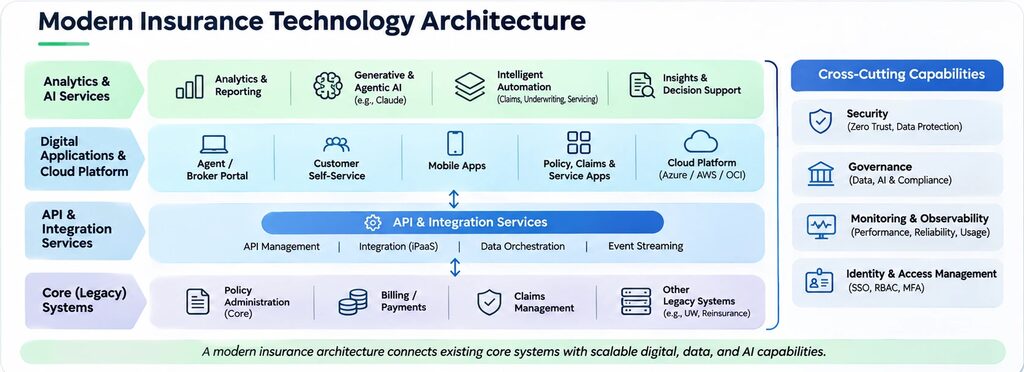
A modernized insurance technology architecture combines existing core systems with modern integration, application, data, cloud, and analytics layers. It allows insurers to preserve stable systems of record while introducing new digital capabilities and gradually reducing dependence on legacy components.
Recommended architecture layers
1. Core insurance systems
Existing policy administration, claims, billing, underwriting, and financial platforms continue supporting essential business transactions.
2. API and integration layer
API gateways, integration services, and messaging platforms connect core systems with modern applications and external partners.
3. Modern application layer
Customer portals, broker platforms, claims applications, document services, and other digital capabilities operate independently where appropriate.
4. Data and analytics layer
Enterprise data platforms consolidate governed information for reporting, analytics, operational intelligence, and AI applications.
5. AI and automation layer
Machine learning, document intelligence, RAG, generative AI, and workflow automation support business processes through controlled integrations.
6. Security and governance layer
Identity management, access control, encryption, monitoring, audit logging, data governance, and resilience practices operate across the architecture.
Architecture design principles
- Preserve stable business-critical systems where appropriate.
- Avoid unnecessary direct dependencies between applications.
- Expose business capabilities through governed interfaces.
- Separate systems of record from analytical data platforms.
- Introduce modular services where independent deployment adds value.
- Apply security and governance consistently.
- Design for observability, resilience, and controlled change.
- Maintain clear ownership of data and business rules.
The goal is not to create a completely new architecture overnight. It is to evolve the existing technology environment into a more connected and adaptable platform.
A Practical Roadmap for Modernizing Legacy Insurance Systems
Insurers can modernize legacy systems without replacing the core through a phased roadmap that begins with application assessment, identifies high-value capabilities, introduces modern integration and data layers, and gradually replaces selected functions. This approach helps maintain business continuity while delivering measurable improvements at each stage.
Phase 1: Assess the existing technology landscape
Create an inventory of core insurance systems, applications, integrations, databases, infrastructure, and operational dependencies.
Evaluate each system based on:
- Business criticality.
- Technical condition.
- Maintenance cost.
- Integration complexity.
- Data quality.
- Security and resilience.
- Available skills.
- Modernization potential.
Deliverable: Current-state architecture and modernization assessment.
Phase 2: Prioritize business capabilities
Identify business functions that create the greatest operational constraints or offer the clearest modernization opportunities.
Potential candidates include:
- Digital claims intake.
- Customer notifications.
- Document management.
- Broker and partner integrations.
- Customer self-service.
- Analytics and reporting.
Deliverable: Prioritized modernization roadmap.
Phase 3: Establish the integration foundation
Introduce API management, integration services, and standardized data access patterns.
Avoid creating new uncontrolled point-to-point integrations.
Deliverable: API and integration architecture.
Phase 4: Modernize data and applications incrementally
Introduce modern data platforms, cloud services, digital applications, and modular components according to business priorities.
Keep existing core systems responsible for stable business functions while new capabilities are introduced around them.
Deliverable: Modernized application and data components.
Phase 5: Validate and transition functionality
Test new services against existing system behavior.
Validate data consistency, transaction integrity, performance, security, and operational readiness before shifting responsibilities.
Deliverable: Tested and approved modernization release.
Phase 6: Optimize and selectively retire legacy components
Monitor operational outcomes and identify components that can be refactored, replaced, or decommissioned.
Retirement should occur only after dependencies, historical records, regulatory retention requirements, and operational continuity have been addressed.
Deliverable: Optimized target architecture and legacy retirement plan.
How Should Insurers Measure the ROI of Legacy Modernization?
Insurers should measure modernization ROI through operational efficiency, integration improvements, system reliability, business agility, data accessibility, and reduced maintenance effort. Technology modernization should be linked to measurable business outcomes rather than evaluated solely through infrastructure upgrades or code migration completion.
| KPI | What it measures | Business relevance |
|---|---|---|
| Application maintenance cost | Cost of supporting legacy applications | Tracks technical debt reduction |
| System availability | Availability of critical insurance platforms | Measures operational reliability |
| Change lead time | Time required to implement a business or technical change | Indicates development agility |
| Integration delivery time | Time required to connect new applications or partners | Measures connectivity improvement |
| Release frequency | Frequency of successful application releases | Tracks delivery capability |
| Claims processing time | Time required to process claims workflows | Measures business impact |
| Data quality score | Accuracy, completeness, and consistency of data | Supports analytics and operational reliability |
| API adoption | Usage of standardized interfaces instead of direct legacy dependencies | Measures architectural progress |
| Incident frequency | Number of relevant production incidents | Tracks stability |
| Legacy dependency reduction | Reduction in critical functions dependent on selected legacy components | Measures modernization progress |
The business case should also account for modernization investment, cloud and licensing costs, integration expenses, training, parallel-run costs, and ongoing operational support.
Not every modernization benefit appears immediately as a cost reduction. Improved release speed, reduced operational risk, better customer experience, and increased capacity for innovation may create value over a longer period.
Common Mistakes Insurers Should Avoid During Legacy Modernization
Insurers can undermine modernization initiatives by focusing on technology replacement rather than business outcomes, introducing unnecessary architectural complexity, or failing to understand existing dependencies. A disciplined modernization strategy should preserve critical functionality while addressing the limitations that prevent innovation.
1. Replacing everything at once
Large-scale replacement increases migration complexity and operational risk.
Better approach: Prioritize business capabilities and modernize incrementally where practical.
2. Building APIs without a clear integration strategy
Uncontrolled API development can create another layer of technical debt.
Better approach: Establish API standards, ownership, security, versioning, and lifecycle management.
3. Moving legacy applications to cloud without modernization
Rehosting an application may improve infrastructure flexibility but does not automatically address poor architecture or complex dependencies.
Better approach: Select the appropriate modernization approach for each application.
4. Recreating every legacy business rule
Some legacy processes may be unnecessary or inefficient.
Better approach: Review and simplify business processes before implementing them in new services.
5. Ignoring data quality
Migrating inconsistent information into modern platforms can reproduce existing problems.
Better approach: Establish data quality, reconciliation, and governance before and during modernization.
6. Introducing microservices without operational readiness
Distributed architectures require monitoring, service management, resilience, and engineering maturity.
Better approach: Use microservices selectively and establish operational capabilities before scaling.
7. Neglecting change management
Employees may continue using old processes even after modern applications become available.
Better approach: Include business teams, training, process ownership, and adoption metrics in the modernization plan.
8. Failing to plan legacy retirement
Running old and new systems indefinitely can increase cost and complexity.
Better approach: Define retirement criteria and dependency-removal plans as part of the modernization roadmap.
The Future of Insurance Technology Modernization
The future of insurance technology modernization will involve more modular architectures, API-connected systems, cloud-based data platforms, AI-assisted engineering, and intelligent automation. Insurers will increasingly focus on making existing technology environments more adaptable rather than treating core replacement as the only path to digital transformation.
AI-assisted legacy modernization
AI can help accelerate code analysis, documentation, data mapping, testing, and migration planning. As tools improve, engineering teams may be able to automate more repetitive modernization activities while retaining human validation.
API-first insurance ecosystems
APIs will continue to connect core insurance platforms with brokers, partners, customers, data providers, and digital applications.
Modern data platforms
Cloud data warehouses, lakehouses, and data integration platforms can provide more consistent access to information across policy, claims, underwriting, and billing systems.
Agentic AI and workflow modernization
AI agents may increasingly coordinate defined operational tasks across legacy and modern systems through approved interfaces. Their adoption will depend on reliable integrations, identity controls, permissions, and auditability.
Composable insurance architecture
Insurers may increasingly adopt modular business capabilities that can be updated independently rather than relying on tightly coupled applications.
Incremental core transformation
Instead of large replacement programs, more modernization initiatives may use staged delivery, measurable milestones, and selective component replacement to manage investment and operational risk.
The long-term direction is a connected, adaptable insurance technology environment that combines stable core capabilities with modern digital and data services.
Conclusion
Modernizing legacy insurance systems does not always require replacing the entire core platform. Insurers can create meaningful business value by improving integration, introducing modern applications, building governed data platforms, adopting cloud services, and modernizing selected capabilities incrementally.
API-led architecture, microservices, application refactoring, the Strangler Fig pattern, and data modernization provide practical ways to evolve existing systems while maintaining critical insurance operations.
The key is to understand which parts of the technology landscape remain valuable, which components create business constraints, and where modernization can deliver measurable improvements.
AI-assisted engineering can further accelerate this process through code analysis, documentation, data mapping, testing, and controlled refactoring. However, modernization must remain grounded in validated business logic, reliable data, security, and operational governance.
For insurers, the objective is not simply to replace old technology with new technology. It is to create an adaptable architecture that supports faster product innovation, better customer experiences, efficient operations, and future AI adoption.
Techment can help insurance organizations develop modernization strategies, strengthen data engineering, implement API-led integration, adopt cloud technologies, and modernize enterprise applications. By combining business-led transformation with modern architecture and engineering practices, insurers can evolve their legacy environments without introducing unnecessary disruption to the core systems that keep their operations running.
Frequently Asked Questions
1. What is legacy system modernization in insurance?
Legacy system modernization in insurance is the process of improving existing applications, integrations, infrastructure, and data architectures to support modern business requirements. It may involve APIs, cloud migration, microservices, refactoring, automation, and selective replacement without requiring a complete core system replacement.
2. Can insurance companies modernize legacy systems without replacing the core?
Yes. Insurers can modernize around existing core systems by introducing APIs, integration layers, modern applications, cloud services, and enterprise data platforms. This allows new capabilities to operate alongside legacy policy administration, billing, and claims systems.
3. What is API-led modernization in insurance?
API-led modernization exposes legacy business capabilities through standardized interfaces. It allows digital applications, partner platforms, and analytics services to interact with existing insurance systems without requiring direct access to their internal code or databases.
4. What is the Strangler Fig pattern in legacy modernization?
The Strangler Fig pattern is an incremental modernization approach in which new services gradually take over selected functions from a legacy application. The old system continues handling remaining operations until its dependencies can be safely reduced or retired.
5. How can AI help modernize legacy insurance applications?
AI can assist with legacy code analysis, documentation, business rule discovery, data mapping, test generation, migration support, and refactoring. AI-generated outputs must be reviewed and validated to preserve critical business logic and system reliability.
6. Is a microservices architecture always better than a monolithic insurance system?
No. Microservices are useful when independent deployment, scalability, and separation of business capabilities provide clear value. For smaller or stable applications, a modular monolith may be simpler and more cost-effective to operate.
7. How should insurers measure the success of legacy modernization?
Insurers should track maintenance cost, system availability, change lead time, release frequency, integration delivery time, data quality, incident frequency, and reduction in legacy dependencies. These measures should be connected to business outcomes.
8. How can insurers start modernizing legacy systems?
Insurers should begin by assessing the technology landscape, identifying business-critical dependencies, prioritizing high-value capabilities, and selecting suitable modernization approaches. They can then introduce APIs, data platforms, cloud services, and modern applications incrementally.
Related Reads
- AI-Ready Enterprise Checklist with Microsoft Fabric
- AI-Powered Risk Assessment in Insurance: Models & Use Cases
- RAG for Insurance: How Retrieval-Augmented AI Speeds Up Claims Processing
- Microsoft Fabric for Insurance Carriers: A Reference Architecture
- AI in Insurance: Benefits, Use Cases in 2026
- From Chatbots to Agents: The AI Maturity in Insurance