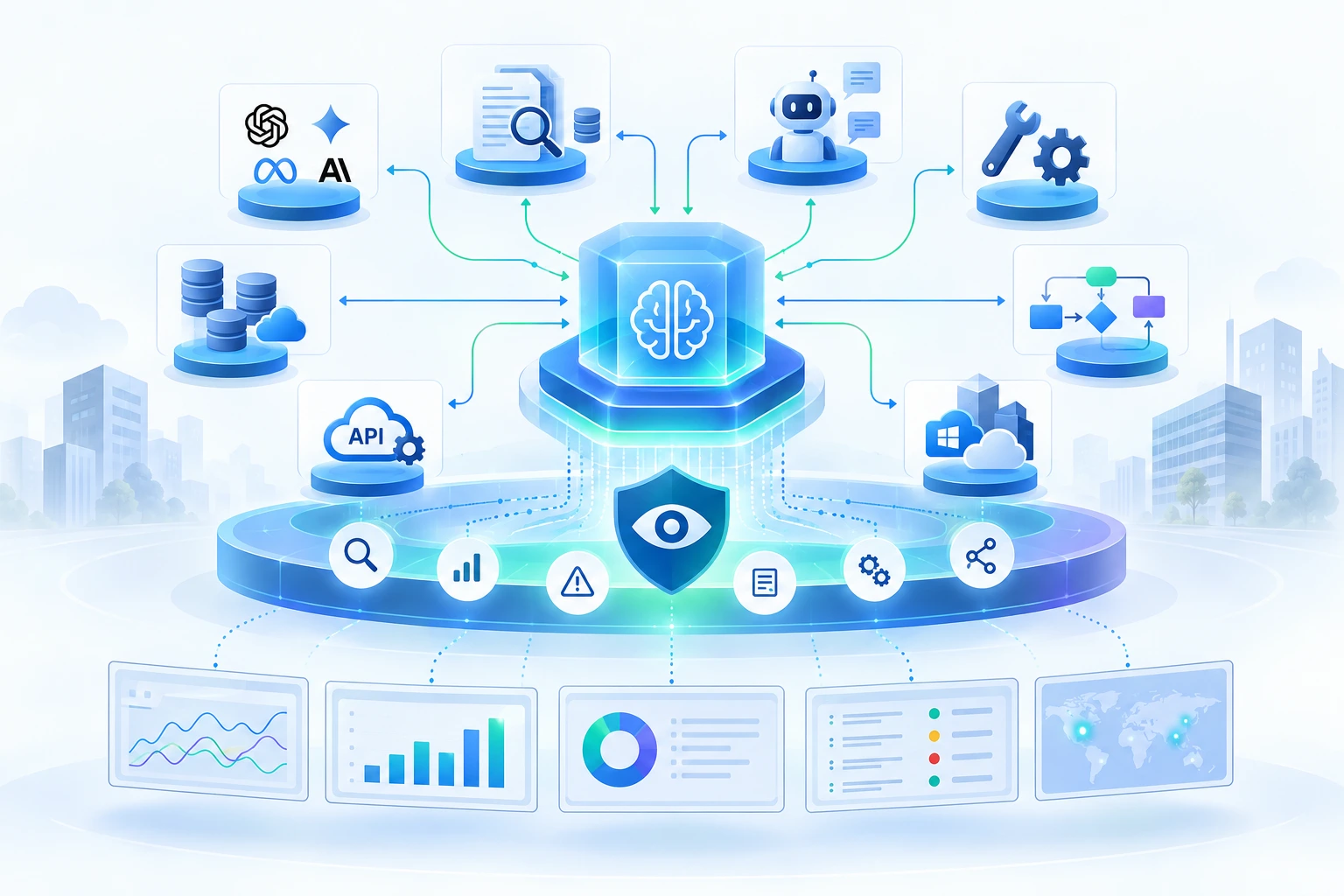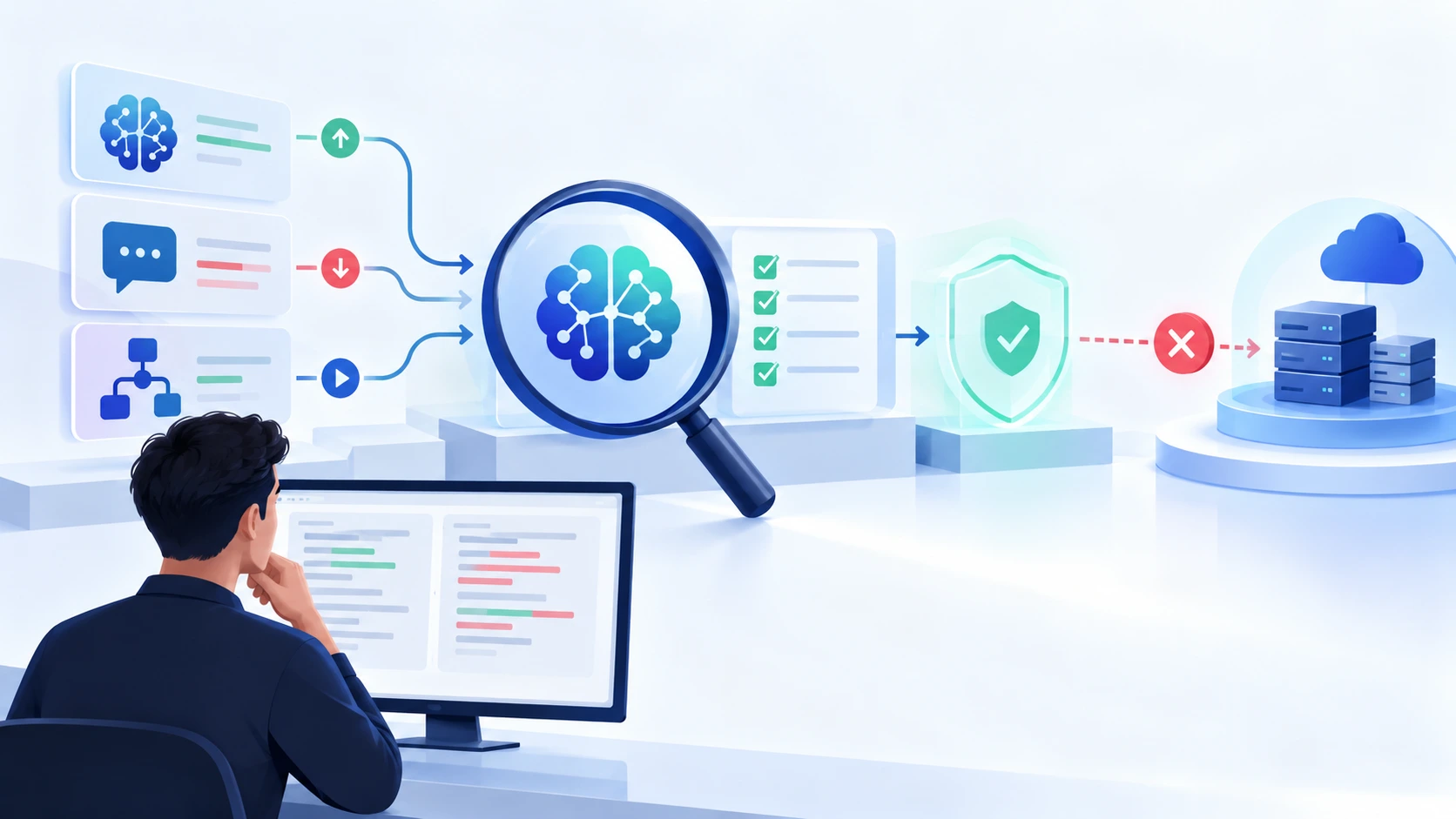
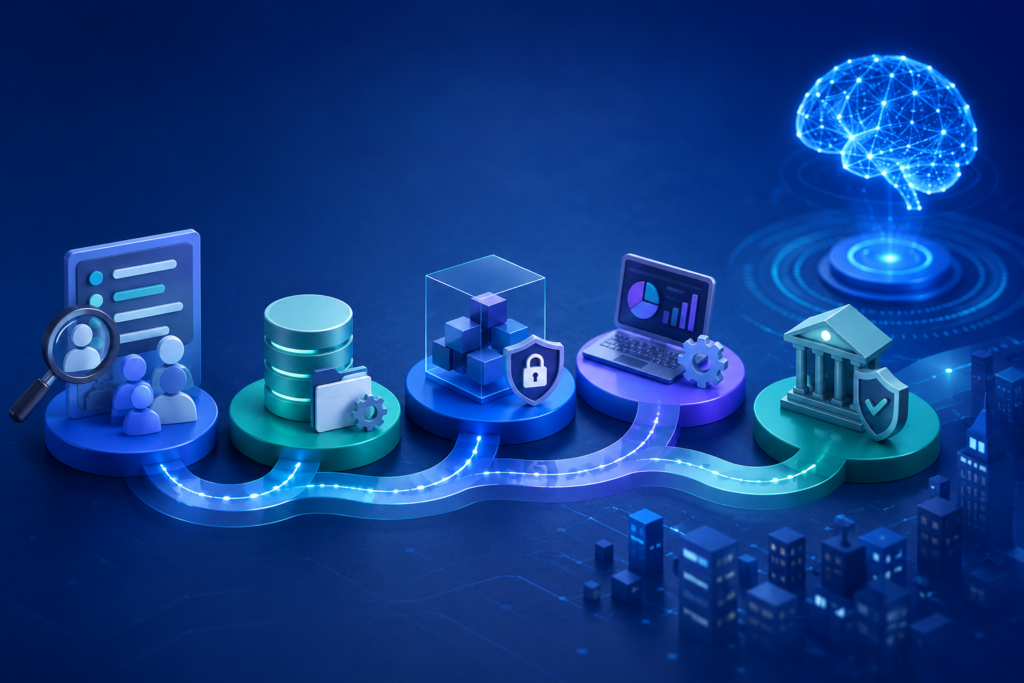
Large Language Models (LLMs) power modern enterprise applications by enabling intelligent automation, natural language interactions, enterprise search, AI copilots, document processing, and decision support. Combined with technologies like Retrieval-Augmented Generation (RAG), vector databases, and AI agents, LLMs help organizations transform business operations while improving productivity, customer experience, and innovation.
TL;DR
- LLMs have evolved from chatbots into enterprise intelligence engines.
- Modern enterprise applications increasingly rely on LLMs for automation, knowledge retrieval, and decision support.
- Enterprises rarely use standalone LLMs—they combine them with RAG, vector databases, AI agents, APIs, and enterprise data platforms.
- Industries such as healthcare, banking, manufacturing, retail, and insurance are already deploying enterprise-grade AI solutions.
- Success depends on governance, security, high-quality data, scalable architecture, and responsible AI practices.
- Organizations that integrate LLMs strategically are better positioned to improve productivity, reduce operational costs, and accelerate innovation.
Introduction
Artificial intelligence has evolved through multiple waves over the past decade. Traditional machine learning enabled organizations to make predictions from structured data. Robotic Process Automation (RPA) streamlined repetitive workflows. Deep learning improved image recognition and speech processing.Large Language Models represent the next major leap.
Unlike traditional AI systems that are trained to perform a single task, LLMs possess a generalized understanding of language. They can summarize documents, answer complex questions, generate reports, translate content, write code, analyze contracts, explain financial statements, and support countless enterprise workflows—all through natural language.This capability is reshaping enterprise software.
Modern enterprise applications are no longer static systems that merely store or process data. They are becoming intelligent assistants capable of understanding context, retrieving organizational knowledge, automating workflows, and helping employees make faster, more informed decisions.
Whether integrated into customer relationship management (CRM) platforms, enterprise resource planning (ERP) systems, healthcare applications, financial services platforms, or internal knowledge portals, LLMs are redefining how organizations interact with information.
Yet, despite growing adoption, many organizations still ask an important question:
How exactly do LLMs power modern enterprise applications?
The answer lies not only in the models themselves but in the broader enterprise AI ecosystem that surrounds them.
What Are Large Language Models (LLMs)?
Large Language Models (LLMs) are advanced AI models trained on vast amounts of text data to understand, generate, summarize, classify, and reason using natural language. In enterprise environments, they serve as intelligent engines that enable applications to interpret human language, automate knowledge work, and deliver context-aware assistance.
Unlike traditional software, which relies on predefined rules, LLMs learn statistical patterns from billions or even trillions of words. This enables them to perform a wide variety of language-related tasks without being explicitly programmed for each one.
For enterprises, this means applications can:
- Understand employee questions
- Analyze contracts
- Summarize reports
- Generate documentation
- Search internal knowledge bases
- Explain complex business metrics
- Draft emails
- Recommend next actions
- Support software developers
- Assist customer service representatives
Instead of navigating multiple systems manually, employees can simply ask questions in natural language and receive accurate, contextual responses. This shift significantly improves productivity while reducing the friction associated with traditional enterprise software.
Why Are LLMs Transforming Enterprise Applications?
LLMs transform enterprise applications because they introduce reasoning, contextual understanding, and conversational interfaces into business systems, enabling employees and customers to interact with enterprise software more naturally and efficiently.
Historically, enterprise applications were designed around structured workflows. Users needed to know exactly where information was stored, how reports were generated, and which sequence of actions produced the desired outcome. LLMs fundamentally change this paradigm. Instead of adapting to software, users communicate with software using everyday language.
For example: A procurement manager can ask: “Show suppliers whose delivery performance dropped below 90% during the last quarter.” Instead of navigating dashboards, filtering reports, and exporting spreadsheets, the AI retrieves, analyzes, and summarizes the relevant information. Similarly: A financial analyst can ask: “Summarize revenue trends across Europe and identify major anomalies.” An HR manager can request: “Generate interview feedback summaries for shortlisted candidates.” A software engineer can ask: “Explain this legacy microservice and suggest performance improvements.”
These capabilities dramatically reduce the time employees spend searching for information, creating reports, and completing repetitive tasks. The result is a more intuitive, efficient, and intelligent enterprise experience.
How Do LLMs Power Modern Enterprise Applications?
LLMs act as the intelligence layer between users, enterprise data, and business systems. They combine language understanding, reasoning, retrieval, and automation to help applications interpret requests, access organizational knowledge, generate responses, and execute workflows.
A modern enterprise application powered by LLMs typically consists of several interconnected layers:
1. Natural Language Interface
Employees no longer need specialized technical knowledge or complex query languages. Instead, they interact conversationally with enterprise systems using plain English (or other supported languages).
Examples include:
- Enterprise copilots
- AI chat assistants
- Intelligent search
- Voice assistants
- Developer assistants
This dramatically lowers the learning curve for enterprise software.
2. Context Understanding
The LLM interprets user intent rather than relying solely on keyword matching.
For example, these requests all express the same intent:
- Show overdue invoices.
- Which invoices are pending?
- What payments are delayed?
- List outstanding receivables.
Traditional search treats them differently. LLMs recognize they refer to the same business objective.
3. Enterprise Knowledge Retrieval
Enterprise applications rarely rely solely on the LLM’s pre-trained knowledge. Instead, they retrieve relevant information from:
- SharePoint
- Confluence
- Salesforce
- SAP
- Oracle
- SQL databases
- Knowledge bases
- PDFs
- Policies
- Contracts
- Internal documentation
This retrieval process ensures responses remain grounded in the organization’s latest information rather than the model’s static training data.
4. Reasoning and Content Generation
After retrieving relevant information, the LLM synthesizes it into clear, actionable responses.
For example, rather than presenting ten separate policy documents, it can generate:
- executive summaries,
- risk assessments,
- compliance recommendations,
- customer responses,
- technical explanations, or
- project updates.
This ability to transform raw enterprise data into usable insights is one of the most valuable contributions of LLMs.
5. Workflow Orchestration
Modern enterprise AI goes beyond answering questions. LLMs increasingly orchestrate business workflows by interacting with enterprise applications through APIs and automation platforms.
Examples include:
- Creating service tickets
- Scheduling meetings
- Updating CRM records
- Initiating approval workflows
- Drafting procurement requests
- Triggering compliance checks
- Generating invoices
- Assigning support cases
In these scenarios, the LLM becomes an intelligent coordinator that connects people, data, and business processes.
Get a comprehensive view about how RAG in 2026 in Enterprise AI scenario has shifted from experimentation to a production-critical architecture to ensure accuracy, compliance, and real-time intelligence.
The Evolution of Enterprise Applications: From Rule-Based Systems to Intelligent AI Platforms
Enterprise software has undergone a remarkable transformation over the past three decades.
Phase 1: Rule-Based Applications
Early enterprise systems relied on predefined rules and structured workflows. They excelled at transaction processing but lacked flexibility when faced with unstructured information or unexpected scenarios.
Phase 2: Analytics-Driven Systems
Business intelligence platforms added dashboards, reporting, and predictive analytics. Organizations gained visibility into historical and operational data, but users still needed technical expertise to interpret insights.
Phase 3: Machine Learning Integration
Machine learning introduced recommendation engines, fraud detection, demand forecasting, and anomaly detection. While powerful, these solutions typically addressed narrow, task-specific problems.
Phase 4: Intelligent Enterprise Applications Powered by LLMs
Today’s enterprise applications combine conversational interfaces, contextual reasoning, enterprise knowledge retrieval, and workflow automation. Instead of merely responding to commands, they assist users in accomplishing complex tasks, accelerating decision-making, and uncovering insights hidden across structured and unstructured data.
This evolution marks a shift from software that users operate to software that actively collaborates with users, laying the foundation for the next generation of intelligent enterprises.
For enterprises exploring early-stage AI assistants, this approach is often aligned with modernization efforts such as those described in Techment’s Best Practices for Generative AI Implementation in Business.
How Does a Modern Enterprise LLM Architecture Work?
Modern enterprise applications combine an LLM with enterprise data, Retrieval-Augmented Generation (RAG), vector databases, APIs, and governance controls. The LLM provides reasoning, while enterprise systems provide business context, enabling accurate, secure, and actionable AI responses.
Unlike consumer AI tools, enterprise LLMs don’t rely solely on pre-trained knowledge. They retrieve real-time organizational data, apply business rules, and interact with enterprise applications to automate workflows.
Read our blog that breaks down 10 critical RAG architectures shaping 2026, their trade-offs, and the enterprise use cases they unlock.
Enterprise LLM Architecture
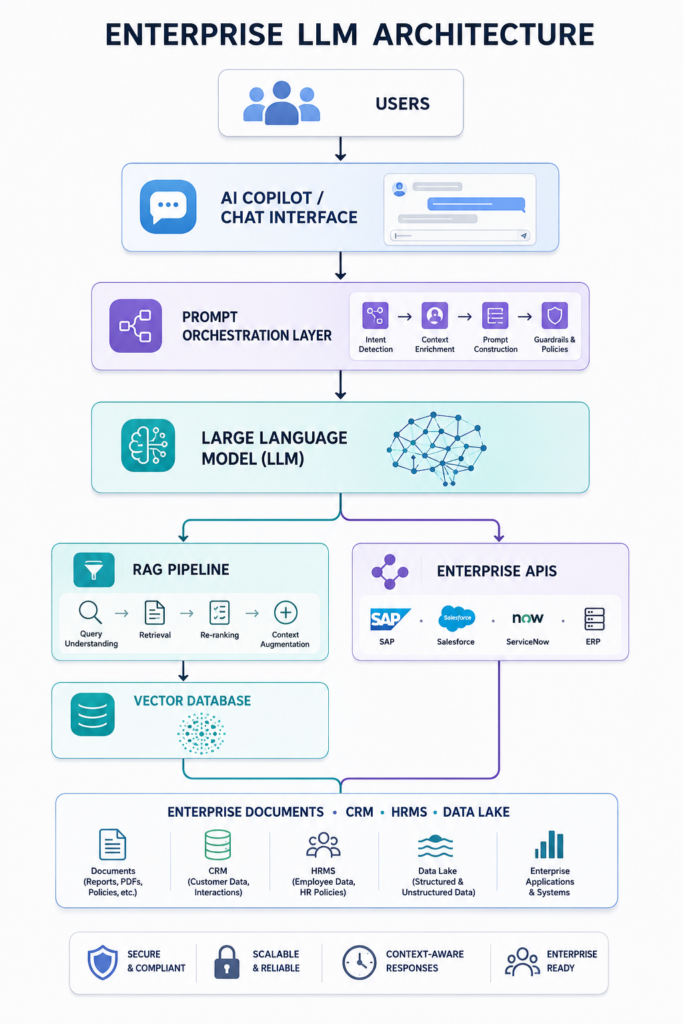
This architecture separates reasoning (LLM) from enterprise knowledge (RAG), making responses more accurate, scalable, and secure.
Core Components of an Enterprise LLM Stack
| Component | Purpose |
|---|---|
| Foundation Model | Understands and generates natural language |
| Prompt Orchestration | Manages prompts, context, and workflows |
| RAG | Retrieves relevant enterprise knowledge at runtime |
| Embeddings | Converts documents into semantic vectors |
| Vector Database | Enables semantic search across enterprise content |
| Enterprise APIs | Connects AI with business systems |
| AI Agents | Automate multi-step business workflows |
| Guardrails & Governance | Enforce security, compliance, and responsible AI |
Each component addresses a different challenge, from improving answer quality to ensuring regulatory compliance.
Read our guide on 10 Effective Steps To Building RAG Applications that provides a step-by-step enterprise roadmap for building RAG applications.
How Enterprise LLMs Process a Request
Instead of keyword matching, enterprise LLMs use a multi-step reasoning pipeline.
| Step | What Happens |
|---|---|
| User Query | Employee asks a business question in natural language |
| Intent Analysis | LLM understands the user’s objective |
| Knowledge Retrieval | RAG retrieves relevant enterprise documents |
| Context Enrichment | Retrieved information is added to the prompt |
| Response Generation | LLM generates a contextual response |
| Business Action | APIs trigger workflows, approvals, or updates if required |
For example, when a sales manager asks: “Summarize our Q2 sales performance in Europe.” The application retrieves CRM records, BI reports, and sales dashboards before generating a concise executive summary. If needed, it can also schedule follow-up meetings, create action items, or update CRM records.
Retrieval-Augmented Generation (RAG): The Enterprise AI Standard
Retrieval-Augmented Generation (RAG) improves LLM accuracy by retrieving relevant enterprise information before generating a response. It enables AI to answer questions using current business data instead of relying only on the model’s training knowledge. Retrieval-Augmented Generation (RAG) has become the preferred architecture for enterprise AI because it combines LLM reasoning with organization-specific knowledge, improving response accuracy while reducing hallucinations. This approach is widely recommended in the Microsoft Azure AI documentation on Retrieval-Augmented Generation (RAG).
For most enterprise applications, RAG has become the preferred implementation approach because it:
- Reduces hallucinations
- Keeps responses up to date
- Preserves data privacy
- Eliminates frequent model retraining
- Works across structured and unstructured enterprise data
Common enterprise data sources include:
- SharePoint
- Confluence
- Salesforce
- SAP
- Oracle
- SQL databases
- Data lakes
- PDFs
- Policies
- Contracts
- Technical documentation
For organizations building AI roadmaps, see: Enterprise AI Strategy in 2026
RAG vs. Fine-Tuning vs. Prompt Engineering vs. AI Agents
Choosing the right implementation approach depends on business goals, data maturity, and operational complexity.
| Approach | Best For | Advantages | Limitations |
|---|---|---|---|
| Prompt Engineering | General productivity | Fast, low cost | Limited enterprise context |
| RAG | Knowledge-intensive applications | Current information, lower hallucinations | Requires a well-managed knowledge base |
| Fine-Tuning | Domain-specific language and workflows | Higher specialization | Higher cost and maintenance |
| AI Agents | End-to-end business automation | Autonomous task execution | Greater governance complexity |
When should you use each approach?
- Prompt Engineering: Content generation, meeting summaries, email drafting, translation.
- RAG: Enterprise search, customer support, policy assistants, knowledge management.
- Fine-Tuning: Legal, healthcare, insurance, financial services, and highly specialized domains.
- AI Agents: Procurement, IT operations, HR onboarding, software delivery, and workflow orchestration.
Many enterprises adopt a hybrid architecture—for example, combining RAG for knowledge retrieval with AI agents to automate downstream actions.
Read our blog on RAG vs Fine-Tuning vs AI Agents: Choosing the Right LLM Strategy
AI Agents: Moving Beyond Conversational AI
AI agents extend LLM capabilities by planning tasks, interacting with enterprise systems, and executing workflows with minimal human intervention.
Unlike chatbots that answer questions, AI agents can complete business processes.
For example, a procurement agent can:
- Identify approved vendors
- Compare supplier pricing
- Check inventory availability
- Generate purchase orders
- Route approvals
- Notify finance
- Update ERP records
This transforms AI from an assistant into an operational collaborator.
Enterprise Security and Governance
Enterprise AI must be designed with security and compliance at its core.
| Security Area | Best Practice |
|---|---|
| Data Privacy | Encrypt sensitive enterprise data and isolate workloads |
| Identity & Access | Enforce role-based access control (RBAC) and single sign-on |
| Prompt Security | Detect and mitigate prompt injection attacks |
| Output Validation | Use human review for high-risk decisions |
| Compliance | Align with GDPR, HIPAA, ISO 27001, SOC 2, and industry regulations |
| Monitoring | Track usage, costs, model quality, and policy violations |
Strong governance ensures AI systems remain trustworthy, auditable, and aligned with organizational policies.
Enterprise AI Technology Stack
A production-ready enterprise AI platform typically combines multiple technologies rather than relying on a single LLM.
| Layer | Example Technologies |
|---|---|
| Foundation Models | GPT, Claude, Gemini, Llama, Mistral |
| Retrieval | RAG, Semantic Search |
| Storage | Vector Database, SQL, Data Lake |
| Orchestration | LangChain, LangGraph, Prompt Flows |
| Integration | REST APIs, Event Streaming, Middleware |
| Monitoring | Observability, Evaluation, Cost Tracking |
| Governance | Guardrails, IAM, Audit Logs |
This layered approach provides flexibility, allowing organizations to upgrade models or integrate new AI capabilities without redesigning the entire application.
Enterprise LLM Implementation Checklist
Successful enterprise AI initiatives typically follow these best practices:
- Define high-value business use cases before selecting models.
- Prioritize Retrieval-Augmented Generation before investing in fine-tuning.
- Build a governed enterprise knowledge base with high-quality data.
- Integrate AI with existing ERP, CRM, HRMS, and workflow platforms through APIs.
- Secure applications using RBAC, encryption, and AI guardrails.
- Continuously monitor accuracy, latency, token usage, and business impact.
- Measure success through productivity gains, operational efficiency, customer experience, and ROI—not just model accuracy.
Following this implementation approach helps organizations move beyond AI pilots to scalable, enterprise-grade applications that deliver measurable business value.
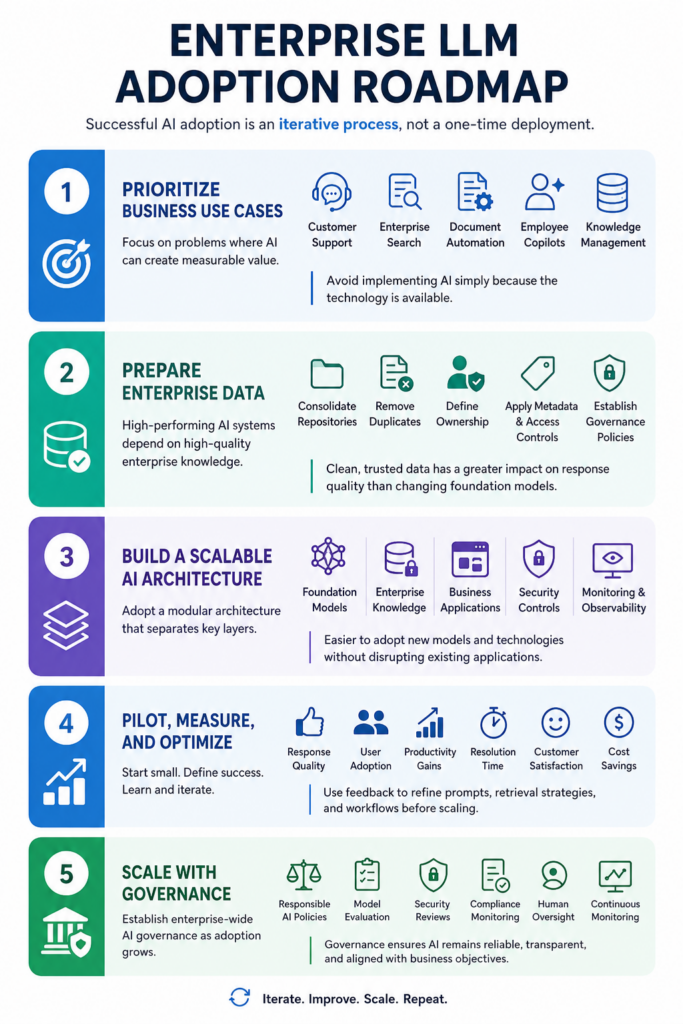
Enterprise LLM Use Cases Across Industries
LLMs create the most value when integrated into core business workflows—not as standalone chatbots. Organizations use them to improve customer experience, automate knowledge work, accelerate decision-making, and increase employee productivity.
The highest ROI typically comes from augmenting existing enterprise applications with AI rather than replacing them.
| Industry | Enterprise LLM Use Cases | Business Impact |
|---|---|---|
| Banking & Financial Services | Customer support, loan underwriting, fraud investigation, regulatory reporting | Faster decisions, improved compliance, lower operational costs |
| Healthcare | Clinical documentation, patient support, medical coding, knowledge retrieval | Reduced administrative burden, improved clinician productivity |
| Manufacturing | Predictive maintenance, SOP assistance, quality documentation, field service copilots | Reduced downtime, faster issue resolution |
| Retail & eCommerce | Product recommendations, customer service, inventory insights, demand forecasting | Higher conversions, improved customer experience |
| Insurance | Claims processing, policy summarization, underwriting assistance, fraud detection | Faster claims settlement, increased operational efficiency |
| Public Sector | Citizen services, policy search, document automation, case management | Improved accessibility and faster service delivery |
While use cases differ by industry, the underlying architecture remains largely the same: an LLM connected to enterprise knowledge, business systems, and governance controls.
Common Challenges in Enterprise LLM Adoption
Enterprise AI initiatives rarely fail because of the model. More often, challenges arise from data quality, governance, integration complexity, or unclear business objectives.
| Challenge | Recommended Approach |
| Poor Data Quality | Build a governed, high-quality knowledge base |
| AI Hallucinations | Use RAG with trusted enterprise sources |
| Security Risks | Apply RBAC, encryption, and AI guardrails |
| Legacy Systems | Integrate through APIs and middleware |
| Regulatory Compliance | Embed governance from the start |
| Measuring ROI | Define business KPIs before implementation |
Addressing these factors early helps organizations move from experimentation to production with greater confidence.
Key Takeaways
- LLMs are becoming the intelligence layer of modern enterprise applications.
- The greatest business value comes from combining LLMs with RAG, enterprise data, and workflow automation.
- AI copilots, intelligent search, document processing, and customer support are among the highest-impact enterprise use cases.
- Success depends as much on data quality, governance, and integration as it does on model selection.
- Enterprises should begin with targeted, high-value use cases, validate outcomes, and scale through a secure, modular AI architecture.
Whether you’re building an AI-powered knowledge assistant, automating business workflows, or integrating generative AI into enterprise applications, Techment can help you accelerate adoption while maintaining security, compliance, and measurable business outcomes.
Future Trends Shaping Enterprise LLM Applications
Enterprise AI is evolving from conversational assistants to autonomous systems that can reason, plan, and execute business processes. The next generation of enterprise applications will be AI-native, multimodal, agent-driven, and governed by enterprise-wide AI platforms.
Organizations investing today should build flexible architectures that can accommodate rapidly evolving models and capabilities.
1. AI Agents Will Orchestrate End-to-End Workflows
The next wave of enterprise AI is shifting from AI assistants to AI agents.
Unlike copilots that respond to prompts, AI agents can:
- Break down complex tasks
- Plan execution steps
- Interact with enterprise systems
- Collaborate with other agents
- Escalate exceptions to humans
Examples include procurement agents, finance agents, IT operations agents, and customer service agents that automate multi-step workflows while keeping humans in control for critical decisions.
2. Multimodal AI Will Become the Enterprise Standard
Future enterprise applications will process more than text.
LLMs are increasingly able to understand and generate:
- Documents
- Images
- Audio
- Video
- Charts
- Spreadsheets
- Diagrams
For example, an insurance claims application could analyze uploaded photos, supporting documents, and customer conversations to recommend claim decisions.
3. AI-Native Enterprise Applications
Instead of adding AI to existing software, vendors are redesigning applications around AI-first experiences.
Users will increasingly interact with enterprise systems by asking questions or assigning tasks rather than navigating menus and dashboards.
Examples include:
- “Create a quarterly sales report.”
- “Summarize customer feedback from the last 30 days.”
- “Identify suppliers with delivery risks.”
Natural language will become the primary interface for enterprise software.
4. Smaller, Domain-Specific Models
While large foundation models will remain important, many organizations are adopting smaller models optimized for specific industries or business functions.
Benefits include:
- Lower inference costs
- Faster response times
- Easier deployment
- Greater control over sensitive data
Hybrid environments combining proprietary and open-source models are also expected to become more common.
5. Responsible AI Will Be a Business Requirement
As AI adoption grows, governance will become a competitive differentiator.
Future enterprise AI platforms will include:
- Explainability
- Audit trails
- Bias monitoring
- Policy enforcement
- Human oversight
- Continuous model evaluation
Responsible AI will be essential for building trust with customers, employees, and regulators.
How to Choose the Right Enterprise LLM Strategy
There is no one-size-fits-all approach. The right strategy depends on business objectives, data maturity, regulatory requirements, and existing technology investments.
Use the following decision framework as a starting point.
| Business Need | Recommended Approach |
|---|---|
| Content generation and productivity | Prompt Engineering |
| Enterprise knowledge search | RAG |
| Domain-specific language or terminology | Fine-Tuning |
| Workflow automation | AI Agents |
| Highly regulated environments | Private deployment with governance controls |
| Multiple enterprise use cases | Hybrid AI architecture |
For most organizations, a combination of RAG + AI agents + enterprise integrations delivers the best balance of accuracy, scalability, and business value.
Common Mistakes to Avoid
Many enterprise AI initiatives stall because organizations focus on the model instead of the business problem.
Avoid these common pitfalls:
| Mistake | Better Approach |
| Starting with technology instead of use cases | Identify high-value business problems first |
| Expecting the LLM to know proprietary information | Connect it to enterprise knowledge using RAG |
| Ignoring governance | Build security, compliance, and monitoring into the architecture |
| Fine-tuning too early | Start with prompt engineering and RAG before retraining models |
| Measuring only technical metrics | Track business outcomes such as productivity, cost savings, and customer satisfaction |
| Treating AI as a standalone project | Integrate AI into existing enterprise applications and workflows |
A business-first approach consistently delivers better long-term outcomes than technology-led experimentation.
Conclusion
Large Language Models are redefining how enterprise applications are built and used. By enabling natural language interaction, contextual reasoning, and intelligent automation, they transform traditional business systems into AI-powered platforms that improve productivity, accelerate decision-making, and enhance customer experiences.
However, enterprise success depends on more than choosing the right foundation model. It requires a well-architected ecosystem that combines LLMs with Retrieval-Augmented Generation (RAG), enterprise data, APIs, governance, and security. This integrated approach ensures AI solutions remain accurate, scalable, and aligned with business objectives.
As enterprises continue their AI transformation, the focus will shift from isolated AI assistants to intelligent, interconnected systems capable of supporting complex business operations. Organizations that invest in secure architectures, high-quality data, and responsible AI practices today will be better positioned to unlock long-term business value.
Why Partner with Techment for Enterprise AI?
Building enterprise-grade LLM applications requires expertise across AI strategy, data engineering, cloud platforms, and enterprise integration.
At Techment, we help organizations move beyond AI experimentation by designing and implementing secure, scalable, and production-ready AI solutions tailored to business needs.
Our expertise includes:
- Enterprise AI strategy and consulting
- Custom LLM application development
- Retrieval-Augmented Generation (RAG) solutions
- AI copilots and intelligent assistants
- AI agent development
- Data engineering and modern data platforms
- Cloud-native AI architectures
- Responsible AI and governance
- Enterprise application modernization
Whether you’re building an AI-powered knowledge assistant, automating business workflows, or integrating generative AI into enterprise applications, Techment can help you accelerate adoption while maintaining security, compliance, and measurable business outcomes.
Frequently Asked Questions (FAQs)
1. What is an enterprise LLM?
An enterprise LLM is a large language model integrated with enterprise data, business applications, and governance controls to support business-specific tasks such as knowledge retrieval, automation, customer service, and decision support.
2. How are LLMs different from traditional AI?
Traditional AI is designed for specific tasks such as prediction or classification. LLMs understand and generate natural language, enabling a broader range of applications including conversational interfaces, summarization, reasoning, and content generation.
3. Why is RAG important for enterprise applications?
RAG connects LLMs to enterprise knowledge sources at runtime, improving response accuracy, reducing hallucinations, and ensuring answers reflect the latest organizational information
4. Should enterprises fine-tune LLMs?
Not always. Many enterprise use cases can be addressed using prompt engineering and RAG. Fine-tuning is most valuable when organizations require specialized domain knowledge, terminology, or behavior.
5. What are the biggest challenges in enterprise LLM adoption?
Common challenges include poor data quality, integration with legacy systems, governance, security, compliance, and measuring business ROI. Addressing these areas early improves the likelihood of successful production deployments.
6. Which industries benefit the most from enterprise LLMs?
Industries such as banking, healthcare, manufacturing, retail, insurance, telecommunications, and the public sector are already using LLMs to automate knowledge work, improve customer service, streamline operations, and support decision-making.
Related Reads
- Best Generative AI Models in 2026 For Enterprises: Top 5 Platforms Compared
- AI-Native vs. AI-Enabled: What’s the Difference
- AI-Native vs Traditional Software Development
- AI Agent Evaluation Frameworks Compared
- How to Build An AI-First Enterprise: A Complete Guide
- 5 Best AI Architectures for Enterprises to Scale AI Successfully