
Introduction
Retail enterprises are entering a new era where customer expectations are shaped by immediacy, personalization, and intelligent digital experiences. Consumers no longer tolerate static ecommerce journeys or delayed responses. They expect retailers to understand what they want, when they want it, and how they prefer to engage. This is precisely why enterprises are investing heavily in systems that allow AI chatbots to analyze customer intent in real time.
Modern conversational AI platforms are transforming ecommerce from reactive support models into predictive engagement ecosystems. Rather than merely responding to questions, AI-powered chatbots now interpret sentiment, detect buying intent, identify hesitation, and personalize interactions dynamically across websites, mobile apps, messaging platforms, and voice channels.
According to industry estimates, the global AI chatbot market is projected to surpass $31 billion by 2029, driven largely by retail and ecommerce transformation initiatives. Enterprises increasingly recognize that conversational intelligence is no longer a customer service enhancement alone. It has become a strategic capability for revenue growth, operational efficiency, and customer retention.
This blog explores how retailers use AI chatbots to analyze customer intent in real time, the technologies powering these systems, their business impact, implementation considerations, governance implications, and how enterprises can build scalable conversational AI ecosystems for long-term competitive advantage.
Explore how conversational AI in retail is transforming customer engagement, sales, support operations, and AI-driven commerce
TL;DR
- AI chatbots analyze customer intent in real time using NLP, machine learning, and behavioral analytics.
- Retailers use conversational AI to personalize experiences, increase conversions, and reduce customer support costs.
- Modern ecommerce chatbots go beyond scripted responses and understand customer context, sentiment, and buying signals.
- AI-powered intent analysis improves upselling, abandoned cart recovery, and omnichannel engagement.
- Enterprises adopting conversational AI require scalable data architecture, governance, and AI readiness strategies.
- Retail leaders increasingly view AI chatbots as strategic growth infrastructure rather than customer support tools.
Why Real-Time Customer Intent Analysis Matters in Modern Retail
Retail competition today is no longer defined solely by product availability or pricing. Customer experience has become the primary differentiator. The ability to interpret customer intent instantly allows retailers to influence purchase decisions at the precise moment consumers are evaluating options.
Traditional ecommerce systems relied heavily on historical analytics. While useful for long-term trends, historical data cannot respond dynamically to customer behavior during live interactions. Real-time customer intent analysis changes this paradigm completely.
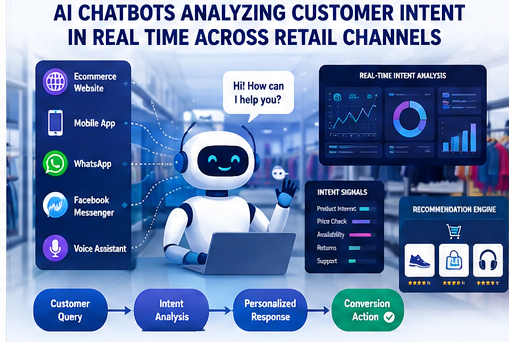
AI chatbots continuously process customer inputs such as:
- Search queries
- Browsing behavior
- Conversation context
- Product comparisons
- Tone and sentiment
- Clickstream activity
- Cart interactions
- Purchase history
This enables retailers to identify whether customers are:
- Looking for product recommendations
- Comparing alternatives
- Facing purchase hesitation
- Seeking support
- Ready to convert
- Considering returns
- Price sensitive
- Exploring premium upgrades
The strategic value lies in timing. Intent detected after a customer exits the platform has limited impact. Intent identified during the interaction creates immediate intervention opportunities.
For example, if a customer repeatedly compares pricing or shipping timelines, the chatbot can proactively offer incentives, alternative fulfillment options, or personalized promotions before abandonment occurs.
This shift toward intelligent engagement aligns closely with enterprise AI modernization strategies discussed in Techment’s guide on enterprise AI transformation.
The Shift From Reactive Support to Predictive Commerce
Historically, chatbots were deployed to reduce support tickets. Their role was transactional and operational.
Modern AI chatbots function differently. They operate as predictive commerce engines capable of influencing customer behavior in real time.
This transformation is driven by several factors:
- Advances in NLP models
- Generative AI integration
- Real-time data pipelines
- Unified customer profiles
- Context-aware recommendation systems
- Emotion and sentiment analysis
Retailers are now using conversational AI to predict outcomes such as:
- Probability of purchase
- Churn likelihood
- Upsell readiness
- Return risk
- Customer satisfaction trends
This predictive capability creates measurable business advantages across customer acquisition, conversion optimization, and retention.
How AI Chatbots Analyze Customer Intent in Real Time
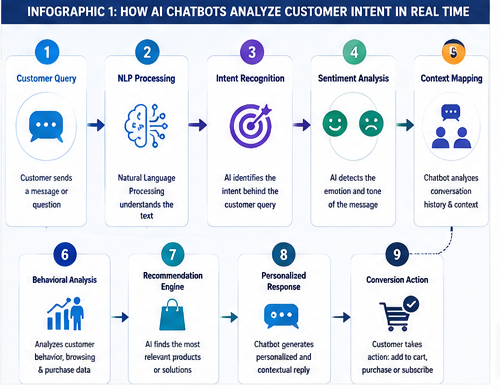
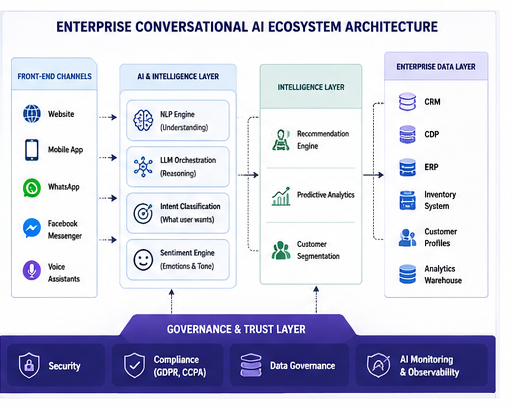
At the core of modern conversational commerce lies a sophisticated combination of AI technologies working together simultaneously. Understanding this architecture is critical for retail leaders evaluating AI investments.
Natural Language Processing (NLP) and Semantic Understanding
Natural Language Processing enables chatbots to understand human language beyond simple keyword matching.
Instead of responding only to predefined phrases, NLP-powered systems interpret:
- Context
- Meaning
- Sentiment
- Intent
- Language variations
- Conversational flow
For example, these customer statements may appear different linguistically but share the same purchase intent:
- “I need running shoes for marathon training.”
- “What are the best long-distance running shoes?”
- “Can you recommend premium endurance shoes?”
AI models classify all three under a similar intent category.
This semantic understanding allows retailers to personalize product recommendations far more effectively than traditional ecommerce filters.
Techment’s insights on conversational AI implementation frameworks provide further guidance for enterprises building scalable NLP ecosystems.
Machine Learning Models and Behavioral Pattern Recognition
Machine learning enables AI chatbots to improve continuously over time.
Retail chatbots analyze millions of interactions to identify behavioral patterns such as:
- High-converting conversation sequences
- Common customer objections
- Purchase triggers
- Cart abandonment signals
- Product affinity trends
The system learns which conversational approaches produce better outcomes and adapts dynamically.
For example:
- Customers hesitating over pricing may respond better to financing options.
- Customers comparing products may convert faster with side-by-side comparisons.
- Customers asking about delivery timelines may prioritize expedited shipping.
These insights help AI chatbots optimize engagement automatically.
Sentiment Analysis and Emotional Intelligence
Advanced retail chatbots increasingly incorporate sentiment analysis to interpret emotional tone.
This allows systems to detect:
- Frustration
- Urgency
- Excitement
- Hesitation
- Dissatisfaction
- Confusion
If a customer expresses frustration regarding delayed shipping, the chatbot can prioritize escalation or compensation workflows immediately.
Emotion-aware AI improves customer experience significantly because responses become context-sensitive rather than generic.
Real-Time Data Integration Across Retail Systems
Intent analysis becomes significantly more powerful when conversational AI integrates with enterprise systems such as:
- CRM platforms
- Ecommerce platforms
- Inventory systems
- Customer data platforms (CDPs)
- Loyalty systems
- Marketing automation platforms
- ERP environments
This unified architecture enables chatbots to deliver highly contextual responses in real time.
For example:
- Product availability updates
- Personalized promotions
- Order tracking
- Loyalty rewards
- Dynamic pricing recommendations
Retailers increasingly require modern data platforms to support these integrations at scale. Techment’s perspective on modern enterprise analytics architectures explains how organizations can prepare foundational infrastructure for AI-driven customer experiences.
AI Chatbots vs Rule-Based Chatbots in Retail Commerce
The difference between traditional rule-based chatbots and AI-powered conversational systems is substantial.
Rule-Based Chatbots
Rule-based chatbots operate using predefined workflows and decision trees.
They typically:
- Follow scripted logic
- Depend on keyword recognition
- Offer limited flexibility
- Struggle with ambiguous questions
- Cannot understand context effectively
These systems remain useful for:
- FAQ automation
- Store hours
- Return policies
- Order tracking
- Basic navigation assistance
However, they lack the intelligence required for sophisticated intent analysis.
AI-Powered Conversational Chatbots
AI-powered chatbots use:
- NLP
- Machine learning
- Generative AI
- Predictive analytics
- Context management
This allows them to:
- Understand nuanced intent
- Maintain conversational memory
- Personalize responses
- Handle complex interactions
- Improve continuously
The difference is especially visible in ecommerce conversion optimization.
A rule-based chatbot might respond generically to “I’m not sure this fits my needs.”
An AI chatbot can interpret uncertainty, analyze browsing behavior, recommend alternatives, provide social proof, and offer incentives dynamically.

Hybrid Models Emerging as Enterprise Standard
Many enterprises now deploy hybrid architectures that combine:
- Rule-based automation for repetitive workflows
- AI-driven systems for adaptive interactions
This creates operational stability while maintaining conversational flexibility.
Hybrid models also improve governance because retailers can define controlled escalation paths for sensitive workflows.
How Retailers Use AI Chatbots Across the Customer Journey
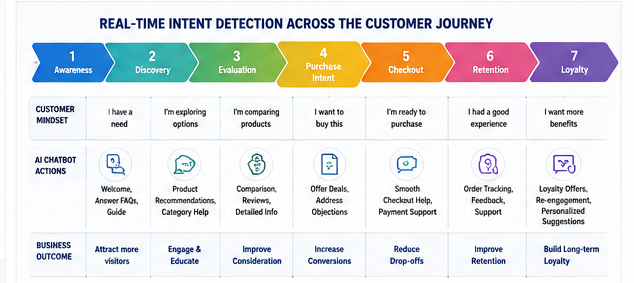
Real-time customer intent analysis affects every stage of the retail lifecycle.
Product Discovery and Personalized Recommendations
One of the strongest use cases for conversational AI is product discovery.
AI chatbots analyze:
- Customer preferences
- Historical purchases
- Browsing patterns
- Budget considerations
- Style preferences
- Demographic indicators
This enables personalized recommendations that resemble in-store assistance.
Retailers increasingly use conversational interfaces to reduce decision fatigue in large product catalogs.
Abandoned Cart Recovery
Cart abandonment remains one of ecommerce’s largest revenue leakage problems.
AI chatbots detect hesitation signals such as:
- Multiple pricing comparisons
- Repeated shipping inquiries
- Long inactivity periods
- Exit intent behavior
The chatbot can then intervene using:
- Discounts
- Financing offers
- Free shipping
- Product comparisons
- Inventory urgency notifications
Real-time intervention significantly improves conversion recovery rates.
Upselling and Cross-Selling
Intent analysis allows chatbots to identify complementary product opportunities naturally.
For example:
- Electronics retailers recommending accessories
- Fashion retailers suggesting coordinated products
- Grocery platforms recommending bundled purchases
Unlike static recommendation engines, conversational AI adjusts recommendations dynamically during interaction.
Customer Support Optimization
AI customer support chatbots handle repetitive requests efficiently while escalating complex cases intelligently.
Benefits include:
- Reduced support costs
- Faster response times
- Improved satisfaction
- 24/7 availability
- Global scalability
Importantly, modern systems preserve conversational context during human handoff.
This prevents customers from repeating information repeatedly.
Techment’s conversational AI implementation frameworks discuss scalable enterprise support architectures in detail.
The Role of Generative AI in Real-Time Intent Analysis
Generative AI is dramatically expanding chatbot capabilities.
Earlier conversational systems focused primarily on retrieval-based responses. Generative AI introduces adaptive reasoning and dynamic language generation.
Contextual Multi-Turn Conversations
Generative AI allows chatbots to maintain conversation continuity across multiple interactions.
Instead of isolated question-answer exchanges, systems now support:
- Ongoing discussions
- Clarification requests
- Product exploration
- Comparative analysis
- Personalized recommendations
This creates more natural customer experiences.
Dynamic Content Generation
Retail chatbots increasingly generate:
- Product descriptions
- Personalized offers
- Styling recommendations
- Purchase summaries
- Follow-up messages
Dynamic generation improves engagement while reducing manual content management burdens.
Voice Commerce and Conversational Interfaces
Voice-enabled conversational AI is becoming increasingly important in retail ecosystems.
AI systems can now:
- Interpret spoken queries
- Detect emotional tone
- Maintain conversational memory
- Support multilingual interactions
This is especially relevant for mobile-first markets and accessibility-focused experiences.
Rule-Based Chatbots Vs AI-powered Chatbots
| Capability | Rule-Based Chatbots | AI-Powered Chatbots |
|---|---|---|
| Context Understanding | Limited | Advanced |
| Personalization | Static | Dynamic |
| Sentiment Analysis | No | Yes |
| Learning Capability | No | Continuous |
| Multi-turn Conversations | Weak | Strong |
| Real-Time Recommendations | Limited | Intelligent |
| Scalability | Moderate | Enterprise-grade |
Governance, Privacy, and Ethical Considerations in Retail AI Chatbots
As retailers scale conversational AI systems, governance becomes increasingly critical. While AI chatbots analyzing customer intent in real time create significant competitive advantages, they also introduce operational, ethical, and regulatory complexities that enterprises cannot ignore.
Retail leaders are under growing pressure to ensure AI systems remain transparent, secure, compliant, and aligned with customer trust expectations.
Customer Data Privacy and Consent Management
AI chatbots rely heavily on customer data to personalize interactions and predict intent accurately. This includes:
- Browsing history
- Purchase behavior
- Demographic information
- Interaction history
- Location signals
- Loyalty data
- Behavioral analytics
However, collecting and processing this information introduces regulatory responsibilities under frameworks such as:
- GDPR
- CCPA
- India DPDP Act
- PCI DSS
- Industry-specific consumer privacy regulations
Retail enterprises must establish clear consent mechanisms and transparent data usage policies.
Customers increasingly expect visibility into:
- What data is collected
- Why it is used
- How long it is stored
- Whether AI models are trained on it
- How recommendations are generated
Retailers that fail to prioritize transparency risk damaging customer trust and brand reputation.
Techment’s perspective on scalable governance frameworks highlights why modern enterprises need strong data governance foundations before scaling AI initiatives.
AI Bias and Ethical Recommendation Systems
AI systems learn from historical data. If training datasets contain bias, chatbot recommendations can unintentionally reinforce discriminatory patterns.
Examples may include:
- Biased product recommendations
- Exclusionary targeting
- Unequal promotional visibility
- Demographic-based pricing inconsistencies
Retailers must therefore implement AI governance models that include:
- Bias detection mechanisms
- Explainable AI frameworks
- Human oversight
- Ethical review processes
- Model auditing standards
Responsible AI implementation is becoming a board-level conversation rather than a purely technical initiative.
Security Risks in Conversational Commerce
Conversational AI platforms increasingly interact with sensitive customer workflows such as:
- Payments
- Account management
- Order history
- Loyalty programs
- Identity verification
This makes chatbot ecosystems attractive targets for cyber threats.
Retailers must secure:
- API integrations
- Authentication layers
- Customer data pipelines
- Cloud environments
- Third-party AI services
Enterprises adopting AI at scale increasingly require unified governance, security, and observability frameworks to ensure operational resilience.
Omnichannel Intent Analysis: The Future of Unified Retail Experience
Modern consumers rarely interact with a single retail channel. Their journeys span:
- Ecommerce websites
- Mobile applications
- Social media
- Messaging apps
- Voice assistants
- Physical stores
- Email campaigns
Retailers now aim to create unified customer experiences where conversational AI maintains continuity across all touchpoints.
Cross-Channel Context Preservation
A customer might:
- Discover a product on Instagram
- Ask questions through WhatsApp
- Browse alternatives on a website
- Complete the purchase on a mobile app
Advanced AI chatbots preserve intent context across each interaction.
This creates frictionless engagement because customers do not need to restart conversations repeatedly.
Cross-channel continuity significantly improves:
- Customer satisfaction
- Conversion rates
- Retention
- Brand consistency
Real-Time Retail Intelligence
Omnichannel conversational AI also gives retailers a real-time pulse on customer behavior trends.
Retailers can identify:
- Emerging demand spikes
- Customer frustrations
- Regional preferences
- Pricing sensitivities
- Product performance trends
This transforms chatbots into strategic business intelligence systems.
AI Chatbots in Physical Retail Environments
Physical retail stores increasingly integrate conversational AI through:
- Smart kiosks
- Mobile assistants
- QR-driven interactions
- Voice-enabled shopping assistance
Intent analysis extends beyond ecommerce into unified retail ecosystems.
For example:
- Customers scanning products in-store can receive personalized recommendations.
- AI systems can suggest complementary products based on loyalty history.
- Store associates can access chatbot insights to improve service quality.
This convergence of digital and physical retail experiences is accelerating globally.
Enterprise Architecture Required for Real-Time AI Chatbot Intelligence
Many retailers underestimate the infrastructure complexity required to support advanced conversational AI ecosystems.
AI chatbots analyzing customer intent in real time depend heavily on modern enterprise data architecture.
Unified Data Platforms and AI Readiness
Real-time intent analysis requires access to:
- Transactional data
- Customer profiles
- Product metadata
- Inventory systems
- Interaction histories
- Marketing systems
- Operational analytics
Fragmented legacy systems often prevent conversational AI from delivering meaningful personalization.
Retailers increasingly modernize their environments using unified analytics platforms and scalable AI-ready architectures.
Techment’s guide on AI-ready enterprise infrastructure explains how organizations can prepare foundational systems for scalable AI adoption:
Data Quality and Conversational Accuracy
AI chatbots are only as effective as the data powering them.
Poor-quality enterprise data creates problems such as:
- Incorrect recommendations
- Irrelevant responses
- Inaccurate customer segmentation
- Failed intent classification
- Broken personalization logic
Retailers therefore need strong data quality frameworks before scaling conversational AI initiatives.
Techment’s enterprise data quality framework provides guidance for improving trust and reliability in AI systems:
Real-Time Analytics and Event Streaming
Intent analysis requires low-latency processing architectures.
Retailers increasingly use:
- Event-driven systems
- Real-time analytics engines
- Stream processing platforms
- Customer data platforms
- AI inference layers
This infrastructure enables chatbots to respond dynamically as customer behavior evolves during live sessions.
How AI Chatbots Improve Retail KPIs
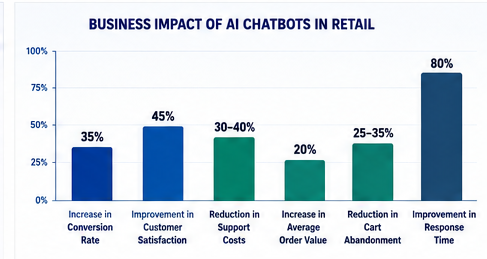
Retail executives increasingly evaluate conversational AI investments through measurable business outcomes rather than technology novelty.
Increased Conversion Rates
AI chatbots improve conversion rates through:
- Faster assistance
- Personalized recommendations
- Reduced friction
- Real-time engagement
- Guided purchasing
Several industry studies show that conversational AI significantly increases ecommerce conversion performance when implemented strategically.
Reduced Customer Support Costs
AI automation lowers operational support costs by handling repetitive inquiries at scale.
This allows human agents to focus on:
- High-value interactions
- Complex escalations
- Retention management
- Relationship building
The result is improved efficiency without sacrificing customer experience quality.
Higher Average Order Value (AOV)
Intent-driven recommendations increase:
- Cross-sell effectiveness
- Upsell opportunities
- Basket size
- Product discovery
AI chatbots can dynamically suggest premium alternatives based on customer behavior patterns.
Improved Customer Retention
Personalized engagement strengthens customer loyalty.
Customers are more likely to return when interactions feel:
- Relevant
- Personalized
- Responsive
- Context-aware
Retention improvements often create greater long-term ROI than acquisition-focused chatbot initiatives alone.
Common Mistakes Retailers Make With AI Chatbots
Despite growing adoption, many chatbot implementations fail to deliver strategic value because organizations focus on automation rather than customer intelligence.
Treating Chatbots as Cost-Cutting Tools Only
Retailers that deploy chatbots solely to reduce support costs often create frustrating customer experiences.
Conversational AI should enhance engagement, not merely deflect support tickets.
Ignoring Human Escalation Paths
AI systems cannot resolve every scenario effectively.
Customers must have seamless escalation options when:
- Emotional sensitivity increases
- Complex problems emerge
- Policy exceptions occur
- High-value relationships are involved
Poor Data Integration
Disconnected systems prevent meaningful personalization.
Without integrated customer data, chatbots become generic and ineffective.
Over-Automation Without Governance
Retailers sometimes scale AI deployments too quickly without establishing governance frameworks.
This increases risks related to:
- Compliance
- Security
- Brand consistency
- Ethical AI usage
Future Trends in AI Chatbots and Customer Intent Analysis
The next phase of conversational commerce will move beyond reactive assistance toward autonomous retail intelligence.
Multimodal Conversational AI
Future systems will combine:
- Text
- Voice
- Images
- Video
- Gesture recognition
Customers may soon upload product photos and receive conversational recommendations instantly.
Hyper-Personalized Commerce
AI systems will increasingly predict intent before customers explicitly communicate it.
This includes:
- Predictive replenishment
- Dynamic recommendations
- Personalized pricing
- Anticipatory support
Autonomous Shopping Agents
Generative AI agents may eventually conduct portions of the shopping process independently on behalf of consumers.
This could reshape:
- Product discovery
- Brand engagement
- Marketplace competition
- Retail loyalty dynamics
AI Governance as Competitive Differentiator
Retailers with transparent, ethical, and trustworthy AI ecosystems will likely gain stronger customer loyalty over time.
Responsible AI implementation will become a brand differentiator rather than merely a compliance requirement.
How Techment Helps Enterprises Build Scalable Conversational AI Ecosystems
Retail enterprises increasingly require more than standalone chatbot deployment. They need integrated AI ecosystems capable of supporting personalization, analytics, governance, scalability, and long-term transformation.
Techment helps enterprises modernize conversational AI strategies through:
- AI readiness assessments
- Data modernization initiatives
- Conversational AI architecture design
- Real-time analytics implementation
- Cloud-native AI infrastructure
- Governance and compliance frameworks
- NLP and machine learning integration
- Omnichannel customer experience transformation
Techment’s enterprise AI and data modernization expertise supports organizations across the full lifecycle from strategy to implementation and optimization.
Techment also helps enterprises establish governance frameworks that ensure conversational AI remains scalable, secure, ethical, and aligned with business outcomes.
Conclusion
Retail is rapidly evolving into an intelligence-driven industry where customer engagement must be immediate, contextual, and personalized. The ability for AI chatbots to analyze customer intent in real time is fundamentally reshaping how enterprises approach ecommerce, customer support, personalization, and revenue growth.
Modern conversational AI systems no longer function as simple automation tools. They operate as strategic intelligence layers capable of interpreting customer behavior, predicting outcomes, and influencing purchasing decisions dynamically across omnichannel ecosystems.
However, successful implementation requires more than deploying chatbot interfaces. Enterprises must build scalable foundations that include unified data platforms, governance frameworks, AI-ready infrastructure, real-time analytics, and ethical AI practices.
As conversational commerce continues to evolve, retailers that invest strategically in AI-powered intent analysis will be better positioned to deliver differentiated customer experiences, improve operational efficiency, and drive sustainable competitive advantage.
Techment helps enterprises navigate this transformation by combining conversational AI expertise, modern analytics capabilities, and enterprise-grade AI governance strategies to build intelligent retail ecosystems designed for long-term growth.
FAQs
1. How do AI chatbots analyze customer intent in real time?
AI chatbots use NLP, machine learning, sentiment analysis, and behavioral analytics to understand customer queries, browsing patterns, and conversational context instantly.
2. Can AI chatbots improve ecommerce conversion rates?
Yes. AI chatbots improve conversions through personalized recommendations, abandoned cart recovery, real-time engagement, and guided purchasing experiences.
3. What is the difference between AI chatbots and rule-based chatbots?
Rule-based chatbots follow predefined scripts, while AI-powered chatbots understand context, learn continuously, and generate dynamic responses.
4. Are AI chatbots replacing human customer support?
No. Most enterprises use hybrid support models where AI handles repetitive interactions while human agents manage complex or sensitive cases.
5. What technologies power real-time customer intent analysis?
Key technologies include:
Natural Language Processing (NLP)
Machine learning
Generative AI
Real-time analytics
Customer data platforms
Sentiment analysis engines
6. Why is data quality important for conversational AI?
Poor-quality data leads to inaccurate recommendations, weak personalization, and ineffective intent classification. Reliable data is essential for AI accuracy and customer trust.