Artificial intelligence in property and casualty insurance helps carriers improve underwriting, pricing, claims processing, fraud detection, catastrophe risk assessment, and customer service. By combining machine learning, computer vision, predictive analytics, and generative AI, P&C insurers can analyze complex data, automate selected workflows, and support better decisions while maintaining appropriate human oversight and governance.
Executive Summary
Artificial intelligence is changing how property and casualty (P&C) insurance carriers assess risk, price policies, process claims, detect fraud, and engage with policyholders. By combining machine learning, predictive analytics, computer vision, natural language processing, and generative AI, insurers can analyze larger volumes of structured and unstructured data, improve operational efficiency, and support more informed decisions across the insurance lifecycle.
For P&C carriers, AI offers practical opportunities in underwriting, risk selection, pricing, claims automation, fraud detection, catastrophe modeling, customer servicing, and loss prevention. It can help underwriters evaluate complex submissions, claims teams assess damage from images, actuaries identify risk patterns, and customer service teams respond to policyholder requests more efficiently.
However, the value of AI extends beyond automating existing tasks. Its broader potential lies in connecting data, decisions, and workflows across the insurance value chain. Carriers can move toward more proactive risk management, faster claims resolution, more responsive customer experiences, and data-driven operating models.
Realizing these benefits requires more than deploying AI models. Insurers need reliable data foundations, integration with core insurance platforms, model validation, explainability, cybersecurity, and governance that addresses fairness, privacy, and regulatory requirements.
The most effective AI strategy for P&C carriers is therefore practical and risk-based: identify high-value business problems, select appropriate AI capabilities, integrate them into existing workflows, and measure their impact through operational and business outcomes.
TL;DR: AI Applications in Property and Casualty Insurance
- Underwriting: AI analyzes applications, historical losses, property characteristics, and external risk data to support risk assessment and underwriting decisions.
- Pricing: Machine learning helps identify risk patterns, improve segmentation, and support actuarial pricing models.
- Claims management: AI automates document processing, claim classification, damage assessment, and workflow prioritization.
- Fraud detection: Predictive models and network analytics identify suspicious patterns and prioritize claims for investigation.
- Catastrophe risk: AI combines geospatial, weather, property, and historical data to support exposure analysis and disaster response.
- Customer experience: Conversational AI and intelligent assistants help policyholders obtain information, submit claims, and receive timely updates.
- Loss prevention: Predictive analytics and connected devices help identify emerging risks before losses occur.
- Operational efficiency: Generative AI supports document analysis, knowledge retrieval, reporting, and employee productivity.
- Enterprise transformation: AI creates greater value when integrated with core insurance systems, governed data platforms, and existing business workflows.
- Responsible adoption: Human oversight, model governance, data protection, and regulatory compliance remain essential.
Introduction: Why Artificial Intelligence Matters for P&C Insurance
Property and casualty insurance operates in an environment characterized by changing risk patterns, increasing data volumes, evolving customer expectations, and pressure to improve underwriting profitability and claims efficiency.
P&C carriers manage a broad range of insurance products, including personal auto, homeowners, commercial property, general liability, workers’ compensation, and specialty insurance. Each line involves different risk characteristics, data requirements, pricing considerations, claims processes, and regulatory obligations.
Traditional insurance processes often depend on manual document reviews, historical loss information, actuarial models, inspection reports, and fragmented operational systems. Although these methods remain important, they can make it difficult to process large volumes of information quickly or identify complex patterns across multiple data sources.
Artificial intelligence introduces additional analytical and automation capabilities. Machine learning can identify patterns in historical claims and underwriting data. Computer vision can analyze vehicle damage and property images. Natural language processing can extract information from policy documents and claims narratives. Generative AI can summarize complex records, retrieve enterprise knowledge, and assist employees with operational tasks.
The adoption of AI is also expanding across the insurance industry. The National Association of Insurance Commissioners (NAIC) reports that 88% of responding private passenger auto insurers and 70% of responding homeowners insurers reported using, planning to use, or exploring AI and machine learning in their operations. These figures reflect the NAIC survey responses and should not be interpreted as adoption rates across every insurer.
For P&C carriers, the opportunity is to move from isolated AI experiments toward integrated capabilities that improve business performance while maintaining the controls required in a regulated insurance environment.
Read our blog on How Insurers Can Use AI to Meet Compliance and Audit Requirements
What Is Artificial Intelligence in Property and Casualty Insurance?
Artificial intelligence in property and casualty insurance refers to the use of machine learning, predictive analytics, computer vision, natural language processing, and generative AI to improve risk assessment, underwriting, pricing, claims management, fraud detection, customer service, and other insurance operations. These technologies help carriers analyze data, identify patterns, automate selected tasks, and support human decision-making across the policy lifecycle.
Key AI technologies used by P&C carriers
Different AI technologies address different insurance challenges. Selecting the right capability depends on the business problem, available data, expected outcome, and risk of the decision.
| AI technology | What it does | P&C insurance applications |
|---|---|---|
| Machine learning (ML) | Identifies patterns and predicts outcomes from data | Risk scoring, pricing, fraud detection, claims prediction |
| Predictive analytics | Estimates future events or probabilities | Loss forecasting, claim severity, customer retention |
| Computer vision | Analyzes images and visual information | Vehicle damage assessment, property inspections, catastrophe evaluation |
| Natural language processing (NLP) | Extracts meaning from text and documents | Claims narratives, policy analysis, submission processing |
| Generative AI | Generates and summarizes content using learned patterns | Claims summaries, underwriting assistance, customer communication |
| Retrieval-augmented generation (RAG) | Grounds AI responses in retrieved information sources | Policy knowledge retrieval, underwriting guidelines, internal knowledge search |
| AI agents | Execute defined multi-step tasks using approved tools | Claims coordination, document collection, policy servicing |
These technologies are complementary rather than interchangeable. A computer vision model may identify visible vehicle damage, a machine learning model may estimate claim severity, and a generative AI assistant may summarize the findings for a claims examiner. Each component should be evaluated for its specific purpose and limitations.
Why Are P&C Insurance Carriers Adopting AI?
P&C carriers are adopting AI to improve risk selection, increase pricing precision, accelerate claims processing, reduce fraud exposure, and respond more effectively to changing customer and environmental risks. AI also helps insurers make better use of structured and unstructured data that traditional workflows may not fully analyze.
1. Increasing complexity of risk assessment
Insurance risks are influenced by multiple variables, including location, property characteristics, driving behavior, weather patterns, historical losses, and economic conditions.
AI can help carriers analyze these variables together and identify relationships that may be difficult to capture through conventional manual analysis alone.
2. Growing volumes of structured and unstructured data
P&C insurers process information from applications, claims forms, inspection photographs, repair estimates, telematics devices, weather feeds, geospatial datasets, and policy documents.
AI can help extract, classify, and analyze information from these sources, making it easier to incorporate relevant data into business workflows.
3. Pressure to improve claims efficiency
Claims operations involve multiple activities, including registration, coverage verification, document collection, damage assessment, fraud screening, settlement evaluation, and communication.
AI can automate or support repetitive activities and help claims professionals prioritize cases that need attention.
4. Increasing fraud sophistication
Insurance fraud can involve staged accidents, inflated repair estimates, duplicate claims, suspicious relationships, and inconsistencies across documents.
Machine learning and network analytics can help identify unusual patterns and prioritize investigations.
5. Changing customer expectations
Policyholders increasingly expect convenient digital interactions, timely claim updates, personalized services, and faster resolution.
AI-enabled customer service can support these expectations while allowing employees to focus on complex or sensitive cases.
6. The need for proactive risk management
AI can help insurers move beyond evaluating losses after they occur. By combining predictive analytics with weather, property, sensor, and geospatial data, carriers can identify emerging risks and support preventive action.
AI in Insurance Underwriting and Risk Assessment
AI helps P&C underwriters evaluate submissions by analyzing historical loss information, property characteristics, external risk indicators, inspection data, and other relevant variables. Machine learning and document intelligence can support risk classification, identify missing information, and improve underwriting workflows while leaving material decisions subject to appropriate underwriting authority and oversight.
How AI improves underwriting
Traditional underwriting often requires professionals to review multiple documents, inspect property details, assess historical claims, and interpret risk information.
AI can support these activities through:
- Automated extraction of information from insurance applications.
- Analysis of historical loss patterns.
- Identification of missing or inconsistent submission information.
- Evaluation of property characteristics using approved data sources.
- Risk classification and prioritization.
- Retrieval of relevant underwriting guidelines.
- Identification of submissions requiring specialist review.
Practical use case: Commercial property underwriting
Consider a commercial property submission containing an application form, property inspection report, building photographs, historical claims information, and location details.
An AI-enabled underwriting workflow can:
- Extract relevant information from the submitted documents.
- Identify missing fields and inconsistent information.
- Retrieve authorized property and geographic risk data.
- Analyze relevant historical loss patterns.
- Flag characteristics requiring additional review.
- Prepare a structured risk summary for the underwriter.
The underwriter reviews the information, validates the sources, applies underwriting guidelines, and makes the final decision according to the carrier’s authority framework.
Business benefits
- Reduced manual document review.
- Faster submission processing.
- More consistent information extraction.
- Better visibility into relevant risk indicators.
- Improved underwriter productivity.
- More time for complex risk evaluation.
Important consideration: AI-generated risk scores should not be treated as automatically reliable underwriting decisions. Carriers must assess data quality, model performance, fairness, explainability, and the suitability of the information used.
Read more about AI in Insurance: Benefits, Use Cases in 2026
AI in Insurance Pricing and Risk Segmentation
AI supports insurance pricing by analyzing historical claims, exposure information, policy characteristics, and other relevant variables to identify patterns associated with expected losses. Machine learning can complement traditional actuarial methods, improve risk segmentation, and support pricing analysis, but pricing decisions must remain consistent with applicable actuarial standards and insurance regulations.
How AI supports insurance pricing
AI and machine learning can help pricing teams:
- Identify relationships between risk factors and claims outcomes.
- Analyze large historical datasets.
- Improve risk segmentation.
- Estimate claim frequency and severity.
- Identify changing loss patterns.
- Support rate adequacy analysis.
- Evaluate the impact of proposed pricing changes.
Practical use case: Personal auto insurance pricing
A personal auto carrier may analyze variables such as vehicle characteristics, driving history, claims experience, geographical exposure, and approved telematics information.
Machine learning models can identify patterns associated with expected claim frequency and severity. Actuaries can evaluate these patterns alongside established rating methodologies and regulatory requirements.
Business benefits
- More granular risk analysis.
- Better understanding of loss drivers.
- Improved analytical efficiency.
- Support for actuarial decision-making.
- Greater visibility into portfolio performance.
Important consideration: More granular pricing is not automatically more accurate or fair. Carriers must evaluate variable suitability, data quality, proxy discrimination, model stability, and regulatory restrictions.
AI in Claims Management and Automation
AI improves P&C claims management by helping insurers classify claims, extract information from documents, analyze photographs, identify missing evidence, estimate damage, and prioritize workflows. It can reduce repetitive processing effort and support faster claims handling, while coverage determinations and other consequential decisions require appropriate validation and authority.
Claims management is one of the most practical areas for AI adoption because it involves high volumes of documents, images, communications, and repeatable administrative activities.
Key AI applications in claims processing
Automated claims intake
AI can extract relevant information from claim forms, emails, uploaded documents, and supporting records to create structured claim data.
Claims classification and triage
Machine learning can classify incoming claims by type, complexity, potential severity, or need for specialist review.
Document processing
NLP and document intelligence can extract information from police reports, repair estimates, invoices, inspection reports, and correspondence.
Damage assessment
Computer vision can analyze photographs of vehicle or property damage and identify visible damage characteristics for further assessment.
Claims summarization
Generative AI can summarize claim histories, correspondence, and supporting documents to help adjusters understand case context.
Workflow prioritization
AI can identify cases with missing information, unusual patterns, or potential escalation requirements.
Practical use case: Automated motor claims assessment
A policyholder submits a motor insurance claim with accident photographs, a claim description, and supporting documents.
An AI-enabled claims workflow can:
- Extract relevant information from the claim submission.
- Classify the claim and identify the type of damage.
- Analyze photographs for visible damage indicators.
- Retrieve relevant policy and coverage information.
- Compare available details with historical claims and repair information.
- Identify missing documentation or inconsistencies.
- Prepare a preliminary assessment for the claims adjuster.
The adjuster validates the findings, evaluates coverage, reviews repair estimates, and determines the appropriate next steps.
Business benefits
- Reduced manual data entry.
- Faster claims registration.
- Improved claims triage.
- Better access to case information.
- Reduced administrative workload.
- More consistent processing workflows.
Important consideration: Image analysis and automated estimates may be affected by image quality, hidden damage, incomplete evidence, and unusual repair conditions. They should support—not automatically replace—qualified claims assessment.
AI in Insurance Fraud Detection and Investigation
AI helps P&C carriers identify potentially fraudulent claims by analyzing transaction patterns, claimant relationships, historical behavior, claim characteristics, and inconsistencies across data sources. Machine learning, anomaly detection, and network analytics can prioritize suspicious cases for investigation, but an AI-generated fraud alert is not proof of fraud.
How AI improves fraud detection
Traditional fraud detection often relies on predefined rules, manual reviews, and investigator experience.
AI adds analytical capabilities by identifying patterns across large datasets.
Common applications include:
- Detection of unusual claim frequency.
- Identification of duplicate or related claims.
- Analysis of inconsistent claim information.
- Detection of suspicious payment patterns.
- Identification of potentially connected claimants, providers, or repair facilities.
- Prioritization of claims for special investigation.
- Analysis of documents and images for inconsistencies.
Practical use case: Suspicious motor claims
A carrier receives several claims involving similar accident circumstances, overlapping parties, and repeated repair providers.
A fraud analytics system can identify relationships across the claims, highlight unusual patterns, and generate a risk alert for the investigation team.
Investigators can then review supporting evidence, validate the connections, and determine whether further investigation is justified.
Business benefits
- Earlier identification of suspicious patterns.
- More focused investigation efforts.
- Better use of specialist resources.
- Improved visibility into fraud networks.
- Potential reduction in avoidable claims leakage.
Important consideration: Fraud models can generate false positives and may disproportionately flag certain customer groups or regions if underlying data is biased. Carriers should monitor model performance and ensure that adverse actions are based on verified evidence and appropriate review.
AI in Catastrophe Modeling and Natural Disaster Risk Assessment
AI can support catastrophe risk management by analyzing weather patterns, geospatial information, property characteristics, historical loss data, and real-time environmental signals. These capabilities help P&C carriers evaluate exposure, prioritize inspections, estimate potential losses, and support response planning for events such as floods, wildfires, hurricanes, and severe storms.
How AI supports catastrophe risk management
AI can assist insurers with:
- Geospatial risk analysis.
- Property exposure assessment.
- Weather and environmental data analysis.
- Satellite and aerial image interpretation.
- Identification of potentially affected properties.
- Claims volume forecasting.
- Post-event damage assessment.
- Catastrophe response prioritization.
Practical use case: Flood exposure assessment
A homeowners insurer can combine property location information, flood maps, elevation data, rainfall forecasts, and historical claims information.
AI models can help identify properties that may be exposed to elevated flood risk and prioritize further assessment.
Following a flood event, computer vision and geospatial analytics can help identify potentially affected properties and organize inspection or claims response activities.
Business benefits
- Better visibility into geographic exposure.
- More efficient catastrophe response.
- Improved inspection prioritization.
- Faster post-event assessment.
- Support for portfolio risk management.
Important consideration: Catastrophe models depend on the quality and resolution of environmental data, assumptions, and event scenarios. AI outputs should be evaluated alongside established catastrophe models and expert risk assessment.
AI in Customer Experience and Policyholder Servicing
AI improves P&C customer experience by supporting faster responses, personalized information retrieval, claims communication, and routine policy servicing. Conversational AI and intelligent assistants can handle common requests, while more complex coverage questions, disputes, and sensitive situations should be escalated to qualified employees.
Common applications
- Policy information and coverage FAQs.
- Claim status updates.
- Renewal reminders.
- Document and form assistance.
- First notice of loss guidance.
- Basic policy servicing.
- Agent and broker support.
- Personalized customer communication.
Practical use case: AI-enabled claims assistant
A policyholder wants to understand the status of a submitted claim.
An AI-enabled assistant can authenticate the customer through the approved process, retrieve the authorized claim status, explain the next required steps, and provide relevant contact information.
If the customer raises a dispute about coverage or settlement, the assistant can route the request to the appropriate claims professional.
Business benefits
- Faster routine customer responses.
- Reduced service workload.
- More consistent communication.
- Improved digital service availability.
- Better access to policy information.
- More time for employees to handle complex inquiries.
Important consideration: Customer-facing AI must protect personal information, avoid unsupported coverage interpretations, and provide appropriate escalation to human representatives.
AI in Telematics and Usage-Based Insurance
AI and telematics enable P&C carriers to analyze driving behavior and vehicle data to support usage-based insurance programs. Depending on the product and applicable requirements, these insights can help insurers understand driving patterns, assess exposure, and develop more individualized risk models.
How AI supports telematics
Telematics platforms may collect information such as:
- Distance driven.
- Speed patterns.
- Acceleration and braking behavior.
- Driving time.
- Trip frequency.
- Location-related exposure, where permitted.
- Other approved vehicle or driving signals.
Machine learning models can analyze these signals to identify driving patterns and support risk assessment.
Practical use case: Usage-based auto insurance
A motor insurer offers a usage-based insurance program in which participating policyholders provide consent for approved driving data collection.
AI models analyze driving behavior over time and generate insights that may support risk segmentation or customer feedback.
Business benefits
- Better visibility into driving behavior.
- More individualized risk analysis.
- Support for usage-based products.
- Potential opportunities for safer-driving engagement.
- Additional insights for portfolio management.
Important consideration: Telematics data introduces privacy, consent, cybersecurity, data retention, and fairness considerations. Insurers must clearly define how data is collected, used, stored, and incorporated into pricing or other decisions.
AI claims automation must be supported by robust enterprise architecture. Techment’s AI-Ready Enterprise Checklist with Microsoft Fabric outlines readiness considerations.
AI in Commercial Risk Engineering and Loss Prevention
AI can help commercial P&C carriers identify operational and property risks by combining inspection information, sensor data, historical claims, equipment information, and environmental signals. These insights can support risk engineering, inspection prioritization, and loss prevention rather than relying exclusively on post-loss claims analysis.
Practical applications
- Predictive maintenance for industrial equipment.
- Identification of potential fire and electrical risks.
- Monitoring of environmental and property conditions.
- Analysis of inspection reports.
- Detection of unusual equipment behavior.
- Prioritization of high-risk locations.
- Recommendations for preventive measures.
Practical use case: Industrial property risk monitoring
A commercial insurer works with a manufacturing customer that uses connected sensors to monitor equipment temperature, vibration, and operating conditions.
AI models analyze the sensor data and identify unusual patterns that may indicate potential equipment failure.
The insurer and customer can use these insights to prioritize inspections and preventive maintenance.
Business benefits
- Earlier identification of emerging risks.
- Better risk engineering insights.
- Support for preventive maintenance.
- Potential reduction in avoidable losses.
- Improved customer risk engagement.
Important consideration: Predictive maintenance models require reliable sensor data, appropriate thresholds, and clear responsibility for responding to alerts. An AI prediction should not be treated as a guarantee that an equipment failure will occur or be prevented.
Generative AI and AI Agents in P&C Insurance
Generative AI and AI agents expand insurance AI capabilities beyond prediction and classification. Generative AI can summarize documents, retrieve knowledge, and assist employees, while AI agents can execute defined multi-step tasks through approved tools and integrations. Their use should be bounded by explicit permissions, validation, and human oversight.
Generative AI use cases
Underwriting knowledge assistance
Retrieves relevant underwriting guidelines and summarizes supporting documents.
Claims document summarization
Consolidates information from claim notes, reports, correspondence, and policy documents.
Policy and procedure search
Helps employees locate approved policy wording, procedures, and operational guidance.
Regulatory and compliance support
Summarizes regulatory publications and assists with evidence preparation, subject to expert verification.
Customer communication drafting
Prepares draft claim updates, renewal communications, and service responses for review.
AI agent use cases
Claims coordination agent
Collects missing documents, checks case completeness, updates approved workflow fields, and prepares a case for adjuster review.
Underwriting preparation agent
Gathers submission information, identifies missing details, retrieves relevant guidelines, and prepares a structured submission summary.
Fraud investigation support agent
Collects relevant indicators from authorized sources and prepares an investigation brief for a specialist.
Policy servicing agent
Coordinates approved low-risk policy servicing activities within defined transaction and authorization limits.
Example: An AI-enabled claims workflow
A claims workflow may combine several capabilities:
- An intake component extracts claim information.
- A document intelligence service identifies supporting records.
- A policy retrieval service retrieves relevant coverage information.
- A computer vision model analyzes submitted damage images.
- An AI assistant prepares a structured claim summary.
- A workflow agent identifies missing information and initiates approved follow-up tasks.
- A claims professional reviews the evidence and makes the required decisions.
This architecture can reduce administrative effort while preserving decision authority and accountability.
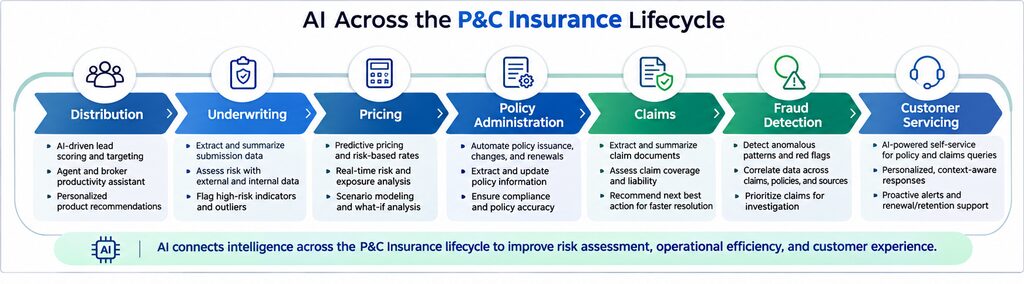
AI Across the P&C Insurance Value Chain
AI delivers broader business value when capabilities are connected across the insurance lifecycle rather than deployed as isolated applications. Data from distribution, underwriting, pricing, claims, and customer servicing can provide additional context for operational decisions and portfolio management, subject to appropriate permissions and governance.
| P&C business function | AI application | Potential business outcome |
|---|---|---|
| Distribution | Lead scoring and customer segmentation | More focused distribution efforts |
| Underwriting | Submission extraction and risk analysis | Faster underwriting workflows |
| Pricing | Predictive modeling and risk segmentation | Better analytical support for pricing |
| Policy administration | Document processing and servicing assistance | Reduced administrative effort |
| Claims | Intake, triage, damage analysis, and summarization | Faster claims processing |
| Fraud investigation | Anomaly detection and network analytics | More focused investigations |
| Catastrophe management | Geospatial and environmental analysis | Better exposure visibility |
| Customer service | Conversational AI and intelligent assistants | Improved service responsiveness |
| Risk engineering | Predictive analytics and sensor analysis | More proactive loss prevention |
| Compliance | Evidence retrieval and control monitoring | Improved audit preparation |
The opportunity is to create a connected operating model in which relevant information flows across business functions without compromising data security, access controls, or regulatory obligations.
What Data Foundations Do P&C Carriers Need for AI?
P&C carriers need accurate, accessible, governed, and well-integrated data to build reliable AI applications. The quality of underwriting, pricing, claims, and fraud analytics depends on the relevance, completeness, consistency, and lineage of the information used by the models.
Key insurance data sources
- Policy administration systems.
- Claims management platforms.
- Underwriting applications.
- Historical loss and exposure records.
- Actuarial and pricing datasets.
- Repair estimates and invoices.
- Inspection reports and photographs.
- Telematics and IoT data.
- Weather and catastrophe datasets.
- Geospatial and property information.
- Customer and broker interactions.
- External risk and third-party datasets.
Common data challenges
Data silos
Information may be distributed across multiple legacy platforms and business units, making it difficult to establish a consistent view of risk or customer history.
Inconsistent data definitions
Different systems may use different definitions for claims status, coverage, loss categories, property attributes, or business entities.
Incomplete historical records
Missing values, inconsistent documentation, and incomplete claims histories can affect model reliability.
Unstructured information
Inspection reports, policy documents, claim narratives, photographs, and emails require additional processing before they can be used effectively.
Third-party data quality
External datasets may have limitations related to coverage, accuracy, update frequency, licensing, and permitted use.
Building an enterprise-ready data foundation
P&C carriers should focus on:
- Data integration across core insurance platforms.
- Standardized data definitions and metadata.
- Data quality monitoring and remediation.
- Secure data access and governance.
- Data lineage and traceability.
- Approved third-party data management.
- Scalable cloud and enterprise data platforms.
- Controlled access to structured and unstructured information.
A strong data foundation is not simply an infrastructure investment. It is a prerequisite for making AI outputs reliable, explainable, and useful in operational insurance workflows.
AI Governance, Risk Management, and Regulatory Compliance for P&C Carriers
P&C carriers must govern AI systems throughout their lifecycle to ensure that model outputs and AI-supported actions are accurate, fair, secure, explainable, and consistent with applicable insurance requirements. Governance should cover internally developed models, acquired third-party solutions, data sources, model changes, operational use, and human oversight.
Key AI governance requirements
Model inventory and ownership
Maintain an inventory of AI models and systems, including their business purpose, owners, risk classification, deployment status, and third-party dependencies.
Fairness and bias assessment
Evaluate whether model inputs or outputs create unfair discrimination or inappropriate differences in treatment. Monitor outcomes across relevant customer groups and jurisdictions.
Explainability and transparency
Establish appropriate methods to explain how models influence material underwriting, pricing, and claims activities.
Data privacy and security
Protect personal, financial, property, and telematics information through appropriate access controls, encryption, retention, and approved processing environments.
Model validation and monitoring
Evaluate model performance before deployment and monitor accuracy, drift, stability, and operational impact after implementation.
Human oversight
Define when an employee must review, approve, override, or escalate an AI-generated recommendation or action.
Third-party model governance
Assess vendors, external datasets, model documentation, security practices, contractual responsibilities, and change-management procedures.
Regulatory considerations
P&C carriers should evaluate applicable requirements based on their jurisdictions, products, and business activities.
In the United States, the NAIC Model Bulletin on the Use of Artificial Intelligence Systems by Insurers, adopted in December 2023, outlines governance expectations and reinforces that AI-supported decisions and actions must comply with applicable insurance laws and regulations. The bulletin is a model for state-level adoption, so carriers should verify the requirements applicable in each relevant jurisdiction.
For insurers operating in Europe, relevant considerations may include the EU AI Act, GDPR, and applicable insurance supervisory requirements. Applicability depends on the specific system, use case, organization, and legal context.
The NIST AI Risk Management Framework can also help carriers structure AI risk management through its Govern, Map, Measure, and Manage functions.
How Can P&C Carriers Implement AI Successfully?
P&C carriers can implement AI successfully by prioritizing measurable business problems, assessing data readiness, selecting appropriate technologies, validating models, integrating solutions into existing workflows, and establishing governance before scaling. A phased approach helps reduce implementation risk and ensures that AI investments deliver operational value.
Phase 1: Identify high-value business opportunities
Assess business functions for manual effort, processing delays, recurring errors, data availability, and potential financial impact.
Potential starting points include claims document extraction, underwriting submission processing, customer service assistance, and fraud investigation prioritization.
Deliverable: AI opportunity assessment and prioritized use-case inventory.
Phase 2: Evaluate data and technology readiness
Review existing data sources, core insurance platforms, API availability, infrastructure, security controls, and integration requirements.
Identify gaps in data quality, system connectivity, and governance.
Deliverable: Data and technology readiness assessment.
Phase 3: Define the AI solution architecture
Select suitable technologies based on the use case.
For example:
- Machine learning for predictive risk analysis.
- Computer vision for image-based damage assessment.
- NLP for document extraction.
- Generative AI and RAG for enterprise knowledge assistance.
- AI agents for bounded multi-step workflows.
Define the interfaces between AI models, business rules, systems of record, and human approval processes.
Deliverable: Solution architecture and governance design.
Phase 4: Develop and validate a pilot
Build the solution using representative data and realistic scenarios.
Evaluate model accuracy, false positives, false negatives, reliability, security, explainability, and operational performance.
Involve underwriting, claims, actuarial, compliance, and technology stakeholders where relevant.
Deliverable: Validated pilot and documented performance results.
Phase 5: Integrate with insurance workflows
Connect the AI solution to relevant platforms and business processes.
Establish user permissions, approval workflows, logging, exception handling, and operational support.
Deliverable: Integrated AI-enabled workflow.
Phase 6: Monitor, optimize, and scale
Track business outcomes and model performance after deployment.
Monitor data drift, model changes, exceptions, customer impact, and operational costs. Expand to additional use cases only when the results and controls justify it.
Deliverable: Production monitoring and continuous improvement plan.
How Should P&C Carriers Measure AI ROI?
P&C carriers should measure AI ROI through operational efficiency, underwriting and pricing performance, claims outcomes, fraud investigation effectiveness, customer experience, and risk-control improvements. A successful AI initiative should demonstrate measurable business value without increasing unacceptable model, operational, or regulatory risk.
| KPI | What it measures | Business relevance |
|---|---|---|
| Underwriting turnaround time | Time required to evaluate a submission | Measures underwriting efficiency |
| Submission processing effort | Manual work required to process submissions | Indicates automation value |
| Claims cycle time | Time from claim registration to resolution | Measures claims efficiency |
| Claims handling cost | Average cost to process a claim | Tracks operational economics |
| Fraud alert precision | Proportion of alerts confirmed as meaningful after investigation | Evaluates investigation prioritization |
| False-positive rate | Proportion of alerts that are not meaningful | Measures unnecessary review effort |
| Model performance | Accuracy and stability against defined validation measures | Evaluates technical reliability |
| Customer satisfaction | Customer feedback on service and claims experience | Measures customer impact |
| Loss ratio and combined ratio | Insurance performance indicators | Provides portfolio-level business context |
| Model governance coverage | Share of relevant models with required controls and documentation | Measures governance maturity |
Metrics should be evaluated against a documented baseline and segmented by product, geography, channel, and use case where appropriate.
Importantly, changes in loss ratio, combined ratio, or claims outcomes cannot automatically be attributed to AI. External factors such as catastrophe frequency, inflation, repair costs, portfolio mix, and underwriting changes must also be considered.
Common Challenges in AI Adoption for P&C Insurance
P&C carriers may face challenges related to fragmented data, legacy systems, model explainability, regulatory compliance, integration complexity, and organizational readiness. Addressing these issues early helps prevent isolated pilots from becoming difficult-to-maintain production systems.
Fragmented legacy systems
Older policy, claims, and billing platforms may lack consistent APIs or standardized data structures.
Approach: Build governed integration and data layers that connect existing systems without requiring immediate replacement of every core platform.
Poor data quality
Incomplete claims histories, inconsistent property information, and inaccurate external datasets can affect model performance.
Approach: Establish data quality controls, lineage, ownership, and continuous monitoring.
Lack of model explainability
Complex models may produce outputs that are difficult for business teams and regulators to interpret.
Approach: Select suitable explainability methods, document model limitations, and establish review processes for material decisions.
Regulatory and fairness concerns
AI models may introduce unfair discrimination or produce outcomes that cannot be adequately justified.
Approach: Integrate compliance, actuarial, legal, and risk teams into model development and validation.
Integration complexity
An AI model may work in isolation but fail to deliver value when it cannot connect with claims, underwriting, or policy administration workflows.
Approach: Design integration and operational requirements before model development.
Skills and organizational readiness
AI adoption requires collaboration across data science, actuarial, engineering, underwriting, claims, compliance, and business operations.
Approach: Build cross-functional ownership, training, and change-management capabilities.
The Future of AI in Property and Casualty Insurance
The future of AI in P&C insurance will involve greater integration of predictive analytics, computer vision, generative AI, connected data, and agentic workflows. Carriers are likely to focus increasingly on connecting intelligence across underwriting, claims, customer servicing, and risk management rather than deploying isolated AI tools.
Predictive and preventive insurance
AI may help insurers identify risk signals earlier by combining environmental, property, telematics, and sensor data. This can support preventive recommendations and more proactive risk management.
More intelligent underwriting workflows
AI assistants may help underwriters retrieve information, summarize complex submissions, identify missing details, and prepare risk assessments.
More automated claims operations
Computer vision, document intelligence, and AI agents may coordinate more of the administrative claims process, while maintaining appropriate review for consequential decisions.
Agentic AI across insurance operations
Bounded AI agents may coordinate tasks across claims, underwriting, servicing, and compliance workflows. Their adoption will depend on reliable integrations, identity controls, explicit permissions, and operational governance.
Greater use of alternative data
Insurers may increasingly evaluate additional sources such as geospatial information, IoT signals, telematics, satellite imagery, and environmental data, subject to appropriate consent, reliability, and regulatory requirements.
Integrated enterprise AI platforms
Carriers may consolidate data, analytics, model governance, and AI-enabled applications on enterprise platforms that provide stronger scalability, security, and operational visibility.
The long-term opportunity is not simply to automate individual insurance tasks. It is to create a more connected, predictive, and responsive insurance operating model.
Conclusion
Artificial intelligence offers P&C carriers practical opportunities to improve underwriting, pricing, claims management, fraud detection, catastrophe risk assessment, customer servicing, and loss prevention.
The greatest value comes when AI capabilities are aligned with specific insurance problems and integrated into existing business workflows. Machine learning can support risk analysis, computer vision can assess damage images, NLP can process complex documents, and generative AI can improve knowledge access and employee productivity.
However, successful AI adoption requires more than technology selection. Carriers must establish reliable data foundations, integrate AI with core insurance platforms, validate model performance, manage third-party dependencies, and maintain governance across the AI lifecycle.
P&C insurers should begin with measurable use cases, demonstrate value through controlled pilots, and expand only when operational results and risk controls support broader deployment.
Techment can help P&C carriers connect enterprise AI strategy with data engineering, cloud modernization, AI implementation, and enterprise software engineering. By building the right data and technology foundations, insurers can move from isolated AI experimentation toward scalable, governed AI capabilities that support better risk decisions and more efficient operations.
Frequently Asked Questions
1. What is artificial intelligence in property and casualty insurance?
Artificial intelligence in P&C insurance uses machine learning, predictive analytics, computer vision, natural language processing, and generative AI to support underwriting, pricing, claims, fraud detection, customer service, and risk management. It helps carriers analyze data, identify patterns, automate selected tasks, and improve operational decision support.
2. How is AI used by P&C insurance companies?
P&C insurers use AI to assess underwriting risk, analyze pricing factors, automate claims intake, evaluate damage images, detect suspicious claim patterns, assess catastrophe exposure, support customer service, and identify opportunities for loss prevention.
3. How does AI improve insurance underwriting?
AI improves underwriting workflows by extracting information from applications, analyzing historical losses, identifying missing data, retrieving relevant guidelines, and highlighting risk indicators. Underwriters use these insights to support risk assessment and make decisions within established authority and governance frameworks.
4. Can AI automate insurance claims processing?
AI can automate or support activities such as claims registration, document extraction, classification, damage image analysis, case summarization, and workflow routing. Coverage decisions, settlement approvals, and complex assessments require appropriate validation and human oversight.
5. How does AI help detect insurance fraud?
AI analyzes claims data, transaction patterns, claimant relationships, historical behavior, and document inconsistencies to identify potentially suspicious activity. It helps investigators prioritize cases, but an AI alert alone does not establish that fraud has occurred.
6. What is the role of computer vision in P&C insurance?
Computer vision analyzes photographs and other visual data to identify visible damage, assess property conditions, support inspections, and help prioritize claims. It is especially useful in motor and property insurance, where image-based evidence can support claims assessment.
7. How does AI support catastrophe risk modeling?
AI can analyze geospatial data, weather patterns, satellite imagery, property information, and historical losses to support exposure analysis and post-event assessment. It complements established catastrophe modeling and expert risk evaluation rather than replacing them.
8. What is the difference between traditional AI and generative AI in insurance?
Traditional AI commonly predicts outcomes, classifies information, and identifies patterns using models trained on data. Generative AI creates or summarizes content, retrieves knowledge, and assists with document-heavy tasks. Both can be used together in insurance workflows.
9. How can P&C carriers start implementing AI?
Carriers should identify high-value business problems, evaluate data readiness, select an appropriate AI capability, develop a controlled pilot, validate performance, integrate the solution into workflows, and establish ongoing monitoring and governance before scaling.
Related Reads
- AI-Ready Enterprise Checklist with Microsoft Fabric
- AI-Powered Risk Assessment in Insurance: Models & Use Cases
- RAG for Insurance: How Retrieval-Augmented AI Speeds Up Claims Processing
- Microsoft Fabric for Insurance Carriers: A Reference Architecture
- AI in Insurance: Benefits, Use Cases in 2026