Introduction
Generative AI has evolved from an experimental productivity tool into a strategic enterprise capability. In 2026, organizations are no longer evaluating AI based solely on content generation or benchmark performance. Instead, they are investing in best Generative AI Models that accelerate decision-making, automate knowledge-intensive workflows, improve customer experiences, and create measurable business outcomes.
According to McKinsey, organizations are rapidly moving from AI experimentation to enterprise-scale deployment, with generative AI becoming a strategic investment across business functions.
The challenge is no longer whether to adopt AI—it is selecting the right model that aligns with enterprise architecture, governance policies, security requirements, and long-term digital transformation goals.
While frontier AI models continue to improve rapidly, choosing the most suitable platform requires evaluating multiple dimensions beyond raw intelligence, including multimodal capabilities, deployment flexibility, integration with enterprise applications, compliance, cost efficiency, and ecosystem maturity.
This guide examines the Best Generative AI Models in 2026, providing an enterprise-focused evaluation framework to help technology leaders make informed investment decisions. It also explains how organizations can maximize AI value through modern data platforms, governance, and scalable implementation strategies.
TL;DR
- Generative AI Models are now enterprise platforms rather than standalone chatbots.
- Business leaders should evaluate AI models based on governance, scalability, integration, and ROI—not benchmarks alone.
- GPT-5.5, Gemini 3.1 Pro, Claude Opus 4.7, Mistral Medium 3.5, and DeepSeek V4 lead enterprise adoption in 2026.
- The right model depends on your business objectives, data residency requirements, technology stack, and AI maturity.
- Organizations combining modern data platforms with governed AI architectures realize significantly higher business value.
Read our blog on Enterprise AI Strategy in 2026
Best Generative AI Models for Enterprises in 2026
1. GPT-5.5 (OpenAI): Best for Enterprise AI Agents and Productivity
Best For: Enterprise AI agents, software engineering, knowledge management, Microsoft ecosystem
Key Strengths
- Advanced reasoning and planning
- AI agent orchestration
- 1M-token context window
- Deep integration with Microsoft 365, Azure AI Foundry, GitHub Copilot, and Microsoft Fabric
- Strong coding and enterprise workflow automation
Limitations
- Higher API pricing than open-weight alternatives
- Premium capabilities available only under enterprise licensing
Ideal Industries
Financial Services • Healthcare • Manufacturing • Professional Services • Retail
2. Gemini 3.1 Pro (Google DeepMind): Best for Multimodal Enterprise Intelligence
Best For: Multimodal AI, Google Workspace, scientific reasoning, enterprise analytics
Key Strengths
- Native text, image, audio, video, and code understanding
- 1M-token context window
- Strong reasoning across multimodal datasets
- Tight integration with Google Workspace and Vertex AI
- Excellent research and analytics capabilities
Limitations
- Some enterprise features remain in preview
- Less mature for software engineering than Claude
Ideal Industries
Healthcare • Retail • Research • Life Sciences • Education
3. Claude Opus 4.7 (Anthropic): Best for Software Engineering and Long-Context Reasoning
Best For: Enterprise coding, compliance, legal analysis, document intelligence
Key Strengths
- Industry-leading software engineering performance
- Excellent long-document reasoning
- Constitutional AI improves safety and reliability
- Available through Amazon Bedrock, Google Cloud, and Azure AI Foundry
- Strong performance on enterprise knowledge tasks
Limitations
- Smaller context window than GPT-5.5 and Gemini
- Premium pricing for advanced capabilities
Ideal Industries
Software • Banking • Insurance • Legal • Government
4. Mistral Medium 3.5: Best Generative AI Models for Data Sovereignty and Private Enterprise AI
Best For: On-premises AI, European enterprises, regulated industries, cost-efficient deployments
Key Strengths
- Open-weight model with Apache 2.0 licensing
- Self-hosting for complete data control
- Strong coding and document intelligence
- GDPR-friendly deployment options
- Lower long-term infrastructure costs for high-volume workloads
Limitations
- Multimodal capabilities are less mature than GPT-5.5 and Gemini
- Requires enterprise GPU infrastructure for self-hosting
Ideal Industries
Government • Manufacturing • Healthcare • Financial Services • European Enterprises
5. DeepSeek V4 Pro: Best for Cost-Optimized Enterprise AI at Scale
Best For: High-volume inference, AI automation, cost-sensitive enterprise deployments
Key Strengths
- Excellent price-to-performance ratio
- Mixture-of-Experts architecture reduces inference costs
- 1M-token context window
- Open-weight deployment options
- Strong reasoning for enterprise automation
Limitations
- Governance and regulatory considerations may affect adoption in highly regulated industries
- Some organizations require additional security reviews based on deployment policies
Ideal Industries
Logistics • Retail • Manufacturing • Customer Operations • Shared Services
Enterprise Comparison of Generative AI Models at a Glance
| Model | Best For | Key Advantage | Enterprise Fit |
|---|---|---|---|
| GPT-5.5 | AI Agents & Productivity | Microsoft ecosystem | ⭐⭐⭐⭐⭐ |
| Gemini 3.1 Pro | Multimodal Intelligence | Native multimodal AI | ⭐⭐⭐⭐⭐ |
| Claude Opus 4.7 | Software Engineering | Long-context reasoning | ⭐⭐⭐⭐⭐ |
| Mistral Medium 3.5 | Data Sovereignty | Open-weight & self-hosting | ⭐⭐⭐⭐☆ |
| DeepSeek V4 Pro | Cost Efficiency | Low-cost enterprise inference | ⭐⭐⭐⭐☆ |
Why These 5 Generative AI Models Lead the Enterprise Market
Choosing the right Generative AI Model is no longer about selecting the model with the highest benchmark score. Enterprise success depends on how effectively a model aligns with business objectives, integrates with existing technology investments, supports governance, and delivers measurable return on investment.
How Small and Medium Enterprises Can Leverage Generative AI – Insights from Our Webinar!
The five models featured in this guide consistently outperform alternatives because they combine technical excellence with enterprise readiness. They have been evaluated across six strategic dimensions that matter most to CIOs, CTOs, CDOs, and enterprise architects.
1. Advanced Reasoning and Decision Intelligence
Modern enterprises require AI systems that go beyond content generation. They need models capable of analyzing financial reports, interpreting legal documents, reviewing source code, understanding customer interactions, and supporting complex business decisions.
GPT-5.5 and Claude Opus 4.7 excel in long-form reasoning and software engineering, while Gemini 3.1 Pro demonstrates exceptional multimodal reasoning across text, images, audio, and video. Mistral Medium 3.5 and DeepSeek V4 offer competitive reasoning performance with greater deployment flexibility and lower operational costs.
For enterprise leaders, reasoning capability directly impacts productivity, operational efficiency, and decision quality.
2. Enterprise Ecosystem Integration
The best Generative AI Model is one that integrates seamlessly with existing enterprise platforms rather than introducing additional complexity.
Organizations increasingly prioritize AI models that work natively with platforms such as:
- Microsoft Fabric
- Azure AI Foundry
- Microsoft 365 Copilot
- Google Workspace
- Vertex AI
- SAP
- Salesforce
- ServiceNow
- Databricks
- Snowflake
Deep integration reduces implementation effort, accelerates adoption, and improves long-term return on AI investments.
3. Multimodal Intelligence
Enterprise information no longer exists solely in text. Organizations process documents, presentations, images, scanned contracts, emails, spreadsheets, videos, and voice conversations every day.
Multimodal AI enables enterprises to analyze these diverse data types within a unified workflow.
Gemini 3.1 Pro currently leads this area with native multimodal capabilities, while GPT-5.5 and Claude Opus 4.7 continue to strengthen their multimodal intelligence through ongoing platform enhancements.
This capability is becoming essential across healthcare, manufacturing, retail, logistics, and financial services.
4. Security, Governance, and Compliance
Responsible AI is now a board-level priority.
Enterprise AI deployments must comply with increasingly complex regulations, including the EU AI Act, GDPR, HIPAA, PCI DSS, and industry-specific governance standards.
Key evaluation criteria include:
- Data residency
- Enterprise security
- Encryption
- Explainability
- Human oversight
- Auditability
- Responsible AI controls
Organizations operating in highly regulated industries increasingly favor models that provide flexible deployment options and comprehensive governance capabilities.
5. Scalability and Cost Efficiency
Selecting the most intelligent model does not always produce the greatest business value.
Organizations processing millions of customer interactions, documents, or transactions must carefully evaluate infrastructure requirements, API pricing, licensing models, GPU utilization, and ongoing operational costs.
Open-weight models such as Mistral Medium 3.5 and DeepSeek V4 significantly reduce long-term costs while providing enterprises with greater control over deployment and data sovereignty.
6. Future Readiness
Enterprise AI investments should remain valuable for years—not months.
Technology leaders increasingly evaluate vendors based on:
- AI agent capabilities
- Long-context reasoning
- Multimodal support
- Open architecture
- Enterprise ecosystem maturity
- Continuous innovation
- Model customization
Organizations investing in flexible AI platforms today will be better positioned for autonomous enterprise workflows over the next three to five years.
The highest-performing enterprise AI initiatives are built on three pillars: trusted data, governed AI, and scalable enterprise architecture. Even the most advanced Generative AI Model cannot consistently deliver business value without these foundational capabilities.
Explore our expert insights in blog on Best Practices for Generative AI Implementation in Business
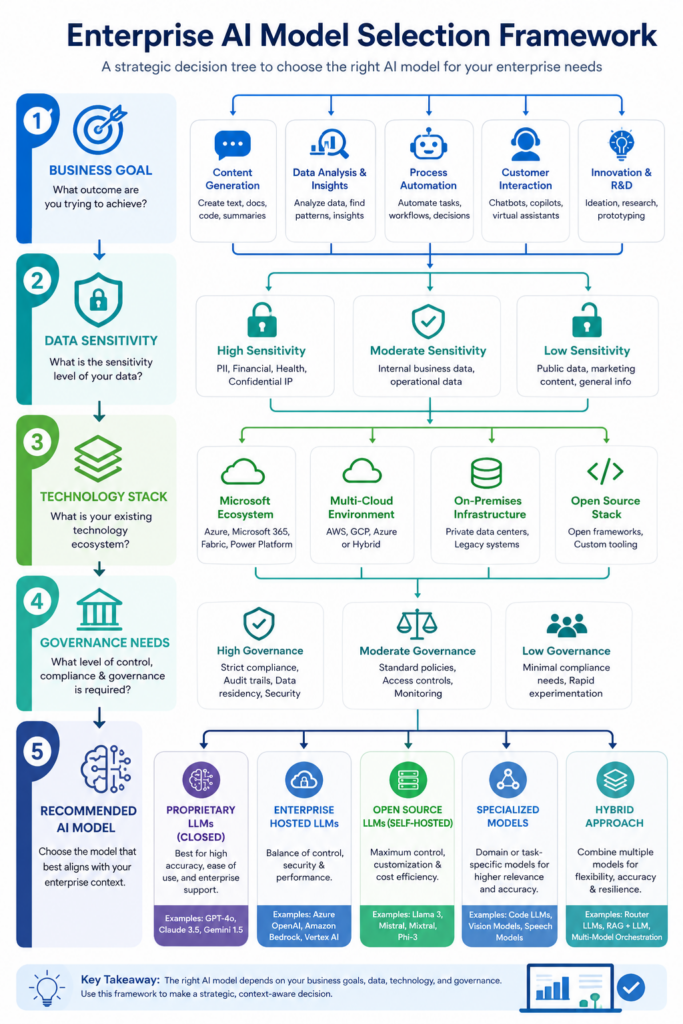
How to Choose the Right Generative AI Model for Your Enterprise
The best generative AI model depends on your business goals, not just benchmark scores. Evaluate models based on your primary use case—content generation, coding, customer support, research, or AI agents—along with factors such as accuracy, cost, security, scalability, and ease of integration with your existing technology stack. Enterprises should also consider multimodal capabilities, support for retrieval-augmented generation (RAG), customization options, and governance features to ensure the model delivers measurable business value while meeting compliance and performance requirements.
| Evaluation Factor | What to Consider |
|---|---|
| Business Use Case | Content, coding, research, customer support, multimodal tasks |
| Accuracy | Performance on enterprise-specific workloads |
| Cost | API pricing, inference costs, scalability |
| Security | Data privacy, compliance, deployment options |
| Integration | Compatibility with your AI stack and enterprise systems |
| Customization | Fine-tuning, RAG, function calling, agents |
Read our blog on AI-Ready Enterprise Checklist with Microsoft Fabric.
Enterprise Use Cases of Generative AI Models
The value of Generative AI Models lies in solving real business problems rather than generating content. Leading enterprises are embedding AI across core business functions to improve productivity, accelerate decision-making, and reduce operational costs.
Financial Services
Banks and insurance companies use AI to automate loan processing, summarize regulatory documents, detect fraud patterns, generate investment reports, and support customer service. AI also helps compliance teams review policies faster while reducing manual effort.
Best-fit models: GPT-5.5, Claude Opus 4.7
Healthcare and Life Sciences
Healthcare providers use multimodal AI to summarize patient records, assist clinical documentation, analyze medical images, accelerate drug discovery, and improve research workflows.
Best-fit models: Gemini 3.1 Pro, GPT-5.5
Manufacturing and Supply Chain
Manufacturers deploy AI to automate maintenance reports, optimize inventory, analyze quality inspection images, and generate supply chain risk assessments using structured and unstructured data.
Best-fit models: Gemini 3.1 Pro, DeepSeek V4
Retail and Customer Experience
Retailers leverage AI for personalized recommendations, dynamic pricing, customer support automation, product content generation, and demand forecasting.
Best-fit models: GPT-5.5, Gemini 3.1 Pro
Software Engineering
Development teams use AI to generate code, review pull requests, explain legacy applications, automate testing, and improve software delivery.
Best-fit models: Claude Opus 4.7, GPT-5.5
Read our blog on Microsoft Fabric AI Solutions for Enterprise Intelligence
Risks and Governance Considerations
Successful AI adoption requires governance as much as model performance.
Hallucinations
AI-generated outputs may contain inaccurate or fabricated information. Human validation remains essential for financial, legal, and healthcare decisions.
Data Privacy
Sensitive enterprise data should only be processed through governed AI environments with appropriate security controls and data residency policies.
Regulatory Compliance
Organizations must align AI deployments with GDPR, the EU AI Act, HIPAA, industry regulations, and internal governance frameworks.
Model Bias
Training data can introduce unintended bias. Enterprises should continuously monitor AI outputs and establish responsible AI review processes.
Vendor Lock-in
Selecting models with flexible deployment options and open architectures reduces long-term technology dependency.
Governance should be embedded into AI architecture from day one—not added after deployment.
Learn more about Gen AI integration in business from our insights shared in Integrating Generative AI into Business Operations: A Strategic Step-by-Step Approach
The Future of Generative AI Models (2026–2028)
Enterprise AI is evolving beyond copilots into autonomous, business-aware systems. Over the next few years, organizations should expect five major trends:
- AI Agents executing end-to-end business workflows.
- Multimodal AI becoming the enterprise standard.
- Open-weight models narrowing the gap with proprietary models.
- AI integrated natively into ERP, CRM, and analytics platforms.
- AI governance becoming a mandatory procurement requirement.
Future enterprise success will depend less on adopting the newest model and more on building scalable AI operating platforms supported by trusted data and governance.
Know more about Data Governance.
How Techment Helps Enterprises Adopt Generative AI
Technology alone does not deliver business value. Organizations need a clear AI strategy, trusted data, modern architecture, and governance to move from pilots to enterprise-scale adoption.
Techment partners with enterprises to design, implement, and optimize AI solutions that align with business objectives.
Our capabilities include:
- Enterprise AI strategy and roadmap
- AI readiness assessments
- Microsoft Fabric implementation
- Azure AI and Copilot solutions
- Retrieval-Augmented Generation (RAG)
- AI agents and workflow automation
- Data modernization and analytics
- Data governance and Microsoft Purview
- Responsible AI and compliance frameworks
- AI platform optimization and managed services
By combining cloud, data engineering, analytics, and AI expertise, Techment helps organizations build secure, scalable AI ecosystems that accelerate innovation while maintaining governance and operational control.
Build long-term data advantage for next-gen AI initiatives with Business Intelligence (BI) and Automation: Using Big Data to create
Conclusion
Generative AI has become a strategic enterprise capability. The leading Generative AI Models in 2026—GPT-5.5, Gemini 3.1 Pro, Claude Opus 4.7, Mistral Medium 3.5, and DeepSeek V4—each address different business priorities, from AI agents and multimodal intelligence to software engineering, data sovereignty, and cost optimization.
Rather than pursuing the most powerful model, enterprises should align AI investments with business goals, governance requirements, technology ecosystems, and long-term scalability. Organizations that combine modern data platforms, responsible AI practices, and enterprise architecture will achieve sustainable business value.
As a Microsoft Solutions Partner specializing in Data and AI, Techment helps enterprises accelerate AI adoption through strategy, data modernization, Microsoft Fabric, Azure AI, governance, and end-to-end implementation—enabling organizations to move confidently from AI experimentation to measurable business outcomes.
Frequently Asked Questions
1. Which Generative AI Model is best for enterprises?
There is no universal best model. GPT-5.5 excels in enterprise productivity, Gemini 3.1 Pro leads in multimodal AI, Claude Opus 4.7 is ideal for software engineering, Mistral Medium 3.5 supports data sovereignty, and DeepSeek V4 delivers cost-efficient AI at scale.
2. How should enterprises choose a Generative AI Model?
Evaluate business objectives, existing technology investments, governance requirements, integration capabilities, deployment flexibility, scalability, and total cost of ownership rather than benchmark scores alone.
3. Are open-weight AI models suitable for enterprises?
Yes. Models such as Mistral Medium 3.5 and DeepSeek V4 provide greater deployment flexibility, data sovereignty, and cost efficiency, making them attractive for regulated industries and private cloud environments.
4. Can organizations use multiple AI models?
Yes. Many enterprises adopt a multi-model strategy, selecting different models for software development, customer service, analytics, document intelligence, and AI agents based on workload requirements.
5. What is the biggest challenge in enterprise AI adoption?
The primary challenge is not model selection—it is ensuring trusted data, governance, integration, and organizational readiness to scale AI responsibly.
Related Reads
- Enterprise Data Quality Framework: Best Practices for Reliable Analytics and AI
- Essential Design Patterns in Modern Data Pipelines
- How to Assess Data Quality Maturity: Your Enterprise Roadmap
- AI-Powered Data Engineering: The Next Frontier for Enterprise Growth
- Data Validation in Pipelines: Ensuring Clean Data Flow for Strategic Impact