
Introduction
Enterprise AI adoption has shifted from experimentation to large-scale deployment. Yet, despite billions invested in AI platforms, many organizations struggle to scale beyond isolated use cases. The challenge is rarely the model—it’s the architecture.
AI architectures for enterprises have become the defining factor in whether AI delivers sustained business value or becomes another fragmented technology layer. According to McKinsey, over 70% of AI initiatives fail to scale due to poor integration, governance gaps, and architectural misalignment.
The reality is simple: deploying AI is easy; operationalizing it across an enterprise is not.
From centralized “AI brain” systems to distributed agent networks, enterprises are exploring multiple architectural patterns to balance control, agility, and innovation. Each model introduces trade-offs across scalability, compliance, performance, and organizational alignment.
This blog breaks down the 5 best AI architectures for enterprises, explaining how they work, where they fit, and what leaders must consider before committing. More importantly, it frames these architectures as strategic decisions, not just technical designs.
TL;DR Summary
- AI architectures for enterprises determine scalability, governance, and ROI
- Five dominant models: centralized, federated, mesh, layered, and hybrid
- No single architecture fits all—alignment with business structure is critical
- Hybrid architectures are emerging as the enterprise standard
- Governance, data access, and integration complexity define success
Why AI Architectures for Enterprises Matter More Than Ever
The Shift from Models to Systems Thinking
Early AI strategies focused heavily on algorithms and model performance. Today, the competitive advantage lies in how AI systems are structured, integrated, and governed across the enterprise.
Modern enterprises operate in highly distributed environments—multi-cloud ecosystems, hybrid data platforms, and decentralized teams. AI must operate seamlessly within this complexity.
This is where AI architectures for enterprises become critical. They determine:
- How AI accesses enterprise data
- How decisions are governed and audited
- How systems scale across departments
- How quickly new capabilities can be deployed
For deeper insights on enterprise AI strategy evolution, refer to our blog on enterprise strategy AI in 2026.
The Cost of Architectural Misalignment
Poor architectural decisions create long-term constraints:
- Data silos limiting AI effectiveness
- Security vulnerabilities in distributed systems
- Bottlenecks in centralized processing layers
- High integration costs across business units
According to IDC, enterprises lose up to 30% of potential AI value due to fragmented architectures.
Enterprise Reality: Complexity is Inevitable
Unlike startups, enterprises must balance:
- Regulatory compliance
- Legacy systems
- Organizational silos
- Global operations
This makes architectural choice less about “best technology” and more about organizational fit.
For a deeper perspective on data foundations enabling AI architectures, read our blog on Data Quality For AI.
1. Centralized AI Architecture: The Enterprise Brain
What is a Centralized AI Architecture?
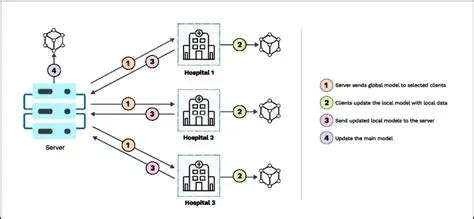
A centralized architecture consolidates all AI capabilities into a single control layer—often described as the “enterprise AI brain.”
All data processing, model execution, and decision orchestration flow through a central system.
How It Works
- Central AI platform manages all models
- Unified data access layer
- Standardized governance policies
- Centralized monitoring and control
Why Enterprises Choose It
This model mirrors traditional enterprise IT structures, making it easier to adopt.
Key Advantages:
- Strong governance and compliance control
- Simplified integration and monitoring
- Clear accountability and ownership
Enterprise Use Cases
- Financial services risk modeling
- Regulatory-heavy industries (healthcare, insurance)
- Centralized analytics platforms
Trade-Offs
While centralized systems offer control, they introduce limitations:
- Scalability bottlenecks as demand grows
- Single point of failure risks
- Reduced flexibility for business-specific needs
According to Gartner, centralized AI systems often struggle beyond enterprise-wide adoption thresholds due to performance constraints.
When It Works Best
- Organizations with strict compliance requirements
- Enterprises early in AI maturity
- Centralized decision-making cultures
For modern centralized data platforms enabling AI, also read our comprehensive guide on the Microsoft Fabric Architecture- A CTOs guide to modern analytics and AI.
2. Federated AI Architecture: Teams of Intelligence
What is a Federated AI Architecture?
Federated architecture distributes AI capabilities across business units while maintaining shared governance standards.
Each unit operates semi-independently but aligns with enterprise-wide protocols.
How It Works
- Local AI systems tailored to business needs
- Shared governance framework
- Interoperability standards across units
- Distributed data ownership
Diagram Suggestion:
Clustered architecture showing multiple AI nodes connected via governance layers.
Why Enterprises Are Adopting It
This model reflects how large organizations actually function—decentralized but coordinated.
Key Advantages:
- Faster innovation at the business unit level
- Domain-specific optimization
- Reduced central bottlenecks
Enterprise Use Cases
- Multinational corporations
- Retail and supply chain ecosystems
- Organizations with diverse business lines
Strategic Trade-Offs
Federated models introduce new complexities:
- Governance inconsistencies across units
- Increased coordination overhead
- Challenges in standardization
According to Accenture, federated AI models improve innovation speed by up to 40%, but increase governance complexity significantly.
When It Works Best
- Large enterprises with multiple divisions
- Organizations prioritizing agility
- Businesses with domain-specific AI needs
Explore the architectural, operational, and strategic differences between Multi-Agent Systems vs Single-Agent Architectures, helping you make informed decisions aligned with scalability, governance, and AI maturity.
3. Mesh AI Architecture: Fully Distributed Intelligence
What is a Mesh Architecture?
Mesh architecture represents a fully decentralized AI system where agents dynamically collaborate without centralized control.
Each AI component interacts autonomously, forming networks based on task requirements.
How It Works
- Peer-to-peer AI interactions
- Dynamic coalition formation
- Event-driven communication
- No fixed hierarchy
Diagram Suggestion:
Network graph showing interconnected AI nodes with no central hub.
Why It’s Conceptually Powerful
Mesh systems mimic natural intelligence systems—adaptive, resilient, and scalable.
Key Advantages:
- High flexibility and adaptability
- Natural scalability
- Strong resilience to system failures
Enterprise Reality Check
Despite its appeal, mesh architecture faces serious enterprise challenges:
- Governance complexity
- Unpredictable system behavior
- Difficulty in cost allocation and accountability
As highlighted in emerging enterprise AI discussions, fully autonomous mesh systems remain experimental in regulated industries.
Strategic Trade-Offs
- High monitoring requirements
- Increased security risks
- Lack of deterministic control
When It Works Best
- Niche domains with clear boundaries
- Innovation labs and R&D environments
- Smaller organizations with less regulatory burden
For scalable AI architectures grounded in real enterprise constraints, read our blog on AI ready Enterprise Checklist for Microsoft Fabric.
4. Layered AI Architecture: Structured Intelligence at Scale
What is a Layered AI Architecture?
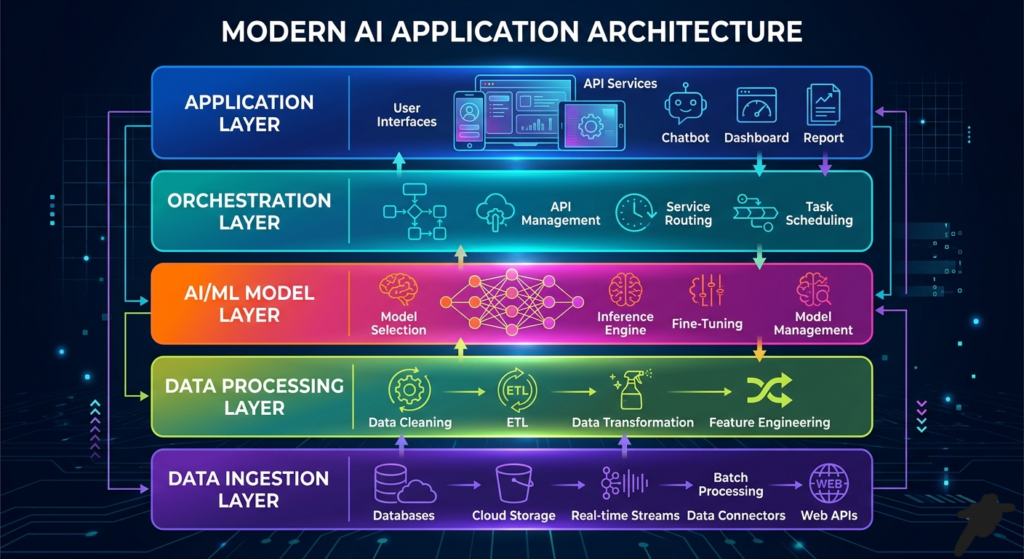
Layered architecture organizes AI systems into clearly defined tiers, each responsible for a specific function—data ingestion, processing, modeling, orchestration, and application.
This mirrors traditional enterprise software design, making it one of the most practical AI architectures for enterprises transitioning from legacy systems.
How It Works
- Data Layer: Ingests and standardizes enterprise data
- Processing Layer: Cleans, transforms, and enriches data
- Model Layer: Runs machine learning and AI models
- Orchestration Layer: Manages workflows and decision logic
- Application Layer: Delivers AI outputs to business users
Diagram Suggestion:
A vertical stacked diagram showing layers from data ingestion to business applications.
Why Enterprises Prefer It
This architecture provides clarity, control, and scalability—critical for regulated and process-driven industries.
Key Advantages:
- Clear separation of responsibilities
- Easier debugging and maintenance
- Scalable component-wise upgrades
- Strong alignment with enterprise IT governance
Enterprise Use Cases
- Banking and financial analytics platforms
- Healthcare diagnostics systems
- Enterprise data platforms like Microsoft Fabric
Strategic Trade-Offs
While structured, layered architectures introduce inefficiencies:
- Communication latency between layers
- Dependency risks across tiers
- Slower innovation compared to decentralized models
According to Microsoft, layered data architectures improve governance compliance by over 35%, but may slow real-time decision-making.
When It Works Best
- Enterprises prioritizing governance and reliability
- Organizations modernizing legacy systems
- Industries requiring auditability and traceability
To explore modern layered architectures in action, read our blog on What is Microsoft Fabric Comprehensive Overview.
5. Hybrid AI Architecture: The Enterprise Reality
What is a Hybrid AI Architecture?
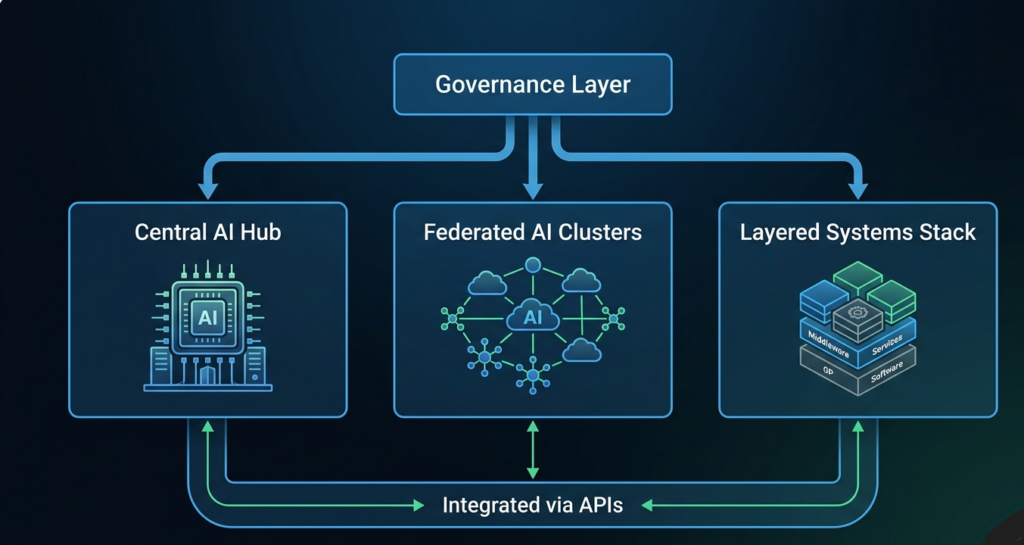
Hybrid architecture combines multiple AI architectural models—centralized, federated, and layered—into a unified ecosystem.
This is not just a design choice; it is the default outcome for most enterprises.
How It Works
- Centralized governance layer
- Federated execution across business units
- Layered infrastructure for scalability
- Selective mesh-like interactions for innovation
Diagram Suggestion:
A composite diagram blending hub-and-spoke, clusters, and layered stacks.
Why Hybrid is Becoming the Standard
Enterprises rarely operate in uniform environments. Different departments have:
- Different risk tolerances
- Different data maturity levels
- Different operational requirements
Hybrid architecture allows organizations to adapt without forcing standardization prematurely.
Key Advantages:
- Maximum flexibility
- Better alignment with business realities
- Enables gradual transformation
- Supports innovation without compromising governance
Strategic Trade-Offs
Hybrid systems are powerful—but complex:
- Integration challenges across models
- Increased governance overhead
- Higher implementation costs
According to McKinsey, hybrid AI architectures deliver the highest ROI when paired with strong governance frameworks.
When It Works Best
- Large enterprises with diverse operations
- Organizations scaling AI across multiple domains
- Businesses balancing innovation and compliance
For a deeper understanding of enterprise AI modernization, read our blog on Microsoft Azure for Enterprises for Cloud Ai Modernization.
Strategic Decision Framework: Choosing the Right AI Architecture
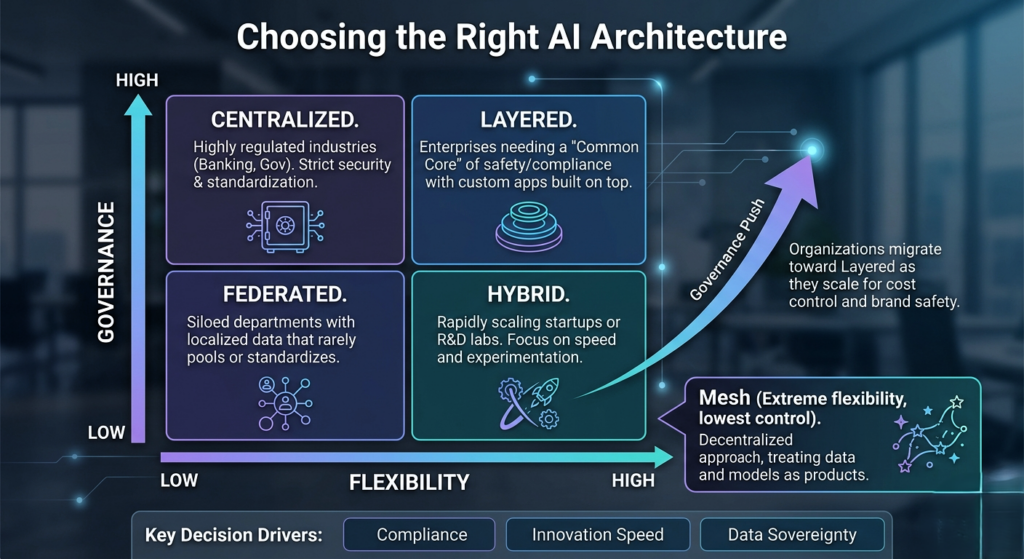
Aligning Architecture with Organizational Reality
Selecting the right AI architectures for enterprises is not a technical decision—it is a strategic one.
Leaders must evaluate:
- Organizational structure (centralized vs decentralized)
- Regulatory requirements
- Data maturity
- Innovation goals
- Talent availability
Key Decision Questions
- Do you prioritize control or agility?
- Is your organization centralized or distributed?
- How critical is regulatory compliance?
- What is your AI maturity level?
Enterprise Insight
There is no “best” architecture—only the best fit.
| Architecture Type | Governance Control | Scalability | Flexibility | Complexity | Best Fit Use Case |
|---|---|---|---|---|---|
| Centralized | High | Medium | Low | Low | Regulated industries (banking, healthcare) |
| Federated | Medium | High | Medium | Medium | Large enterprises with multiple business units |
| Mesh | Low | Very High | Very High | Very High | Experimental, R&D environments |
| Layered | High | High | Medium | Medium | Enterprises modernizing legacy systems |
| Hybrid | Balanced | Very High | High | High | Large-scale enterprise AI transformation |
Organizations that succeed:
- Start with one model
- Evolve toward hybrid
- Invest heavily in governance and data quality
Read our blog explores the most critical enterprise AI agent adoption challenges, including data readiness, governance complexity, orchestration issues, ROI ambiguity, and organizational resistance.
Implementation Roadmap: From Strategy to Execution
Phase 1: Foundation
- Establish data governance frameworks
- Standardize data pipelines
- Identify high-value AI use cases
Phase 2: Architecture Selection
- Map organizational structure to architecture model
- Define integration patterns
- Establish security protocols
Phase 3: Pilot and Scale
- Launch pilot projects
- Measure performance and ROI
- Expand across business units
Phase 4: Optimization
- Introduce automation
- Enhance monitoring and observability
- Continuously refine governance
Infographic Suggestion:
A 4-stage roadmap showing maturity progression from pilot to enterprise-scale AI.
To understand how enterprises can overcome these challenges, explore 7 Proven Strategies to Build Secure, Scalable AI with Microsoft Azure For implementation best practices.
How Techment Helps Enterprises
Enterprises navigating AI architectures for enterprises need more than tools—they need a strategic partner that understands the intersection of data, AI, and business transformation.
Techment enables organizations to move from fragmented AI initiatives to scalable, governed, and high-impact AI ecosystems.
Data Modernization & AI Readiness
Techment helps enterprises build robust data foundations through:
- Unified data platforms (Microsoft Fabric, Azure)
- Data quality frameworks for AI reliability
- Real-time data pipelines for scalable AI
To further understand how reliable data drives enterprise outcomes, refer to Designing Scalable Data Architectures for Enterprise Data Platforms.
Architecture Design & Implementation
Techment designs AI architectures tailored to enterprise realities:
- Centralized governance models
- Federated AI operating frameworks
- Hybrid architecture enablement
Layered Architecture For AI
Governance & Compliance
- End-to-end data governance frameworks
- AI model monitoring and explainability
- Compliance-ready architectures
End-to-End Execution
From strategy to optimization, Techment delivers:
- Roadmaps aligned with business outcomes
- Platform implementation and integration
- Continuous performance optimization
Techment positions AI not as a tool—but as a strategic enterprise capability.
Conclusion
AI success in the enterprise is no longer defined by models—it is defined by architecture.
The AI architectures for enterprises explored in this blog—centralized, federated, mesh, layered, and hybrid—each represent different approaches to balancing control, scalability, and innovation.
The future clearly points toward hybrid architectures, where organizations integrate multiple models to reflect real-world complexity.
However, architecture alone is not enough. Success requires:
- Strong data foundations
- Robust governance frameworks
- Continuous optimization
Enterprises that treat AI architecture as a strategic capability—not just a technical design—will be the ones that unlock sustained competitive advantage.
Techment stands as a trusted partner in this journey, helping organizations design, implement, and scale AI architectures that deliver measurable business impact.
FAQ Section
1. What is the best AI architecture for enterprises?
There is no single best model. Hybrid architectures are most common because they balance scalability, governance, and flexibility.
2. How do enterprises choose the right AI architecture?
By aligning architecture with organizational structure, data maturity, and regulatory requirements.
3. Are centralized AI architectures outdated?
No. They are still highly relevant for compliance-heavy industries but may limit scalability.
4. Is mesh architecture practical for enterprises?
Currently limited to niche or experimental use cases due to governance and predictability challenges.
5. How long does it take to implement enterprise AI architecture?
Typically 6–18 months depending on complexity, data readiness, and organizational scale.
Related Reads
- Data Management for Enterprises: Roadmap
- Enterprise Data Quality Framework: Best Practices for Reliable Analytics and AI
- Essential Design Patterns in Modern Data Pipelines
- How to Assess Data Quality Maturity: Your Enterprise Roadmap
- Data Migration
- Data Transformation
- Data Pipeline Engineering
- Data Cleansing & Cataloging
- Data Governance & Quality