

Artificial Intelligence is no longer a competitive advantage—it is rapidly becoming a baseline expectation for enterprise survival. Yet, despite heavy investments, most organizations remain stuck in fragmented pilots, struggling to translate AI ambition into measurable business outcomes.
This is where the AI readiness maturity model becomes indispensable.
It provides a structured way to evaluate not just whether AI exists in the organization—but whether it is scalable, governed, and strategically aligned. According to Gartner, over 80% of AI projects fail to scale beyond pilot stages due to poor data readiness, lack of governance, and unclear ownership models.
The challenge is not deploying AI—it is operationalizing it across the enterprise.
This blog breaks down a comprehensive, enterprise-grade AI readiness maturity model, inspired by leading frameworks and real-world transformation journeys. You’ll learn:
- The five stages of AI maturity
- How to assess your organization’s current position
- The architectural and governance implications at each stage
- Key risks, trade-offs, and decision points
- A practical roadmap to move from experimentation to enterprise-scale AI
TL;DR Summary
- The AI readiness maturity model helps enterprises assess their current AI capabilities and roadmap future growth
- Most organizations overestimate AI maturity but underestimate data and governance readiness
- AI transformation evolves through five stages—from awareness to agentic enterprise
- Data, governance, talent, and operating models are the true differentiators—not tools
- Enterprises that operationalize AI achieve 3–5x higher ROI than pilot-only adopters
Why the AI Readiness Maturity Model Matters for Enterprises
The Shift from AI Experimentation to Enterprise Value
Over the last decade, AI has evolved from niche experimentation to a strategic pillar. However, many enterprises still operate in disconnected pockets of AI innovation—data science teams building models without integration into business workflows.
This creates a critical disconnect:
- AI exists, but business impact is limited
- Models are built, but not deployed at scale
- Insights are generated, but not operationalized
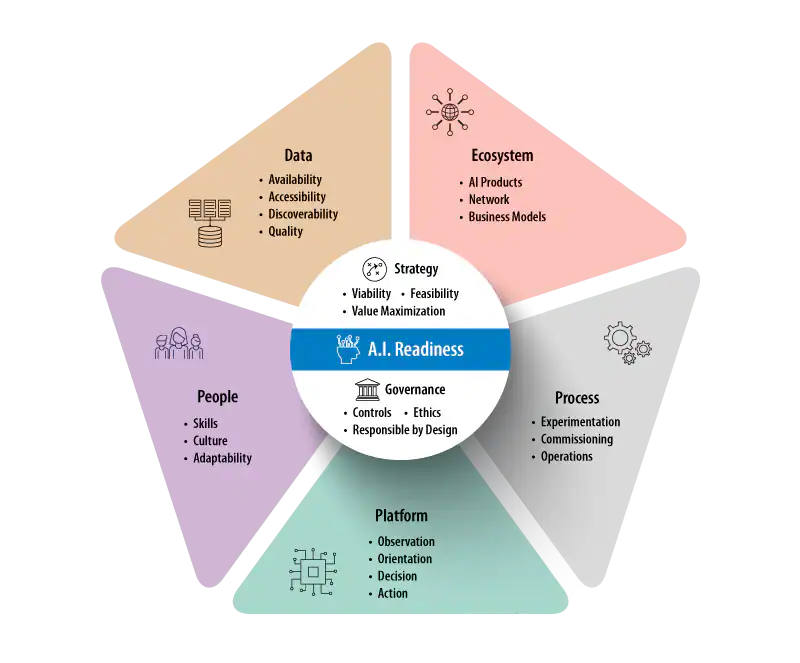
The AI readiness maturity model addresses this gap by aligning AI capabilities with enterprise strategy.
Read our blog on it for comprehensive understanding of the right enterprise AI strategy to follow in 2026.
The Cost of Misjudging AI Maturity
Many organizations assume they are “AI-ready” because they:
- Have data lakes
- Use machine learning models
- Invest in cloud platforms
But true maturity depends on deeper factors:
- Data quality and governance
- Integration into workflows
- Organizational alignment
- Ethical AI practices
According to McKinsey & Company, companies that fully integrate AI into operations see 20–30% higher operational efficiency gains compared to those stuck in pilot stages.
Enterprise Implications
Without a maturity model:
- AI investments become fragmented
- Governance risks increase
- ROI becomes difficult to measure
- Scaling becomes unpredictable
With a maturity model:
- AI becomes a repeatable capability
- Investments align with business value
- Risk is proactively managed
- Transformation becomes structured
What Defines AI Readiness?
AI readiness is not just about technology—it is a multi-dimensional capability across:
- Data infrastructure
- Governance frameworks
- Talent and culture
- Operating models
- Technology platforms
The AI readiness maturity model evaluates all these dimensions holistically.
Core Dimensions of AI Maturity
A robust AI maturity model is built on five foundational dimensions that collectively determine how effectively an organization can adopt, scale, and derive value from artificial intelligence. These dimensions go beyond technology—they reflect the organization’s ability to align data, people, processes, and strategy into a cohesive AI-driven ecosystem.
1. Data Readiness
Data is the backbone of any AI initiative, and its readiness directly impacts model performance and business outcomes. High-maturity organizations ensure strong data quality through standardized validation, cleansing, and enrichment processes. Equally important is data lineage—understanding where data originates, how it flows, and how it transforms across systems—which enhances trust and transparency. Accessibility is another critical factor; data should be available to the right stakeholders in a secure and governed manner. Leading enterprises invest in unified data architectures, such as data lakes or lakehouses, to eliminate silos and enable seamless integration. Additionally, real-time or near-real-time data capabilities are increasingly essential, allowing AI systems to respond dynamically to changing conditions and support time-sensitive decision-making.
2. Technology & Platforms
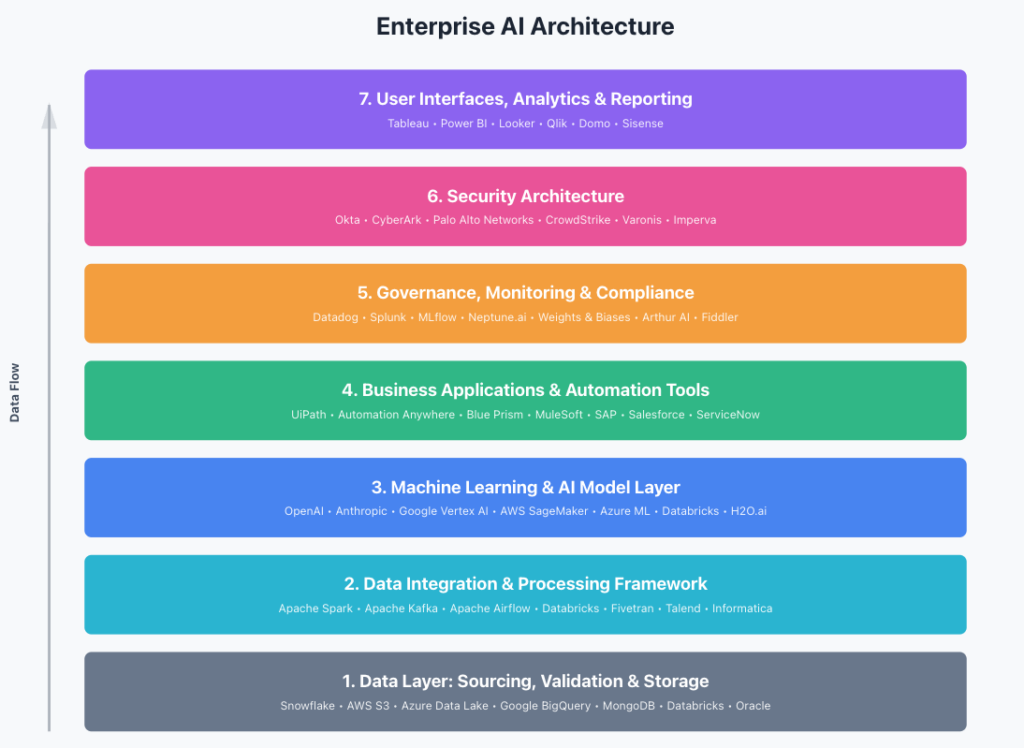
AI maturity requires a scalable and flexible technology foundation. This includes cloud-based infrastructure that supports high-performance computing, storage, and distributed processing. Mature organizations adopt advanced AI/ML platforms that streamline experimentation, deployment, and scaling of models. A key component is MLOps (Machine Learning Operations), which brings DevOps principles to AI—automating model training, testing, deployment, and monitoring to ensure consistency and reliability. Integration capabilities also play a vital role; AI systems must seamlessly connect with existing enterprise applications, APIs, and data pipelines. Organizations that excel in this dimension create modular, interoperable ecosystems that accelerate innovation and reduce time-to-market.
3. Governance & Risk
As AI adoption grows, so do concerns around ethics, compliance, and risk management. Mature organizations establish robust governance frameworks that define policies for responsible AI usage, including fairness, accountability, and transparency. Compliance with regulatory requirements—such as data privacy laws and industry standards—is embedded into AI workflows. Auditability ensures that decisions made by AI systems can be traced and explained, which is critical for building stakeholder trust. Continuous model monitoring is also essential to detect drift, bias, or performance degradation over time. By proactively managing these risks, organizations can scale AI confidently while minimizing legal and reputational exposure.
4. Talent & Culture
AI maturity is as much about people as it is about technology. Organizations must cultivate AI literacy across all levels—not just within data science teams, but also among business leaders and operational staff. This ensures that AI is understood, trusted, and effectively utilized. Cross-functional collaboration is another hallmark of maturity, bringing together domain experts, engineers, and analysts to co-create solutions. Equally important is change management; adopting AI often requires shifts in workflows, decision-making processes, and organizational mindset. Companies that invest in upskilling, knowledge sharing, and a culture of experimentation are better positioned to sustain long-term AI success.
5. Business Alignment
Ultimately, AI maturity is measured by business impact. Organizations must prioritize use cases that align with strategic objectives and deliver tangible value. This involves identifying high-impact opportunities, assessing feasibility, and sequencing initiatives effectively. ROI measurement is critical—tracking both financial and non-financial outcomes to justify investments and guide future decisions. Mature enterprises embed AI into their core business strategy, rather than treating it as a standalone initiative. This strategic integration ensures that AI drives competitive advantage, enhances customer experiences, and supports long-term growth.
Together, these five dimensions provide a comprehensive framework for assessing and advancing AI maturity, enabling organizations to move from experimentation to enterprise-wide transformation.
For modern centralized data platforms enabling AI, also read our comprehensive guide on the Microsoft Fabric Architecture- A CTOs guide to modern analytics and AI.
Why Most Frameworks Fail in Practice
Many maturity models fail because they:
- Focus too heavily on tools
- Ignore organizational complexity
- Lack actionable steps
The model presented here is execution-focused, bridging strategy and implementation.
Get a deep, enterprise-grade analysis of the 7 best AI data platforms in 2026, including a strategic comparison framework to make informed decisions.
The 5 Stages of the AI Readiness Maturity Model
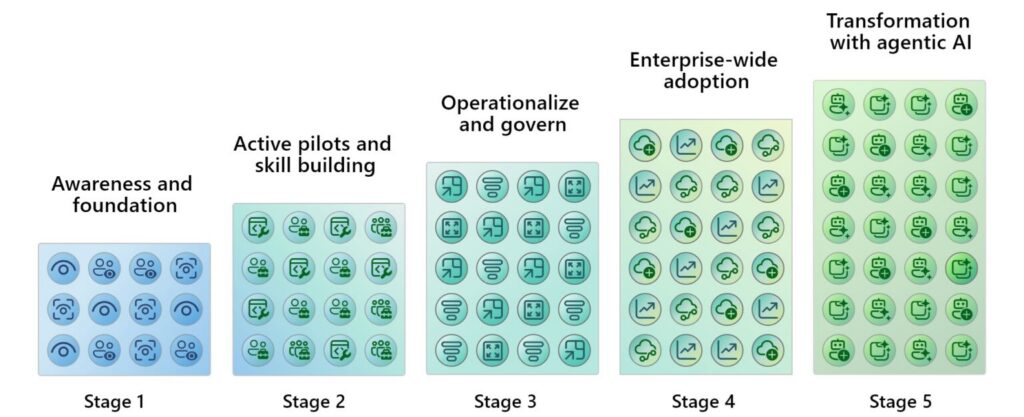
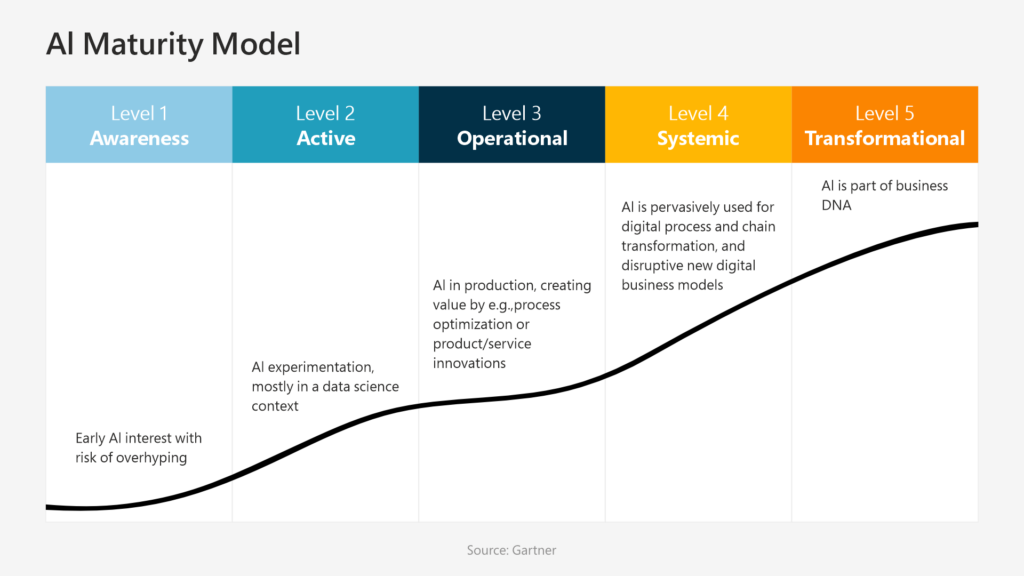
Stage 1: Awareness and Foundation
At this initial stage, organizations begin to recognize the transformative potential of AI but lack a structured roadmap to implement it effectively. Efforts are often exploratory, driven by curiosity rather than strategy.
Key characteristics:
- Isolated experiments across teams
- Limited executive sponsorship or alignment
- Absence of governance, policies, or ethical frameworks
Strategic insight:
This is where most enterprises begin—but it’s also where many stall. Without a clear direction, AI initiatives remain fragmented and fail to scale. Leading organizations, as highlighted by Microsoft, emphasize starting with clearly defined business outcomes rather than jumping into tools or technologies. Establishing a strong data foundation and aligning leadership early are critical to progressing beyond this stage.
Stage 2: Pilots and Capability Building
Organizations in this stage move from curiosity to experimentation. They begin deploying AI in targeted use cases, often within specific departments such as marketing, operations, or customer service.
Key characteristics:
- Multiple AI pilots across business units
- Initial upskilling and hiring of AI talent
- Early governance frameworks and data policies
Business impact:
- Measurable efficiency improvements in select areas
- Validation of AI’s potential through proof-of-concept projects
However, this stage introduces a significant risk: fragmentation. Without centralized coordination, organizations may end up with siloed solutions that are difficult to scale or integrate.
Stage 3: Operationalization
This stage marks a critical inflection point. AI transitions from isolated pilots to production-grade systems embedded within core business workflows.
Key characteristics:
- AI models integrated into day-to-day operations
- Establishment of MLOps pipelines for continuous deployment and monitoring
- Standardization of data platforms and architectures
Critical shift:
AI is no longer confined to innovation labs—it becomes part of how the business runs. Organizations start treating AI as a core capability, similar to cloud or cybersecurity. This requires robust infrastructure, governance, and cross-functional collaboration.
At this stage, success depends heavily on scalability, reliability, and the ability to operationalize insights in real time.
Stage 4: Enterprise-Scale Adoption
In this phase, AI is deeply embedded across the organization, influencing decisions at every level. The focus shifts from implementation to optimization and value realization.
Key characteristics:
- AI-driven decision-making across departments
- Strong alignment between business, technology, and data teams
- Continuous monitoring of model performance and business outcomes
Outcome:
AI delivers consistent, measurable value—whether through revenue growth, cost optimization, or enhanced customer experience. Organizations also begin to establish feedback loops, enabling continuous learning and improvement of AI systems.
This stage differentiates leaders from followers. Enterprises that reach this level are not just using AI—they are competing on AI.
Stage 5: AI-Driven Enterprise (Agentic Stage)
This is the most advanced and transformative stage of AI maturity. Organizations evolve into fully AI-driven enterprises, where intelligent systems operate autonomously and continuously optimize business processes.
Key characteristics:
- Deployment of autonomous AI agents capable of decision-making
- End-to-end workflow automation across complex systems
- Continuous optimization through real-time data and feedback loops
Future outlook:
According to IDC, by 2028, over 40% of enterprise workflows will involve AI-driven decision-making. This signals a shift toward “agentic AI,” where systems not only analyze data but also act on it independently.
At this stage, AI becomes a strategic differentiator and a core driver of innovation. Organizations are no longer asking how to use AI—they are redefining their business models around it.
Progressing through these stages is not just about adopting new technologies—it requires a fundamental shift in mindset, culture, and operating models. Enterprises that successfully navigate this maturity curve position themselves to unlock exponential value, while those that remain stuck in early stages risk falling behind in an increasingly AI-driven world.
Mapping Your Enterprise to the AI Maturity Curve
How to Assess Your Current Stage
To apply the AI readiness maturity model effectively, enterprises must conduct a structured assessment across dimensions.
Key questions:
- Is your data AI-ready or fragmented?
- Are AI models deployed or just built?
- Do you have governance frameworks in place?
- Is AI integrated into business workflows?
A Practical Assessment Approach
Step 1: Score each dimension
- Data
- Technology
- Governance
- Talent
- Business alignment
Step 2: Identify bottlenecks
Most enterprises find data and governance as limiting factors.
Step 3: Prioritize transformation areas
Focus on high-impact gaps rather than incremental improvements.
How Techment Helps Enterprises Accelerate AI Maturity
Techment partners with enterprises to move beyond fragmented AI initiatives and build scalable, governed, and value-driven AI ecosystems.
We focus on:
- Data modernization: Building unified, AI-ready data platforms
- AI readiness frameworks: Assessing and accelerating maturity stages
- Governance & compliance: Implementing responsible AI practices
- Platform engineering: Leveraging modern ecosystems like Microsoft Fabric and Azure
- End-to-end execution: From strategy to implementation to optimization
Learn how governance impacts AI success: Data Governance For Data Quality
Techment enables organizations to transition from AI experimentation to enterprise-scale transformation—ensuring measurable ROI and long-term sustainability.
Risks, Trade-offs, and Blind Spots in the AI Readiness Maturity Model
The Illusion of AI Maturity
One of the most dangerous pitfalls in enterprise AI transformation is the false perception of maturity. Many organizations equate:
- Cloud adoption with AI readiness
- Data lakes with data quality
- Pilot success with scalability
In reality, these are foundational signals—not indicators of maturity.
According to Accenture, only 12% of enterprises achieve AI maturity that delivers sustained business value, despite widespread adoption efforts.
Key Risks Across Maturity Stages
Stage 1–2 Risks (Exploration & Pilots):
- Fragmented use cases
- Shadow AI initiatives
- Lack of governance
Stage 3 Risks (Operationalization):
- Model drift and performance degradation
- Infrastructure scalability challenges
- Data inconsistencies
Stage 4–5 Risks (Enterprise & Agentic AI):
- Ethical and regulatory exposure
- Over-automation risks
- Lack of human oversight
Trade-offs Leaders Must Navigate
AI maturity is not linear—it involves strategic trade-offs:
Speed vs Governance
- Faster deployment increases risk
- Strong governance slows innovation
Centralization vs Agility
- Centralized control ensures consistency
- Decentralization enables innovation
Automation vs Human Control
- High automation improves efficiency
- Human oversight ensures accountability
Building an Enterprise AI Roadmap Using the AI Readiness Maturity Model
From Assessment to Action
The AI readiness maturity model becomes valuable only when translated into a clear, executable roadmap.
Phase 1: Establish Foundations
Key priorities:
- Define AI vision aligned with business outcomes
- Establish governance frameworks
- Assess data readiness
Enterprise outcome:
Clarity and alignment across leadership and teams
Phase 2: Pilot High-Impact Use Cases
Approach:
- Identify 5–10 high-value use cases
- Run controlled experiments
- Measure ROI and feasibility
Key insight:
Focus on business impact, not technical novelty
Phase 3: Build Scalable Infrastructur
Critical components:
- Unified data platforms
- MLOps pipelines
- Integration layers
To understand which would work better for your enterprise needs, read our blog on the Comparison between Snowflake vs Fabric.
Phase 4: Scale Across the Enterprise
Focus areas:
- Standardization of AI workflows
- Cross-functional collaboration
- Enterprise-wide governance
Phase 5: Drive Continuous Innovation
Future-ready enterprises:
- Continuously evolve AI capabilities
- Integrate agentic AI systems
- Optimize human-AI collaboration
The roadmap is not static—it must evolve alongside technology, regulations, and business priorities.
Designing the AI Operating Model for Scale
Why Operating Models Define Success
Technology enables AI—but operating models determine whether it scales.
Most enterprises fail not due to lack of tools, but due to:
- Unclear ownership
- Siloed teams
- Lack of accountability
The Future of AI Maturity: From Models to Autonomous Enterprises
The Rise of Agentic AI
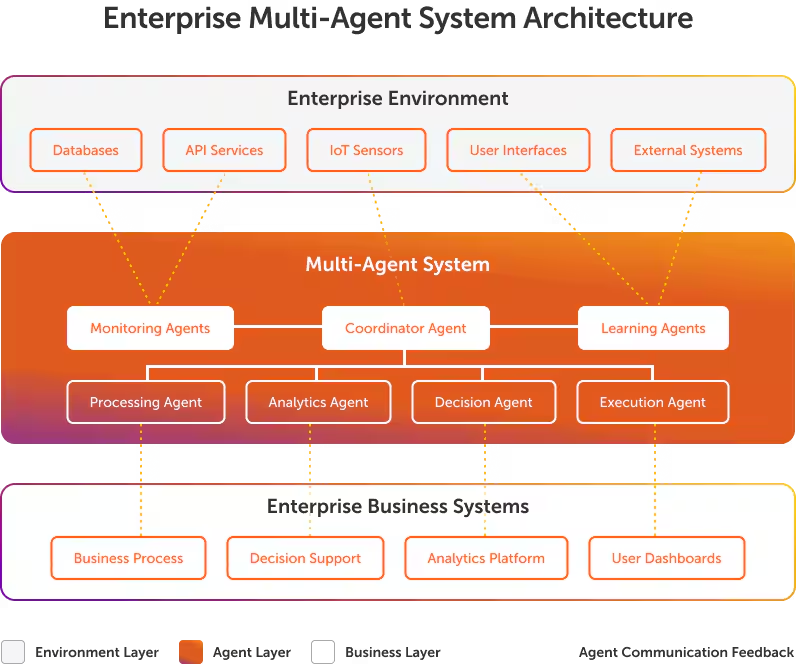
The next evolution of the AI readiness maturity model is the transition to agentic enterprises.
In this model:
- AI systems do not just assist—they act autonomously
- Workflows become self-optimizing
- Decision-making becomes data-driven and continuous
Conclusion: From AI Readiness to AI Leadership
The AI readiness maturity model is more than a framework—it is a strategic lens through which enterprises can evaluate their transformation journey.
The organizations that lead in AI are not those that adopt it first—but those that:
- Align AI with business strategy
- Build strong data foundations
- Embed governance and ethics
- Scale systematically
As AI continues to evolve toward autonomous systems, enterprises must move beyond experimentation and embrace structured, scalable transformation.
Techment stands as a strategic partner in this journey—helping organizations translate AI ambition into measurable, enterprise-wide impact.
FAQ: AI Readiness Maturity Model for Enterprises
1. What is an AI readiness maturity model?
It is a framework that helps organizations assess their AI capabilities across data, technology, governance, and business alignment.
2. How long does it take to reach AI maturity?
Typically 2–5 years, depending on starting point, investment, and organizational alignment.
3. What is the biggest barrier to AI maturity?
Data quality and governance—not technology.
4. Can small teams achieve AI maturity?
Yes, with the right architecture and prioritization, even smaller teams can scale AI effectively.
5. How do you measure AI maturity?
Through metrics such as:
Number of production AI use cases
Business impact (ROI)
Data quality scores
Governance compliance
Related Reads
- 12 Proven RAG Optimization Techniques for Production
- 5 Proven RAG Best Practices to Build Production-Ready Enterprise AI Systems
- Migrating from Azure Data and AI Stack to Microsoft Fabric
- Enterprise Data Access Control Model for Unified Analytics and AI Security
- AI Strategy Consulting: Frameworks, Benefits, and Enterprise Best Practices
- What Is Microsoft Fabric? A Comprehensive Overview for Enterprise Leaders
- Microsoft Fabric vs Snowflake: A Data Management Showdown
- AI-Ready Enterprise Checklist with Microsoft Fabric