
Introduction
Enterprise data platforms are under unprecedented pressure. As organizations scale analytics, AI, and real-time decision-making, the underlying data pipelines often become the weakest link—fragile, inconsistent, and difficult to govern.
This is where medallion architecture has emerged as a foundational design pattern in modern data engineering. Instead of treating data pipelines as linear flows, medallion architecture introduces a layered approach—bronze, silver, and gold—where data progressively improves in quality, structure, and business value.
For CTOs, CDOs, and data leaders, the importance of medallion architecture goes beyond technical elegance. It directly impacts data trust, AI model accuracy, operational efficiency, and governance maturity.
In this blog, we will take a deep, enterprise-focused look at medallion architecture—explaining how bronze, silver, and gold data layers work, why traditional pipelines fail, and how organizations can implement scalable, governed data platforms that support analytics and AI at scale.
TL;DR Summary
- Medallion architecture structures data pipelines into bronze (raw), silver (clean), and gold (curated) layers
- It solves common enterprise data challenges like poor quality, lack of lineage, and pipeline fragility
- Each layer introduces control, improving governance, trust, and scalability
- Critical for AI/ML readiness and enterprise analytics at scale
- Requires thoughtful implementation to balance performance, cost, and complexity
Why Traditional Data Pipelines Fail at Scale
Modern enterprises rarely struggle due to lack of tools. Instead, failures in data pipelines are almost always structural.
The Hidden Structural Problem in Data Engineering
Most traditional pipelines evolve organically. Teams ingest data, transform it for immediate use, and expose it directly to analytics systems. Over time, this creates tightly coupled systems where ingestion, transformation, and consumption are deeply intertwined.
This lack of separation introduces systemic fragility.
According to industry perspectives from Gartner and McKinsey, poor data quality and pipeline instability are among the top reasons AI initiatives fail in enterprises. The issue is not the absence of data—but the inability to trust and operationalize it.
As highlighted in enterprise AI strategy discussions , organizations that underestimate this complexity often face delays, cost overruns, and scalability challenges.
Common Failure Patterns
Tight Coupling Between Systems
When ingestion pipelines directly feed dashboards or machine learning systems, any upstream change breaks downstream consumers.
Schema Volatility
Uncontrolled schema changes propagate errors across the pipeline, leading to failed jobs and inconsistent reporting.
Duplicate and Inconsistent Data
Without controlled transformation stages, multiple versions of “truth” emerge across teams.
Lack of Traceability
When data transformations are not layered, tracing errors back to their source becomes complex and time-consuming.
Enterprise Impact
These issues are not just technical—they translate directly into business risk:
- Inaccurate executive dashboards
- Failed AI models due to poor training data
- Increased operational costs from firefighting pipelines
- Delayed decision-making
Why Medallion Architecture Solves This
Medallion architecture introduces intentional separation of concerns.
Each layer—bronze, silver, gold—has a defined responsibility. This decoupling ensures that:
- Raw data is preserved independently
- Transformations are controlled and repeatable
- Business logic is isolated from ingestion
This structural clarity is what enables scalability—not just in data volume, but in organizational complexity.
What Is Medallion Architecture in Data Engineering?
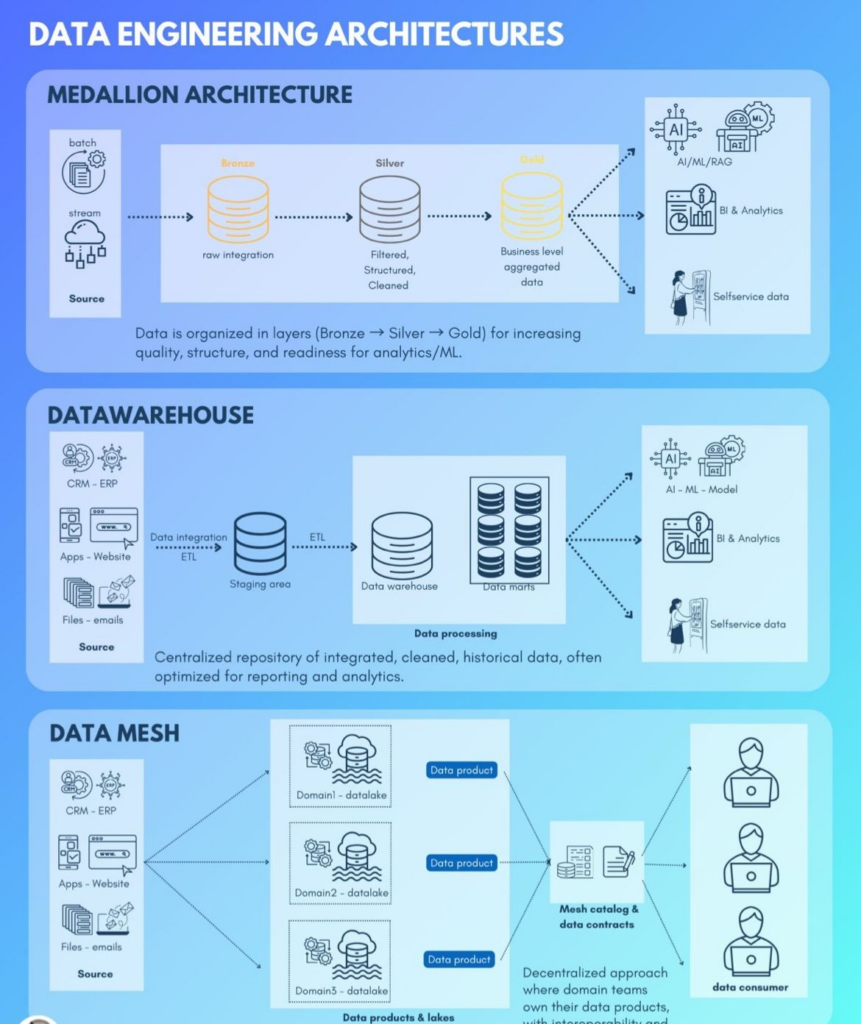
Medallion architecture is a layered data design pattern that organizes data pipelines into three progressive stages: bronze, silver, and gold.
Rather than exposing raw data directly to analytics systems, it introduces controlled transformation layers that improve data reliability, traceability, and usability.
The Core Concept
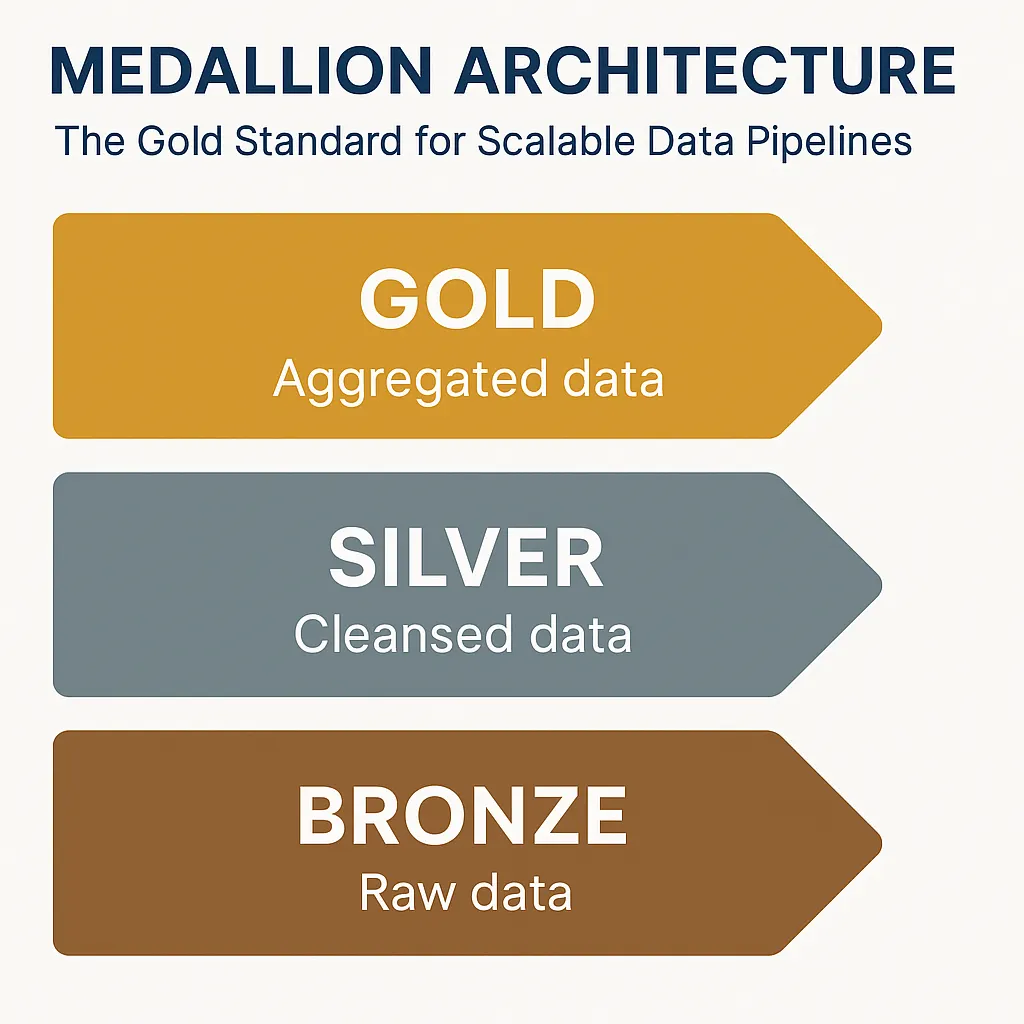
At its core, medallion architecture is about progressive refinement.
- Bronze: Raw, unprocessed data
- Silver: Cleaned and standardized data
- Gold: Business-ready, curated datasets
Each stage represents a higher level of data quality and alignment with business use cases.
Why This Matters for Enterprises
Enterprises deal with:
- Multiple data sources (ERP, CRM, IoT, third-party APIs)
- Diverse data formats (structured, semi-structured, unstructured)
- Multiple consumers (analysts, data scientists, applications)
Without a structured approach, this complexity becomes unmanageable.
Medallion architecture provides a scalable blueprint that aligns technical design with business outcomes.
For a broader perspective on modern data platform evolution, explore
Alignment with Modern Data Platforms
Medallion architecture is widely adopted in:
- Data lakehouse platforms
- Cloud-native data ecosystems
- AI and analytics pipelines
It complements technologies like distributed processing engines, columnar storage formats, and metadata-driven governance systems.
Key Design Principles
Separation of Concerns
Each layer handles a specific responsibility.
Data Lineage and Traceability
Every transformation is traceable across layers.
Reusability
Intermediate datasets (silver layer) can be reused across multiple use cases.
Scalability
The architecture scales horizontally across data domains and teams.
Strategic Insight
Medallion architecture is not just a technical pattern—it is an operating model for data.
It enables organizations to move from:
- Data chaos → structured pipelines
- Reactive analytics → proactive intelligence
- Fragmented governance → unified control
Bronze, Silver, Gold Layers Explained in Detail
Understanding the nuances of each layer is critical for implementing medallion architecture effectively.
Bronze Layer: The Raw Data Foundation
The bronze layer is the entry point of the pipeline. It ingests data from source systems with minimal or no transformation.
Key Characteristics
- Stores data in its original format
- Captures ingestion timestamps
- Preserves full data fidelity
- Supports schema evolution
Why Raw Data Matters
Many organizations underestimate the importance of retaining raw data.
The bronze layer acts as a system of record, enabling:
- Replay of data pipelines
- Debugging and root cause analysis
- Recovery from transformation errors
Enterprise Implications
For regulated industries, retaining raw data is essential for compliance and auditability.
It also supports advanced use cases like:
- Historical reprocessing
- Model retraining
- Data lineage tracking
Bronze vs Silver vs Gold Comparison Table
| Layer | Purpose | Data State | Key Operations | Consumers |
|---|---|---|---|---|
| Bronze | Raw ingestion | Unprocessed | Ingest, store as-is, capture metadata | Data engineers |
| Silver | Data refinement | Cleaned & standardized | Deduplication, validation, transformation | Analysts, data scientists |
| Gold | Business-ready data | Aggregated & curated | KPI modeling, aggregation, enrichment | Business users, AI systems |
Common Mistakes
Over-transforming data too early
Introducing transformations in the bronze layer reduces flexibility and increases risk.
Skipping metadata capture
Without proper metadata, traceability is compromised.
Silver Layer: The Data Quality Engine
The silver layer is where data becomes reliable and structured.
Key Transformations
- Deduplication
- Handling missing values
- Standardizing formats
- Schema enforcement
Why Silver Layer Is Critical
This is the layer where data quality is enforced.
Without a robust silver layer:
- Data inconsistencies propagate downstream
- Analytics becomes unreliable
- AI models produce inaccurate results
Enterprise Perspective
The silver layer enables cross-functional consistency.
Different teams can rely on standardized datasets without redefining transformations independently.
The silver layer is often the most underestimated—and the most critical. It is the foundation of trust in enterprise data platforms.
Gold Layer: Business-Ready Intelligence
The gold layer delivers curated datasets aligned with business needs.
Examples
- Customer 360 views
- Revenue and KPI dashboards
- Machine learning feature tables
Example: Customer 360 Pipeline Table (Enterprise Use Case)
| Layer | Example Data | Transformation | Output |
|---|---|---|---|
| Bronze | CRM records, website logs, transaction data | Raw ingestion | Source-level datasets |
| Silver | Cleaned customer profiles | Deduplication, normalization | Unified customer records |
| Gold | Customer 360 view | Aggregation, enrichment | Customer insights for analytics & AI |
Key Characteristics
- Aggregated and optimized datasets
- Business logic applied
- Performance-optimized for consumption
Why Gold Layer Drives Value
This is where data becomes actionable.
Executives, analysts, and applications consume gold-layer data to:
- Make strategic decisions
- Monitor performance
- Train AI models
Enterprise Risks
Poor data modeling
Misaligned KPIs lead to inconsistent reporting across teams.
Over-customization
Too many variations of gold datasets reduce standardization.
Strategic Insight
The gold layer should represent a single version of truth aligned with business definitions.
How Layered Data Architecture Improves Data Quality and Governance
One of the most significant advantages of medallion architecture is its impact on governance and data quality.
Control Points Across Layers
Each layer introduces a control mechanism:
- Bronze → Traceability
- Silver → Data quality enforcement
- Gold → Business alignment
This layered control is what enables enterprise-grade governance.
Data Lineage and Observability
With medallion architecture, organizations can trace:
- Where data originated
- How it was transformed
- Which systems consumed it
This is critical for:
- Regulatory compliance
- Debugging
- Trust in analytics
Governance at Scale
As organizations scale, governance becomes exponentially complex.
Medallion architecture simplifies this by:
- Isolating transformation stages
- Enforcing schema contracts
- Enabling role-based access control
Enterprise Impact
- Improved data trust
- Reduced operational risk
- Faster issue resolution
- Better alignment across teams
For a deeper dive into governance strategies, refer to Data Governance for Data Quality: Future-Proofing Enterprise Data
Medallion Architecture vs Other Data Architecture Patterns
Governance is not a layer—it is embedded across layers in medallion architecture.
| Architecture Type | Best For | Limitation |
|---|---|---|
| Medallion | Scalable pipelines | More layers = more management |
| Data Warehouse | Structured reporting | Limited flexibility |
| Data Mesh | Domain ownership | High organizational complexity |
Step-by-Step Implementation of Medallion Architecture
Designing medallion architecture is straightforward conceptually—but executing it at enterprise scale requires rigor, governance alignment, and architectural discipline.
Step 1: Design Data Flow Across Bronze, Silver, Gold
The first step is defining how data moves across layers.
Typical enterprise flow:
- Source systems → Bronze (raw ingestion)
- Transformation pipelines → Silver (cleaned, standardized)
- Aggregation & modeling → Gold (business-ready datasets)
This flow must be explicitly documented, not implicitly assumed.
A common mistake is allowing teams to bypass layers under delivery pressure. This breaks the architecture and reintroduces fragility.
For a broader perspective on cloud and AI modernization, explore: Microsoft Azure for Enterprises: Cloud AI Modernization
Step 2: Establish Data Contracts Early
Data contracts define expectations between producers and consumers.
They include:
- Schema definitions
- Data types and formats
- SLA expectations
- Validation rules
Without data contracts, schema drift becomes inevitable.
Step 3: Build Robust Transformation Pipelines
Transformation pipelines operationalize the silver layer.
They should:
- Be modular and reusable
- Include validation checkpoints
- Support incremental processing
This is where distributed data processing frameworks play a critical role.
Step 4: Optimize for Performance and Scalability
Enterprise data pipelines must handle:
- High data volume
- Concurrent workloads
- Complex transformations
Optimization strategies include:
- Partitioning large datasets
- Using columnar storage formats
- Avoiding full table scans
Step 5: Implement Governance and Observability
Governance must be embedded—not added later.
Key capabilities include:
- Data lineage tracking
- Quality monitoring
- Access control per layer
For AI readiness strategies, refer to: Fabric AI Readiness: How to Prepare Your Data for Scalable AI Adoption
How Medallion Architecture Enables AI and Advanced Analytics
AI success depends on one thing: data quality and consistency.
Medallion architecture directly addresses this requirement.
Structured Data for Machine Learning
AI models require:
- Clean, consistent datasets
- Repeatable transformations
- Versioned data pipelines
The silver and gold layers provide exactly this.
Standardized Feature Engineering
Feature engineering becomes more scalable when:
- Data is standardized (silver layer)
- Business logic is centralized (gold layer)
This reduces duplication across data science teams.
Improved Model Accuracy and Reliability
Poor data leads to:
- Biased models
- Inaccurate predictions
- Failed deployments
Medallion architecture ensures models are trained on validated datasets.
According to Accenture and McKinsey insights, organizations with strong data foundations outperform peers significantly in AI adoption success.
For AI readiness strategies, explore Fabric AI Readiness: How to Prepare Your Data for Scalable AI Adoption:
Performance and Cost Considerations
Medallion architecture introduces both benefits and trade-offs.
Benefits
- Reduced query complexity
- Improved data reuse
- Better pipeline stability
- Faster analytics performance
Costs
- Increased storage across layers
- Additional processing overhead
- More orchestration complexity
Performance vs Cost Trade-Off Table
| Factor | Impact | Optimization Strategy |
|---|---|---|
| Storage Cost | Higher due to multiple layers | Use compression and lifecycle policies |
| Processing Cost | Increased transformations | Implement incremental processing |
| Query Performance | Improved at Gold layer | Optimize partitions and indexing |
| Pipeline Complexity | Higher orchestration overhead | Use modular pipeline design |
Optimization Strategies
Incremental Processing
Avoid reprocessing entire datasets.
Efficient Storage Formats
Use optimized formats to reduce cost and improve performance.
Data Partitioning
Improve query efficiency.
Strategic Insight
Cost is not eliminated—it is shifted and optimized.
Enterprises must balance:
- Performance
- Scalability
- Cost efficiency
When to Use (and Not Use) Medallion Architecture
Not every organization needs medallion architecture.
Use It When
- You have multiple data sources
- Data quality is inconsistent
- You support analytics and AI workloads
- Governance and lineage are critical
Avoid or Reconsider When
- Data volume is very small
- Pipelines are simple and static
- Ultra-low latency is required
Medallion architecture is a strategic investment, not a default choice.
How Techment Helps Enterprises Implement Medallion Architecture
Implementing medallion architecture at scale requires more than technical knowledge—it requires alignment across data strategy, governance, and execution.
Techment supports enterprises through:
Data Strategy and Architecture Design
- Define scalable medallion architecture aligned with business goals
- Design data flow, contracts, and governance models
Data Modernization and Platform Implementation
- Implement lakehouse and modern data platforms
- Build bronze, silver, gold pipelines using scalable frameworks
Explore Microsoft Fabric Architecture: CTO’s Guide to Modern Analytics & AI
Data Quality and Governance
- Establish enterprise-grade data quality frameworks
- Implement governance, lineage, and observability
For a deeper roadmap on modern data platform transformation, explore: What is Microsoft Fabric? Comprehensive Overview
AI and Analytics Enablement
- Prepare data for AI/ML workloads
- Build scalable feature engineering pipelines
- Enable unified analytics
Explore Microsoft Fabric AI Solutions for Enterprise Intelligence
Techment acts as a strategic partner, helping enterprises move from fragmented pipelines to governed, scalable data platforms.
Conclusion
Medallion architecture is not just a data engineering pattern—it is a strategic foundation for enterprise data platforms.
By structuring data into bronze, silver, and gold layers, organizations gain:
- Improved data quality
- Stronger governance
- Scalable analytics and AI capabilities
As enterprises continue to invest in AI and real-time intelligence, the importance of structured, reliable data pipelines will only increase.
Medallion architecture provides the blueprint.
For organizations looking to operationalize data at scale, the question is no longer whether to adopt layered architecture—but how effectively it can be implemented.
Techment brings the expertise, frameworks, and execution capability to help enterprises make that transition with confidence.
FAQ
1. What is medallion architecture in data engineering?
Medallion architecture is a layered data design pattern that organizes data into bronze (raw), silver (cleaned), and gold (curated) stages to improve scalability and reliability.
2. What are bronze, silver, and gold data layers?
They represent progressive stages of data refinement—raw ingestion, standardized data, and business-ready datasets.
3. How does medallion architecture improve data quality?
By isolating transformation stages and enforcing validation at each layer, ensuring consistent and reliable data.
4. When should enterprises adopt medallion architecture?
When dealing with complex pipelines, multiple data sources, or AI and analytics workloads.
5. What are the limitations of medallion architecture?
It introduces additional storage, processing overhead, and architectural complexity.