

RAG for insurance combines retrieval-augmented generation with insurance policy documents, claims files, guidelines, correspondence, and enterprise data so AI can generate answers grounded in current evidence. For claims teams, this can reduce the time spent searching documents, comparing coverage rules, summarizing evidence, and preparing claim assessments—while keeping human professionals involved in consequential decisions.
Insurance claims are information-intensive by nature. A single claim can involve policy wording, endorsements, FNOL records, medical documents, repair estimates, invoices, adjuster notes, correspondence, photographs, previous claims, regulatory requirements, and internal claims procedures.
The problem is not necessarily a lack of data.
It is the time required to find the right information, establish which version is authoritative, connect evidence across documents, and apply it consistently.
That makes claims processing a strong candidate for Retrieval-Augmented Generation (RAG).
RAG allows an LLM to retrieve relevant enterprise information at query time and use that information as grounding context before generating an answer. Modern RAG systems can also attach citations, apply metadata filters, combine keyword and vector retrieval, and use multi-step or agentic retrieval for complex questions.
The important distinction is this:
RAG does not have to replace the claims adjuster. It can remove the information-search burden surrounding the adjuster.
That distinction matters because insurance AI operates in a regulated environment where accuracy, explainability, privacy, fairness, and auditability are critical. The NAIC’s AI guidance explicitly highlights risks including inaccuracy, unfair discrimination, data vulnerability, and lack of transparency and explainability.
TL;DR: RAG for Insurance Claims
- RAG retrieves relevant insurance information before an LLM generates an answer.
- It can ground claims responses in policy wording, endorsements, claim documents, procedures, guidelines, and correspondence.
- Claims adjusters can use RAG to find coverage clauses, summarize claim evidence, identify missing documents, and prepare assessment notes faster.
- Citations and source references make RAG more auditable than relying on an LLM’s pretrained knowledge alone.
- RAG does not eliminate hallucinations; poor retrieval can still produce incorrect answers.
- Metadata filtering, hybrid search, reranking, document versioning, and access controls are critical in production.
- RAG is particularly useful when insurance knowledge is large, fragmented, proprietary, and frequently updated.
- Fine-tuning and RAG solve different problems: RAG supplies current knowledge; fine-tuning primarily changes model behavior or task performance.
- Human-in-the-loop controls should remain around high-impact claims decisions.
- The strongest enterprise architecture combines RAG + document intelligence + enterprise systems + workflow orchestration + governance + observability.
What Is RAG for Insurance?
RAG for insurance is an AI architecture that retrieves relevant insurance documents and enterprise data at query time and provides that information to an LLM as context for generating a response. In claims processing, this allows AI to answer questions using current policy terms, claim evidence, procedures, and guidelines rather than relying only on information encoded in the model.
Traditional generative AI has a fundamental limitation for insurance.
An LLM may know what insurance is, but it does not automatically know:
- The latest version of a specific policy
- A customer’s exact endorsements
- A claim’s current status
- An internal claims procedure
- A newly revised claims guideline
- The latest repair estimate
- Which document superseded an earlier document
- Company-specific coverage rules
- Internal escalation requirements
RAG addresses this by adding a retrieval layer between the user’s question and the model.
A simplified insurance RAG flow
Claims / Policy Data
        ↓
Document Processing
        ↓
Chunking + Metadata + Embeddings
        ↓
Search / Retrieval Layer
        ↓
Relevant Policy + Claim Evidence
        ↓
LLM / Generative AI
        ↓
Grounded Answer + Citations
        ↓
Claims Adjuster / Employee
        ↓
Human Decision + Workflow
Microsoft describes the core RAG pattern as retrieve → augment → generate: retrieve relevant content, add it to the model’s context, and generate a response grounded in that content.
For insurance, however, the architecture needs another layer:
retrieve → validate → ground → cite → review → act
That additional control layer is what turns a generic RAG demonstration into an enterprise insurance capability.
Read our blog on RAG in 2026: How Retrieval-Augmented Generation Works for Enterprise AI
Why Is RAG Important for Insurance Claims Processing?
RAG matters for insurance claims because claims teams must combine information from large volumes of structured and unstructured sources, often under time pressure. Retrieval-augmented AI can reduce manual searching and summarization by bringing relevant policy clauses, claim evidence, correspondence, and procedures into the adjuster’s workflow with source references.
The underlying industry need is already significant.
According to the NAIC’s current insurance AI overview, 88% of responding private passenger auto insurers, 70% of home insurers, 58% of life insurers, and 92% of responding health insurers reported that they use, plan to use, or plan to explore AI/ML models in their operations.
Claims is one of the most information-heavy areas where this adoption can translate into operational value.
Consider a health claim.
An adjudicator may need to review:
- Policy terms
- Member eligibility
- Hospital discharge summary
- Medical bills
- Lab reports
- Treatment information
- Previous correspondence
- Applicable treatment guidelines
- Internal adjudication rules
- Fraud or anomaly indicators
The information may exist.
The challenge is finding, connecting, interpreting, and validating it quickly.
This is where RAG fits.
How Does RAG Work in Insurance Claims Processing
A production insurance RAG workflow typically ingests claims and policy documents, extracts and normalizes their content, creates searchable representations, retrieves relevant evidence for a claim-related question, and passes that evidence to an LLM. The model then generates a response that should remain grounded in retrieved sources and expose citations or provenance for review.
Step 1: Collect insurance data
A claims RAG system may connect to:
- Core insurance platforms
- Claims management systems
- Policy administration systems
- CRM platforms
- Document management systems
- Data lakes
- Data warehouses
- Email and correspondence repositories
- SharePoint or enterprise content repositories
- Regulatory and compliance repositories
- Claims notes
- Medical records
- Repair estimates
- Invoices
- Police reports
- Photographs and scanned documents
The goal is not necessarily to move everything into one database.
The goal is to make authorized information retrievable in context.
Step 2: Process documents
Insurance information is rarely stored as clean text.
It can arrive as:
- PDFs
- Scanned forms
- Images
- Word documents
- Emails
- Tables
- Handwritten notes
- Invoices
- Spreadsheets
- Audio transcripts
- Structured database records
Document intelligence and OCR can convert these sources into machine-readable content.
This is particularly important for claims because relevant evidence may be buried inside attachments rather than stored as searchable database fields.
AWS’s recent claims RAG implementation, for example, describes claims information distributed across adjuster diary entries, repair estimates, police reports, payment ledgers, and scanned attachments.
Step 3: Chunk and enrich the content
Large documents are usually divided into smaller retrieval units called chunks.
For insurance, generic chunking is often insufficient.
A better approach is to preserve business context such as:
| Metadata | Example |
|---|---|
| Claim ID | CLM-102845 |
| Policy ID | POL-45821 |
| Document type | Policy endorsement |
| Line of business | Auto |
| Effective date | 2026-04-01 |
| Expiry date | 2027-04-01 |
| Customer ID | CUST-7781 |
| Document version | V3 |
| Region | California |
| Source system | Policy Admin |
| Confidentiality | Restricted |
This metadata becomes critical during retrieval.
For example, the query:
“Is windshield damage covered?”
should not retrieve an outdated policy belonging to another customer.
What Data Should Be Included in an Insurance RAG Knowledge Base?
An insurance RAG knowledge base should contain authoritative, permission-controlled sources that directly support the workflow, including current policy wordings, endorsements, claims documents, procedures, guidelines, correspondence, and relevant structured claim data. Source ownership, effective dates, document versions, and access permissions should be preserved as retrieval metadata.
Typical sources include:
Policy information
- Policy contracts
- Terms and conditions
- Endorsements
- Exclusions
- Coverage limits
- Deductibles
- Riders
- Amendments
Claims information
- FNOL records
- Adjuster notes
- Claim forms
- Damage assessments
- Repair estimates
- Medical bills
- Police reports
- Claim correspondence
- Settlement history
- Previous claims
Operational information
- Claims-handling manuals
- Standard operating procedures
- Escalation rules
- Approval matrices
- Internal guidelines
- Service-level policies
External information
Where legally and operationally appropriate:
- Regulatory guidance
- Government guidelines
- Medical guidelines
- Industry standards
- Approved third-party reference data
The quality of this knowledge layer matters more than simply adding more documents.
More documents do not automatically produce better RAG.
If the knowledge base contains conflicting, obsolete, duplicate, or unauthorized information, retrieval can become less reliable.
RAG vs Traditional Insurance Claims Processing
Traditional claims processing often requires adjusters to navigate multiple applications and manually locate supporting evidence. RAG introduces a conversational retrieval layer that can assemble relevant information across those sources and summarize it in context. The key change is not simply automation; it is reducing the time required to locate and interpret evidence.
| Traditional workflow | RAG-enabled workflow |
|---|---|
| Search multiple systems | Ask a natural-language question |
| Open documents individually | Retrieve relevant passages |
| Manually compare policy terms | Surface applicable clauses |
| Read long correspondence | Generate evidence summary |
| Search claims history | Retrieve relevant historical context |
| Manually locate procedures | Retrieve applicable guidelines |
| Copy information into notes | Generate structured assessment |
| Manually track references | Provide source citations |
| Decision based on scattered evidence | Decision supported by consolidated evidence |
This is why RAG should be viewed as an information acceleration layer, rather than simply a chatbot.
8 High-Value RAG Use Cases in Insurance Claims
1. Policy Coverage Verification
RAG can retrieve the policy clauses, endorsements, exclusions, and limits relevant to a claim and present them to the adjuster in context. This reduces the need to manually search lengthy policy documents and can make coverage analysis more consistent and traceable.
Example:
“Is water damage from this incident covered under the customer’s policy?”
The system can retrieve:
- Applicable coverage section
- Relevant exclusion
- Endorsement
- Deductible
- Effective dates
The adjuster can then review the cited evidence before making the determination.
2. Claims Document Summarization
RAG can consolidate information from multiple claim documents into a structured summary, allowing adjusters to understand the claim without manually reading every document from beginning to end.
For example:
Claim summary
- Incident date
- Cause of loss
- Reported damage
- Estimated loss
- Supporting evidence
- Policy coverage
- Previous communications
- Missing documents
- Potential inconsistencies
- Relevant policy clauses
This can significantly reduce information-search time.
3. Missing Document Detection
RAG can compare the available claim file against documented claims procedures and identify potentially missing evidence, helping claims teams detect incomplete files earlier in the workflow.
For example:
“What information is still missing before this claim can proceed?”
The system might identify:
- Missing repair estimate
- Missing proof of ownership
- Missing medical document
- Missing police report
- Missing authorization
- Missing invoice
This is particularly useful during intake and triage.
4. Claims History Retrieval
RAG can search historical claims and correspondence using natural-language questions, allowing adjusters to identify relevant prior incidents, interactions, and documents without manually searching multiple records.
An adjuster could ask:
“Show previous claims involving water damage for this policyholder and summarize the relevant evidence.”
The retrieval system can combine:
- Claim history
- Adjuster notes
- Correspondence
- Settlement information
- Supporting documentation
5. Claims Adjudication Assistance
RAG can support adjudication by bringing policy language, claim evidence, and applicable guidelines together into a reviewable assessment. The system can prepare evidence and reasoning for a qualified professional rather than automatically making high-impact decisions.
For example:
Claim Evidence
      +
Policy Terms
      +
Endorsements
      +
Claims Guidelines
      ↓
RAG Retrieval
      ↓
Structured Assessment
      ↓
Source Citations
      ↓
Human Review
This human-review boundary is particularly important in regulated insurance workflows.
6. Customer Service and Claims Status
RAG can help customer-service representatives retrieve claim status, correspondence, payment information, and relevant policy details without navigating several systems manually.
Examples include:
- “Has the estimate been approved?”
- “What document is still outstanding?”
- “When was the last customer communication?”
- “Who is the assigned adjuster?”
- “What is the current claim status?”
A recent AWS claims RAG example specifically demonstrates natural-language querying across claim documents and metadata, with source citations returned alongside answers.
7. Claims Correspondence Generation
RAG can help draft customer communications using current policy information, claim status, approved templates, and internal procedures. Human review should remain in place for consequential communications such as coverage explanations, denials, settlement decisions, or regulatory responses.
Instead of generating from a blank prompt, the system can retrieve:
- Claim facts
- Approved communication templates
- Applicable policy language
- Internal communication rules
This helps reduce unsupported statements.
8. Fraud Investigation Support
RAG can assist fraud teams by retrieving related claims, documents, correspondence, and investigative guidelines and organizing the available evidence for review. RAG should support evidence discovery rather than independently determine that a customer has committed fraud.
For example:
“What similarities exist between this claim and prior claims involving the same vehicle?”
The system can retrieve relevant cases and identify supporting documents for investigators.
How RAG Speeds Up Insurance Claims Processing
RAG speeds claims processing primarily by reducing information retrieval and document-review time. Instead of manually searching across policy systems, document repositories, claims notes, and procedures, adjusters can retrieve relevant evidence through natural-language queries and receive a concise, source-grounded response.
The speed advantage comes from several places.
1. Less manual document searching
Instead of opening 20-page documents one by one, the adjuster asks a question and retrieves relevant passages.
2. Faster evidence consolidation
Information scattered across multiple documents can be assembled into one response.
3. Faster policy interpretation
Relevant coverage clauses and exclusions can be surfaced immediately.
4. Faster claims summaries
The system can summarize correspondence, claim history, and supporting evidence.
5. Faster identification of missing information
The workflow can compare available evidence against procedures.
6. Faster customer responses
Customer-service employees can retrieve claim information without switching between multiple applications.
7. Faster onboarding of new claims professionals
An AI assistant can help less-experienced employees locate relevant procedures and policy information while escalating complex cases.
A real-world example illustrates the broader opportunity. Microsoft reports that ICICI Lombard’s claims copilot, built using Azure OCR, Azure AI Document Intelligence, Azure OpenAI, and an indigenous model, reduced the time claims adjudicators spent processing a single health claim by more than 50%. Microsoft also reports more than a 2x productivity increase for claims adjudicators. This system is not presented as a pure RAG implementation, so these results should be viewed as evidence for the broader AI claims-copilot opportunity rather than as a benchmark for RAG specifically.
RAG Architecture for Insurance Claims Processing
A production RAG architecture for insurance claims should connect document ingestion, OCR/document intelligence, metadata management, hybrid retrieval, reranking, an LLM, source citations, access control, workflow systems, and human review. The architecture should also preserve document versions and claim-level security so that the model retrieves only authorized and current evidence.
A practical enterprise architecture looks like this:
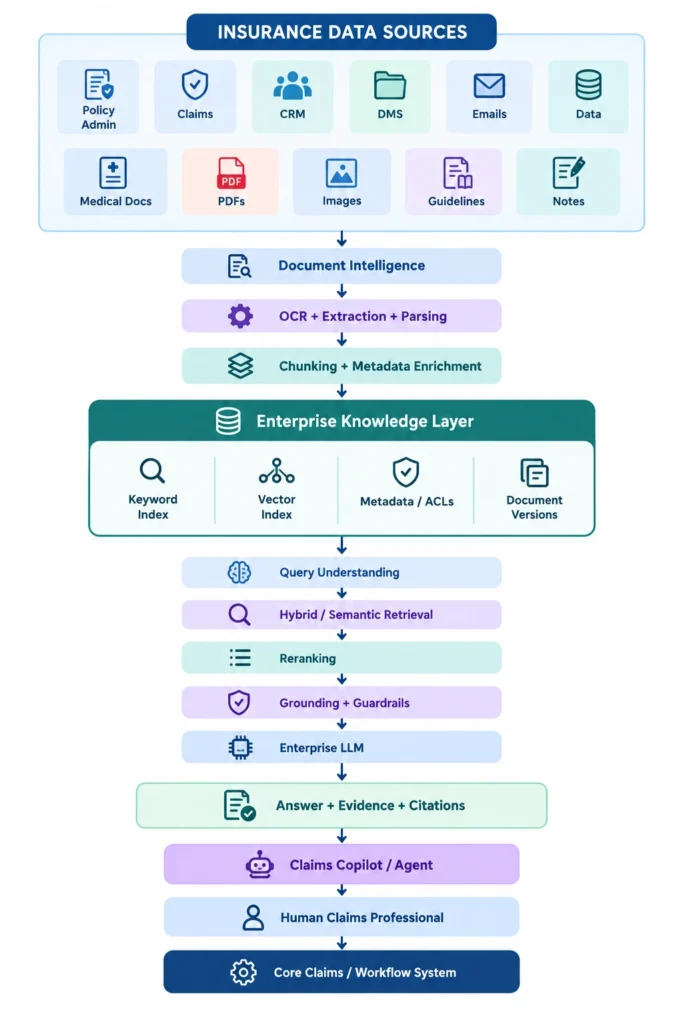
MongoDB describes a similar high-level RAG interaction for insurance: a user question is vectorized, relevant claim documents are retrieved, the retrieved documents are supplied to the LLM as context, and the model generates a contextual answer.
Modern RAG architectures increasingly go beyond a single vector search.
Microsoft’s current RAG guidance describes agentic retrieval that can break complex questions into focused subqueries, execute them in parallel, rerank results, and return structured grounding data and citations.
Explore how Techment enables organizations to operationalize AI through RAG architectures and autonomous AI Agents.
Why Hybrid Search Matters for Insurance RAG
Insurance RAG should rarely depend on vector similarity alone. Hybrid retrieval combines semantic or vector search with keyword retrieval, which is valuable when queries contain exact policy numbers, claim IDs, legal terms, medical codes, dates, or specialized insurance terminology that semantic similarity may not retrieve reliably.
Microsoft recommends hybrid retrieval for maximizing recall in RAG scenarios and describes reranking as a way to improve precision after the initial retrieval stage.
For insurance, this can be particularly important because the corpus may contain:
RAG vs Fine-Tuning for Insurance
RAG and fine-tuning solve different problems in insurance AI. RAG is primarily useful when the model needs access to current, proprietary, or claim-specific information. Fine-tuning is better suited to changing model behavior, style, classification, or repeatable task performance. Many enterprise insurance systems can use both.
| Requirement | RAG | Fine-tuning |
|---|---|---|
| Current policy information | Strong fit | Weak fit |
| Frequently changing guidelines | Strong fit | Weak fit |
| Claim-specific evidence | Strong fit | Weak fit |
| Source citations | Strong fit | Not inherent |
| Document retrieval | Strong fit | Not primary purpose |
| Classification | Possible | Strong fit |
| Document routing | Possible | Strong fit |
| Writing style | Moderate | Strong fit |
| Domain terminology | Strong with retrieval | Strong |
| Auditability | Stronger with citations | Requires additional controls |
| Fresh information | Strong fit | Requires retraining |
| Behavioral adaptation | Moderate | Strong fit |
Microsoft’s current guidance similarly distinguishes RAG for private/frequently changing information from fine-tuning for changing model behavior, style, or task performance.
A useful enterprise pattern is therefore:
Fine-Tuned / Specialized Model
          ↓
Classification + Routing
          ↓
          RAG
          ↓
Current Enterprise Knowledge
          ↓
        LLM
          ↓
Grounded Response
What Makes Insurance RAG Different From Generic Enterprise RAG?
Insurance RAG requires stronger controls than a typical enterprise knowledge chatbot because the answer can depend on policy version, claim state, effective dates, jurisdiction, customer identity, and regulatory requirements. The system must retrieve not merely relevant information, but the correct authorized information for the specific claim and context.
This creates several insurance-specific requirements.
1. Version awareness
The system must know which policy version applies to the claim date.
2. Temporal reasoning
A claim may involve:
- Policy effective date
- Incident date
- Submission date
- Document creation date
- Policy amendment date
- Settlement date
These are not interchangeable.
3. Claim-level authorization
An adjuster should not automatically retrieve every customer’s information.
4. Source hierarchy
When two documents conflict, the system needs rules for determining which source is authoritative.
5. Jurisdiction awareness
Insurance rules can vary by:
- Country
- State
- Province
- Product
- Policy
- Regulatory authority
6. Human decision boundaries
The AI should clearly distinguish:
evidence retrieval from decision authority.
The Biggest RAG Challenge: Retrieval Quality
The quality of an insurance RAG system depends heavily on retrieval quality. A powerful LLM cannot compensate for missing, outdated, unauthorized, or irrelevant evidence. Enterprise teams should therefore optimize the full retrieval pipeline—including document preparation, chunking, metadata, hybrid search, reranking, query expansion, and evaluation—not just the underlying language model.
This is one of the most important differences between an RAG demo and a production insurance platform.
Poor RAG
Question
   ↓
Vector Search
   ↓
Random Similar Chunks
   ↓
LLM
   ↓
Confident Answer
Production RAG
Question
   ↓
Intent + Entity Extraction
   ↓
Access Control
   ↓
Metadata Filters
   ↓
Hybrid Retrieval
   ↓
Candidate Expansion
   ↓
Reranking
   ↓
Source / Version Validation
   ↓
Grounding Check
   ↓
LLM
   ↓
Cited Answer
Microsoft’s RAG architecture guidance emphasizes that irrelevant or incomplete retrieval can still result in inaccurate answers, even when the response is technically “grounded.”
How to Reduce Hallucinations in Insurance RAG
RAG can reduce reliance on a model’s pretrained knowledge, but it does not eliminate hallucinations. Insurance organizations should combine high-quality retrieval with source citations, explicit grounding instructions, confidence thresholds, refusal behavior, access controls, evaluation datasets, and human review for high-impact workflows.
Use these controls:
1. Require source citations
Every material answer should identify the evidence used.
2. Add “insufficient evidence” behavior
If relevant evidence cannot be found:
“I don’t have sufficient evidence in the approved sources to answer this question.”
This is often safer than generating a plausible answer.
3. Validate source freshness
Check:
- Effective date
- Version
- Last updated date
- Claim date
4. Use metadata filters
For example:
claim_id = CLM-12345
policy_id = POL-90872
document_status = ACTIVE
jurisdiction = CA
5. Use reranking
Retrieve broadly, then prioritize the most relevant passages.
6. Evaluate retrieval separately
Do not measure only final answer quality.
Measure:
- Retrieval recall
- Citation recall
- Context precision
- Groundedness
- Answer correctness
- Abstention accuracy
A recent AWS claims RAG example explicitly evaluates expected-source retrieval recall and citation recall rather than treating generated answer quality as the only metric.
Security and Privacy Requirements for Insurance RAG
Insurance RAG systems handle sensitive personal, financial, medical, and claims information, so security must be enforced at retrieval time—not merely after an answer is generated. Access control, encryption, tenant isolation, document-level permissions, audit logs, and data-loss prevention should be part of the architecture from the beginning.
Key controls include:
Identity and access
Use enterprise identity systems and role-based access control.
Document-level authorization
The retriever should only return documents the requesting user is authorized to access.
PII and PHI protection
Depending on the insurance line, data may include:
- Names
- Addresses
- Financial information
- Medical records
- Social identifiers
- Vehicle information
- Payment details
Encryption
Protect:
- Data at rest
- Data in transit
- Vector stores
- Document repositories
- Logs
- Backups
Audit logging
Record:
- Who asked
- What was asked
- What sources were retrieved
- What answer was generated
- What action was taken
- Who approved the action
Microsoft specifically recommends access control at retrieval time and warns that retrieved content should be treated as untrusted input because it can introduce security risks such as prompt injection.
Governance: Why Human-in-the-Loop Still Matters
RAG can accelerate evidence gathering without making the final claims decision. For high-impact workflows, insurers should define explicit approval boundaries where qualified professionals review AI-generated assessments, verify supporting evidence, and retain responsibility for consequential decisions.
This is not simply an AI design preference.
Insurance regulators are actively examining how AI is used.
The NAIC’s Model Bulletin states that insurer decisions or actions supported by AI must comply with applicable insurance laws and regulations and emphasizes governance, risk management, accuracy, fairness, transparency, and documentation.
A sensible operating model is:
| Activity | AI | Human |
|---|---|---|
| Find policy clauses | ✓ | Review |
| Summarize documents | ✓ | Review |
| Identify missing evidence | ✓ | Review |
| Retrieve claims history | ✓ | Review |
| Draft communication | ✓ | Approve |
| Prepare assessment | ✓ | Approve |
| Recommend escalation | ✓ | Decide |
| Approve claim | Assist | Decision |
| Deny claim | Assist | Decision |
| Determine final settlement | Assist | Decision |
The exact control boundary should be determined by the insurer’s legal, regulatory, risk, and operating requirements.
RAG Evaluation Framework for Insurance Claims
Insurance RAG should be evaluated as a retrieval-and-generation system rather than judged only by whether the final answer sounds convincing. A production evaluation framework should measure retrieval recall, relevance, citation accuracy, groundedness, answer correctness, latency, security, and the system’s ability to abstain when evidence is insufficient.
A practical scorecard includes:
| Metric | Question |
|---|---|
| Retrieval Recall | Did the system retrieve the required evidence? |
| Context Precision | Were retrieved passages actually relevant? |
| Citation Recall | Did the answer cite required sources? |
| Citation Correctness | Do citations support the claims made? |
| Groundedness | Is the response supported by retrieved evidence? |
| Answer Accuracy | Is the final response factually correct? |
| Abstention Accuracy | Does the system refuse when evidence is insufficient? |
| Latency | How quickly is the answer returned? |
| Security | Can unauthorized content be retrieved? |
| Freshness | Does retrieval use current approved information? |
Microsoft’s RAG guidance recommends evaluating the retrieval process and the end-to-end response rather than assuming that a single model metric is sufficient.
RAG Metrics That Matter to Claims Operations
Technical metrics are necessary, but business metrics determine whether the system is actually valuable.
Track:
Claims processing time
Average time from claim intake to assessment.
Adjuster productivity
Claims handled per employee or per shift.
Document review time
Time spent searching and reading evidence.
Rework rate
How often claims need additional review because information was missed.
Escalation rate
Percentage of claims requiring specialist intervention.
First-contact resolution
Particularly relevant for claims customer service.
Evidence retrieval time
How long it takes to find the information required for a decision.
Customer response time
Time between customer request and accurate response.
Cost per claim
Operational cost associated with processing a claim.
The objective is not simply:
“How accurate is the chatbot?”
The better enterprise question is:
“How much faster can a qualified claims professional reach a well-supported decision without increasing risk?”
A Practical Implementation Roadmap for RAG in Insurance
Insurers should implement RAG incrementally, beginning with a narrow, document-heavy workflow where the knowledge sources are identifiable and the business outcome is measurable. The safest path is usually assistive use cases such as document retrieval, summarization, missing-information detection, and claims research before expanding into higher-impact decision workflows.
Phase 1: Identify the claims bottleneck
Choose one workflow where employees spend significant time searching or reviewing information.
Examples:
- Health claim review
- Auto claim documentation
- Property claim coverage research
- Claims correspondence
- Customer claims inquiries
Phase 2: Map the information landscape
Document:
- Data sources
- Systems of record
- Document types
- Policy versions
- Access rules
- Data owners
- Update frequency
- Regulatory constraints
Do not begin with the LLM.
Begin with the knowledge landscape.
Phase 3: Establish the source of truth
Define:
- Authoritative source
- Version rules
- Effective dates
- Retention requirements
- Document hierarchy
- Conflict-resolution rules
This prevents the RAG system from treating every document as equally authoritative.
Phase 4: Build the retrieval layer
Implement:
- Chunking
- Embeddings
- Keyword search
- Vector search
- Hybrid retrieval
- Metadata filters
- Reranking
- Source references
Microsoft’s current RAG guidance highlights content preparation, hybrid search, semantic ranking, metadata filtering, and reranking as key components of retrieval quality.
Phase 5: Add the LLM
Only after retrieval quality is established should the generation layer be optimized.
The prompt should define:
- What sources can be used
- How evidence should be cited
- When the model must abstain
- How conflicts should be handled
- What it must never infer
- What actions require human approval
Phase 6: Add governance
Implement:
- RBAC
- Data masking
- Audit logging
- Prompt-injection defenses
- PII controls
- Model monitoring
- Source monitoring
- Human review
- Incident management
Phase 7: Measure business impact
Run a controlled pilot and compare:
Before RAG
     ↓
Manual Search
     ↓
Manual Review
     ↓
Assessment
     ↓
Decision

After RAG
     ↓
AI Retrieval
     ↓
Evidence Summary
     ↓
Human Verification
     ↓
Assessment
     ↓
Decision
Measure both productivity and risk.
Common Mistakes When Implementing RAG for Insurance
The most common insurance RAG mistakes are treating retrieval as a simple vector-search problem, ingesting documents without version or access metadata, measuring only answer quality, and allowing AI to operate beyond clearly defined decision boundaries. Successful implementations treat RAG as an enterprise knowledge and workflow system rather than a chatbot layered over documents.
Mistake 1: “Just upload all the PDFs”
More documents do not guarantee better retrieval.
You need:
- Metadata
- Versioning
- Ownership
- Effective dates
- Access rules
- Document quality
Mistake 2: Using vector search alone
Insurance contains exact identifiers and specialized terms.
Use hybrid retrieval where appropriate.
Mistake 3: Ignoring document versions
An outdated policy can produce a technically fluent but operationally wrong answer.
Mistake 4: No claim-level access control
Retrieval must respect authorization boundaries.
Mistake 5: Measuring only hallucination rate
A system can generate a well-grounded answer from the wrong document.
Measure retrieval correctness too.
Mistake 6: Treating citations as decoration
A citation is useful only if it actually supports the statement.
Mistake 7: No abstention mechanism
The AI should be able to say:
“The available evidence is insufficient.”
Mistake 8: Automating the decision too early
Start with:
assist → validate → recommend → automate selectively
rather than:
retrieve → decide → execute
RAG vs AI Agents for Insurance Claims
RAG retrieves knowledge and grounds responses, while AI agents can use RAG as one capability within a larger workflow that also invokes enterprise systems and performs actions. For insurance, RAG is often the foundational knowledge layer; agents can subsequently use that knowledge to coordinate tasks such as requesting documents, updating systems, or routing claims.
Modern agentic retrieval systems can decompose complex questions into multiple focused queries and return structured evidence and citations.
The important architectural principle is:
An agent should not be allowed to perform an action simply because it can retrieve information.
Permissions and approval policies must be enforced separately.
Where RAG Delivers the Most Value in Insurance
RAG tends to be particularly valuable when a workflow has four characteristics:
High document volume
There are too many documents for employees to review manually.
High information fragmentation
Evidence exists across several systems.
Frequently changing knowledge
Policies, procedures, regulations, or guidelines change over time.
High cost of search
Employees spend substantial time finding information before they can act.
This makes RAG especially relevant for:
- Claims
- Underwriting research
- Policy servicing
- Customer service
- Compliance
- Broker support
- Claims investigation
- Regulatory research
MongoDB’s insurance RAG example similarly highlights fragmented policy, customer, claim, image, and voice information as a core problem that retrieval can help unify.
The Future of RAG in Insurance: From Search to Evidence-Centered AI
Insurance RAG is evolving from simple vector search into evidence-centered AI systems that combine hybrid retrieval, metadata-aware search, agentic query planning, multimodal retrieval, source citations, and enterprise workflow integration. The next generation will increasingly connect retrieved knowledge with actions while preserving permissions, traceability, and human governance.
Several developments are particularly important.
Agentic retrieval
Instead of one search query, AI can decompose complex claims questions into multiple retrieval tasks.
Multimodal RAG
Claims contain more than text.
Future systems will increasingly retrieve and reason across:
- Text
- Tables
- Images
- Scanned forms
- Invoices
- Audio transcripts
- Video evidence
Evidence graphs
Claims may eventually be represented as connected evidence structures:
Policy
  ↓
Coverage
  ↓
Endorsement
  ↓
Claim
  ↓
Incident
  ↓
Evidence
  ↓
Assessment
  ↓
Decision
This can improve traceability across complex claims.
Continuous knowledge updates
Rather than retraining an LLM whenever policy documents change, the knowledge layer can be updated while the underlying model remains unchanged.
RAG + AI agents
RAG can become the knowledge layer for agents that coordinate multi-step claims workflows.
Stronger governance
As insurers move from experimentation to production, auditability, fairness, privacy, explainability, and model-risk management will become increasingly important.
The NAIC’s ongoing work in 2026 includes evaluation of insurer AI systems, governance practices, high-risk models, and data inputs, demonstrating that AI oversight remains an active area of insurance regulation.
A Production Checklist for RAG in Insurance
Before moving an insurance RAG system into production, ask:
Data
- Are authoritative sources clearly identified?
- Are outdated documents excluded?
- Are policy versions preserved?
- Are effective dates available?
- Are claim documents correctly associated with claim IDs?
Retrieval
- Is hybrid retrieval available where required?
- Are metadata filters implemented?
- Is reranking evaluated?
- Are exact identifiers searchable?
- Are conflicting documents detected?
Security
- Is document-level authorization enforced?
- Is access evaluated at retrieval time?
- Are PII/PHI controls implemented?
- Are prompts and responses appropriately protected?
- Are retrieval and user actions audited?
AI
- Are responses grounded in retrieved sources?
- Are citations displayed?
- Can the system abstain?
- Are unsupported claims blocked?
- Are prompt-injection risks tested?
Operations
- Are latency metrics monitored?
- Is retrieval quality monitored?
- Are source updates tracked?
- Are failed retrievals logged?
- Are model and prompt versions tracked?
Governance
- Are human approval points defined?
- Are high-impact decisions reviewed?
- Is there an AI risk-management process?
- Can an auditor reconstruct how an answer was generated?
- Are regulatory requirements mapped to system controls?
Read our blog that explores how AI copilots for enterprises are transforming executive leadership in 2026.
How Enterprises Should Start With RAG for Insurance
A practical starting point is not full claims automation.
Start with a high-volume, document-heavy task where employees spend significant time searching for information.
For example:
Phase 1
Claims document search
“Find all documents relevant to this claim.”
Phase 2
Claims summarization
“Summarize the claim and identify outstanding evidence.”
Phase 3
Coverage research
“Which policy clauses are relevant to this incident?”
Phase 4
Claims assessment assistance
“Prepare an evidence-backed assessment for adjuster review.”
Phase 5
Workflow orchestration
“If required documentation is missing, initiate the approved request workflow.”
This staged approach provides a measurable path from retrieval → assistance → recommendation → controlled automation.
Key Takeaways
- RAG for insurance connects LLMs to current enterprise knowledge.
- Claims are a strong RAG use case because critical information is distributed across documents and systems.
- RAG can reduce time spent searching policies, claims files, guidelines, and correspondence.
- The real value is not simply generating text—it is retrieving the right evidence at the right time.
- Citations improve traceability but do not automatically guarantee correctness.
- Hybrid retrieval, metadata filters, reranking, and version control are important production capabilities.
- RAG should respect claim-level and document-level permissions.
- RAG can support adjudication without necessarily replacing the adjudicator.
- RAG and fine-tuning solve different problems and can be combined.
- The strongest insurance AI architecture combines RAG, document intelligence, enterprise data, APIs, workflow orchestration, governance, and human oversight.
- Organizations should measure both business outcomes and retrieval/AI quality.
- The best starting point is usually a narrow, high-volume, information-intensive claims workflow.
Conclusion
RAG changes the role of generative AI in insurance from a system that simply generates answers into one that can retrieve and explain enterprise evidence.
That distinction is especially important in claims processing.
A claims professional does not simply need an answer.
They need the right answer, based on the right policy, the right claim evidence, the right version of the document, and an evidence trail they can verify.
That is where RAG can create measurable value.
It can reduce document-search time, consolidate fragmented information, surface applicable policy language, summarize claim files, identify missing evidence, support customer service, and prepare claims assessments.
But RAG should not be treated as a magic layer placed over a collection of PDFs.
Production insurance RAG requires:
trusted data + strong retrieval + metadata + access control + citations + evaluation + governance + human oversight.
For insurers moving toward AI-powered claims operations, the opportunity is therefore larger than building a claims chatbot.
It is about building an evidence-centered claims intelligence layer that connects enterprise knowledge with the people and workflows responsible for resolving claims.
That is the foundation on which more advanced AI agents and claims automation can safely be built.
For enterprises exploring this transition, Techment can help design and implement the underlying Enterprise AI, RAG, data engineering, AI modernization, and workflow architecture needed to move from an AI proof of concept to a production-ready insurance claims capability.
Frequently Asked Questions About RAG for Insurance
1. What is RAG in insurance?
RAG in insurance is an AI architecture that retrieves relevant policy, claims, guideline, and enterprise information before an LLM generates a response. This grounds AI outputs in current business data and can provide source references for verification.
2. How does RAG improve insurance claims processing?
RAG reduces the time claims professionals spend searching documents and systems. It can retrieve relevant policy clauses, summarize claims evidence, identify missing information, retrieve claims history, and prepare source-grounded assessments.
3. Can RAG automatically approve insurance claims?
RAG can support claim assessment and workflow automation, but it does not inherently provide authority to approve or deny a claim. High-impact decisions should follow the insurer’s governance, regulatory, and human-review requirements.
4. What documents should be used for insurance RAG?
Common sources include policy documents, endorsements, claims forms, FNOL records, adjuster notes, repair estimates, medical records, invoices, correspondence, claims procedures, internal guidelines, and approved regulatory or industry sources.
5. Is RAG better than fine-tuning for insurance?
They solve different problems. RAG is generally better when answers depend on current, proprietary, claim-specific information. Fine-tuning can be useful for classification, routing, style, or repeatable task behavior. Enterprise systems may use both.
6. How does RAG handle changing insurance policies?
RAG can retrieve the current approved version from an enterprise knowledge base without retraining the underlying LLM whenever a document changes. Effective dates, version metadata, and retrieval filters are important for ensuring the correct policy is used.
7. How can insurers evaluate RAG quality?
Evaluate retrieval recall, context precision, citation correctness, groundedness, answer accuracy, abstention behavior, latency, security, and business metrics such as claims processing time and adjuster productivity.
Related Reads
- Enterprise AI Strategy in 2026
- How to Build AI-Ready Data Foundations: A Strategic Enterprise Guide.
- 7 Real-World Agentic AI Use Cases Transforming Enterprise Operations in 2026
- Agentic Workflow Solutions: The Future of Enterprise Automation in 2026
- Best Practices for Generative AI Implementation in Business
- How AI Agents Are Driving 10x Productivity for Modern Businesses
- Fabric AI Readiness: How to Prepare Your Data for Scalable AI Adoption.
- Agentic AI Orchestration: 7 Strategic Pillars for Scalable AI in 2026