Agentic Workflow Solutions use AI agents to automate complex business processes by reasoning, planning, making decisions, and executing actions within enterprise guardrails. Unlike traditional workflow automation, they adapt to changing conditions, resolve exceptions intelligently, and continuously optimize operations across ERP, CRM, IT, finance, and customer service systems.
Introduction
Enterprise automation is evolving beyond rule-based workflows. Agentic Workflow Solutions combine AI reasoning, planning, contextual understanding, and autonomous execution to manage complex business processes with minimal human intervention. Unlike traditional automation, they can interpret changing conditions, resolve exceptions intelligently, and optimize outcomes across enterprise systems while operating within governance and compliance guardrails.
For CIOs, CTOs, and business leaders, this marks a shift from automating repetitive tasks to orchestrating intelligent, outcome-driven operations that improve efficiency, resilience, and decision-making at scale.
TL;DR
- Agentic Workflow Solutions automate complex business processes using AI reasoning and autonomous decision-making.
- They outperform traditional workflow automation by handling exceptions, adapting to changing business conditions, and coordinating actions across enterprise systems.
- Success depends on trusted enterprise data, context engineering, governance, observability, and human oversight.
- High-impact use cases include finance, customer service, IT operations, HR, procurement, and supply chain management.
- Organizations that implement agentic workflows strategically can reduce operational costs, improve customer experiences, and accelerate enterprise-wide automation.
- CIOs and CTOs who invest early in Agentic Workflow Solutions will create significant operational advantages.
What Are Agentic Workflow Solutions
Agentic Workflow Solutions are AI-powered systems that autonomously execute multi-step business processes by understanding context, reasoning through decisions, coordinating actions across enterprise applications, and continuously adapting to changing business conditions—all within predefined governance policies.
Unlike conventional automation, which follows predefined rules, agentic workflows pursue business outcomes. They can evaluate multiple options, resolve exceptions intelligently, and determine the next best action without requiring every scenario to be explicitly programmed.
This shift enables enterprises to automate processes that were previously too dynamic or complex for traditional workflow engines.
From Task Automation to Intelligent Execution
Enterprise automation has traditionally focused on executing repetitive tasks:
- Process an invoice
- Route a support ticket
- Generate a report
- Approve a purchase order
These workflows work well when every input follows predictable rules. Modern enterprises, however, rarely operate under predictable conditions. Customer requests vary. Supply chains are disrupted. Regulatory requirements change. Business priorities evolve continuously.
Rather than asking, “What predefined step comes next?”, agentic workflows ask:
“What action best achieves the intended business outcome based on the current context?”
This outcome-driven approach allows AI to make informed decisions, adapt dynamically, and improve operational resilience.
Read our blog on How to Build AI-Ready Data Foundations.
Key Characteristics of Agentic Workflow Solutions
Enterprise-grade agentic workflows typically combine five capabilities:
| Capability | Purpose |
|---|---|
| Context Awareness | Understand structured and unstructured enterprise data |
| AI Reasoning | Evaluate options and determine the best next action |
| Autonomous Execution | Perform actions across enterprise applications |
| Continuous Learning | Improve recommendations using operational feedback |
| Governance | Operate within predefined business rules and compliance policies |
Together, these capabilities transform automation from static execution into intelligent orchestration.
Why Enterprises Are Moving Beyond Traditional Workflow Automation
Enterprise Automation Has Reached a New Inflection Point
For nearly two decades, organizations have invested in workflow automation, business process management (BPM), and robotic process automation (RPA) to improve efficiency and reduce operational costs.
These technologies delivered significant value by automating repetitive, rules-based tasks.
However, enterprise operations have become significantly more complex.
Organizations now manage:
- Hybrid cloud environments
- Multiple ERP and CRM platforms
- Distributed workforces
- Increasing regulatory requirements
- Large volumes of structured and unstructured data
- AI-powered customer interactions
Traditional automation struggles in environments where business conditions change rapidly or exceptions occur frequently.
As a result, many organizations spend as much time maintaining automated workflows as they do creating them.
Read our blog on Cost of Managing Enterprise AI Systems: A Complete Guide to AI Total Cost of Ownership.
Traditional Workflow Automation vs. Agentic Workflow Solutions
Traditional workflow automation has helped organizations streamline repetitive processes for years. However, it relies on static rules that perform well only when every scenario is predictable.
Modern enterprises operate in dynamic environments where exceptions, incomplete information, and changing priorities are the norm rather than the exception. Agentic Workflow Solutions address these challenges by combining AI reasoning with workflow orchestration to make informed decisions and execute actions autonomously.
| Capability | Traditional Workflow Automation | Agentic Workflow Solutions |
|---|---|---|
| Decision-making | Rule-based | AI-driven reasoning |
| Workflow execution | Fixed | Dynamic and adaptive |
| Context awareness | Limited | Enterprise-wide |
| Exception handling | Manual escalation | Intelligent resolution |
| Learning | Static | Continuous optimization |
| Human intervention | Frequent | Primarily for approvals and edge cases |
| Scalability | Moderate | High |
Traditional automation remains valuable for repetitive, structured tasks. Agentic workflows complement these investments by automating high-context processes where static rules are insufficient.
Read our blog on AI Orchestration vs Traditional Workflow Automation: 9 Critical Differences Enterprise Leaders Must Know in 2026
How Agentic Workflow Solutions Work
Every agentic workflow follows the same fundamental lifecycle:
Rather than executing predefined instructions, the system first understands the business objective and gathers relevant context from enterprise applications, knowledge repositories, and business policies.
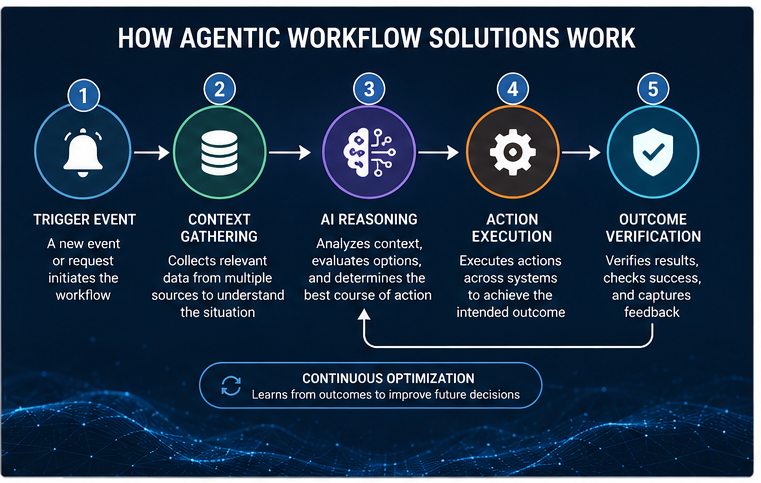
AI models then evaluate available options, determine the most appropriate action, and validate decisions against organizational guardrails before executing tasks across connected systems. Once completed, the workflow verifies outcomes, monitors performance, and uses operational feedback to improve future decisions.
For example, during customer onboarding, an agentic workflow can verify submitted documents, assess risk, create customer records, trigger compliance checks, notify relevant teams, and escalate only when predefined confidence thresholds are not met. This reduces manual effort while improving consistency and customer experience.
For organizations building broader AI roadmaps, this challenge aligns closely with broader enterprise modernization priorities discussed in Enterprise AI Strategy in 2026, where scalable intelligence increasingly depends on adaptive AI operating models rather than isolated automation initiatives.
Why Agentic Workflow Solutions Matter
Organizations are under increasing pressure to improve efficiency while managing growing operational complexity. Traditional automation can reduce repetitive work, but it often struggles when processes involve multiple systems, unstructured data, or frequent exceptions.
Agentic Workflow Solutions address these limitations by combining automation with AI-driven reasoning. Instead of simply executing tasks, they evaluate situations, coordinate decisions, and adapt workflows in real time.
For enterprises, this translates into:
- Faster process execution
- Reduced manual intervention
- Improved decision quality
- Better customer and employee experiences
- Greater operational resilience
- Scalable automation across business functions
As AI technologies continue to mature, agentic workflows are becoming a foundational capability for organizations looking to build intelligent, adaptive, and future-ready operations.
Enterprise Architecture of Agentic Workflow Solutions
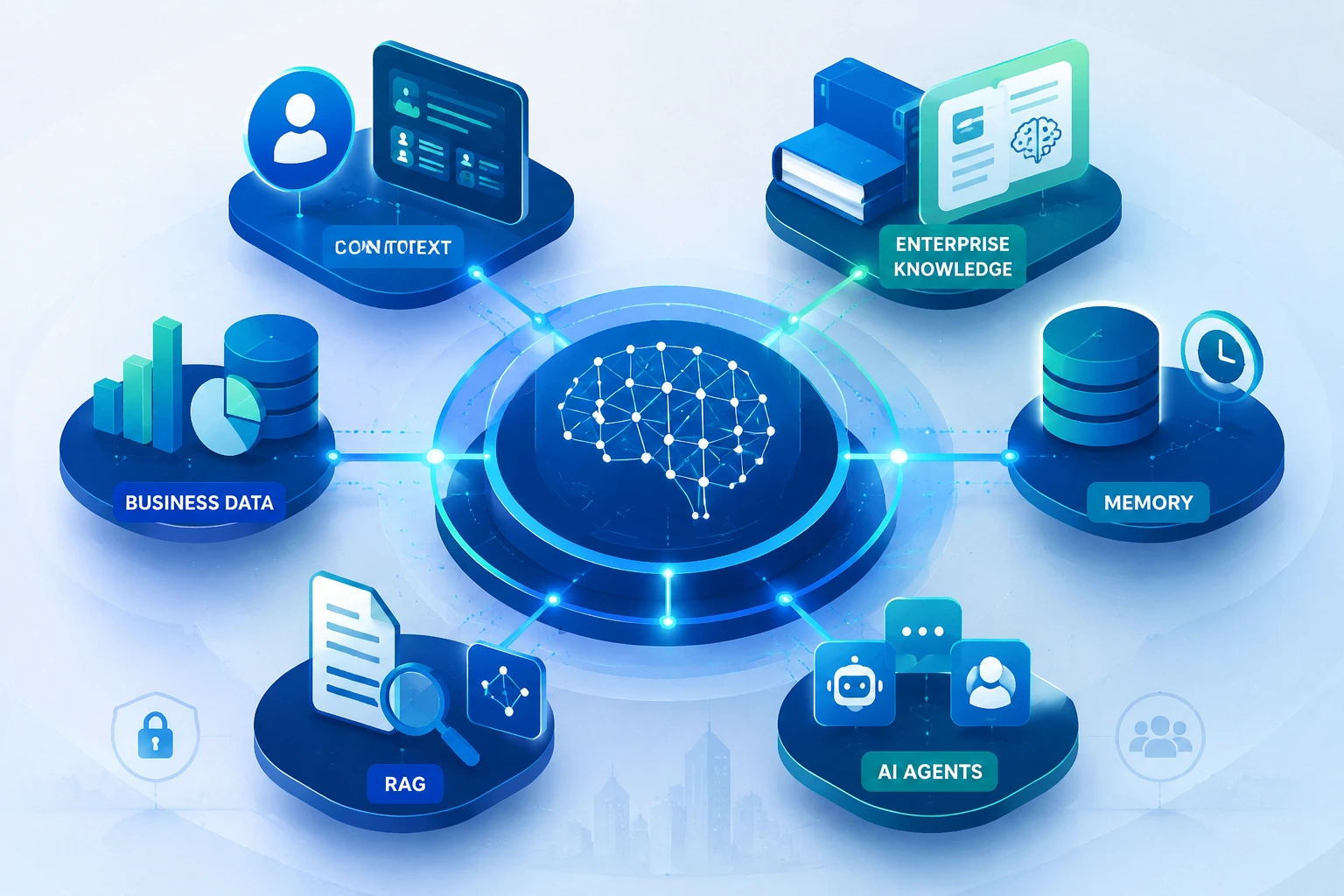
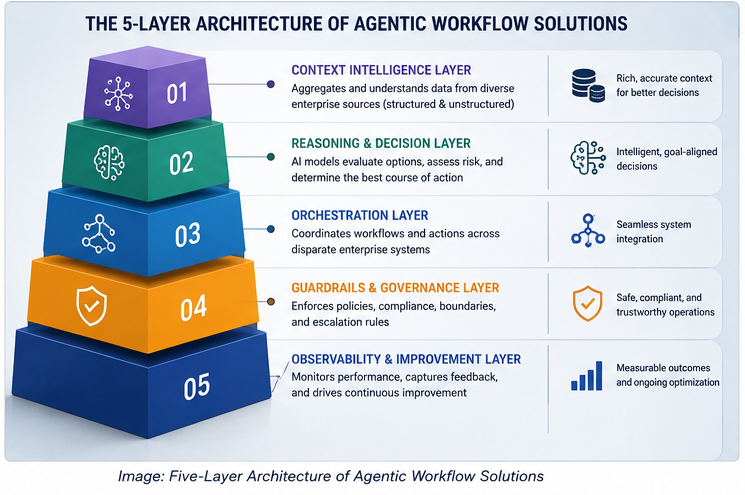
Enterprise-grade Agentic Workflow Solutions combine AI reasoning with workflow orchestration, enterprise data, and governance to automate complex business processes. Rather than replacing existing applications, they coordinate actions across business systems while maintaining security, compliance, and human oversight.
Instead of hardcoding every business rule, AI evaluates enterprise context, determines the best course of action, and coordinates activities across connected systems while operating within predefined governance policies.
Key Takeaway: The intelligence of an agentic workflow comes from combining enterprise context, AI reasoning, orchestration, and governance—not from the language model alone.
This becomes especially relevant as organizations strengthen AI foundations through enterprise governance frameworks such as Enterprise Data Governance Framework: A Practical Guide That Actually Workswhich emphasizes trust and reliability for intelligent systems.
Core Components of Agentic Workflow Solutions
Every enterprise implementation relies on five foundational capabilities.
1. Context Intelligence
AI decisions are only as good as the information available.
The context layer aggregates structured and unstructured enterprise data from ERP systems, CRM platforms, knowledge bases, policies, contracts, emails, and historical transactions to provide the AI with the information required to make accurate decisions.
Without trusted context, autonomous workflows become unreliable.
2. AI Reasoning & Decision Engine
This layer evaluates multiple possible actions and selects the most appropriate outcome based on business objectives, organizational policies, and confidence scores.
Unlike deterministic automation, reasoning engines adapt to changing business conditions rather than following predefined decision trees.
3. Workflow Orchestration
The orchestration layer connects enterprise applications and coordinates actions across multiple systems.
Typical integrations include:
- ERP
- CRM
- HRMS
- ITSM
- Finance platforms
- Collaboration tools
- Cloud applications
This enables AI to execute complete business processes instead of isolated tasks.
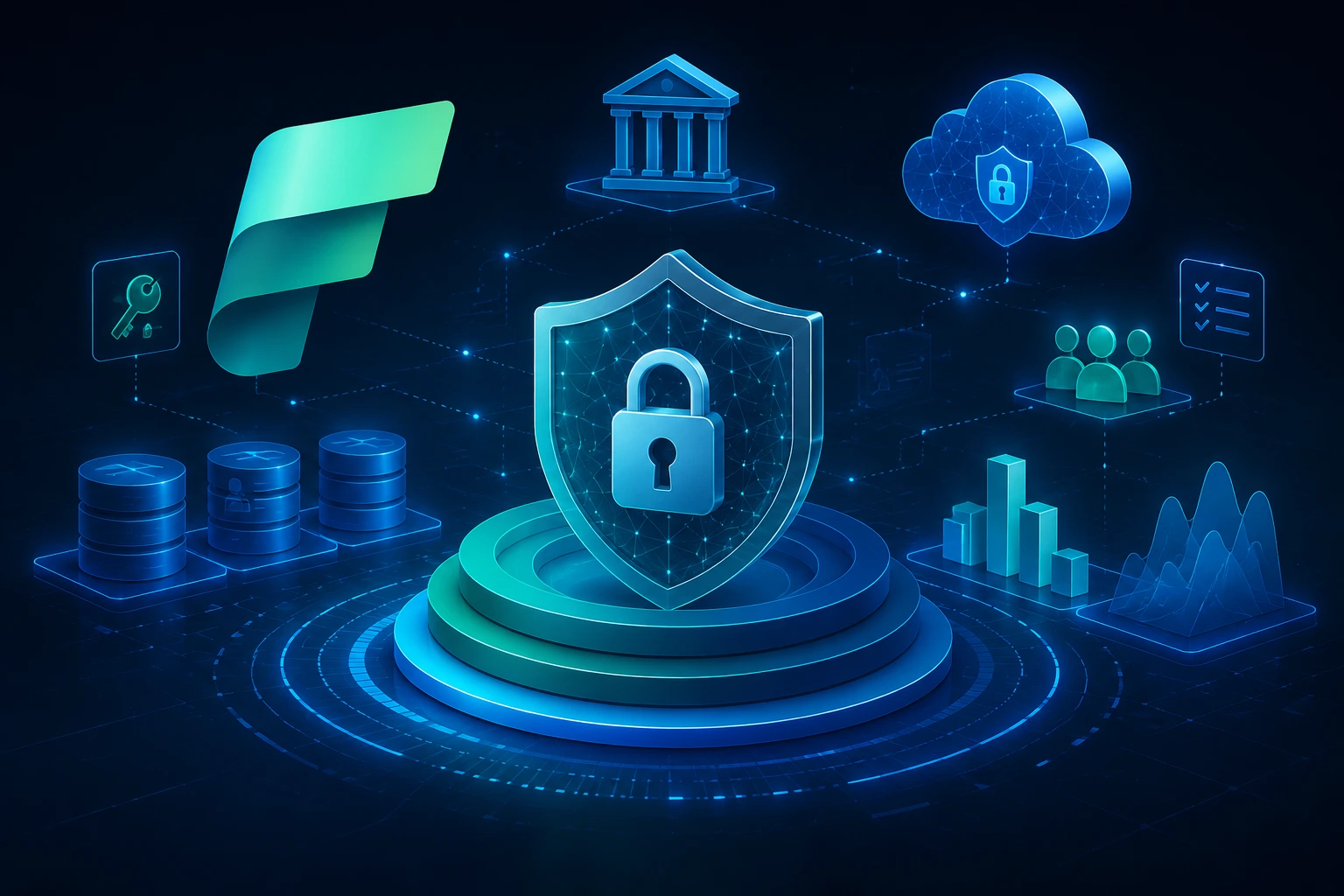
4. Governance & Guardrails
Enterprise AI must operate within clearly defined boundaries.
Governance establishes:
- Approval thresholds
- Compliance policies
- Role-based access
- Audit trails
- Escalation rules
- Human review points
These controls ensure AI remains transparent, secure, and accountable.
5. Observability & Continuous Improvement
Operational visibility is essential for enterprise AI.
Organizations should continuously monitor:
- Workflow success rates
- Escalation frequency
- Processing time
- Business outcomes
- Model performance
- Operational costs
These insights enable continuous optimization while maintaining governance and reliability.
High-Impact Enterprise Use Cases
The greatest value comes from automating processes that involve multiple systems, frequent exceptions, and context-based decision-making.
1. Customer Service
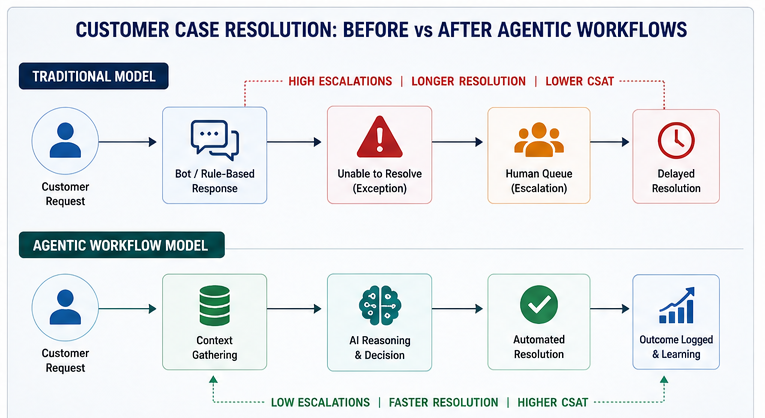
Agentic workflows retrieve customer history, analyze sentiment, recommend resolutions, and automate follow-up activities while escalating only complex cases.
Business Outcome
- Faster case resolution
- Higher customer satisfaction
- Reduced support costs
2. Finance & Invoice Processing
AI validates invoices, reconciles discrepancies, applies approval policies, and coordinates payment workflows across finance systems.
Business Outcome
- Faster invoice processing
- Reduced manual reviews
- Improved financial accuracy
3. IT Operations
Agentic workflows classify incidents, identify root causes, trigger remediation workflows, and update service management platforms automatically.
Business Outcome
- Reduced downtime
- Faster incident resolution
- Improved IT productivity
4. Human Resources
AI automates employee onboarding, document verification, access provisioning, compliance checks, and training assignments across HR platforms.
Business Outcome
- Faster onboarding
- Improved employee experience
- Reduced administrative effort
5. Procurement
Agentic workflows evaluate vendor requests, verify compliance, generate approvals, and coordinate purchasing activities across procurement systems.
Business Outcome
- Faster procurement cycles
- Better policy compliance
- Reduced operational bottlenecks
6. Supply Chain Management
AI detects disruptions, evaluates alternative suppliers, adjusts delivery schedules, and coordinates logistics across multiple enterprise applications.
Business Outcome
- Improved supply chain resilience
- Faster response to disruptions
- Lower operational risk
7. Sales & Proposal Management
AI analyzes RFPs, recommends relevant case studies, drafts proposal content, routes approvals, and coordinates document creation across sales teams.
Business Outcome
- Faster proposal development
- Improved win rates
- Higher sales productivity
8. Compliance & Risk Management
Agentic workflows continuously monitor business activities, detect policy violations, generate audit evidence, and escalate compliance issues when required.
Business Outcome
- Stronger governance
- Reduced compliance risk
- Better audit readiness
Where Agentic Workflow Solutions Deliver the Greatest ROI
Organizations typically achieve the highest returns when implementing agentic workflows in processes that combine:
- High transaction volumes
- Frequent exceptions
- Multiple enterprise applications
- Knowledge-intensive decisions
- Repetitive manual effort
- Clearly measurable business outcomes
Starting with these high-value workflows enables organizations to demonstrate measurable ROI quickly before expanding automation across additional business functions.
Agentic Workflow Solutions are not simply an upgrade to workflow automation—they represent a shift toward intelligent enterprise operations. By combining AI reasoning, contextual understanding, workflow orchestration, and governance, organizations can automate complex processes that traditional automation cannot handle efficiently. The most successful implementations focus on high-impact workflows where better decisions, faster execution, and reduced manual intervention deliver measurable business value.etention.
Organizations modernizing conversational intelligence should align workflow orchestration with enterprise-grade customer AI strategies, similar to approaches discussed in Conversational AI for Customer Service: A Step-by-Step Enterprise Guide.
Organizations modernizing enterprise intelligence increasingly recognize that AI readiness starts with trusted data foundations, governance maturity, and contextual accessibility—an area explored in AI-Ready Enterprise Checklist: Microsoft Fabric.
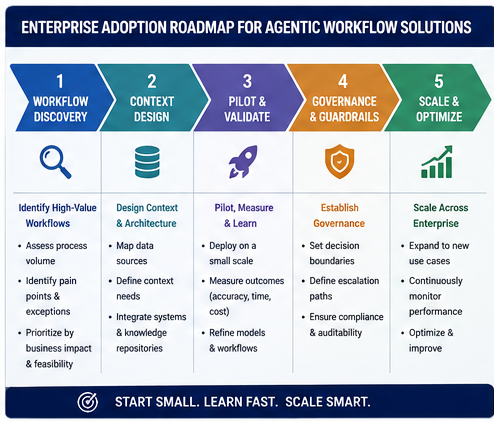
5-Step Framework for Implementing Agentic Workflow Solutions
Successful organizations start with targeted, measurable initiatives before scaling enterprise-wide.
1. Prioritize High-Value Use Cases
Focus on workflows with:
- High manual effort
- Frequent exceptions
- Clear business outcomes
- Cross-functional processes
Examples include invoice processing, customer service, IT operations, and employee onboarding.
2. Prepare Enterprise Data
AI depends on trusted, accessible enterprise information.
Before deployment, ensure:
- High-quality data
- Standardized business definitions
- Well-governed knowledge repositories
- Secure access to enterprise systems
3. Establish Governance
Define policies before enabling autonomous execution.
Include:
- Approval thresholds
- Human-in-the-loop checkpoints
- Compliance requirements
- Audit logging
- Escalation workflows
4. Pilot and Measure
Start with a limited implementation and track measurable KPIs such as:
- Automation rate
- Resolution time
- Accuracy
- Escalation frequency
- Cost savings
- User satisfaction
5. Scale Continuously
Expand automation incrementally by refining workflows, improving context, and monitoring operational performance.
Best Practices for Enterprise Adoption
Organizations that achieve long-term success typically follow these principles:
✔ Start with a single, high-impact business process.
✔ Use trusted enterprise data instead of relying solely on public AI models.
✔ Maintain human oversight for complex or regulated decisions.
✔ Design workflows around business outcomes, not technology.
✔ Continuously monitor performance and optimize workflows using operational metrics.
✔ Embed governance, security, and compliance into every workflow from the outset.
Future Trends Shaping Agentic Workflow Solutions
Enterprise automation is evolving rapidly. Over the next few years, organizations can expect several trends to shape the next generation of agentic workflows.
Multi-Agent Collaboration
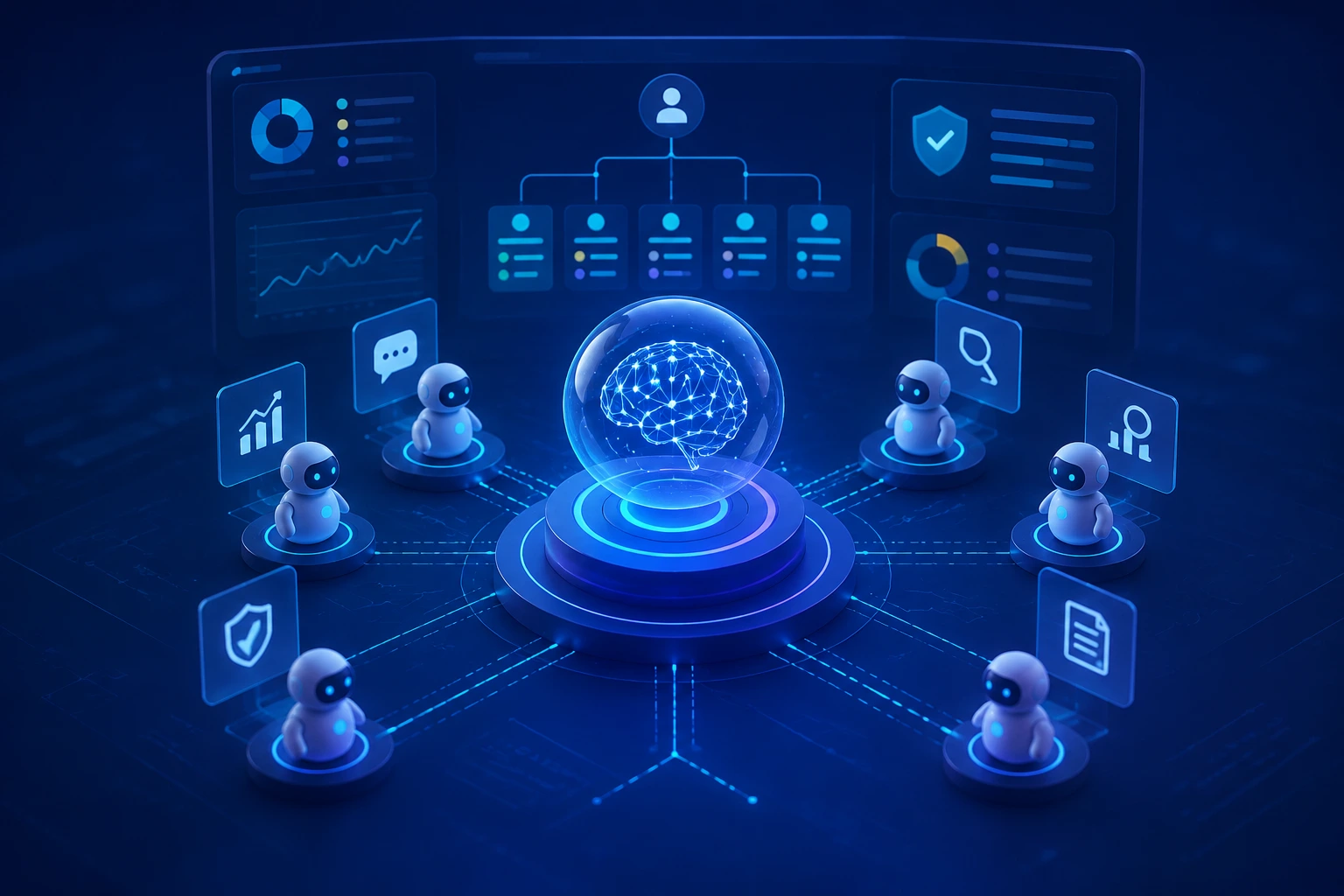
Specialized AI agents will collaborate to solve complex business processes, with planner, executor, reviewer, and compliance agents working together to achieve business goals.
Model Context Protocol (MCP)
Standardized context-sharing protocols will enable AI agents to securely access enterprise systems, making workflows more interoperable and scalable.
Autonomous Enterprise Operations
Organizations will increasingly automate end-to-end processes across finance, customer service, procurement, and IT, reducing manual intervention while maintaining governance.
Built-In AI Governance
Governance will become a core architectural capability, with explainability, auditability, and policy enforcement integrated directly into enterprise AI platforms.
How Techment Helps Enterprises Operationalize Agentic Workflow Solutions
Successfully implementing Agentic Workflow Solutions requires more than deploying AI models. It demands a strong data foundation, scalable architecture, and governance that aligns with business objectives.
Techment helps enterprises accelerate adoption through:
- AI Strategy & Readiness: Identify high-value use cases and develop an implementation roadmap.
- Data Engineering: Build trusted, AI-ready data foundations for reliable decision-making.
- Workflow Engineering: Design and integrate intelligent workflows across enterprise applications.
- Responsible AI Governance: Implement security, compliance, observability, and human oversight.
- Continuous Optimization: Monitor performance, refine workflows, and scale automation across the enterprise.
By combining AI, data, analytics, and automation expertise, Techment enables organizations to move from isolated automation initiatives to intelligent, enterprise-wide operations.
Explore our AI Data Readiness Assessment Services.
Conclusion
Enterprise automation is undergoing its most important transformation in decades. Rigid workflows that depend on static logic are increasingly unable to support the complexity, uncertainty, and speed modern organizations require. This is why Agentic Workflow Solutions are emerging as a strategic priority for enterprise leaders.
The real opportunity is not simply cost reduction. It is operational intelligence. Organizations that successfully deploy context-aware, governed, and scalable AI workflows will improve responsiveness, reduce inefficiencies, and unlock new levels of enterprise agility. The leaders who act now will not simply automate workflows. They will redefine how intelligent work gets done.
Frequently Asked Questions
1. What are Agentic Workflow Solutions?
Agentic Workflow Solutions are AI-powered systems that autonomously execute multi-step business workflows using contextual understanding, reasoning, and adaptive decision-making.
2. How are Agentic Workflow Solutions different from traditional automation?
Traditional automation follows predefined rules. Agentic workflows pursue outcomes, adapt to changing conditions, and handle exceptions intelligently.
3. Are Agentic Workflow Solutions safe for enterprise environments?
Yes—when deployed with governance, bounded autonomy, explainability, and human oversight.
4. What business functions benefit most?
Customer support, finance, supply chain, IT operations, HR onboarding, and proposal generation are among the highest-impact use cases.
5. Do enterprises need to replace existing systems?
No. Most Agentic Workflow Solutions integrate with existing ERP, CRM, cloud, and analytics systems.
6. What is the biggest implementation challenge?
Poor enterprise context limits AI effectiveness.
Context and data quality.
Related Reads
- AI Orchestration vs Traditional Workflow Automation: 9 Critical Differences Enterprise Leaders Must Know in 2026
- AI Agent Evaluation Frameworks Compared: Choosing the Right Platform for Enterprise AI in 2026
- AI-Ready Enterprise Checklist with Microsoft Fabric
- How to Build AI-Ready Data Foundations: A Strategic Enterprise Guide
- AI strategy and modernization planning.
- The 30-60-90 Day Enterprise AI Readiness Roadmap For Enterprise AI Success
- 5 Best AI Architectures for Enterprises to Scale AI Successfully