Fabric AI Readiness: The New Competitive Mandate
Artificial intelligence is now the defining capability of modern enterprises — but AI can only be as powerful as the data foundation behind it. Organizations across every industry are racing to deploy predictive models, generative AI copilots, automation agents, and real-time decision engines. Yet most teams quickly discover that AI fails not because of weak models, but because the underlying data is fragmented, inconsistent, inaccessible, ungoverned, or outdated.
The challenge is not a lack of ambition — it’s a lack of AI-ready data.
According to IDC, organizations struggle with AI readiness largely because most enterprise information is unstructured and poorly managed—IDC reports that 90% of enterprise data is unstructured, creating major quality and governance barriers for AI initiatives.
IDC also finds that although AI adoption is accelerating—with over 70% of organizations building their own AI solutions—data maturity remains uneven, limiting companies’ ability to operationalize AI effectively. As AI initiatives scale—from experimentation to production—legacy architectures buckle under the weight of new requirements: real-time insight, cross-domain data activation, lineage, governance, trustworthy outputs, and multimodal data fusion.
This is where Fabric AI Readiness becomes a competitive differentiator.
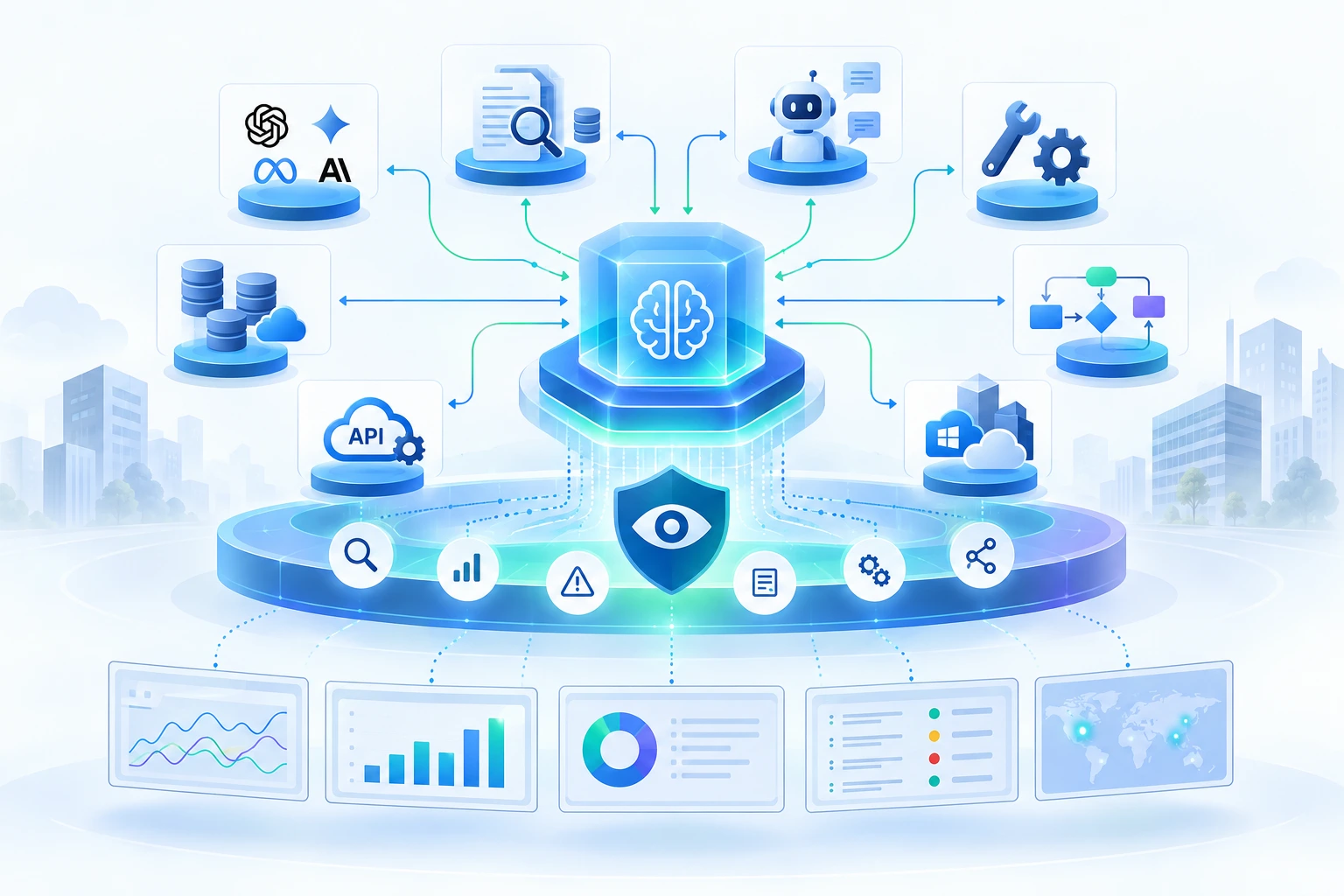
It represents the holistic set of capabilities that enable enterprises to prepare their data estate—storage, pipelines, governance, security, metadata, semantics, and access layers—for industrial-scale AI adoption.
With Microsoft Fabric unifying storage (OneLake), engineering, governance (Purview), real-time intelligence, and MLOps, enterprises finally have a foundation where data becomes AI-ready by design.
This blog provides a comprehensive roadmap for leaders seeking to modernize their data estate for scalable AI adoption—grounded in Fabric AI Readiness principles, executive frameworks, and practical transformation steps.
Discover more in our partnership page and understand the strategic benefits we bring as a solutions partner.
TL;DR (Summary Box)
- AI success depends on data readiness, not just advanced models. Fabric AI Readiness helps enterprises unify, govern, and optimize data for scalable AI adoption.
- Microsoft Fabric enables an end-to-end, SaaS-based analytics and AI ecosystem—powered by OneLake, Purview governance, real-time analytics, and integrated ML tooling.
- Traditional analytics platforms fall short in supporting real-time intelligence, multimodal data, and enterprise-grade AI workloads.
- This guide provides a step-by-step roadmap for evaluating your data maturity, modernizing pipelines, enabling governance, and operationalizing AI at scale.
- Techment, as a Microsoft Partner, offers strategy, architecture, governance, and implementation accelerators to help organizations become AI-first.
Why AI Fails Without the Right Data Foundation
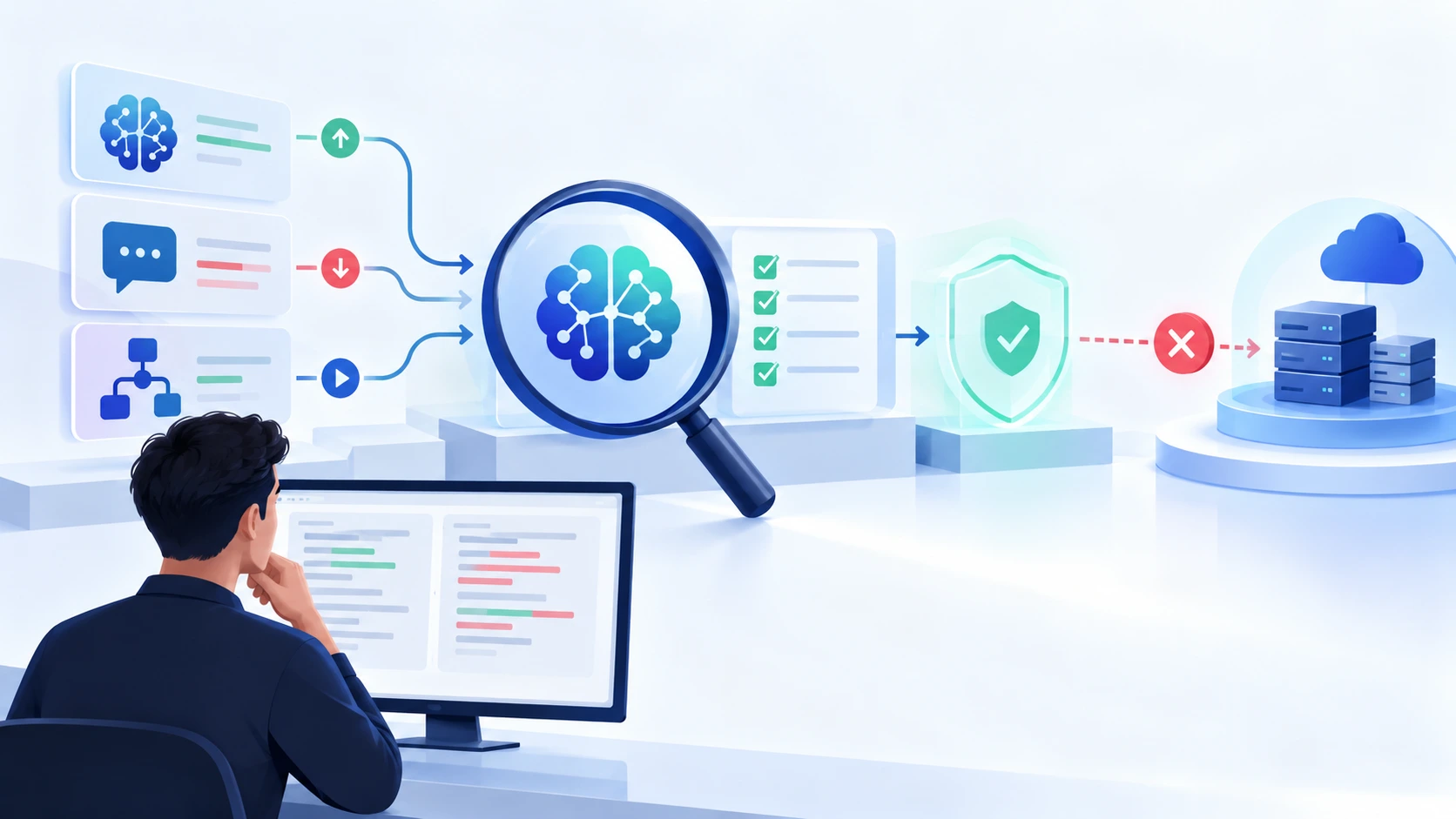
Despite unprecedented AI investment, most enterprise AI projects fail to scale. Gartner estimates that over 80% of AI initiatives never reach production, and the reasons are almost always rooted in insufficient data readiness — not modeling failures.
Explore frameworks for architecture, implementation, and scaling conversational AI securely and efficiently in our latest blog on Conversational AI on Microsoft Azure: Building Intelligent Enterprise Assistants.
Key Reasons AI Projects Fail in Low-Readiness Environments
1. Fragmented Data Across Silos
Business-critical data often lives in dozens of disconnected systems: CRM, ERP, marketing platforms, operational logs, IoT streams, third-party feeds, and legacy warehouses. Without consolidation, AI models cannot generate accurate or contextual insights.
2. Lack of Data Governance and Quality Controls
Models trained on inconsistent, mislabeled, or biased data yield equally flawed outputs.
Poor lineage and unclear ownership further complicate trust and auditability.
3. Inability to Support Real-Time or High-Velocity Data
Modern AI requires data that updates continuously — not nightly or weekly.
Legacy ETL pipelines, batch ingestion, and slow refresh cycles prevent dynamic decision-making.
4. Unstructured & Multimodal Data Remains Untapped
Audio, documents, images, logs, clickstreams, and PDFs hold enormous value for AI — but traditional architectures cannot ingest or prepare them efficiently.
5. Lack of Scalability for Large AI Workloads
Vector databases, deep learning pipelines, inference workloads, and LLM fine-tuning require compute elasticity and unified architecture, which legacy systems lack.
6. No Unified Semantics or Business Context
AI without enterprise semantics is blind. Teams lack a single definition of customers, products, transactions, or risk events — leading to inconsistent outcomes.
This is why leaders increasingly recognize that Fabric AI Readiness is not optional — it’s foundational.
Microsoft Fabric provides a unified, governed, AI-oriented data platform, but organizations still need to prepare their data estate for transformation.
Explore how enterprise reliability improves with governance-forward architecture in our data governance solution offerings.
What Is Fabric AI Readiness?
Fabric AI Readiness refers to the set of architectural, operational, and governance capabilities required to ensure that an enterprise data environment is fully prepared to support scalable, trustworthy, and secure AI adoption. It reflects not just technology readiness, but organizational alignment, data maturity, and process optimization.
At its core, Fabric AI Readiness requires unifying, governing, and operationalizing data across the enterprise so AI can deliver consistent, explainable, and scalable value.
Read what Microsoft Fabric is, how it works, why organizations are rapidly adopting it, and what leaders must know in our latest blog – What Is Microsoft Fabric? A Comprehensive Overview for Modern Data Leaders.
Key Components of Fabric AI Readiness
1. Unified Storage & Accessibility Through OneLake
Microsoft Fabric introduces OneLake, a tenant-wide, open data lake that consolidates all structured, semi-structured, and unstructured data.
This eliminates silos, enables cross-domain analytics, and dramatically reduces time-to-insight.
2. Consistent Data Structures & Semantic Models
Fabric integrates semantic models, enabling shared business definitions across analytics, AI workflows, and operational systems.
This ensures models interpret data consistently across teams.
3. Built-In Governance with Microsoft Purview
Fabric AI Readiness mandates governance that scales with AI workloads:
- Lineage tracking
- Data classification
- Access controls
- Privacy management (PII/PHI)
- Regulatory compliance
This is especially critical for highly regulated sectors like BFSI and healthcare.
4. Automated Data Engineering & Transformation Pipelines
Fabric’s Data Factory and Synapse pipelines allow organizations to:
- Ingest data in real-time
- Cleanse and transform datasets
- Orchestrate ML workflows
- Prepare multimodal datasets
5. AI/ML Integration & MLOps
Fabric integrates directly with Azure ML and Azure OpenAI, enabling:
- Model training
- Model deployment
- Monitoring and feedback loops
- Feature store activation
6. Real-Time Event Processing
Fabric’s event-streaming capabilities allow enterprises to trigger:
- Fraud detection
- Predictive maintenance
- Anomaly alerts
- Automated workflow triggers
7. Cost-Optimized Scalability
Fabric’s consumption-based architecture ensures compute power scales elastically to match AI demands.
8. Secure, Governed Democratization of AI
Fabric AI Readiness includes enabling both technical and business users with:
- Power BI
- Copilot in Fabric
- No-code data manipulation tools
This wide adoption is critical for scaling AI across departments.
Explore how unified analytics enhances decisions and why Microsoft solutions partner can accelerate your market growth in our latest blog on Microsoft Data Fabric vs Traditional Data Warehousing: What Leaders Need to Know
Why Microsoft Fabric Is the Ideal Platform for AI Readiness
Microsoft Fabric is purpose-built to help organizations achieve Fabric AI Readiness quickly, securely, and at enterprise scale. Unlike traditional data platforms, Fabric unifies every layer required for AI — from ingestion to modeling to governance — under a single, integrated SaaS ecosystem.
1. OneLake as a Universal Storage Backbone
With OneLake, all teams access a single, open-format data lake.
This eliminates redundant storage, duplicated ETL, and inconsistent datasets — the biggest hurdles in AI adoption.
2. Built-In Multimodal Data Support
Fabric ingests:
- Text
- Images
- Documents
- Logs
- Telemetry
- Streaming data
- Relational data
This makes AI significantly more powerful.
3. Seamless Integration With Microsoft AI Ecosystem
Fabric connects natively to:
- Azure Machine Learning
- Azure OpenAI
- Cognitive Services
- Vector storage for embeddings
- RAG (Retrieval-Augmented Generation) patterns
- MLOps workflows
This accelerates enterprise adoption of generative AI, predictive modeling, and intelligent automation.
4. Real-Time Analytics & Event Processing
Fabric supports live processing through:
- Event ingestion
- Stream analytics
- Data Activator
- Automated pipeline triggers
AI agents and decision engines require instant data — not delayed batch refreshes.
5. Enterprise-Grade Governance Through Purview
Purview enables:
- Cross-tenant lineage
- Unified metadata
- Automated compliance
- Consistent RBAC/ABAC enforcement
- Sensitive data handling
- Data usage audits
AI cannot scale without transparent governance, oversight, and trust.
6. Democratized AI for Business Users
Fabric brings AI to the entire organization by enabling:
- Copilot for natural-language analytics
- Power BI Direct Lake
- Self-service semantic models
- Low-code transformations
AI becomes everyone’s capability — not just the data science team’s.
7. Cost and Operational Efficiency
Fabric eliminates the need to manage:
- Distributed lakehouses
- Multiple data warehouses
- Disconnected pipeline engines
- Separate BI tools
- Separate governance systems
This reduces TCO and accelerates development cycles.
We help enterprises build governance-by-design foundations, know more about our data services here.
Fabric AI Readiness Framework: A Practical Guide for Enterprises
Preparing your organization for scalable AI requires a structured, multi-dimensional approach. Below is a proven Fabric AI Readiness Framework used by leading enterprises.
Phase 1: Assess Your Current Data Maturity
Key Questions:
- How fragmented is your data estate?
- Do you have a unified data dictionary or business glossary?
- What percentage of your data is AI-ready?
- How much of your data is unstructured?
- Do you have lineage, metadata, and governance visibility?
- Are real-time use cases currently feasible?
Typical findings include:
- Redundant ETL pipelines
- Silos across BI, operations, and data science teams
- Inconsistent semantics
- Poor-quality models due to dirty data
Phase 2: Establish a Unified Data Foundation With OneLake
Consolidation into OneLake is foundational to Fabric AI Readiness.
Actions:
- Move structured and unstructured data into a unified lake
- Implement medallion architecture (bronze → silver → gold)
- Enable Direct Lake for BI at scale
- Minimize data duplication across systems
This dramatically reduces complexity and increases AI agility.
Phase 3: Build Strong Data Governance With Purview
AI requires clean, compliant, and trustworthy data.
Implement:
- Data classification
- PII/PHI tagging
- Data access policies
- Column- and row-level security
- Data lineage mapping
- Business glossary and metadata models
Governance becomes an accelerator — not a bottleneck — for AI.
Phase 4: Modernize Data Engineering Pipelines
AI requires high-quality, frequently refreshed data.
Recommendations:
- Transition from batch ETL to real-time or micro-batch ingestion
- Introduce pipeline observability
- Automate quality validation
- Integrate transformation logic with Data Factory & Spark
- Embed feature engineering pipelines for ML
Automated pipelines reduce drift and eliminate manual inefficiencies.
Phase 5: Prepare for AI/ML Integration
Ensure:
- Feature stores are available
- Training data pipelines are versioned
- Bias detection tools are in place
- Model lineage and governance are documented
- Scalable MLOps lifecycle is operational
Fabric’s native integration with Azure ML simplifies this significantly.
Phase 6: Enable Real-Time AI Use Cases
Through streaming analytics and Data Activator, enterprises can support:
- Fraud detection
- Predictive maintenance
- Supply chain monitoring
- Customer journey optimization
- Risk scoring
Real-time intelligence distinguishes AI adopters from AI leaders.
Phase 7: Empower Business Users With AI
Adoption accelerates when business teams are empowered.
Enable:
- Copilot for semantic analysis
- Power BI natural-language queries
- Low-code ML workflows
- No-code data modeling
This democratization is essential for enterprise-wide AI maturity.
Read more about Microsoft Fabric architecture, evaluate its advantages, compare it with traditional systems to leverage it to the fullest.
Key Benefits of Achieving Fabric AI Readiness
Once organizations achieve Fabric AI Readiness, the benefits compound across all business units.
1. Accelerated AI Deployment
Data pipelines, governance, lineage, and semantic layers are already prepared — reducing model deployment time from months to days.
2. Improved Model Accuracy
Consistent, governed datasets reduce noise, bias, and inconsistency.
3. Real-Time, Automated Decision Intelligence
Event-driven triggers unlock predictive and prescriptive capabilities.
4. End-to-End Explainability
Lineage and metadata ensure AI is:
- Traceable
- Auditable
- Compliant
5. Lower Total Cost of Ownership
Unifying tools into one ecosystem eliminates integration overhead.
6. Enterprise-Wide AI Adoption
AI becomes pervasive — not isolated in labs.
Learn how Microsoft differs from other platforms, read Microsoft Fabric vs Power BI: A Strategic, Future-Ready Analytics Comparison
How Techment Accelerates Your Fabric AI Readiness Journey
Techment, as a Microsoft Partner, specializes in building AI-first enterprises using Fabric, Azure, and next-gen analytics platforms. Techment provides not just technology enablement but strategic, architectural, and operational guidance for AI transformation.
Learn how Techment helps organizations build conversational and generative AI capabilities through our Conversational AI offerings.
1. Unified Data & AI Strategy for Your Enterprise
Techment works with CDOs, CTOs, and data leaders to define:
- AI use-case strategy
- Data architecture redesign
- Migration roadmap
- Governance and compliance blueprint
We ensure alignment between business priorities and data foundation readiness.
2. Fabric-Aligned Lakehouse Implementation
We help organizations implement:
- OneLake setup
- Domain-based architectures
- Fabric workspaces & capacity planning
- Semantic model modernization
- Bronze–Silver–Gold pipeline deployment
3. Enterprise Data Governance With Purview
Techment establishes:
- Security and access policies
- Metadata and lineage mapping
- Compliance-ready governance
- Catalog adoption & stewardship models
Governance becomes embedded in daily operations.
4. Real-Time Analytics Enablement
Techment builds real-time intelligence capabilities using:
- Event-driven pipelines
- Stream processing
- Data Activator triggers
- Predictive alerting frameworks
5. AI/ML Integration and Operationalization
Techment accelerates:
- Azure ML integration
- Feature pipeline creation
- MLOps lifecycle automation
- Responsible AI frameworks
- RAG model integration and vectorization
6. Organizational Enablement & Upskilling
We train:
- Data engineers
- BI teams
- Citizen analysts
- AI product teams
Ensuring long-term, sustainable AI maturity.
Transform into an AI-first enterprise. Book your Fabric Readiness Assessment.
CONCLUSION — The Future Belongs to AI-Ready Enterprises
AI’s potential is undeniable — but only organizations with a strong, unified, governed, and intelligent data foundation will scale sustainably. Fabric AI Readiness is the roadmap that transforms fragmented data into enterprise-grade AI capability.
Microsoft Fabric provides the architecture to unify analytics, governance, data engineering, and AI into one seamless experience. But achieving Fabric AI Readiness requires intentional strategy, organizational alignment, governance maturity, and expert implementation.
The message for data leaders is clear:
AI will not wait. Neither should your data transformation.
Organizations that modernize today will lead markets tomorrow — with faster decisions, smarter automation, and continuous innovation.
See how Techment streamlines data with Fabric AI-readiness through our services.
FAQs on Fabric AI Readiness
1. What is Fabric AI Readiness?
It is the combination of architectural, governance, and operational capabilities required to prepare enterprise data for scalable AI adoption using Microsoft Fabric.
2. Why is unified storage critical for AI readiness?
A single source of truth eliminates silos, reduces redundancy, and accelerates feature generation and model training.
3. Does Fabric support real-time AI?
Yes — Fabric includes event streams, Data Activator, and real-time pipelines for fraud detection, monitoring, predictive alerts, and more.
4. How does Purview enable AI governance?
Purview offers lineage, metadata, data classification, access control, and compliance — essential for trustworthy and auditable AI.
5. Why partner with Techment for Fabric AI Readiness?
Techment provides end-to-end strategy, architecture, pipeline modernization, governance, real-time analytics, AI/ML integration, and organizational enablement as a Microsoft Partner.