Executive Summary
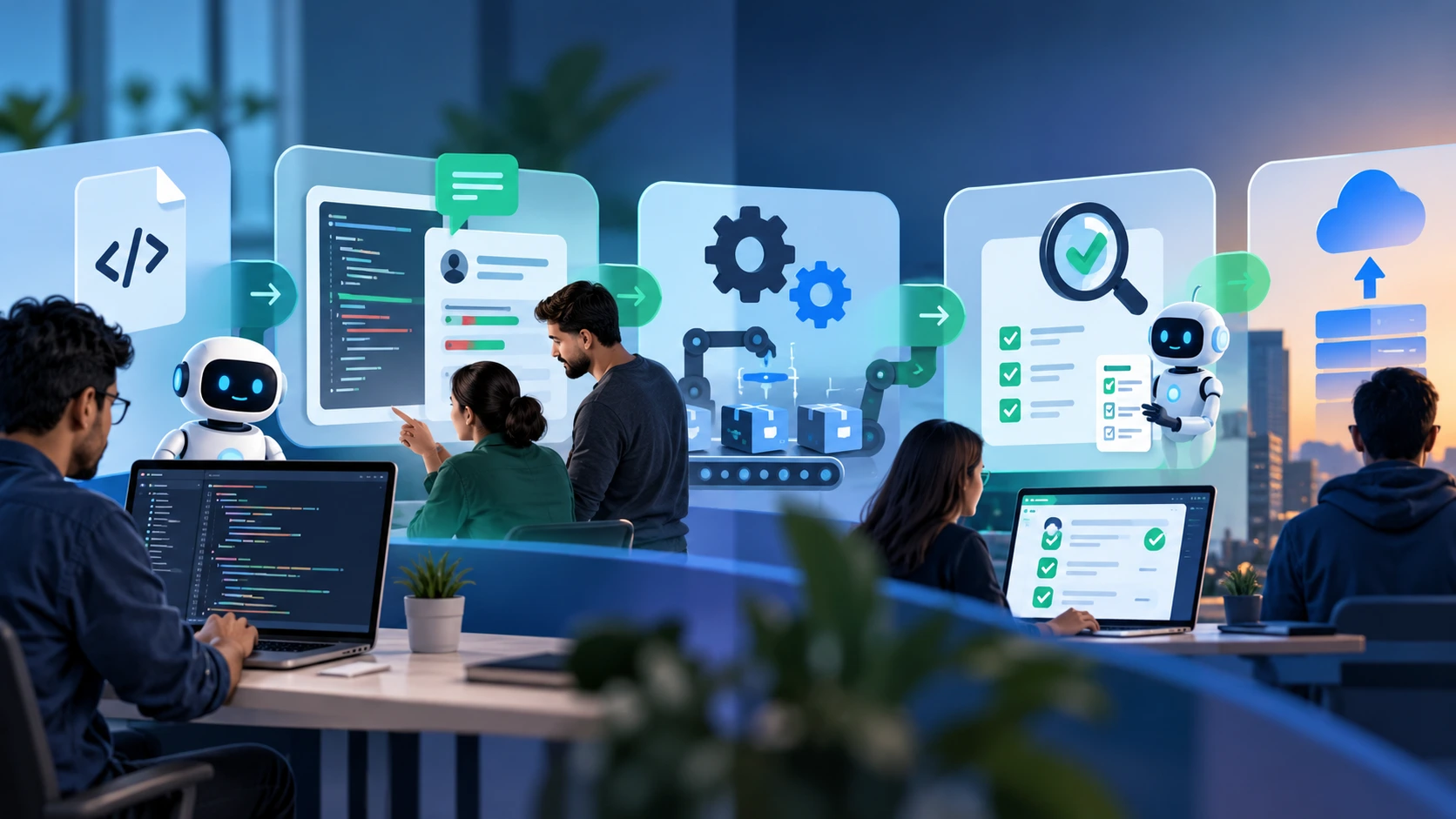
The AI-Native SDLC or the AI-native software development lifecycle changes how engineering teams build, review, test, deploy, and maintain software when AI becomes an active participant in development. AI can interpret requirements, generate code, create tests, review pull requests, analyze failures, and support CI/CD workflows—but faster generation also increases the importance of verification, risk-based testing, and human decision-making.
The traditional lifecycle:
Requirements → Development → Code Review → Testing → Deployment → Monitoring
is evolving toward:
Requirements + AI → AI-Assisted Development → AI-Assisted Review → Continuous Validation → Deployment → AI-Assisted Operations
The critical shift is that code generation can become faster than human verification. Recent AI-native engineering guidance increasingly identifies verification and quality gates as a new bottleneck when coding agents produce changes at high velocity.
For enterprises, the objective should not be maximum AI autonomy.
It should be:
Faster software delivery with sufficient evidence that the resulting software is correct, secure, maintainable, and fit for production.
TL;DR: How AI Changes the Software Development Lifecycle
AI-native software development does not eliminate the traditional SDLC. It changes who performs each activity, how quickly work moves through the lifecycle, and where verification happens.
The key changes are:
- AI can participate in requirements analysis and acceptance-criteria generation.
- AI can generate code faster, increasing the volume of changes requiring verification.
- AI-assisted code review can help identify defects, security concerns, and affected components.
- AI can generate tests, but test quantity does not guarantee meaningful coverage.
- AI-native QA needs to evaluate behavior, business rules, integrations, and AI-specific outputs.
- CI/CD can become more risk-aware through AI-assisted change-impact analysis and regression selection.
- AI can accelerate failure investigation but should not automatically be treated as the final root-cause authority.
- Human oversight should increase with business impact, security sensitivity, and irreversibility.
- Continuous evaluation becomes increasingly important as AI-generated software changes faster.
- QA is evolving from test execution toward lifecycle-wide quality engineering.
What Is an AI-Native Software Development Lifecycle?
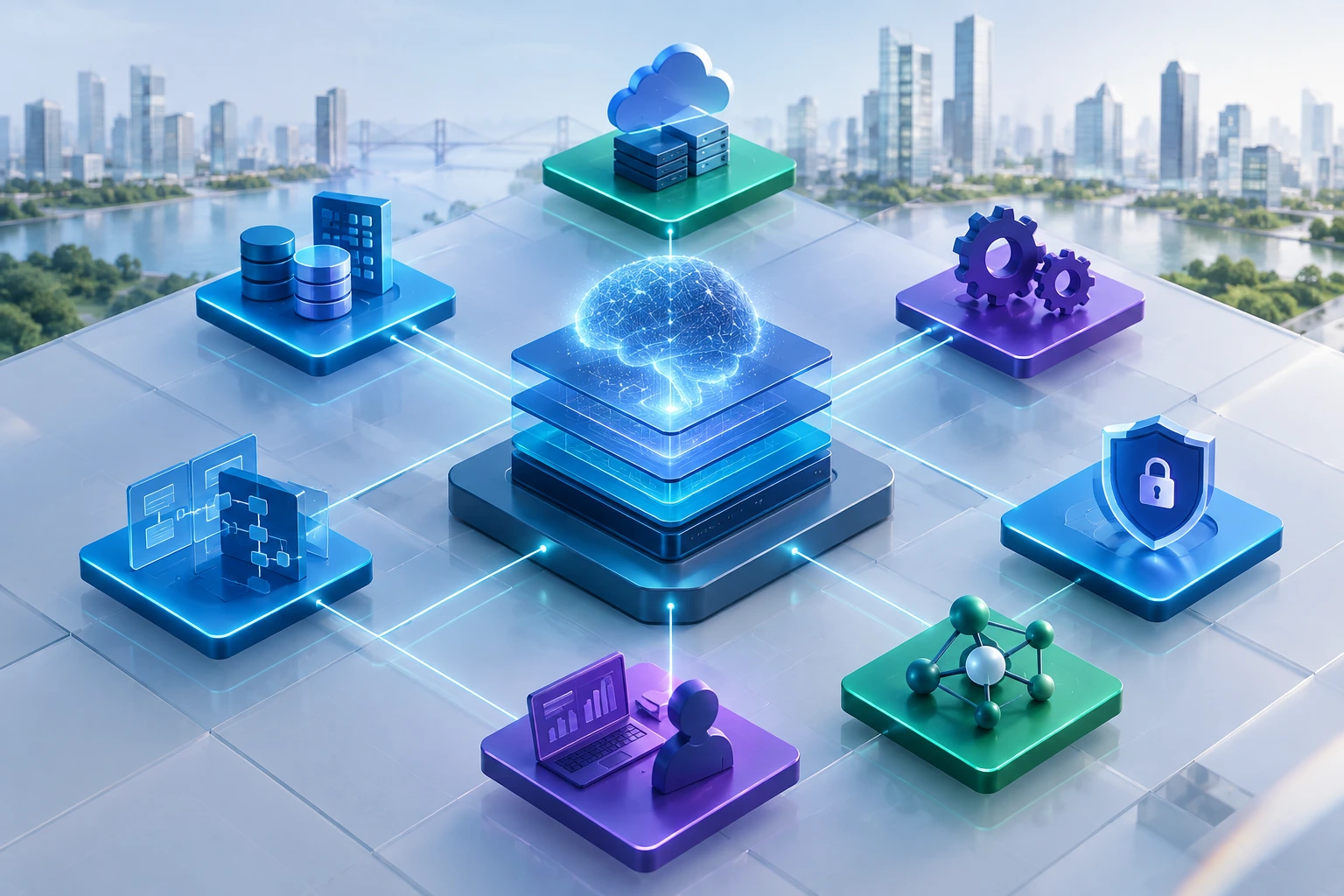
An AI-native software development lifecycle is an SDLC in which AI participates across requirements, design, coding, testing, code review, deployment, operations, and feedback rather than being used only as a coding assistant. The defining characteristic is not AI-generated code alone; it is the redesign of engineering workflows, verification, and decision boundaries around AI participation.

Research on AI-native software development similarly describes a lifecycle in which AI participates across planning, implementation, testing, and deployment, while shifting more human attention toward validation and verification.
Why AI-Native Development Changes Software Quality
AI-native development changes software quality because AI can increase the volume and speed of software changes without proportionally increasing human verification capacity. As a result, engineering organizations must evaluate not only whether code executes successfully, but whether it implements the intended business behavior, satisfies security requirements, and provides sufficient evidence for release.
Consider a requirement:
Premium customers receive a 20% discount on orders above $100.
An AI coding assistant could generate logic that applies the discount to every premium customer, regardless of order value.
The code may:
- compile successfully
- pass basic unit tests
- satisfy static analysis
- return expected responses for simple test cases
and still implement the requirement incorrectly.
This leads to a central principle:
Successful execution does not necessarily mean correct implementation.
The source article correctly identifies this distinction as one of the central challenges of AI-native engineering.
AI therefore changes the quality question from:
“Does the software work?”
to:
“Does the software behave as intended, under the scenarios and risks that matter?”
Read our blog on AI-Native Engineering Explained: The Enterprise Guide to AI-Driven Software Development
Traditional Software Engineering vs. AI-Native Engineering
| Software Engineering Activity | Traditional Approach | AI-Native Approach |
|---|---|---|
| Requirements | Human-written | Human-defined + AI analysis |
| Design | Architect-led | Human architecture + AI assistance |
| Coding | Developer implementation | Developer + coding agent |
| Code review | Human review | Automated + AI-assisted + human review |
| Test creation | QA/developer authored | AI-generated + human validated |
| Regression | Fixed suites | Fixed + risk-based selection |
| Failure analysis | Manual investigation | AI-assisted investigation |
| CI/CD | Rule-based gates | Rule-based + AI-assisted analysis |
| Release | Human-led | Automated workflows + approval policies |
| Operations | Human monitoring | AI-assisted detection and analysis |
| Learning loop | Retrospectives/incidents | Production feedback + evaluation |
The important point is that AI-native engineering does not replace established engineering practices. It changes how those practices are performed and where they fit into the lifecycle.
How AI Changes the Software Development Lifecycle
1. Requirements: Validate AI’s Understanding
AI can accelerate requirements analysis, but human teams still need to validate whether the AI correctly understood business intent, constraints, acceptance criteria, and edge cases. An incorrect interpretation at the requirements stage can propagate through architecture, implementation, testing, and release.

If the requirement is misunderstood at the beginning, every downstream artifact can reinforce the same mistake.
AI can help identify:
- ambiguous requirements
- missing acceptance criteria
- conflicting business rules
- negative scenarios
- boundary conditions
- missing dependencies
- unclear assumptions
- potential failure scenarios
QA and engineering teams should then validate whether those interpretations are correct and testable.
A useful requirement gate
Before implementation begins, ask:
Could an engineer or AI coding agent implement this requirement without guessing?
If the answer is no, the requirement is not ready.
This principle is increasingly reflected in AI-native development approaches that treat specifications and requirements as executable inputs rather than informal handoff documents.
2. AI-Generated Code: Faster Development, New Verification Risks
AI-generated code can accelerate implementation across APIs, database queries, UI components, configuration, infrastructure, and application logic, but the increased generation rate also increases the need for verification. AI-generated code should remain subject to established engineering controls such as static analysis, security scanning, testing, architectural review, and peer review.
AI can generate:
- APIs
- database queries
- application logic
- UI components
- infrastructure configuration
- test code
- documentation
- integration code
- refactoring changes
But generated code can also contain:
- incorrect business logic
- security vulnerabilities
- missing edge cases
- performance problems
- unsuitable dependencies
- architectural inconsistencies
- incorrect assumptions about existing systems
NIST has specifically established evaluation work around AI-generated software tests, highlighting the need to measure whether AI-generated tests are actually effective rather than assuming generation equals quality.
The engineering objective therefore becomes:
Faster development without faster defect generation.
3. AI-Assisted Code Review: Focus Human Attention Where Risk Is Highest
AI-assisted code review can reduce review effort by summarizing pull requests, identifying potential defects, highlighting security concerns, and identifying affected components. However, AI review should complement rather than eliminate engineering judgment, particularly for architecture, business logic, security, and high-impact changes.
A practical review flow is:
AI Review
    ↓
Automated Checks
    ↓
Developer Review
    ↓
QA Validation
    ↓
Release Decision
AI can help reviewers identify:
- code smells
- likely defects
- security concerns
- missing tests
- affected dependencies
- duplicated logic
- risky changes
- potential regression areas
For example:
A change to an isolated UI component may require limited regression.
A change to:
- authentication
- authorization
- payment processing
- shared APIs
- customer identity
- data-access layers
may require substantially broader validation.
Read our blog on AI Coding Agents in Enterprise Software Development: Use Cases, Risks & Best Practices
The principle
Human review should be risk-focused, not merely line-focused.
Recent AI-native SDLC guidance similarly emphasizes that the bottleneck moves toward verification when coding agents substantially increase implementation throughput.
4. AI-Generated Tests: More Tests Do Not Mean Better Testing
AI can generate test cases rapidly, but test volume is not the same as test effectiveness. AI-generated tests must be evaluated for requirements coverage, business-rule coverage, assertions, edge cases, integration behavior, and regression value.
Consider:
Submit Payment
      ↓
HTTP 200
      ↓
PASS
A test like this may pass even if:
- the wrong amount was charged
- the transaction was not persisted
- duplicate payment occurred
- downstream reconciliation failed
- the wrong customer account was updated
The more important question is:
What does this test actually prove?
QA should evaluate AI-generated tests against:
- business requirements
- positive scenarios
- negative scenarios
- boundary conditions
- integration behavior
- failure handling
- security conditions
- expected state changes
- meaningful assertions
- regression impact
NIST’s code-generation evaluation work is particularly relevant here because it focuses on measuring the effectiveness of AI-generated unit tests rather than simply counting generated tests.
5. AI-Native QA Gates: From Test Execution to Evidence
AI-native QA gates combine traditional software quality controls with AI-specific evaluation of behavior, outputs, grounding, tool usage, business rules, and workflow behavior. The goal is not to add more gates everywhere, but to introduce the right evidence at the right risk level.
Current AI-native engineering material emphasizes layered verification using deterministic checks, AI-assisted review, deployment safeguards, and runtime observability.
A traditional pipeline may look like:
Build
 ↓
Unit Tests
 ↓
Security
 ↓
Integration
 ↓
Regression
 ↓
Release
An AI-native pipeline can extend this to:
Build
 ↓
Unit Tests
 ↓
Static Analysis
 ↓
Security
 ↓
Integration
 ↓
Regression
 ↓
AI Evaluation
 ↓
Risk Assessment
 ↓
Release
Not every application needs every AI-specific gate.
Controls should depend on:
- application risk
- business impact
- AI functionality
- autonomy level
- data sensitivity
- regulatory requirements
- production exposure
The source article makes this same risk-based distinction: quality gates should be aligned to application risk rather than applied uniformly.
Read our blog on Legacy Modernization Services in 2026.
Traditional QA Metrics vs. AI-Native Quality Signals
| Traditional Metric | AI-Native Quality Question |
|---|---|
| Test pass rate | What behavior was actually validated? |
| Automation coverage | Are high-risk scenarios covered? |
| Test count | Are generated tests meaningful? |
| Code coverage | Does execution represent business behavior? |
| Defect count | Are recurring AI-related failure patterns identified? |
| Regression duration | Can validation be prioritized by risk? |
| Build success | Does the change satisfy intended behavior? |
| PR approval | What evidence supports the approval? |
Traditional metrics remain valuable.
The difference is that AI-native development adds another layer:
Evidence of behavioral correctness.
CI/CD: When Development Becomes Faster
AI-assisted development can increase both development velocity and change volume, placing additional pressure on CI/CD pipelines. AI can help identify impacted components, prioritize high-risk changes, recommend regression tests, analyze failed builds, and summarize likely causes.
A useful AI-assisted CI/CD workflow is:
Code Change
    ↓
Impact Analysis
    ↓
Risk Classification
    ↓
Relevant Tests
    ↓
Automated Validation
    ↓
AI-Assisted Failure Analysis
    ↓
Human / Policy Gate
    ↓
Release
Consider two changes:
Change A
Small UI text adjustment.
Change B
Shared authentication-service modification.
They should not necessarily receive identical validation.
Risk-based CI/CD can prioritize broader testing for changes with:
- larger dependency graphs
- security implications
- database changes
- shared infrastructure
- authentication impact
- financial impact
- customer-data impact
This is where AI can improve delivery efficiency without weakening quality controls.
Failure Analysis: From Logs to Investigation
AI can accelerate software failure analysis by correlating logs, stack traces, test failures, recent commits, deployment events, and dependency information. However, AI-generated diagnoses should be treated as hypotheses until engineers verify the underlying evidence.
A practical workflow is:
Test / Production Failure
          ↓
AI Analysis
          ↓
Possible Causes
          ↓
Evidence Collection
          ↓
Engineer Investigation
          ↓
Confirmed Root Cause
          ↓
Remediation
Possible causes may include:
- application defects
- test-data problems
- environment issues
- deployment configuration
- infrastructure failures
- external dependencies
- race conditions
- recent code changes
The important distinction is:
AI can accelerate investigation.
It should not automatically become:
the authority that declares the root cause.
This preserves the source article’s important emphasis on evidence and human confirmation.
Human Oversight in AI-Native Software Engineering
AI-native engineering does not mean making every engineering activity autonomous. Human oversight should be proportional to business impact, reversibility, security sensitivity, and operational risk. Low-risk tasks can support greater automation, while high-impact changes should retain explicit human or policy-based approval.
A practical model is:
| Engineering Activity | AI Role | Human Involvement |
|---|---|---|
| Code formatting | Execute | Minimal |
| Documentation | Generate | Review as needed |
| Unit-test generation | Generate | Review |
| Pull-request analysis | Recommend | Developer review |
| Regression selection | Recommend | QA/engineering review |
| Failure investigation | Analyze | Engineer confirms |
| Production deployment | Assist | Policy-based approval |
| Security-sensitive change | Assist | Mandatory review |
| Critical business change | Assist | Mandatory approval |
The governing principle is:
The higher the impact of an action, the stronger the human decision boundary should be.
This preserves one of the strongest expert insights in the original article.
How the QA Role Is Evolving in AI-Native Development
AI-native development expands QA from test execution toward lifecycle-wide quality engineering. QA increasingly contributes to requirements validation, risk assessment, test strategy, AI evaluation, release readiness, observability, and production feedback—not simply executing test cases after development.
Traditional QA often follows:
Test
 ↓
Find Defect
 ↓
Report
 ↓
Retest
AI-native quality engineering expands this to:
Requirement Analysis
        ↓
Risk Assessment
        ↓
Test Strategy
        ↓
Continuous Validation
        ↓
AI Evaluation
        ↓
Release Readiness
        ↓
Production Feedback
        ↺
QA professionals increasingly need capabilities across:
- AI-assisted testing
- automation
- APIs and integrations
- CI/CD
- AI evaluation
- risk-based testing
- observability
- data quality
- failure analysis
- security testing
The role shifts from:
“How many tests did we execute?”
toward:
“What risk did we validate, and what evidence do we have?”
AI-Native Quality Engineering: What Should Be Tested?
A mature AI-native QA strategy should validate four layers.
Layer 1: Code Quality
- compilation
- linting
- type checking
- static analysis
- dependency checks
- code quality
Layer 2: Application Behavior
- functional tests
- integration tests
- API tests
- end-to-end tests
- regression tests
- performance tests
Layer 3: AI Behavior
Where applicable:
- output quality
- grounding
- consistency
- tool usage
- prompt behavior
- model behavior
- AI workflow execution
- business-rule adherence
Layer 4: Production Behavior
- runtime failures
- anomalies
- user feedback
- model regressions
- workflow failures
- operational impact
- business outcomes
This layered approach reflects the broader direction of current AI-native engineering guidance: deterministic checks remain foundational, while AI-specific evaluation and runtime evidence become additional quality layers.
A Practical AI-Native Quality Gate
A useful enterprise pipeline is:
                    ┌───────────────┐
                    │ Requirements  │
                    └───────┬───────┘
                            ↓
                    ┌───────────────┐
                    │ AI Planning   │
                    └───────┬───────┘
                            ↓
                    ┌───────────────┐
                    │ AI Development│
                    └───────┬───────┘
                            ↓
              ┌───────────────────────────┐
              │ Deterministic Validation │
              │ Build | Lint | Unit      │
              │ Security | Integration   │
              └────────────┬──────────────┘
                           ↓
              ┌───────────────────────────┐
              │ AI-Assisted Review       │
              │ Risk | Impact | Quality  │
              └────────────┬──────────────┘
                           ↓
              ┌───────────────────────────┐
              │ AI / Behavioral Eval     │
              │ Output | Grounding |     │
              │ Workflow | Business Rule │
              └────────────┬──────────────┘
                           ↓
                    ┌───────────────┐
                    │ Human / Policy│
                    │ Decision Gate │
                    └───────┬───────┘
                            ↓
                         Release
                            ↓
                       Observability
                            ↓
                     Production Feedback
                            ↺
The important architectural principle is that AI-generated output should move through increasingly expensive and context-aware validation layers before high-impact release decisions are made.
Recent AI-native engineering guidance describes a similar layered model combining deterministic guardrails, AI review, deploy-time safety, and runtime monitoring.
A Practical Adoption Model for AI-Native Engineering
Enterprises can adopt AI-native software engineering progressively rather than attempting full autonomy immediately. A staged model starts with AI-assisted development, expands into AI-assisted validation and orchestration, and eventually introduces controlled autonomy with explicit permissions, quality thresholds, and escalation rules.
Stage 1 — AI-Assisted Development
Use AI for:
- code generation
- refactoring
- documentation
- test creation
- debugging
- code explanation
Primary control: developer review.
Stage 2 — AI-Assisted Validation
Introduce AI for:
- code review
- test analysis
- regression selection
- failure investigation
- impact analysis
Primary control: engineering and QA validation.
Stage 3 — AI-Orchestrated Engineering Workflows
Connect activities such as:
Requirement
    ↓
Plan
    ↓
Code
    ↓
Test
    ↓
Analyze
    ↓
Pull Request
    ↓
Validation
with explicit checkpoints.
Primary control: workflow and policy gates.
Stage 4 — Controlled Autonomy
Allow AI agents to perform selected tasks within:
- defined permissions
- security policies
- quality thresholds
- scope boundaries
- approval rules
- escalation mechanisms
- audit requirements
Primary control: risk-based autonomy.
The objective is not maximum autonomy.
The objective is appropriate autonomy based on risk and evidence.
This is one of the strongest principles in the original expert-authored article and should remain a prominent thesis rather than being diluted by SEO additions.
AI-Native SDLC: Where Human Judgment Moves
One of the biggest changes is not the disappearance of human engineering work.
It is the relocation of human attention.
| Traditional Focus | AI-Native Focus |
|---|---|
| Write code | Define intent |
| Write every test | Define meaningful coverage |
| Review every line equally | Review high-risk changes |
| Investigate every failure manually | Validate AI-generated hypotheses |
| Execute fixed regression | Prioritize risk |
| Approve based on process | Approve based on evidence |
| Monitor systems | Interpret production signals |
Recent AI-native lifecycle research similarly describes a shift from humans as primary implementers toward humans acting more heavily as validators and verifiers.
Enterprise Insight: Quality Becomes a Lifecycle Capability
For enterprises, the largest change may not be AI-generated code itself.
It may be the redesign of the engineering operating model around AI.
If AI:
- produces code faster → teams need efficient verification
- generates tests → teams need meaningful test evaluation
- reviews pull requests → teams need clear review responsibility
- investigates failures → teams need reliable evidence
- executes workflows → teams need explicit boundaries
- increases change volume → CI/CD needs risk-based validation
Quality therefore becomes a lifecycle capability rather than a final testing activity.
The source article’s core conclusion is especially strong here: AI acceleration only creates sustainable value when engineering teams retain the visibility, controls, and evidence required to trust what is being delivered.
Common Mistakes in AI-Native Software Delivery
| Mistake | Why It Fails | Better Approach |
|---|---|---|
| Treating AI-generated code as trusted code | AI can misunderstand requirements | Validate behavior |
| Measuring test volume | More tests may not mean better coverage | Measure evidence and risk coverage |
| Removing human review completely | High-impact decisions still require judgment | Risk-based review |
| Using AI review as the only review | AI can miss architectural/business issues | Layered review |
| Keeping identical QA gates for every change | Not all changes have equal risk | Risk-based validation |
| Treating HTTP 200 as success | Technical success may hide business failure | Validate business outcomes |
| Letting AI declare root cause | AI analysis can be wrong | Require evidence and confirmation |
| Adding AI without changing CI/CD | Verification becomes the bottleneck | Redesign quality gates |
| Making everything autonomous | Complexity and risk increase unnecessarily | Controlled autonomy |
| Ignoring production feedback | Evaluation becomes stale | Continuous learning loop |
How to Measure AI-Native Software Quality
A mature AI-native engineering organization should measure more than traditional test metrics.
Development Metrics
- cycle time
- deployment frequency
- pull-request throughput
- change volume
- rework rate
Quality Metrics
- escaped defects
- regression failures
- defect recurrence
- test effectiveness
- risk coverage
- production incidents
AI-Specific Quality Signals
Where AI participates directly:
- AI output accuracy
- evaluation scores
- grounding
- behavioral consistency
- tool-call correctness
- AI workflow success
- failure patterns
Operational Metrics
- mean time to detection
- mean time to recovery
- deployment failure rate
- rollback rate
- production anomalies
The goal is not simply:
“Did AI make developers faster?”
It is:
“Did AI improve engineering throughput without degrading software quality, security, reliability, or business outcomes?”
DORA’s AI-assisted software-development research is useful context here because it emphasizes measuring AI’s broader effects on delivery systems rather than treating individual developer productivity as the only outcome.
The AI-Native Quality Engineering Loop
A sustainable operating model is:
Intent
  ↓
AI-Assisted Development
  ↓
Automated Verification
  ↓
AI-Assisted Review
  ↓
Risk-Based Release
  ↓
Production Observability
  ↓
Incident / Feedback Analysis
  ↓
New Tests + Rules + Evaluation Cases
  ↓
Future Development
  ↺
Every production failure should ideally create a reusable artifact:
Failure → Root Cause → Regression Test → Quality Rule → Future Prevention
This turns production experience into engineering knowledge.
Key Takeaways
- AI-native software development changes the entire lifecycle, not just coding.
- AI-generated code increases the importance of verification.
- Successful execution does not necessarily mean correct implementation.
- AI-assisted code review should focus human attention on higher-risk changes.
- More AI-generated tests do not automatically mean better testing.
- QA should evaluate the quality of evidence produced by testing.
- AI-native CI/CD should use risk-based validation rather than identical gates for every change.
- AI can accelerate failure investigation but should not automatically determine root cause.
- Human oversight should increase with business impact and irreversibility.
- Continuous evaluation and production feedback should become part of the engineering lifecycle.
- The objective is not maximum AI autonomy; it is appropriate autonomy supported by evidence and controls.
Conclusion
AI-native software development is moving engineering toward a collaborative model involving developers, QA teams, automation, AI assistants, and increasingly capable coding agents.
The opportunity is substantial:
faster implementation, faster analysis, faster testing, and faster iteration.
But speed changes the quality equation.
When AI can generate software faster than humans can review it, verification becomes the constraint.
When AI can generate hundreds of tests, test effectiveness becomes more important than test count.
When AI can investigate failures, evidence becomes more important than confident explanations.
And when AI can execute engineering workflows, explicit human and policy boundaries become essential.
QA therefore has an expanding role across the lifecycle:
Requirements → Risk → Test Strategy → Validation → Release Readiness → Production Feedback
The future of AI-native engineering is not simply about allowing AI to do more.
It is about designing a software delivery system where AI can move faster while engineering teams retain the visibility, controls, accountability, and evidence required to trust the result.
AI can accelerate software engineering. Quality engineering determines whether that acceleration can be trusted.
FAQs: AI-Native Software Development Lifecycle
1. What is an AI-native software development lifecycle?
An AI-native software development lifecycle is an SDLC in which AI participates across requirements, planning, coding, testing, code review, CI/CD, deployment, operations, and feedback. It combines AI-assisted execution with deterministic engineering controls and human decision-making.
2. How does AI change the software development lifecycle?
AI can participate in requirements analysis, code generation, test creation, code review, regression selection, debugging, failure analysis, CI/CD, and operational monitoring. This increases development velocity while creating a greater need for verification and risk-based quality controls.
3. Does AI-generated code reduce the need for QA?
No. AI-generated code still requires validation for business behavior, security, integrations, edge cases, performance, maintainability, and regression impact. As code-generation volume increases, QA increasingly focuses on risk, evidence, and test effectiveness.
4. Are AI-generated tests reliable?
AI-generated tests can accelerate test creation, but their effectiveness depends on whether they validate meaningful requirements, business rules, edge cases, expected outcomes, and failure scenarios. Test quantity alone does not establish coverage.
5. What are AI-native quality gates?
AI-native quality gates combine traditional engineering checks with AI-specific evaluations. Depending on the application, these can include build validation, security testing, functional testing, regression testing, output evaluation, grounding, tool-call behavior, business-rule adherence, and workflow validation.
6. How is QA changing because of AI?
QA is expanding from test execution toward quality engineering across the lifecycle. QA teams increasingly contribute to requirements analysis, risk assessment, test strategy, AI evaluation, release readiness, observability, failure analysis, and production feedback.
7. How should enterprises validate AI-generated software?
Enterprises should use layered validation: deterministic checks, security scanning, unit and integration tests, behavioral and regression testing, AI-specific evaluation where applicable, risk-based review, and production observability.
Related Reads
- AI Data Engineering: Building Autonomous Enterprise Data Pipelines.
- How to Build AI-Native Applications for Enterprise Scale.
- Legacy Modernization Services in 2026: How Enterprises Are Cutting Costs with AI
- Enterprise AI agent adoption challenges
- AI-Native Engineering Explained: The Enterprise Guide to AI-Driven Software Development