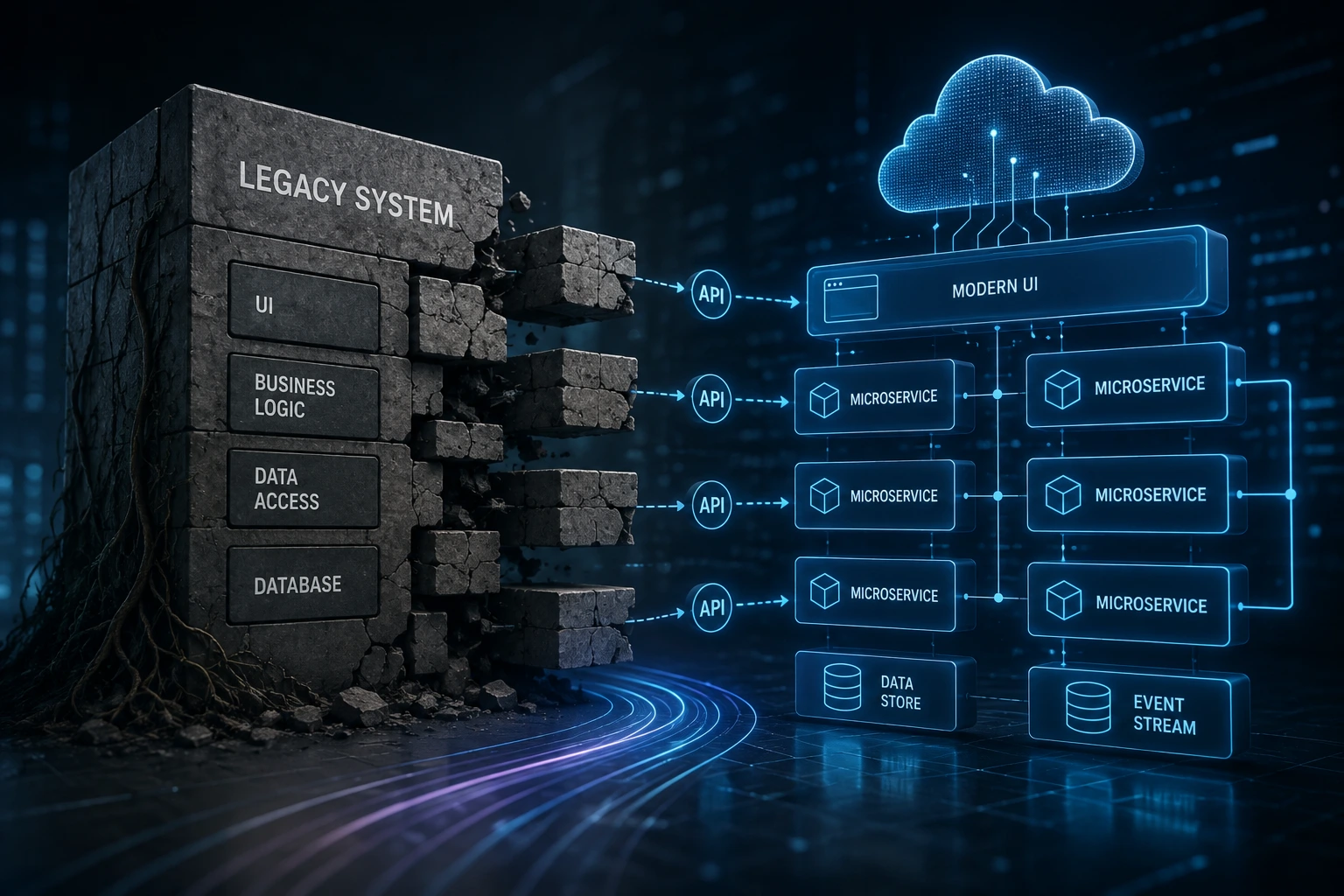
What is the Strangler Fig Pattern in legacy modernization?
The Strangler Fig Pattern is an incremental approach to legacy modernization in which new functionality is built alongside an existing application and gradually takes over its responsibilities. Traffic is progressively routed to the modern components while the legacy system continues operating, reducing migration risk and allowing organizations to modernize without a complete rewrite.
TL;DR
- The Strangler Fig Pattern modernizes legacy applications incrementally instead of replacing them in one large cutover.
- New services or application components are built around the existing system.
- A facade, proxy, gateway, or routing layer directs traffic between legacy and modern functionality.
- Teams migrate one capability at a time while the legacy application continues to operate.
- Successful migrations typically follow transform → coexist → eliminate.
- Start with a well-understood, valuable capability rather than the most complicated part of the application.
- Automated testing, observability, rollback, and dependency mapping are critical.
- The pattern reduces big-bang migration risk but introduces temporary architectural and operational complexity.
What Is the Strangler Fig Pattern?
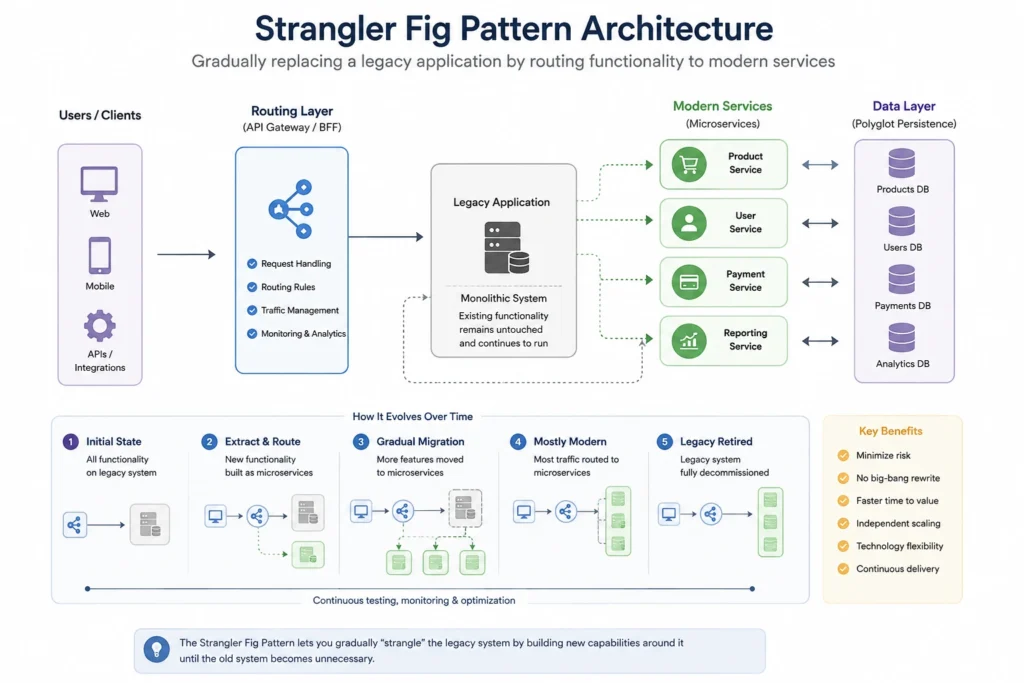
The Strangler Fig Pattern is a legacy modernization technique that gradually replaces an existing application by moving individual capabilities into new services or applications. Instead of rewriting the entire system at once, enterprises run the old and new systems together and progressively route functionality to the modern implementation.
The pattern was popularized by Martin Fowler as a way to reduce the risk associated with large-scale system rewrites. AWS and Microsoft both document the approach as an incremental modernization pattern.
The basic idea is:
Legacy application → Introduce routing layer → Build modern capability → Shift traffic → Retire legacy capability → Repeat
Eventually, the legacy application has nothing meaningful left to serve and can be decommissioned.
The Strangler Fig Pattern was popularized by Martin Fowler as an approach for gradually replacing legacy functionality rather than attempting a high-risk, all-at-once rewrite.
Read our blog on Legacy Modernization Services in 2026
How the Strangler Fig Pattern Works
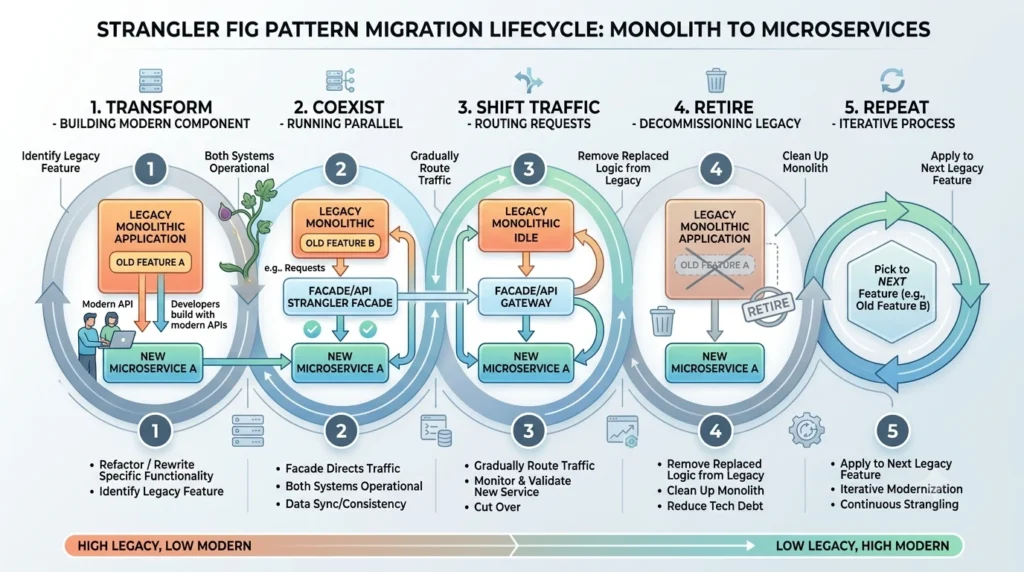
The Strangler Fig Pattern typically works through three core phases:
1. Transform
Identify a capability within the legacy application and implement its modern replacement.
This could be:
- Customer profile
- Product catalog
- Order management
- Authentication
- Payments
- Reporting
- Notifications
- Search
- Pricing
The new capability can be implemented as a service, modular application component, or independently deployable workload.
2. Coexist
The legacy and modern implementations operate simultaneously.
A facade, API gateway, reverse proxy, or routing layer sits between consumers and the underlying applications.
Initially:
100% traffic → Legacy
As capabilities are migrated:
Traffic → Router → Legacy OR Modern Service
This provides an important advantage: the business can continue operating while modernization progresses. Microsoft describes the facade as an intermediary that routes requests to either the legacy application or new services.
3. Eliminate
Once a capability has been successfully migrated and validated:
Traffic → Modern Service
The corresponding legacy functionality can then be removed.
Repeat this process until the legacy application can be safely decommissioned.
AWS describes these stages as transform, coexist, and eliminate.
Strangler Fig vs. Big-Bang Rewrite
The biggest reason enterprises consider the Strangler Fig Pattern is that a complete rewrite concentrates risk into one major transformation event.
| Factor | Strangler Fig Pattern | Big-Bang Rewrite |
|---|---|---|
| Migration approach | Incremental | All at once |
| Legacy system | Continues operating | Eventually replaced |
| Value delivery | Early and continuous | Usually delayed |
| Rollback | Possible per migration slice | More difficult |
| Production risk | Distributed | Concentrated |
| Testing | Incremental | Large-scale final validation |
| Business disruption | Lower potential | Higher potential |
| Architecture complexity | Temporary coexistence | Simpler after cutover |
| Change management | Continuous | Large transition |
| Best suited for | Complex evolving systems | Smaller or well-understood systems |
The trade-off: Strangler Fig reduces transformation risk, but the organization must manage a period in which old and new architectures coexist.
When Should You Use the Strangler Fig Pattern?
The Strangler Fig Pattern is particularly useful when the legacy application is too important, complex, or risky to replace in a single release.
Consider it when:
- The application is business-critical.
- A big-bang migration carries unacceptable risk.
- The system contains identifiable business capabilities.
- The organization needs to continue delivering features during modernization.
- Components can be separated incrementally.
- Traffic can be intercepted or redirected.
- The legacy system must remain available during transition.
- The business wants measurable progress before full decommissioning.
AWS recommends the pattern when gradual migration is required, business continuity matters, and a large-scale rewrite would introduce significant transformation risk.
Read more about Application Modernization Challenges.
How to Choose the First Capability to Strangle
The first migration slice can determine whether the modernization program gains momentum or becomes another source of complexity.
A strong first candidate typically has:
| Selection Factor | Ideal First Candidate |
|---|---|
| Business value | Clearly measurable |
| Technical complexity | Low to moderate |
| Dependencies | Limited and understood |
| Test coverage | Good |
| Deployment frequency | Relatively high |
| Scalability need | Visible |
| Ownership | Clearly defined |
| Failure impact | Contained |
| Modernization feasibility | High |
AWS recommends considering components with good test coverage, lower technical debt, scalability requirements, or frequent business changes when selecting candidates.
A useful rule: Don’t start with the largest component. Start with the smallest meaningful capability that can prove the modernization approach.
Thoughtworks similarly emphasizes finding the right-sized migration slices—the “Goldilocks zone”—rather than attempting either tiny meaningless changes or excessively large migration chunks.
Read our blog on Legacy Modernization Best Practices: Strategies for Enterprise Success
Strangler Fig Architecture: A Simple Enterprise Model
A typical architecture looks like this:
Users / Applications
↓
API Gateway / Facade / Routing Layer
↓ ↓
Modern Services | Legacy Application
↓
Modern Data Store / Integration Layer
The routing layer becomes strategically important because it hides the migration from consumers.
For example:
/customers → Modern Customer Service
/orders → Legacy Order Module
/payments → Modern Payment Service
As migration progresses, more routes move away from the legacy application.
Microsoft’s architecture guidance illustrates this progression from routing traffic between legacy and new components to fully decommissioning the legacy system and eventually removing the facade.
The Hardest Part: Data Migration and Dependencies
Moving application code is often easier than separating its data.
Legacy applications frequently contain:
- Shared databases
- Stored procedures
- Cross-module transactions
- Shared tables
- Batch jobs
- Direct database access
- Hidden integrations
- Hard-coded dependencies
If a new service is extracted but still depends heavily on the legacy database, the organization may have created a distributed monolith rather than a modern architecture.
A practical approach is to define ownership for each data domain and progressively reduce dependencies on shared legacy data.
Thoughtworks highlights data synchronization as a key technical consideration and recommends carefully understanding dependencies while simplifying synchronization as more functionality moves to the new system.
Read more on Rehost vs Refactor vs Rebuild vs Replace Explained
Strangler Fig Modernization Best Practices
Successful Strangler Fig modernization depends on small migration slices, clear service boundaries, automated testing, controlled traffic routing, observability, and disciplined legacy retirement.
1. Map dependencies before extracting functionality
Understand:
- API calls
- Database dependencies
- Events
- Batch jobs
- Authentication
- External integrations
- Shared libraries
- Upstream and downstream systems
2. Define boundaries around business capabilities
Don’t simply extract code because it is technically convenient.
Ask:
Can this capability be independently owned, tested, deployed, scaled, and operated?
3. Put an explicit routing mechanism in place
The routing layer should make traffic ownership visible and controllable.
4. Automate regression testing
Every migrated capability should have sufficient automated coverage before traffic is shifted.
5. Use observability as a migration control
Track:
- Error rates
- Latency
- Throughput
- Business transactions
- Availability
- Dependency failures
- New vs. legacy traffic
6. Restrict unnecessary legacy enhancements
Continuously adding features to the legacy system can increase the amount of functionality that eventually needs to be migrated. Thoughtworks recommends actively managing legacy enhancements during the modernization period.
7. Define retirement criteria upfront
A migration isn’t complete simply because traffic has moved.
Define when a legacy component can be:
Disconnected → Archived → Decommissioned
Common Strangler Fig Mistakes
Treating it as “microservices by default”
The pattern does not require every extracted capability to become a microservice. The modernization architecture should follow business and technical boundaries.
Extracting without dependency analysis
A seemingly independent module may depend on shared database tables, batch processes, or undocumented integrations.
Running two systems indefinitely
Coexistence is a migration phase—not the end state.
Ignoring observability
Without production telemetry, teams cannot confidently determine whether the modern component is performing as expected.
Recreating every legacy feature
Modernization is an opportunity to reassess functionality. Some legacy capabilities may be obsolete and should be retired rather than rebuilt. Thoughtworks specifically warns against assuming complete feature parity is always desirable.
Moving traffic without rollback
Every migration slice should have a defined rollback mechanism before production cutover.
Read our blog on Modernize Legacy Applications Without Rewriting.
A Practical Strangler Fig Modernization Roadmap
Assess → Decompose → Route → Build → Test → Shift → Observe → Retire → Repeat
Phase 1: Assess
Inventory the legacy application, business capabilities, dependencies, data, risks, and operational constraints.
Phase 2: Decompose
Identify candidate capabilities and establish sensible boundaries.
Phase 3: Introduce the routing layer
Create the facade, gateway, proxy, or equivalent interception mechanism.
Phase 4: Modernize one capability
Build the replacement independently while the legacy implementation remains available.
Phase 5: Validate
Compare functional behavior, performance, security, reliability, and business outcomes.
Phase 6: Shift traffic
Move traffic gradually where appropriate, using controlled releases or canary techniques.
Phase 7: Retire
Remove the replaced legacy functionality and its unnecessary dependencies.
Phase 8: Repeat
Apply the pattern to the next capability.
How to Know When the Legacy Application Is Ready to Retire
Do not decommission the legacy system simply because the replacement appears functional.
Before retirement, verify:
- All required capabilities have migrated.
- Legacy traffic has reached zero or an explicitly approved residual level.
- No critical consumers depend on legacy interfaces.
- Data reconciliation is complete.
- Monitoring confirms stable production behavior.
- Security controls are validated.
- Backup and recovery requirements are satisfied.
- Rollback requirements have expired or been replaced.
- Operational ownership has moved to the modern platform.
- Legacy infrastructure and licenses can be safely removed.
The final objective is not merely “new system running.”
It is:
“Legacy dependency eliminated.”
Key Takeaway
The Strangler Fig Pattern lets enterprises modernize legacy applications without betting production on a single rewrite.
Instead of asking:
“How do we replace this entire legacy application?”
ask:
“Which capability can we safely replace next?”
That shift—from application replacement to incremental capability migration—is what makes the pattern powerful for complex enterprise modernization programs.
For organizations modernizing legacy estates, the approach can also provide a practical foundation for cloud migration, application modernization, API modernization, AI modernization, and software engineering transformation.
Frequently Asked Questions
1. What is the Strangler Fig Pattern in software modernization?
The Strangler Fig Pattern is an incremental modernization approach where new functionality gradually replaces functionality in a legacy application while the existing system continues operating.
2. Why is it called the Strangler Fig Pattern?
The name comes from the strangler fig plant, which grows around an existing tree and gradually replaces it. In software, the new application progressively takes over responsibilities from the legacy system.
3.Does the Strangler Fig Pattern require rewriting the entire application?
No. It is specifically designed to avoid a single complete rewrite. Organizations modernize selected capabilities incrementally while keeping the legacy system operational.
4.What are the main stages of the Strangler Fig Pattern?
The commonly described stages are transform, coexist, and eliminate: build modern functionality, run it alongside the legacy system while shifting traffic, and then remove the obsolete legacy functionality.
5. What is the biggest risk of the Strangler Fig Pattern?
The biggest risk is prolonged coexistence complexity. Legacy and modern systems may create additional routing, data synchronization, testing, monitoring, and operational requirements if migration boundaries and retirement criteria are not clearly managed.
6. Can the Strangler Fig Pattern be used for monolith modernization?
Yes. It is commonly used to incrementally decompose monolithic applications and move selected capabilities into independently deployable services or applications
Related Reads
- AI Retrofit vs. Rewrite: Choosing the Right Enterprise Modernization Strategy
- Modernize Legacy Applications Without Rewriting
- 7 Critical Differences Between AI Readiness vs AI Adoption That Most Enterprises Ignore in 2026
- Enterprise AI Strategy in 2026
- AI-Ready Enterprise Checklist for Microsoft Fabric