Application modernization challenges include technical debt, legacy architecture, security vulnerabilities, cloud migration complexity, integration issues, skills shortages, and organizational resistance. Enterprises can overcome these challenges through phased modernization, cloud-native architecture, automation, DevSecOps, and a well-defined modernization roadmap aligned with business objectives.
Introduction
Application modernization has become a strategic priority as organizations strive to reduce technical debt, accelerate software delivery, strengthen security, and adopt cloud-native architectures. However, modernizing legacy applications is rarely straightforward. Aging infrastructure, monolithic architectures, integration complexity, compliance requirements, and skills shortages often slow modernization initiatives and increase project risk.
This guide explains the most common application modernization challenges, compares modernization strategies, and outlines practical best practices that help enterprises modernize legacy systems with lower risk and higher business value.
TL;DR
- Application modernization replaces or transforms legacy applications to improve scalability, security, agility, and operational efficiency.
- Technical debt, legacy architecture, cloud migration, integration, security, and organizational change are the most common modernization challenges.
- A phased modernization strategy delivers better outcomes than large-scale application rewrites.
- Cloud-native architectures, APIs, DevSecOps, automation, and platform engineering improve modernization success.
- Business KPIs—not project completion—should measure modernization ROI.
What Are Application Modernization Challenges?
Application modernization challenges are technical, operational, and organizational obstacles that make it difficult to transform legacy applications into scalable, secure, and cloud-ready solutions.
These challenges extend beyond rewriting code. Enterprises must modernize application architecture, infrastructure, deployment pipelines, security controls, integrations, and operating models while maintaining business continuity.
Without a structured application modernization strategy, organizations often experience cost overruns, delayed releases, security risks, and limited return on investment.
Read our blog on How to Build AI-Native Applications for Enterprise Scale.
Why Application Modernization Matters
Legacy applications support critical business operations, but many were designed before cloud computing, containers, APIs, and DevSecOps became standard engineering practices. As organizations pursue digital transformation, these systems become difficult to maintain, expensive to operate, and slower to evolve.
Modernizing applications helps organizations:
- Reduce technical debt
- Improve software delivery speed
- Strengthen cybersecurity
- Increase application scalability
- Lower infrastructure costs
- Improve customer experience
- Support AI, analytics, and automation initiatives
Business Impact of Legacy Applications
| Legacy Challenge | Business Impact |
|---|---|
| Technical debt | Higher maintenance costs |
| Monolithic architecture | Slow feature releases |
| Unsupported software | Increased security risks |
| Manual deployments | Lower developer productivity |
| Limited scalability | Poor customer experience |
| High infrastructure costs | Reduced operational efficiency |
What Is Application Modernization?
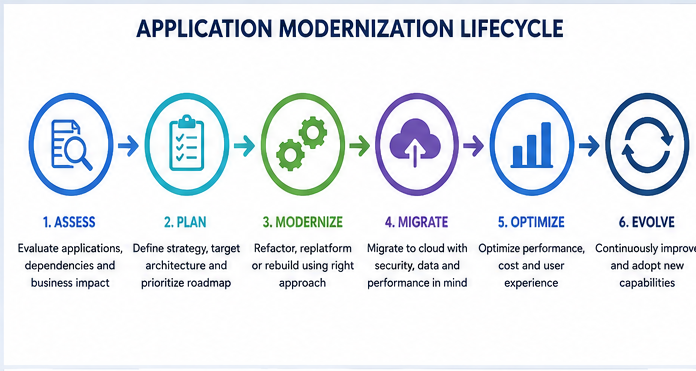
Application modernization is the process of updating legacy applications to improve performance, maintainability, scalability, security, and business agility.
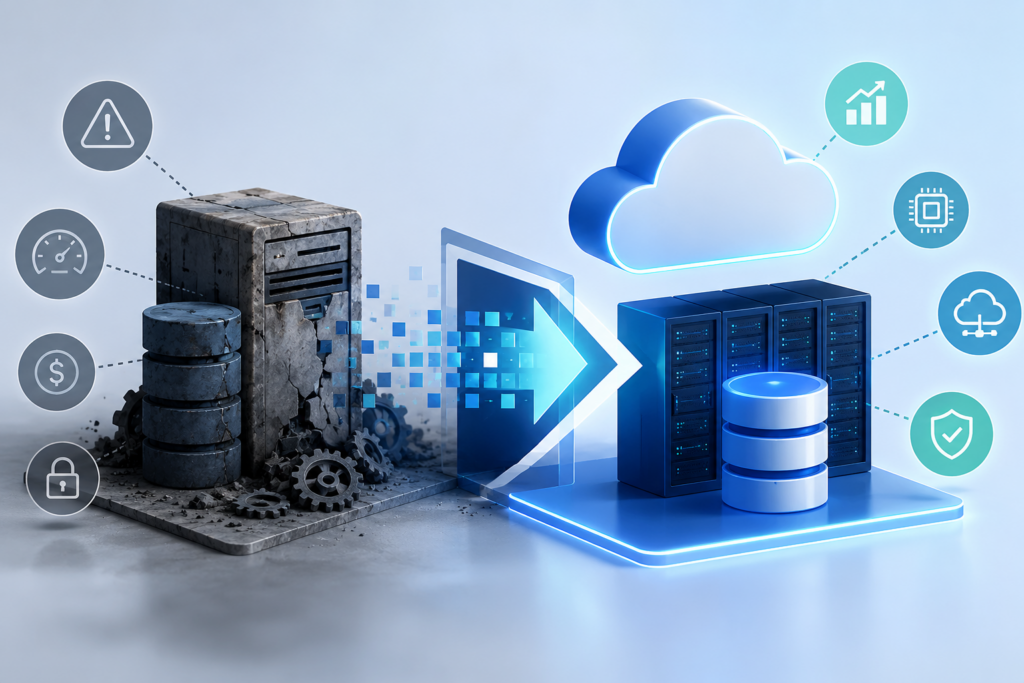
Depending on business requirements, modernization may involve migrating applications to the cloud, refactoring code, decomposing monoliths into microservices, adopting containers, replacing outdated platforms, or retiring obsolete applications.
The objective is not simply to move applications—it is to enable faster innovation while reducing operational risk.
Read expert insights in our blog on AI Data Engineering: Building Autonomous Enterprise Data Pipelines.
Common Modernization Approaches
| Approach | Best For | Benefits |
|---|---|---|
| Rehost | Quick cloud migration | Fast implementation |
| Replatform | Infrastructure upgrades | Better performance with limited code changes |
| Refactor | Reducing technical debt | Improved maintainability |
| Rearchitect | Business-critical applications | Cloud-native scalability |
| Rebuild | Obsolete applications | Modern architecture |
| Replace | Commodity capabilities | Lower maintenance effort |
Selecting the right approach depends on application value, technical complexity, compliance needs, and long-term business goals.
Top Application Modernization Challenges
Modernization initiatives rarely fail because of a single issue. Most organizations encounter a combination of technical, operational, and organizational barriers that increase project complexity.
The table below summarizes the most common application modernization challenges and the recommended approach for addressing each.
| Challenge | Business Impact | Recommended Strategy |
|---|---|---|
| Technical debt | Higher maintenance costs | Refactor incrementally |
| Legacy architecture | Poor scalability | Rearchitect or decompose |
| Cloud migration complexity | Cost overruns | Assess workloads first |
| Integration complexity | Project delays | API-first integration |
| Security and compliance | Regulatory risk | DevSecOps and Zero Trust |
| Skills gap | Slower delivery | Upskill teams and partner strategically |
| Budget constraints | Limited ROI | Prioritize high-value applications |
| Organizational resistance | Slow adoption | Strong change management |
| Data migration | Business disruption | Phased migration with validation |
| Measuring ROI | Unclear outcomes | Define business KPIs early |
In the following sections, we’ll examine each challenge, its business impact, and the most effective mitigation strategies used by successful enterprise modernization programs.Application modernization has evolved from a technology initiative into a business imperative. Organizations relying on legacy applications often struggle with rising maintenance costs, limited scalability, security vulnerabilities, and slow innovation. As digital transformation accelerates across industries, modernizing legacy systems enables enterprises to improve agility, enhance customer experiences, strengthen cybersecurity, and reduce operational costs.
Explore more in our blog on Microservices vs Monolithic AI Architecture: Enterprise Guide on What to Choose.
Top 10 Application Modernization Challenges
1. Technical Debt
Technical debt is one of the biggest application modernization challenges because outdated code, unsupported frameworks, and legacy dependencies increase maintenance costs, slow software delivery, and make modernization more expensive.
Technical debt accumulates over years of incremental changes, temporary fixes, and aging technology stacks. As it grows, engineering teams spend more time maintaining existing systems than delivering new features.
Common causes
- Legacy programming languages
- Unsupported libraries and frameworks
- Hard-coded business logic
- Duplicate code
- Manual testing and deployments
- Poor documentation
| Business Impact | Recommended Action |
|---|---|
| Slow releases | Refactor high-value applications |
| High maintenance costs | Eliminate obsolete dependencies |
| Security vulnerabilities | Upgrade supported frameworks |
| Low developer productivity | Automate testing and CI/CD |
Best practices
- Prioritize applications with the highest business value.
- Introduce automated testing before refactoring.
- Modernize APIs and remove obsolete dependencies.
- Reduce technical debt as part of every release instead of treating it as a one-time project.
Enterprise Tip: Allocate 15–20% of engineering capacity to continuous technical debt reduction to prevent modernization efforts from stalling.
2. Legacy Architecture
Monolithic applications are difficult to scale, update, and integrate, making legacy architecture a major obstacle to application modernization.
Many enterprise applications were designed for on-premises environments with tightly coupled components and shared databases. While these systems often remain reliable, they limit agility and make even small changes risky.
Common architecture challenges
- Monolithic application design
- Tight service dependencies
- Shared databases
- Limited scalability
- Long deployment cycles
- Vendor-specific platforms
| Legacy Architecture Issue | Business Impact |
|---|---|
| Monolithic design | Slower feature delivery |
| Tight coupling | Higher deployment risk |
| Shared infrastructure | Limited scalability |
| Legacy middleware | Increased operational costs |
Best practices
- Adopt domain-driven design (DDD).
- Break monoliths into independently deployable services where justified.
- Containerize workloads using Docker and Kubernetes.
- Introduce API gateways to decouple applications.
- Modernize incrementally using the Strangler Fig pattern rather than replacing everything at once.
Know more about Legacy Modernization Services in 2026: How Enterprises Are Cutting Costs with AI
3. Cloud Migration Complexity
Migrating applications to the cloud without modernizing them often transfers existing inefficiencies to a new environment.
Cloud migration and application modernization are closely related but not interchangeable. A lift-and-shift migration may reduce infrastructure management, but it does not address architectural limitations, technical debt, or scalability issues.
Common cloud migration challenges
- Legacy infrastructure dependencies
- Unsupported middleware
- Cloud cost management
- Downtime during migration
- Hybrid cloud complexity
- Vendor lock-in concerns
| Cloud Migration | Cloud Modernization |
|---|---|
| Moves applications | Improves applications |
| Infrastructure-focused | Architecture-focused |
| Faster implementation | Higher long-term value |
| Limited optimization | Cloud-native capabilities |
Best practices
- Conduct an application portfolio assessment before migration.
- Choose the right modernization path (Rehost, Replatform, Refactor, or Rearchitect).
- Automate infrastructure using Infrastructure as Code (IaC).
- Monitor cloud costs with FinOps practices.
4. Integration Complexity
Application modernization becomes significantly harder when legacy systems depend on dozens of interconnected applications, databases, and third-party services.
Many enterprises rely on tightly integrated ERP, CRM, finance, and operational systems. Modernizing one application without understanding these dependencies can interrupt critical business processes.
Common integration challenges
- Point-to-point integrations
- Legacy messaging systems
- API incompatibility
- Shared databases
- Data synchronization
- Third-party software dependencies
| Integration Challenge | Recommended Solution |
|---|---|
| Legacy interfaces | API-first architecture |
| Shared databases | Decouple services |
| Batch processing | Event-driven integration |
| Multiple applications | Integration platform (iPaaS) |
Best practices
- Standardize REST and event-driven APIs.
- Implement API gateways for centralized management.
- Use message brokers for asynchronous communication.
- Document application dependencies before modernization begins.
5. Security and Compliance
Modernization initiatives must improve security—not introduce new vulnerabilities.
Legacy applications often rely on unsupported operating systems, outdated encryption standards, and manual security controls that increase cyber risk. Modernization provides an opportunity to embed security into every stage of the software lifecycle.
Common security challenges
- Unsupported software
- Weak authentication
- Unpatched vulnerabilities
- Poor audit logging
- Legacy identity management
- Regulatory compliance requirements
| Security Risk | Modern Best Practice |
|---|---|
| Weak authentication | Multi-Factor Authentication (MFA) |
| Manual security testing | DevSecOps automation |
| Unencrypted data | End-to-end encryption |
| Limited visibility | Continuous monitoring |
Best practices
- Adopt Zero Trust principles.
- Integrate security testing into CI/CD pipelines.
- Automate vulnerability scanning.
- Apply Role-Based Access Control (RBAC).
- Align modernization with compliance requirements such as GDPR, HIPAA, PCI DSS, or ISO 27001.
Organizations should also align modernization initiatives with established security frameworks such as the NIST Cybersecurity Framework (CSF 2.0) and the OWASP Application Security Verification Standard (ASVS) to strengthen governance, risk management, and secure software development practices. Successful modernization strengthens both application resilience and regulatory compliance.
6. Skills Gap and Talent Shortages
Modern application modernization requires expertise in cloud platforms, microservices, Kubernetes, DevSecOps, APIs, and automation—skills that many organizations are still building.
Legacy application teams often possess deep business knowledge but limited experience with cloud-native development. At the same time, hiring experienced cloud architects and platform engineers remains competitive and expensive.
Common skills gaps
- Cloud architecture
- Kubernetes and containers
- Platform engineering
- DevSecOps
- Infrastructure as Code (IaC)
- API design
- Observability
- Cloud security
| Skills Challenge | Business Impact | Recommended Solution |
|---|---|---|
| Cloud expertise shortage | Slower modernization | Upskill engineering teams |
| Limited DevSecOps adoption | Manual releases | Build CI/CD pipelines |
| Shortage of cloud architects | Delayed projects | Partner with modernization specialists |
| Legacy-only expertise | Technology risk | Establish a Cloud Center of Excellence (CCoE) |
Best practices
- Invest in continuous learning and certification programs.
- Create reusable cloud and DevSecOps standards.
- Build cross-functional product teams instead of siloed infrastructure teams.
- Use experienced implementation partners for complex modernization initiatives.
7. Budget Constraints
Application modernization competes with other IT priorities, making budget allocation one of the most common barriers to modernization.
Large-scale modernization programs require investment in cloud infrastructure, application refactoring, security, automation, training, and governance. Without clear business value, modernization projects often lose executive sponsorship.
Common cost drivers
- Legacy infrastructure maintenance
- Cloud migration expenses
- Software licensing
- Third-party consulting
- Employee training
- Security and compliance
| Cost Challenge | Recommended Approach |
|---|---|
| Limited budget | Prioritize high-value applications |
| High migration cost | Modernize incrementally |
| Uncertain ROI | Define measurable business KPIs |
| Rising cloud spend | Implement FinOps practices |
Best practices
- Focus on applications that directly support revenue or customer experience.
- Modernize in phases to spread investment.
- Measure modernization against operational savings, deployment speed, and business outcomes—not just project costs.
8. Organizational Resistance
Technology modernization often fails because organizations resist process changes, new operating models, and cultural transformation.
Moving to cloud-native development requires new ways of working. Agile delivery, DevSecOps, automation, and product-centric teams may require significant organizational change.
Common organizational challenges
- Resistance to change
- Siloed IT teams
- Limited executive sponsorship
- Unclear ownership
- Poor communication
- Lack of governance
| Organizational Barrier | Recommended Solution |
|---|---|
| Resistance to change | Executive sponsorship |
| Functional silos | Cross-functional teams |
| Poor communication | Change management plan |
| Lack of ownership | Define governance early |
Best practices
- Align modernization initiatives with business objectives.
- Communicate expected outcomes early and often.
- Involve business stakeholders throughout the modernization lifecycle.
- Celebrate early wins to build momentum.
Technology transformation succeeds when people, processes, and governance evolve alongside the applications.
9. Data Migration and Modernization
Data migration is often the highest-risk phase of application modernization because business-critical information must remain accurate, secure, and available throughout the transition.
Poor planning can result in data loss, downtime, inconsistent reporting, and compliance issues.
Common data migration challenges
- Inconsistent data quality
- Legacy database structures
- Data synchronization
- Downtime risks
- Large data volumes
- Regulatory requirements
| Data Challenge | Best Practice |
|---|---|
| Poor data quality | Cleanse and validate data before migration |
| Large databases | Migrate in phases |
| Downtime concerns | Use replication and synchronization |
| Compliance risks | Encrypt and audit migrated data |
Best practices
- Assess data quality before migration.
- Classify sensitive and regulated data.
- Validate migrated data with automated testing.
- Maintain rollback plans for critical workloads.
A phased migration approach minimizes disruption while maintaining business continuity.
10. Measuring Modernization ROI
Modernization success should be measured by business outcomes—not simply by completing migration projects.
Organizations that fail to define success metrics early often struggle to justify continued investment.
Explore the most critical enterprise AI agent adoption challenges, including data readiness, governance complexity, orchestration issues, ROI ambiguity, and organizational resistance.
Key modernization KPIs
| KPI | Why It Matters |
|---|---|
| Deployment frequency | Measures engineering agility |
| Lead time for changes | Tracks delivery speed |
| Mean Time to Recovery (MTTR) | Indicates operational resilience |
| Infrastructure cost | Measures cloud optimization |
| Application availability | Evaluates reliability |
| Security vulnerabilities | Tracks cyber risk reduction |
| Customer satisfaction | Reflects business impact |
| Developer productivity | Measures engineering efficiency |
Best practices
- Establish baseline metrics before modernization begins.
- Track both engineering and business KPIs.
- Continuously optimize applications after deployment.
- Review modernization outcomes quarterly to identify opportunities for improvement.
Strategies to Overcome Application Modernization Challenges
Modernization is most successful when organizations combine technical improvements with strong governance, automation, and business alignment.
Build a Business-First Modernization Strategy
Start by identifying applications that create the greatest business value. Prioritize customer-facing, revenue-generating, or business-critical systems before modernizing lower-value workloads.
Modernize Incrementally
Avoid large-scale rewrites whenever possible. A phased approach reduces risk, delivers value faster, and allows teams to learn and adapt throughout the modernization journey.
Adopt Cloud-Native Engineering Practices
Modern applications benefit from:
- Microservices architecture
- Containers and Kubernetes
- API-first design
- Event-driven integration
- Infrastructure as Code (IaC)
- CI/CD automation
- DevSecOps
These practices improve scalability, resilience, and deployment speed.
Standardize Governance
Successful modernization programs establish:
- Architecture standards
- Security policies
- Cloud governance
- Cost management processes
- API standards
- Engineering best practices
Strong governance ensures consistency across teams and reduces operational complexity.
Know more about How to Build AI-Ready Data Foundations.
Choosing the Right Application Modernization Strategy
Not every application requires the same modernization approach. Selecting the right strategy depends on business value, technical complexity, compliance requirements, and expected ROI.
| Strategy | Best For | Benefits | Considerations |
|---|---|---|---|
| Rehost | Stable applications | Fast cloud migration | Minimal architectural improvement |
| Replatform | Infrastructure optimization | Better performance | Limited code changes |
| Refactor | Reducing technical debt | Improved maintainability | Moderate engineering effort |
| Rearchitect | Business-critical applications | Cloud-native scalability | Higher investment |
| Rebuild | Obsolete systems | Modern architecture | Longer implementation timeline |
| Replace | Commodity applications | Lower maintenance | Reduced customization |
| Retire | Low-value systems | Cost savings | Requires stakeholder alignment |
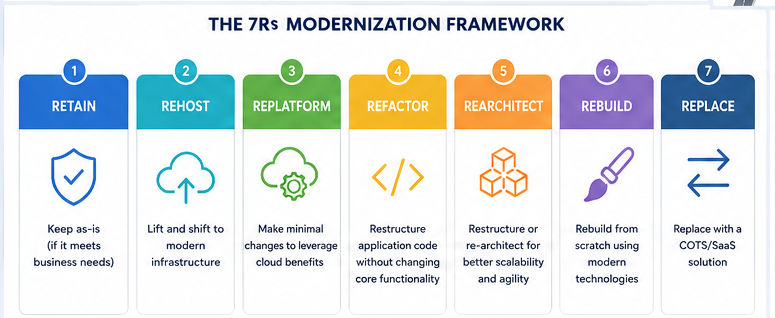
Decision Matrix: Which Strategy Fits Your Application?
| If your application is… | Recommended Strategy |
|---|---|
| Stable but expensive to host | Rehost |
| Business-critical with scalability issues | Rearchitect |
| Difficult to maintain but strategically important | Refactor |
| Highly customized legacy platform | Rebuild |
| Commodity business capability | Replace |
| Rarely used or obsolete | Retire |
This framework helps organizations align modernization investments with business priorities instead of applying the same approach to every application.
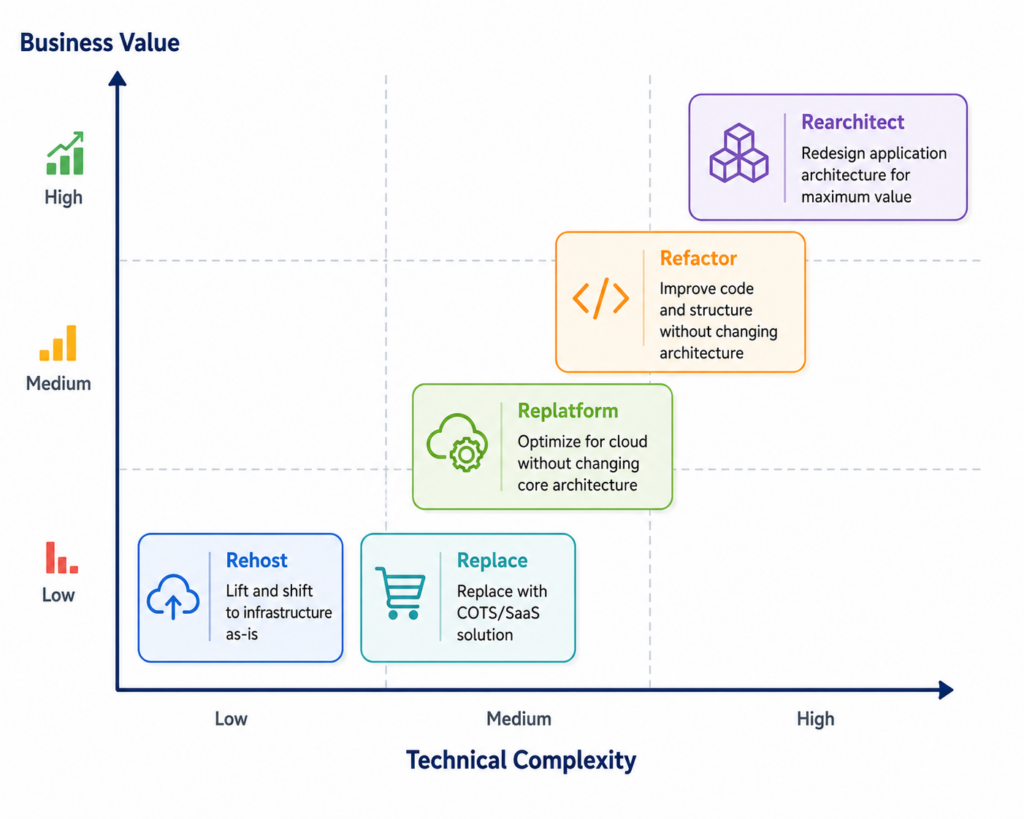
Application Modernization Best Practices
Organizations that consistently deliver successful application modernization initiatives follow a disciplined, incremental approach rather than treating modernization as a one-time technology project.
Modernization Best Practices
| Best Practice | Business Benefit |
|---|---|
| Align modernization with business goals | Higher ROI and executive support |
| Prioritize high-value applications | Faster business impact |
| Modernize incrementally | Lower delivery risk |
| Adopt cloud-native architecture | Better scalability and resilience |
| Build CI/CD pipelines | Faster software releases |
| Integrate DevSecOps | Improved security and compliance |
| Automate testing | Higher application quality |
| Monitor applications continuously | Better performance and reliability |
| Optimize cloud costs | Improved operational efficiency |
| Measure business outcomes | Demonstrate modernization success |
Key takeaway: Successful modernization balances technology transformation with governance, automation, security, and measurable business outcomes.
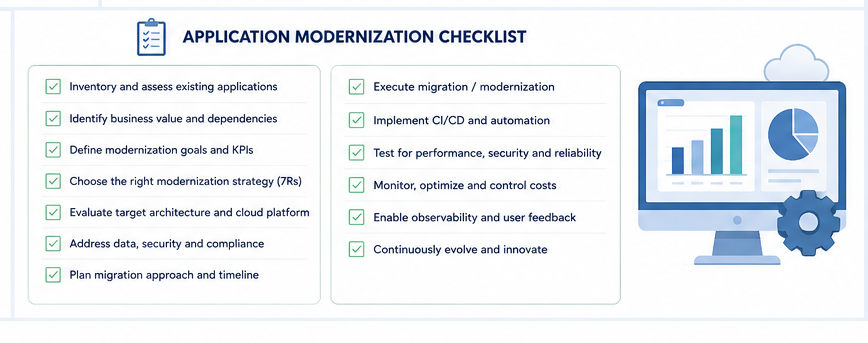
Application Modernization Checklist
Before modernizing a legacy application, validate the following:
Business Readiness
- □ Define business objectives
- □ Identify modernization drivers
- □ Secure executive sponsorship
- □ Prioritize applications by business value
- □ Estimate expected ROI
Technical Readiness
- □ Assess technical debt
- □ Map application dependencies
- □ Review security vulnerabilities
- □ Evaluate cloud readiness
- □ Select the appropriate modernization strategy
Delivery Readiness
- □ Build CI/CD pipelines
- □ Automate testing
- □ Define rollback plans
- □ Establish governance
- □ Track modernization KPIs
This checklist helps reduce project risk while improving delivery consistency across modernization programs.
Enterprise Use Cases
Financial Services
Banks modernize core banking, payment processing, and fraud detection systems to improve scalability, strengthen security, support regulatory compliance, and accelerate digital banking initiatives.
Healthcare
Healthcare organizations modernize clinical systems, electronic health records (EHRs), and patient portals to improve interoperability, enhance cybersecurity, and support AI-enabled diagnostics while maintaining compliance.
Manufacturing
Manufacturers modernize ERP, supply chain, and production applications to enable IoT integration, predictive maintenance, and real-time operational visibility.
Retail and E-commerce
Retailers modernize commerce platforms to support omnichannel experiences, personalize customer interactions, improve inventory management, and handle seasonal traffic spikes.
Future Trends in Application Modernization
Application modernization is evolving beyond cloud migration toward intelligent, AI-driven software engineering.
Key trends include:
- AI-assisted code modernization and refactoring
- Agentic AI for operations and incident resolution
- Platform engineering and Internal Developer Platforms (IDPs)
- Event-driven and serverless architectures
- Hybrid and multi-cloud modernization
- Policy-as-Code and automated compliance
- AI-powered observability and performance optimization
- Green software engineering for sustainable cloud operations
Organizations that combine these capabilities with modern engineering practices will be better positioned to innovate and adapt to changing business demands.
Key Takeaways
- Application modernization challenges include technical debt, legacy architecture, cloud migration, integration complexity, security, compliance, organizational change, and skills shortages.
- Successful legacy application modernization starts with business priorities, not technology choices.
- Incremental modernization delivers lower risk and faster value than large-scale application rewrites.
- Cloud-native architecture, APIs, DevSecOps, automation, and platform engineering improve scalability, resilience, and developer productivity.
- Measuring modernization with business and engineering KPIs helps maximize long-term ROI.
Transform your legacy applications into innovation engines that accelerate business outcomes with our Application Modernization Services.
Conclusion
Application modernization is no longer just an IT initiative—it is a business strategy for improving agility, resilience, security, and innovation. While organizations face challenges such as technical debt, legacy architecture, cloud migration complexity, integration, and compliance, these obstacles can be overcome with a phased, business-led modernization approach.
Enterprises that prioritize high-value applications, adopt cloud-native engineering practices, automate delivery through DevSecOps, and measure success using business-focused KPIs are better positioned to reduce operational costs, accelerate software delivery, and respond to evolving customer and market demands.
For organizations planning their modernization journey, success depends on building a continuous modernization capability—not simply completing a migration project. With the right strategy, governance, and technology foundation, application modernization becomes a catalyst for sustainable digital transformation and long-term business growth.
Frequently Asked Questions
| Image | Recommended Alt Text |
|---|---|
| Application modernization lifecycle | Enterprise application modernization roadmap |
| Legacy vs. cloud-native architecture | Legacy application modernization architecture comparison |
| 7Rs modernization framework | Application modernization strategies comparison |
| Monolith vs. microservices | Modern application architecture for legacy modernization |
| Application modernization checklist | Enterprise application modernization checklist |