Modernize legacy applications by incrementally upgrading architecture, integrating AI, exposing APIs, and adopting cloud-native services instead of replacing entire systems. For most enterprises, a phased modernization strategy reduces risk, preserves valuable business logic, accelerates innovation, and delivers faster ROI than a complete application rewrite.
TL;DR
- Most legacy applications do not require a complete rewrite.
- Incremental modernization reduces risk while preserving proven business capabilities.
- API enablement, AI retrofitting, cloud migration, and modular architectures extend application life.
- Rewrites should be reserved for systems that no longer support business growth.
- Enterprise modernization is a continuous transformation—not a one-time migration project.
Executive Summary
Modernize Legacy Applications has become one of the highest priorities for enterprise technology leaders as organizations accelerate cloud adoption, AI integration, and digital transformation. Yet many modernization initiatives begin with a costly assumption—that legacy systems must be completely rewritten to remain relevant.
In reality, most enterprise applications still contain years of valuable business logic, integrations, and operational knowledge. Replacing them from scratch often introduces unnecessary cost, delivery delays, operational disruption, and implementation risk.
Today’s modernization strategies take a different approach. By combining APIs, cloud-native services, AI retrofitting, microservices, and incremental architectural improvements, organizations can modernize existing applications while keeping critical business operations running.
This guide explores practical strategies for modernizing legacy applications without rewriting everything, helping enterprise leaders make informed modernization decisions that balance innovation, business continuity, and long-term scalability.
Watch our Webinar For More Insights on AI Copilots & The Decision Intelligence Gap
Why Complete Application Rewrites Often Fail
Complete application rewrites are expensive, time-consuming, and operationally risky. While they promise a clean architectural foundation, they often underestimate the complexity of existing business logic, resulting in longer delivery cycles, increased costs, and delayed business value.
When legacy applications become difficult to maintain, a full rewrite often appears to be the obvious solution.
However, enterprise history tells a different story.
Many large-scale rewrite projects fail because organizations underestimate:
- Years of embedded business rules
- Complex system integrations
- Regulatory requirements
- Hidden operational dependencies
- User adoption challenges
- Ongoing business changes during redevelopment
Instead of accelerating innovation, large rewrites frequently delay it.
Meanwhile, competitors continue improving existing products through incremental modernization.
Enterprise Insight: Legacy applications rarely fail because of their business logic—they fail because their architecture can no longer support evolving business needs.
Why Rewrites Become High-Risk Projects
| Challenge | Business Impact |
|---|---|
| Long delivery timelines | Delayed innovation |
| High implementation costs | Reduced ROI |
| Business disruption | Operational risk |
| Knowledge loss | Missing business functionality |
| Large migration effort | Increased project complexity |
| User retraining | Lower adoption |
Modernization vs. Replacement: Understanding the Difference
Modernization improves an existing application while preserving valuable business capabilities, whereas replacement introduces an entirely new system. Choosing between the two depends on business value, technical debt, and long-term strategic objectives rather than technology trends alone.
One of the biggest misconceptions in enterprise IT is treating modernization and replacement as the same initiative.
They are fundamentally different.
Modernization focuses on improving what already delivers value.
Replacement starts over.
Modernization typically includes:
- Cloud migration
- API enablement
- AI integration
- UI modernization
- Database modernization
- Modular architecture
- Platform optimization
Replacement often involves:
- New technology stack
- New business workflows
- New integrations
- Data migration
- Complete user transition
For many organizations, modernization provides faster business outcomes with significantly lower operational risk.
Modernization vs Replacement
| Modernization | Replacement |
|---|---|
| Preserves business logic | Rebuilds functionality |
| Lower implementation risk | Higher transformation risk |
| Faster time-to-value | Longer delivery timelines |
| Incremental improvements | Large-scale change |
| Lower investment | Higher investment |
| Easier business continuity | Greater operational disruption |
When Should You Modernize Instead of Rewrite?
Organizations should modernize legacy applications when existing systems continue to support business operations but require improvements in scalability, integration, user experience, or AI readiness. A rewrite is appropriate only when architectural limitations significantly restrict future growth.
Rather than asking,
“Should we rewrite our application?”
Technology leaders should ask:
“What business problem are we trying to solve?”
If the objective is to:
- Improve scalability
- Enable cloud adoption
- Add AI capabilities
- Improve customer experience
- Reduce maintenance costs
a complete rewrite may not be necessary.
Incremental modernization often delivers these outcomes while preserving years of proven business functionality.
Enterprise Decision Matrix
| Business Scenario | Modernize | Rewrite |
|---|---|---|
| Stable business workflows | ✅ | |
| High customer adoption | ✅ | |
| Need AI integration | ✅ | |
| Existing APIs available | ✅ | |
| Excessive technical debt | ✅ | |
| Obsolete technology stack | ✅ | |
| Complete product redesign | ✅ | |
| Unsupported legacy platform | ✅ |
Decision Tip: If the application continues to create business value, modernize first. Rewrite only when architectural constraints prevent future innovation.
Principles of Incremental Modernization
Incremental modernization reduces transformation risk by improving applications in manageable stages rather than replacing entire systems. This approach enables continuous delivery, faster ROI, and greater flexibility while maintaining business continuity.
Successful enterprises rarely modernize everything at once.
Instead, they focus on continuous improvement.
Core principles include:
Preserve What Works
Retain proven business logic while modernizing outdated technology.
Modernize by Business Capability
Prioritize customer-facing and high-value processes.
Decouple Before Replacing
Introduce APIs and modular services before replacing components.
Deliver Incrementally
Release improvements continuously rather than waiting for a complete transformation.
Build for AI Readiness
Modernization should prepare applications for AI copilots, intelligent automation, and future digital capabilities.
Traditional Transformation vs Incremental Modernization
| Traditional Rewrite | Incremental Modernization |
|---|---|
| Large transformation project | Continuous improvement |
| High business risk | Lower operational risk |
| Long delivery cycle | Faster releases |
| Large capital investment | Incremental investment |
| Delayed ROI | Continuous business value |
The Enterprise Modernization Mindset
Successful modernization is driven by business outcomes rather than technology replacement. Organizations that focus on incremental value, architectural flexibility, and AI readiness are more likely to achieve sustainable digital transformation.
Modernization should not begin with the question:
“Which technology should we replace?”
Instead, ask:
- Which business capability creates the most value?
- What prevents faster innovation?
- Which systems limit customer experience?
- Where can AI deliver measurable business outcomes?
- Which technical constraints create operational risk?
Answering these questions creates a modernization roadmap aligned with business priorities rather than technology trends.
Key Takeaways
- Modernizing legacy applications does not automatically require rebuilding them.
- Incremental modernization reduces risk while preserving valuable business logic and customer workflows.
- Rewrites should be reserved for systems with severe architectural or technical limitations.
- API enablement, cloud modernization, and AI retrofitting allow enterprises to innovate faster without disrupting production.
- Organizations that modernize strategically are better positioned to adopt AI, improve agility, and accelerate digital transformation.
5 Proven Ways to Modernize Legacy Applications Without Rewriting
Organizations can modernize legacy applications incrementally by improving architecture, integration, user experience, and AI capabilities without replacing core business systems. These approaches reduce transformation risk, accelerate time-to-value, and prepare enterprise applications for future innovation.
Instead of replacing entire applications, successful enterprises modernize the components that create the greatest business value.
This approach minimizes disruption while allowing technology teams to continuously improve application performance, scalability, and customer experience.
1. Modernize Through API Enablement
API enablement extends the life of legacy applications by exposing existing business capabilities as reusable services. It improves interoperability, accelerates digital transformation, and enables integration with cloud platforms, mobile applications, and AI solutions.
Many legacy systems still contain valuable business logic but lack modern integration capabilities.
By introducing an API layer, organizations can:
- Connect legacy systems with cloud applications
- Enable mobile and web experiences
- Support AI copilots and intelligent assistants
- Simplify third-party integrations
- Reduce dependency on legacy user interfaces
Instead of replacing the application, APIs expose existing capabilities to new consumers.
Best For
- ERP modernization
- CRM modernization
- Banking systems
- Insurance platforms
- Manufacturing applications
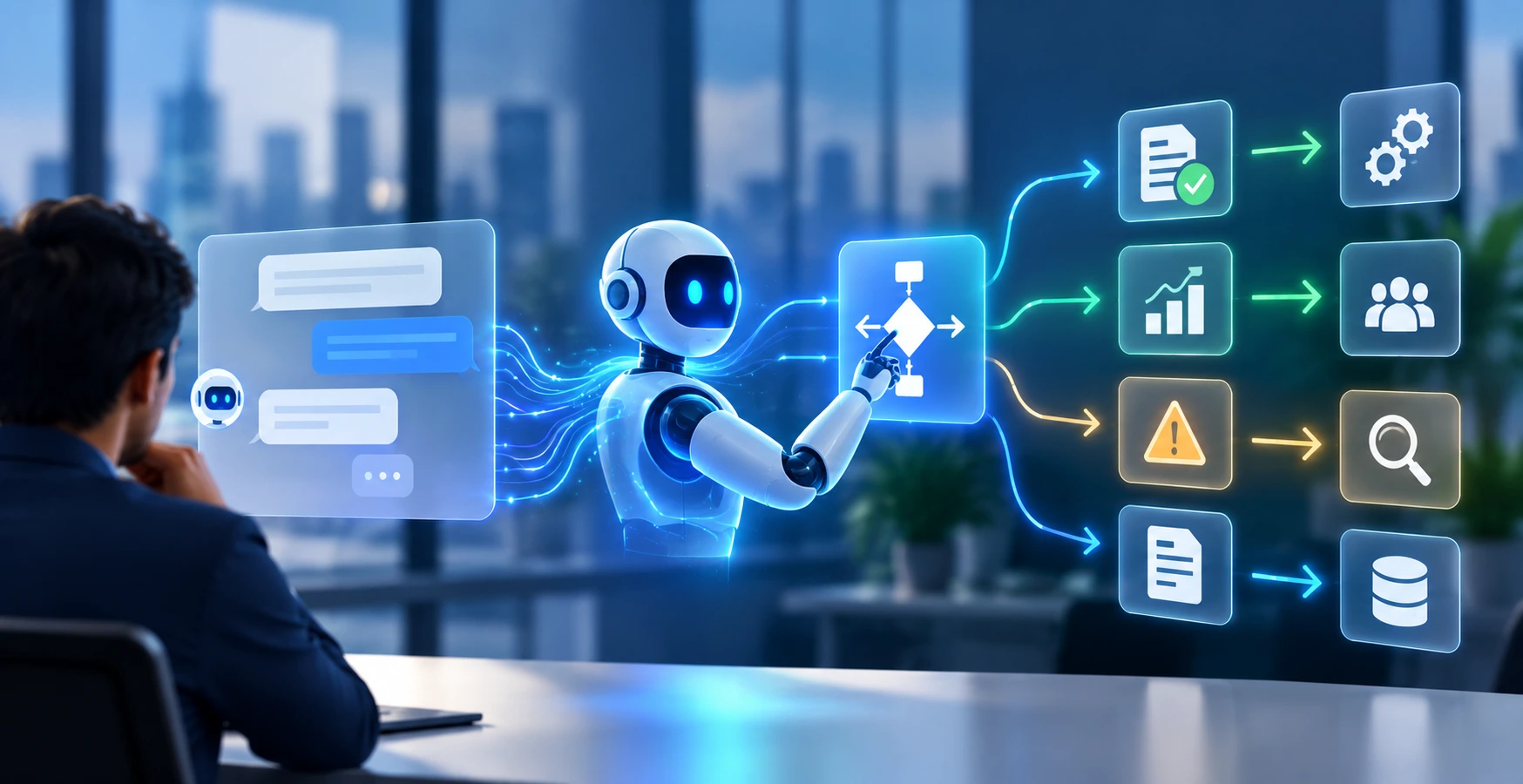
2. Add AI Without Rebuilding the Application
AI retrofitting enables enterprises to introduce copilots, intelligent search, workflow automation, and predictive capabilities into existing applications without modifying core business logic. It provides one of the fastest paths to AI adoption while minimizing modernization costs.
One of the biggest misconceptions about Enterprise AI is that organizations need AI-native applications.
Modern AI architectures allow businesses to integrate:
- AI Copilots
- Intelligent Search
- Document Intelligence
- Workflow Recommendations
- Conversational Interfaces
- AI Agents
through APIs and orchestration layers while leaving the underlying application unchanged.
This approach significantly reduces implementation risk while accelerating AI adoption.
Enterprise Insight: AI should enhance proven business processes—not replace them.
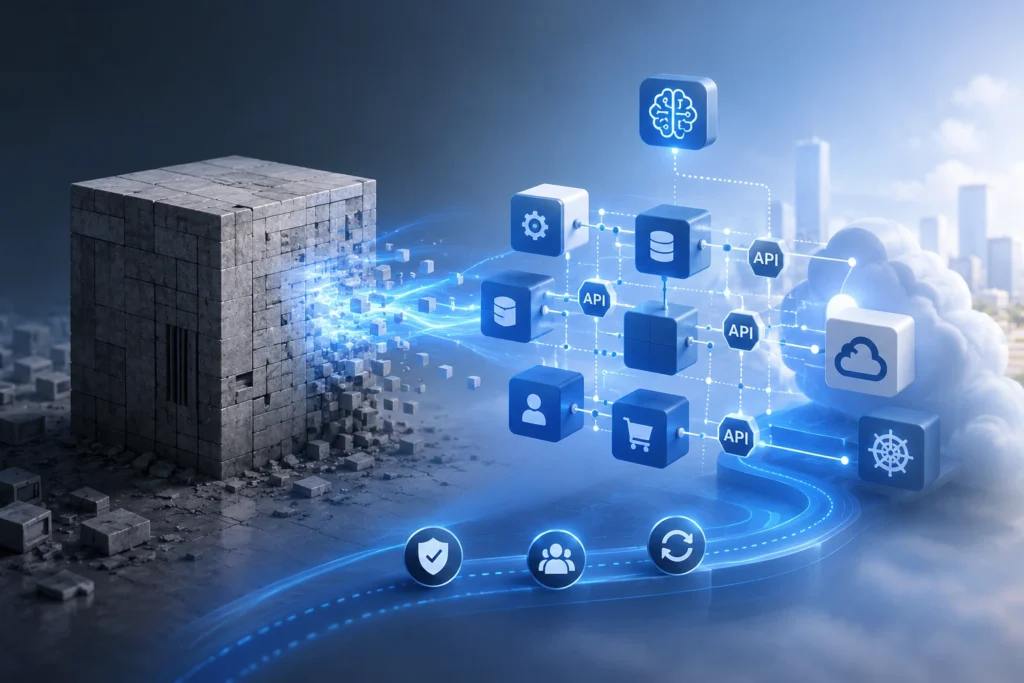
3. Adopt the Strangler Fig Pattern
The Strangler Fig Pattern modernizes applications incrementally by replacing individual services over time rather than rebuilding the entire system. This approach minimizes operational disruption while allowing organizations to transition toward modern architectures at their own pace.
Instead of replacing an entire monolithic application, enterprises gradually introduce new services alongside existing functionality.
Over time:
- Legacy components are replaced.
- New services assume responsibility.
- The legacy application becomes progressively smaller.
This strategy enables continuous delivery while avoiding the risks associated with large-scale migrations.
Traditional Rewrite vs Strangler Pattern
| Traditional Rewrite | Strangler Pattern |
|---|---|
| Replace everything | Replace incrementally |
| High implementation risk | Lower operational risk |
| Long delivery cycles | Continuous delivery |
| Large migration events | Phased migration |
| Delayed business value | Incremental ROI |
4. Modernize the User Experience First
Modernizing the user interface improves customer and employee experiences without requiring immediate backend replacement. A modern frontend can interact with existing business systems through APIs while preserving core functionality.
Many legacy applications fail to meet modern usability expectations even though their backend processes remain reliable.
Organizations can rapidly improve user satisfaction by introducing:
- Responsive web applications
- Mobile interfaces
- AI-powered assistants
- Personalized dashboards
- Self-service portals
This strategy delivers visible business value while allowing backend modernization to occur over time.
5. Move to Cloud-Native Services Gradually
Cloud-native modernization enables organizations to improve scalability, resilience, and operational efficiency by gradually adopting managed cloud services instead of migrating every application component simultaneously.
Cloud modernization doesn’t always require complete application migration.
Many organizations begin by modernizing supporting services such as:
- Authentication
- Monitoring
- Storage
- Databases
- Messaging
- Analytics
This hybrid approach allows enterprises to gain cloud benefits while minimizing business disruption.
Modernization Strategy Comparison
Every modernization strategy offers different trade-offs in terms of cost, implementation effort, business disruption, and long-term flexibility. Choosing the right approach depends on business priorities rather than technology preferences.
| Strategy | Speed | Business Risk | AI Readiness | Best For |
|---|---|---|---|---|
| API Enablement | ⭐⭐⭐⭐⭐ | Low | High | System integration |
| AI Retrofit | ⭐⭐⭐⭐⭐ | Low | Very High | AI adoption |
| UI Modernization | ⭐⭐⭐⭐☆ | Low | Moderate | Customer experience |
| Strangler Pattern | ⭐⭐⭐⭐☆ | Medium | High | Monolith modernization |
| Cloud-Native Services | ⭐⭐⭐⭐☆ | Low | Very High | Infrastructure modernization |
| Complete Rewrite | ⭐⭐☆☆☆ | High | Very High | Obsolete platforms |
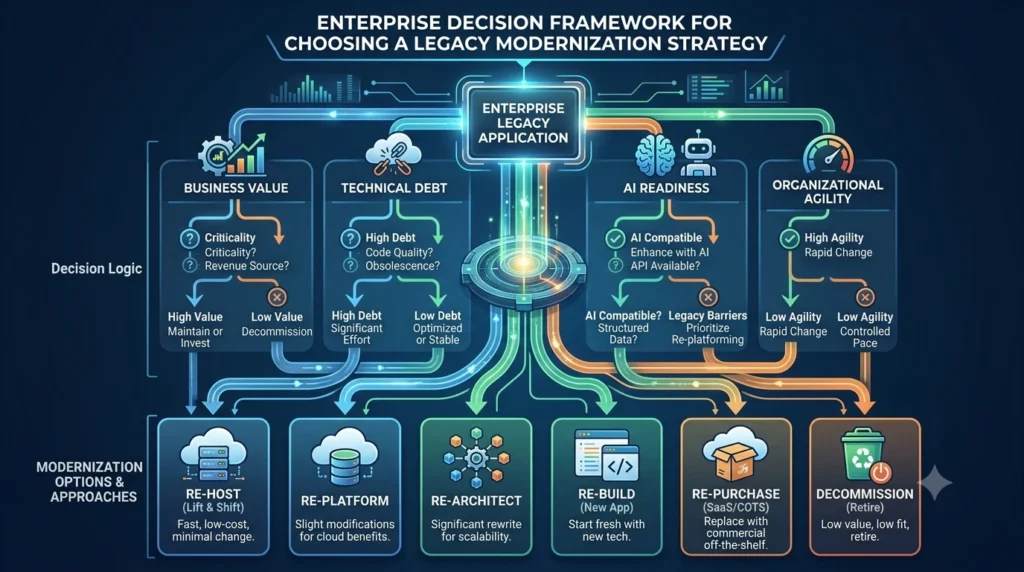
Enterprise Decision Framework
The right modernization strategy depends on business value, technical debt, scalability requirements, and future AI ambitions. Organizations should evaluate applications individually rather than applying the same modernization approach across the entire portfolio.
Which Strategy Should You Choose?
| Business Requirement | Recommended Strategy |
|---|---|
| Faster AI adoption | AI Retrofit |
| Improve customer experience | UI Modernization |
| Modernize integrations | API Enablement |
| Reduce infrastructure costs | Cloud-Native Services |
| Gradually replace a monolith | Strangler Pattern |
| Replace unsupported technology | Complete Rewrite |
Best Practices for Modernizing Legacy Applications
Successful modernization initiatives focus on business outcomes, incremental delivery, and architectural flexibility. Organizations that modernize in phases reduce risk while creating a scalable foundation for future innovation.
Modernization Checklist
✔ Modernize business capabilities—not just technology.
✔ Start with applications that deliver the highest business value.
✔ Introduce APIs before replacing existing services.
✔ Separate AI capabilities from core business logic.
✔ Adopt cloud services incrementally.
✔ Measure business outcomes instead of technical milestones.
✔ Modernize continuously rather than through one-time transformation projects.
AWS Prescriptive Guidance outlines practical strategies for modernizing legacy applications, helping organizations evaluate approaches such as rehosting, replatforming, refactoring, and rebuilding based on business objectives and technical complexity.
Common Mistakes to Avoid
Many legacy modernization initiatives fail because organizations focus on replacing technology rather than solving business problems. Avoiding common modernization pitfalls improves delivery success and long-term ROI.
| Common Mistake | Better Approach |
|---|---|
| Assuming every legacy system needs replacement | Evaluate modernization first |
| Modernizing everything simultaneously | Prioritize high-value capabilities |
| Ignoring business stakeholders | Align modernization with business outcomes |
| Delaying AI adoption until modernization completes | Introduce AI incrementally |
| Measuring only technology upgrades | Measure customer and business impact |
Enterprise Insight: The objective of modernization isn’t to eliminate legacy systems—it’s to eliminate the limitations that prevent business growth.
Enterprise Modernization Roadmap
Legacy modernization delivers the greatest value when approached as a phased business transformation rather than a one-time migration. Incremental delivery enables organizations to reduce risk, validate outcomes, and continuously improve enterprise applications.
Five-Step Roadmap
| Phase | Objective |
|---|---|
| Assess | Identify business-critical applications and technical debt |
| Prioritize | Select modernization initiatives with the highest business value |
| Modernize | Implement APIs, AI, cloud services, or UI improvements incrementally |
| Optimize | Improve performance, security, governance, and scalability |
| Scale | Expand modernization across the enterprise while continuously measuring business outcomes |
Key Takeaways
- Most legacy applications can be modernized successfully without a complete rewrite.
- API enablement, AI retrofitting, cloud-native services, UI modernization, and the Strangler Fig Pattern offer practical, low-risk modernization paths.
- Incremental modernization delivers faster business value, lower operational risk, and greater flexibility than large-scale replacement projects.
- Technology decisions should always align with business priorities, customer needs, and long-term AI readiness.
- Enterprises that modernize continuously are better positioned to innovate, integrate emerging technologies, and compete in a rapidly evolving digital landscape.
Conclusion
Modernizing legacy applications is no longer about replacing everything that exists—it’s about unlocking greater business value from systems that already power the enterprise. While legacy applications often carry technical debt, they also contain years of proven business logic, operational knowledge, and critical integrations that shouldn’t be discarded without careful consideration.
The most successful organizations approach modernization incrementally. By introducing APIs, cloud-native services, AI capabilities, and modular architectures in phases, they reduce transformation risk, accelerate innovation, and improve customer experiences without disrupting business operations.
Rather than asking “Should we rewrite this application?”, enterprise leaders should ask “What is the fastest, lowest-risk way to deliver business value?” In many cases, the answer lies in modernizing legacy applications—not replacing them.
At Techment, we help enterprises modernize legacy applications through AI-driven engineering, cloud-native architectures, API modernization, and digital transformation strategies that balance innovation with operational continuity. Whether your goal is AI readiness, cloud migration, or application modernization, adopting the right strategy can extend the value of your existing investments while preparing your business for the future.
Frequently Asked Questions (FAQs)
1. What is legacy application modernization?
Legacy application modernization is the process of improving existing enterprise applications to enhance scalability, security, performance, and integration capabilities without necessarily replacing the entire system. Modernization can include API enablement, cloud migration, AI integration, UI modernization, or architectural refactoring.
2. Do all legacy applications need to be rewritten?
No. Most enterprise applications can be modernized incrementally through APIs, cloud-native services, AI retrofitting, and modular architecture. A complete rewrite should be considered only when the application can no longer support business or technical requirements.
3. What is the safest way to modernize legacy applications?
A phased modernization approach is typically the safest strategy. Techniques such as API enablement, the Strangler Fig Pattern, AI retrofitting, and cloud modernization allow organizations to reduce implementation risk while maintaining business continuity.
4. How does AI help modernize legacy applications?
AI accelerates modernization by enabling intelligent search, conversational assistants, workflow automation, code analysis, documentation generation, and predictive insights without requiring organizations to rebuild existing systems from scratch.
5. How do organizations choose the right modernization strategy?
The right strategy depends on business priorities, technical debt, application criticality, integration complexity, and future scalability goals. Enterprises should evaluate whether incremental modernization can deliver the desired outcomes before considering a full application rewrite.
Related Reads
- 7 Strategic Reasons Enterprise AI Adoption and Readiness Is No Longer Optional in 2026
- AI Retrofit vs. Rewrite: Choosing the Right Enterprise Modernization Strategy
- 7 Critical Differences Between AI Readiness vs AI Adoption That Most Enterprises Ignore in 2026
- Enterprise AI Strategy in 2026
- AI-Ready Enterprise Checklist for Microsoft Fabric
- Data Quality for AI in 2026: The Ultimate Blueprint
- Why Modern Data Platforms Are Critical for RAG Success in Enterprises