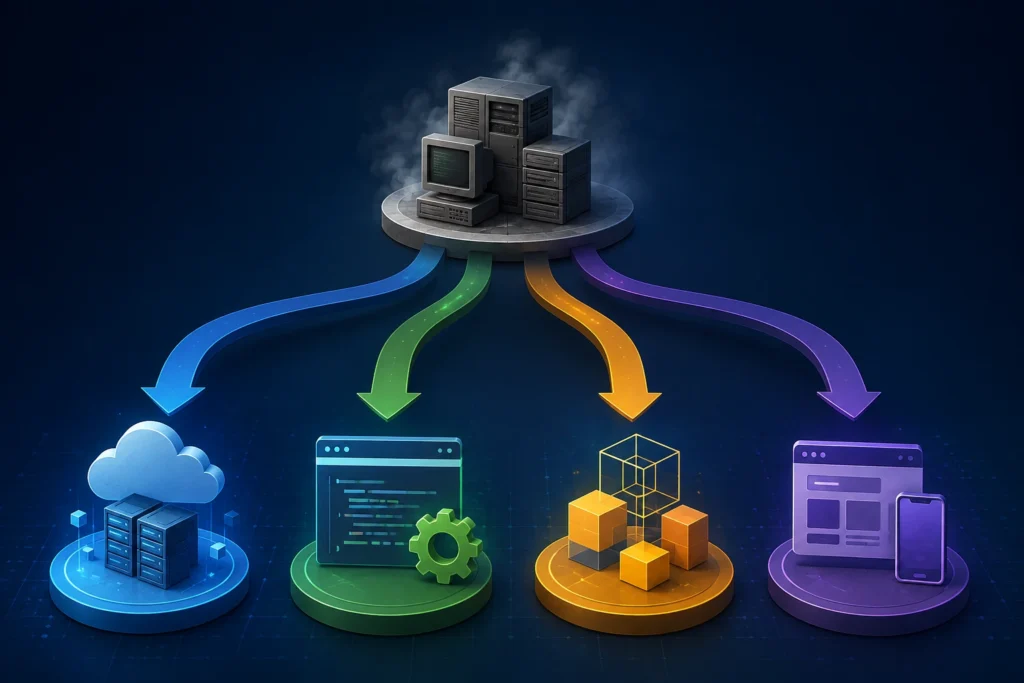
Rehost, refactor, rebuild, and replace are four common approaches to modernizing legacy applications. Rehosting moves applications with minimal changes, refactoring improves the existing codebase, rebuilding creates a new application while preserving business functionality, and replacing introduces an entirely new solution. The right choice depends on business objectives, technical debt, cost, implementation risk, and long-term scalability.
TL;DR
- There is no single modernization approach for every enterprise application.
- Rehosting delivers quick infrastructure improvements with minimal code changes.
- Refactoring modernizes architecture while preserving business logic.
- Rebuilding creates a modern application using existing business requirements.
- Replacing is best suited for obsolete platforms that no longer support business needs.
- Successful enterprises evaluate modernization decisions based on business value—not technology trends.
Executive Summary
Rehost vs Refactor vs Rebuild vs Replace is one of the most important decisions enterprise technology leaders face when modernizing legacy applications. While every organization wants greater agility, cloud readiness, and AI capabilities, choosing the wrong modernization approach can increase costs, delay innovation, and introduce unnecessary operational risk.
Many modernization initiatives begin with the assumption that older applications should be completely replaced. In reality, most enterprise systems contain years of valuable business logic, integrations, and operational knowledge that can often be modernized rather than discarded.
The challenge is determining which modernization path delivers the greatest business value with the least disruption.
This guide compares the four most common modernization approaches, explains when each is appropriate, and provides a practical decision framework to help CIOs, CTOs, and enterprise architects modernize with confidence.
Why Choosing the Right Modernization Approach Matters
Selecting the right modernization approach directly impacts project cost, implementation risk, business continuity, and future scalability. Rather than defaulting to a complete rebuild, organizations should evaluate modernization options based on application value, technical complexity, and long-term business goals.
Modernization projects rarely fail because the technology is outdated.
They fail because organizations choose an approach that doesn’t align with business priorities.
For example:
- Rehosting a highly complex application may simply move technical debt to the cloud.
- Rebuilding an application with stable business processes may waste years of proven functionality.
- Replacing an enterprise platform without understanding business dependencies can disrupt operations and increase adoption challenges.
Successful modernization begins with understanding what the application needs—not what the technology market recommends.
Enterprise Insight: Modernization is not about replacing technology. It’s about removing the constraints that prevent the business from growing.
Cost of Choosing the Wrong Modernization Path
| Challenge | Business Impact |
|---|---|
| Unnecessary rebuild | Higher costs and delayed ROI |
| Poor modernization fit | Increased technical debt |
| Business disruption | Reduced productivity |
| Long implementation cycles | Slower innovation |
| Complex migrations | Higher operational risk |
| Missed AI opportunities | Delayed digital transformation |
Understanding the Four Modernization Approaches
Rehost, refactor, rebuild, and replace each solve different modernization challenges. Understanding how these approaches differ helps organizations select the most effective path based on business objectives, technical debt, and long-term architectural goals.
Although these approaches are often grouped together, they vary significantly in terms of effort, cost, business impact, and future flexibility.
Understanding the distinction is essential before committing to a modernization initiative.
Rehost
Move the application to a new infrastructure—typically the cloud—with minimal or no changes to the application code.
Best suited for: Organizations seeking rapid cloud adoption with minimal disruption.
Refactor
Improve the application’s internal architecture and codebase while preserving its core business functionality.
Typical activities include:
- Modularizing components
- Introducing APIs
- Improving scalability
- Optimizing performance
- Preparing the application for AI and cloud-native services
Best suited for: Applications with valuable business logic but growing technical debt.
Rebuild
Develop a new version of the application using modern technologies while retaining the same business capabilities and workflows.
Unlike refactoring, rebuilding recreates the application rather than modifying the existing codebase.
Best suited for: Applications with outdated architectures but well-defined business requirements.
Replace
Retire the existing application and introduce an entirely new commercial or custom-built solution.
This typically includes new workflows, user experiences, integrations, and operational processes.
Best suited for: Unsupported platforms, obsolete technologies, or applications that no longer align with business objectives.
At-a-Glance Comparison
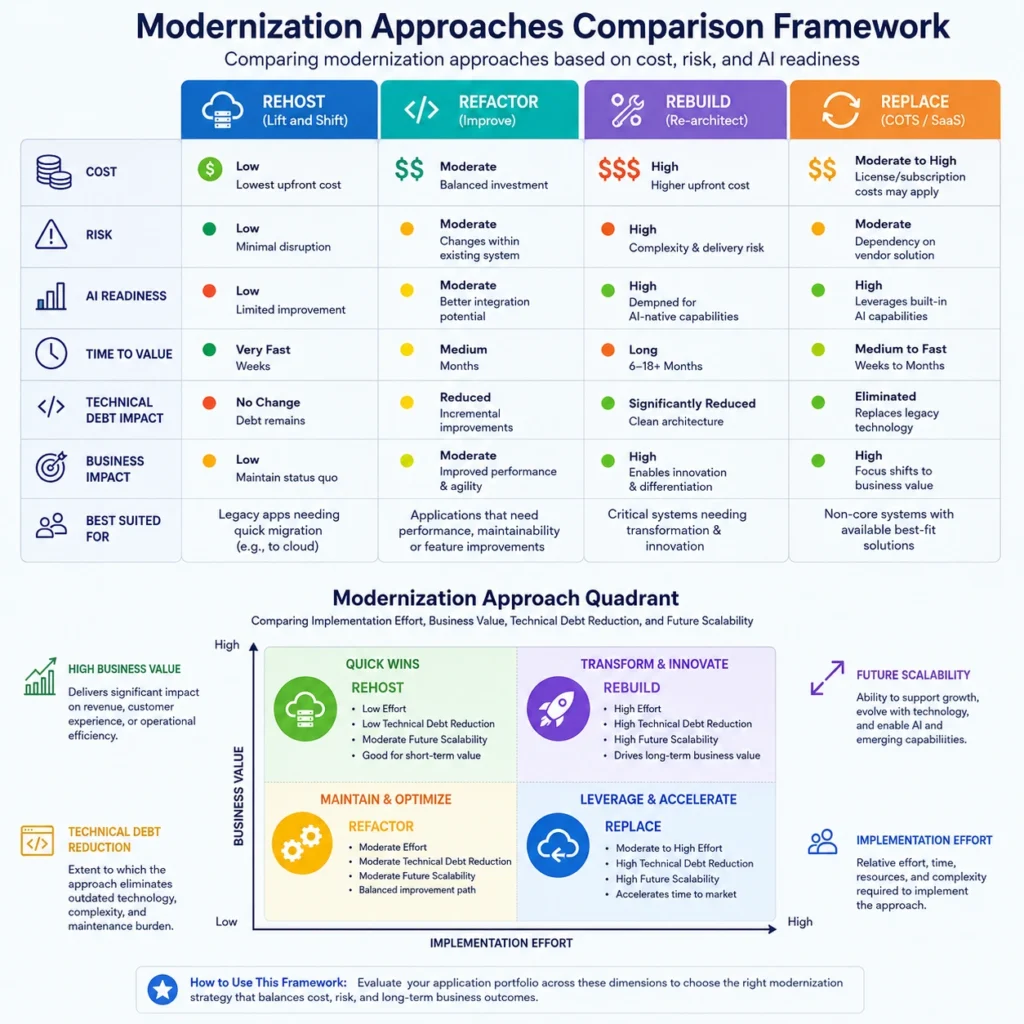
Each modernization approach offers different trade-offs between speed, investment, risk, and long-term flexibility. Comparing these characteristics helps organizations identify the approach that best aligns with their modernization goals.
| Approach | Code Changes | Cost | Time | Business Risk | AI Readiness |
|---|---|---|---|---|---|
| Rehost | Minimal | Low | Fast | Low | Medium |
| Refactor | Moderate | Medium | Medium | Medium | High |
| Rebuild | Significant | High | Longer | Medium | Very High |
| Replace | Complete | Highest | Longest | High | Very High |
Before You Decide: Ask These Five Questions
Before selecting a modernization approach, organizations should evaluate business value, technical debt, scalability, integration complexity, and future AI requirements. These factors provide a stronger foundation for modernization decisions than technology preferences alone.
Ask the following:
- Does the application still deliver strong business value?
- Is technical debt preventing innovation?
- Can APIs and AI extend the application’s life?
- How much operational disruption can the business tolerate?
- What level of modernization will support our next five years of growth?
The answers to these questions often eliminate unsuitable options before technical planning even begins.
Key Takeaways
- Rehost, refactor, rebuild, and replace each address different modernization scenarios.
- Choosing the right approach requires balancing business value, technical debt, implementation risk, and long-term scalability.
- Organizations should evaluate applications individually rather than applying a single modernization model across the enterprise.
- Modernization decisions should be driven by measurable business outcomes and future AI readiness—not by technology trends alone.
How to Choose the Right Modernization Approach
The best modernization approach depends on business value, technical debt, scalability requirements, application complexity, and future AI ambitions. Organizations should evaluate each application individually instead of applying the same modernization approach across their entire technology portfolio.
No two legacy applications have the same modernization requirements.
Some applications continue to deliver significant business value but require better scalability. Others are limited by outdated technology, while some simply need improved integration with cloud platforms and AI services.
Rather than asking “Which modernization approach is best?”, enterprise leaders should ask:
- What business capability does this application support?
- Is the architecture limiting future innovation?
- Can the application evolve incrementally?
- What level of operational disruption is acceptable?
- How quickly does the business need results?
Answering these questions provides a stronger foundation for modernization than focusing solely on technology.
Rehost: The Fastest Path to Cloud Migration
Rehosting, often called “lift and shift,” moves applications to modern infrastructure with minimal code changes. It is best suited for organizations seeking rapid cloud adoption while minimizing implementation effort and business disruption.
Rehosting is typically the first step in modernization—not the final destination.
It enables organizations to migrate workloads from on-premises infrastructure to cloud platforms while preserving the existing application architecture.
Best suited for
- Stable business applications
- Infrastructure modernization
- Data center exits
- Applications with limited technical debt
Advantages
- Fast implementation
- Lower migration costs
- Minimal business disruption
- Improved infrastructure scalability
Limitations
- Technical debt remains
- Limited architectural improvements
- Doesn’t fully leverage cloud-native capabilities
Refactor: Improve What Already Works
Refactoring enhances an application’s internal architecture while preserving its business functionality. It reduces technical debt, improves maintainability, and prepares applications for cloud-native services, APIs, and AI integration.
Refactoring focuses on improving the application’s structure rather than replacing its functionality.
Typical refactoring initiatives include:
- Breaking monoliths into modular services
- Introducing APIs
- Optimizing database access
- Improving performance
- Containerizing workloads
- Adopting event-driven architectures
This approach is ideal for organizations that want long-term agility without losing valuable business logic.
Best suited for
- Mission-critical applications
- High-value business systems
- Cloud-native transformation
- AI-ready architectures
Rebuild: Start Fresh, Preserve Business Logic
Rebuilding creates a new application using modern technologies while retaining proven business processes and functional requirements. It offers greater flexibility than refactoring but requires higher investment and longer implementation timelines.
Rebuilding is appropriate when:
- Existing architecture is no longer sustainable.
- Modern development practices are required.
- Customer expectations have changed significantly.
Unlike replacement, rebuilding retains the organization’s business knowledge while modernizing the underlying technology stack.
Benefits
- Modern architecture
- Better scalability
- Improved developer productivity
- Enhanced customer experience
Challenges
- Higher cost
- Longer implementation
- Greater delivery complexity
Replace: When Modernization Is No Longer Enough
Replacing an application involves retiring the existing solution and implementing a new commercial or custom-built platform. It should be considered only when modernization cannot meet current or future business requirements.
Replacement represents the most significant modernization effort.
Organizations typically choose replacement when:
- Vendor support has ended.
- Technology is obsolete.
- Business processes have fundamentally changed.
- The application no longer aligns with organizational goals.
Although replacement offers a clean start, it also introduces the highest implementation risk.
Martin Fowler’s Strangler Fig Application Pattern explains how organizations can incrementally modernize legacy applications by gradually replacing components, reducing operational risk while maintaining business continuity.
Read our blog on Modernize Legacy Applications Without Rewriting.
Enterprise Comparison Matrix
Comparing modernization approaches across cost, complexity, risk, and business outcomes helps organizations identify the most appropriate modernization path for each application.
| Evaluation Criteria | Rehost | Refactor | Rebuild | Replace |
|---|---|---|---|---|
| Time to Deliver | ⭐⭐⭐⭐⭐ | ⭐⭐⭐⭐☆ | ⭐⭐☆☆☆ | ⭐⭐☆☆☆ |
| Investment | Low | Medium | High | Very High |
| Business Disruption | Low | Medium | Medium | High |
| Technical Debt Reduction | Low | High | Very High | Complete |
| Cloud Readiness | Medium | High | Very High | Very High |
| AI Readiness | Medium | High | Very High | Very High |
| Long-Term Flexibility | Medium | High | Very High | High |
Which Approach Fits Your Business?
Each modernization approach addresses different business priorities. Aligning modernization decisions with strategic outcomes improves implementation success and maximizes return on investment.
| Business Goal | Recommended Approach |
|---|---|
| Exit the data center quickly | Rehost |
| Improve scalability | Refactor |
| Reduce technical debt | Refactor |
| Introduce AI capabilities | Refactor or Rebuild |
| Launch a modern digital experience | Rebuild |
| Replace unsupported software | Replace |
| Improve cloud adoption | Rehost or Refactor |
| Modernize customer-facing applications | Rebuild |
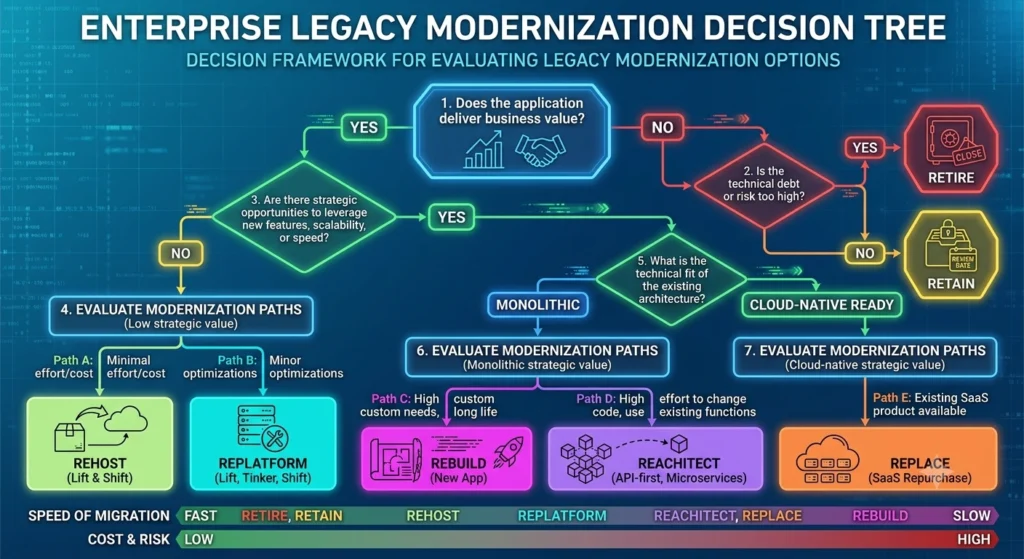
Enterprise Decision Framework
A structured decision framework helps organizations evaluate modernization options objectively by balancing business value, technical complexity, operational risk, and future scalability.
Step 1: Assess Business Value
Ask:
- Does this application support critical business operations?
- Does it create competitive advantage?
- Would replacing it disrupt customers?
Step 2: Measure Technical Debt
Evaluate:
- Maintainability
- Security
- Performance
- Integration complexity
- Platform support
Step 3: Assess Future Requirements
Determine whether the application needs:
- AI capabilities
- Cloud-native scalability
- API integration
- Real-time analytics
- Mobile experiences
Step 4: Choose the Lowest-Risk Option
Follow this hierarchy whenever possible:
Rehost → Refactor → Rebuild → Replace
The objective isn’t to choose the most modern approach.
It’s to choose the one that delivers the greatest business value with the least disruption.
Read our blog on AI Retrofit vs. Rewrite: Choosing the Right Enterprise Modernization Strategy
Best Practices To Follow When Undertaking Modernization
Successful modernization programs prioritize incremental business value, architectural flexibility, and continuous improvement instead of large-scale technology replacement.
Modernization Best Practices
✔ Start with business objectives—not technology.
✔ Evaluate each application independently.
✔ Preserve valuable business logic wherever possible.
✔ Introduce APIs before replacing applications.
✔ Build cloud-native capabilities incrementally.
✔ Modernize data alongside applications.
✔ Design every modernization initiative with AI readiness in mind.
✔ Measure business outcomes, not just technical milestones.
Common Modernization Mistakes
Many modernization initiatives underperform because organizations focus on technology replacement rather than business outcomes. Avoiding common pitfalls improves delivery speed, reduces risk, and increases long-term value.
| Mistake | Better Approach |
|---|---|
| Treating every application the same | Evaluate each individually |
| Choosing technology before defining business goals | Start with business outcomes |
| Rebuilding stable applications unnecessarily | Modernize incrementally |
| Ignoring integration dependencies | Map the application ecosystem first |
| Delaying AI planning | Design for AI readiness from the beginning |
Enterprise Insight: The most successful modernization initiatives don’t replace the most software—they remove the most business constraints.
Key Takeaways
- Rehost is best for rapid infrastructure modernization.
- Refactor delivers long-term agility while preserving valuable business logic.
- Rebuild creates modern applications without discarding proven business processes.
- Replace should be reserved for applications that no longer meet business or technical requirements.
- Enterprise modernization succeeds when technology decisions are guided by business outcomes, operational risk, and future AI readiness.
Conclusion
Choosing between rehost, refactor, rebuild, or replace is not simply a technology decision—it is a business transformation decision. Every enterprise application has a different level of business value, technical complexity, operational dependency, and future potential. Applying the same modernization approach across every application often leads to unnecessary costs, increased risk, and delayed outcomes.
Successful organizations evaluate modernization through a business-first lens. They preserve what creates competitive value, modernize where innovation is needed, and replace only when existing systems can no longer support future growth. Incremental modernization, supported by cloud-native architectures, APIs, AI capabilities, and modular engineering practices, enables enterprises to innovate without disrupting critical business operations.
The goal is not to modernize everything. The goal is to modernize intelligently.
At Techment, we help enterprises assess application portfolios, design modernization roadmaps, and implement cloud, AI, and software engineering solutions that accelerate digital transformation while maximizing the value of existing technology investments.
Frequently Asked Questions (FAQs)
1. What is the difference between rehosting, refactoring, rebuilding, and replacing?
Rehosting moves an application to new infrastructure with minimal changes. Refactoring improves the existing codebase and architecture while preserving business functionality. Rebuilding creates a new application based on existing business requirements, while replacing retires the application in favor of a new commercial or custom-built solution.
2. Which modernization approach is the least risky?
Rehosting generally carries the lowest implementation risk because it involves minimal application changes. However, it does not address technical debt. For long-term business value, many organizations combine rehosting with incremental refactoring over time.
3. When should an enterprise rebuild rather than refactor an application?
Rebuilding is appropriate when the application’s architecture limits scalability, maintainability, or customer experience, but the underlying business processes remain valuable. Refactoring is better suited for applications that can evolve without recreating the entire solution.
4. Should every legacy application be replaced?
No. Many legacy applications continue to deliver significant business value and can be modernized through API enablement, cloud migration, AI integration, or architectural improvements without requiring complete replacement.
5. How do organizations choose the right modernization approach?
Organizations should evaluate business value, technical debt, application criticality, integration complexity, regulatory requirements, and future AI readiness before selecting a modernization approach. A structured assessment helps balance implementation risk with long-term business outcomes.
Related Reads
- AI Retrofit vs. Rewrite: Choosing the Right Enterprise Modernization Strategy
- Modernize Legacy Applications Without Rewriting
- 7 Critical Differences Between AI Readiness vs AI Adoption That Most Enterprises Ignore in 2026
- Enterprise AI Strategy in 2026
- AI-Ready Enterprise Checklist for Microsoft Fabric