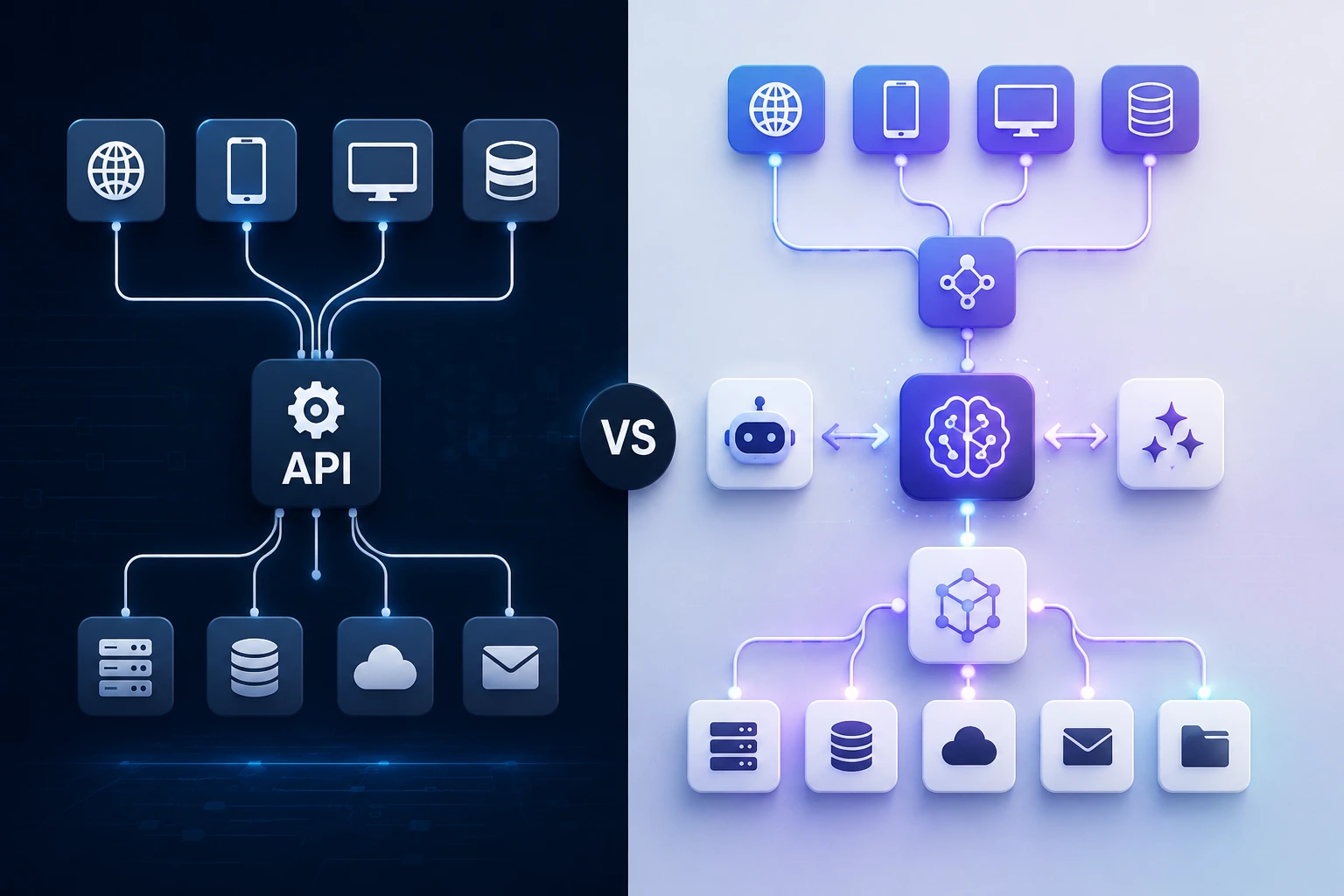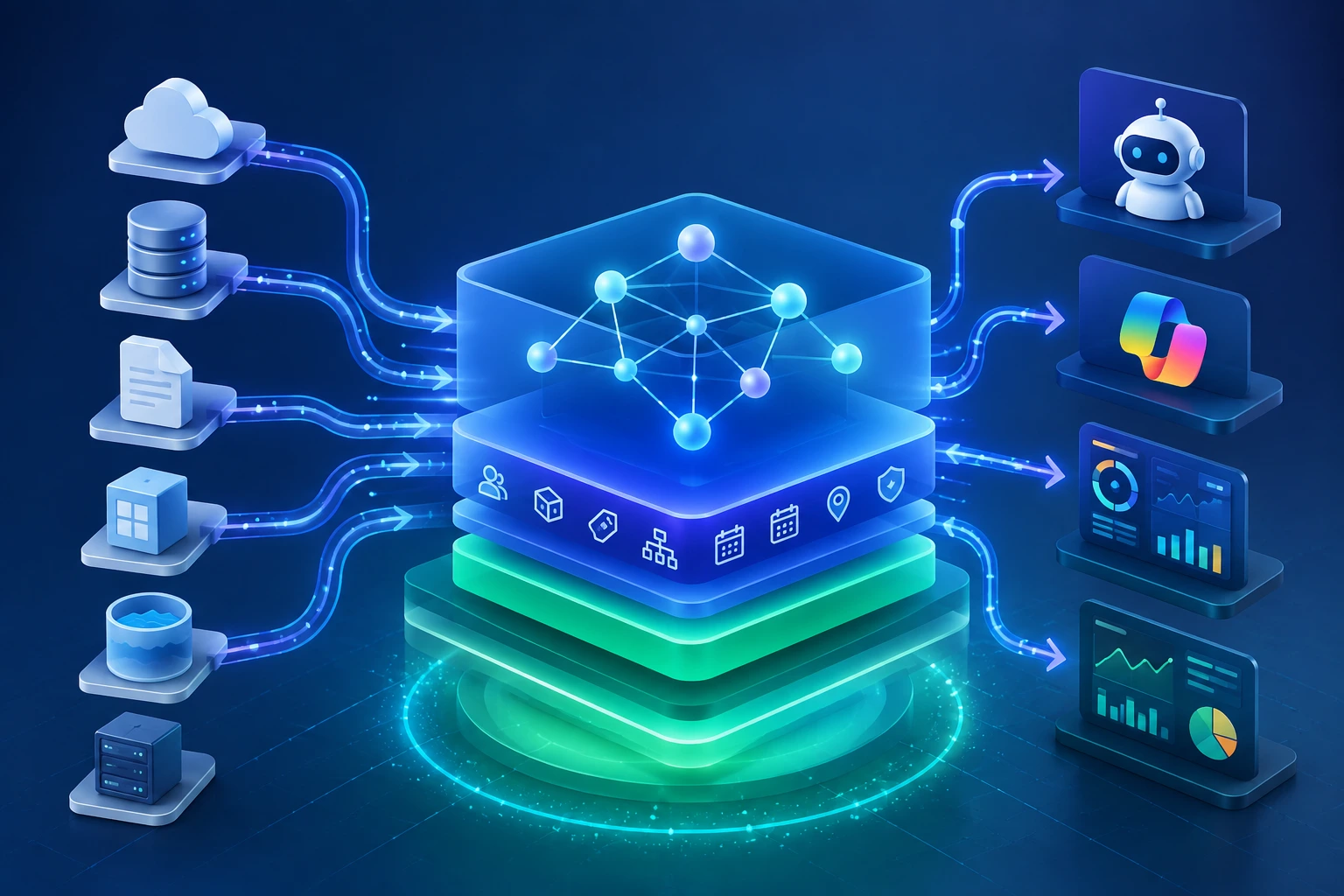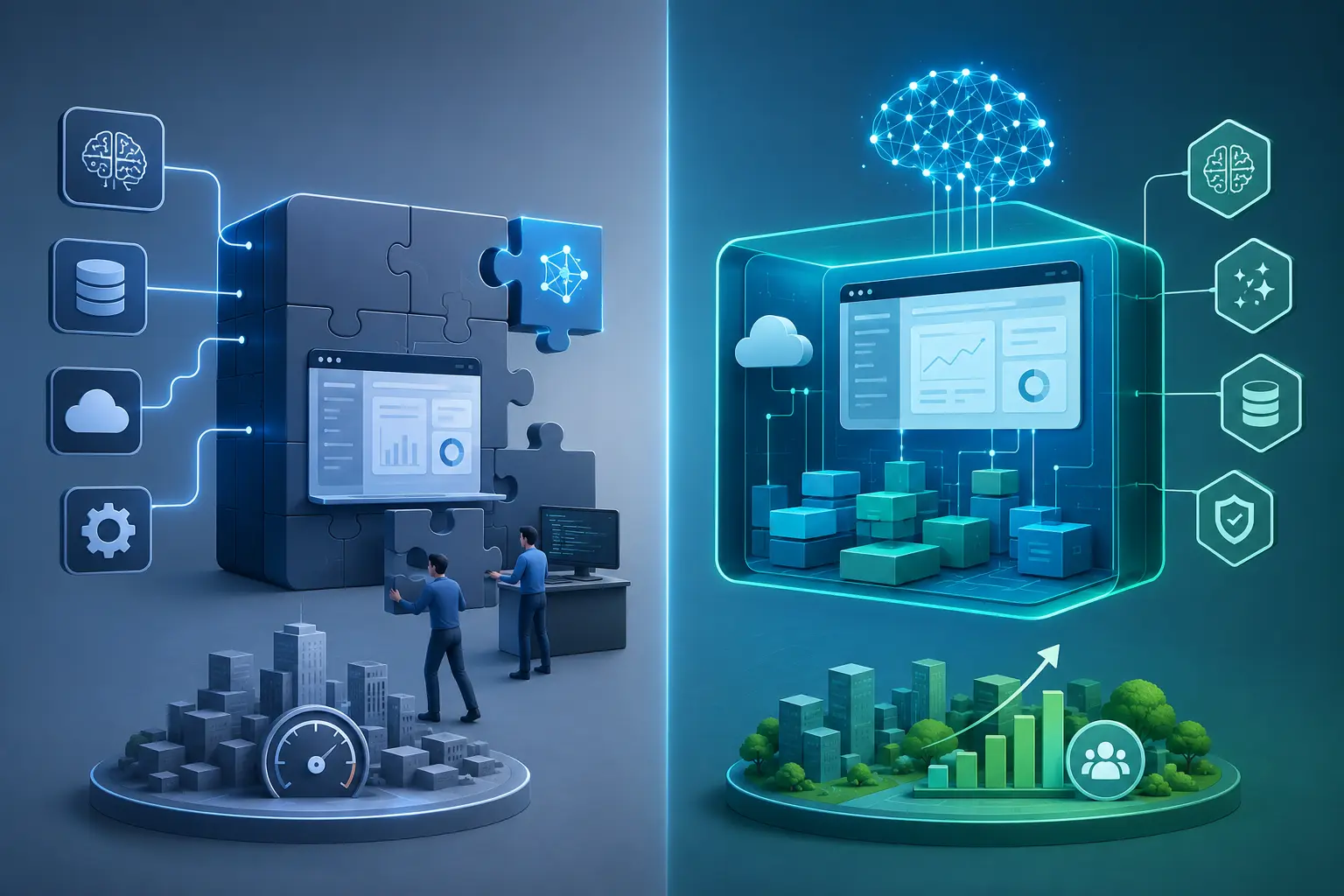
MCP vs APIs is a comparison between two different approaches to connecting AI systems with enterprise applications. APIs enable software-to-software communication by exposing predefined services and data, while the Model Context Protocol (MCP) provides a standardized way for AI models to discover, access, and interact with enterprise tools, data sources, and workflows using structured context. APIs remain essential for integration, while MCP enables AI-native interoperability across enterprise ecosystems.
TL;DR
- APIs connect applications and expose business functionality.
- MCP provides AI models with standardized access to enterprise context.
- APIs answer “How do systems communicate?”
- MCP answers “How do AI models understand and use enterprise systems?”
- MCP complements APIs rather than replacing them.
- Most Enterprise AI architectures will use both MCP and APIs together.
Executive Summary
MCP vs APIs has become one of the most important architectural discussions as organizations move from traditional software integration to AI-native applications. While APIs have long been the foundation for connecting applications and services, they were designed primarily for deterministic software—not autonomous AI agents or Large Language Models (LLMs).
As enterprises adopt AI copilots, intelligent assistants, and autonomous agents, these systems need more than API endpoints—they need structured context, tool discovery, standardized permissions, and consistent interaction models across enterprise applications.
This is where the Model Context Protocol (MCP) introduces a new approach. Rather than replacing APIs, MCP provides a universal interface that allows AI models to discover available tools, understand their capabilities, and interact with them in a secure and standardized way.
Understanding how MCP and APIs complement each other is becoming essential for organizations building scalable, governed, and future-ready Enterprise AI platforms.
Why Enterprises Are Comparing MCP and APIs
As Enterprise AI adoption accelerates, organizations are comparing MCP and APIs because traditional APIs were designed for application integration, while MCP addresses the unique requirements of AI systems by providing standardized context, tool discovery, and intelligent interaction across enterprise environments.
Traditional APIs have successfully powered digital transformation for decades.
They connect:
- CRM systems
- ERP platforms
- Payment gateways
- SaaS applications
- Mobile apps
- Cloud services
However, AI systems operate differently.
Unlike conventional software, AI models must:
- understand available tools
- interpret business context
- discover capabilities dynamically
- select appropriate actions
- execute workflows autonomously
Traditional APIs alone were never designed for these responsibilities.
MCP fills this gap by creating a standardized protocol between AI models and enterprise tools.
Traditional Software vs AI Systems
| Traditional Applications | AI Applications |
|---|---|
| Execute predefined workflows | Reason dynamically |
| Call known APIs | Discover available tools |
| Deterministic logic | Context-aware reasoning |
| Fixed integrations | Dynamic orchestration |
| User-driven actions | AI-assisted decision-making |
Enterprise Insight: APIs expose functionality. MCP enables AI to understand, discover, and orchestrate that functionality intelligently.
What Are APIs?
Application Programming Interfaces (APIs) enable applications to communicate by exposing predefined services, data, and business functionality. APIs remain the foundation of enterprise integration, allowing systems to exchange information securely and consistently across cloud, mobile, and enterprise environments.
For decades, APIs have been the backbone of enterprise software.
They enable applications to:
- Retrieve customer information
- Create orders
- Process payments
- Authenticate users
- Access enterprise data
- Trigger business workflows
For example:
A CRM system may expose an API that returns customer records.
A payment gateway may provide an API to process transactions.
An ERP platform may expose inventory data.
Applications know exactly which endpoint to call and what response to expect.
This deterministic communication model has powered enterprise integration for years.
Characteristics of APIs
| Capability | APIs |
|---|---|
| System Integration | ✔ |
| Business Services | ✔ |
| Authentication | ✔ |
| Data Exchange | ✔ |
| Deterministic Responses | ✔ |
| Tool Discovery | Limited |
| AI Context | Limited |
What Is Model Context Protocol (MCP)?
The Model Context Protocol (MCP) is an open standard that enables AI models to securely discover, access, and interact with enterprise tools, data, and services using structured context. It provides a consistent interface that simplifies how AI assistants and agents connect with external systems.
As organizations deploy AI agents across enterprise environments, integrating each model with every application individually becomes increasingly complex.
MCP addresses this challenge by introducing a standardized communication layer between AI models and enterprise systems.
Rather than requiring custom integrations for every AI application, MCP allows AI models to:
- Discover available tools.
- Understand tool capabilities.
- Access enterprise knowledge.
- Execute approved actions.
- Maintain secure interactions.
Think of APIs as individual doors into enterprise systems.
MCP acts as the building directory, helping AI understand which doors exist, what they do, and how to use them appropriately.
Read our blog on What is Model Context Protocol (MCP)? A Complete Enterprise Guide
APIs vs MCP Responsibilities
| APIs | MCP |
|---|---|
| Expose business functions | Expose AI context |
| Execute requests | Discover tools |
| Return structured responses | Standardize AI interactions |
| Connect applications | Connect AI models |
| Manage transactions | Manage context and capabilities |
MCP vs APIs: What’s the Difference?
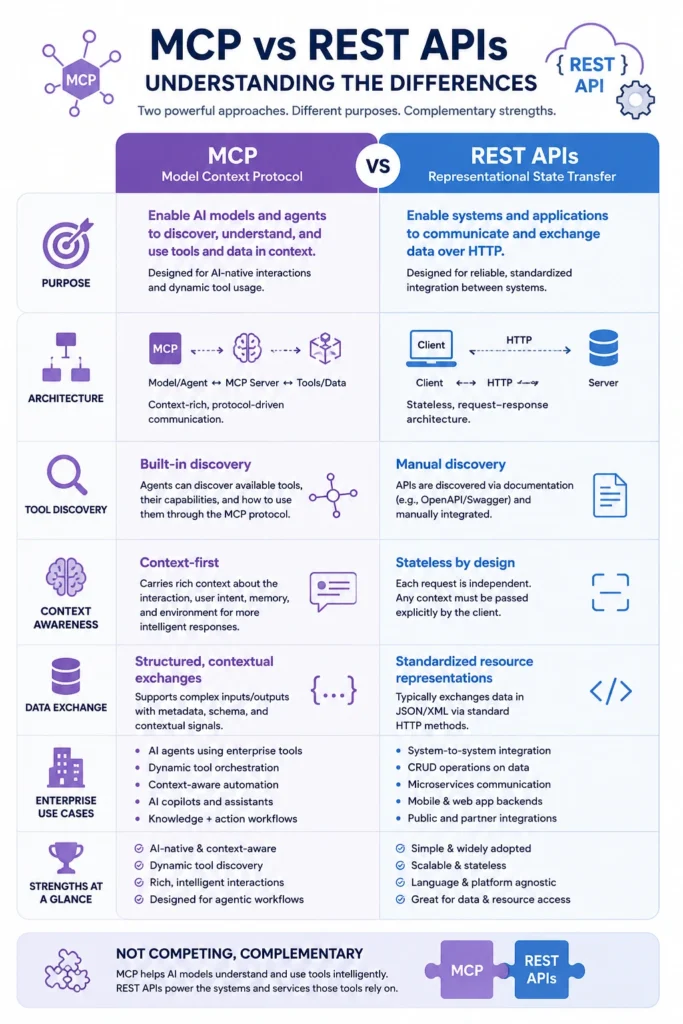
APIs and MCP solve different integration challenges. APIs enable applications to exchange data and execute services, while MCP provides AI systems with standardized context, tool discovery, and interaction models. Together, they create the foundation for intelligent, interoperable enterprise AI architectures.
Although MCP and APIs are often compared, they are not competing technologies. The Model Context Protocol (MCP) Official Specification provides comprehensive guidance on the protocol’s architecture, communication model, and implementation patterns, helping developers build interoperable AI systems that securely connect to enterprise tools and data sources.
Instead, they operate at different layers of the architecture.
APIs provide access to business functionality.
MCP enables AI systems to intelligently consume that functionality.
MCP vs APIs Comparison
| Capability | APIs | MCP |
|---|---|---|
| Primary Purpose | System integration | AI integration |
| Designed For | Applications | AI Models & Agents |
| Data Access | Yes | Via tools |
| Tool Discovery | No | Yes |
| Context Awareness | Limited | Native |
| Dynamic Capability Discovery | No | Yes |
| AI Agent Support | Limited | Excellent |
| Standardized Tool Interface | No | Yes |
| Enterprise AI Ready | Partial | Yes |
When Should You Use APIs vs MCP?
APIs remain the preferred choice for traditional software integration, while MCP is best suited for AI assistants, copilots, and autonomous agents that require contextual understanding and dynamic tool access. Most enterprise architectures will benefit from using both together.
The decision is not MCP or APIs.
It is understanding where each technology fits.
Use APIs When:
- Connecting enterprise applications
- Exposing business services
- Integrating SaaS platforms
- Building web or mobile applications
- Supporting transactional workflows
Use MCP When:
- Building AI assistants
- Deploying enterprise AI agents
- Connecting LLMs to business tools
- Enabling tool discovery
- Standardizing AI interactions
Enterprise Decision Framework
| Business Scenario | APIs | MCP |
|---|---|---|
| Traditional SaaS Integration | ✅ | |
| Mobile Applications | ✅ | |
| ERP & CRM Integration | ✅ | |
| AI Copilot | ✅ | |
| AI Agent | ✅ | |
| Retrieval-Augmented Generation (RAG) | ✅ | |
| Intelligent Workflow Automation | ✅ | ✅ |
| Enterprise AI Platform | ✅ | ✅ |
Read our blog on AI Context Engineering: The New Competitive Advantage for Enterprise AI
Key Takeaways
- APIs remain the backbone of enterprise application integration.
- MCP introduces a standardized protocol for AI models to discover and interact with enterprise tools.
- APIs and MCP are complementary technologies, not competing standards.
- Organizations building Enterprise AI platforms should view APIs as the integration layer and MCP as the AI interaction layer.
- Combining MCP with existing APIs creates a scalable foundation for copilots, AI agents, and intelligent enterprise applications.
How MCP and APIs Work Together
MCP and APIs complement rather than replace each other. APIs continue to expose enterprise services and business functions, while MCP provides a standardized interface that enables AI models to discover, understand, and securely interact with those APIs using structured context.
A common misconception is that MCP is a replacement for REST APIs or GraphQL
In reality, MCP sits above existing APIs.
Enterprise applications continue exposing functionality through APIs, while MCP allows AI applications to consume those capabilities intelligently without requiring custom integrations for every tool.
Think of it as two complementary layers:
- APIs expose business capabilities.
- MCP explains those capabilities to AI.
For example, instead of an AI assistant integrating separately with Salesforce, SAP, Jira, GitHub, Microsoft 365, and ServiceNow APIs, each tool exposes an MCP server that standardizes how AI discovers and interacts with them.
Enterprise AI Integration Stack
| Layer | Responsibility | Technology |
|---|---|---|
| Enterprise Applications | Business systems | CRM, ERP, HRMS, SaaS |
| APIs | Expose business functionality | REST, GraphQL, gRPC |
| MCP Server | Tool discovery & context | Model Context Protocol |
| AI Runtime | Reasoning & orchestration | LLMs, AI Agents |
| User Experience | AI interaction | Copilot, Chatbots, Applications |
Enterprise Insight: APIs expose services. MCP transforms those services into AI-ready capabilities by providing structured context and standardized interaction patterns.
MCP vs REST APIs vs GraphQL
REST APIs, GraphQL, and MCP address different integration requirements. REST and GraphQL optimize application communication, while MCP standardizes how AI systems discover tools, understand capabilities, and execute tasks across enterprise environments.
Although all three enable connectivity, their design goals differ significantly.
REST and GraphQL help applications exchange information efficiently.
MCP helps AI systems understand what they can do—not just how to call an endpoint.
REST vs GraphQL vs MCP
| Capability | REST API | GraphQL | MCP |
|---|---|---|---|
| Primary Purpose | Application Integration | Flexible Data Retrieval | AI Tool Integration |
| Designed For | Developers | Frontend Applications | AI Models & Agents |
| Tool Discovery | No | No | Yes |
| Context Awareness | Limited | Limited | Native |
| Dynamic Capability Discovery | No | Partial | Yes |
| AI Native | No | Partial | Yes |
| Enterprise AI Ready | Moderate | Moderate | Excellent |
MCP Architecture for Enterprise AI
MCP introduces a standardized architecture that connects AI models with enterprise systems through discoverable tools, structured context, and secure communication. This approach simplifies AI integration while improving scalability and governance.
Traditional AI integrations often require custom code for every enterprise application.
As organizations adopt dozens of AI assistants and hundreds of enterprise tools, maintaining these integrations becomes increasingly difficult.
MCP reduces this complexity through a standardized architecture.
Typical MCP Workflow
- User submits a request.
- AI interprets the intent.
- MCP identifies available enterprise tools.
- AI selects the appropriate capability.
- Underlying APIs execute the requested action.
- Results are returned to the AI application.
This separation allows AI models to focus on reasoning while enterprise systems continue handling business transactions.
Traditional AI Integration vs MCP
| Traditional Integration | MCP Architecture |
|---|---|
| Custom integrations for every tool | Standardized protocol |
| Hardcoded connectors | Dynamic discovery |
| Higher maintenance | Reusable integrations |
| Vendor-specific implementations | Open ecosystem |
| Limited scalability | Enterprise scale |
Security and Governance
Enterprise AI requires more than secure APIs—it also requires secure context sharing, tool authorization, identity management, and governance. MCP complements existing API security by introducing standardized mechanisms for controlling AI access to enterprise resources.
As AI systems become capable of executing business actions, organizations must govern what AI can access, which tools it can use, and under what conditions.
Security therefore extends beyond API authentication.
It also includes:
- Tool authorization
- Context isolation
- Identity propagation
- Audit logging
- Responsible AI controls
Security Comparison
| Traditional API Security | MCP Security |
|---|---|
| Authentication | Authentication + AI Identity |
| Authorization | Tool-level Authorization |
| API Keys | Secure Context Exchange |
| Audit Logs | AI Interaction Logs |
| Role-Based Access | Fine-grained Tool Permissions |
Governance Best Practices
- Authenticate every MCP connection.
- Apply least-privilege access.
- Validate AI tool permissions.
- Encrypt enterprise context.
- Monitor AI interactions continuously.
- Maintain audit trails for compliance.
Best Practices for Enterprise Adoption
Organizations should adopt MCP incrementally by integrating it with existing APIs rather than replacing established integration architectures. A phased approach minimizes risk while accelerating AI innovation.
Most enterprises already have mature API ecosystems.
The objective should be to extend, not replace, those investments.
Enterprise Best Practices
| Best Practice | Business Benefit |
|---|---|
| Keep APIs as the system of record | Protect existing investments |
| Introduce MCP gradually | Lower modernization risk |
| Separate AI orchestration from business logic | Easier maintenance |
| Use MCP for tool discovery | Better AI interoperability |
| Implement centralized governance | Improved compliance |
| Monitor AI tool usage | Better security and optimization |
Common Misconceptions About MCP
Because MCP is a relatively new standard, it is often misunderstood as an API replacement or a new AI model. In reality, MCP is an interoperability protocol that complements existing enterprise integration strategies.
| Myth | Reality |
|---|---|
| MCP replaces APIs | MCP uses existing APIs to execute business operations. |
| MCP is an AI model | MCP is an open communication protocol. |
| APIs become obsolete | APIs remain essential for enterprise integration. |
| MCP only works with LLMs | It supports AI assistants, agents, and intelligent applications. |
| Existing systems need rewriting | Most organizations can add MCP without major architectural changes. |
Enterprise Decision Framework
Organizations should choose APIs, MCP, or both based on the application being built. Traditional software relies on APIs, while AI-native applications benefit from MCP’s standardized approach to tool discovery and contextual interactions.
| Enterprise Requirement | APIs | MCP |
|---|---|---|
| Mobile & Web Applications | ✅ | |
| SaaS Integrations | ✅ | |
| ERP & CRM Connectivity | ✅ | |
| AI Copilot | ✅ | |
| AI Agents | ✅ | |
| Multi-Agent Systems | ✅ | |
| Enterprise Knowledge Assistants | ✅ | |
| End-to-End AI Platform | ✅ | ✅ |
Architecture Recommendation: APIs should continue serving as the integration backbone, while MCP becomes the standardized interaction layer that enables AI systems to discover, understand, and orchestrate enterprise capabilities.
Read our blog on 10 Effective Steps To Building RAG Applications: From Prototype to Production-Grade Enterprise Systems
Key Takeaways
- MCP builds on—not replaces—the API ecosystem.
- REST APIs and GraphQL remain essential for application integration, while MCP enables AI-native interoperability.
- Combining APIs with MCP reduces integration complexity for AI assistants, copilots, and autonomous agents.
- Security must evolve from API authentication alone to include AI identity, tool authorization, and context governance.
- Enterprises adopting MCP incrementally can accelerate AI innovation without disrupting existing architectures.
Conclusion
As Enterprise AI evolves from chatbots to intelligent copilots and autonomous agents, integration strategies must evolve as well. APIs remain the foundation of enterprise connectivity, but AI systems require additional context, standardized tool discovery, and secure interaction models to operate effectively.
This is where the Model Context Protocol (MCP) adds significant value. Rather than replacing APIs, MCP builds upon them by creating a consistent interface through which AI applications can discover enterprise capabilities, retrieve trusted context, and execute tasks more intelligently.
For technology leaders, the decision is no longer MCP vs APIs—it is understanding how MCP and APIs work together to build scalable, secure, and AI-ready enterprise architectures.
At Techment, we help organizations design future-ready AI platforms by combining Enterprise AI engineering, API-first architecture, cloud-native development, and intelligent data platforms to accelerate AI adoption while preserving existing technology investments.
Frequently Asked Questions (FAQs)
1. What is the difference between MCP and APIs?
APIs enable applications to exchange data and execute business functions, while MCP provides a standardized protocol that allows AI models to discover, understand, and interact with enterprise tools using structured context. APIs power integration, whereas MCP enables AI interoperability.
2. Does MCP replace REST APIs?
No. MCP complements REST APIs rather than replacing them. Enterprise systems continue exposing services through APIs, while MCP helps AI applications discover and consume those services more intelligently.
3. Should organizations replace existing APIs with MCP?
No. Existing APIs remain essential for enterprise integration. Organizations should continue investing in robust API ecosystems while adopting MCP to support AI assistants, copilots, and autonomous agents.
4. When should enterprises use MCP?
MCP is best suited for AI-native applications such as enterprise copilots, AI agents, Retrieval-Augmented Generation (RAG), and multi-agent systems that require contextual understanding and dynamic tool discovery.
5. Can MCP and APIs work together?
Yes. APIs provide the underlying business functionality, while MCP standardizes how AI systems discover and interact with those APIs. Together they create a scalable and future-ready Enterprise AI architecture.
Related Reads
- RAG in 2026
- RAG vs Fine-Tuning vs AI Agents: Choosing the Right LLM Strategy
- Best Practices for Generative AI Implementation in Business.
- Agentic AI
- Microsoft Fabric Readiness Assessment
- AI, data and analytics trends to rule in 2026
- Enterprise Data Quality Framework: Best Practices for Reliable Analytics and AI
- How to Manage AI Agents Across Your Organization: Governance, Security & Best Practices