AI Context Engineering is the practice of designing, managing, and delivering the right context to AI models so they generate accurate, relevant, and business-aware responses. By combining enterprise data, memory, prompts, business rules, and retrieval mechanisms, organizations can significantly improve the reliability and performance of AI applications and AI agents.
Executive Summary
Large Language Models (LLMs) have made AI more accessible than ever, but the model itself is no longer the primary differentiator. As organizations increasingly adopt Generative AI and AI agents, the quality of the context provided to these systems has become the key factor driving performance.
This is where AI Context Engineering comes in. Rather than relying solely on prompts or model fine-tuning, context engineering ensures AI systems receive the right combination of enterprise knowledge, real-time data, business rules, and user intent to produce relevant, accurate, and trustworthy outputs.
For enterprises, context engineering is becoming a strategic capability that improves AI accuracy, reduces hallucinations, enables personalization, and accelerates business value. Organizations that invest in context-rich AI systems are better positioned to scale AI across customer service, knowledge management, software development, and decision-making.
TL;DR
AI Context Engineering provides AI models with the right information at the right time.
It combines prompts, enterprise data, memory, retrieval, and business rules to improve AI responses.
Context-rich AI systems deliver higher accuracy, personalization, and reliability than prompt-only approaches.
Enterprise AI success increasingly depends on context quality rather than model size alone.
Context Engineering is emerging as a core capability for AI agents, RAG applications, and enterprise AI platforms.
Introduction
AI Context Engineering is rapidly becoming one of the most important disciplines in enterprise AI. As organizations move beyond AI experimentation and deploy AI agents into production, simply writing better prompts is no longer enough.
Modern AI applications need business context, historical interactions, organizational knowledge, user preferences, and real-time enterprise data to make informed decisions. Without this context, even advanced language models can produce incomplete, inaccurate, or irrelevant responses.
Think of an AI model as a highly capable consultant. Its effectiveness depends not only on its expertise but also on the quality of the information it receives. Context engineering ensures that AI systems have access to the right information, in the right format, at the right time—making AI responses more reliable, explainable, and aligned with business objectives.
What Is AI Context Engineering?
AI Context Engineering is the process of collecting, organizing, and delivering relevant information—including enterprise knowledge, user intent, business rules, memory, and real-time data—to AI models so they can generate accurate, context-aware, and actionable responses.
Context Engineering focuses on everything an AI model needs before generating an answer.
Instead of treating prompts as isolated instructions, it builds a broader context that helps AI understand:
Business objectives
User intent
Organizational policies
Historical conversations
Enterprise knowledge
Real-time business data
Task-specific constraints
For example, an enterprise support agent answering a customer query should not rely only on the user’s question. It should also consider product documentation, customer history, support policies, warranty information, and previous interactions to deliver a more accurate and personalized response.
This shift—from prompt-centric AI to context-aware AI—is enabling organizations to build more reliable AI applications that can support complex business workflows.
Why AI Context Engineering Is Becoming the New Competitive Advantage
As foundation AI models become increasingly accessible, competitive advantage is shifting from the model itself to the quality of the context provided. Organizations that effectively combine enterprise knowledge, business rules, and real-time information can build AI systems that deliver more accurate, personalized, and business-relevant outcomes.
The rapid advancement of foundation models has reduced the gap in model capabilities. Today, many organizations have access to similar LLMs, making it harder to differentiate based on the model alone. As enterprise AI evolves, organizations increasingly rely on Retrieval-Augmented Generation (RAG) and context-aware architectures to improve factual accuracy and reduce hallucinations. Microsoft recommends grounding AI responses with trusted enterprise data rather than relying solely on foundation model knowledge.
The real differentiator lies in how well AI understands your business.
Organizations with strong context engineering capabilities can:
Deliver more relevant AI responses.
Reduce hallucinations and factual errors.
Personalize customer and employee experiences.
Improve decision-making with enterprise knowledge.
Enable AI agents to execute complex business workflows.
Scale AI across departments while maintaining consistency.
Context Engineering vs Prompt Engineering vs RAG vs Fine-Tuning
Prompt Engineering, Retrieval-Augmented Generation (RAG), Fine-Tuning, and Context Engineering each improve AI performance in different ways. While prompts optimize instructions and RAG retrieves external knowledge, Context Engineering combines these techniques with memory, business rules, and user context to deliver more reliable enterprise AI experiences.
Although these approaches are often discussed together, they solve different challenges.
Approach
Primary Focus
Best Used For
Prompt Engineering
Writing effective instructions
Simple tasks and conversational AI
Retrieval-Augmented Generation (RAG)
Retrieving relevant enterprise knowledge
Knowledge assistants and search
Fine-Tuning
Customizing model behavior
Domain-specific AI models
AI Context Engineering
Orchestrating prompts, memory, business rules, and enterprise data
Enterprise AI, AI agents, and intelligent automation
Rather than replacing these techniques, Context Engineering brings them together into a unified strategy that helps AI systems understand both the task and the business environment in which they operate.
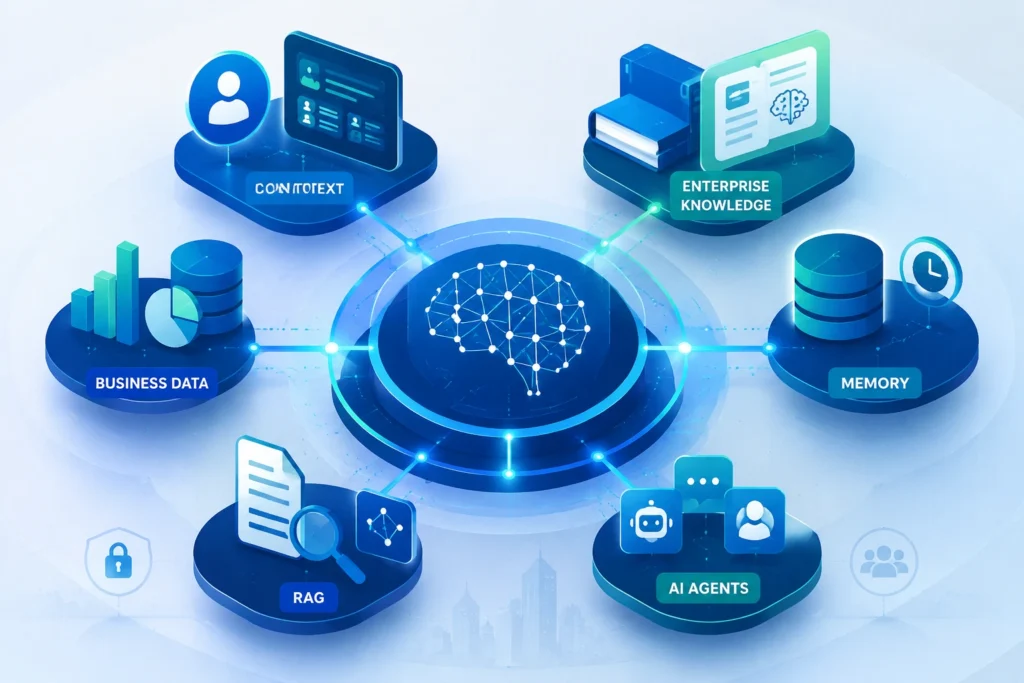
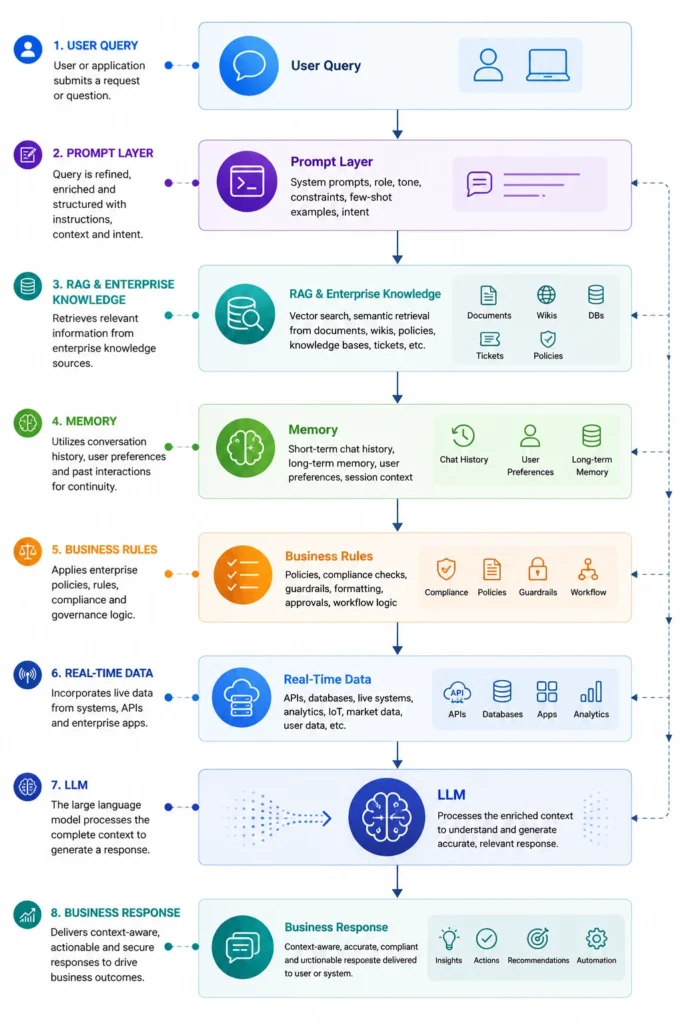
Effective AI Context Engineering combines multiple components—including prompt design, Retrieval-Augmented Generation (RAG), memory, business rules, context management, and real-time data—to provide AI models with the information needed to generate accurate and relevant responses.
Successful context engineering is built on several interconnected capabilities.
Prompt Design
Prompts define the AI’s immediate task, tone, and expected outcome. Well-structured prompts provide clear instructions and reduce ambiguity.
Retrieval-Augmented Generation (RAG)
RAG enhances AI responses by retrieving relevant enterprise information from trusted knowledge sources before generating an answer, helping reduce hallucinations and improve factual accuracy.
Memory
Memory enables AI systems to retain conversational history, user preferences, and prior interactions, creating more personalized and context-aware experiences.
Business Rules
Embedding organizational policies, compliance requirements, and workflow logic ensures AI responses align with enterprise standards and regulatory obligations.
Real-Time Data
Access to live business data—such as inventory levels, customer records, or operational metrics—allows AI applications to generate responses based on the most current information available.
Enterprise Insight: High-performing enterprise AI systems rarely rely on a single technique. Instead, they combine prompts, RAG, memory, business rules, and real-time enterprise data to create a rich context that enables AI to deliver accurate, reliable, and business-aware outcomes.
Enterprise Use Cases for AI Context Engineering
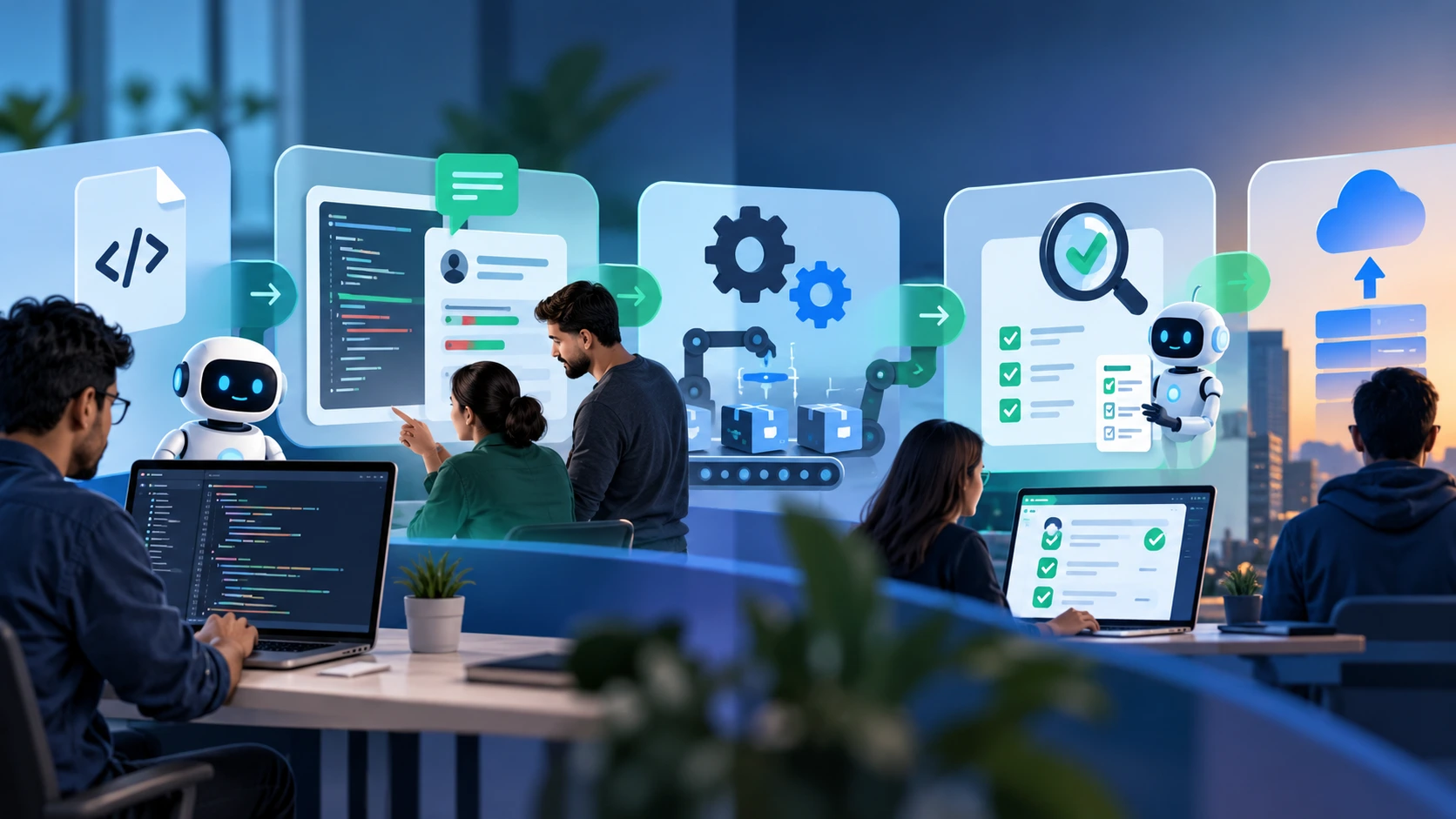
AI Context Engineering enables enterprises to build AI applications that understand business context, retrieve trusted information, and deliver accurate, personalized responses. It is particularly valuable for customer support, enterprise search, software development, healthcare, financial services, and intelligent business automation.
Context Engineering transforms generic AI models into business-aware assistants by combining enterprise knowledge with real-time context.
Faster issue resolution and improved customer satisfaction
Software Development
Code repositories, documentation, APIs
AI-assisted coding and developer productivity
Enterprise Insight: The most successful AI applications don’t rely on general knowledge—they leverage proprietary business context that competitors cannot easily replicate.
Successful AI Context Engineering depends on delivering trusted, relevant, and timely information to AI models. Organizations should combine enterprise knowledge, Retrieval-Augmented Generation (RAG), governance, memory, and continuous evaluation to improve AI accuracy and reliability.
Follow these best practices to maximize the value of Context Engineering:
Treat context as a strategic asset, not just supporting data.
Use Retrieval-Augmented Generation (RAG) to access trusted enterprise knowledge instead of relying solely on model memory.
Prioritize data quality and governance to ensure AI uses accurate and up-to-date information.
Incorporate user context and conversation history to deliver personalized responses.
Apply business rules and guardrails to align AI outputs with organizational policies and compliance requirements.
Continuously evaluate context quality by monitoring response accuracy, relevance, and user feedback.
Secure enterprise knowledge with role-based access control and Zero Trust principles.
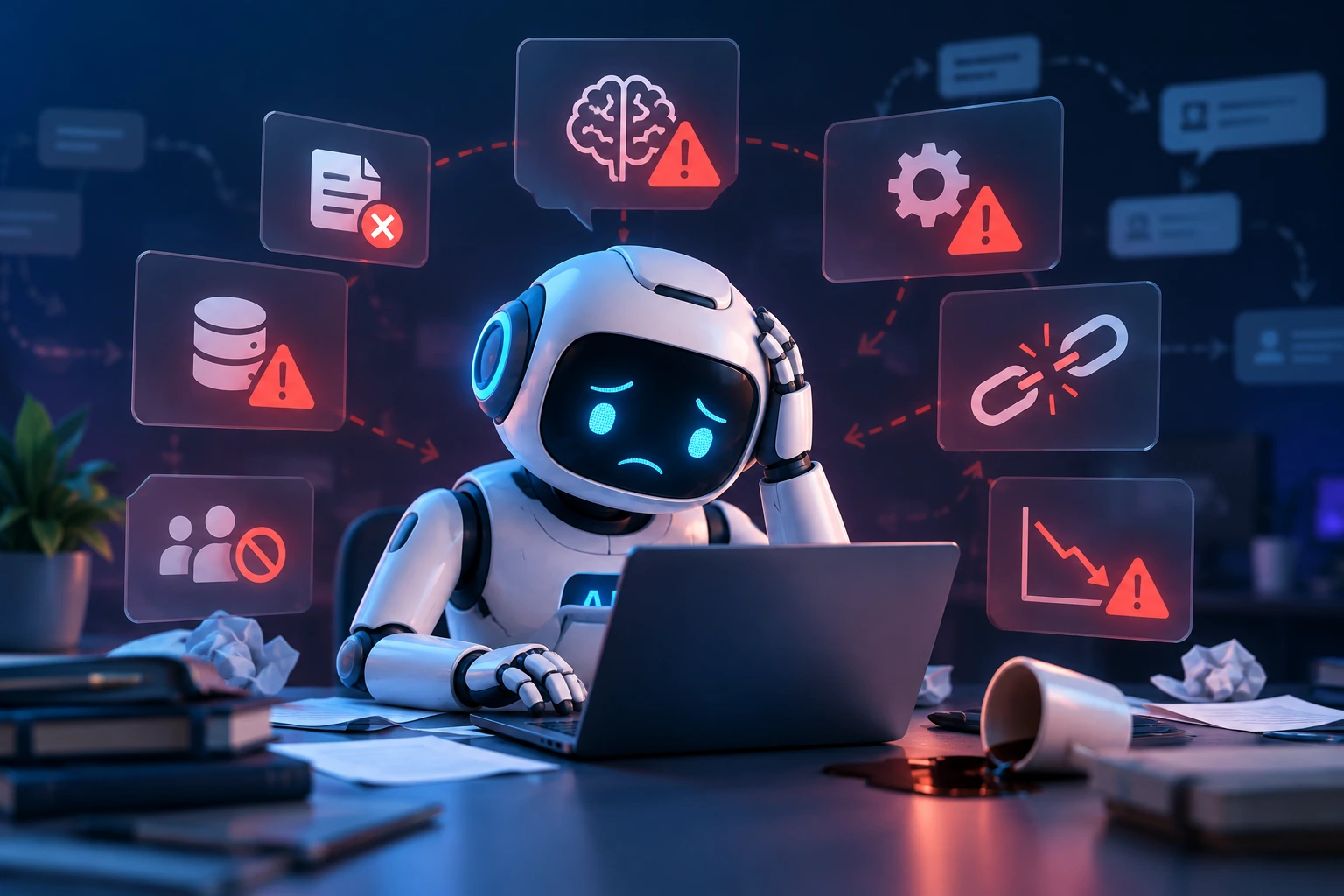
Organizations often face challenges such as fragmented data, poor context quality, security concerns, and rapidly changing business information. Addressing these issues requires strong data governance, continuous context management, and secure enterprise AI architectures.
Challenge
Impact
Recommended Solution
Data Silos
AI lacks complete business context
Build a unified enterprise knowledge layer
Poor Data Quality
Inaccurate or inconsistent responses
Implement data governance and quality controls
Context Drift
Outdated responses over time
Continuously refresh knowledge sources
Security & Compliance
Risk of exposing sensitive information
Enforce RBAC, Zero Trust, and data classification
Large Context Windows
Increased latency and higher inference costs
Retrieve only the most relevant information dynamically
Scalability
AI performance declines as data grows
Use scalable retrieval architectures and vector databases
Future of AI Context Engineering
AI Context Engineering is evolving beyond prompts and retrieval toward intelligent, context-aware systems powered by AI agents, long-term memory, knowledge graphs, and standardized protocols such as the Model Context Protocol (MCP).
Several emerging trends are shaping the future of enterprise AI:
AI Agents
Autonomous AI agents increasingly rely on rich contextual information to perform multi-step tasks, collaborate with other agents, and make informed decisions.
Long-Term Memory
Future AI systems will retain relevant historical interactions and organizational knowledge, enabling more personalized and consistent user experiences.
Model Context Protocol (MCP)
The Model Context Protocol (MCP) is emerging as a standard for securely connecting AI models to enterprise tools, knowledge bases, APIs, and business systems. It simplifies context sharing while improving interoperability and governance.
Context-Aware Orchestration
Rather than passing static prompts, enterprises are orchestrating AI workflows that dynamically assemble context from multiple sources based on the user’s intent and business scenario.
AI models are becoming increasingly powerful, but context is what transforms them into enterprise-ready solutions. As foundation models become widely available, competitive advantage will depend less on the model itself and more on an organization’s ability to provide high-quality, trusted, and business-specific context.
By combining enterprise knowledge, Retrieval-Augmented Generation (RAG), memory, business rules, and real-time data, organizations can build AI systems that are more accurate, explainable, secure, and aligned with business objectives.
At Techment, we help enterprises design context-aware AI solutions using Enterprise AI, AI Agents, RAG, Microsoft Fabric, Data Engineering, and modern cloud architectures—enabling organizations to build scalable, trustworthy AI that delivers measurable business outcomes.
Frequently Asked Questions (FAQs)
1. What is AI Context Engineering?
AI Context Engineering is the practice of providing AI models with relevant business context—including enterprise data, user intent, memory, business rules, and real-time information—to improve the accuracy and relevance of AI responses.
2. How is Context Engineering different from Prompt Engineering?
Prompt Engineering focuses on crafting better instructions for AI models, while Context Engineering manages the broader information ecosystem—including retrieval, memory, enterprise knowledge, and business logic—that supports AI decision-making.
3. Is Context Engineering the same as Retrieval-Augmented Generation (RAG)?
No. RAG is one component of Context Engineering. While RAG retrieves relevant information from external sources, Context Engineering also incorporates prompts, memory, user context, business rules, and real-time data to deliver richer AI experiences.
4. Why is AI Context Engineering important for AI Agents?
AI agents need contextual information to make informed decisions, execute tasks, and interact with enterprise systems. Context Engineering ensures they have access to the right information while maintaining governance and security.
5. Which industries benefit most from Context Engineering?
Industries such as financial services, healthcare, manufacturing, retail, customer support, and software development benefit significantly because they rely on domain-specific knowledge and real-time business data.
6. How can organizations measure the success of Context Engineering?
Key metrics include response accuracy, retrieval relevance, hallucination rate, user satisfaction, task completion rate, response latency, and business outcomes such as productivity improvements or faster decision-making.
The Techment Editorial Team collaborates with subject matter experts, architects, consultants, and technology leaders to create practical insights on AI, data engineering, cloud modernization, Microsoft Fabric, analytics, and enterprise transformation.