AI agents are rapidly transforming enterprise operations by automating workflows, enhancing decision-making, and improving productivity across departments. From customer service and finance to IT operations and supply chain management, organizations are deploying AI agents to execute increasingly complex tasks with minimal human intervention.
However, as AI agent adoption accelerates, many enterprises face a new challenge: managing dozens—or even hundreds—of autonomous agents operating across disconnected systems, business units, and data sources. Without a structured governance model, organizations risk security vulnerabilities, inconsistent performance, duplicated efforts, and regulatory non-compliance.
This guide explores how enterprises can effectively manage AI agents through governance, lifecycle management, security, monitoring, and operating models that enable scalable, responsible AI adoption.
TL;DR
AI agent management is an enterprise governance capability, not just a technical task.
Establish clear ownership, security policies, and lifecycle management before scaling AI agents.
Monitor AI agents continuously using operational, business, and AI performance metrics.
Secure AI agents with identity management, least-privilege access, and human oversight.
Build an AI operating model that aligns technology, governance, and business objectives.
Introduction
Manage AI agents effectively, and they become a competitive advantage. Manage them poorly, and they introduce operational risk, fragmented governance, inconsistent decision-making, and security challenges.
As organizations adopt Generative AI, Retrieval-Augmented Generation (RAG), AI copilots, and autonomous AI agents, enterprise AI environments become increasingly distributed. Individual departments often deploy AI solutions independently, resulting in duplicated capabilities, inconsistent governance, and limited visibility into how AI agents access enterprise systems and data.
Managing AI agents is no longer about supervising individual bots. It requires a comprehensive enterprise strategy that combines governance, security, observability, lifecycle management, and continuous optimization. Organizations that establish these foundations early are better positioned to scale AI responsibly while maximizing business value.
Enterprise AI agent management provides the governance, visibility, and operational controls needed to deploy AI agents securely at scale. It helps organizations reduce operational risks, improve compliance, optimize AI performance, and ensure autonomous agents align with business objectives.
AI agents differ from traditional automation tools because they make contextual decisions, interact with enterprise applications, retrieve information, and collaborate with users or other AI agents.
Without centralized management, organizations may experience:
Shadow AI deployments
Duplicate AI agents performing similar tasks
Inconsistent security policies
Unauthorized data access
Limited auditability
Poor AI performance monitoring
Compliance risks
As AI becomes embedded across business functions, organizations need an enterprise-wide management strategy that balances innovation with governance.
Enterprise Insight: Successful organizations don’t manage AI agents individually—they manage an AI ecosystem consisting of agents, models, enterprise data, orchestration platforms, APIs, and governance policies working together.
An AI agent operating model defines how AI agents are governed, deployed, monitored, and continuously improved across the enterprise. It establishes clear ownership, accountability, security, and operational processes that enable scalable and responsible AI adoption.
One of the biggest gaps in enterprise AI initiatives is the absence of an operating model. Many organizations deploy AI agents without defining who owns them, how they are monitored, or how they evolve over time.
Unlike traditional automation programs, enterprise AI requires governance across technology, business, and compliance functions—not just IT.
Step 1: Create an Enterprise AI Agent Inventory
The first step in managing AI agents is creating a centralized inventory that documents every AI agent, its purpose, owner, data access, integrations, and business function. A complete inventory improves visibility, governance, and operational control across the organization.
Organizations cannot govern what they cannot see.
AI agents are often deployed independently by business teams using cloud AI services, low-code platforms, or custom applications. Without centralized visibility, duplicate agents, inconsistent policies, and unmanaged risks quickly emerge.
Every AI agent inventory should capture:
Attribute
Purpose
Agent Name
Unique identifier
Business Owner
Accountable department
Technical Owner
IT or platform owner
Business Function
Customer service, HR, finance, etc.
Data Sources
Enterprise systems accessed
AI Model
LLM or ML model used
Integrations
APIs, CRM, ERP, databases
Risk Level
Low, Medium, High
Compliance Requirements
GDPR, HIPAA, ISO, NIST
Maintaining this inventory enables organizations to assess risk, prioritize governance, and identify opportunities for consolidation or optimization.
Step 2: Establish an AI Agent Governance Framework
AI agent governance defines the policies, ownership, approval workflows, and compliance controls required to manage AI agents consistently across the enterprise. A governance framework ensures AI agents operate securely, transparently, and in accordance with business and regulatory requirements.
As organizations scale AI agents across business functions, governance should align with recognized frameworks such as the NIST AI Risk Management Framework (AI RMF 1.0) and ISO/IEC 42001, which provide guidance on AI risk management, accountability, human oversight, and continuous improvement. Aligning AI governance with these standards helps organizations build trustworthy and compliant AI systems.
As AI adoption grows, governance becomes the foundation for sustainable scale.
Governance should answer key questions such as:
Who approves new AI agents?
Which AI use cases are permitted?
How are AI risks assessed?
Who monitors AI performance?
When is human approval required?
How are incidents escalated?
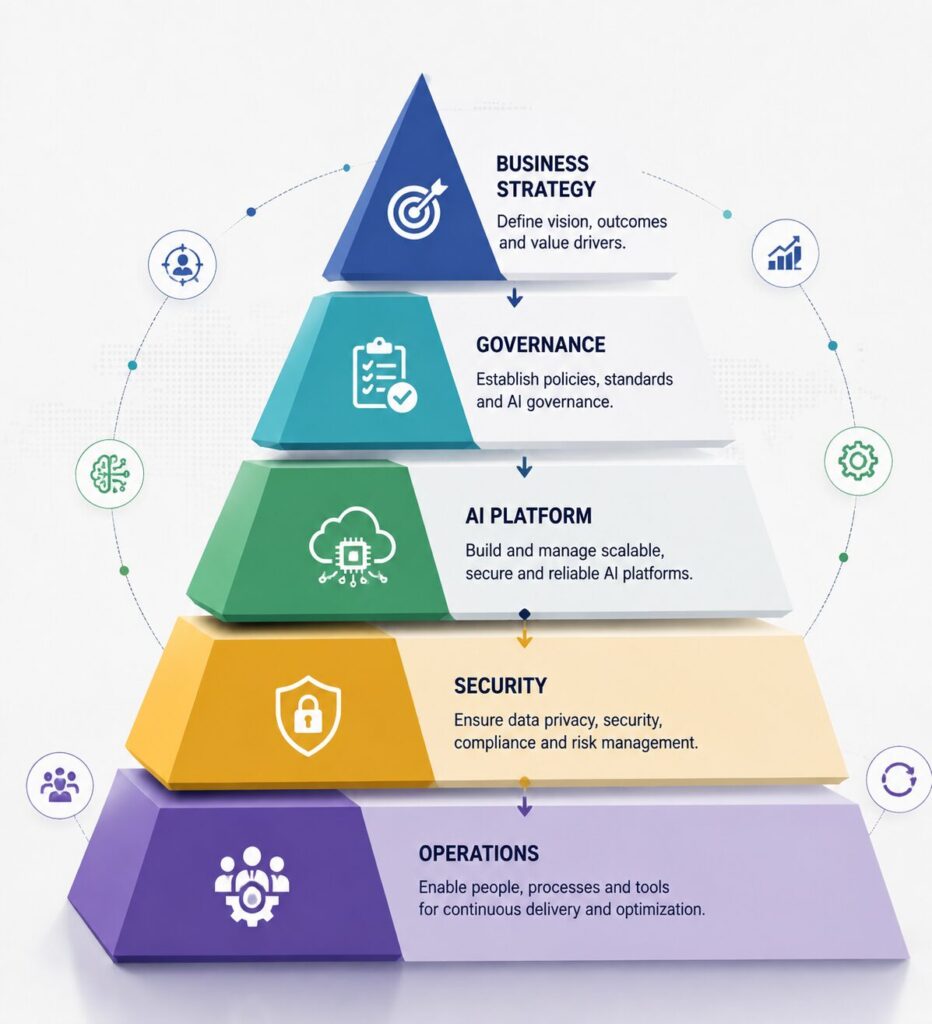
Enterprise AI Agent Governance Framework
Governance Pillar
Objective
Strategy & Business Alignment
Prioritize high-value AI initiatives
Governance & Compliance
Define policies, approvals, and risk management
Security & Identity
Secure AI access and enterprise data
AI Operations
Monitor, optimize, and continuously improve AI agents
Responsible AI
Ensure transparency, fairness, and accountability
This governance model transforms AI from isolated departmental initiatives into a scalable enterprise capability.
Clear ownership is essential for effective AI agent management. Defining business, technical, security, and governance responsibilities ensures every AI agent has accountable owners throughout its lifecycle, reducing operational risks and improving decision-making.
AI agents often span multiple teams, making ownership unclear unless responsibilities are explicitly defined.
A recommended ownership model includes:
Role
Responsibility
Business Owner
Defines business objectives and KPIs
AI Platform Team
Builds and maintains AI infrastructure
Security Team
Manages identity, access, and compliance
Data Team
Ensures trusted, governed data
Risk & Compliance
Reviews regulatory and policy adherence
Operations Team
Monitors AI performance and incidents
Shared ownership prevents governance gaps while ensuring AI initiatives remain aligned with business priorities.
Step 4: Secure AI Agents with Identity, Access & Zero Trust
AI agents should be secured using Zero Trust principles, least-privilege access, identity-based authentication, and continuous verification. Assigning unique identities to each AI agent, restricting system permissions, and monitoring every interaction significantly reduces enterprise security risks while improving governance and compliance.
As AI agents evolve from assistants to autonomous decision-makers, they often gain access to enterprise applications, APIs, databases, CRMs, ERPs, and confidential business information. Without robust security controls, these agents can unintentionally expose sensitive data or execute unauthorized actions.
Security should therefore be embedded into every stage of the AI agent lifecycle—not added after deployment.
Enterprise AI Agent Security Best Practices
Assign a unique digital identity to every AI agent.
Apply Role-Based Access Control (RBAC) and the principle of least privilege.
Implement Multi-Factor Authentication (MFA) for administrative access.
Use short-lived API tokens instead of permanent credentials.
Encrypt sensitive data both at rest and in transit.
Restrict access to enterprise knowledge bases and vector databases.
Maintain immutable audit logs for every AI action.
Periodically review permissions and revoke unused access.
Enterprise Insight
As organizations adopt Agentic AI, identity management becomes as important as model selection. AI agents should be treated like enterprise users—with defined identities, scoped permissions, and continuous authentication.
Step 5: Implement an AI Agent Lifecycle Management Framework
AI agent lifecycle management ensures every AI agent is governed from planning through retirement. A structured lifecycle improves security, performance, compliance, and operational efficiency by defining how AI agents are designed, deployed, monitored, optimized, and eventually decommissioned.
Many organizations successfully build AI agents but fail to manage them after deployment. Enterprise AI requires continuous governance rather than one-time implementation.
Archive logs, revoke access, preserve compliance records
Unlike traditional software, AI agents continuously evolve as models improve, business processes change, and enterprise knowledge expands.
Step 6: Monitor AI Agents with Enterprise Observability
AI observability enables organizations to monitor AI agent behavior, detect performance issues, track business outcomes, and ensure responsible AI operation. Continuous monitoring helps identify model drift, inaccurate responses, security incidents, and operational bottlenecks before they impact business performance.
Enterprise AI cannot operate as a “black box.”
Organizations should implement observability across every AI interaction.
Monitor Operational Metrics
Response latency
API failures
Workflow completion rate
Infrastructure utilization
Availability
Monitor AI Performance
Response accuracy
Hallucination frequency
Task completion rate
Prompt effectiveness
User satisfaction
Monitor Business KPIs
Time saved
Cost reduction
Customer satisfaction
Employee productivity
Process automation rate
Enterprise Insight: AI observability extends beyond infrastructure monitoring. It combines operational health, model performance, user experience, and business impact into a unified view of enterprise AI success.
Step 7: Keep Humans in the Loop
Human-in-the-loop governance ensures AI agents remain accountable by requiring human oversight for high-risk decisions. Combining AI autonomy with human review improves accuracy, regulatory compliance, customer trust, and responsible AI adoption.
Not every AI decision should be autonomous.
Organizations should define situations requiring human approval.
Examples include:
Financial transactions
Medical recommendations
Contract approvals
Legal decisions
Customer disputes
HR hiring recommendations
Regulatory reporting
Recommended Approval Matrix
AI Task
Human Approval Required
Knowledge Search
No
Customer Support Draft
Optional
Invoice Processing
Threshold-based
Financial Approval
Yes
Healthcare Recommendation
Yes
Contract Changes
Yes
Human oversight increases trust while reducing operational and compliance risks.
Step 8: Orchestrate AI Agents Across the Enterprise
AI agent orchestration coordinates multiple AI agents, enterprise applications, APIs, and business workflows to automate complex processes. Orchestration improves scalability, collaboration, and operational efficiency while ensuring agents work together securely and consistently.
Most enterprise processes involve multiple AI agents working together.
For example:
Customer submits request
↓
Customer Service Agent
↓
Knowledge Retrieval Agent
↓
Policy Validation Agent
↓
CRM Update Agent
↓
Notification Agent
↓
Human Approval (if required)
↓
Customer Response
This coordinated approach creates intelligent workflows instead of isolated AI applications.
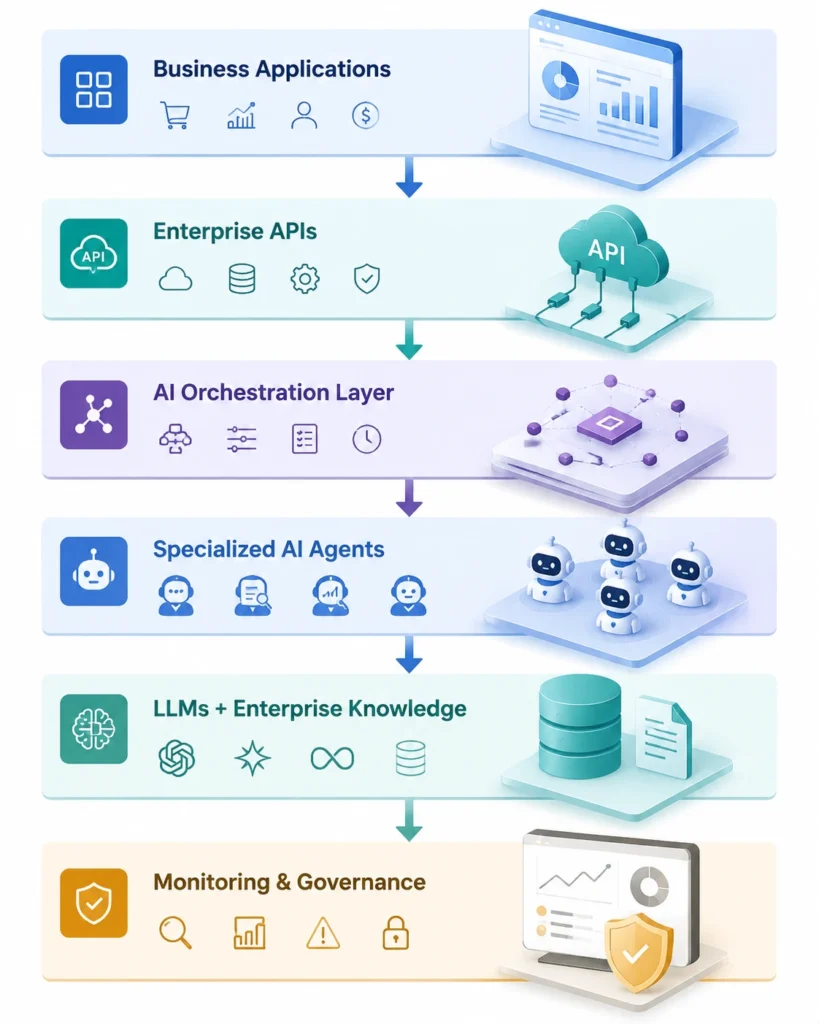
Enterprise AI Agent Architecture
Modern orchestration platforms also support:
Multi-agent collaboration
Shared memory
Agent handoffs
Workflow automation
Event-driven execution
Enterprise policy enforcement
Enterprise AI Agent KPIs
Successful AI agent programs measure business value, operational performance, and governance outcomes. Organizations should track productivity, accuracy, response quality, security, and AI adoption metrics to evaluate enterprise AI performance.
Enterprise AI Scorecard
Category
KPI
Business Goal
Business
Productivity Improvement
↑
Business
Cost Reduction
↑
Operations
Task Completion Rate
>95%
Operations
Response Time
<3 seconds
AI Quality
Accuracy
>90%
AI Quality
Hallucination Rate
↓
Security
Policy Violations
Zero Critical
Security
Unauthorized Access
Zero
User Experience
Employee Satisfaction
↑
Innovation
AI Adoption Rate
Continuous Growth
Rather than measuring only technical metrics, enterprise leaders should evaluate AI agents based on measurable business outcomes.
Common Mistakes Organizations Make
Organizations often struggle with AI agent management because they prioritize deployment over governance. Common mistakes include unclear ownership, weak security, poor monitoring, duplicated agents, and treating AI as isolated projects instead of enterprise capabilities.
Avoid these common pitfalls:
1. Deploying AI without governance
Scaling AI before defining ownership and policies creates long-term operational risks.
2. Building duplicate AI agents
Different departments frequently develop similar agents independently, increasing costs and maintenance effort.
3. Ignoring AI observability
Without monitoring, organizations cannot detect declining performance or governance issues.
4. Over-permissioning AI agents
Excessive access increases the impact of security incidents.
5. Measuring only technical performance
AI initiatives should ultimately be evaluated using business KPIs such as productivity, customer experience, operational efficiency, and ROI.
Enterprise AI Agent Maturity Model
An AI Agent Maturity Model helps organizations assess their readiness to deploy, govern, and scale AI agents. Enterprises that progress from isolated pilots to governed, observable, and autonomous AI ecosystems achieve higher ROI, stronger security, and more sustainable AI adoption.
One of the biggest reasons AI initiatives stall is that organizations attempt to scale AI agents without first building the operational capabilities needed to support them.
Enterprise AI Agent Maturity Model provides a roadmap for progressing from experimentation to enterprise-wide AI operations.
Maturity Level
Characteristics
Business Outcome
Level 1 – Experimenting
Individual AI pilots, limited governance
Learning and experimentation
Level 2 – Departmental Adoption
AI agents deployed within individual business units
Local productivity improvements
Level 3 – Enterprise Governance
Standardized policies, ownership, and security
Controlled AI adoption
Level 4 – Intelligent Orchestration
Multi-agent workflows integrated across enterprise systems
Cross-functional automation
Level 5 – Autonomous Enterprise
AI agents continuously optimize business processes with governance and human oversight
Enterprise-wide AI transformation
Enterprise Insight
Organizations shouldn’t measure success by the number of AI agents deployed. The real indicator of maturity is the ability to govern, monitor, and continuously optimize AI agents across the enterprise.
Build, Buy, or Orchestrate? Choosing the Right AI Agent Strategy
The right AI agent strategy depends on business objectives, technical capabilities, compliance requirements, and time-to-value. Organizations should evaluate whether to build custom AI agents, adopt commercial platforms, or orchestrate multiple specialized agents into enterprise workflows.
Every enterprise faces the same strategic question:
Should we build AI agents, buy an AI platform, or orchestrate existing solutions?
AI Agent Decision Matrix
Approach
Best For
Advantages
Considerations
Build
Proprietary business processes
Full customization, competitive differentiation
Higher development effort and ongoing maintenance
Buy
Standard business functions
Faster implementation, vendor support
Less flexibility and potential vendor lock-in
Orchestrate
Enterprise-wide automation
Connects multiple AI agents and business systems
Requires strong governance and integration capabilities
Recommended Approach
Build when AI capabilities create competitive advantage.
Buy for standardized workflows such as HR or IT service management.
Orchestrate when multiple AI agents must collaborate across enterprise applications.
Many organizations ultimately adopt a hybrid strategy that combines all three approaches.
Enterprise AI agent management is evolving toward autonomous multi-agent ecosystems, standardized communication protocols, AI observability, and governance-first operating models. Organizations that prepare for these trends today will be better positioned to scale AI securely and responsibly.
1. Multi-Agent Collaboration
Rather than relying on a single AI assistant, enterprises are deploying specialized agents that collaborate to complete complex workflows across customer service, finance, HR, and IT.
2. Model Context Protocol (MCP)
The Model Context Protocol (MCP) is emerging as a standard for connecting AI agents to enterprise tools, knowledge sources, and applications. By standardizing how agents access context and execute actions, MCP simplifies interoperability while improving security and governance.
3. Agentic AI
Future AI systems will move beyond responding to prompts and begin proactively planning, coordinating, and executing multi-step business processes with minimal human intervention.
4. AI Observability Platforms
Organizations will increasingly adopt dedicated AI observability solutions to monitor:
AI performance
Hallucinations
Prompt effectiveness
Cost optimization
Business outcomes
Security events
5. Governance by Design
AI governance will become embedded into enterprise architecture rather than implemented after deployment, ensuring compliance, transparency, and accountability from day one.
Enterprise AI Agent Management Checklist
Before scaling AI agents across your organization, verify the following:
✅ Centralized AI agent inventory
✅ Defined ownership model
✅ Governance framework established
✅ Identity and access controls implemented
✅ AI lifecycle management process documented
✅ Human-in-the-loop approvals defined
✅ AI observability dashboards deployed
✅ KPIs aligned to business outcomes
✅ Security and compliance policies enforced
✅ Continuous optimization strategy established
Enterprise Insight: Organizations that complete this checklist before large-scale deployment reduce operational risk, improve governance, and accelerate enterprise AI adoption.
AI agent management is an enterprise capability that combines governance, security, operations, and business strategy.
Managing AI agents requires centralized visibility, defined ownership, lifecycle management, and continuous monitoring.
Zero Trust, least-privilege access, and human oversight remain foundational security principles.
AI observability is essential for measuring performance, detecting issues, and demonstrating business value.
AI orchestration enables multiple specialized agents to collaborate across enterprise workflows.
A governance-first approach helps organizations scale AI responsibly while maximizing long-term ROI.
Frequently Asked Questions (FAQs)
1. What is AI agent management?
AI agent management is the practice of governing, monitoring, securing, and optimizing AI agents throughout their lifecycle. It includes deployment, identity management, performance monitoring, compliance, and continuous improvement across the enterprise.
2. Why is AI agent governance important?
AI agent governance ensures AI systems operate securely, transparently, and in compliance with organizational policies and regulations. It establishes ownership, approval workflows, security controls, and monitoring processes that reduce risk while enabling scalable AI adoption.
3. How do organizations manage multiple AI agents?
Organizations manage multiple AI agents through centralized inventories, governance frameworks, AI orchestration platforms, lifecycle management, identity and access controls, observability, and continuous monitoring.
4. What are the biggest challenges in managing AI agents?
Common challenges include shadow AI, inconsistent governance, duplicate agents, weak security, excessive permissions, lack of monitoring, unclear ownership, and measuring business value beyond technical performance.
5. How is AI agent management different from traditional IT management?
Traditional IT management focuses on deterministic software and infrastructure, whereas AI agent management addresses autonomous decision-making, dynamic interactions, model behavior, AI governance, prompt management, and continuous learning.
6. What KPIs should enterprises track for AI agents?
Organizations should measure task completion rate, response accuracy, productivity gains, customer satisfaction, operational efficiency, AI adoption, policy compliance, security incidents, and business ROI.
7. What role does human oversight play in AI agent management?
Human oversight is essential for high-risk decisions involving financial approvals, legal reviews, healthcare recommendations, compliance, or sensitive customer interactions. Human-in-the-loop governance improves accountability, trust, and regulatory compliance.
8. How can enterprises scale AI agents securely?
Enterprises should adopt Zero Trust principles, implement identity-based access controls, establish governance frameworks, monitor AI performance continuously, secure enterprise knowledge, and align AI initiatives with business objectives.
The Techment Editorial Team collaborates with subject matter experts, architects, consultants, and technology leaders to create practical insights on AI, data engineering, cloud modernization, Microsoft Fabric, analytics, and enterprise transformation.