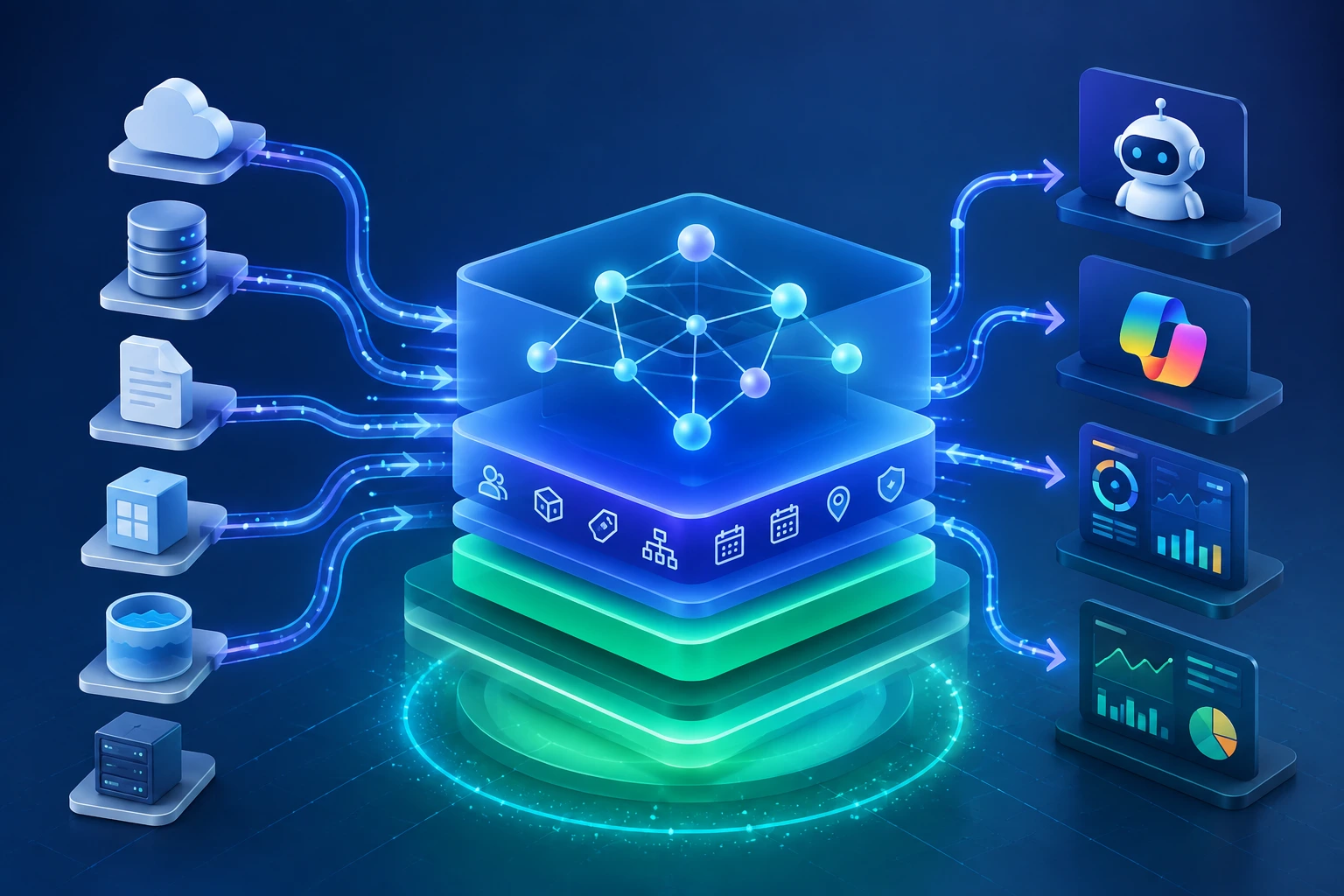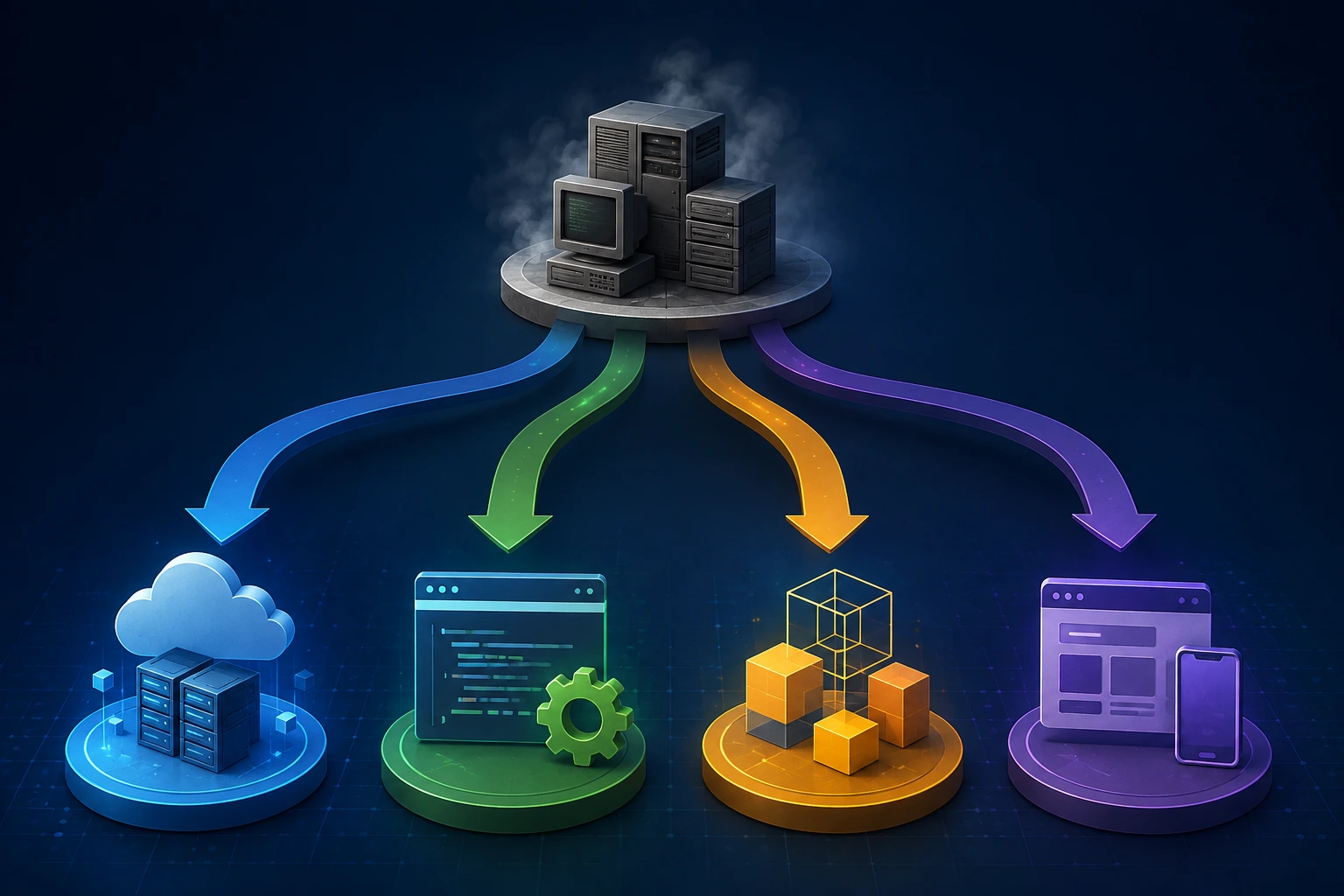
A semantic layer for Enterprise AI creates a trusted business abstraction over enterprise data by standardizing metrics, relationships, and business definitions. It enables AI applications, copilots, analytics platforms, and business users to access consistent, governed, and business-friendly information, improving AI accuracy, governance, and enterprise decision-making.
TL;DR
- AI performs better when it understands business context.
- A semantic layer standardizes KPIs and business definitions.
- It reduces inconsistent AI responses.
- It enables self-service analytics and AI assistants.
- It becomes the trusted knowledge layer for Enterprise AI.
Executive Summary
Semantic Layer for Enterprise AI is becoming one of the most critical architectural components for organizations adopting Generative AI, AI copilots, and intelligent business applications. While enterprises have invested heavily in data lakes, warehouses, and analytics platforms, AI systems still struggle when business definitions differ across departments or data sources.
A semantic layer solves this challenge by creating a centralized business abstraction where metrics, relationships, hierarchies, and governance are defined once and reused across analytics, reporting, and AI applications. Instead of forcing AI models to interpret raw enterprise data, organizations provide a trusted business context that improves accuracy, consistency, and decision-making.
This article explores five reasons why a semantic layer has become the foundation of modern Enterprise AI strategies.
What Is a Semantic Layer?
A semantic layer is a business-friendly abstraction that sits between enterprise data and consuming applications. It transforms technical datasets into standardized business entities, metrics, and relationships, enabling consistent analytics and AI-driven insights across the organization.
Rather than exposing raw database tables directly to business users or AI systems, a semantic layer organizes information into familiar business concepts such as customers, revenue, products, regions, and profitability.
This enables both humans and AI to work from the same governed understanding of enterprise data.
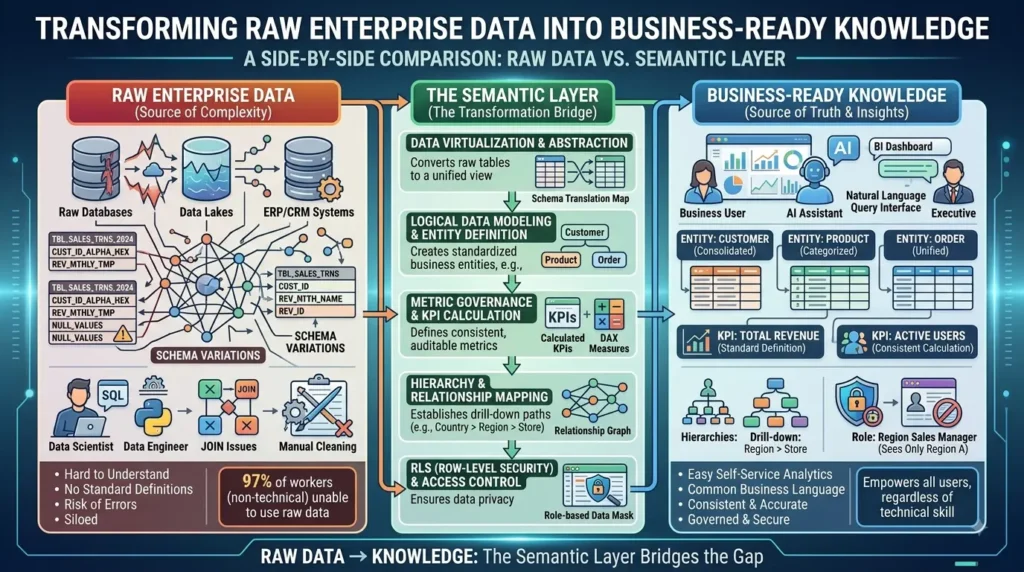
Why Enterprise AI Needs a Semantic Layer
Enterprise AI depends on trusted business context to generate accurate insights. A semantic layer provides that context by centralizing business definitions, KPIs, metadata, and relationships, enabling AI applications to deliver consistent responses, improve governance, and reduce ambiguity across enterprise data.\
Read our blog on Microsoft Fabric Semantic Models Explained: The Enterprise Guide to Building Trusted, AI-Ready Business Intelligence
Enterprise Data Without vs With a Semantic Layer
| Without Semantic Layer | With Semantic Layer |
|---|---|
| Multiple KPI definitions | Standardized metrics |
| Department-specific logic | Shared business definitions |
| Duplicate calculations | Reusable measures |
| Data silos | Unified business view |
| Inconsistent AI responses | Trusted AI outputs |
5 Advantages of a Semantic Layer for Enterprise AI
A semantic layer improves Enterprise AI by providing trusted business context, consistent metrics, reusable business logic, stronger governance, and scalable AI integration. Together, these capabilities create a reliable foundation for analytics, AI copilots, and intelligent automation.
1. Creates a Single Source of Truth
A semantic layer establishes a single source of truth by centralizing business definitions, KPIs, and calculations. This ensures every report, dashboard, AI assistant, and analytics application uses the same trusted business logic, improving consistency and reducing conflicting interpretations across the organization. One of the biggest challenges in enterprise AI is inconsistent business definitions.
For example:
- Finance defines revenue differently than Sales.
- Marketing reports attributed revenue.
- Operations measures invoiced revenue.
A semantic layer centralizes these definitions so every dashboard, AI assistant, and business application works from the same trusted metrics.
Business Value
✔ Consistent reporting
✔ Trusted KPIs
✔ Better executive decisions
2. Improves AI Accuracy
A semantic layer improves Enterprise AI accuracy by providing standardized business definitions, metadata, relationships, and governed context. Instead of retrieving fragmented or inconsistent information, AI applications access trusted business knowledge, resulting in more accurate, explainable, and reliable responses.
Large Language Models reason using context.
Without standardized business meaning, AI may interpret identical terms differently depending on the source dataset.
A semantic layer provides:
- Business relationships
- Standardized calculations
- Metadata
- Business hierarchies
This improves:
- Copilot responses
- AI search
- RAG accuracy
- Agent reasoning
How Semantic Layers Improve AI Accuracy
| Enterprise AI Challenge | Without a Semantic Layer | With a Semantic Layer |
|---|---|---|
| Business Definitions | Multiple interpretations of KPIs | Standardized business metrics |
| Data Retrieval | Searches across fragmented datasets | Retrieves governed, curated information |
| AI Responses | Inconsistent or conflicting answers | Accurate and consistent outputs |
| Context Understanding | Limited business context | Rich business semantics and relationships |
| Explainability | Difficult to trace responses | Transparent business logic and lineage |
| Trust in AI | Lower user confidence | Higher confidence in AI-generated insights |
AI Without Semantic Layer vs AI With Semantic Layer
| Without | With |
|---|---|
| Hallucination risk | Trusted context |
| Multiple answers | Consistent responses |
| Fragmented data | Unified knowledge |
| Lower confidence | Higher reliability |
3. Accelerates Self-Service Analytics
A semantic layer enables self-service analytics by presenting enterprise data using familiar business terminology instead of technical database structures. This empowers business users to explore trusted data independently, reducing reliance on IT teams while improving reporting consistency and decision-making.
Business users should not need SQL expertise to answer business questions.
A semantic layer exposes:
- Customers
- Products
- Regions
- Revenue
- Profitability
instead of database tables.
This simplifies analytics while improving adoption.
4. Strengthens Governance
A semantic layer strengthens enterprise data governance by centralizing business definitions, security policies, metadata, and access controls. It enables organizations to maintain consistent reporting, improve regulatory compliance, and ensure AI applications retrieve only trusted and authorized business information.
Enterprise AI requires trusted data.
Semantic layers support:
- Role-Based Access Control (RBAC)
- Row-Level Security
- Data lineage
- Business metadata
- Policy enforcement
This ensures AI systems and users access governed information.
5. Scales Enterprise AI
A semantic layer enables Enterprise AI to scale by allowing multiple applications—including AI agents, Microsoft Copilot, business intelligence platforms, and intelligent search—to reuse the same governed business logic, reducing duplication while improving consistency across enterprise AI initiatives.
Semantic layers enable multiple AI applications to reuse the same business knowledge.
Examples include:
- Microsoft Copilot
- AI Agents
- Power BI
- Enterprise Search
- Customer Support Assistants
Instead of recreating business logic, every application consumes the same trusted semantic foundation.
Understand how semantic models create reusable business logic across Microsoft Fabric with Microsoft Learn – Semantic Models in Microsoft Fabric
Semantic Layer Business Impact
| Enterprise Challenge | Semantic Layer Benefit |
|---|---|
| Data silos | Unified business view |
| AI inconsistency | Trusted context |
| Duplicate KPIs | Standardized metrics |
| Governance gaps | Centralized policies |
| Slow analytics | Faster self-service |
Read our blog on Traditional Search vs Semantic Search: Which Search Technology Is Right for Modern Enterprises?
Best Practices
An effective semantic layer should standardize business metrics, follow consistent naming conventions, centralize reusable calculations, implement governance and security, and integrate seamlessly with enterprise AI platforms. These practices improve analytics quality, AI accuracy, and long-term scalability.
- Build semantic models using business terminology.
- Centralize KPI definitions.
- Reuse measures across reports.
- Integrate with AI through APIs and RAG.
- Govern metadata with Microsoft Purview or similar tools.
- Continuously review and update business definitions.
Read more on How LLMs Power Modern Enterprise Applications.
Key Takeaways
- A semantic layer transforms technical data into business-friendly knowledge that both people and AI systems can understand.
- It establishes a single source of truth by standardizing metrics, relationships, and business definitions.
- Semantic layers improve AI accuracy by providing consistent business context for copilots, AI agents, and RAG applications.
- They strengthen governance through centralized metadata, security, and data lineage.
- As Enterprise AI adoption grows, semantic layers are becoming the trusted knowledge foundation for scalable, explainable, and enterprise-ready AI.
Conclusion
A semantic layer is no longer just a Business Intelligence capability—it is becoming the knowledge foundation for Enterprise AI. By standardizing business meaning and governance, it enables trusted analytics, more accurate AI responses, and scalable intelligent applications across the enterprise.
As enterprises move from experimentation to production AI, the quality of business context becomes just as important as the quality of data. A semantic layer bridges the gap between raw enterprise information and intelligent decision-making by standardizing business meaning across analytics, applications, and AI systems.
Rather than treating the semantic layer as a reporting feature, organizations should view it as a strategic enterprise asset that enables trusted AI, scalable self-service analytics, and consistent business outcomes. Whether you’re implementing Microsoft Fabric, Power BI, Databricks, Snowflake, or a modern data platform, investing in a governed semantic layer is a foundational step toward building reliable, enterprise-ready AI.
Frequently Asked Questions (FAQs)
1. What is a semantic layer in Enterprise AI?
A semantic layer is a business-friendly abstraction that sits between enterprise data and AI applications. It standardizes business definitions, relationships, KPIs, and governance, enabling analytics platforms, copilots, and AI agents to access trusted and consistent business information.
2. Why is a semantic layer important for AI?
AI models rely on context to generate accurate responses. A semantic layer provides consistent business meaning, reducing ambiguity and improving the quality, explainability, and reliability of AI-generated insights.
3. How does a semantic layer improve AI accuracy?
By centralizing business logic, metadata, and relationships, a semantic layer ensures AI systems retrieve governed information instead of fragmented datasets. This results in more consistent responses, improved Retrieval-Augmented Generation (RAG), and better decision-making.
4. Is a semantic layer only used for Business Intelligence?
No. While semantic layers have traditionally supported Business Intelligence and reporting, they are now a critical component of Enterprise AI architectures, powering Microsoft Copilot, AI agents, conversational analytics, and intelligent search.
5. Which platforms support semantic layers?
Several modern analytics platforms support semantic layers, including Microsoft Fabric Semantic Models, Power BI, dbt Semantic Layer, AtScale, Cube, Looker, and enterprise data platforms built on Snowflake, Databricks, and Google Cloud.
Related Reads
- What Is Microsoft Fabric? A Comprehensive Overview for Enterprise Leaders
- Microsoft Fabric vs Snowflake: A Data Management Showdown
- AI-Ready Enterprise Checklist with Microsoft Fabric
- RAG in 2026: How Retrieval-Augmented Generation Works for Enterprise AI
- RAG architectures
- Agentic AI Use Cases: 7 Enterprise Examples Driving Autonomous Operations
- Enterprise AI Strategy in 2026: A Practical Guide for CIOs and Data Leaders
- Is Your Enterprise AI-Ready? Explore our A Fabric-Focused Readiness Checklist
- RAG vs Knowledge Graphs: Which Performs Better for Enterprise AI?