
Building an AI solution is only the beginning. The real investment lies in operating, governing, and continuously improving AI systems at scale. From cloud infrastructure and model inference to governance, security, compliance, and skilled talent, enterprises must account for a wide range of ongoing costs that directly impact the Cost of Managing Enterprise AI Systems and AI ROI.
Understanding the Total Cost of Ownership (TCO) enables technology leaders to budget effectively, optimize operational expenses, and build scalable AI programs. This guide breaks down the major cost drivers, hidden expenses, and practical strategies to manage the Cost of Managing Enterprise AI Systems without compromising performance or innovation.
TL;DR
- Enterprise AI management costs extend beyond model development and include infrastructure, MLOps, governance, security, data engineering, monitoring, and talent.
- Infrastructure, inference, and skilled AI teams are typically the largest recurring expenses.
- Hidden costs such as model drift, compliance, human review, and vendor lock-in can significantly increase Total Cost of Ownership (TCO).
- Organizations that adopt AI FinOps, MLOps, and strong governance frameworks reduce operational costs while improving AI reliability and ROI.
- Measuring AI TCO—not just implementation cost—is essential for scaling enterprise AI successfully.
Why Does Cost of Managing Enterprise AI Systems More Than Deploying It?
Many organizations underestimate the long-term operational costs of AI initiatives. While development and deployment require an initial investment, AI systems demand continuous monitoring, maintenance, retraining, governance, and infrastructure optimization throughout their lifecycle.
Unlike traditional software, AI models evolve with changing data, business requirements, and regulatory expectations. Without proper operational planning, maintenance costs can quickly exceed initial implementation expenses.
For CIOs and AI leaders, managing AI should be viewed as an ongoing operational capability—not a one-time technology project.
Read our insights on Managed Data Analytics on Microsoft Fabric: The Enterprise Guide to AI and Knowledge Management
What Makes Up the Cost of Managing Enterprise AI Systems?
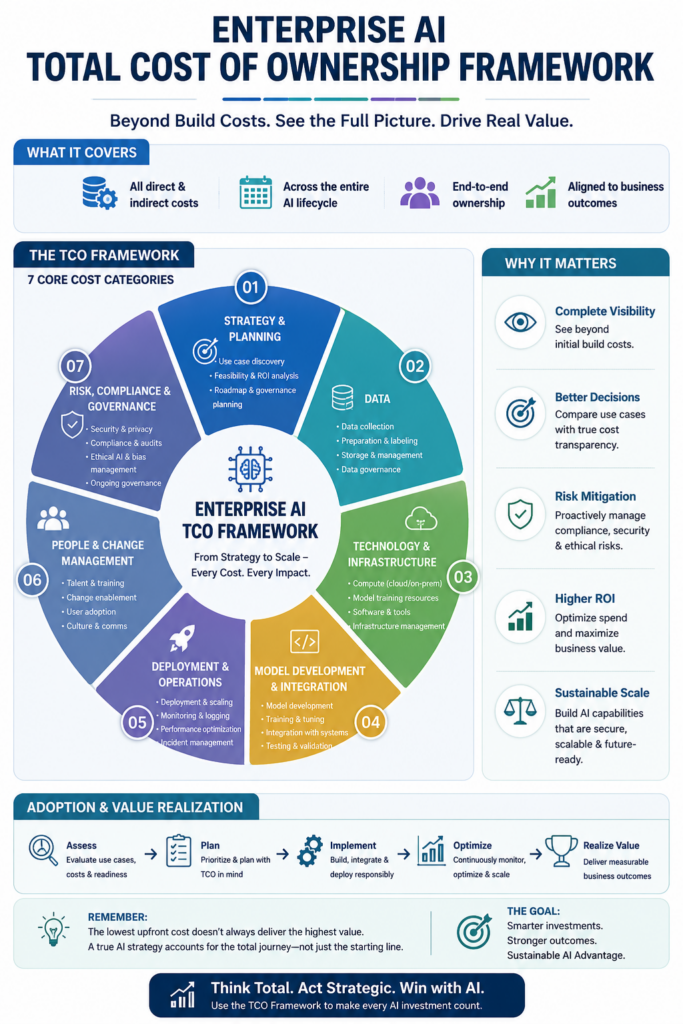
Enterprise AI costs extend across technology, people, processes, and governance. A comprehensive cost model typically includes the following components.
1. Infrastructure and Compute Costs
Infrastructure is often the largest recurring expense in enterprise AI operations. AI infrastructure costs are heavily influenced by GPU utilization, storage, networking, and model inference workloads. Organizations should monitor these resources continuously to optimize spending.
Organizations running foundation models, generative AI applications, or real-time inference workloads require scalable compute resources such as GPUs, high-performance storage, networking, and cloud services.
Typical infrastructure Cost of Managing Enterprise AI Systems include:
- GPU and CPU compute
- Cloud storage
- Networking
- Model inference
- Data transfer
- Backup and disaster recovery
Inference costs become particularly significant for customer-facing AI assistants, recommendation engines, and large-scale document processing systems where thousands or millions of requests are processed daily.
2. Data Engineering and Pipeline Management
AI systems are only as effective as the data that powers them.
Operational teams continuously ingest, clean, transform, validate, and monitor enterprise data to ensure models receive accurate and reliable inputs.
Recurring costs include:
- Data integration
- ETL/ELT pipelines
- Feature engineering
- Data quality monitoring
- Metadata management
- Pipeline maintenance
As AI adoption expands across departments, maintaining trusted data pipelines becomes a major operational investment.
3. Model Operations (MLOps)
Deploying a model is not the end of the AI lifecycle.
Production AI requires continuous operational management through MLOps practices that automate deployment, monitoring, retraining, version control, and performance optimization.
Key operational activities include:
- Model monitoring
- Drift detection
- Automated retraining
- CI/CD pipelines
- Experiment tracking
- Model registry management
Organizations with mature MLOps capabilities typically reduce operational risk while accelerating AI deployment cycles.
4. Security, Governance, and Compliance
Enterprise AI introduces new governance responsibilities beyond traditional IT systems.
Organizations must establish controls for:
- Data privacy
- Access management
- Responsible AI
- Regulatory compliance
- Audit logging
- Risk management
As regulations governing AI continue to evolve, governance investments become essential rather than optional.
5. AI Talent and Operational Teams
Technology alone cannot manage enterprise AI.
Successful organizations invest in multidisciplinary teams that include:
- Data Scientists
- ML Engineers
- Platform Engineers
- Data Engineers
- AI Product Managers
- Security Specialists
- Governance Teams
In many enterprises, talent represents one of the largest long-term operational costs, particularly as AI skills remain in high demand.
6. Model Monitoring and Observability
AI performance changes over time.
Customer behavior evolves, data distributions shift, and business conditions change. Continuous monitoring helps organizations detect issues before they impact business outcomes.
Observability platforms typically monitor:
- Model accuracy
- Latency
- Hallucination rates
- Data drift
- Feature drift
- Infrastructure utilization
- User feedback
Without continuous monitoring, AI systems can silently degrade, increasing business risk.
7. Vendor Licensing and AI Services
Many enterprises combine proprietary AI services with open-source models.
Recurring costs may include:
- LLM API usage
- AI platform subscriptions
- Vector databases
- Model hosting platforms
- Annotation tools
- Security platforms
- Monitoring software
Selecting the right combination of managed services and self-hosted solutions significantly influences long-term operating costs of managing enterprise AI systems.
8. Continuous Improvement
Enterprise AI is never “finished.”
Organizations continuously improve AI systems by:
- Retraining models
- Expanding datasets
- Optimizing prompts
- Updating RAG knowledge bases
- Incorporating user feedback
- Evaluating new foundation models
Continuous optimization ensures AI systems remain accurate, relevant, and aligned with evolving business objectives.
Begin your modernization roadmap and automate governance across all platforms with our data solutions.
Hidden Costs Organizations Often Overlook
Many AI budgets focus on infrastructure and development while overlooking operational expenses that accumulate over time.
Common hidden costs include:
| Hidden Cost | Business Impact |
|---|---|
| Poor data quality | Lower model accuracy and higher remediation costs |
| Prompt optimization | Increased engineering effort for GenAI applications |
| AI governance | Compliance, audits, and policy enforcement |
| Human review | Quality assurance for sensitive AI outputs |
| Model retraining | Performance degradation without regular updates |
| Change management | Employee adoption and training |
| Vendor lock-in | Higher migration and licensing costs |
Accounting for these hidden expenses provides a more accurate view of AI Total Cost of Ownership.
Enterprise AI vs Traditional Enterprise Software
| Cost Area | Traditional Applications | Enterprise AI Systems |
| Infrastructure | Moderate | High |
| Maintenance | Periodic | Continuous |
| Data Dependency | Medium | Very High |
| Monitoring | Application Health | Model + Data + Infrastructure |
| Governance | Security | Security + Responsible AI + Compliance |
| Performance Optimization | Occasional | Continuous |
| Operational Complexity | Moderate | High |
Unlike conventional applications, AI systems require ongoing optimization across both software and data ecosystems.
How Can Enterprises Reduce the Cost of Managing AI Systems?
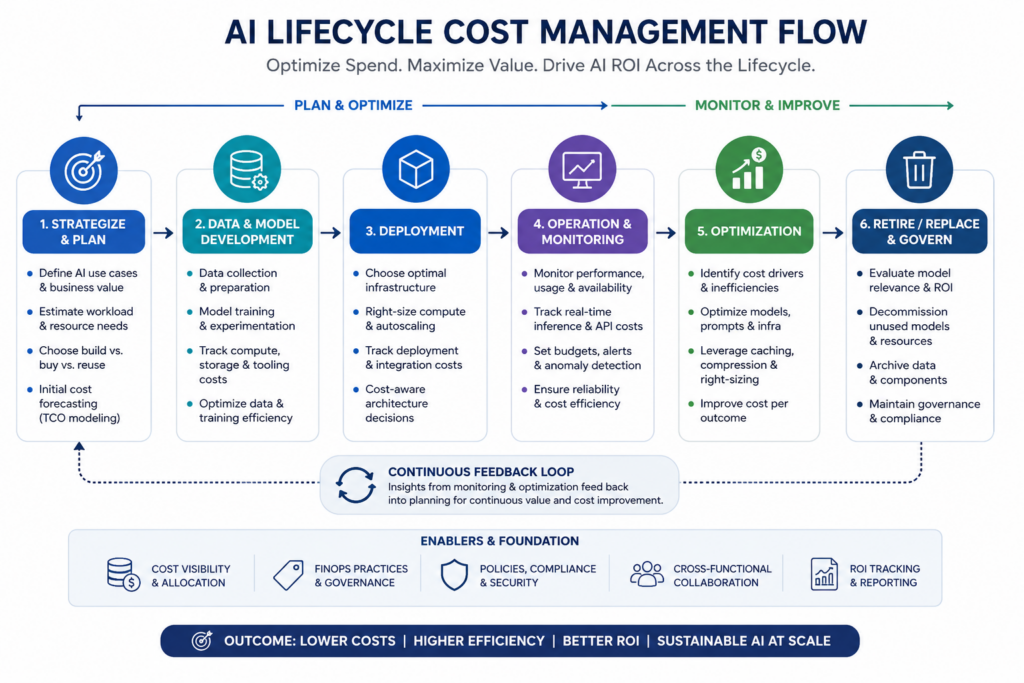
Reducing AI costs isn’t about cutting investment—it’s about optimizing how AI is developed, deployed, and governed. Enterprises that adopt AI FinOps, automate operations, and standardize AI platforms can significantly improve efficiency while maximizing ROI.
1. Build a Strong Data Foundation
Poor-quality data leads to inaccurate models, frequent retraining, and increased operational costs. Investing in AI infrastructure cost management modules, data governance, automated quality checks, and standardized pipelines minimizes downstream issues and improves model performance.
2. Standardize AI Infrastructure
Avoid managing multiple disconnected AI platforms across business units. Standardizing cloud services, MLOps tools, and monitoring platforms reduces licensing costs, simplifies operations, and improves scalability.
3. Automate MLOps
Automating model deployment, testing, monitoring, and retraining reduces manual effort and shortens release cycles. Mature MLOps practices also minimize downtime and improve model reliability.
4. Optimize Model Selection
Not every business problem requires a large language model. Smaller models or fine-tuned domain-specific models often deliver comparable performance at a lower inference cost.
5. Monitor AI Usage
Track API consumption, GPU utilization, inference latency, and user adoption to identify inefficiencies. AI FinOps practices help organizations align AI spending with business outcomes.
6. Embed Governance Early
Incorporating security, compliance, and Responsible AI policies during development avoids expensive remediation later in the AI lifecycle.
7. Continuously Measure ROI
Define measurable KPIs such as automation rates, productivity improvements, customer satisfaction, or revenue impact. Regularly reviewing these metrics ensures AI investments remain aligned with business goals.
Reducing AI management costs requires better governance, automation, standardized infrastructure, and continuous optimization—not simply reducing spending.
Explore the architectural, operational, and strategic differences between Multi-Agent Systems vs Single-Agent Architectures, helping you make informed decisions aligned with costs, scalability, governance, and AI maturity.
Enterprise AI Cost Optimization Framework
A practical way to evaluate AI operational costs is to assess spending across five key dimensions.
| Cost Category | Key Questions |
|---|---|
| Infrastructure | Are compute resources appropriately sized? |
| Data | Is data clean, governed, and continuously available? |
| Operations | Are deployment and monitoring automated? |
| Governance | Are compliance and security integrated into AI workflows? |
| Business Value | Are AI initiatives delivering measurable ROI? |
Organizations that optimize all five dimensions typically achieve lower operational costs while improving scalability and business outcomes.
AI cost optimization is an enterprise-wide initiative involving technology, governance, operations, and business alignment.
Build, Buy, or Managed AI: Which Is More Cost-Effective?
Choosing the right implementation approach has a significant impact on long-term AI costs.
| Approach | Advantages | Considerations | Best For |
|---|---|---|---|
| Build In-House | Full customization and control | High development and operational costs | Large enterprises with mature AI teams |
| Buy AI Platforms | Faster deployment and predictable pricing | Limited customization and potential vendor lock-in | Standard enterprise use cases |
| Managed AI Services | Access to specialized expertise and reduced operational burden | Less control over underlying infrastructure | Organizations accelerating AI adoption without building large internal teams |
The right choice depends on business goals, available talent, regulatory requirements, and the desired speed of implementation.
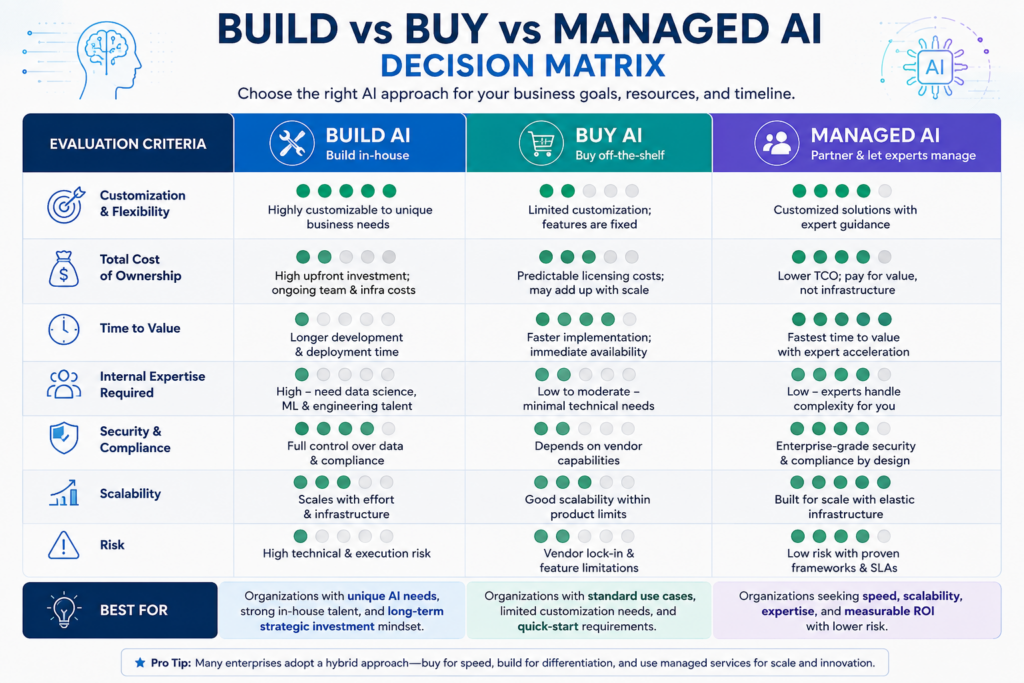
There is no one-size-fits-all approach. Evaluate enterprise AI management costs alongside scalability, governance, and long-term operational requirements.
Read our blog on Build vs Buy AI in 2026: The Ultimate Enterprise Strategy Guide for Faster ROI, Control, and Scalable Innovation
Future Trends Shaping Enterprise AI Costs
AI management costs will continue to evolve as technologies mature. Key trends include:
- Increased adoption of AI FinOps to optimize infrastructure and inference costs.
- Greater use of smaller, domain-specific models to reduce compute requirements.
- Expanded automation across MLOps and ModelOps.
- Stronger governance driven by emerging AI regulations.
- Wider adoption of retrieval-augmented generation (RAG) to improve accuracy while controlling model costs.
Organizations that proactively adopt these practices will be better positioned to scale AI efficiently.
The future of AI cost management lies in automation, governance, and smarter resource utilization.
Conclusion
Managing enterprise AI systems is an ongoing operational commitment rather than a one-time technology investment. Organizations that proactively manage infrastructure, data quality, governance, and AI operations are better positioned to scale responsibly while controlling costs.
A structured approach to AI Total Cost of Ownership enables technology leaders to make informed investment decisions, improve operational efficiency, and maximize the long-term value of AI initiatives.
As enterprises accelerate AI adoption, success will increasingly depend not on how quickly AI is deployed, but on how effectively it is managed throughout its lifecycle.
Frequently Asked Questions
1. What is the biggest cost of managing enterprise AI?
For most organizations, recurring infrastructure, model inference, skilled talent, and data engineering represent the largest operational expenses.
2. How is AI Total Cost of Ownership (TCO) different from implementation cost?
Implementation cost covers development and deployment. AI TCO includes ongoing expenses such as infrastructure, monitoring, governance, retraining, licensing, and operational support throughout the AI lifecycle.
3. How can organizations reduce AI operational costs?
Standardizing AI platforms, automating MLOps, improving data quality, monitoring AI usage, and embedding governance early are among the most effective cost optimization strategies.
4. Is cloud AI always more cost-effective than on-premises deployment?
Not necessarily. Cloud platforms offer flexibility and faster scalability, while on-premises deployments may provide cost advantages for organizations with sustained, high-volume AI workloads or strict data residency requirements.