

Spec-Driven Development (SDD) is a software engineering approach where structured specifications define requirements, behavior, constraints, and acceptance criteria before implementation. AI coding agents then use these specifications to plan, generate, test, and validate software. SDD helps reduce ambiguity, preserve business intent, improve traceability, and make AI-assisted development more predictable.
As AI coding agents become capable of generating and modifying increasingly large portions of a codebase, the bottleneck is shifting from writing code to defining intent clearly.
A short prompt can generate working code quickly—but working code is not necessarily the same as correct software.
Spec-Driven Development addresses this gap by putting a durable specification between human intent and implementation.
Microsoft describes SDD as a way to keep requirements, design, implementation, and validation aligned, with structured specifications serving as a shared source of truth for humans and AI.
What Is Spec-Driven Development?
Spec-Driven Development is a software development approach in which requirements and expected behavior are defined in a structured specification before implementation begins.
The specification describes what the system should do, the expected behavior, constraints, interfaces, business rules, and acceptance criteria.
Developers—and increasingly AI coding tools—then use this specification to generate, implement, test, and validate the solution.
In simple terms:
Intent → Specification → Implementation → Validation
The goal is to reduce ambiguity between what a business needs, what engineers build, and what users ultimately receive.
Read more on AI Coding Agents in Enterprise Software Development: Use Cases, Risks & Best Practices
Why Is Spec-Driven Development Becoming Important?
Spec-Driven Development matters because AI coding agents can generate software faster than teams can review every implementation detail. A well-maintained specification gives the agent persistent context and gives humans a stable reference for reviewing whether the generated solution actually matches the intended behavior.
Without a specification, the workflow often becomes:
Prompt → generate → inspect → patch → regenerate → repeat.
This can work for small tasks.
For larger systems, problems become harder to control:
- Requirements get lost between conversations.
- AI agents make assumptions.
- Different developers provide different instructions.
- Architecture decisions become implicit.
- Tests may validate implementation rather than intent.
- Documentation becomes stale.
- Features can drift from the original business requirement.
Microsoft’s 2026 guidance describes SDD as a response to precisely this alignment problem: AI increases implementation speed, but teams still need a mechanism for preserving business intent.
How Does Spec-Driven Development Work?
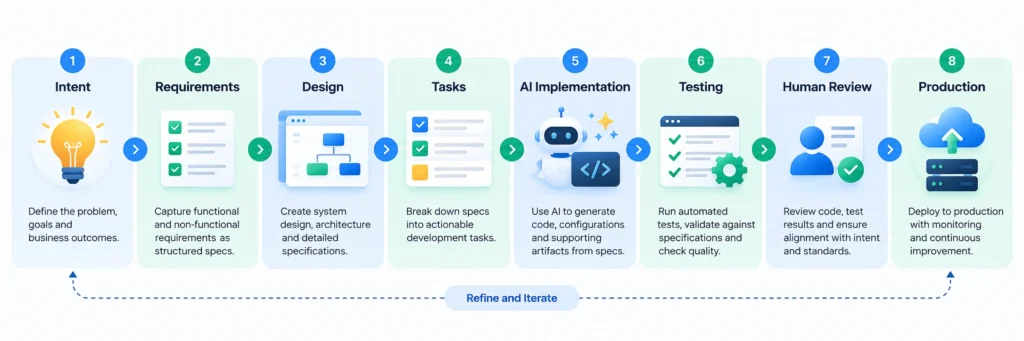
A typical Spec-Driven Development workflow moves from requirements to design, then to implementation tasks and code, with human review between major stages. The exact workflow varies by tool, but the common principle is to resolve intent before asking an AI agent to execute it. A typical SDD workflow includes five stages:
1. Define the Requirement
Start by clearly describing the business problem and desired outcome.
For example:
Customers should be able to submit an insurance claim online and receive an acknowledgement without contacting a claims representative.
2. Create the Specification
Translate the requirement into explicit functional and non-functional expectations.
A specification could define:
- User workflows
- Business rules
- Data requirements
- API behavior
- Security requirements
- Performance expectations
- Error scenarios
- Acceptance criteria
3. Review and Refine the Specification
Before implementation, stakeholders review the specification to identify ambiguity, missing requirements, or conflicting rules.
This is an important step because fixing ambiguity before coding is generally less costly than fixing it after implementation.
4. Build Against the Specification
Developers can implement the solution based on the approved specification.
In AI-assisted workflows, coding agents can also use the specification as structured context for generating code, tests, documentation, or implementation plans.
5. Validate Against the Specification
The final implementation is tested against the defined requirements and acceptance criteria.
This creates a traceable connection between:
Requirement → Specification → Code → Test → Outcome
Spec-Driven Development vs. Vibe Coding
Vibe coding is an exploratory AI coding approach where developers rely heavily on prompts, generated code, and iterative correction. Spec-Driven Development introduces a more deliberate planning layer, making requirements, architecture, and acceptance criteria explicit before implementation. Both approaches can be useful; SDD becomes more valuable as software complexity, risk, and team size increase.
| Dimension | Vibe Coding | Spec-Driven Development |
|---|---|---|
| Starting point | Prompt | Specification |
| Requirements | Often implicit | Explicit |
| Architecture | Emerges during implementation | Reviewed before coding |
| AI context | Conversation-dependent | Persistent artifacts |
| Testing | Often after implementation | Derived from requirements |
| Traceability | Limited | Stronger |
| Best suited for | Exploration, prototypes | Production features and complex systems |
| Human role | Prompt + code review | Intent + design + validation |
| Change management | Modify prompts/code | Update specification and implementation |
Google’s current developer guidance similarly describes SDD as a structured alternative to prompt-and-patch workflows, particularly as projects become larger and more interconnected.
Read our blog on AI-Native Engineering Explained: The Enterprise Guide to AI-Driven Software Development
Key Benefits of Spec-Driven Development
1. Reduces Ambiguity
Clear specifications give developers a shared understanding of what needs to be built.
2. Improves AI-Assisted Development
AI tools perform better when provided with clear requirements, constraints, and expected behavior instead of vague prompts.
3. Creates a Single Source of Truth
The specification provides a reference point for product managers, developers, testers, architects, and AI agents.
4. Strengthens Testing
Acceptance criteria and expected behaviors can be translated into test scenarios, helping teams validate whether the implementation actually meets the requirement.
5. Improves Traceability
Teams can connect business requirements with implementation and testing, making changes easier to understand and manage.
6. Enables Faster Iteration
When requirements are structured and reusable, teams can modify the specification and systematically propagate changes through development and testing.
Reads our blog on 10 Best AI Coding Agents in 2026: Compared
Spec-Driven Development vs Traditional Development
| Traditional Development | Spec-Driven Development |
|---|---|
| Requirements may be distributed across documents and tickets | Specification acts as a central source of truth |
| Developer interpretation plays a major role | Expected behavior is explicitly defined |
| Documentation can become outdated | Specification remains part of the development workflow |
| Testing may be defined separately | Testing can be derived from specifications |
| AI receives prompts and fragmented context | AI can work from structured specifications |
SDD does not necessarily replace Agile, DevOps, or existing engineering methodologies. Instead, it can complement them by making intent and expected behavior more explicit.
Spec-Driven Development in the Age of AI
The rise of AI coding agents makes SDD particularly relevant.
A developer might ask an AI agent:
“Build an insurance claims API.”
That instruction is too broad to reliably define the expected system.
A specification can instead provide:
- Required endpoints
- Authentication rules
- Claim validation logic
- Data structures
- Business rules
- Error handling
- Performance requirements
- Acceptance criteria
The AI agent now has a much stronger foundation for generating implementation and tests.
This shifts the developer’s role from simply writing code toward defining intent, reviewing specifications, validating implementations, and governing AI-generated output.
What Should a Good Specification Contain?
A useful SDD specification should be detailed enough to eliminate material ambiguity without becoming an unmaintainable technical document. It should capture behavior, constraints, boundaries, dependencies, and acceptance criteria while leaving implementation choices open where they do not need to be predetermined.
A practical specification can include:
Feature
├── Purpose
├── Users / Actors
├── Functional Requirements
├── Business Rules
├── Acceptance Criteria
├── Constraints
├── Non-Goals
├── Dependencies
├── Security Requirements
├── Edge Cases
└── Definition of Done
One important principle is:
Specify what must be true; do not unnecessarily specify how every line of code must be written.
This allows AI agents to make implementation decisions while keeping them inside defined boundaries.
AWS’s Kiro guidance, for example, recommends explicit requirements and acceptance criteria before moving into design and implementation tasks.
The level of detail should match the complexity and risk of the system.
Read our blog on Legacy Modernization Services in 2026.
Spec-Driven Development for Enterprise Software
For enterprise engineering teams, SDD can provide a structured control layer around AI-generated code. Specifications can preserve business intent, architecture decisions, security requirements, and acceptance criteria across developers, AI agents, repositories, and development cycles.
This becomes especially useful for:
- Large codebases
- Microservices
- APIs
- Enterprise applications
- Cloud modernization
- AI applications
- Regulated software
- Legacy modernization
- Multi-team development
For example:
Business Requirement
        ↓
Enterprise Specification
        ↓
Architecture Decision
        ↓
AI Implementation
        ↓
Automated Tests
        ↓
Security Checks
        ↓
Human Review
        ↓
CI/CD
Microsoft reports that its own engineering organization adopted SDD to preserve business intent and improve alignment between humans and AI agents.
Best Practices for Spec-Driven Development
To make SDD effective, teams should:
Keep specifications clear and testable.
Avoid vague requirements that cannot be objectively validated.
Treat specifications as living artifacts.
Update them when requirements change instead of allowing documentation and implementation to diverge.
Make acceptance criteria explicit.
Every important requirement should have a way to determine whether it has been satisfied.
Design specifications for both humans and AI.
Use structured, consistent language that can be understood by developers as well as AI development agents.
Connect specifications with testing.
Use requirements and acceptance criteria to drive automated validation wherever possible.
When Should You Use Spec-Driven Development?
SDD is most useful when a feature has meaningful complexity, multiple dependencies, cross-layer changes, significant business rules, or a high cost of implementation mistakes. For simple prototypes or isolated edits, a conventional AI coding workflow may be sufficient.
Good candidates
- New business capabilities
- Multi-file features
- New APIs
- Database changes
- Cross-service workflows
- AI agents
- Enterprise integrations
- Security-sensitive features
- Large refactoring
- Legacy modernization
Less suitable as a mandatory process
- Small UI tweaks
- Simple typo fixes
- Exploratory prototypes
- One-line configuration changes
- Disposable experiments
The goal is not to make every coding task bureaucratic.
The goal is to add just enough specification to prevent expensive ambiguity.
The Future of Software Development Is Becoming More Intent-Driven
As software development becomes increasingly AI-assisted, the ability to clearly define what should be built becomes as important as the ability to build it.
Spec-Driven Development provides a structured bridge between business intent, engineering execution, testing, and AI-assisted development.
The fundamental idea is simple:
Don’t just tell AI what to code. Define what the software must achieve.
When specifications become a reliable source of truth, teams can create a development process that is more structured, traceable, testable, and better suited to the era of AI-powered software engineering.
Key Takeaways
- Spec-Driven Development puts specifications between human intent and AI-generated implementation.
- It is particularly relevant as AI coding agents take on larger software-development tasks.
- The specification becomes a persistent source of truth for requirements and expected behavior.
- A typical workflow is requirements → design → tasks → implementation → verification.
- SDD differs from vibe coding by making intent and acceptance criteria explicit before substantial implementation.
- Good specifications define requirements, constraints, boundaries, edge cases, and success criteria without unnecessarily prescribing implementation.
- Enterprise teams can use SDD to improve alignment, traceability, testing, and governance around AI-assisted development.
- SDD should be applied proportionally: complex production work benefits more from it than trivial changes.
Conclusion
AI has made it dramatically easier to generate software.
The next challenge is ensuring that the software generated is the software the organization actually intended to build.
Spec-Driven Development addresses that problem by moving the center of the development process from the prompt and the code to a shared, reviewable specification.
The emerging AI-native workflow is therefore not simply:
Prompt → Code
It is:
Intent → Specification → Design → Implementation → Verification
For enterprise engineering teams, this creates a practical foundation for using AI coding agents at greater scale without allowing implementation speed to outpace engineering intent.
Techment can help organizations apply this model across AI-native software engineering, enterprise application modernization, AI agents, cloud engineering, and enterprise software development, connecting specification-led development with architecture, automation, testing, and production governance.
Frequently Asked Questions
1. What is Spec-Driven Development?
Spec-Driven Development is a software development approach where a structured specification defines requirements, expected behavior, constraints, and acceptance criteria before and during implementation.
2. Is Spec-Driven Development the same as Test-Driven Development?
No. TDD starts with tests that drive implementation, while SDD starts with a broader specification describing requirements, behavior, constraints, and acceptance criteria. The two approaches can complement each other.
3. Is Spec-Driven Development only for AI coding?
No. Specifications have long been used in software engineering. SDD has become particularly prominent with AI coding agents because structured specifications give agents persistent context and clearer boundaries.
4. What is the difference between SDD and vibe coding?
Vibe coding generally relies on iterative prompting and generated code, while SDD introduces an explicit specification and planning stage before implementation. SDD is generally more structured and traceable.
5. What tools support Spec-Driven Development?
Examples of current tooling include GitHub Spec Kit and AWS Kiro, while other AI coding environments are also adopting specification-first workflows. The methodology itself is not inherently tied to one vendor or tool.
Related Reads
- AI Data Engineering: Building Autonomous Enterprise Data Pipelines.
- How to Build AI-Native Applications for Enterprise Scale.
- Legacy Modernization Services in 2026: How Enterprises Are Cutting Costs with AI
- Enterprise AI agent adoption challenges
- AI-Native Engineering Explained: The Enterprise Guide to AI-Driven Software Development