
Introduction
Artificial intelligence is no longer an experimental capability reserved for innovation labs. It has become a boardroom priority.
Yet despite billions in enterprise AI spending, many organizations still struggle to move beyond isolated pilots and impressive demos. According to research from major advisory firms, a significant percentage of AI initiatives fail to scale because they lack measurable business alignment, implementation readiness, or organizational trust.
The problem is rarely technology.
The real challenge lies in identifying the enterprise AI use cases that genuinely create business value.
Too often, organizations pursue AI because competitors are doing it, because a vendor demonstration looked compelling, or because executives feel pressure to “have an AI strategy.” The result is predictable: fragmented experiments, inflated expectations, and expensive prototypes disconnected from operational priorities.
Enterprise leaders need a more rigorous approach.
The organizations creating meaningful returns from AI are not necessarily the ones investing the most. They are the ones prioritizing the right opportunities—those that improve measurable business outcomes, fit operational realities, and scale responsibly across teams.
This guide presents a practical, executive-ready framework to identify and prioritize enterprise AI use cases that actually drive ROI. We will examine why most AI initiatives fail, how leaders can systematically evaluate opportunities, where AI creates measurable impact, and how organizations can avoid the costly “cool demo” trap.
For leaders building long-term AI capability, success starts with prioritization—not technology selection.
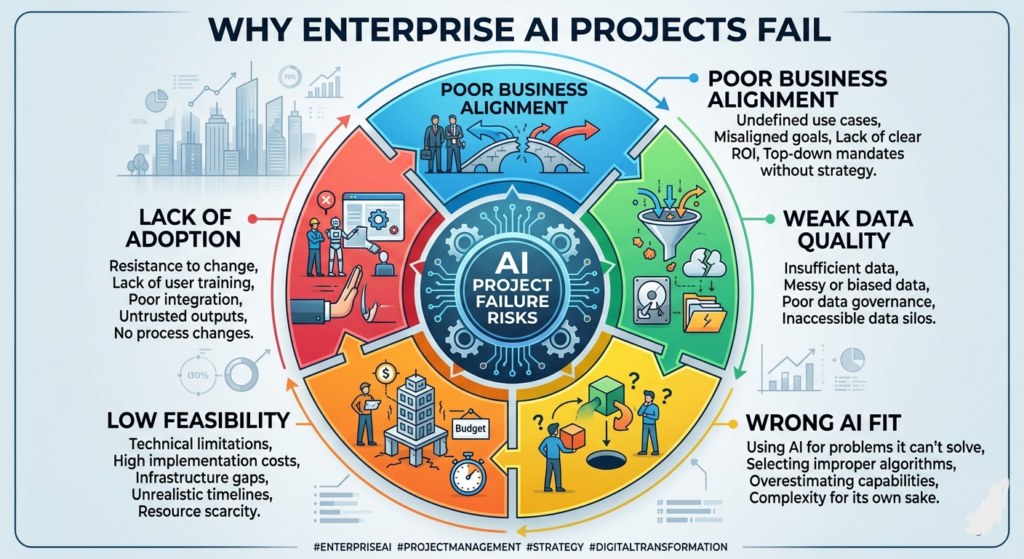
Why Enterprise AI Use Cases Fail Before They Deliver Value
Many enterprises assume that AI failure happens during implementation.
In reality, failure often begins long before deployment—during use case selection.
Organizations frequently choose opportunities based on novelty instead of measurable outcomes. The consequence is predictable: technically impressive systems that generate little operational value.
Research consistently shows that enterprises struggle to transition from experimentation to production because they underestimate the operational complexity required to support AI at scale.
Common failure patterns include:
Misaligned Business Objectives
One of the largest reasons enterprise AI use cases fail is weak alignment with strategic priorities.
AI should improve something leadership already cares about:
- Revenue growth
- Customer retention
- Cost reduction
- Decision velocity
- Compliance readiness
- Workforce productivity
When an AI initiative cannot clearly connect to a measurable business objective, momentum disappears quickly.
A chatbot for internal FAQs may seem innovative, but if it does not materially reduce support costs or improve employee productivity, executive sponsorship fades.
The most successful enterprises begin with business pain—not technology capability.
For organizations defining AI roadmaps, enterprise alignment should begin alongside a broader data modernization strategy. Techment discusses this relationship extensively in its perspective on enterprise AI strategy and modernization planning.
Weak Data Foundations
AI is fundamentally a data problem.
Even highly sophisticated models fail when organizations lack trusted, accessible, governed data.
Many enterprises discover too late that:
- Critical data exists in silos
- Business definitions vary between teams
- Documents remain unstructured
- Historical records are incomplete
- Compliance requirements limit usage
This is particularly problematic in highly regulated industries where data lineage and governance matter as much as model accuracy.
Before prioritizing enterprise AI use cases, organizations should evaluate whether their data environment can realistically support implementation.
A predictive maintenance model without historical maintenance logs will struggle.
A customer intelligence model built on inconsistent CRM data will generate unreliable outputs.
An LLM implementation trained on fragmented knowledge repositories will reduce trust instead of improving efficiency.
For enterprise leaders, AI readiness begins with reliable data quality.
Organizations exploring scalable AI foundations should first evaluate data quality frameworks for AI readiness and enterprise governance models to reduce implementation risk.
The “Technology-Looking-for-a-Problem” Trap
A surprising number of AI initiatives begin with a tool.
Leadership hears about generative AI, autonomous agents, or predictive analytics and immediately asks:
“How can we use this?”
That is the wrong question.
The better question is:
“What business constraint are we trying to solve?”
Strong enterprise AI use cases emerge from operational friction.
For example:
Weak starting point:
“Let’s implement generative AI.”
Strong starting point:
“Our legal review process delays contract execution by 21 days.”
The second example creates measurable outcomes:
- Faster approvals
- Reduced labor costs
- Improved customer responsiveness
- Better legal productivity
Technology becomes an enabler—not the objective.
No Clear Ownership Model
Another overlooked issue is accountability.
Many enterprise AI initiatives fail because ownership remains ambiguous.
Questions often go unanswered:
- Who owns success?
- Who governs outputs?
- Which team operationalizes adoption?
- How will performance be monitored?
Without operational accountability, even promising pilots stall.
AI cannot remain an innovation-side experiment.
It must become part of a business workflow.
The 5-Part Framework for Identifying Enterprise AI Use Cases That Deliver ROI
Organizations succeeding with AI typically follow a structured evaluation methodology.
Rather than launching disconnected pilots, they assess opportunities systematically.
The following framework helps leaders identify enterprise AI use cases that balance value, practicality, and scale.
The framework includes five dimensions:
- Business Alignment
- Data Availability
- AI Capability Fit
- Value vs Feasibility
- Trust and Adoption
This model helps enterprises reduce wasted spend while accelerating meaningful outcomes.
Why Frameworks Matter
Without prioritization frameworks, organizations default to politics or hype.
The loudest stakeholder wins.
The newest technology gets attention.
The most exciting demo receives funding.
But enterprise AI maturity requires discipline.
High-performing organizations assess opportunities based on measurable business outcomes, organizational readiness, and implementation viability.
Leaders investing in AI at scale increasingly combine prioritization with structured governance and roadmap planning. This becomes particularly important when moving from experimentation to production-grade AI delivery. Techment explores this transition in its enterprise AI readiness guidance.
Business Alignment: The First Filter for High-Value Enterprise AI Use Cases
Why Business Alignment Matters
Every successful AI initiative starts with strategic relevance.
Before asking whether AI can solve a problem, leadership must ask:
Does solving this problem matter to the business?
High-performing enterprise AI use cases directly connect to strategic priorities.
Examples include:
- Reducing operational cost
- Increasing customer retention
- Accelerating time-to-market
- Improving compliance
- Reducing employee workload
- Increasing forecast accuracy
If leadership does not care deeply about the outcome, the initiative will struggle to scale.
Questions Leaders Should Ask
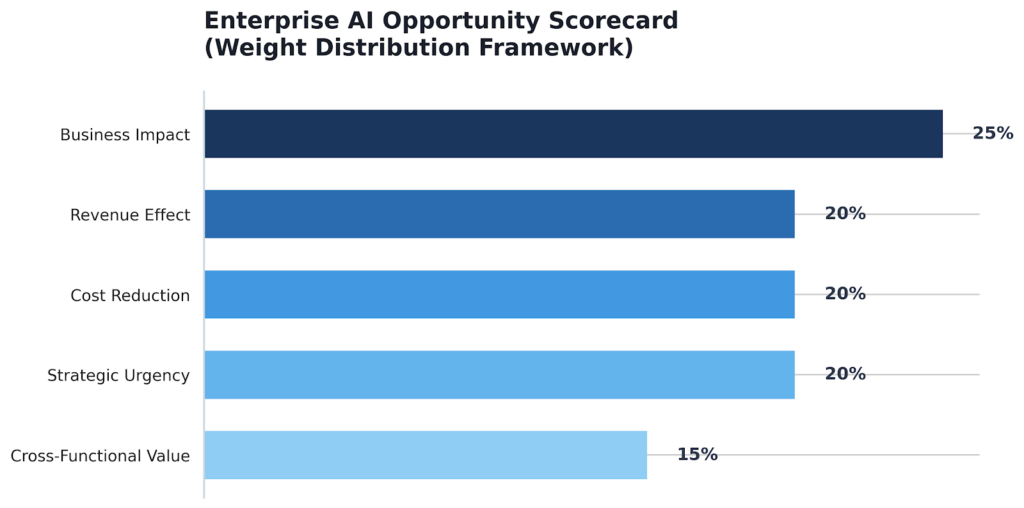
Before approving an AI investment, executives should evaluate:
Does this improve a measurable KPI?
AI initiatives should influence metrics leadership already tracks.
Examples include:
- Customer churn
- Revenue growth
- Cost per transaction
- Resolution speed
- SLA adherence
- Workforce efficiency
If success cannot be measured, prioritization becomes subjective.
Is the Pain Point Enterprise-Wide?
High-value enterprise AI use cases typically affect multiple business functions.
For example:
A customer intelligence engine benefits:
- Sales
- Marketing
- Customer service
- Operations
- Product teams
Cross-functional impact increases ROI and executive buy-in.
Is Leadership Invested?
Strategic initiatives receive funding.
Non-strategic ones remain pilots forever.
If executive stakeholders are not actively advocating for the outcome, implementation risk increases significantly.
Data Availability: The Reality Check Most AI Strategies Ignore
Why Data Determines Success
Many promising enterprise AI use cases fail because organizations underestimate data complexity.
Executives often assume:
“If we have systems, we have data.”
That assumption is dangerous.
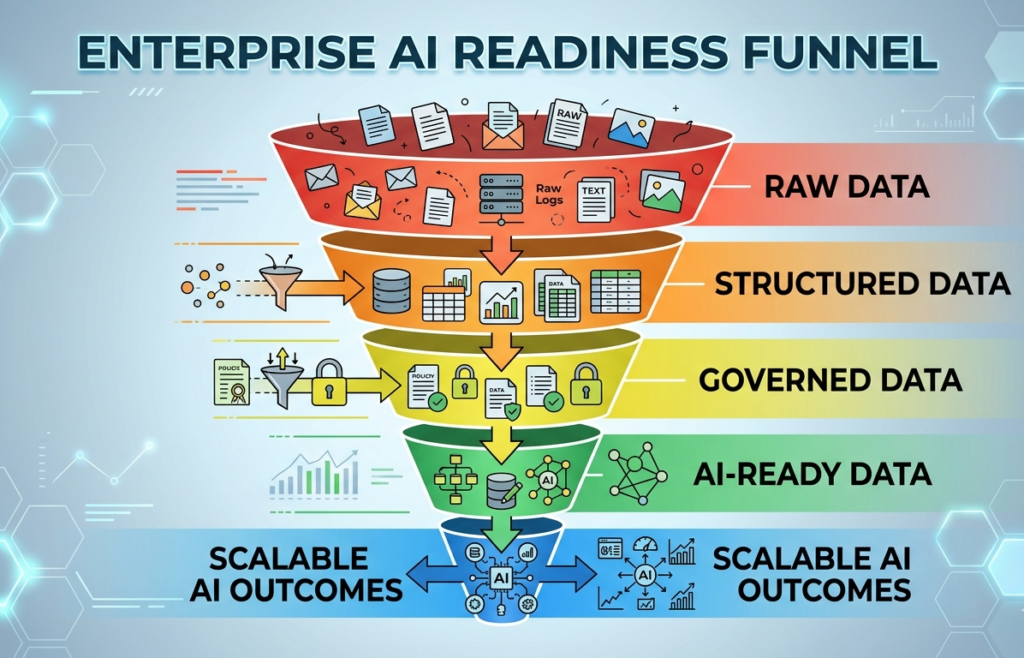
Data readiness includes far more than availability.
Organizations must assess:
- Accessibility
- Quality
- Labeling
- Governance
- Completeness
- Security
- Compliance readiness
AI systems amplify data quality problems.
Poor data quality does not create slightly worse outcomes.
It creates dramatically worse outcomes.
Key Questions for Enterprise Leaders
Is the Data Already Available?
Can the required information be accessed?
Or does it exist across disconnected systems?
Many enterprises struggle because critical operational data lives in:
- PDFs
- Email archives
- Vendor systems
- Legacy applications
- Departmental spreadsheets
If foundational data is fragmented, implementation timelines grow rapidly.
Is the Data Trusted?
Trust determines adoption.
Even highly accurate models fail when users question output reliability.
This is why governance becomes essential.
Organizations preparing for AI scale should strengthen data governance alongside modernization initiatives to ensure transparency and explainability. Techment’s data transformation and governance guidance provides strong foundations for AI readiness.
AI Capability Fit: Does This Problem Actually Need AI?
One of the most expensive enterprise mistakes is forcing AI into problems where simpler solutions work better.
Just because something can be automated with AI does not mean it should.
Before greenlighting enterprise AI use cases, leaders should identify the problem category.
Typical AI capability areas include:
Classification Problems
Used when organizations need categorization.
Examples:
- Fraud detection
- Ticket routing
- Sentiment analysis
- Compliance classification
Forecasting Problems
Used when organizations need prediction.
Examples:
- Demand forecasting
- Inventory optimization
- Revenue prediction
- Workforce planning
Generation Problems
Used when organizations need content creation.
Examples:
- Contract summaries
- Knowledge assistants
- Technical documentation
- Customer support responses
Recommendation Problems
Used when organizations need decision support.
Examples:
- Product recommendations
- Next-best-action systems
- Dynamic pricing suggestions
Value vs Feasibility: The Prioritization Model That Separates AI ROI from Experimentation
Even when organizations identify promising enterprise AI use cases, not every opportunity deserves immediate investment.
Some initiatives generate measurable impact quickly.
Others require years of infrastructure modernization, governance design, or cultural change before value materializes.
This is why leading enterprises prioritize AI opportunities using a value-versus-feasibility model.
Without this evaluation, organizations often overinvest in technically impressive projects that fail operationally.
Why Prioritization Matters
Enterprise resources are limited.
Budgets, talent, executive attention, and implementation bandwidth all create constraints.
Organizations that outperform competitors do not necessarily pursue more AI initiatives.
They pursue the right ones.
A practical prioritization matrix helps leadership determine:
- Which use cases deserve immediate funding
- Which require pilot experimentation
- Which should remain on the roadmap
- Which should be deprioritized entirely
The Enterprise AI Value vs Feasibility Matrix
AI opportunities typically fall into four categories:
High Value + High Feasibility = Prioritize Immediately
These are the strongest enterprise AI use cases.
Characteristics include:
- Strong business impact
- Available data
- Clear ROI pathway
- Low organizational resistance
- Reasonable implementation complexity
Examples:
- Customer support summarization
- Contract clause extraction
- Predictive maintenance
- Knowledge assistants for internal teams
These projects should move quickly into pilot design.
High Value + Low Feasibility = Strategic R&D
Some opportunities matter greatly but require ecosystem readiness.
Examples:
- Autonomous enterprise agents
- Fully predictive supply chain systems
- AI-driven enterprise planning
These should remain strategic investments while infrastructure matures.
Low Value + High Feasibility = Opportunistic
These are easy to build but deliver modest returns.
They may help internal productivity but should not distract from strategic priorities.
Low Value + Low Feasibility = Deprioritize
These projects create technical debt without meaningful business impact.
They are often driven by hype rather than necessity.
Trust and Adoption: The Enterprise AI Layer Most Leaders Underestimate
Technology alone does not create transformation.
Adoption does.
Many technically successful AI projects fail because employees do not trust outputs or integrate systems into workflows.
This is particularly true for enterprise AI use cases involving decision-making.
Why Trust Determines Scale
If employees question AI outputs, adoption drops.
If executives distrust explainability, deployment stalls.
If compliance teams lack governance visibility, projects slow dramatically.
Organizations must ask:
Will people actually use this?
Questions Leaders Should Ask Before Scaling AI
Who Will Use It?
Every AI implementation needs a clearly defined user group.
Potential users include:
- Frontline workers
- Analysts
- Legal teams
- Service agents
- Operations managers
- Executives
Unclear ownership creates weak adoption.
Does It Fit Existing Workflows?
Successful enterprise AI use cases integrate into familiar systems.
Examples:
- Embedded copilots in CRM
- AI recommendations inside ERP
- Automated summarization in ticketing platforms
New interfaces create friction.
Embedded intelligence drives adoption.
Is Human Oversight Required?
In regulated industries, human-in-the-loop governance becomes essential.
Examples include:
- Healthcare
- Financial services
- Insurance
- Legal operations
AI should augment—not replace—critical decisions.
Organizations designing enterprise AI responsibly increasingly align deployment with governance, risk frameworks, and explainability standards. Techment’s perspectives on AI implementation readiness and governance help enterprises operationalize trust at scale.
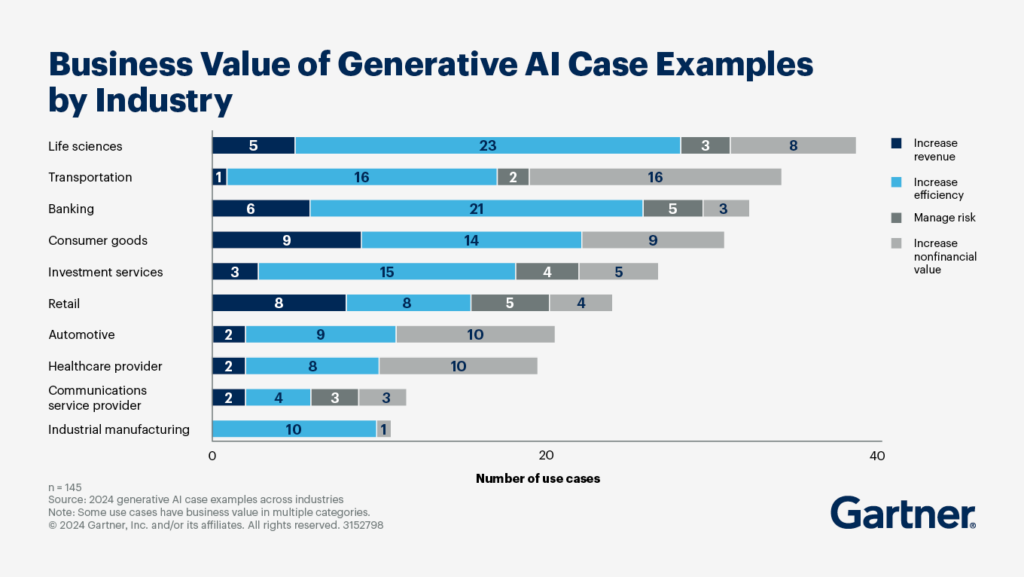
11 Proven Enterprise AI Use Cases That Actually Drive Business Value in 2026
Not all AI initiatives deliver equal returns.
The highest-performing enterprise AI use cases share three characteristics:
- Measurable business impact
- Operational feasibility
- Strong adoption potential
Below are proven enterprise examples across industries.
1. Intelligent Contract Review (Legal)
Legal teams increasingly use AI for:
- Clause extraction
- Contract summarization
- Risk flagging
- Compliance review
Business impact:
Reduced legal review time and faster deal execution.
2. AI-Powered Customer Service Summaries
Contact centers use LLMs to summarize interactions automatically.
Benefits include:
- Faster resolution
- Lower agent workload
- Improved documentation quality
3. Predictive Maintenance (Manufacturing)
AI predicts equipment failures before downtime occurs.
Benefits:
- Reduced outages
- Lower maintenance cost
- Improved operational continuity
4. Intelligent Claims Processing (Insurance)
AI accelerates:
- Claims triage
- Fraud detection
- Document validation
5. Clinical Support & Patient Triage (Healthcare)
Healthcare providers increasingly deploy AI for:
- Intake prioritization
- Patient routing
- Support ticket categorization
6. Intelligent Sales Recommendations
AI analyzes historical customer data to recommend:
- Next-best offers
- Cross-sell opportunities
- Customer retention actions
7. Financial Forecasting
Finance teams use AI to improve:
- Revenue prediction
- Budget planning
- Cost forecasting
8. Enterprise Knowledge Assistants
Internal copilots help employees retrieve knowledge instantly.
Examples:
- HR policy assistants
- Engineering documentation copilots
- Compliance knowledge bots
9. Fraud Detection & Risk Monitoring
AI strengthens enterprise security through anomaly detection.
10. Supply Chain Optimization
AI predicts:
- Demand fluctuations
- Inventory shortages
- Delivery disruptions
11. Technician Documentation Assistants
Field teams use voice-enabled AI for:
- Service note automation
- Compliance reporting
- Mobile documentation
Organizations scaling these capabilities successfully often combine AI deployment with data modernization and platform readiness strategies. Techment explores how enterprises can align modernization efforts with scalable AI adoption frameworks.
Top enterprise AI use cases across industries in 2026
The “Cool Demo Trap”: Why Great AI Demos Fail in Production
Enterprise AI enthusiasm often begins with excitement.
A vendor demo looks revolutionary.
An executive sees a chatbot answer complex questions.
A prototype generates impressive summaries.
Then reality appears.
Warning Signs of Weak Enterprise AI Use Cases
🚩 The project solves a small problem with massive complexity.
🚩 The initiative has no measurable KPI.
🚩 Adoption assumptions are vague.
🚩 Sensitive data restrictions make deployment impossible.
🚩 No operational owner exists.
🚩 The solution feels exciting—but unnecessary.
Good demos create excitement.
Strong implementations create outcomes.
The Enterprise Rule of Thumb
If a use case cannot be piloted in 30–60 days, measured clearly, and operationalized realistically, it may not be the right first investment.
Organizations transitioning from AI experimentation to enterprise execution benefit from structured implementation frameworks rather than isolated pilots. Techment’s guidance on enterprise AI strategy and scalable implementation can help reduce deployment risk.
7 Questions Leaders Should Ask Before Funding Any Enterprise AI Use Case
Before approving investment, leadership should challenge assumptions.
Ask these questions:
1. Which Business KPI Will Improve?
Tie AI directly to measurable outcomes.
2. Do We Have Trusted Data?
If not, readiness comes first.
3. Does This Actually Require AI?
Could automation solve it cheaper?
4. Can We Pilot This Within 60 Days?
Speed matters.
5. Who Owns It?
Ownership drives accountability.
6. What Are the Governance Risks?
Consider:
- Bias
- Security
- Compliance
- Explainability
7. If It Works, How Will We Scale?
A pilot without a scaling roadmap becomes shelfware.
How Techment Helps Enterprises Move from AI Exploration to Enterprise Execution
AI transformation is rarely limited by technology.
It is limited by prioritization, readiness, governance, and execution discipline.
Techment helps enterprises identify, validate, and operationalize enterprise AI use cases through a practical, measurable approach.
Our capabilities include:
Enterprise AI Strategy & Roadmapping
We help organizations align AI investments with measurable business priorities and modernization goals.
Data Readiness for AI
Strong AI outcomes begin with trusted data.
We support:
- Data modernization
- Quality assessment
- AI-ready architectures
- Governance models
Relevant reads:
Data Quality for AI in 2026 and Data Governance for Enterprise Reliability
AI Pilot Design & Implementation
We help enterprises move beyond experimentation into measurable deployment.
This includes:
- Use case prioritization
- Pilot architecture
- Governance controls
- Scalable implementation planning
Microsoft & Cloud AI Enablement
Techment supports enterprise modernization across Microsoft ecosystems and AI-powered data architectures.
Conclusion
AI success is not determined by how many pilots an organization launches.
It is determined by whether those pilots create measurable business outcomes.
The strongest enterprise AI use cases emerge when organizations combine business alignment, trusted data, feasibility analysis, governance, and adoption planning into a repeatable prioritization model.
The future of enterprise AI will not belong to organizations running the most experiments.
It will belong to organizations making smarter bets.
As enterprises move from AI curiosity to scaled implementation, disciplined prioritization becomes the difference between wasted spend and sustainable competitive advantage.
For organizations ready to move beyond experimentation, Techment can help define AI priorities, modernize data foundations, and operationalize enterprise AI with measurable impact.
FAQs
1. What are the best enterprise AI use cases?
The best enterprise AI use cases solve measurable business problems, have strong data availability, and improve outcomes such as cost reduction, operational efficiency, customer experience, or forecasting accuracy.
2. How do enterprises prioritize AI use cases?
Leading organizations use frameworks based on business value, data readiness, feasibility, governance, and adoption potential.
3. What industries benefit most from enterprise AI?
Healthcare, manufacturing, retail, insurance, logistics, and financial services currently demonstrate strong AI adoption and measurable ROI.
4. How long should an enterprise AI pilot take?
Most successful pilots should deliver measurable signals within 30–60 days, with clear KPIs and ownership models.
5. What is the biggest reason enterprise AI initiatives fail?
Poor business alignment is one of the biggest reasons AI initiatives fail. Organizations often prioritize technology instead of solving operational problems.