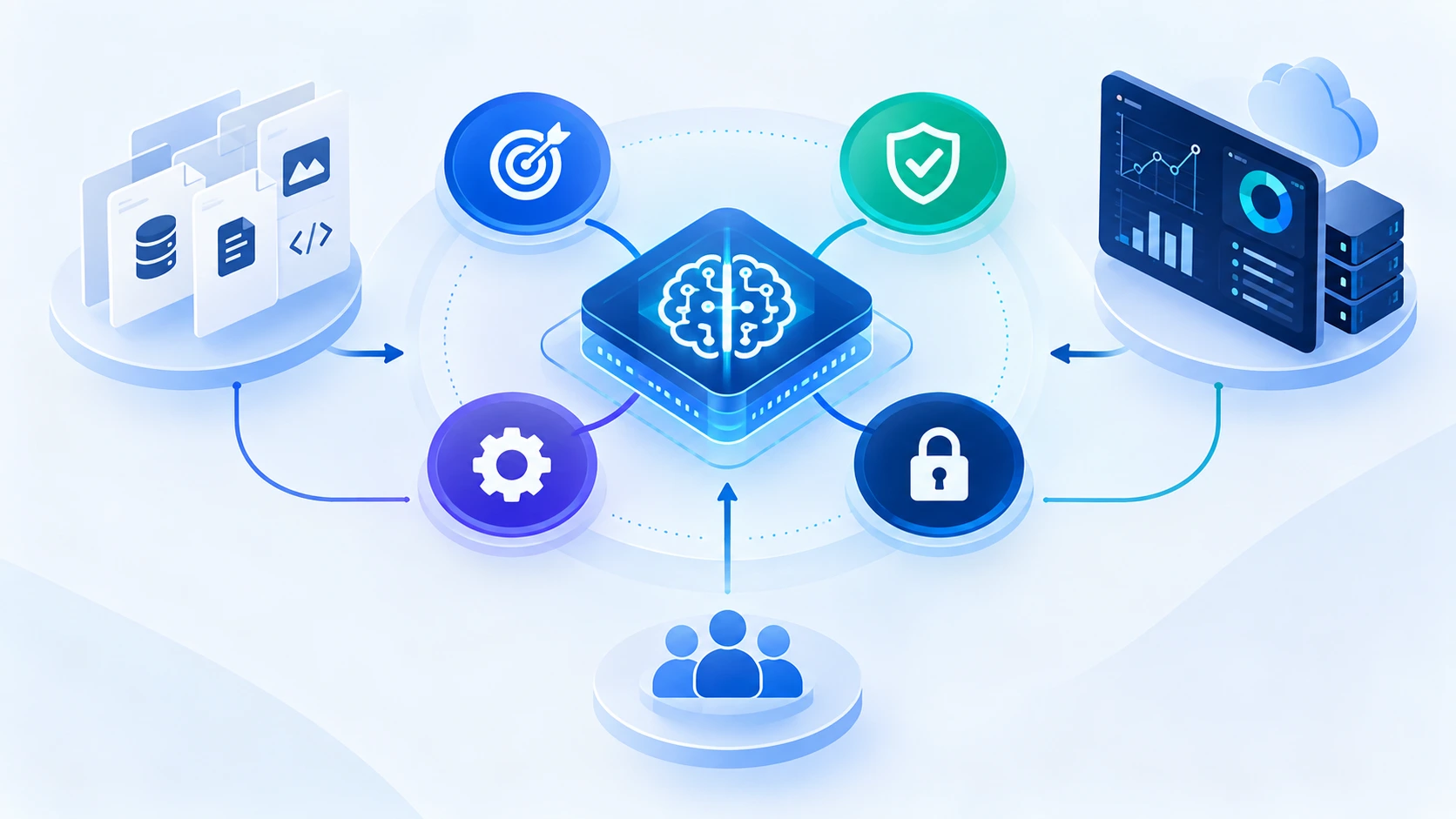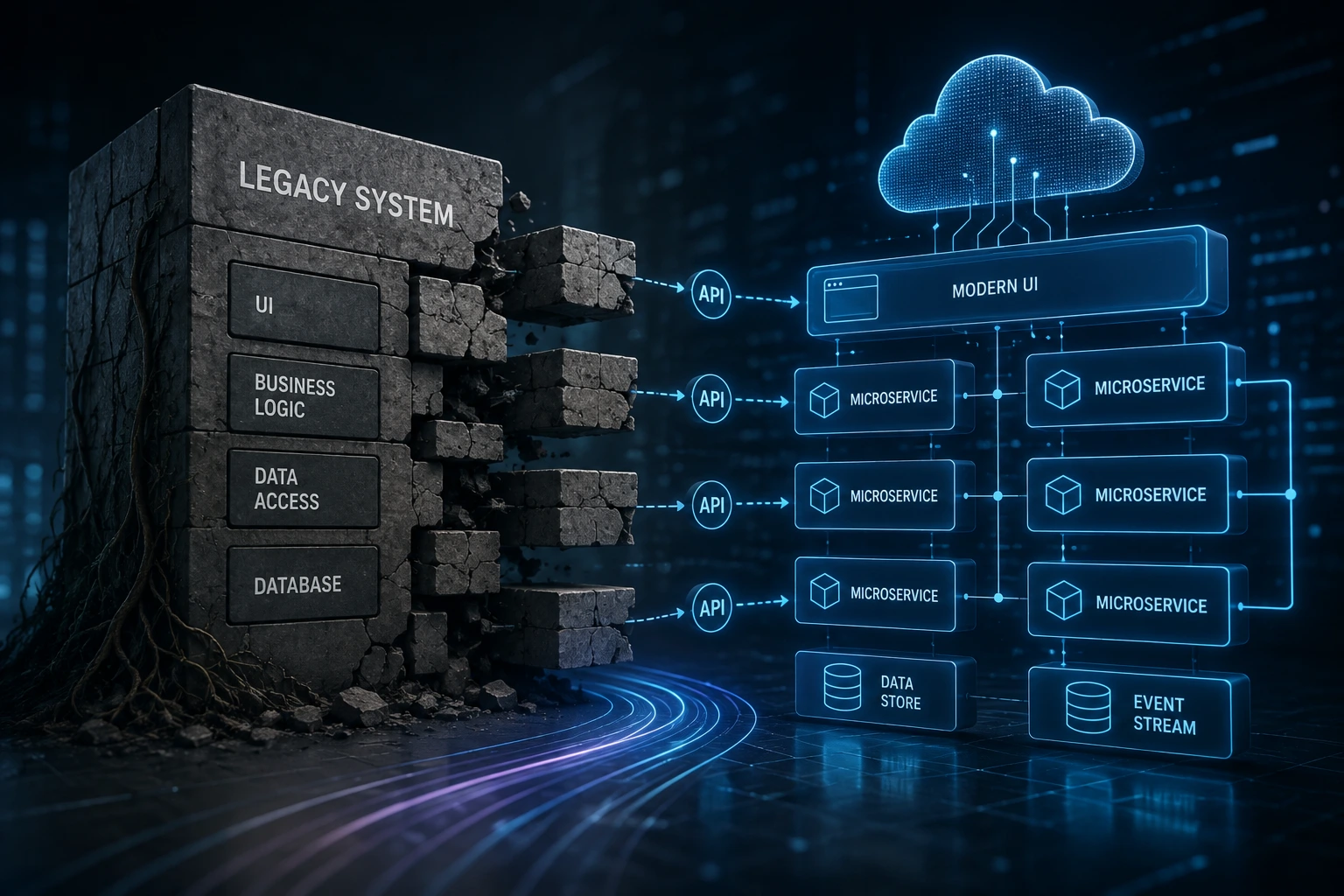

AI coding agents are AI-powered software development tools that can understand requirements, navigate codebases, generate and modify code, run tests, troubleshoot failures, and create pull requests with limited human intervention. In enterprises, they can accelerate development, testing, refactoring, documentation, and technical-debt reduction—but require strong security, permissions, testing, review, and governance controls.
TL;DR
- AI coding agents go beyond code completion by planning and executing multi-step software engineering tasks.
- They can support coding, testing, debugging, refactoring, documentation, code review, and technical-debt reduction.
- The biggest enterprise opportunity is not simply generating more code—it is automating repetitive engineering work while developers focus on architecture and business outcomes.
- AI coding agents can introduce risks involving incorrect code, security vulnerabilities, prompt injection, excessive permissions, dependency risks, data exposure, and uncontrolled changes.
- Enterprises should give agents least-privilege access, defined scopes, sandboxed environments, and clear approval boundaries.
- Treat agent instructions, repository context, and generated code as engineering artifacts that require governance.
- Use CI/CD, automated testing, SAST, dependency scanning, secret scanning, and human review as independent quality gates.
- Start with low-risk, measurable use cases and increase autonomy based on demonstrated performance.
Introduction: What Are AI Coding Agents?
AI coding agents are AI systems that can plan, execute, and iterate on software development tasks rather than simply suggesting individual lines of code. They can inspect repositories, understand project context, edit multiple files, run commands and tests, diagnose failures, and prepare changes for developer review.
That distinction is important.
Traditional AI coding assistants primarily operate as developer copilots:
Developer asks → AI suggests → Developer decides.
AI coding agents introduce a more autonomous workflow:
Goal → Agent analyzes → Plans → Changes code → Runs tests → Investigates → Iterates → Submits changes → Human reviews
This makes AI coding agents particularly relevant to enterprise software development, where engineering teams manage large repositories, technical debt, legacy systems, testing backlogs, documentation gaps, and continuous delivery requirements.
GitHub’s enterprise guidance describes this shift from AI as a pair-programming tool toward agents that can perform asynchronous development tasks and participate across the software development lifecycle.
Read our blog on AI-Native Engineering Explained: The Enterprise Guide to AI-Driven Software Development
AI Coding Agents vs. AI Coding Assistants
The key difference between AI coding assistants and AI coding agents is autonomy. Assistants primarily provide suggestions within a developer’s workflow, while coding agents can independently perform multi-step tasks, use tools, modify files, execute tests, and return completed work for review.
| Capability | AI Coding Assistant | AI Coding Agent |
|---|---|---|
| Code completion | ✓ | ✓ |
| Generate functions | ✓ | ✓ |
| Explain code | ✓ | ✓ |
| Navigate repository | Limited | ✓ |
| Plan multi-step work | Limited | ✓ |
| Modify multiple files | Limited | ✓ |
| Run tests | Sometimes | ✓ |
| Debug failures | Assisted | ✓ |
| Refactor modules | Assisted | ✓ |
| Create pull requests | Usually no | Increasingly common |
| Operate asynchronously | Limited | ✓ |
| Make iterative decisions | Limited | ✓ |
The enterprise implication: once an AI system can take actions rather than merely make suggestions, software governance must account for what the agent can access, change, execute, and deploy.
For enterprises evaluating agentic development, GitHub — Integrating agentic AI into your enterprise SDL guidance outlines how AI agents can participate across planning, coding, testing, review, optimization, and security within the software development lifecycle.
Read our blog on Legacy Modernization Services in 2026.
Where AI Coding Agents Deliver the Most Enterprise Value
AI coding agents deliver the most value when they handle repetitive, well-bounded engineering tasks with clear acceptance criteria. High-value use cases include test generation, bug remediation, refactoring, documentation, code migration, code review, technical-debt reduction, and developer environment setup.
1. Automated Code Generation
Agents can translate requirements, issues, or technical specifications into implementation changes.
Typical applications include:
- CRUD functionality
- API endpoints
- Service-layer changes
- Data transformation logic
- Validation rules
- Unit-test scaffolding
- Configuration changes
The productivity opportunity is strongest when requirements and coding standards are already well defined.
2. Test Generation and Test Repair
AI coding agents can generate:
- Unit tests
- Integration tests
- Regression tests
- Edge-case scenarios
- Test data
- Missing assertions
They can also investigate failing tests and propose fixes.
This creates a useful engineering loop:
Code → Test → Failure → Diagnosis → Fix → Retest
However, generated tests should not automatically be treated as evidence of quality. Enterprises should still measure assertion quality, coverage, mutation detection, and regression effectiveness.3. Legacy Code Refactoring
AI coding agents can help modernize legacy applications incrementally by identifying dependencies, explaining unfamiliar code, creating characterization tests, and performing bounded refactoring tasks.
Examples include:
- Breaking large modules into smaller components
- Updating deprecated APIs
- Converting repetitive code
- Improving test coverage
- Migrating frameworks
- Modernizing language versions
- Removing obsolete dependencies
This is particularly useful for large enterprise codebases where rewriting an entire application is too risky or expensive.
4. Debugging and Root-Cause Analysis
Agents can investigate:
- Stack traces
- Logs
- Failed tests
- Recent commits
- Dependency changes
- Configuration differences
Instead of simply identifying that a test failed, an agent can investigate the surrounding evidence and suggest probable causes and remediation steps.
The important enterprise control is to require evidence-backed diagnosis rather than accepting the agent’s first explanation.
5. Code Review and Quality Improvement
AI coding agents can review changes for:
- Bugs
- Security weaknesses
- Code smells
- Missing tests
- Incorrect patterns
- Maintainability issues
- Documentation gaps
GitHub has increasingly positioned agentic code review as a way to provide repository-aware, higher-signal feedback rather than simply generating large volumes of review comments.
6. Technical-Debt Reduction
One of the more practical enterprise use cases is turning neglected engineering work into manageable agent tasks.
For example:
Technical debt backlog → Agent analyzes issue → Creates implementation plan → Applies bounded change → Runs tests → Opens PR
This can help engineering teams address smaller maintenance tasks without repeatedly diverting senior developers from strategic work.
The Risks of AI Coding Agents in Enterprise Software Development
The primary risks of AI coding agents arise from their combination of code-generation capability, repository access, tool access, and increasing autonomy. Enterprises must address incorrect code, security vulnerabilities, prompt injection, data exposure, excessive permissions, supply-chain risks, scope creep, and changes reaching production without adequate validation.
AWS’s current guidance specifically recommends combining author-time controls with build-time verification and preserving existing secure software development lifecycle controls.
Key risks
| Risk | What Can Go Wrong | Enterprise Control |
|---|---|---|
| Incorrect code | Logic or API errors | Tests + review |
| Security flaws | Vulnerable generated code | SAST + security scanning |
| Prompt injection | Untrusted content manipulates agent behavior | Treat external content as untrusted |
| Excessive permissions | Agent changes sensitive resources | Least privilege |
| Data exposure | Sensitive source or credentials exposed | Access controls + secrets management |
| Supply-chain risk | Unsafe dependencies introduced | Approved dependency policies |
| Scope creep | Agent modifies unrelated code | Explicit task boundaries |
| Uncontrolled changes | Bad code reaches protected branches | PR and branch controls |
| Hallucination | Agent invents APIs or implementation details | Documentation/context + verification |
| Cost escalation | Excessive autonomous execution | Usage monitoring and limits |
Read more about Application Modernization Challenges.
The Most Important Best Practices for AI Coding Agents
Successful enterprise adoption of AI coding agents requires more than selecting a capable model. Organizations need a controlled operating model covering context, permissions, task boundaries, testing, security, human oversight, observability, and measurable outcomes.
1. Give the Agent the Right Context
An agent is only as effective as the context it can reliably access.
Provide:
- Architecture documentation
- Coding standards
- Repository structure
- Build commands
- Testing instructions
- API conventions
- Security requirements
- Deployment constraints
- Business rules
Anthropic recommends maintaining repository-specific instructions and explicitly documenting commands, conventions, testing procedures, and project context for agentic coding workflows. Anthropic’s engineering guidance highlights repository-specific instructions, clear workflows, tool permissions, and iterative verification as practical foundations for agentic coding.
Practical insight: Treat agent context as part of your engineering system—not as an informal prompt.
2. Start With a Clearly Defined Task
Avoid:
“Improve this application.”
Prefer:
“Update the customer API to support pagination. Modify only the API and service layers, add unit tests, preserve backward compatibility, and do not change database schemas.”
Good agent tasks have:
Goal + Scope + Constraints + Acceptance Criteria
This reduces unnecessary changes and makes the output easier to review.
3. Apply Least-Privilege Access
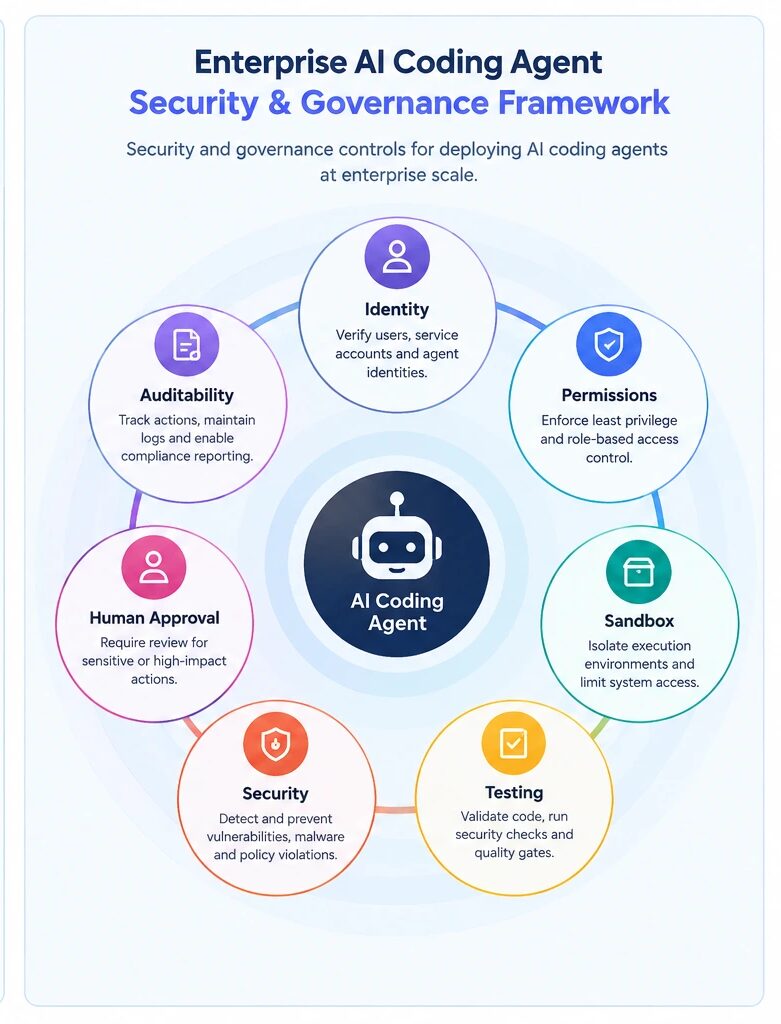
AI coding agents should receive only the permissions required for the task. Repository access, filesystem access, command execution, cloud resources, databases, and deployment permissions should be explicitly scoped.
A sensible progression is:
Read → Modify → Test → PR → Deploy
rather than:
Full repository + production access from day one
Google Cloud similarly recommends limiting agent scope, controlling dangerous commands, restricting dependency sources, and maintaining audit trails for enterprise agentic coding.
4. Use Sandboxes for Agent Execution
Agents that can execute commands create a larger security boundary than conventional autocomplete tools.
Use isolated environments for:
- Code execution
- Dependency installation
- Test execution
- Browser automation
- Tool calls
- Generated scripts
Anthropic’s engineering work on Claude Code highlights filesystem and network isolation as mechanisms for allowing greater agent autonomy while controlling its operating boundary.
5. Keep Human Review Where Risk Requires It
Human review should focus on high-impact decisions rather than forcing humans to manually approve every low-risk agent action. This creates a better balance between autonomy and control.
Suggested model
| Change Type | Recommended Control |
|---|---|
| Documentation | Automated checks |
| Unit-test generation | Developer review |
| Small refactor | Automated tests + PR review |
| Authentication change | Mandatory human review |
| Database migration | Human approval |
| Infrastructure change | Human approval |
| Production deployment | Explicit authorization |
| Security-sensitive code | Specialist review |
This is risk-based autonomy, not unrestricted autonomy.
Build Verification Into the Agentic SDLC
AI-generated code should pass through the same engineering controls as human-written code, with additional AI-specific safeguards where necessary. The fastest way to scale coding agents safely is to make quality and security checks automatic rather than relying exclusively on developers to detect problems manually.
A robust workflow looks like:
Requirement
    ↓
AI Coding Agent
    ↓
Plan + Context
    ↓
Code Changes
    ↓
Automated Tests
    ↓
SAST / SCA / Secret Scanning
    ↓
Quality Gates
    ↓
Pull Request
    ↓
Human Review
    ↓
CI/CD
    ↓
Deployment
    ↓
Production Monitoring
This approach preserves the existing SDLC while adding agent-specific controls around autonomy.
Read more on AI Data Engineering: Building Autonomous Enterprise Data Pipelines.
How to Measure AI Coding Agent ROI
AI coding agent ROI should be measured through engineering outcomes rather than lines of AI-generated code. Useful measures include cycle time, developer throughput, review time, defect rates, rework, test effectiveness, lead time for changes, and engineering cost per delivered outcome.
Avoid vanity metrics such as:
- Lines of code generated
- Number of prompts
- Number of agent sessions
- Number of generated tests
Instead measure:
| Metric | What It Tells You |
|---|---|
| Lead time for changes | Delivery speed |
| PR cycle time | Review efficiency |
| Rework rate | Output quality |
| Defect escape rate | Production impact |
| Test effectiveness | Quality |
| Developer time saved | Productivity |
| Deployment frequency | Delivery capability |
| Cost per task | Economic efficiency |
| Agent acceptance rate | Output usefulness |
The goal is not:
“How much code did the AI write?”
It is:
“Did the engineering organization deliver better software faster and safely?”
A Practical Enterprise Adoption Roadmap
Enterprises should introduce AI coding agents incrementally, beginning with low-risk development tasks, measuring quality and productivity, then expanding agent permissions and autonomy as evidence supports it.
Phase 1 — Pilot
Select 2–3 low-risk use cases:
- Test generation
- Documentation
- Small refactoring
- Bug investigation
Phase 2 — Standardize
Create:
- Agent usage policies
- Repository instructions
- Approved tools
- Security controls
- Evaluation criteria
Phase 3 — Integrate
Connect agents with:
- Git repositories
- Issue trackers
- CI/CD
- Testing frameworks
- Code-quality tools
- Security scanning
Phase 4 — Scale
Measure:
- Productivity
- Quality
- Security
- Adoption
- Cost
Then expand to more complex engineering tasks.
Phase 5 — Govern Agentic Development
Establish centralized controls for:
- Permissions
- Agent inventory
- Auditability
- Model/tool usage
- Security
- Compliance
- Cost
- Human approval
Gartner’s current enterprise AI coding-agent research highlights governance, validation, support, commercial maturity, and operational readiness as increasingly important considerations as agentic coding moves beyond individual developer productivity.
AI Coding Agents: The Enterprise Decision Framework
The right question for enterprise leaders is not whether AI coding agents can write code. It is where agent autonomy creates measurable value without exceeding the organization’s acceptable risk.
Before deploying an agent, ask:
- Is the task well defined?
- Can success be objectively tested?
- What systems can the agent access?
- What is the impact of an incorrect change?
- Can the action be reversed?
- What automated controls can verify the output?
- Where is human approval required?
- Can every agent action be audited?
- How will productivity and quality be measured?
A useful rule is:
Increase autonomy only when verification is stronger than the potential blast radius.
Conclusion
AI coding agents can significantly change enterprise software development by moving AI from code suggestion to delegated engineering work. They can generate code, create tests, debug applications, refactor legacy systems, reduce technical debt, and support broader SDLC activities.
But autonomy changes the engineering risk model.
The winning enterprise approach is not to give AI unrestricted access. It is to build an environment where agents can move quickly inside clearly defined boundaries.
That means:
Better context + least privilege + sandboxing + automated verification + human oversight + continuous measurement.
The organizations that benefit most from AI coding agents will be those that treat them not simply as developer tools, but as new participants in the software engineering lifecycle—with defined responsibilities, permissions, quality gates, and accountability.
For enterprises pursuing software engineering transformation, Techment can help integrate AI-native development practices with AI Engineering, Quality Engineering, application modernization, cloud engineering, and enterprise software development to build a scalable path toward agent-assisted delivery.
FAQs
1. What are AI coding agents?
AI coding agents are autonomous or semi-autonomous AI systems that can perform multi-step software development tasks such as analyzing code, planning changes, generating code, running tests, debugging, refactoring, and creating pull requests.
2. How are AI coding agents different from GitHub Copilot or other coding assistants?
Traditional coding assistants primarily provide suggestions while developers remain continuously in the loop. AI coding agents can take broader actions, including modifying multiple files, running tools and tests, and completing asynchronous development tasks.
3. What are the main enterprise use cases for AI coding agents?
The highest-value use cases include code generation, test generation, debugging, refactoring, legacy modernization, documentation, code review, technical-debt reduction, dependency updates, and developer environment automation.
4. What are the biggest risks of AI coding agents?
The major risks include incorrect code, security vulnerabilities, prompt injection, excessive permissions, sensitive-data exposure, unsafe dependencies, scope creep, and uncontrolled changes reaching production.
5. Are AI coding agents safe for enterprise use?
They can be used safely when deployed with appropriate controls such as least-privilege access, sandboxing, secure development practices, automated testing, security scanning, branch protection, audit logs, and risk-based human approval.
6. How should enterprises measure AI coding agent productivity?
Measure business and engineering outcomes such as lead time, PR cycle time, developer effort, defect rates, rework, deployment frequency, test effectiveness, and cost per completed task rather than lines of generated code.
7. Can AI coding agents work with legacy applications?
Yes. They can help analyze unfamiliar codebases, generate documentation, create characterization tests, identify dependencies, refactor modules, modernize code, and support incremental application modernization. Complex legacy changes should remain subject to strong testing and architectural review.
Related Reads
- AI Data Engineering: Building Autonomous Enterprise Data Pipelines.
- How to Build AI-Native Applications for Enterprise Scale.
- Legacy Modernization Services in 2026: How Enterprises Are Cutting Costs with AI
- Enterprise AI agent adoption challenges
- AI-Native Engineering Explained: The Enterprise Guide to AI-Driven Software Development