

Microsoft Fabric for insurance carriers provides a unified data and analytics foundation for bringing together policy, claims, billing, customer, underwriting, actuarial, and external data. Using OneLake, Data Factory, Lakehouse, Warehouse, Real-Time Intelligence, Power BI, Data Science, and Fabric governance capabilities, insurers can build a governed platform for analytics, AI, reporting, and operational decision-making.
Insurance carriers rarely have a single data problem.
They have a fragmentation problem.
Policy administration may sit in one system. Claims in another. Billing in another. CRM data may live elsewhere, while actuarial models, spreadsheets, documents, and external risk data create additional silos.
Microsoft Fabric is designed to unify data ingestion, storage, engineering, analytics, real-time processing, data science, and BI on a shared platform centered on OneLake. Microsoft specifically positions Fabric for financial-services organizations as a platform for modernizing data platforms, enabling AI readiness, and supporting data-driven capabilities.
For insurers, the opportunity is to create a common data foundation across:
Policies → Customers → Claims → Billing → Risk → Actuarial → AI
Read more about our partnership with Microsoft to understand how we help enterprises unify their data.
What Is Microsoft Fabric for Insurance?
Microsoft Fabric for insurance is an enterprise data and analytics architecture that uses Fabric’s shared OneLake foundation and integrated workloads to unify insurance data for reporting, analytics, AI, and real-time decision-making. It can support use cases across claims, underwriting, policy servicing, actuarial analysis, fraud, customer analytics, and regulatory reporting.
Fabric combines workloads including:
- Data Factory
- Data Engineering
- Lakehouse
- Data Warehouse
- Data Science
- Real-Time Intelligence
- Power BI
- Databases
- Copilot and AI capabilities
These workloads operate over a shared platform and OneLake storage layer.
For an insurance carrier, this means the platform can be organized around business domains rather than disconnected analytics projects.
Why Insurance Carriers Need a Modern Data Architecture
Insurance carriers need a modern data architecture because policy, claims, customer, billing, underwriting, actuarial, and external data often exist across disconnected systems with different schemas, update cycles, and ownership models. A unified architecture can reduce data duplication, improve lineage, and create reusable data products for analytics and AI.
A typical carrier may have:
| Domain | Typical data |
|---|---|
| Policy | Policy, coverage, endorsements, limits |
| Claims | FNOL, reserves, payments, adjuster activity |
| Customer | Demographics, interactions, preferences |
| Billing | Premiums, invoices, payments |
| Underwriting | Risk attributes, quotes, decisions |
| Actuarial | Loss triangles, assumptions, models |
| Distribution | Agents, brokers, channels |
| Fraud | SIU cases, alerts, investigation outcomes |
| External | Weather, geospatial, economic, regulatory data |
The challenge is not simply storing this information.
It is creating consistent, governed and reusable data from it.
Microsoft’s financial-services guidance explicitly highlights Fabric’s ability to provide a unified data platform and governance across financial-services data, including insurance-related scenarios such as claims processing.
Microsoft Fabric for Insurance: Reference Architecture
A practical Microsoft Fabric architecture for an insurance carrier should ingest data from core insurance systems into OneLake, refine it through Bronze, Silver, and Gold layers, expose governed semantic models for analytics, and connect real-time, AI, and operational use cases to the same trusted data foundation.
Proposed reference architecture
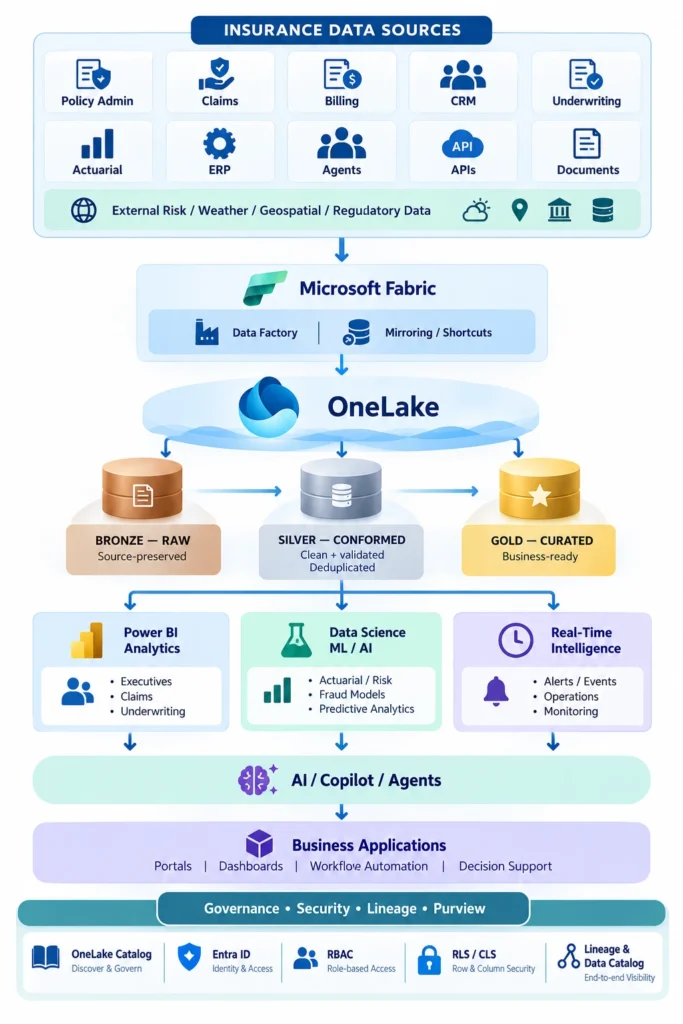
This architecture follows Microsoft’s documented Fabric patterns around OneLake, medallion architecture, Data Factory, analytics, and governed consumption.
Read our blog on Microsoft Fabric Architecture Explained: Complete Enterprise Guide (2026)
How the Insurance Fabric Architecture Works
1. Ingest Insurance Data
Fabric Data Factory, mirroring, and other Fabric integration capabilities can bring data from operational insurance systems into the shared OneLake environment. The ingestion layer should preserve source information while supporting both batch and near-real-time requirements.
Typical sources include:
- Policy administration systems
- Claims platforms
- Billing systems
- CRM
- ERP
- Data warehouses
- APIs
- Files
- External data providers
Fabric Mirroring can make supported source data available in OneLake with near-real-time updates without requiring traditional scheduled ETL pipelines for those sources.
For insurers, this can be useful where claims, policy, or customer data needs to be available quickly for downstream analytics.
2. Build the Medallion Data Layer
The medallion architecture is a strong foundation for insurance data because it separates raw source data from validated and curated data. Fabric’s recommended pattern uses Bronze, Silver, and Gold layers to progressively improve data quality while preserving the original source information.
Bronze — Raw
Preserve:
- Original claims
- Policy transactions
- Billing events
- Customer records
- External files
Rule: Preserve source data rather than modifying it in place.
Silver — Conformed
Perform:
- Data-quality validation
- Deduplication
- Standardization
- Entity matching
- Business-rule validation
- Historical handling
Gold — Curated
Create reusable business datasets such as:
- Claims profitability
- Loss ratio
- Combined ratio
- Policy performance
- Customer lifetime value
- Underwriting performance
- Fraud analytics
- Regulatory reporting
Microsoft identifies Bronze, Silver, and Gold as the core layers of its Fabric medallion architecture.\
3. Create Insurance Data Products
The Gold layer should expose reusable insurance data products rather than forcing every analytics team to rebuild the same transformations. Data products can organize information around business domains such as claims, policy, customer, underwriting, billing, and actuarial analytics.
For example:
Claims data product
Claim
├── Claim Event
├── Policy
├── Coverage
├── Reserve
├── Payment
├── Adjuster
├── Claimant
├── Fraud Indicator
└── Settlement
Policy data product
Policy
├── Customer
├── Product
├── Coverage
├── Premium
├── Endorsement
├── Agent / Broker
└── Policy Lifecycle
This creates reusable foundations for Power BI, machine learning, AI applications, and downstream operational systems.
4. Add Real-Time Insurance Intelligence
Insurance carriers can use Fabric Real-Time Intelligence when decisions depend on continuously arriving events rather than only historical batch data. Event-driven use cases can include claims events, fraud alerts, catastrophe signals, customer activity, and operational monitoring.
A simplified flow is:
Real-Time Event
      ↓
Eventstream
      ↓
Eventhouse
      ↓
KQL Analytics
      ↓
Detection / ML
      ↓
Power BI / Activator / Application
Microsoft’s Fabric reference architectures demonstrate this pattern for continuously arriving healthcare and operational data, using Eventstream, Eventhouse, OneLake, machine learning, dashboards, and Activator. The same architectural pattern can be adapted to insurance event streams.
Potential insurance applications include:
- Fraud-event detection
- Catastrophe monitoring
- Claims anomaly detection
- Payment monitoring
- Customer-event analytics
- Underwriting risk signals
5. Build the Insurance Analytics Layer
Power BI and Fabric’s semantic modeling capabilities can turn governed Gold-layer insurance data into reusable analytical experiences for executives, claims teams, underwriters, actuaries, and operations teams.
Example dashboards include:
Claims
- Claims frequency
- Severity
- Cycle time
- Reserve development
- Settlement trends
- Leakage indicators
Underwriting
- Loss ratio
- Quote-to-bind
- Risk segment performance
- Product profitability
- Channel performance
Customer
- Retention
- Cross-sell
- Service interactions
- Customer value
Finance
- Premium
- Losses
- Expenses
- Combined ratio
- Profitability
The key architectural principle is:
Build governed semantic models once; reuse them across reporting, analytics and AI.
Microsoft Fabric for Insurance: Key Use Cases
A Fabric-based insurance data platform can support multiple insurance functions from the same governed data foundation, including claims analytics, underwriting, actuarial modeling, fraud detection, customer analytics, regulatory reporting, and AI applications.
| Insurance function | Fabric use case |
|---|---|
| Claims | Claims analytics, leakage, cycle time |
| Underwriting | Risk and portfolio analytics |
| Actuarial | Loss development and modeling |
| Fraud | Anomaly detection and SIU analytics |
| Customer | Retention and segmentation |
| Billing | Premium and payment analytics |
| Catastrophe | Event and exposure analytics |
| Compliance | Regulatory reporting |
| AI | RAG, copilots, agents and predictive models |
Microsoft’s insurance customer story for Milliman is a useful real-world example: Milliman adopted Fabric to enable self-service actuarial modeling, with Microsoft reporting reduced latency and cost and more advanced analytics as early outcomes.
Why OneLake Matters for Insurance
OneLake provides Fabric’s shared logical data-lake foundation, allowing different Fabric workloads to work from the same underlying data rather than creating separate copies for every analytics workload. For insurers, this can simplify data sharing across claims, actuarial, underwriting, BI, data science, and AI workloads.
Microsoft describes OneLake as the single unified logical data lake for the organization, with Fabric workloads sharing data through the common platform.
This can help reduce a common insurance architecture problem.
Security and Governance for Insurance Data
Insurance data architecture must treat governance and security as architectural layers, not post-implementation controls. Fabric provides workspace and item permissions alongside OneLake security, which can restrict access at the table, folder, row, and column levels. Microsoft also provides governance capabilities through the OneLake catalog and Microsoft Purview integrations.
This is particularly important for:
- PII
- Financial information
- Health information
- Claims documents
- Fraud investigations
- Underwriting data
Microsoft documents separate control-plane and data-plane security in OneLake, including fine-grained access to tables, rows, and columns.
A carrier should establish:
- Microsoft Entra ID
- RBAC
- Least privilege
- Row-level security
- Column-level security
- Data classification
- Audit logging
- Data lineage
- Retention policies
- Sensitive-data controls
The OneLake catalog also provides centralized governance and security experiences across Fabric data estates.
Learn more about implementing unified data framework in Implementing Data Governance Frameworks That Work: A Strategic Playbook for Enterprise Leaders
Microsoft Fabric for Insurance and AI
Fabric can provide the data foundation for insurance AI by bringing governed policy, claims, customer, financial, and external data into a common environment. This enables predictive models, RAG applications, copilots, and AI agents to operate against more consistent enterprise data rather than disconnected departmental datasets.
A modern insurance AI architecture can therefore look like:

This is particularly relevant for:
- Claims copilots
- Underwriting assistants
- Fraud investigation
- Policy Q&A
- Customer-service AI
- Actuarial analytics
- Enterprise AI agents
The architecture should keep AI outputs separate from systems of record and enforce the same authorization and governance model as other enterprise data.
Fabric vs a Traditional Insurance Data Platform
Microsoft Fabric can simplify an insurance data estate by consolidating ingestion, storage, engineering, analytics, real-time intelligence, data science, and BI around OneLake. Traditional architectures may require multiple specialized platforms and integration layers, while Fabric provides a more unified operating model.
| Capability | Traditional fragmented estate | Fabric-based architecture |
|---|---|---|
| Data ingestion | Multiple tools | Fabric Data Factory |
| Data lake | Separate platform | OneLake |
| Transformation | Multiple engines | Fabric workloads |
| Data warehouse | Separate service | Fabric Warehouse |
| Real-time analytics | Separate stack | Real-Time Intelligence |
| BI | Separate BI platform | Power BI |
| Data science | Separate environment | Fabric Data Science |
| Governance | Multiple tools | Fabric + Purview capabilities |
| AI readiness | Additional integration | Shared data foundation |
Fabric’s value proposition is therefore less about replacing every existing insurance system and more about creating a common analytics and AI foundation around them.
Implementation Roadmap for Insurance Carriers
Insurers should adopt Fabric incrementally, starting with one high-value domain such as claims or actuarial analytics, then expanding the shared data foundation to policy, billing, underwriting, customer, and AI workloads. A domain-first rollout reduces migration risk while establishing reusable architecture and governance patterns.
Phase 1 — Assess
Map:
- Core systems
- Data sources
- Data owners
- Critical reports
- Data-quality issues
- Regulatory requirements
Phase 2 — Establish OneLake
Define:
- Workspaces
- Domains
- Security model
- Naming standards
- Data ownership
Phase 3 — Build Bronze/Silver/Gold
Start with one business domain.
Claims is often a strong candidate because it combines structured transactions, documents, analytics, and operational KPIs.
Phase 4 — Create semantic models
Build governed models for:
- Claims
- Policy
- Customer
- Underwriting
Phase 5 — Add AI and ML
Introduce:
- Fraud models
- Predictive analytics
- RAG
- Copilots
- AI agents
Phase 6 — Scale across domains
Connect:
Claims + Policy + Billing + Customer + Underwriting + Actuarial
Phase 7 — Operationalize governance
Continuously monitor:
- Data quality
- Security
- Lineage
- Cost
- Performance
- AI usage
- Business outcomes
Common Mistakes
The biggest mistakes in a Fabric insurance implementation are migrating data without defining business domains, reproducing existing silos inside Fabric, ignoring governance until later, and building dashboards before establishing trusted data products. Fabric should simplify the architecture, not become another place where disconnected datasets accumulate.
Avoid:
1. Recreating every legacy warehouse
Do not migrate technical silos without redesigning the data model.
2. Skipping the Bronze layer
Preserving source data improves replayability and traceability.
3. Building dashboards directly on raw data
Create governed Silver and Gold layers.
4. Ignoring security
Insurance data requires fine-grained access controls.
5. Treating AI as a separate data estate
AI should consume governed enterprise data.
6. Starting with every domain
Prove the architecture with one business-critical workload first.
Read our guide on Microsoft Fabric OneLake Best Practices
Insurance Fabric Architecture Checklist
Before production, confirm:
- Core insurance sources are mapped.
- OneLake workspace/domain structure is defined.
- Bronze, Silver, and Gold layers are implemented.
- Claims and policy entities have defined ownership.
- Data-quality rules are automated.
- Data lineage is available.
- RBAC and fine-grained security are implemented.
- Sensitive data is classified.
- Business semantic models are certified.
- Power BI consumption is governed.
- Real-time workloads have defined SLAs.
- AI workloads consume governed data.
- Cost and capacity are monitored.
- Disaster recovery and operational procedures are documented.
Key Takeaways
- Microsoft Fabric can provide a unified data and analytics foundation for insurance carriers.
- OneLake is the architectural center, providing shared data across Fabric workloads.
- A Bronze → Silver → Gold architecture provides a practical foundation for insurance data quality and reuse.
- Claims, policy, underwriting, billing, actuarial, customer, and fraud data can become reusable business data products.
- Fabric’s Real-Time Intelligence capabilities can support event-driven insurance scenarios.
- Power BI provides the governed consumption layer for operational and executive analytics.
- Security should use least privilege and fine-grained data access controls.
- Fabric can provide the data foundation for RAG, AI copilots, predictive models, and AI agents.
- Insurers should start with one high-value domain rather than attempting an enterprise-wide migration immediately.
- The objective is not simply a new data platform—it is a governed insurance data foundation for analytics and AI.
Conclusion
For insurance carriers, the strategic value of Microsoft Fabric is not simply that it combines multiple analytics tools.
The larger opportunity is to establish a shared, governed data foundation across the insurance value chain.
A well-designed architecture can connect:
Policy → Customer → Claims → Billing → Underwriting → Actuarial → AI
while preserving raw data, improving data quality, enabling reusable business models, and supporting both batch and real-time analytics.
The reference architecture proposed here uses Microsoft’s documented Fabric patterns—OneLake, medallion architecture, Data Factory, Warehouse, Real-Time Intelligence, Power BI, and Fabric security/governance capabilities—and adapts them to the specific data landscape of insurance carriers.
For insurers preparing for AI-driven claims, underwriting, fraud, and customer operations, the key architectural decision is therefore not simply “Should we adopt Fabric?”
It is:
“How do we create a governed insurance data foundation that every analytics and AI workload can reliably use?”
That is where Microsoft Fabric can become part of an insurer’s broader data modernization, AI strategy, and enterprise analytics architecture.
Techment can help insurance organizations assess their existing data estate, design Fabric-based architectures, modernize data pipelines, build governed insurance data products, and connect the resulting platform to Enterprise AI, RAG, AI agents, analytics, and modernization initiatives.
Frequently Asked Questions
1. What is Microsoft Fabric for insurance?
Microsoft Fabric for insurance is a proposed enterprise data architecture that uses Fabric and OneLake to unify insurance data for analytics, AI, reporting, and real-time intelligence across areas such as claims, policy, billing, underwriting, and actuarial operations.
2. How can insurance companies use Microsoft Fabric?
Insurers can use Fabric for claims analytics, underwriting analytics, actuarial modeling, fraud detection, customer analytics, regulatory reporting, real-time event processing, predictive models, and AI applications.
3. What is the best Microsoft Fabric architecture for insurance?
A practical starting pattern is OneLake + Bronze/Silver/Gold medallion architecture + Data Factory + governed semantic models + Power BI, with Real-Time Intelligence and AI capabilities added where business requirements justify them.
4. Can Microsoft Fabric handle insurance claims data?
Yes. Fabric supports architectures for structured and unstructured data, analytics, real-time processing, governance, and AI. Microsoft’s Fabric security documentation also provides fine-grained OneLake controls relevant to sensitive datasets.
5. Can Microsoft Fabric support insurance AI?
Yes. Fabric can provide a governed data foundation for machine learning, RAG applications, copilots, and AI agents. The AI workload should still apply appropriate model, application, security, and governance controls.
6. Is Microsoft Fabric suitable for actuarial analytics?
Fabric can support actuarial data engineering, analytics, and modeling workloads. Microsoft has published a customer story describing Milliman’s use of Fabric for self-service actuarial modeling.
Related Reads
- What Is Microsoft Fabric? A Comprehensive Overview for Enterprise Leaders
- Microsoft Fabric vs Snowflake: A Data Management Showdown
- AI-Ready Enterprise Checklist with Microsoft Fabric
- RAG in 2026: How Retrieval-Augmented Generation Works for Enterprise AI
- RAG architectures
- Agentic AI Use Cases: 7 Enterprise Examples Driving Autonomous Operations
- Enterprise AI Strategy in 2026: A Practical Guide for CIOs and Data Leaders
- Is Your Enterprise AI-Ready? Explore our A Fabric-Focused Readiness Checklist
- RAG vs Knowledge Graphs: Which Performs Better for Enterprise AI?