

Introduction
As enterprises move beyond AI experimentation and pilot projects, a new challenge has emerged: how do you architect applications where intelligence is not a feature, but a foundational system capability?
Many organizations have successfully integrated generative AI into existing software through copilots, chat interfaces, and automation workflows. However, these approaches often rely on traditional application architectures that were never designed to support reasoning, autonomous decision-making, context persistence, or agent orchestration.
Building truly intelligent software requires a different architectural approach.
AI-native application architecture is the discipline of designing software systems where large language models, retrieval systems, memory layers, agent frameworks, and governance mechanisms operate as core architectural components. Rather than embedding AI into existing workflows, these systems are designed around intelligence from the outset.
As enterprises invest in agentic AI, Retrieval-Augmented Generation (RAG), autonomous workflows, and enterprise knowledge systems, architecture decisions increasingly determine whether AI initiatives scale successfully or remain trapped in proof-of-concept environments.
This guide explores the architectural patterns, system components, and engineering practices required to build production-ready AI-native applications that are scalable, observable, secure, and enterprise-ready.
What Is AI-Native Application Architecture?
AI-native application architecture is a software design approach where AI models, memory systems, retrieval mechanisms, and autonomous agents serve as core architectural components rather than optional features. These systems are designed to reason, adapt, and execute workflows using natural language and contextual intelligence. Therefore, AI-native application architecture refers to the design framework used to build software systems where AI-driven reasoning, planning, and decision-making serve as the primary execution layer.
Unlike traditional application architectures that rely on deterministic business logic and predefined workflows, AI-native architectures dynamically interpret user intent, retrieve context, generate responses, and orchestrate actions across multiple systems.
For a deeper dive into production architecture patterns, read our guide to AI-native application architecture – AI-Native Engineering Explained: The Enterprise Guide to AI-Driven Software Development
AI-Native Application Architecture Definition
AI-native application architecture is a software architecture pattern that combines reasoning models, enterprise data sources, memory systems, orchestration frameworks, and governance controls to deliver intelligent, context-aware, and autonomous user experiences.
Why Architecture Matters More Than Models
A common misconception is that enterprise AI success depends primarily on selecting the right model. In reality, production performance depends far more on architecture than on model choice.
| Dimension | Traditional Applications | AI-Native Applications |
|---|---|---|
| User Interface | Forms & Screens | Conversational Interfaces |
| Logic | Rules-Based | Reasoning-Based |
| Data Access | Direct Queries | Retrieval + Reasoning |
| Decision Making | Deterministic | Context-Aware |
| Automation | Workflow Automation | Autonomous Agents |
| Personalization | Rule Driven | Dynamic Context |
Organizations that struggle to move beyond AI pilots often face challenges such as:
- Hallucinated outputs
- Poor retrieval quality
- Context loss
- Agent failures
- Rising inference costs
- Governance gaps
- Lack of observability
These challenges are architectural problems, not model problems.
The most successful enterprise AI systems are built on architectures that combine reasoning, retrieval, memory, orchestration, evaluation, and governance into a cohesive operating framework.
What Makes an Application Truly AI-Native?
The word “AI-native” is being used loosely — and that is causing real confusion in engineering teams. Let us draw a clear line.
AI-Augmented vs. AI-Native
An AI-augmented application is a traditional software product with AI capabilities added to it. Think of a CRM that added a summarisation button, or a search engine that added semantic reranking. The core architecture — request handlers, databases, business logic layers — remains unchanged. AI is a service call.
An AI-native application is designed from the start around the assumption that intelligence is the primary mechanism through which value is delivered. The “business logic” is not a set of if-else rules — it is a reasoning system. The “user interface” is not a form — it is a conversation or an autonomous workflow. The system does not just retrieve and display data; it interprets, decides, and acts.
| Dimension | AI-Native Characteristics |
| Core logic | Reasoning models, not deterministic rules |
| Input handling | Unstructured language, context, intent |
| Decision making | Probabilistic inference, not branching code |
| User experience | Conversational, agentic, adaptive |
| State management | Memory systems, not just session variables |
| Testing | Evaluation frameworks, not just unit tests |
| Failure modes | Hallucination, drift, context loss — not null pointers |
The Four Pillars of AI-Native Architecture
Every AI-native application, regardless of domain, is built on four foundational pillars:
- Language Interface Layer: the system accepts natural language as a primary input modality. Instructions, queries, and commands arrive as prose, not structured API payloads.
- Reasoning Engine: an LLM (or ensemble of models) performs interpretation, planning, and generation. This is not a classifier or a recommendation system — it is a full reasoning layer.
- Tool & Data Layer: the reasoning engine has access to tools — databases, APIs, code executors, search indices — and calls them autonomously based on what the task requires.
- Memory & State: the system maintains context across turns, sessions, and even users — using vector stores, structured memory, or persistent state graphs.
Core Components of AI-Native Application Architecture
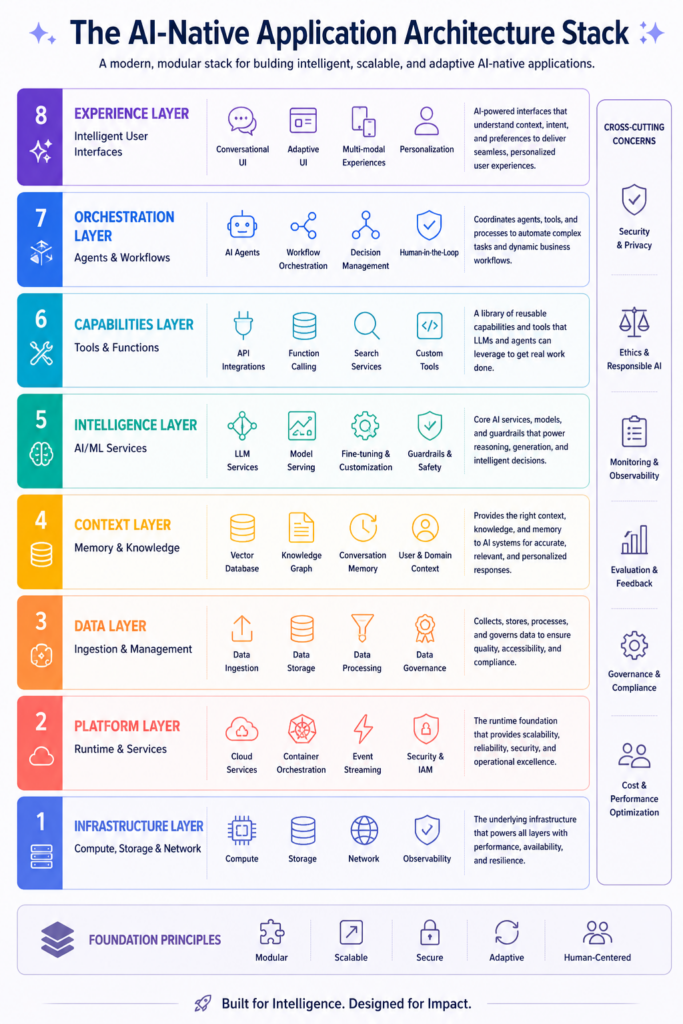
Production-grade AI-native systems typically consist of six interconnected architectural layers.
1. Experience Layer
The experience layer acts as the interaction surface between users and intelligent systems.
Common interfaces include:
- Enterprise copilots
- Conversational assistants
- Knowledge portals
- Workflow automation interfaces
- Multimodal applications
Natural language becomes the primary interaction mechanism, reducing reliance on rigid forms and traditional user interfaces.
2. Reasoning Layer
The reasoning layer serves as the application’s cognitive engine.
Responsibilities include:
- Intent understanding
- Task decomposition
- Decision support
- Workflow planning
- Content generation
- Action selection
Large language models enable this capability, but architecture determines how reasoning is controlled, validated, and optimized.
3. Retrieval Layer
Enterprise AI systems require access to organizational knowledge.
The retrieval layer provides:
- Semantic search
- Knowledge retrieval
- Context assembly
- Source attribution
- Relevance ranking
This layer forms the foundation of modern Retrieval-Augmented Generation (RAG) architectures.
4. Memory Layer
Memory enables continuity and personalization across interactions.
Effective AI-native architectures combine:
- In-context memory
- Session memory
- Semantic memory
- Structured enterprise memory
Without a dedicated memory strategy, applications struggle to maintain context, relevance, and user trust.
5. Tool Orchestration Layer
AI systems increasingly interact with enterprise applications and external services.
Typical integrations include:
- CRM platforms
- ERP systems
- Analytics tools
- Databases
- Internal APIs
- Workflow engines
This layer allows intelligent systems to move beyond conversation and perform meaningful actions.
6. Governance and Observability Layer
Enterprise deployment requires mechanisms to monitor, evaluate, and control AI behavior.
Critical capabilities include:
- Output validation
- Policy enforcement
- Audit logging
- Performance monitoring
- Cost tracking
- Evaluation frameworks
Without governance, enterprise AI adoption cannot scale safely.
Successful AI-native applications are built on six interconnected architectural layers.
| Layer | Purpose |
|---|---|
| Language Interface | Understands user intent |
| Reasoning Engine | Interprets and plans actions |
| Agent Orchestration | Coordinates tasks and workflows |
| Tool & Data Layer | Connects enterprise systems |
| Memory Layer | Maintains context and continuity |
| Governance & Observability | Ensures trust, compliance, and performance |
Together, these layers create a scalable foundation for enterprise AI systems.
Reference Architecture for Enterprise AI-Native Applications
A modern AI-native application architecture typically follows this flow:
User Request → Reasoning Layer → Retrieval Layer → Memory Layer → Tool Execution Layer → Governance Layer → Response Generation
Each layer contributes specific capabilities while maintaining clear separation of responsibilities.
This modular approach improves scalability, maintainability, and compliance while enabling organizations to evolve individual components without redesigning the entire system.
AI Agent Architecture Patterns for Enterprise Systems
As organizations adopt autonomous workflows, agent architecture becomes increasingly important.
ReAct Architecture
Best suited for dynamic environments where agents must continuously reason and act based on changing information.
Plan-and-Execute Architecture
Separates planning from execution, improving performance on complex, multi-step workflows.
Multi-Agent Architecture
Uses specialized agents working together to solve complex tasks.
Examples include:
- Research agents
- Analytics agents
- Compliance agents
- Workflow agents
Human-in-the-Loop Architecture
Introduces approval checkpoints before high-impact actions are executed.
This pattern is particularly important for regulated industries and mission-critical workflows.
Agentic Orchestration Patterns
The most powerful — and most complex — AI-native systems are agentic: they do not just respond, they plan and execute multi-step workflows autonomously. Agentic systems introduce patterns that traditional software engineers have never had to reason about:
ReAct (Reason + Act)
The agent reasons about what it needs to do, selects a tool, executes it, observes the result, reasons again, and continues until the task is complete. This is the backbone of most production agents today.
Plan-and-Execute
A planner model produces a structured multi-step plan upfront. An executor model carries out each step. This separation improves reliability on long-horizon tasks where a single model tends to lose track.
Human-in-the-Loop (HITL) Checkpoints
The agent executes autonomously up to a defined confidence threshold, then pauses and routes to a human reviewer before proceeding. This is not a fallback — it is a designed architectural feature for high-stakes decisions.
| Pattern | Best Used When |
| ReAct | Dynamic, unpredictable tasks requiring adaptive tool use |
| Plan-and-Execute | Complex, long-horizon tasks with known structure |
| HITL Checkpoint | High-stakes decisions, regulated domains, low-confidence outputs |
| Parallelised Agents | Independent sub-tasks that can run simultaneously |
| Critic-Revisor | Output quality matters more than speed; self-improvement loop |
AI-Native Architecture Best Practices
Building successful AI-native applications requires more than selecting the right model. Enterprise teams need an architecture that prioritizes reliability, scalability, and governance from the start.
Design for Retrieval Before Generation
In enterprise AI systems, retrieval quality often has a greater impact on output quality than the model itself. AI-native applications should use Retrieval-Augmented Generation (RAG) to ground responses in trusted enterprise data. Key practices include hybrid search, effective document chunking, reranking, and source attribution. A strong retrieval layer improves accuracy, reduces hallucinations, and keeps responses aligned with current business information.
Treat Models as Infrastructure
Large language models should be managed like any other critical enterprise infrastructure. Organizations should implement model versioning, fallback strategies, latency monitoring, and cost controls. Planning for model updates, outages, and scaling requirements helps ensure consistent application performance in production environments.
Build Observability Into Every Layer
Traditional monitoring is not enough for AI systems. Organizations should track model performance, retrieval quality, agent actions, response latency, and business outcomes. End-to-end observability helps teams identify failures, improve user experiences, and maintain trust in AI-generated outputs.
Implement Continuous Evaluation
AI outputs should be continuously evaluated for faithfulness, groundedness, relevance, accuracy, and safety. Combining automated evaluation with human review enables organizations to detect quality issues early and improve performance over time.
Establish Governance Early
Governance should be a foundational architectural component rather than an afterthought. Effective AI governance includes human oversight, auditability, access controls, and risk management policies that support transparency, compliance, and responsible AI adoption.
Industry Frameworks Shaping AI-Native Architecture
As organizations move AI-native applications into production, several industry frameworks are influencing architecture, governance, and risk management decisions. Engineering teams commonly align their practices with frameworks such as the National Institute of Standards and Technology AI Risk Management Framework, the EU AI Act, and emerging enterprise AI governance standards. These frameworks emphasize transparency, human oversight, explainability, security, and continuous monitoring—capabilities that should be embedded directly into AI-native application architecture rather than added later.
Enterprise Use Cases for AI-Native Application Architecture
AI-native architecture is enabling organizations to move beyond traditional automation and build systems that can reason, adapt, and act across complex business workflows.
Intelligent Knowledge Systems
AI-native knowledge platforms combine retrieval, memory, and reasoning to deliver contextual answers from enterprise information sources. Common use cases include employee assistants, IT support copilots, and internal knowledge search systems that improve productivity and reduce information silos.
Autonomous Customer Service
Modern customer service platforms use AI-native architecture to understand customer intent, retrieve relevant information, and execute workflows across enterprise systems. These solutions can automate issue resolution, improve response times, and support human agents with contextual recommendations.
AI-Powered Operations
Organizations are increasingly using AI-native systems to automate operational processes that span multiple applications and teams. Examples include supply chain coordination, IT operations, procurement workflows, and business process automation where adaptability is critical.
Decision Intelligence Platforms
AI-native decision intelligence platforms help business leaders transform data into actionable insights. By combining enterprise knowledge, analytics, and reasoning capabilities, these systems support strategic planning, risk management, forecasting, and executive decision-making.
Conclusion
AI-native application architecture represents the next evolution of enterprise software design.
As organizations move from isolated AI features to intelligent systems capable of reasoning, acting, and learning, architecture becomes the critical factor that determines scalability, reliability, and business value.
Success requires more than deploying language models. It requires a deliberate architecture that integrates reasoning, retrieval, memory, orchestration, observability, and governance into a unified operating framework.
Organizations that invest in AI-native architecture today will be better positioned to build intelligent applications that deliver measurable business outcomes while maintaining enterprise-grade reliability, security, and control.
Techment helps enterprises design, engineer, and scale AI-native application architectures that transform AI initiatives into production-ready business capabilities.
FAQ
1. What is AI-native application architecture?
AI-native application architecture is a software design approach where AI models, memory systems, agents, and retrieval frameworks form the foundation of the application rather than acting as add-on features.
2. How is AI-native architecture different from traditional software architecture?
Traditional architectures rely on deterministic business logic, while AI-native architectures use reasoning engines, contextual memory, and probabilistic decision-making.
3. What are the key components of AI-native application architecture?
The primary components include language interfaces, reasoning engines, agent orchestration, memory systems, retrieval mechanisms, and observability frameworks.
4. Why is memory important in AI-native applications?
Memory enables AI systems to maintain context, personalize interactions, improve task completion, and support long-running workflows.
5. What role does RAG play in AI-native architecture?
Retrieval-Augmented Generation improves accuracy by retrieving relevant enterprise information before generating responses.
6. How do enterprises deploy AI-native applications safely?
Organizations use governance controls, evaluation frameworks, observability tools, human oversight mechanisms, and guardrails to ensure reliability and compliance.