
How do you identify which legacy applications to modernize first?
A legacy modernization assessment ranks applications using business value, technical risk, cost, complexity, dependencies, security exposure, modernization readiness, and expected ROI. The highest-priority candidates are typically applications where business impact and modernization value are high, while technical complexity and transformation risk remain manageable.
TL;DR
- Do not prioritize applications simply because they are old. Prioritize based on business value, technical risk, cost, and modernization potential.
- Start with a complete application portfolio assessment covering business, technical, financial, operational, and dependency data.
- Score each application against a consistent set of modernization criteria.
- Prioritize applications with high business value + high legacy risk + achievable modernization effort.
- Avoid starting with the most complex application simply because it creates the biggest technical challenge.
- Consider retire, retain, rehost, replatform, refactor, rebuild, or replace before selecting a modernization approach.
- Begin with a manageable pilot and use its lessons to refine subsequent modernization waves.
What Is a Legacy Modernization Assessment?
A legacy modernization assessment is a structured evaluation of an organization’s applications to determine which systems should be modernized, when they should be modernized, and what approach should be used. It combines business value, technical health, cost, risk, dependencies, and modernization readiness to create a defensible application modernization roadmap.
Microsoft recommends beginning application modernization with an assessment of the existing digital estate, including applications, data, infrastructure, costs, and organizational readiness.
For enterprises with hundreds or thousands of applications, modernization cannot be treated as a single-project decision. It is a portfolio prioritization problem.
Microsoft’s application modernization guidance recommends assessing the digital estate, defining business goals, prioritizing applications, selecting modernization strategies, and then executing modernization in phases.
AWS similarly frames application portfolio assessment around discovery, analysis, prioritization, strategy selection, and migration wave planning.
The objective is simple:
Identify where modernization can create the greatest business value without taking disproportionate risk.
Know more about Legacy Modernization Services in 2026: How Enterprises Are Cutting Costs with AI
Why Enterprises Struggle to Decide What to Modernize First
Legacy portfolios rarely have a simple relationship between age and business importance.
An application that has been running for 15 years may be stable, inexpensive, and easy to maintain. Another application built five years ago may have become a major bottleneck because of poor architecture, rising infrastructure costs, security constraints, or integration limitations.
Common assessment problems include:
- Incomplete application inventories
- Unknown application dependencies
- Outdated technology stacks
- High technical debt
- Rising maintenance costs
- Security and compliance exposure
- Poor application documentation
- Business-critical applications with fragile architectures
- Duplicate applications performing similar functions
- Systems that are difficult to integrate with modern platforms
- Applications with unclear ownership
This is why “oldest first” is rarely a reliable modernization strategy.
Which Legacy Applications Should You Modernize First?
The best candidates are usually applications with high business value, significant technical or operational risk, and a realistic path to modernization.
A practical prioritization model evaluates applications across seven dimensions:
| Assessment Factor | Key Question | Priority Signal |
|---|---|---|
| Business Value | How important is the application to revenue or operations? | High |
| Technical Risk | Is the technology becoming difficult or unsafe to maintain? | High |
| Cost | Is the application expensive to operate or support? | High |
| Security & Compliance | Does it create material security or regulatory risk? | High |
| User/Customer Impact | Does poor performance affect customers or employees? | High |
| Dependencies | How many systems depend on it? | Lower complexity is better for early waves |
| Modernization Readiness | Can it realistically be changed with available skills and technology? | High readiness |
The sweet spot
The strongest early candidates often sit here:
High business value + high technical pain + manageable complexity + clear modernization path
That combination creates a stronger business case than simply selecting the application’s age or technology stack.
A Practical Legacy Modernization Prioritization Framework
Instead of relying on subjective discussions, assign each application a weighted score.
AWS Prescriptive Guidance recommends progressively assessing application portfolios, establishing prioritization criteria, and using business and technical factors to create migration and modernization waves
Example scoring model
| Criterion | Weight | Score |
|---|---|---|
| Business criticality | 25% | 1–5 |
| Technical debt | 15% | 1–5 |
| Operational cost | 15% | 1–5 |
| Security/compliance risk | 15% | 1–5 |
| Customer/user impact | 10% | 1–5 |
| Modernization readiness | 10% | 1–5 |
| Dependency complexity | 10% | 1–5* |
*For dependency complexity, a lower complexity should receive the higher modernization-priority score.
Modernization Priority Score = Σ (Criterion Score × Weight)
For example, an application with high business criticality, significant technical debt, high operating cost, and manageable dependencies may score substantially higher than an older but stable application.
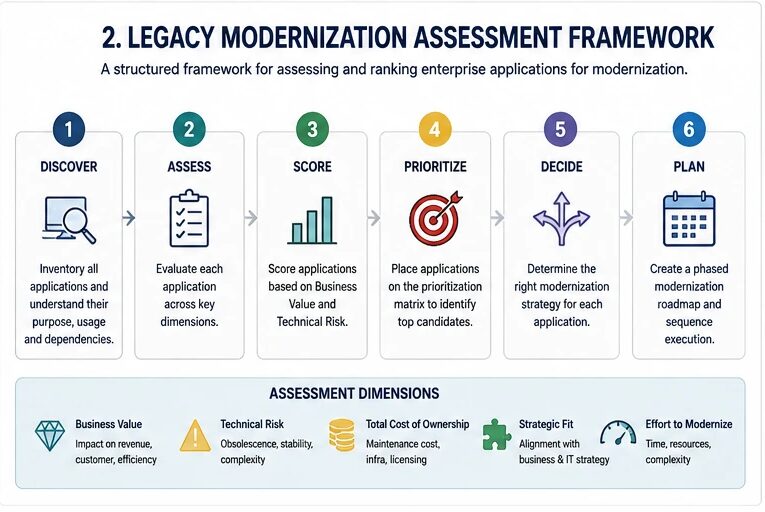
The important point is not the exact weighting. The organization should agree on the criteria and apply them consistently.
AWS recommends establishing prioritization criteria and progressively refining the model as the organization learns from initial assessments and modernization waves.
Business Value vs. Technical Risk: The Fastest Way to Find Candidates
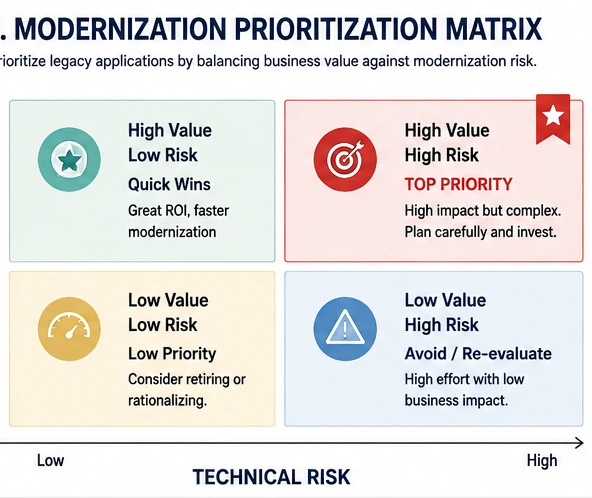
A simple two-axis matrix can make portfolio decisions easier.
| Low Technical Risk | High Technical Risk | |
|---|---|---|
| High Business Value | Modernize selectively | Top priority |
| Low Business Value | Retain / monitor | Retire / replace / defer |
High-value + high-risk applications
These often deserve immediate attention because failure, downtime, security exposure, or maintenance problems can directly affect the business.
High-value + low-risk applications
These may still benefit from modernization, but the business case should demonstrate measurable gains such as scalability, development velocity, cloud efficiency, or AI readiness.
Low-value + high-risk applications
Do not automatically modernize them. Retirement or replacement may deliver more value than transformation.
Low-value + low-risk applications
These are generally poor candidates for early modernization waves.
What Data Should a Modernization Assessment Collect?
A credible assessment needs more than an application name and technology stack.
At minimum, collect:
Business data
- Business owner
- Business function
- Criticality
- Revenue impact
- Customer impact
- Regulatory requirements
- Strategic importance
Technical data
- Programming language
- Framework and runtime version
- Database technology
- Infrastructure
- Architecture
- Technical debt
- Performance
- Scalability limitations
- End-of-support technology
Operational data
- Incident volume
- Downtime
- Maintenance effort
- Release frequency
- Deployment complexity
- Support costs
- SLA requirements
Dependency data
- Upstream systems
- Downstream systems
- APIs
- Databases
- Identity systems
- Third-party services
- Data integrations
AWS’s application portfolio assessment guidance explicitly includes business, infrastructure, cost, ownership, dependencies, DR, support, and other application attributes as inputs to portfolio analysis.
The quality of the prioritization is directly related to the quality of the portfolio data.
How to Identify the Right Modernization Candidates
A practical assessment can follow five steps.
1. Build the application inventory
Create a single portfolio view of applications, owners, technologies, infrastructure, costs, business criticality, and dependencies.
Do not wait for perfect data. Start with what is available and progressively enrich the inventory.
2. Identify modernization pressure
Look for measurable signals such as:
- End-of-support technology
- Security vulnerabilities
- High infrastructure costs
- Frequent production incidents
- Slow release cycles
- Poor scalability
- Manual operational processes
- Integration limitations
- Excessive technical debt
3. Quantify business impact
Determine what happens if the application remains unchanged.
Ask:
- Does it affect revenue?
- Does it affect customers?
- Does it constrain growth?
- Does it prevent digital initiatives?
- Does it create regulatory exposure?
- Does it slow product development?
- Does it prevent AI or cloud adoption?
4. Score modernization feasibility
A strategically important application may still be a poor first candidate if it has extremely complex dependencies, limited documentation, scarce skills, or difficult data migration requirements.
5. Create modernization waves
Group applications into practical waves rather than creating one enormous modernization program.
Microsoft recommends phased modernization and using proof-of-concept work to build momentum and validate the approach.
Know more about How to Build AI-Ready Data Foundations.
Don’t Modernize Every Legacy Application
Legacy modernization does not mean transforming every application. A portfolio assessment should also identify applications that should be retired, retained, replaced, or moved with minimal change.
A useful decision framework is:
| Application Condition | Likely Action |
|---|---|
| Low business value + redundant | Retire |
| Stable + low strategic importance | Retain |
| Valuable but infrastructure-bound | Rehost / Replatform |
| Valuable with significant technical debt | Refactor / Re-architect |
| Business capability is obsolete | Replace |
| Application requires fundamental redesign | Rebuild |
Microsoft’s modernization guidance uses the widely adopted 6 Rs framework—Rehost, Replatform, Refactor, Rebuild, Retire, and Retain—to help organizations determine the appropriate treatment for individual applications.
The key insight is that prioritization and modernization strategy are separate decisions.
First determine:
Which application should we address first?
Then determine:
What should we do with it?
A Better Way to Think About Modernization Readiness
One useful refinement is to separate modernization urgency from modernization readiness.
An application may have extremely high modernization urgency but low readiness.
For example:
High urgency + low readiness
→ Start discovery, dependency mapping, architecture planning, and risk reduction.
High urgency + high readiness
→ Strong candidate for an early modernization wave.
Low urgency + high readiness
→ Consider modernization when capacity is available or when it supports another strategic initiative.
Low urgency + low readiness
→ Retain, monitor, or reassess later.
This prevents enterprises from confusing “needs modernization” with “should be modernized now.”
How to Build a Modernization Roadmap
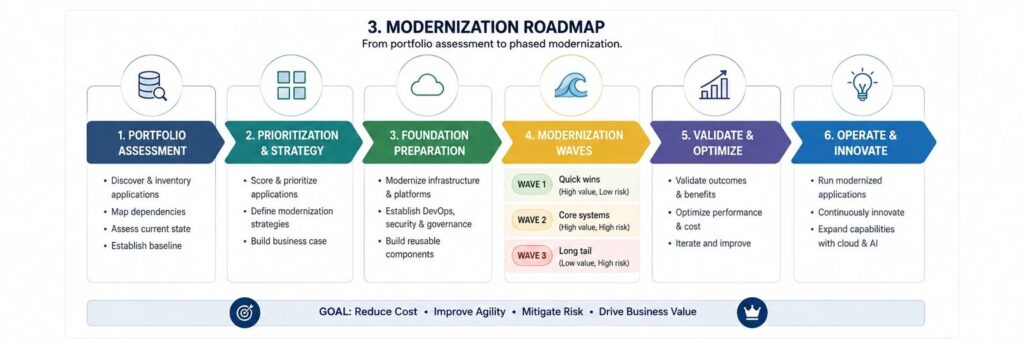
A modernization roadmap should translate assessment results into actionable waves.
Wave 1: Prove the model
Select a small number of applications with:
- Manageable dependencies
- Clear business ownership
- Measurable pain points
- Strong modernization potential
- Reasonable implementation risk
AWS recommends using initial low-risk, low-complexity workloads as candidates to establish experience and validate the assessment approach before expanding the program.
Wave 2: Scale the pattern
Use lessons from the first wave to improve:
- Architecture patterns
- Migration tooling
- Testing
- Security controls
- Data migration
- CI/CD
- Observability
- Governance
Wave 3: Tackle strategic complexity
Move toward applications with higher dependency complexity, deeper technical debt, and greater transformation requirements.
At this point, the organization has reusable modernization patterns and better risk visibility.
Read more about Enterprise Data Platform Modernization Frameworks: The Strategic Blueprint for AI-Ready, Scalable Data Architecture in 2026
Modernization Assessment Checklist
Before selecting an application for modernization, ask:
- Do we know who owns it?
- Do we understand its business criticality?
- Do we know its major dependencies?
- Do we know its current operating cost?
- Are there security or compliance concerns?
- Is its technology approaching end of support?
- Does technical debt materially affect delivery?
- Is there measurable customer or employee impact?
- Can modernization produce a measurable business outcome?
- Is the application technically ready for the proposed approach?
- Have we evaluated retirement or replacement?
- Can the modernization be delivered incrementally?
- Do we have rollback and business-continuity plans?
If several answers are unknown, the application may need more assessment before it needs modernization.
Read more in our blog on Application Modernization Challenges: Top Obstacles, Strategies, and Best Practices
Final Takeaway
A successful legacy modernization assessment is not about finding the oldest applications and moving them first. It is about identifying the applications where modernization can produce the strongest combination of business value, risk reduction, cost improvement, technical resilience, and future readiness.
The most effective enterprise approach is:
Inventory → Assess → Score → Prioritize → Select Strategy → Pilot → Modernize in Waves → Measure → Reassess
This turns legacy modernization from a technology cleanup exercise into a measurable portfolio decision.
For enterprises modernizing complex application estates, the assessment can also become the foundation for cloud modernization, AI modernization, data modernization, and broader software engineering transformation.
FAQs
1. What is a legacy modernization assessment?
A legacy modernization assessment evaluates an application portfolio to determine which systems should be modernized, retired, retained, replaced, or migrated, based on business value, technical health, cost, risk, dependencies, and modernization readiness.
2. Which applications should be modernized first?
Applications with high business value, significant technical or operational risk, rising costs, and manageable modernization complexity are generally strong candidates for early modernization waves.
3. Should the oldest legacy applications be modernized first?
No. Application age alone is not a reliable prioritization criterion. Business criticality, technical risk, cost, security exposure, dependencies, and modernization readiness should also influence the decision.
4.What factors should be included in an application modernization assessment?
Key factors include business criticality, technical debt, operating cost, security and compliance risk, performance, customer impact, application dependencies, architecture, technology lifecycle, and modernization feasibility.
5.How do you prioritize legacy applications for modernization?
Create a weighted scoring model that evaluates business value, technical risk, cost, security, user impact, dependency complexity, and modernization readiness. Rank applications and validate the highest-priority candidates through detailed assessment.
6. Should every legacy application be modernized?
No. Some applications should be retired, retained, replaced, or left unchanged when modernization does not produce sufficient business value.
7. What is the difference between application assessment and modernization?
Application assessment determines the current state, business importance, risks, costs, and dependencies of an application. Modernization is the subsequent transformation of the application using an appropriate approach such as rehost, replatform, refactor, rebuild, replace, or retire.
Related Reads
- AI Data Engineering: Building Autonomous Enterprise Data Pipelines.
- How to Build AI-Native Applications for Enterprise Scale.
- Legacy Modernization Services in 2026: How Enterprises Are Cutting Costs with AI
- Enterprise AI agent adoption challenges
- The 30-60-90 Day Enterprise AI Readiness Roadmap For Enterprise AI Success
- Application Modernization Challenges: Top Obstacles, Strategies, and Best Practices