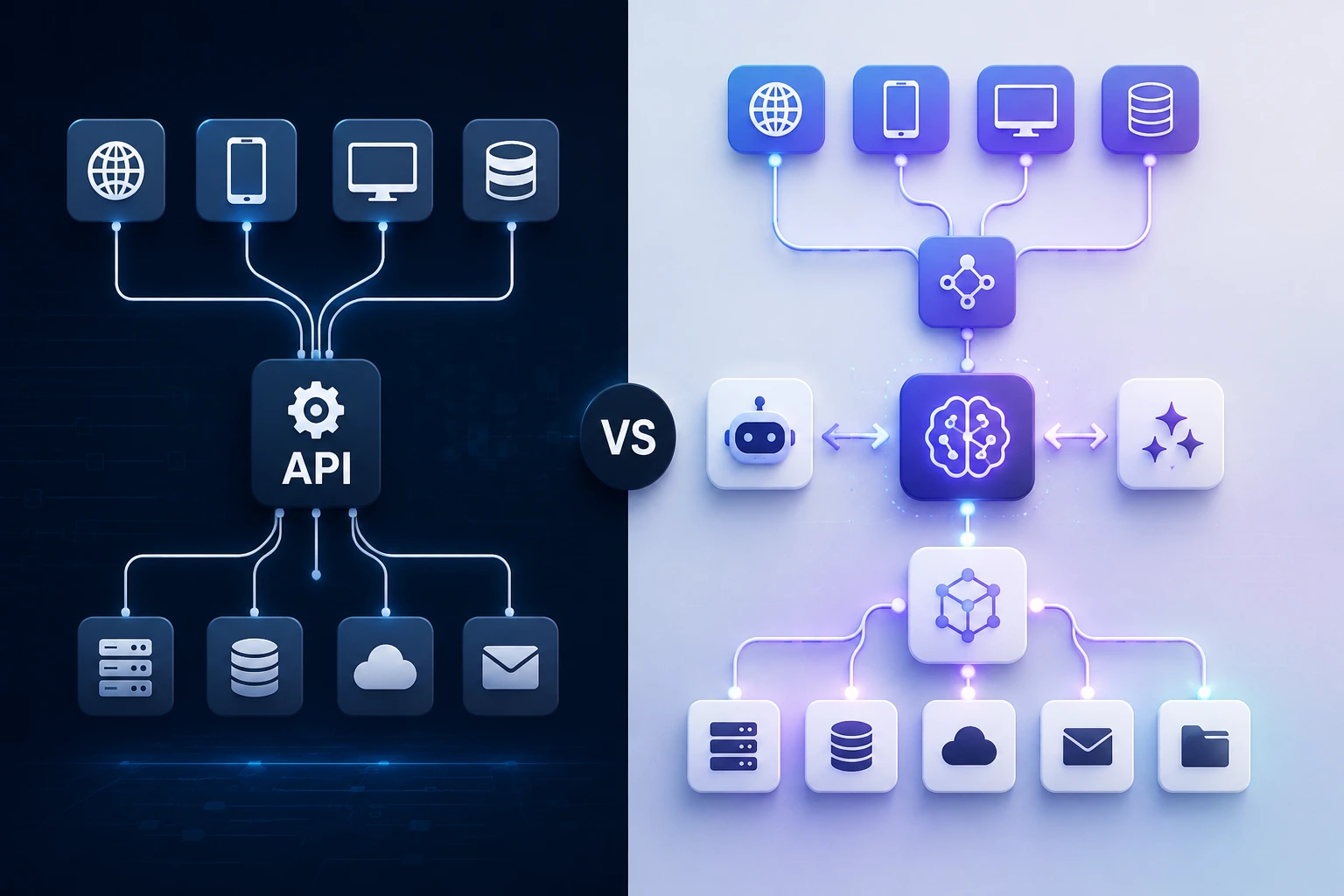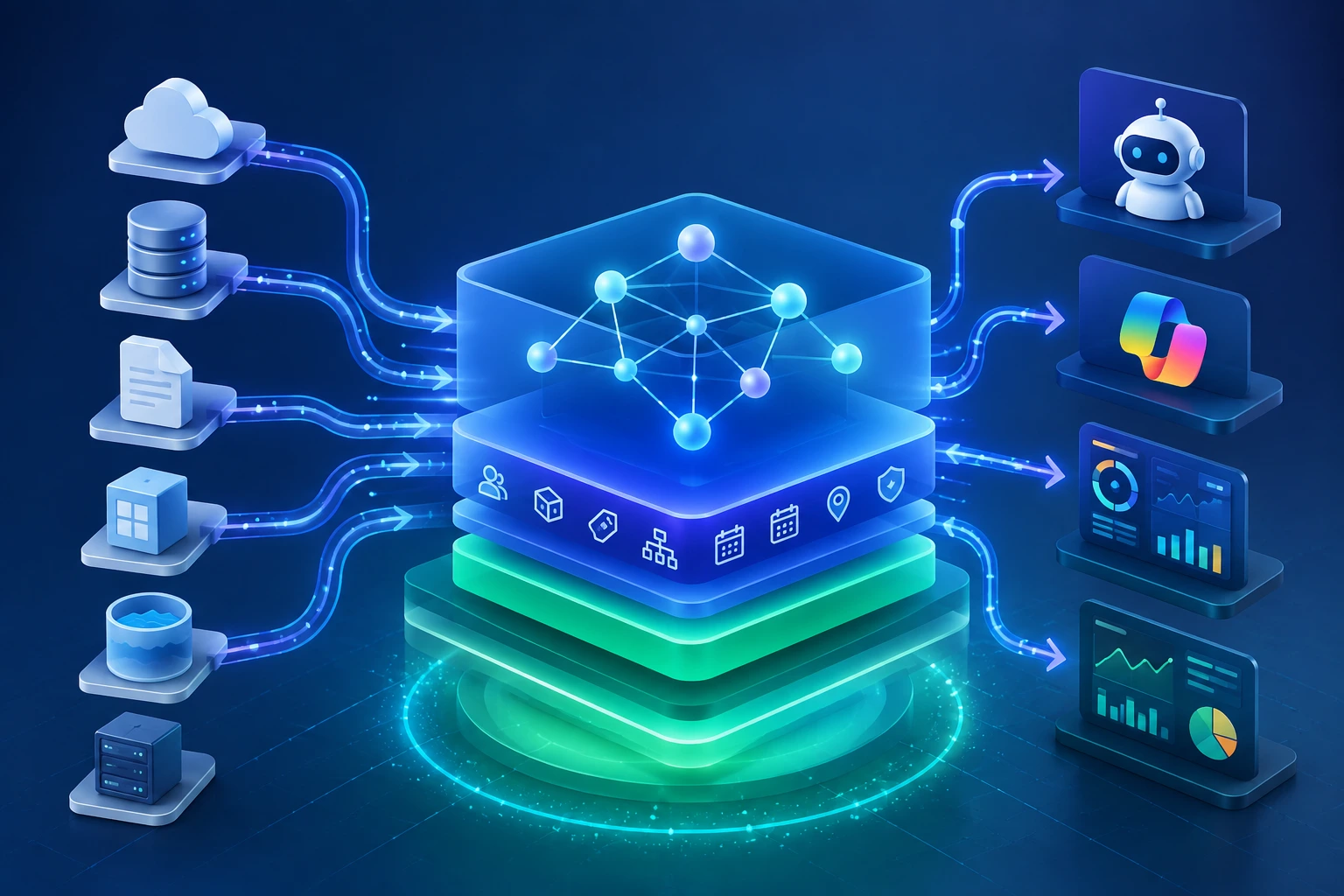
A Continuous Improvement Framework for Enterprise AI is a structured approach to continuously monitor, evaluate, optimize, govern, and enhance AI systems throughout their lifecycle. It combines AI governance, MLOps, performance monitoring, human feedback, and responsible AI practices to ensure enterprise AI remains accurate, compliant, secure, scalable, and aligned with changing business objectives.
Executive Summary
Enterprise AI initiatives often deliver promising pilot results but struggle to sustain long-term business value. The primary challenge is not model development—it is maintaining AI systems as business environments, data, regulations, and user expectations continuously evolve.
A Continuous Improvement Framework for Enterprise AI establishes a repeatable operating model that integrates AI governance, MLOps, observability, feedback loops, model retraining, risk management, and business KPIs into a continuous lifecycle. Rather than treating AI deployment as the finish line, organizations create an ecosystem where AI systems learn, improve, and adapt over time.
This framework is designed for CIOs, CTOs, Chief Data Officers, AI Leaders, Enterprise Architects, Product Owners, and Governance Teams responsible for scaling AI across the enterprise.
Why Continuous Improvement Matters in Enterprise AI
Enterprise AI systems operate in dynamic environments. Customer behavior changes, new regulations emerge, data distributions shift, and business processes evolve. Models that performed well during deployment may gradually lose effectiveness due to concept drift, data drift, or changing operational conditions.
Without a structured improvement framework, organizations experience:
- Declining prediction accuracy
- Increased operational risk
- Governance gaps
- Compliance failures
- Higher technical debt
- Reduced business trust
- Lower AI adoption
Continuous improvement transforms AI from a static project into a living enterprise capability that continuously delivers measurable business outcomes.
What Is a Continuous Improvement Framework for Enterprise AI?
A Continuous Improvement Framework for Enterprise AI is an enterprise operating model that continuously evaluates, governs, measures, optimizes, and enhances AI systems across the entire AI lifecycle.
Unlike traditional software maintenance, AI systems require continuous attention because both the underlying data and business context change over time.
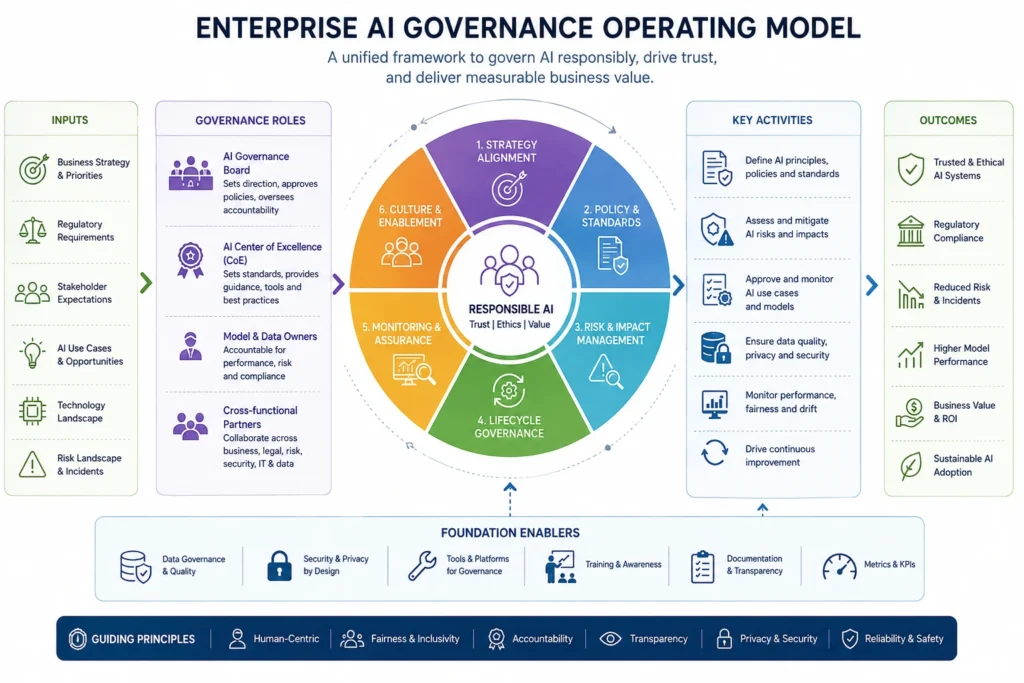
The framework integrates five core disciplines:
- AI Governance
- MLOps
- Responsible AI
- Business Performance Management
- Organizational Learning
Together, these create an adaptive ecosystem capable of sustaining AI value at enterprise scale.
The Enterprise AI Continuous Improvement Lifecycle
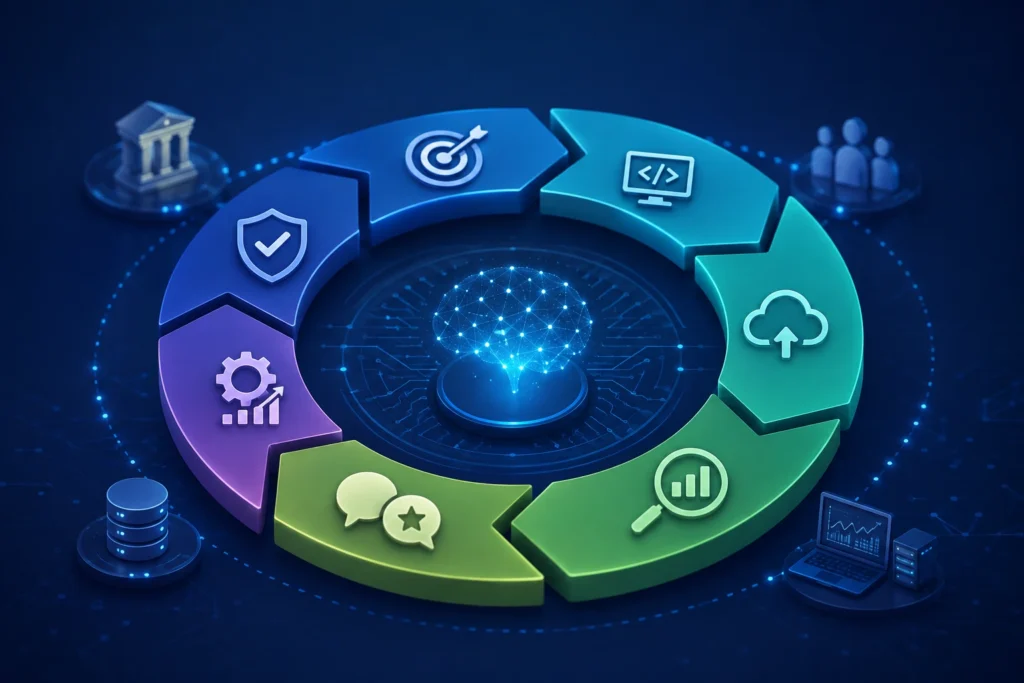
Rather than a linear process, enterprise AI follows a continuous feedback loop consisting of seven interconnected stages:
1. Strategy Alignment
Define:
- Business objectives
- Success metrics
- Risk appetite
- Responsible AI principles
- Regulatory requirements
2. Model Development
Build AI models using:
- High-quality datasets
- Explainable techniques
- Secure development practices
- Model validation
- Human oversight
3. Deployment
Production deployment includes:
- CI/CD pipelines
- Security validation
- Infrastructure scaling
- Version control
- Documentation
4. Continuous Monitoring
Monitor:
- Accuracy
- Latency
- Hallucination rate (Generative AI)
- Drift detection
- User satisfaction
- Bias indicators
- Cost
- Carbon footprint
- Compliance
5. Human Feedback
Capture feedback from:
- End users
- Subject matter experts
- Compliance teams
- Business stakeholders
- Customers
Human-in-the-loop (HITL) mechanisms improve trust and enable continuous learning.
6. Optimization
Improve through:
- Prompt optimization
- Model retraining
- Feature engineering
- Fine-tuning
- Infrastructure optimization
- Cost optimization
7. Governance Review
Regular governance reviews evaluate:
- Policy compliance
- Security posture
- Responsible AI metrics
- Ethical considerations
- Regulatory alignment
The insights feed directly into the next planning cycle, creating a continuous improvement loop.
Read further in our blog on Enterprise AI Governance Framework: Complete 2026 Guide for Responsible AI.
Core Pillars of an Enterprise AI Continuous Improvement Framework
1. AI Governance
Governance ensures AI systems remain accountable, transparent, secure, and compliant throughout their lifecycle.
Key capabilities include:
- AI policies
- Model inventory
- Risk classification
- Approval workflows
- Documentation
- Audit trails
- Responsible AI controls
The attached reference blog rightly emphasizes that governance should evolve continuously rather than relying on static approvals. Governance drift occurs when controls remain unchanged while AI systems, datasets, and business use cases evolve, increasing operational and compliance risks.
2. AI Observability
Observability extends beyond system uptime to provide deep visibility into AI behavior.
Monitor:
- Data drift
- Concept drift
- Prompt performance
- LLM hallucinations
- Token consumption
- Model confidence
- Feature importance
- API latency
3. MLOps & LLMOps
MLOps operationalizes machine learning, while LLMOps extends these practices to Generative AI.
Best practices include:
- Automated retraining
- Experiment tracking
- Version management
- CI/CD pipelines
- Rollback strategies
- Prompt versioning
- Model registry
4. Responsible AI
Responsible AI must become operational rather than aspirational.
Core principles include:
- Fairness
- Transparency
- Privacy
- Accountability
- Human oversight
- Security
- Explainability
These principles should be embedded into every stage of the AI lifecycle instead of being treated as post-deployment compliance checks.
5. Business Value Measurement
Technical performance alone does not determine AI success.
Track business outcomes such as:
- Revenue impact
- Productivity gains
- Customer satisfaction
- Cost savings
- Decision quality
- Employee adoption
- Time-to-value
Enterprise Architecture for Continuous AI Improvement
An enterprise-grade framework typically includes:
| Layer | Components |
|---|---|
| Business | KPIs, Strategy, Governance |
| Data | Fabric, Lakehouse, Pipelines |
| AI Platform | Models, Vector Databases, Prompt Management |
| MLOps | CI/CD, Registry, Monitoring |
| Observability | Drift Detection, Logging, Metrics |
| Security | IAM, Encryption, Compliance |
| Feedback | Human Review, User Feedback, Retraining |
Key KPIs for Continuous AI Improvement
Operational KPIs
- Model accuracy
- Precision
- Recall
- F1 score
- Drift frequency
- Deployment frequency
Business KPIs
- Revenue uplift
- Customer retention
- Productivity improvements
- Automation rate
- Cost reduction
- Time saved
Responsible AI KPIs
- Bias incidents
- Explainability score
- Human review rate
- Compliance violations
- Security incidents
Generative AI KPIs
- Hallucination rate
- Prompt success rate
- Response relevance
- Grounding accuracy
- Token efficiency
Read our blog on Human-in-the-Loop Agentic AI: Why Autonomous Doesn’t Mean Uncontrolled.
Best Practices for Implementing Continuous Improvement
Organizations that successfully scale Enterprise AI typically adopt the following practices:
- Treat AI as a continuously evolving product rather than a one-time implementation.
- Embed governance into development and operational workflows.
- Automate monitoring, alerting, and retraining wherever appropriate.
- Establish cross-functional AI governance boards with business, legal, security, and technical stakeholders.
- Use human feedback to refine prompts, models, and business workflows.
- Align improvement initiatives with measurable business outcomes.
- Standardize documentation, model cards, and audit trails for every production model.
- Continuously review policies to address new regulatory requirements and emerging AI risks.
Google Responsible AI provides comprehensive guidance on designing, developing, and deploying AI systems that are fair, transparent, privacy-preserving, accountable, and beneficial. Organizations can leverage these best practices to embed responsible AI principles throughout the AI lifecycle.
Common Challenges
| Challenge | Solution |
| Model drift | Automated monitoring & retraining |
| Governance gaps | Central AI governance office |
| Data quality | Data governance framework |
| AI bias | Fairness testing |
| Security risks | AI security controls |
| Regulatory changes | Continuous compliance monitoring |
| Low adoption | Human-centered AI design |
Enterprise Implementation Roadmap
Phase 1 – Assess
- AI maturity assessment
- Current governance review
- Technology inventory
- Risk assessment
Phase 2 – Design
- Governance framework
- KPI definition
- AI operating model
- Monitoring strategy
Phase 3 – Build
- MLOps platform
- AI observability
- Feedback mechanisms
- Automation pipelines
Phase 4 – Operate
- Continuous monitoring
- Performance optimization
- Governance reviews
- Executive reporting
Phase 5 – Optimize
- Fine-tuning
- Process improvements
- AI portfolio optimization
- Innovation roadmap
Read more in our blog on How to Build AI-Native Applications for Enterprise Scale.
Common Mistakes to Avoid
- Assuming deployment marks the end of the AI lifecycle.
- Measuring only technical metrics instead of business outcomes.
- Neglecting continuous monitoring for drift and bias.
- Treating governance as a periodic audit rather than an ongoing capability.
- Ignoring human feedback in AI refinement.
- Failing to align AI initiatives with enterprise strategy and measurable ROI.
Future Trends
Over the next five years, enterprise AI continuous improvement will increasingly rely on:
- Agentic AI operations
- Autonomous AI observability
- AI copilots for governance
- Self-healing AI systems
- Continuous compliance automation
- AI-native FinOps
- Multi-agent orchestration
- Adaptive RAG optimization
- AI policy-as-code
Organizations investing in these capabilities today will be better positioned to scale trustworthy AI across complex enterprise environments.
Why Techment Is Uniquely Positioned
Techment helps enterprises operationalize AI beyond proof of concepts by combining Enterprise AI Strategy, Microsoft Fabric, Data Engineering, RAG architectures, AI Agents, Cloud Modernization, Responsible AI, and Enterprise Software Engineering.
Our approach emphasizes measurable business value, governance-by-design, and continuous optimization, enabling organizations to build AI systems that remain secure, compliant, and effective as business needs evolve.
Conclusion
A Continuous Improvement Framework for Enterprise AI is essential for sustaining long-term business value. It shifts the focus from one-time deployment to continuous optimization through governance, monitoring, feedback, and measurable outcomes. Enterprises that institutionalize this approach can improve model performance, reduce operational risk, strengthen regulatory compliance, and accelerate responsible AI adoption at scale.
Frequently Asked Questions
1. What is a Continuous Improvement Framework for Enterprise AI?
It is a structured operating model that continuously monitors, evaluates, optimizes, and governs AI systems across their lifecycle to maintain performance, compliance, and business value.
2. Why is continuous improvement important for enterprise AI?
AI systems evolve with changing data, regulations, and business needs. Continuous improvement helps mitigate model drift, reduce risk, improve accuracy, and sustain ROI.
3. How does AI governance support continuous improvement?
AI governance establishes policies, accountability, lifecycle controls, and ongoing reviews that ensure AI systems remain transparent, compliant, and aligned with organizational objectives.
4. Which KPIs should organizations track?
Key KPIs include model accuracy, drift frequency, bias incidents, deployment frequency, business ROI, customer satisfaction, hallucination rates for generative AI, and governance compliance metrics.
5. How can enterprises implement this framework?
Start with an AI maturity assessment, define governance and success metrics, implement MLOps and observability, establish feedback loops, and continuously optimize models based on monitoring insights.