
What is Human-in-the-Loop (HITL) in Agentic AI?
Human-in-the-Loop (HITL) in Agentic AI is an enterprise architecture pattern that combines autonomous AI decision-making with human oversight for high-impact actions. AI agents automate routine tasks independently, while financial, legal, regulatory, or sensitive decisions require human approval to ensure governance, compliance, transparency, and business accountability.
Executive Summary
Agentic AI enables systems to independently plan, reason, and execute multi-step business workflows, moving beyond traditional AI assistants that only respond to prompts. While this autonomy unlocks significant gains in productivity and operational efficiency, enterprises cannot rely on autonomous decision-making alone. Human-in-the-Loop (HITL) introduces governance, transparency, and accountability by ensuring that high-impact decisions receive human oversight while routine tasks remain automated.
Traditional AI vs Agentic AI vs Human-in-the-Loop Agentic AI
| Capability | Traditional AI | Agentic AI | HITL Agentic AI |
|---|---|---|---|
| Responds to prompts | ✓ | ✓ | ✓ |
| Plans tasks | ✗ | ✓ | ✓ |
| Autonomous execution | ✗ | ✓ | ✓ |
| Human approvals | Optional | Rare | Built-in |
| Governance | Low | Medium | High |
| Enterprise readiness | Medium | High | Highest |
Rather than slowing innovation, HITL enables organizations to deploy Agentic AI confidently across regulated and business-critical environments by balancing automation with enterprise control.
TL;DR
- Agentic AI autonomously plans and executes complex workflows.
- Human-in-the-Loop (HITL) ensures governance for high-risk decisions.
- Enterprises should automate low-risk tasks while routing critical actions for approval.
- Approval workflows, confidence thresholds, and audit trails reduce operational risk.
- Governed autonomy delivers scalable automation without compromising trust or compliance.
What Is Human-in-the-Loop Agentic AI?
Human-in-the-Loop (HITL) Agentic AI combines autonomous AI decision-making with human oversight for high-impact business actions. AI agents independently execute routine tasks while escalating decisions involving financial, legal, regulatory, or operational risk to designated reviewers.
According to insights from Gartner, autonomous agents are among the most transformative technology trends shaping enterprise architecture. Meanwhile, McKinsey & Company estimates that generative AI could add between $2.6 trillion and $4.4 trillion in annual economic value, with automation driving significant productivity gains.
Unlike traditional AI assistants that wait for user prompts, Agentic AI can:
- Break complex goals into smaller tasks
- Create execution plans
- Retrieve enterprise knowledge
- Interact with multiple business systems
- Adapt workflows dynamically
- Complete multi-step objectives with minimal user intervention
This shift enables organizations to automate increasingly sophisticated business processes while maintaining accountability where it matters most.
Why is Human-in-the-Loop Agentic AI important?
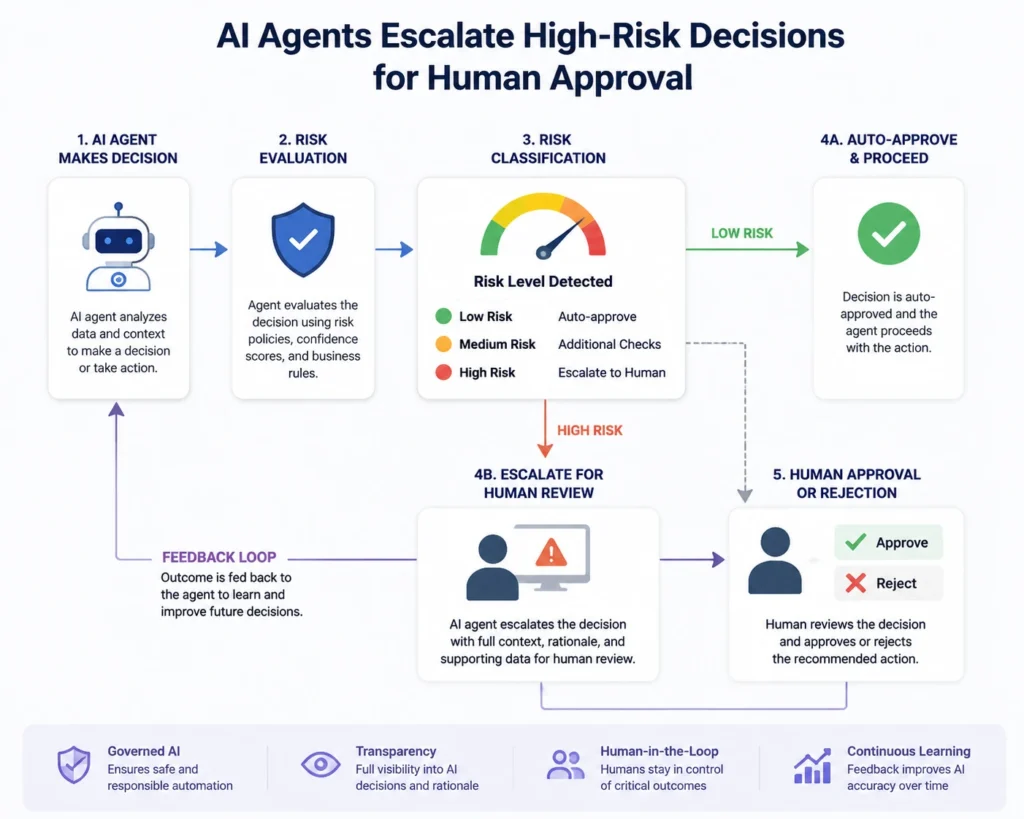
Human-in-the-Loop enables organizations to deploy Agentic AI safely by balancing automation with governance. It allows AI agents to execute low-risk tasks autonomously while routing critical decisions to human reviewers, reducing operational risk, improving compliance, and increasing trust in enterprise AI systems.
Modern large language models demonstrate impressive reasoning capabilities but can still misunderstand business context, misinterpret ambiguous requests, or recommend actions that conflict with organizational policies. When autonomous agents operate across enterprise systems, even isolated errors can scale rapidly.
For example, an AI agent processing customer refunds may correctly approve routine transactions. However, unusually large refunds, policy exceptions, or suspected fraud should trigger human review before execution.
The objective is not to reduce automation—it is to ensure that automation remains transparent, governed, and aligned with business objectives.
Read more in our blog on A Complete Guide On Agentic AI Orchestration
How does Human-in-the-Loop Agentic AI work?
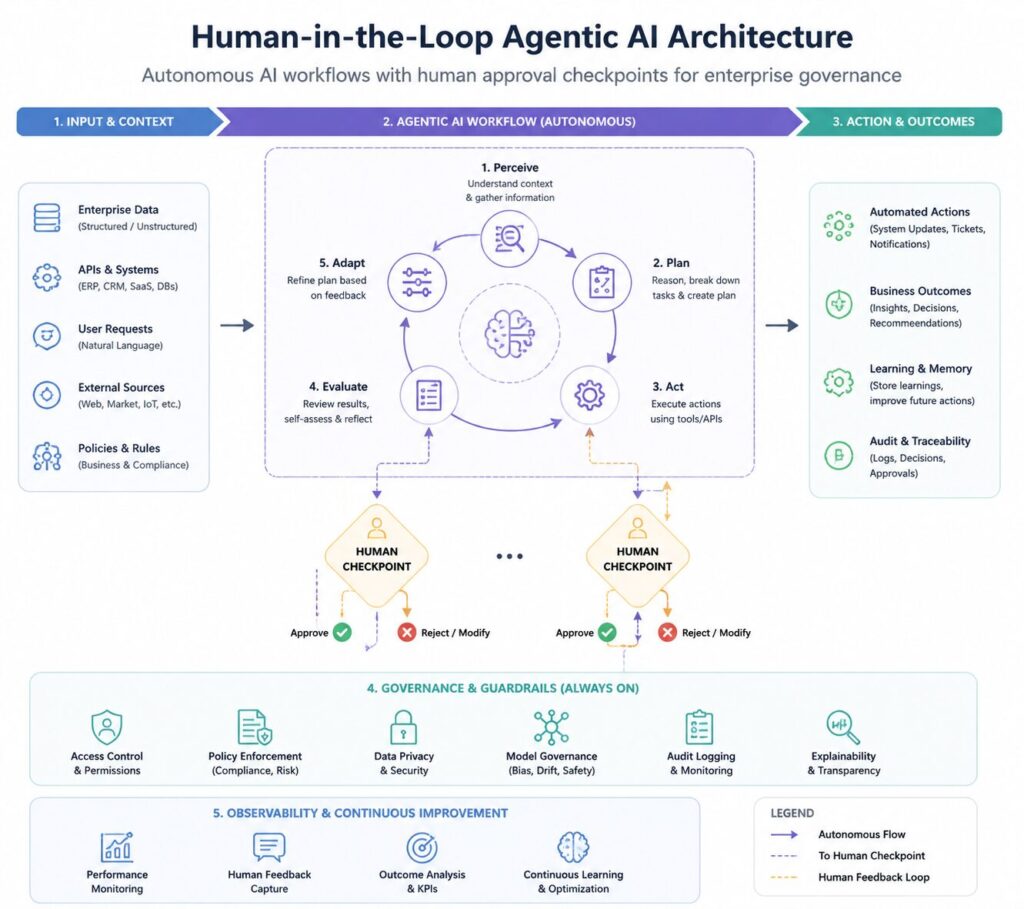
Human-in-the-Loop Agentic AI uses a risk-based workflow where AI plans and executes routine business tasks while escalating high-risk actions for human approval. This approach combines intelligent automation with governance, enabling enterprises to improve efficiency without sacrificing transparency, compliance, or accountability.
Rather than requiring approval for every action, mature enterprise architectures classify decisions according to business risk.
Typical Human-in-the-Loop Agentic AI Workflow
- Business request received
- AI creates an execution plan
- Enterprise knowledge is retrieved
- Policies and validation rules are applied
- Confidence and risk are evaluated
- Low-risk actions execute automatically
- High-risk decisions are routed for approval
- Complete audit logs are recorded
This approach maximizes automation while ensuring accountability for critical decisions.
What are the benefits of Human-in-the-Loop Agentic AI?
Human-in-the-Loop Agentic AI helps enterprises automate complex workflows while maintaining control over business-critical decisions. By combining AI autonomy with human oversight, organizations improve decision quality, reduce compliance risk, strengthen governance, accelerate operations, and build greater trust in AI-driven business processes.
Enterprise Decision Framework
Instead of applying human oversight uniformly, organizations should align governance with business impact.
| Decision Type | AI Action | Human Role |
|---|---|---|
| Routine operational tasks | Execute automatically | Monitor outcomes |
| Medium-risk recommendations | Recommend actions | Review if required |
| Financial, legal, regulatory, or sensitive decisions | Pause workflow | Approve before execution |
This risk-based model allows organizations to scale automation without sacrificing governance.
When Should Humans Intervene?
Human review is typically required when AI decisions involve significant business, regulatory, or customer impact.
Common approval scenarios include:
- Financial approvals above predefined thresholds
- Contract modifications
- Healthcare recommendations
- Regulatory compliance decisions
- Customer data access requests
- Employee-related decisions
- High-value procurement
- AI outputs with low confidence scores
Establishing these criteria upfront reduces operational risk while preserving automation efficiency.
Designing Governed Agentic AI Workflows
Effective Human-in-the-Loop architectures combine AI reasoning with enterprise governance throughout the workflow.
Key design principles include:
- Define approval checkpoints for high-impact decisions.
- Use confidence thresholds to determine escalation.
- Maintain comprehensive audit trails.
- Separate planning, execution, and approval responsibilities.
- Enforce role-based access controls and organizational policies.
- Provide explanations for AI-generated recommendations.
Together, these practices improve transparency, strengthen compliance, and increase user trust.
Enterprise Platforms Are Enabling Governed AI
Enterprise AI platforms increasingly provide native support for Human-in-the-Loop orchestration through approval workflows, policy validation, audit logging, and workflow automation.
Organizations can design AI agents that:
- Retrieve enterprise knowledge
- Reason across structured and unstructured data
- Trigger business processes
- Pause for approvals
- Resume after validation
- Record every decision for compliance and auditing
This enables organizations to scale autonomous workflows without compromising enterprise governance.
As highlighted in Techment’s Enterprise AI Strategy in 2026, scaling AI requires aligning data, governance, and infrastructure before automation expands.
Measuring Success Beyond Automation
Automation rates alone do not determine the success of an Agentic AI program. Mature organizations evaluate broader business outcomes, including:
- Decision accuracy
- Policy compliance
- Human approval rates
- Workflow completion time
- User trust and adoption
- Reduction in operational errors
- Audit readiness
- Overall business value delivered
These metrics provide a more complete view of responsible AI adoption.
Common Implementation Mistakes
Organizations often encounter avoidable challenges when deploying Agentic AI.
Common mistakes include:
- Treating governance as an afterthought
- Requiring approval for every AI decision
- Deploying agents without confidence thresholds
- Failing to maintain audit trails
- Over-automating regulated business processes
- Providing limited visibility into AI reasoning
Avoiding these pitfalls helps organizations build trusted, scalable AI systems.
Human Oversight Is a Competitive Advantage
Organizations that balance autonomy with governance achieve more than regulatory compliance—they build confidence among employees, customers, and stakeholders.
When users understand how AI reaches decisions, know when human review occurs, and can intervene when necessary, adoption increases significantly. Human oversight transforms AI from an unpredictable automation tool into a dependable business capability that supports enterprise-scale operations.
For deeper context on AI readiness foundations, see Techment’s Fabric AI Readiness: How to Prepare Your Data for Scalable AI Adoption.
Conclusion
Agentic AI represents a significant evolution in enterprise automation by enabling systems to reason, plan, and execute increasingly sophisticated workflows. However, greater autonomy also requires stronger governance.
Human-in-the-Loop ensures that autonomous AI remains transparent, accountable, and aligned with organizational objectives. By combining intelligent automation with targeted human oversight, enterprises can accelerate productivity while maintaining compliance, reducing operational risk, and building lasting trust.
As organizations expand the use of autonomous agents across finance, operations, customer service, healthcare, and software engineering, the most successful implementations will not eliminate human involvement—they will orchestrate effective collaboration between humans and AI.
Key Takeaways
- Autonomous AI should be governed—not unrestricted.
- Human approval should depend on business risk.
- Auditability builds enterprise trust.
- Governance accelerates AI adoption rather than slowing it.
- Responsible automation is becoming the enterprise standard.
Frequently Asked Questions
1. What is Human-in-the-Loop (HITL) in Agentic AI?
Human-in-the-Loop is an architectural approach that introduces human oversight into autonomous AI workflows. AI executes routine tasks independently while routing high-risk or business-critical decisions to designated reviewers.
2. Does HITL reduce automation?
No. HITL focuses human involvement only where business impact or regulatory requirements justify oversight, allowing low-risk activities to remain fully automated.
3. Which industries benefit most from HITL?
Finance, healthcare, insurance, legal services, manufacturing, and public sector organizations commonly use HITL to govern compliance-sensitive workflows and high-impact decisions.
4. How do organizations determine when human approval is required?
Approval criteria are typically based on business rules such as transaction value, confidence scores, regulatory obligations, security policies, or operational risk.
5. Why is Human-in-the-Loop essential for enterprise Agentic AI?
Human oversight improves transparency, accountability, regulatory compliance, and organizational trust, enabling enterprises to deploy autonomous AI safely in production environments.
Related Reads
- Agentic AI Use Cases: 7 Enterprise Examples Driving Autonomous Operations
- How AI copilots for enterprises are transforming executive leadership in 2026.
- Enterprise AI Strategy in 2026: A Practical Guide for CIOs and Data Leaders
- Enterprise AI Governance Framework: Complete 2026 Guide for Responsible AI
- How to Build Enterprise AI Copilots: A Complete Guide for Business Leaders (2026)
- The 30-60-90 Day Enterprise AI Readiness Roadmap For Enterprise AI Success