

An Enterprise AI Governance Framework is a structured set of policies, processes, technologies, and organizational controls that ensure AI systems are secure, transparent, compliant, ethical, and aligned with business objectives. It helps organizations manage AI risks, satisfy regulations like the EU AI Act, and deploy trustworthy AI solutions at enterprise scale.
TL;DR
- AI governance is no longer optional. As enterprise AI adoption accelerates, organizations need structured governance to manage risks, ensure compliance, and build trust.
- An Enterprise AI Governance Framework establishes the policies, processes, roles, and technical controls required to develop, deploy, monitor, and retire AI systems responsibly.
- Regulations such as the EU AI Act, ISO/IEC 42001, NIST AI RMF, GDPR, and industry-specific standards are making governance a strategic business priority rather than a compliance exercise.
- Effective AI governance balances innovation with accountability by embedding security, privacy, fairness, explainability, and human oversight throughout the AI lifecycle.
- Core governance capabilities include AI risk assessment, data governance, model governance, audit trails, bias monitoring, AI guardrails, continuous monitoring, and incident management.
- Organizations with mature AI governance can reduce operational and compliance risks, accelerate AI adoption, improve customer trust, and simplify regulatory audits.
- A risk-based, lifecycle-driven approach enables enterprises to apply stronger controls to high-risk AI systems while maintaining agility for lower-risk use cases.
- Successful AI governance is cross-functional, bringing together business leaders, AI teams, IT, security, legal, compliance, and risk management to ensure responsible AI at scale.
- Building governance early is significantly more cost-effective than retrofitting controls after AI systems have been deployed into production.
What Is an Enterprise AI Governance Framework?
Quick Answer
An Enterprise AI Governance Framework is a structured operating model that defines the policies, standards, processes, organizational roles, and technical controls required to ensure AI systems remain secure, compliant, transparent, ethical, and aligned with business objectives throughout their lifecycle.
Unlike traditional IT governance, AI governance addresses challenges unique to machine learning and generative AI, including:
- Model transparency
- Bias mitigation
- Explainability
- Human oversight
- AI security
- Data quality
- Regulatory compliance
- Continuous monitoring
- Responsible AI practices
- Lifecycle management
Rather than acting as a compliance checklist, governance establishes repeatable processes that allow organizations to innovate responsibly while minimizing operational and regulatory risks.
AI Governance at a Glance
| Aspect | Description |
|---|---|
| Purpose | Enable responsible, secure, and compliant AI adoption |
| Primary Goal | Reduce AI-related business, operational, and regulatory risks |
| Applies To | Machine Learning, Generative AI, AI Agents, Predictive Analytics, RAG Systems |
| Stakeholders | CIO, CTO, CDO, Compliance, Security, Data Science, Legal, Risk Teams |
| Key Standards | EU AI Act, NIST AI RMF, ISO/IEC 42001, ISO 27001, GDPR, HIPAA, SOC 2 |
| Business Outcome | Trusted AI systems that scale across the enterprise |
Why AI Governance Matters in 2026
Quick Answer
AI governance has become essential because enterprises are deploying increasingly autonomous AI systems while governments worldwide introduce stricter regulations. Organizations need governance to balance innovation with accountability, ensuring AI remains secure, transparent, compliant, and aligned with business goals.
Several industry trends are driving this shift.
1. AI Adoption Is Growing Faster Than Governance
Generative AI has significantly reduced the barriers to building intelligent applications. Business units can now deploy AI assistants, copilots, document intelligence solutions, and autonomous agents within weeks instead of months.
Without governance, organizations face challenges such as:
- Uncontrolled AI deployments
- Shadow AI usage
- Sensitive data leakage
- Model hallucinations
- Regulatory violations
- Inconsistent decision-making
Governance provides the operating model needed to manage AI responsibly across the enterprise.
2. Global Regulations Are Expanding
AI regulation is moving rapidly from voluntary guidance to enforceable legislation.
Enterprise governance frameworks increasingly need to align with regulations including:
- EU AI Act
- NIST AI Risk Management Framework
- ISO/IEC 42001
- GDPR
- HIPAA
- SOC 2
- Industry-specific compliance requirements
Organizations operating across multiple regions must also address varying legal obligations around transparency, explainability, data protection, and human oversight.
3. AI Risks Extend Beyond Technology
Many AI failures are not caused by poor algorithms alone but by inadequate governance.
Common enterprise risks include:
- Biased hiring recommendations
- Incorrect financial decisions
- Hallucinated responses from LLMs
- Unauthorized exposure of confidential information
- Lack of auditability
- Model drift over time
- Regulatory non-compliance
Governance introduces policies and technical safeguards that reduce these risks before they impact customers or business operations.
4. Trust Has Become a Competitive Advantage
Customers, regulators, partners, and employees increasingly expect organizations to demonstrate responsible AI practices.
Enterprises with mature governance frameworks can:
- Accelerate regulatory approvals
- Win enterprise contracts
- Improve customer confidence
- Simplify compliance audits
- Reduce operational risk
- Scale AI initiatives more efficiently
Responsible AI is no longer just an ethical consideration—it is becoming a key differentiator in enterprise transformation initiatives.
Key Business Benefits of an AI Governance Framework
A well-designed governance framework delivers value far beyond regulatory compliance by improving operational resilience, reducing AI-related risks, and enabling scalable innovation.
| Business Objective | Governance Benefit |
|---|---|
| Risk Management | Identifies and mitigates AI risks early |
| Regulatory Compliance | Aligns AI initiatives with global regulations |
| Data Protection | Prevents misuse of sensitive information |
| AI Transparency | Improves explainability and accountability |
| Operational Excellence | Standardizes AI development and deployment |
| Customer Trust | Demonstrates responsible AI practices |
| Business Agility | Enables faster, repeatable AI adoption |
| Enterprise Scale | Supports governance across multiple business units |
Traditional IT Governance vs Enterprise AI Governance
| Traditional IT Governance | Enterprise AI Governance |
|---|---|
| Focuses on IT systems | Focuses on AI decision-making |
| Static software | Continuously learning models |
| Security-first | Security + Ethics + Compliance |
| Infrastructure management | AI lifecycle management |
| Predictable outputs | Probabilistic outputs |
| Limited monitoring | Continuous model monitoring |
| Standard audits | AI-specific audit trails |
| Software testing | Bias, fairness, robustness, and explainability testing |
Unlike conventional governance frameworks, AI governance must account for changing data, evolving models, autonomous decision-making, and emerging regulatory requirements.
What Makes an Effective Enterprise AI Governance Framework?
Successful AI governance is built on five foundational principles:
- Business Alignment: AI initiatives should support measurable business outcomes and strategic priorities.
- Risk-Based Controls: Governance efforts should scale according to the potential impact and risk level of each AI system.
- Lifecycle Governance: Oversight should span the entire AI lifecycle—from data collection and model development to deployment, monitoring, and retirement.
- Automation: Governance controls such as policy enforcement, model validation, and monitoring should be embedded into AI development workflows to reduce manual overhead.
- Continuous Improvement: Governance frameworks should evolve alongside changing regulations, technologies, and business needs.
These principles help organizations strike the right balance between innovation and responsible AI adoption.
Enterprise AI Governance Framework Architecture
Quick Answer
An effective Enterprise AI Governance Framework combines business policies, governance processes, technical controls, and continuous monitoring into a unified operating model. Instead of treating governance as a one-time compliance exercise, enterprises should embed governance throughout the AI lifecycle—from data collection and model development to deployment, monitoring, and retirement.
Unlike traditional governance models, AI governance requires cross-functional collaboration between business leaders, AI engineers, data teams, security professionals, legal experts, and compliance officers. This ensures AI systems remain secure, transparent, explainable, and aligned with both regulatory requirements and business objectives.
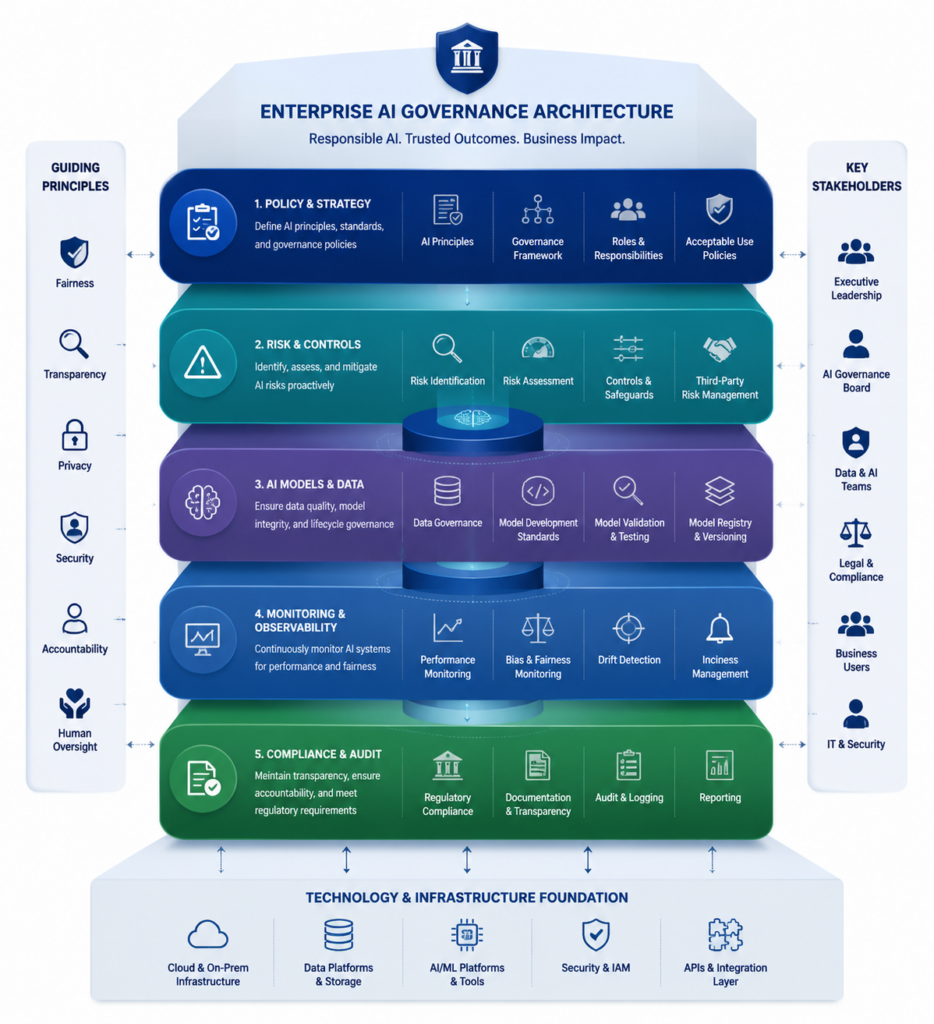
Enterprise AI Governance Architecture
A mature governance architecture operates across multiple interconnected layers, each responsible for managing specific aspects of AI risk, compliance, and operational performance.
| Governance Layer | Purpose | Key Stakeholders |
|---|---|---|
| Business Strategy | Defines AI vision, business objectives, and governance policies | Executive Leadership, CIO, CTO |
| Governance & Risk | Establishes policies, ethical guidelines, and risk management processes | AI Governance Board, Risk, Legal |
| Data Governance | Ensures data quality, lineage, privacy, and access management | Data Office, Security, Compliance |
| AI Development | Builds, validates, and documents AI models | Data Scientists, ML Engineers |
| AI Operations (MLOps/LLMOps) | Automates deployment, monitoring, and lifecycle management | Platform Engineering, DevOps |
| Responsible AI Controls | Implements explainability, bias detection, and guardrails | AI Engineering, Responsible AI Teams |
| Monitoring & Compliance | Tracks model performance, drift, compliance, and incidents | Security Operations, Compliance Teams |
The 10 Core Pillars of an Enterprise AI Governance Framework
Quick Answer
An effective AI governance framework is built on ten interconnected pillars that collectively ensure AI systems are secure, compliant, transparent, and aligned with organizational goals. Together, these pillars provide end-to-end governance across the AI lifecycle, from data acquisition to ongoing monitoring and retirement.
1. AI Strategy and Governance
AI governance begins with a clear business strategy.
Organizations should define:
- Enterprise AI vision
- Governance objectives
- Responsible AI principles
- Executive sponsorship
- Governance policies
- Success metrics
Every AI initiative should support measurable business outcomes while adhering to ethical and regulatory standards.
2. AI Risk Management
Every AI system introduces varying levels of operational, legal, and reputational risk.
A risk-based governance model should classify AI applications based on factors such as:
- Business criticality
- Customer impact
- Decision autonomy
- Personal data usage
- Regulatory obligations
- Financial implications
Higher-risk systems require stronger governance controls, more frequent audits, and greater human oversight.
3. Data Governance
AI systems are only as reliable as the data they are trained on.
Data governance should address:
- Data quality
- Data lineage
- Metadata management
- Privacy controls
- Consent management
- Access governance
- Data retention policies
- Data minimization
Strong data governance improves model accuracy while reducing compliance and privacy risks.
4. Model Governance
Model governance ensures AI models remain accurate, reliable, explainable, and compliant throughout their lifecycle.
Key practices include:
- Model documentation
- Version control
- Validation testing
- Explainability assessments
- Approval workflows
- Performance benchmarking
- Lifecycle management
Maintaining comprehensive model documentation and audit trails is particularly important for regulated industries and high-risk AI applications.
5. Responsible AI and Ethics
Responsible AI extends beyond regulatory compliance by ensuring AI systems are fair, transparent, inclusive, and accountable.
Organizations should establish principles for:
- Fairness
- Bias mitigation
- Human oversight
- Transparency
- Explainability
- Accountability
- Inclusiveness
Embedding ethical considerations into AI development builds stakeholder trust and reduces long-term business risks.
6. AI Security and Privacy
AI introduces new attack surfaces that traditional cybersecurity controls may not fully address.
Governance should include protections against:
- Prompt injection
- Data leakage
- Model theft
- Adversarial attacks
- Unauthorized access
- API abuse
- Supply chain risks
Security controls should be integrated across the entire AI lifecycle rather than applied only after deployment.
7. AI Guardrails and Human Oversight
Generative AI systems require technical and procedural safeguards to ensure outputs remain reliable and within acceptable boundaries.
Common governance controls include:
- Content moderation
- Policy enforcement
- Output validation
- Human review workflows
- Confidence thresholds
- Escalation mechanisms
- Sensitive data filtering
These guardrails reduce the likelihood of harmful, biased, or non-compliant AI outputs reaching end users.
8. Monitoring and AI Observability
Governance does not end at deployment.
Organizations should continuously monitor:
- Model accuracy
- Drift
- Hallucination rates
- Bias indicators
- Usage patterns
- Latency
- Cost optimization
- Security events
Continuous observability enables teams to detect issues early and maintain AI performance over time.
9. Compliance and Audit Readiness
Regulatory compliance requires more than documentation—it demands evidence that governance processes are consistently followed.
An effective framework should support:
- Audit trails
- Policy management
- Risk registers
- Compliance reporting
- Regulatory mapping
- Incident documentation
- Change management
Automating evidence collection can significantly reduce audit preparation efforts and improve governance maturity.
10. Continuous Improvement
AI governance is an ongoing discipline rather than a one-time implementation.
Organizations should establish feedback loops to:
- Review governance policies regularly
- Incorporate lessons from incidents
- Adapt to new regulations
- Improve governance controls
- Retrain models when necessary
- Optimize governance processes
A culture of continuous improvement helps organizations remain resilient as AI technologies and regulatory expectations evolve.
AI Governance Lifecycle
Governance should be embedded across every stage of the AI lifecycle rather than treated as a post-deployment activity.
| Lifecycle Stage | Governance Focus |
|---|---|
| Identify Use Case | Business value, regulatory applicability, ethical considerations |
| Data Collection | Data quality, consent, privacy, lineage |
| Model Development | Validation, explainability, documentation |
| Testing | Bias testing, security testing, red teaming |
| Deployment | Risk approvals, guardrails, human oversight |
| Production Monitoring | Drift detection, performance monitoring, compliance checks |
| Retirement | Archiving, audit preservation, data retention compliance |
This lifecycle approach enables organizations to identify and mitigate risks early while supporting scalable AI adoption.
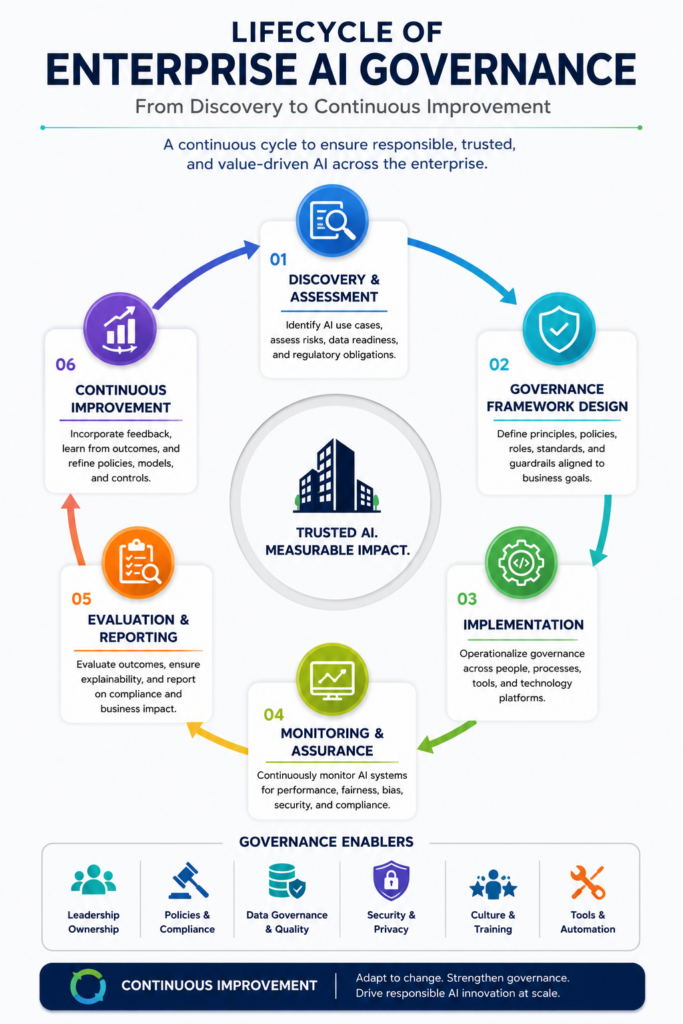
Enterprise AI Governance Maturity Model
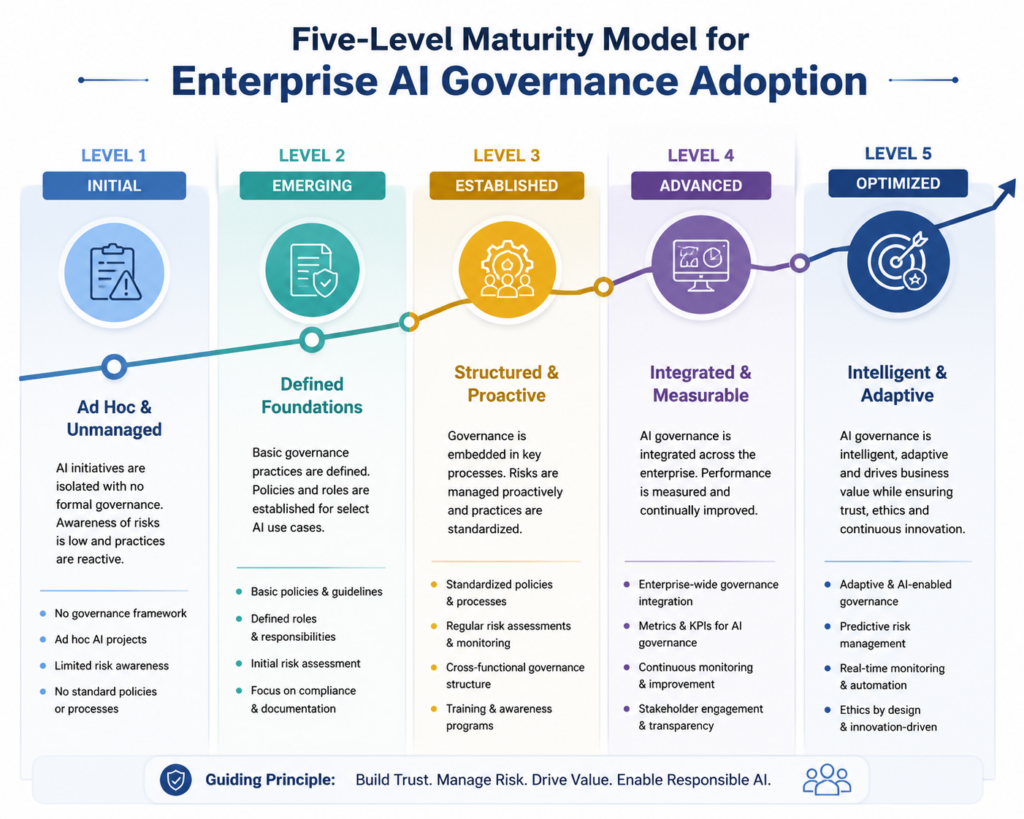
Organizations typically progress through five stages of AI governance maturity.
| Level | Maturity | Characteristics |
|---|---|---|
| Level 1 | Ad Hoc | AI projects managed independently with minimal governance. |
| Level 2 | Developing | Basic governance policies and documentation established for selected AI initiatives. |
| Level 3 | Standardized | Organization-wide governance framework with defined roles, processes, and technical controls. |
| Level 4 | Managed | Governance integrated into AI development workflows with automated monitoring and compliance. |
| Level 5 | Optimized | Continuous governance supported by AI-driven monitoring, predictive risk management, and ongoing policy refinement. |
Organizations should assess their current maturity level to prioritize investments and establish a phased governance roadmap.
How to Implement an Enterprise AI Governance Framework
Quick Answer
Implementing an Enterprise AI Governance Framework requires more than drafting policies—it involves embedding governance into the AI lifecycle, aligning stakeholders, automating controls, and continuously monitoring AI systems. A phased, risk-based approach enables organizations to build governance capabilities without slowing innovation.
Rather than attempting a large-scale transformation, successful enterprises start by assessing their current AI landscape, prioritizing high-risk use cases, and integrating governance into existing DataOps, MLOps, and DevSecOps practices.
Enterprise AI Governance Implementation Roadmap
The following roadmap outlines a practical, phased approach for establishing AI governance at enterprise scale.
| Phase | Objective | Key Deliverables |
|---|---|---|
| Phase 1 | Assess Current State | AI inventory, governance maturity assessment, gap analysis |
| Phase 2 | Define Governance Strategy | Governance policies, Responsible AI principles, operating model |
| Phase 3 | Build Governance Foundation | Governance board, roles, risk framework, standards |
| Phase 4 | Deploy Technical Controls | AI guardrails, monitoring, model registry, audit logging |
| Phase 5 | Operationalize Governance | Automated governance within AI development workflows |
| Phase 6 | Continuous Monitoring & Improvement | KPI dashboards, compliance reviews, governance optimization |
AI Governance Decision Framework
Before deploying any AI solution, organizations should evaluate a common set of governance questions.
| Decision Area | Key Question |
|---|---|
| Business Impact | Does the AI influence critical business decisions? |
| Customer Impact | Will AI outputs affect customers or citizens? |
| Data Sensitivity | Does the model process personal or confidential information? |
| Regulatory Exposure | Are industry regulations applicable? |
| Human Oversight | Can critical decisions be reviewed by humans? |
| Explainability | Can model outputs be justified when challenged? |
| Security | Are AI-specific threats adequately mitigated? |
| Monitoring | Can the model be continuously monitored in production? |
If multiple answers indicate elevated risk, additional governance controls should be applied before deployment.
Mapping AI Governance to Major Compliance Frameworks
AI governance should align with globally recognized standards and regulations. While requirements vary by industry and geography, several frameworks have emerged as foundational references for enterprise AI governance.
| Framework | Primary Focus | Governance Considerations |
|---|---|---|
| EU AI Act | Risk-based AI regulation | Risk classification, transparency, human oversight, technical documentation |
| NIST AI Risk Management Framework (AI RMF) | AI risk management | Govern, Map, Measure, Manage functions |
| ISO/IEC 42001 | AI Management Systems | Organizational governance, lifecycle controls, continual improvement |
| ISO 27001 | Information security | Access controls, risk management, security governance |
| GDPR | Personal data protection | Consent, lawful processing, data minimization, privacy by design |
| HIPAA | Healthcare information | Protection of PHI, audit logs, access controls |
| SOC 2 | Trust services criteria | Security, availability, confidentiality, privacy, processing integrity |
Best Practice: Rather than treating each framework independently, develop a unified governance model that maps common controls to multiple regulatory requirements. This reduces duplication and simplifies compliance.
Enterprise AI Governance Best Practices
Organizations with mature governance programs consistently follow these practices:
Establish Executive Sponsorship
Governance initiatives require active involvement from executive leadership to align AI investments with business priorities and enterprise risk appetite.
Adopt a Risk-Based Governance Model
Allocate governance resources based on the potential impact of AI systems instead of applying uniform controls to every application.
Build Cross-Functional Governance Teams
Include representatives from IT, Security, Data, Legal, Compliance, Risk, HR, and Business Units to ensure balanced decision-making.
Automate Governance Where Possible
Integrate governance checks into AI development workflows using automated testing, monitoring, policy enforcement, and documentation generation.
Maintain Comprehensive Documentation
Create and maintain model cards, risk assessments, approval records, audit logs, and governance policies to support transparency and regulatory readiness.
Invest in AI Literacy
Provide regular training to executives, developers, business users, and compliance teams to foster a culture of responsible AI.
Common AI Governance Mistakes to Avoid
Even well-intentioned organizations can undermine governance efforts through common pitfalls.
- Treating governance solely as a compliance initiative rather than a business capability.
- Applying identical governance controls to all AI use cases regardless of risk.
- Ignoring third-party AI services and foundation models.
- Overlooking data quality and lineage.
- Failing to document model decisions and approvals.
- Implementing governance after AI deployment instead of embedding it into development.
- Neglecting continuous monitoring for model drift, security threats, and policy violations.
- Creating governance processes that are overly bureaucratic, discouraging innovation and adoption.
Avoiding these mistakes helps organizations maintain agility while reducing operational and regulatory risks.
Future Trends in Enterprise AI Governance
AI governance is expected to evolve rapidly as AI capabilities and regulatory expectations mature. Key trends include:
- AI governance platforms that automate policy enforcement, risk assessments, and compliance reporting.
- Governance for AI agents and autonomous systems, including multi-agent orchestration and delegated decision-making.
- LLMOps integration, embedding governance into large language model deployment pipelines.
- AI observability with real-time monitoring for model drift, hallucinations, bias, and cost optimization.
- Machine-readable governance policies enabling automated compliance checks.
- Global harmonization of AI regulations, increasing the need for unified governance frameworks across jurisdictions.
- Responsible AI metrics becoming standard enterprise KPIs for board reporting.
Organizations that invest in adaptable governance models today will be better prepared for future regulatory and technological changes.
Conclusion
Enterprise AI governance is no longer a future consideration—it is a foundational capability for organizations seeking to deploy AI responsibly, securely, and at scale. As AI becomes embedded in critical business processes, governance provides the structure needed to manage risks, maintain compliance, and foster stakeholder trust without stifling innovation.
The most successful organizations treat governance as an enabler rather than a barrier. By embedding governance into the AI lifecycle, adopting a risk-based approach, and leveraging automation, enterprises can accelerate AI adoption while maintaining accountability and resilience.
For organizations embarking on or advancing their AI journey, a well-designed governance framework is essential for achieving sustainable business value in an increasingly regulated and AI-driven world.
Frequently Asked Questions (FAQs)
1. What is an Enterprise AI Governance Framework?
An Enterprise AI Governance Framework is a structured operating model that defines the policies, processes, organizational roles, and technical controls required to ensure AI systems are secure, compliant, transparent, ethical, and aligned with business objectives throughout their lifecycle.
2. Why is AI governance important?
AI governance helps organizations reduce operational, legal, ethical, and security risks while ensuring compliance with evolving regulations such as the EU AI Act, ISO/IEC 42001, and NIST AI RMF. It also builds stakeholder trust and supports responsible AI adoption at scale.
3. What are the core components of AI governance?
Core components include AI strategy, risk management, data governance, model governance, responsible AI, security and privacy, guardrails, monitoring, compliance, auditability, and continuous improvement.
4. How is AI governance different from AI security?
AI security focuses on protecting AI systems from cyber threats, data breaches, and adversarial attacks. AI governance is broader, encompassing security alongside ethics, compliance, transparency, accountability, risk management, and lifecycle oversight.
5. Which industries benefit most from AI governance?
Industries with high regulatory and operational risk—such as healthcare, financial services, insurance, manufacturing, retail, telecommunications, and the public sector—derive significant value from formal AI governance frameworks.
6. Can small and mid-sized organizations implement AI governance?
Yes. Governance should be proportional to organizational size and AI maturity. Smaller organizations can begin with foundational policies, risk assessments, and monitoring practices, then expand capabilities as AI adoption grows.
Related Reads
- AI-Native Engineering Explained: The Enterprise Guide to AI-Driven Software
- Application Modernization Challenges: Top Obstacles, Strategies, and Best Practices
- AI-Native vs. AI-Enabled: What’s the Difference
- How to Build AI-Native Applications for Enterprise Scale
- Product Engineering Strategy: 9 Proven Strategies for Building AI-Native Products in 2026