AI Testing Agents can generate, execute, analyze, and optimize software tests with minimal human intervention. However, validating the AI testing agent itself requires independent evaluation, governance, mutation testing, adversarial testing, and human oversight to ensure testing decisions remain accurate, explainable, and trustworthy.
TL;DR
- AI testing agents require validation just like the software they test.
- High automation does not guarantee high-quality testing.
- Independent evaluation, mutation testing, and adversarial testing improve trust.
- Risk-based governance enables safe AI autonomy.
- Future Quality Engineering must validate both the application and the AI performing the testing.
Executive Summary
AI Testing Agents are transforming software quality engineering by automating test generation, execution, failure analysis, and self-healing. As these systems become increasingly autonomous, organizations face a new challenge: how do you validate the intelligence responsible for testing your software?
Unlike traditional automation tools, AI testing agents make decisions that influence test coverage, defect detection, and release confidence. This means organizations must evaluate not only the application under test but also the quality, reliability, and governance of the AI performing the testing.
This article introduces a practical framework for validating AI testing agents through independent review, mutation testing, adversarial testing, and risk-based governance—helping enterprises adopt autonomous testing without compromising trust.
Why a Passing Test Is Not Enough
A successful test execution does not necessarily indicate effective testing. AI testing agents should be evaluated on the quality of their testing strategy, risk coverage, and defect detection—not simply the number of executed tests.
Consider an AI testing agent validating an e-commerce checkout application.
The agent generates hundreds of tests, executes them, analyzes the results, and reports that the regression suite has passed. The result looks positive. But did the agent test the risks that matter?
A meaningful checkout strategy should consider:
- Expired payment methods
- Duplicate order submissions
- Inventory changes during checkout
- Payment callback failures
- Authorization failures
- Network interruptions
- Partial transactions
A high number of executed tests does not necessarily indicate effective testing.
Test execution is not the same as test effectiveness.
The AI testing agent must therefore be evaluated on the quality and relevance of the testing it performs—not simply the number of tests it produces.
Traditional Test Metrics vs AI Testing Metrics
| Traditional QA Metrics | AI QA Metrics |
|---|---|
| Test Pass Rate | Test Intent Accuracy |
| Automation Coverage | Mutation Score |
| Defect Leakage | Defect Detection Quality |
| Regression Duration | Failure Diagnosis Accuracy |
| Flaky Tests | Behavioral Consistency |
| Execution Time | Safe Self-Correction Rate |
What Should We Validate in an AI Testing Agent?
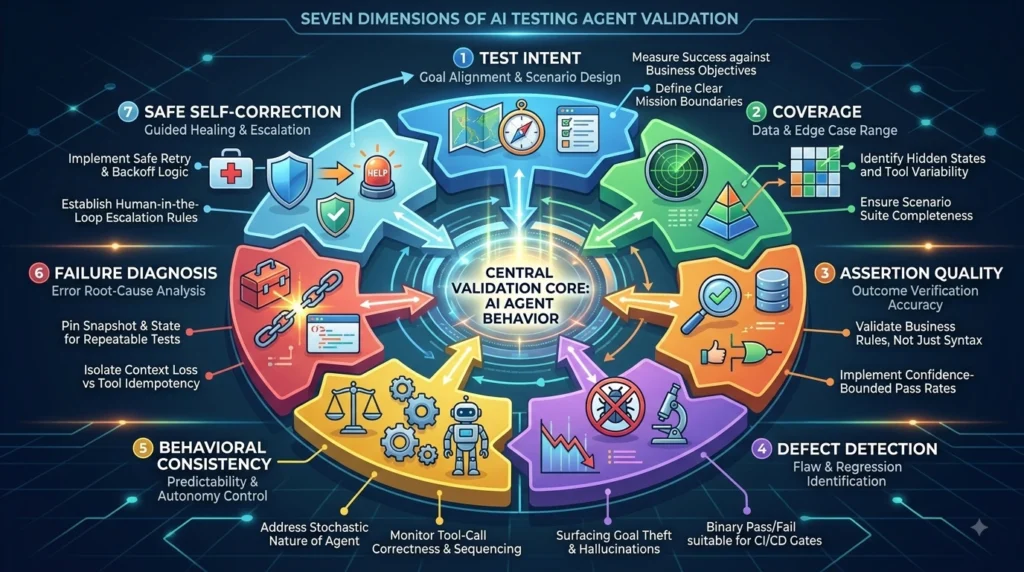
Evaluating AI testing agents requires more than measuring automation. Organizations should assess seven critical capabilities: test intent, coverage, assertion quality, defect detection, behavioral consistency, failure diagnosis, and safe self-correction.
A practical evaluation framework can focus on seven areas:
- Test Intent
- Coverage
- Assertion Quality
- Defect Detection
- Behavioral Consistency
- Failure Diagnosis
- Safe Self-Correction
Together, these dimensions help determine whether an AI testing agent is making sound testing decisions.
Read our blog on Agentic AI in Testing: From Script Generation to Autonomous Orchestration
1. Test Intent: Does the AI Understand What to Test?
Consider the requirement:
Customers must not be able to purchase products that are out of stock.
An AI agent could generate a test verifying that an available product can be purchased successfully. The test may execute perfectly, but it does not validate the actual business requirement.
This highlights a fundamental principle:
Execution correctness does not equal requirement correctness.
The agent should be evaluated on whether it can translate requirements into meaningful testing objectives, including business rules, negative scenarios, boundary conditions, and ambiguous requirements.
The goal is not simply more tests.
It is the right test.
2. Coverage: Is the AI Testing Meaningful Risk?
Traditional coverage metrics remain useful, but AI-driven testing requires a broader perspective.
An effective agent should consider:
- Functional scenarios
- Business requirements
- High-risk areas
- Boundary conditions
- Negative scenarios
- Integration points
- Failure and recovery paths
An application may achieve high code coverage while missing a critical payment failure scenario.
Coverage should therefore represent meaningful business and technical behavior—not simply the number of executed tests.
3. Assertion Quality: Does the Test Prove the Expected Behavior?
Consider a payment test:
Submit Payment → Verify HTTP Status = 200
The test passes. But does a 200 response prove that the payment was processed, the correct amount was charged, the transaction was recorded, and the order was updated?
Not necessarily.
A stronger test validates the actual business outcome:
Payment Accepted + Transaction Created + Correct Amount Recorded + Order Updated
AI-generated tests should therefore be evaluated on assertion effectiveness, not simply test count.
The key question is:
Does the test provide meaningful evidence that the expected behavior occurred?
4. Defect Detection: Can the AI Find Real Defects?
One effective way to evaluate AI-generated tests is to introduce known defects and determine whether the tests detect them.
For example:
Correct: if paymentAmount == orderAmount
Defective: if paymentAmount != orderAmount
If the AI-generated tests still pass, the suite has failed to detect an intentionally introduced defect.
This is where mutation testing can provide valuable evidence.
Mutation Score = Defects Detected ÷ Defects Introduced × 100
A suite with 300 tests and an 86% mutation score may provide stronger evidence of defect-detection capability than a 1,000-test suite with a 42% score.
The objective should therefore be meaningful defect detection, not maximum test generation.
5. Behavioral Consistency: Can We Trust Its Decisions?
AI systems can produce different outputs for similar inputs. Variation is not necessarily a problem; it can sometimes help discover additional scenarios.
The concern is uncontrolled variation in testing intent or risk assessment.
For example, one run may identify authorization as a critical risk, while another prioritizes UI validation and ignores authorization.
The goal is not identical output every time. It is:
Consistent testing intent with useful scenario diversity.
Organizations can compare repeated runs for requirement interpretation, test objectives, risk prioritization, and assertion consistency.
6. Failure Diagnosis: Can the AI Identify the Real Cause?
A failed test does not automatically mean an application defect.
The failure could originate from the application, test, test data, environment, infrastructure, dependency, network, authentication, or AI agent.
Consider a payment test that fails. The AI reports a payment service defect, but investigation reveals that the test environment contained an expired authentication token.
The application was correct. The test was correct. The environment was wrong.
An inaccurate diagnosis can result in false defects, unnecessary development work, and incorrect release decisions.
A practical classification model could include:
Application Defect | Test Defect | Data Defect | Environment Defect | Infrastructure Failure | Dependency Failure | Agent Error | Unknown
Importantly, the AI should not be forced to provide an answer when evidence is insufficient.
Knowing when to say “unknown” can be a sign of a trustworthy testing agent.
7. Safe Self-Correction: Does Self-Healing Hide Defects?
Self-healing is one of the most attractive capabilities of AI testing agents.
If a UI locator changes from #submitOrder to #confirmOrder, an agent may identify the change and update the locator. That can be useful.
But consider a more serious situation. An application behavior changes and a test starts failing. Instead of investigating the failure, the AI modifies the assertion until the test passes.
The pipeline becomes green, but the test has become weaker.
Self-healing should not mean self-approval.
Before modifying a test, the agent should determine the likely source of the failure and provide evidence for the proposed change. High-risk changes should remain subject to appropriate review and governance.
Enterprise Insight: As AI testing agents become more autonomous, organizations must establish governance mechanisms that evaluate not only whether tests pass, but whether the AI made appropriate testing decisions. Trustworthy AI in Quality Engineering is built through continuous validation, transparency, and measurable assurance—not automation alone.
For deeper insights into enterprise data and AI strategy foundations, explore: Enterprise AI strategy in 2026.
Don’t Let the Tester Grade Its Own Homework
AI testing agents should not evaluate their own effectiveness without independent validation. Combining human oversight, deterministic controls, adversarial testing, and independent AI reviewers improves trust while reducing the risk of incorrect testing decisions.
What happens when the same AI agent generates the test, executes it, analyzes the result, evaluates the test quality, and declares the testing successful?
Can that be considered independent validation?
Not necessarily.
A stronger assurance model introduces additional validation mechanisms:
- Human Review: High-risk scenarios and quality decisions receive expert review.
- Independent AI Review: A separate evaluation agent challenges the testing agent’s decisions.
- Deterministic Controls: Critical business rules are validated through deterministic checks.
- Adversarial Testing: The agent is challenged with ambiguous requirements, known defects, environment failures, and unexpected conditions.
The objective is not to eliminate AI autonomy.
It is to make that autonomy measurable and governable.
A Risk-Based Path to Controlled Autonomy
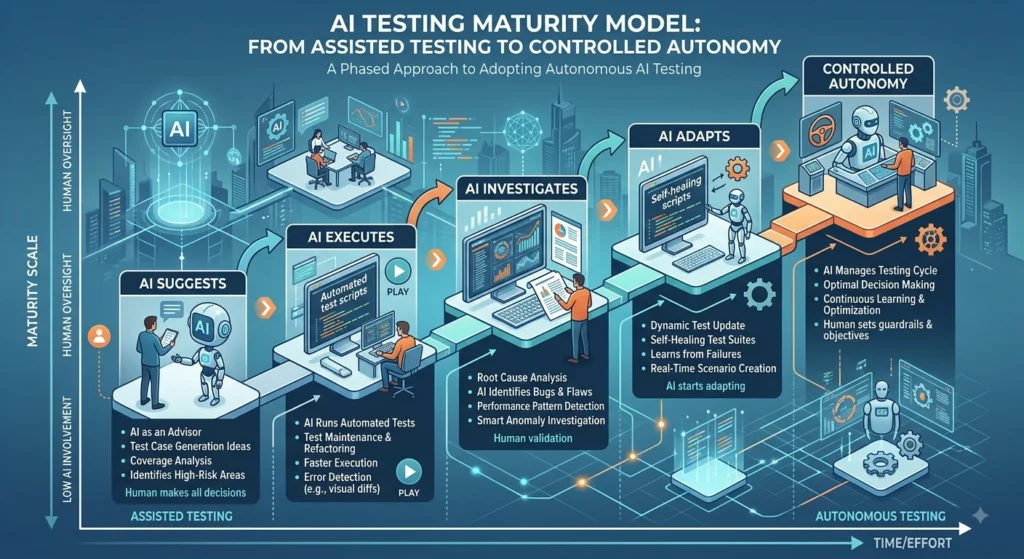
Organizations should adopt AI testing incrementally using a risk-based maturity model. Gradually increasing AI autonomy while maintaining human oversight for higher-risk decisions enables safer adoption and stronger governance.
Organizations do not need to move directly to fully autonomous testing. A staged approach can build confidence while reducing risk.
Stage 1: AI Suggests
The AI generates test ideas, scenarios, test data, and assertions. Human testers review the output.
Stage 2: AI Executes
The agent executes approved tests and analyzes results while humans retain decision authority.
Stage 3: AI Investigates
The agent analyzes failures and recommends probable root causes, reproduction steps, and additional tests.
Stage 4: AI Adapts
The agent recommends or applies appropriate test changes, with high-risk changes requiring evidence and governance.
Stage 5: Controlled Autonomy
The AI operates independently within predefined boundaries, permissions, and measurable quality controls.
A risk-based model can support this progression:
- Low Risk → Autonomous Execution
- Medium Risk → AI Execution + Human Review
- High Risk → AI Recommendation + Human Approval
- Critical Risk → Mandatory Human Decision
This allows organizations to increase AI autonomy without removing quality governance.
The NIST AI Risk Management Framework provides practical guidance for designing, evaluating, and governing trustworthy AI systems, helping organizations assess AI reliability, manage risks, and implement responsible AI practices across the software development lifecycle.
For organizations building strong data foundations to enable such AI systems, refer to: Data Quality For AI in 2026
From Test Automation to Test Assurance
Traditional automation metrics remain important, including automation coverage, execution time, regression duration, maintenance effort, defect detection, and test flakiness.
Traditional Test Automation vs AI Test Assurance
| Traditional Test Automation | AI Test Assurance |
|---|---|
| Measures execution speed | Measures decision quality |
| Focuses on automation coverage | Focuses on testing effectiveness |
| Evaluates scripts | Evaluates AI reasoning |
| Static automation | Adaptive intelligence |
| Detects defects | Validates AI trustworthiness |
AI-driven testing introduces another dimension:
Test Assurance
Organizations must also ask:
How much confidence should we place in the testing system itself?
This creates two complementary capabilities:
Testing Capability
Test Generation → Test Execution → Test Analysis → Test Repair → Test Optimization
Assurance Capability
Agent Evaluation → Test Validation → Adversarial Testing → Independent Review → Governance
The first tells us:
What can the AI do?
The second tells us:
Can we trust what it does?
Together, these capabilities create a continuous assurance loop in which the product is tested, the testing evidence is challenged, and the AI’s decisions are measured and governed.
Key Takeaways
- AI testing agents should be evaluated independently rather than validating their own outputs.
- Effective AI testing depends on meaningful test intent, defect detection, and reliable failure analysis—not just automation coverage.
- Mutation testing and adversarial testing provide objective evidence of AI testing quality.
- Risk-based governance enables organizations to safely increase AI autonomy while maintaining control over critical decisions.
- The future of Quality Engineering lies in validating both the software under test and the AI systems performing the testing.
Conclusion
AI testing agents can transform Quality Engineering by exploring scenarios faster, analyzing failures at scale, generating tests, and adapting to changing applications.
But greater autonomy introduces a new responsibility:
We must validate the system performing the testing.
A high test count is not proof of quality. A high automation percentage is not proof of effectiveness. A green pipeline is not proof of complete coverage. And an AI-generated test is not automatically trustworthy simply because it was generated by AI.
The next generation of Quality Engineering will therefore need to test the product, the tests, the testing process, and increasingly, the intelligence making testing decisions.
Organizations that succeed with AI-driven testing will not necessarily be those that give AI the most authority. They will be those that build strong mechanisms to measure, challenge, govern, and continuously validate that authority.
Because when the tester becomes intelligent, adaptive, and autonomous, Quality Engineering has one more responsibility:
Test the Tester.
Frequently Asked Questions
1. What does “Testing the Tester” mean in AI-driven testing?
It means evaluating the AI testing agent itself to determine whether its test decisions, evidence, defect detection, failure analysis, and self-correction behavior are reliable.
2. How can organizations measure the effectiveness of an AI testing agent?
Organizations can evaluate test intent, meaningful coverage, assertion quality, defect detection, behavioral consistency, failure diagnosis, and safe self-correction.
3. Can mutation testing be used to evaluate AI-generated tests?
Yes. Mutation testing introduces controlled defects and measures how effectively generated tests detect them, providing evidence beyond simple test counts.
4. Should AI testing agents operate fully autonomously?
Not necessarily. A risk-based adoption model can allow greater autonomy for low-risk activities while requiring human review or approval for high- and critical-risk decisions.
5. Why is independent validation important for AI testing agents?
Independent validation ensures that AI-generated testing decisions are challenged objectively, reducing bias and improving confidence in automated quality assurance.
6. What is adversarial testing in AI Quality Engineering?
Adversarial testing intentionally introduces ambiguous requirements, unexpected inputs, and failure scenarios to evaluate how reliably an AI testing agent responds under uncertain conditions.
Related Reads
- Ultimate Guide to Optimizing Spark Workloads in Microsoft Fabric for Data Engineers
- Microsoft Fabric Architecture: CTO’s Guide to Modern Analytics & AI
- Data Governance for Data Quality: Future-Proofing Enterprise Data
- Data Quality for AI in 2026: Enterprise Guide
- Microsoft Fabric vs Power BI: Understanding the Difference
- Microsoft Fabric vs Snowflake: Data Management Showdown
- AI-Ready Enterprise Checklist for Microsoft Fabric Microsoft Fabric vs Power BI: Understanding the Difference
- Microsoft Fabric vs Snowflake: Data Management Showdown
- AI-Ready Enterprise Checklist for Microsoft Fabric