
AI-powered risk assessment in insurance uses machine learning, predictive analytics, statistical models, and AI to evaluate the probability or severity of insurance risks. Insurers use it for underwriting, pricing, claims assessment, fraud detection, catastrophe exposure, accelerated underwriting, and portfolio monitoring. Production systems require governed data, validated models, explainability, fairness controls, human oversight, and continuous monitoring.
AI-powered risk assessment is therefore not simply a model-selection exercise.
A production insurance risk system requires:
Data → Features → Risk Model → Validation → Decision → Human Oversight → Monitoring
The most effective enterprise implementations combine actuarial expertise with machine learning, governed data platforms, model risk management, and continuous performance monitoring
TL;DR
- AI-powered risk assessment in insurance uses AI, machine learning, predictive analytics, and statistical models to estimate the likelihood, severity, or financial impact of insurance risks.
- Common applications include underwriting, pricing, claims severity, fraud detection, catastrophe risk, risk segmentation, and accelerated underwriting.
- Models can use policy, claims, customer, property, behavioral, geographic, telematics, image, document, and external data.
- The best model is not necessarily the most complex model; predictive performance, stability, explainability, fairness, and operational fit matter.
- AI risk assessment requires more than historical data. Enterprises need data quality, feature governance, model validation, monitoring, and auditability.
- High-impact insurance decisions require controls for unfair discrimination, transparency, privacy, data quality, and human oversight. NAIC guidance specifically expects insurers to govern AI systems and comply with applicable insurance laws.
- A scalable architecture connects enterprise data → feature engineering → model services → underwriting/claims workflows → decision systems → monitoring.
What Is AI-Powered Risk Assessment in Insurance?
AI-powered risk assessment in insurance is the use of machine learning, predictive analytics, statistical techniques, and AI-enabled systems to evaluate the probability, severity, or financial consequences of insurance risks. Instead of relying only on predefined rules and historical actuarial factors, AI systems can identify patterns across large, diverse datasets and produce risk scores or decision-support signals.
Traditional insurance risk assessment often follows a structured process:
Application
    ↓
Data Collection
    ↓
Risk Factors
    ↓
Actuarial / Statistical Model
    ↓
Risk Classification
    ↓
Pricing / Underwriting Decision
AI can expand this workflow:
Multiple Data Sources
        ↓
Data Engineering
        ↓
Feature Engineering
        ↓
ML / Statistical Models
        ↓
Risk Score / Prediction
        ↓
Decision Rules
        ↓
Human Review Where Required
        ↓
Monitoring & Feedback
The goal is not to remove underwriting or actuarial judgment.
The goal is to augment risk evaluation with additional predictive signals while maintaining appropriate controls over the resulting decisions.
Read more about AI in Insurance: Benefits, Use Cases in 2026 – techment.com
Why Are Insurers Using AI for Risk Assessment?
Insurers are using AI because risk assessment increasingly depends on large volumes of structured, unstructured, behavioral, geographic, and external data that traditional processes cannot evaluate efficiently at scale. AI can help insurers identify patterns, automate repetitive analysis, improve risk segmentation, accelerate decisions, and support more dynamic risk monitoring.
Key drivers include:
1. More Available Data
Modern insurers can evaluate information from:
- Policy systems
- Claims systems
- Customer interactions
- Telematics
- IoT sensors
- Property characteristics
- Geospatial datasets
- Satellite imagery
- Inspection images
- Documents
- External risk datasets
- Weather and catastrophe data
2. Faster Decision-Making
AI can support automated or accelerated workflows that previously required manual analysis.
NAIC notes that accelerated life underwriting can use external data, predictive models, and machine learning to shorten underwriting processes substantially, although some applicants still require traditional underwriting when available data is insufficient.
3. More Granular Risk Segmentation
Traditional segmentation may group customers into relatively broad risk categories.
Machine learning can identify more complex interactions among:
- Exposure
- Geography
- Claims history
- Asset characteristics
- Behavior
- Coverage
- Demographics where legally and appropriately usable
- External risk factors
4. Earlier Risk Detection
AI can help identify signals associated with:
- Fraud
- Claims escalation
- Customer churn
- Catastrophe exposure
- High-risk properties
- Underwriting anomalies
- Emerging portfolio risks
AI claims automation must be supported by robust enterprise architecture. Techment’s AI-Ready Enterprise Checklist with Microsoft Fabric outlines readiness considerations.
How Does AI-Powered Insurance Risk Assessment Work?
AI-powered insurance risk assessment typically combines data ingestion, data quality, feature engineering, predictive modeling, decision rules, human review, and continuous monitoring. The model produces a risk estimate or classification, but the production system must also determine how that output can be used within underwriting, claims, pricing, or other regulated business processes.
A practical architecture is:
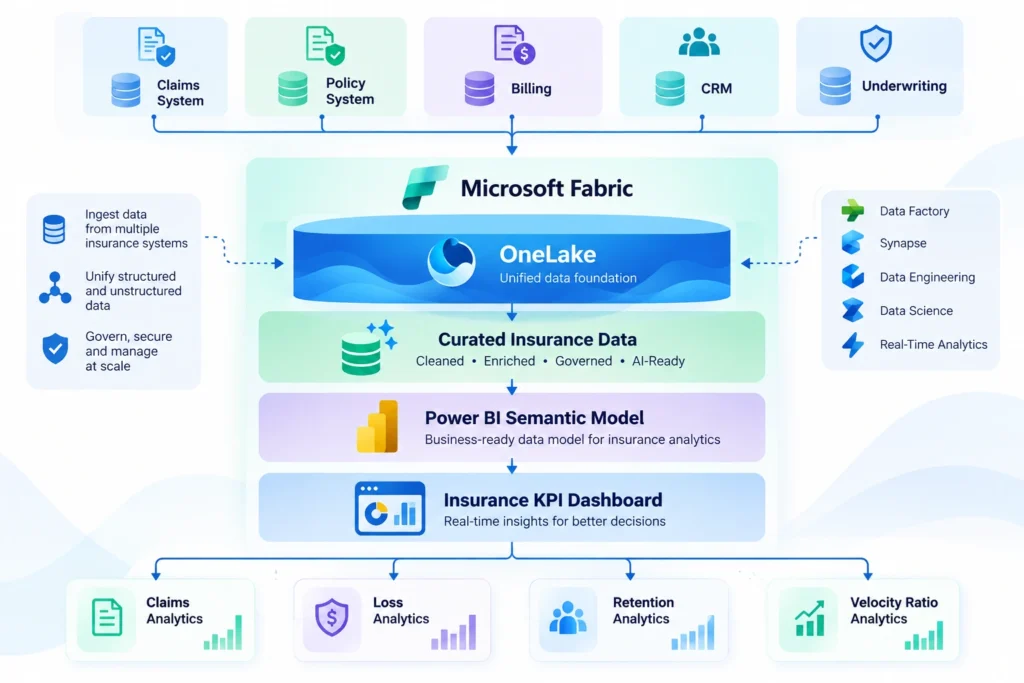
This closed-loop design is important because model performance can change as markets, customer behavior, claim patterns, regulations, and external risks change.
What Data Is Used for AI-Powered Insurance Risk Assessment?
AI risk assessment depends on the quality, relevance, provenance, and governance of the data used to train and operate models. Insurers can combine internal policy and claims data with property, behavioral, geospatial, telematics, image, document, and external datasets, but every data source must be evaluated for accuracy, permitted use, fairness, privacy, and predictive relevance.
Core Insurance Data
| Data Category | Examples | Potential Risk Signal |
|---|---|---|
| Policy | Coverage, limits, tenure, product | Exposure and coverage risk |
| Claims | Frequency, severity, history | Future claims likelihood |
| Customer | Interaction and service history | Retention or behavioral signals |
| Underwriting | Application and inspection data | Risk characteristics |
| Payments | Premium and payment history | Financial behavior |
| Geography | Location, region, proximity | Environmental/exposure risk |
| Property | Construction, age, characteristics | Property risk |
| Telematics | Driving behavior, mileage | Auto risk |
| Images | Property/vehicle images | Physical condition |
| Documents | Applications, reports, records | Risk attributes |
| External Data | Weather, catastrophe, economic data | External exposure |
NAIC describes insurance “big data” as structured and unstructured information used across underwriting, rating, pricing, marketing, and claims, including sources such as images and satellite data.
What Types of AI and Machine Learning Models Are Used?
Insurance risk assessment can use statistical models, supervised machine learning, unsupervised learning, time-series models, computer vision, and other AI techniques depending on the risk problem and available data. Model selection should be driven by predictive performance, interpretability, data characteristics, regulatory requirements, stability, and the consequences of model errors—not by algorithm complexity alone.
1. Logistic Regression
Useful for:
- Binary risk outcomes
- Claim probability
- Fraud likelihood
- Underwriting decisions
Advantages:
- Interpretable
- Fast
- Well understood
- Easier to validate
2. Generalized Linear Models
GLMs remain important in insurance because they can model relationships between risk factors and outcomes while providing useful interpretability.
Common applications include:
- Frequency modeling
- Severity modeling
- Pricing
- Risk classification
AI and machine learning do not automatically replace established actuarial methods.
In many enterprises, they complement traditional statistical models.
3. Decision Trees
Decision trees can classify risks using rule-like structures.
Example:
Property Risk
     │
     ├── High Exposure
     │      ↓
     │   High Risk
     │
     └── Low Exposure
            ↓
         Lower Risk
They are useful where decision transparency is important.
4. Random Forests
Random forests combine multiple decision trees to improve predictive performance and reduce dependence on a single tree.
They can be useful for:
- Risk classification
- Fraud detection
- Claim prediction
- Nonlinear relationships
5. Gradient Boosting Models
Gradient boosting methods can capture complex nonlinear relationships and interactions.
Typical applications include:
- Claim propensity
- Claim severity
- Fraud scoring
- Customer churn
- Risk segmentation
- Underwriting risk prediction
6. Neural Networks
Neural networks can become useful when risk assessment involves complex or high-dimensional data.
Potential applications include:
- Image-based property assessment
- Vehicle damage analysis
- Document analysis
- Complex behavioral patterns
- Large-scale risk prediction
However, greater model complexity can increase explainability, validation, governance, and monitoring requirements.
7. Computer Vision Models
Computer vision can evaluate images such as:
- Vehicle damage
- Property condition
- Roof condition
- Inspection photographs
- Accident scenes
This can support claims assessment and property risk evaluation.
8. Natural Language Processing
NLP can extract risk-relevant information from:
- Claims notes
- Underwriting submissions
- Inspection reports
- Legal documents
- Customer communications
- Medical or policy documentation where permitted
NLP can convert unstructured information into structured features for downstream risk models.
9. Time-Series Models
Time-series techniques can support:
- Claim trends
- Loss development
- Demand forecasting
- Risk changes over time
- Catastrophe exposure
- Portfolio monitoring
AI Risk Assessment Use Cases in Insurance
1. AI-Powered Underwriting
AI-powered underwriting uses predictive models and external or internal data to assess applicant and exposure risk, classify submissions, identify missing information, and support underwriting decisions. The objective is to improve decision speed and consistency without eliminating appropriate human judgment.
Typical workflow:
Application
   ↓
Data Extraction
   ↓
Risk Features
   ↓
Predictive Model
   ↓
Risk Score
   ↓
Underwriting Rules
   ↓
Auto-Decision / Referral
AI can help underwriters:
- Prioritize submissions
- Identify risk characteristics
- Detect inconsistencies
- Recommend additional information
- Segment risks
- Accelerate low-complexity cases
NAIC identifies underwriting and pricing among the major insurance areas where AI is being used.
2. AI-Powered Pricing and Risk Scoring
Machine learning can support insurance pricing by identifying relationships between risk factors and expected outcomes, producing more granular risk scores or supporting rate-factor analysis. Pricing models require particularly strong actuarial, regulatory, fairness, and governance controls because model outputs can directly affect consumer pricing.
Potential inputs include:
- Historical claims
- Exposure
- Geography
- Vehicle or property characteristics
- Telematics
- Policy history
- Environmental variables
NAIC notes that machine learning is used in insurance pricing for risk scoring and determining rate-factor relativities.
3. Claims Risk Assessment
AI can assess claims risk by predicting severity, identifying complex claims, prioritizing workloads, and detecting signals that indicate a claim may require additional investigation. This allows claims organizations to allocate adjuster capacity toward claims where human expertise is most valuable.
Possible outputs include:
- Expected severity
- Complexity score
- Litigation likelihood
- Escalation risk
- Settlement estimate
- Investigation priority
NAIC reports AI use in claims for accident image analysis, estimating ultimate claim settlement values, and fraud detection.
4. Insurance Fraud Detection
AI-powered fraud detection identifies patterns that may indicate suspicious claims, applications, transactions, or relationships. Machine learning can evaluate many variables simultaneously and prioritize cases for investigation rather than requiring investigators to review every claim with equal intensity.
Potential signals include:
- Unusual claim timing
- Repeated claimant/provider relationships
- Inconsistent information
- Suspicious document patterns
- Abnormal claim amounts
- Network relationships
- Repeated addresses or entities
The model should generally produce an investigation signal or risk score, not automatically establish that fraud occurred.
5. Property and Catastrophe Risk Assessment
AI can combine geospatial, property, weather, satellite, and catastrophe-related data to assess exposure at property, portfolio, or geographic levels. This can help insurers identify concentrations of risk, support underwriting decisions, and improve portfolio monitoring.
Potential applications include:
- Flood exposure
- Wildfire exposure
- Hurricane exposure
- Property condition
- Geographic concentration
- Climate-related risk
- Accumulation risk
This area is particularly relevant as insurers and regulators increasingly focus on catastrophe modeling, exposures, stress testing, and resilience. NAIC’s 2026 priorities include enhanced regulatory work around catastrophe modeling, exposures, stress testing, and climate disclosures.
6. Accelerated Life Underwriting
AI and predictive analytics can help life insurers evaluate applicants using external data and models, reducing the need for some traditional underwriting steps. However, accelerated underwriting does not mean every applicant can be automatically approved; insufficient or unsuitable data may require additional underwriting evidence.
Typical workflow:
Application
    ↓
External Data Retrieval
    ↓
Risk Model
    ↓
Confidence / Eligibility Check
    ↓
 ┌───────────────┐
 │               │
 ▼               ▼
Accelerated     Traditional
Path            Underwriting
This is an important example of AI supporting decision routing, not simply producing a risk score.
7. Customer Churn and Retention Risk
AI can estimate the likelihood that a customer or policyholder will cancel, fail to renew, or reduce engagement. Insurers can combine policy tenure, claims experience, service interactions, premium changes, payment behavior, and product information to identify retention risk.
Potential outputs:
- Renewal probability
- Cancellation probability
- Customer lifetime value
- Intervention priority
This can help insurers distinguish between customers who are likely to renew naturally and those requiring targeted retention actions.
8. Portfolio Risk Monitoring
AI can move risk assessment beyond individual policies by identifying emerging patterns across an insurer’s portfolio. Portfolio-level models can detect concentrations, changes in claim behavior, geographic exposure, or shifts in risk characteristics that may not be obvious from individual underwriting decisions.
Examples include:
- Geographic concentration
- Product-level loss deterioration
- Claims severity trends
- Exposure accumulation
- Emerging fraud patterns
- Changes in customer mix
AI Risk Assessment Architecture for Insurance
A production architecture should separate data, modeling, decisioning, and governance.
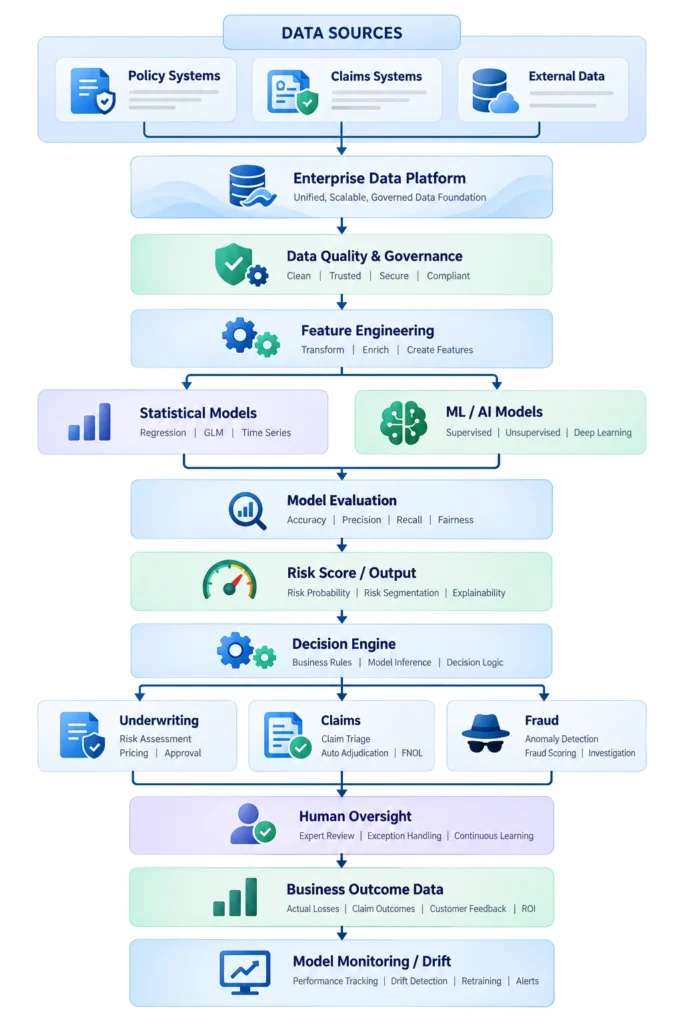
A lakehouse or enterprise data platform can provide the data foundation, but the architecture should not allow model logic, business rules, and governance to become inseparable.
Read more about Microsoft Fabric for Insurance Carriers: A Reference Architecture
What Makes an AI Insurance Risk Model Production-Ready?
A production-ready insurance AI model must demonstrate more than predictive accuracy. It should be validated for the intended use, monitored for performance and drift, evaluated for fairness and explainability, supported by reliable data, and governed throughout its lifecycle. NIST’s AI RMF identifies validity and reliability, safety, security and resilience, accountability and transparency, explainability and interpretability, privacy, and fairness with harmful bias managed as key trustworthiness characteristics.
Production Readiness Checklist
| Area | Key Question |
|---|---|
| Data quality | Is the input data accurate and complete? |
| Data lineage | Can every important feature be traced to its source? |
| Model performance | Does the model perform on unseen data? |
| Generalization | Does performance hold across relevant populations and periods? |
| Explainability | Can appropriate stakeholders understand the output? |
| Fairness | Could the model produce unfairly discriminatory outcomes? |
| Stability | Does performance remain reliable over time? |
| Drift | Are input distributions or model relationships changing? |
| Security | Can the model or data be manipulated or compromised? |
| Governance | Is there a documented owner and approval process? |
| Human oversight | When must a person review or override the output? |
| Auditability | Can decisions be reconstructed later? |
NAIC’s current AI risk evaluation work specifically considers governance, data practices, generalizability of outputs, model performance testing, consumer-data protection, and record retention.
Read more on RAG for Insurance: How Retrieval-Augmented AI Speeds Up Claims Processing
AI Risk Assessment and Explainability
Explainability matters because insurance AI can influence underwriting, pricing, claims, and other decisions with direct consumer and financial consequences. An insurer should be able to understand what a model is doing, identify important risk drivers, validate its behavior, and provide appropriate explanations to relevant stakeholders.
NIST distinguishes explainability from interpretability but treats both as important trustworthiness characteristics. Explainability concerns how the system operates, while interpretability concerns the meaning of its outputs in context.
Practical Explainability Levels
| Audience | Required Explanation |
|---|---|
| Data Scientist | Feature behavior and model diagnostics |
| Actuary | Risk relationships and model assumptions |
| Underwriter | Key factors influencing the recommendation |
| Claims Manager | Drivers behind prioritization |
| Compliance Team | Governance and decision controls |
| Regulator | Model purpose, data, validation, controls |
| Customer | Appropriate explanation of relevant decision factors |
The explanation should match the audience.
AI Risk Assessment and Fairness
Insurance AI models require explicit controls for unfair discrimination because historical insurance data can contain structural biases, proxy variables, missing populations, and historical decision patterns that a model may reproduce or amplify. Fairness testing should therefore be part of model development and monitoring rather than an after-the-fact compliance exercise.
Potential risk sources include:
- Biased historical outcomes
- Incomplete datasets
- Proxy variables
- Geographic correlations
- Sampling bias
- Label bias
- Data drift
- Model interactions
NAIC’s Model Bulletin states that AI-supported decisions must comply with applicable insurance laws and regulations, including requirements concerning unfair trade practices and unfair discrimination.
AI Risk Assessment Governance for Insurers
AI governance should cover the complete lifecycle of an insurance risk model—from use-case approval and data selection through development, validation, deployment, monitoring, modification, and retirement. Governance should also extend to third-party data and models because insurers increasingly depend on external technology and data providers. NAIC is developing a regulatory framework specifically addressing third-party data and models used by insurers.
A practical governance model is:
Use Case Approval
       ↓
Data Assessment
       ↓
Model Development
       ↓
Independent Validation
       ↓
Fairness / Explainability Review
       ↓
Business Approval
       ↓
Production Deployment
       ↓
Continuous Monitoring
       ↓
Periodic Revalidation
       ↓
Retirement / Replacement
Governance Ownership
| Function | Responsibility |
|---|---|
| Business | Define intended use |
| Actuarial | Validate insurance assumptions |
| Data Science | Develop and evaluate model |
| Data Engineering | Ensure data reliability |
| Model Risk | Independent validation |
| Compliance | Regulatory assessment |
| Security | Protect model and data |
| Legal | Assess applicable requirements |
| Underwriting/Claims | Human oversight |
| Executive Governance | Approve material risk |
Third-Party AI and Insurance Risk Models
Third-party AI models and external data can accelerate insurance innovation, but they introduce additional risks around transparency, data provenance, validation, vendor dependency, and accountability. Insurers should not assume that purchasing a model transfers responsibility for the decisions produced by that model.
NAIC’s 2026 work includes a proposed regulatory framework for third-party data and model vendors covering property and casualty pricing and underwriting data and models.
Before deploying a third-party risk model, insurers should ask:
- What data trained the model?
- What data does it require in production?
- How frequently is it updated?
- How is performance validated?
- What populations were represented?
- How are changes communicated?
- Can the insurer audit the model?
- What documentation is available?
- What happens if the vendor changes the model?
- Who owns the resulting decision?
How to Implement AI-Powered Risk Assessment in Insurance
Step 1: Select a High-Value Risk Decision
Start with a specific problem:
- Claim severity prediction
- Fraud prioritization
- Underwriting triage
- Property risk scoring
- Renewal risk
- Submission prioritization
Avoid starting with:
“We need an AI platform.”
Start with:
“We need to improve this measurable risk decision.”
Step 2: Define the Decision and Its Consequences
Document:
- What decision is being supported?
- Who makes the final decision?
- What happens when the model is wrong?
- What is the acceptable error rate?
- Which decisions require human review?
The consequences of an incorrect prediction should influence the level of governance.
Step 3: Build a Governed Data Foundation
Integrate:
- Policy data
- Claims data
- Customer data
- Underwriting data
- External data
Then establish:
- Data quality rules
- Lineage
- Access controls
- Feature definitions
- Data retention
- Data ownership
Step 4: Establish a Baseline Model
Start with an interpretable baseline where practical.
For example:
Baseline
   ↓
Logistic / GLM
   ↓
Evaluate
   ↓
Gradient Boosting
   ↓
Compare
   ↓
Select Based on Performance + Governance
Do not assume the most complex model is the best enterprise model.
Step 5: Validate Before Deployment
Evaluate:
- Accuracy
- Precision
- Recall
- Calibration
- Stability
- Generalization
- Segment performance
- Fairness
- Explainability
- Business impact
Step 6: Integrate the Model Into the Workflow
A model that exists only in a data science notebook does not create operational value.
Connect it to:
- Underwriting workbenches
- Claims systems
- Fraud investigation platforms
- Pricing systems
- Policy administration
- Decision engines
Step 7: Monitor Continuously
Track:
- Model performance
- Input drift
- Output drift
- Data quality
- Segment-level performance
- False positives
- False negatives
- Override rates
- Business outcomes
Common Mistakes in AI-Powered Insurance Risk Assessment
1. Optimizing Only for Accuracy
A highly accurate model can still be inappropriate if it is:
- Unexplainable
- Unstable
- Biased
- Poorly governed
- Impossible to audit
2. Using Historical Data Without Examining Its Bias
Historical decisions are not automatically objective ground truth.
A model can learn historical practices—including undesirable ones.
3. Treating External Data as Automatically Reliable
External data requires:
- Provenance
- Quality assessment
- Relevance testing
- Legal review
- Bias assessment
- Change monitoring
4. Automating High-Impact Decisions Too Early
AI should not automatically make every decision simply because it can.
Use confidence thresholds and referral workflows:
High Confidence
      ↓
Automated / Straight-through

Medium Confidence
      ↓
Human Review

Low Confidence / High Risk
      ↓
Specialist Review
5. Ignoring Model Drift
Insurance risk changes.
Examples:
- Climate patterns
- Driving behavior
- Fraud tactics
- Economic conditions
- Claims inflation
- Customer behavior
- Regulatory requirements
A model that performed well historically may degrade in production.
6. Separating Model Governance From Business Governance
AI risk assessment is not exclusively a data science responsibility.
Actuarial, underwriting, claims, compliance, legal, data, technology, and risk teams all have roles.
AI-Powered Risk Assessment: Key Enterprise Metrics
A production program should measure both model performance and business outcomes.
| Category | Example Metrics |
|---|---|
| Model | AUC, precision, recall, F1, calibration |
| Risk | Loss ratio, frequency, severity |
| Underwriting | Quote-to-bind, referral rate, turnaround time |
| Claims | Severity accuracy, cycle time, leakage |
| Fraud | Investigation yield, false positives |
| Operations | Automation rate, manual review rate |
| Fairness | Segment-level performance and outcome analysis |
| Stability | Drift, performance degradation |
| Business | Loss reduction, expense reduction, retention, profitability |
The exact metrics should be defined according to the model’s intended purpose.
AI-Powered Risk Assessment in Insurance: Enterprise Architecture Decision Framework
Before investing in an AI risk assessment platform, answer these questions:
Is the decision predictive?
Yes → Evaluate statistical or machine learning models.
Is the data primarily structured?
Yes → Start with tabular statistical/ML models.
Does the decision depend heavily on images?
Yes → Evaluate computer vision.
Does it depend on documents or narrative text?
Yes → Evaluate NLP or multimodal AI.
Does the risk change continuously?
Yes → Consider streaming or near-real-time scoring.
Is the decision high impact?
Yes → Increase validation, explainability, fairness, governance, and human oversight.
Is the model sourced from a vendor?
Yes → Apply third-party data/model governance and validation.
Does the model influence pricing or underwriting?
Yes → Involve actuarial, compliance, legal, and model-risk stakeholders early.
The Future of AI-Powered Risk Assessment in Insurance
Insurance risk assessment is moving from periodic, document-heavy evaluation toward more continuous, data-driven risk intelligence. AI can increasingly combine structured insurance data with images, documents, geospatial information, behavioral signals, and real-time or near-real-time data. The enterprise challenge is ensuring that greater predictive capability does not outpace governance, explainability, and regulatory accountability.
Three developments are particularly important:
1. Continuous Risk Assessment
Instead of evaluating risk only at policy inception or renewal:
Policy Issuance
      ↓
Continuous Data
      ↓
Risk Monitoring
      ↓
Risk Change Detection
      ↓
Action
2. AI-Augmented Underwriters and Claims Professionals
AI increasingly acts as a decision-support layer rather than a standalone decision maker.
McKinsey describes emerging AI-enabled underwriting operating models in which AI can support intake, triage, risk selection, pricing, and issuance while underwriters remain responsible for complex decisions and portfolio management.
3. Risk-Aware AI Governance
Regulators are increasingly focused not only on whether insurers use AI but how AI systems are governed, evaluated, documented, and monitored.
NAIC’s 2025–2026 work includes AI evaluation tools for regulators, while EIOPA’s 2025 opinion emphasizes risk-based and proportionate AI governance and risk management in insurance.
AI-Powered Risk Assessment in Insurance: Final Takeaway
AI-powered risk assessment can help insurers make faster, more granular, and more data-driven decisions across underwriting, pricing, claims, fraud, catastrophe exposure, and customer risk. But successful implementation depends on more than selecting a machine learning model. Insurers need governed data, validated models, explainable outputs, fairness controls, human oversight, secure architecture, and continuous monitoring.
The winning enterprise architecture is:
Trusted Data → Strong Features → Fit-for-Purpose Model → Governed Decision → Human Oversight → Continuous Monitoring
AI should strengthen the insurer’s ability to understand and manage risk—not create a new source of unmanaged risk.
For insurers modernizing their data and AI capabilities, Techment can help build governed data foundations, predictive risk models, AI-enabled underwriting and claims workflows, and enterprise AI architectures that connect analytics with measurable insurance outcomes.
Key Takeaways
- AI-powered risk assessment uses AI, machine learning, and predictive analytics to evaluate insurance risk.
- Major applications include underwriting, pricing, claims, fraud, catastrophe exposure, accelerated underwriting, retention, and portfolio monitoring.
- Insurance AI models can include GLMs, logistic regression, decision trees, random forests, gradient boosting, neural networks, NLP, computer vision, and time-series models.
- Data quality and provenance are as important as model sophistication.
- High-impact insurance decisions require stronger controls for fairness, explainability, validation, privacy, security, and human oversight.
- Third-party data and models require explicit governance.
- Model monitoring should cover both technical performance and business outcomes.
- The strongest implementations integrate AI directly into underwriting, claims, pricing, and risk-management workflows.
- AI should augment actuarial and insurance expertise rather than simply replace it.
Frequently Asked Questions
1. What is AI-powered risk assessment in insurance?
AI-powered risk assessment uses machine learning, predictive analytics, and AI to evaluate insurance risks using policy, claims, customer, property, behavioral, geographic, and external data.
2. How is AI used in insurance underwriting?
AI can analyze application and external data, identify risk factors, score submissions, detect missing or inconsistent information, prioritize cases, and support underwriting decisions.
3. What data is used for AI risk assessment in insurance?
Insurers can use policy, claims, underwriting, property, customer, telematics, geospatial, image, document, weather, catastrophe, and other external data, depending on the use case and applicable requirements.
4. Which machine learning models are used in insurance risk assessment?
Common approaches include generalized linear models, logistic regression, decision trees, random forests, gradient boosting, neural networks, time-series models, NLP, and computer vision. The appropriate model depends on the data, use case, performance requirements, and governance needs.
5. How does AI improve insurance risk assessment?
AI can process larger datasets, identify nonlinear relationships, automate repetitive analysis, improve risk segmentation, accelerate underwriting, prioritize claims and investigations, and identify emerging risk patterns.
6. What are the risks of using AI in insurance underwriting?
Key risks include inaccurate predictions, unfair discrimination, poor data quality, lack of explainability, privacy issues, model drift, cybersecurity threats, insufficient human oversight, and inadequate governance. NAIC specifically highlights risks including inaccuracy, unfair discrimination, data vulnerability, and lack of transparency and explainability.
7. How can insurers make AI risk assessment trustworthy?
Insurers should combine reliable data, appropriate models, independent validation, explainability, fairness testing, security, human oversight, auditability, and continuous monitoring. NIST’s AI RMF provides a general framework organized around Govern, Map, Measure, and Manage.